Translating the City’s report on the Food & Agriculture Strategy

The agenda for next week’s non-statutory public hearing on the Food & Agriculture Strategy is now available online, as is the final draft of fresh: Edmonton’s Food and Urban Agriculture Strategy. In addition to some tidying up and a “fresh” new look, the final draft includes an executive summary. Here’s an excerpt:

fresh is not an endpoint, but a starting point. With that in mind, the Strategy does not provide a detailed implementation plan, but rather sets directions for moving forward. Implementation will occur over time as the Edmonton Food Council is established, partnerships are formed, research is continued, resources are allocated and progress builds towards results.

fresh

Also included in the agenda is a nine-page report prepared by Administration with an overview of the strategy, commentary on the recommendations, and a recommendation to Executive Committee on how to proceed. Here is the recommendation:

That Executive Committee recommend to City Council:

  1. That fresh: Edmonton’s Food and Urban Agriculture Strategy, as outlined in Attachment 1 of the Sustainable Development report 2012SPE029, be endorsed in principle.
  2. That implementation of fresh (Edmonton’s Food and Urban Agriculture Strategy) be postponed pending Administration reporting to Executive Committee in the first quarter of 2013 on the options and costs.

Endorsed in principle, but with implementation delayed pending an update on options and costs. I wasn’t entirely sure why they’d structure the recommendation that way. I mean, since when does Administration implement anything without first gathering options and costs? Why couldn’t Council approve the strategy, if they think it is ready to be approved, and then direct Administration to start implementation immediately, the first step of which might be to gather more information on costs?

So I kept reading. Here are the final remarks in the report:

While Administration views the recommendations of fresh as being generally reasonable and worthy of follow up, it also sees it being prudent to postpone implementation of fresh pending the development of a better shared understanding between Council and Administration on the options and costs to implement the Strategy.

Notwithstanding advice to postpone its implementation, endorsement of fresh in principle will satisfy the requirements of Municipal Development Plan Policy 3.2.1.7 relative to enabling consideration of future Area Structure Plans and will provide City Council with the means to evaluate future Area Structure Plans for the Urban Growth Areas by way of the tool kit contained in strategic direction 9 (see Attachment 3).

Right, so allow me to translate. Administration is basically saying: “Look, we have the development industry breathing down our neck and we need to get this taken care of ASAP so that the Area Structure Plans in the Urban Growth Areas can move forward. We know the recommendation that deals with land use raises a bunch of questions, but we don’t think it is important to answer those right now. Also, we don’t want your endorsement to necessarily commit us to implementing anything, even something as straightforward as establishing a food council, so we’re just going to come back with a report on costs and go from there. Cool?”

No, not cool.

I’d encourage you to read through the documents here in more detail.

The arena deal is dead, but the City of Edmonton came away the victor

After a heated discussion on the arena yesterday afternoon, City Council voted to cease all negotiations with the Katz Group and directed Administration to explore alternatives. Here are the three motions they passed:

  1. As a result of Mr. Katz’s letter and unwillingness to have an open discussion with Council and the frustration of the Interim Design Agreement, all negotiations and ongoing City work related to the October 26, 2011, framework cease immediately.
  2. That Administration provide a report, as soon as possible, to City Council to report on the completion of the cessation of negotiations and the status of the City’s current, transferable investments in a potential downtown arena project.
  3. That Administration provide a report outlining a framework for Council to explore potential avenues to achieve the long term goals of sustainable NHL Hockey in Edmonton.

That means the arena as we know it is dead, but it doesn’t mean that a new arena is completely off the table. With that third motion, Administration is empowered to explore alternatives to working with the Katz Group, which could mean the City builds a new arena by itself. Here’s the full video of Mayor Mandel and City Manager Simon Farbrother answering questions about yesterday’s meeting:

Supporters of the arena will no doubt lament the fact that we appear to be no further ahead than we were four years ago, but I don’t think that’s true. Here are some of the reasons that I think the City and Council came away the victors in this whole debacle:

  • The City owns the land. No matter what happens with the arena, that land was a great investment. And I’d much rather have the City own it than some speculator who is just going to sit on it.
  • The City owns the design of the arena. Last October, Council directed Administration to spend $30 million to get the design completed to 60%. The City can take this design to a new partner or use it as the basis for building the arena itself.
  • The City now has a head start on a CRL for downtown. I think a case could be made for a downtown CRL even without the arena. Maybe it would be scaled back, but all the work that has already been done to develop the CRL plans could be reused.
  • Council no longer look like the bad guys & gals. I’m no fan of the way that Council handled the negotiations over the last couple of years, but fortunately for them Katz handled things even more poorly!
  • It may seem as though Katz has the upper hand with the ability to move the team elsewhere, but that has always been an empty threat and remains so. The NHL still wants hockey in Edmonton, and I honestly believe that Katz wants to keep the Oilers here too. If anything has changed, it’s that the NHL would be even less likely to allow a move now that Council has done everything it can to work with the Katz Group.

I’m less confident this will actually come to pass, but I was encouraged by comments made yesterday by one of the Councillors that the “unprecedented” use of in-camera sessions should be avoided in the future. It’s clear that the private meetings did more harm than good in progressing the deal and getting Council what they wanted, and I hope that means Council will avoid in-camera sessions in the future.

The arena is getting all the attention right now, but in the grand scheme of things, there are far more important issues for Council to be dealing with. More than 150 neighbourhoods need renewal and it’s going to take billions to maintain all of that infrastructure. At the same time, Edmonton’s population and economy continue to grow much faster than the national average and that means big pressures in terms of where we put new infrastructure, how we move people efficiently throughout the city, etc. As soon as they were done with the arena issue yesterday, Council starting talking about the LRT.

Back to business.

If you care about local food & urban agriculture, tell your Councillor

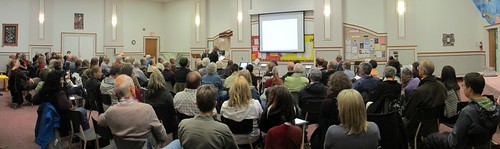
In an effort to connect City Council with constituents to discuss the Food & Agriculture Strategy, the Greater Edmonton Alliance (GEA) organized two ward meetings in advance of the public hearing on October 26. The first took place on Tuesday at the Robertson Wesley United Church, and while the councillors for wards 2, 3, 4, 6, 7, and 8 were invited, only Councillor Henderson attended. GEA officials told us that Councillor Krushell had responded and that she was unable to attend, and that Councillor Loken had responded and wanted to meet privately with GEA (he confirmed to me he is waiting for GEA to confirm a meeting, GEA has told me they want a public meeting, not a private one).

GEA Local Food Ward Meeting

The meeting was scheduled to last one hour, and GEA officials did a good job of sticking to that schedule. Unfortunately most of the hour was spent bringing everyone up-to-speed on the issue, and on GEA’s efforts thus far. We heard from Elizabeth Smythe from GEA’s Local Food Team, Debbie Hubbard, who served as GEA’s representative on the Food & Ag Strategy Advisory Committee, and Monique Nutter, Co-Chair of GEA’s Local Food Team. Monique concluded her remarks with a call-to-action for citizens and a request that Councillor Henderson respond by October 22:

Unfortunately, pressures are mounting to push decisions on this land forward quickly in a way that denies the time to explore options and, more concerning, marginalizes the voices of citizens.

We are here tonight to ask our City Councillors to work with us to ensure the Citywide Food and Agriculture Strategy provides the necessary information to enable good decisions.

Finally, we got to hear from Councillor Henderson. “I’m not the one that needs to be convinced,” he started, gesturing to the empty chairs that had been set aside for his colleagues on Council. He received a loud ovation for his attendance from the crowd.

Asked whether he felt the strategy sufficiently answered questions about what to do with the land in the northeast, Councillor Henderson responded: “I absolutely do not have enough information yet.”

In his remarks, Councillor Henderson noted that whatever support might have existed for preserving the land in the northeast back when the MDP was passed now appears to be gone. What happened? The answer might be found in a blog post by former GEA organizer Michael Walters:

The campaign to “preserve farmland” in northeast Edmonton was never an either-or endeavor. It was never about opposing development. It was about making something amazing in Northeast Edmonton.

In short, he feels the conversation has shifted from wondering where our food will come from in the future to a debate over sprawl and farmland. A debate he feels is unwinnable.

It was a strategic decision to tie the creation of the Food & Agriculture Strategy to the development of the three Urban Growth Areas. Whether that was the right strategy or not remains to be seen, but at the moment things feel far more uncertain than they did three years ago. There are some good things in the strategy and it would be a shame to see them held up or abandoned because of the land use issue in the northeast. At the same time, what other leverage do proponents of preserving the land have? The Growth Coordination Strategy has already been made much less comprehensive, and the Integrated Infrastructure Management Plan has already been approved as a “framework”, rather than as a plan of Council as originally identified.

“What happens if we delay the entire strategy?” Councillor Henderson wondered aloud at the meeting. “I’m uncertain about what happens next.”

GEA Local Food Ward Meeting

Councillor Henderson also reminded everyone in attendance that this is a regional land issue. “The essence of this is the fixation in this province with the primacy of property rights,” he said. Michael Walters notes the responsibility to deal with the issue has been floating back and forth for years:

The Capital Region Board has shown little courage in facing this question and in fact handed back the responsibility for addressing protection of farmland to the province in 2010. So for the City of Edmonton to pass this decision to the regional board cements an existing culture of timidity in dealing with this issue.

This is despite clear input to the Capital Region Board on the issue of preserving agricultural land:

In the quantitative survey, a significant majority (60 percent) of residents said agricultural lands should be preserved and protected. This support was consistent across the region.

How can we address the ongoing lack of action? How can we get City Council to pay attention? Liane Faulder says a “noisy, loud, foot-stomping and engaged” food movement is needed:

City council may well get away with doing precisely nothing of any substance to deal with the issue of urban agriculture because nobody is going to make them. There’s not a single council member who has shown any real interest in the urban food debate.

In other words, if you care about this issue, you need to get involved now!

GEA Local Food Ward Meeting

The next meeting takes place on Thursday evening at 7pm at St. Theresa’s Parish (7508 29 Avenue). Councillors Sloan and Diotte have apparently confirmed their attendance, and the councillors for wards 5, 9, 10, and 12 have been invited.

Don’t forget the non-statutory public hearing on the Food & Agriculture Strategy takes place on Friday, October 26. If you want to speak at the hearing, fill out this form.

Why hasn’t there been any public involvement for the Growth Coordination Strategy?

One of the most important sections in The Way We Grow, Edmonton’s Municipal Development Plan, is the one that deals with the Growth Coordination Strategy. It is section 3.1 that earned the document the nickname “The Way We Sprawl” for specifying that just 25% of housing growth should happen in mature neighbourhoods. That shortcoming aside, the section is important because it aims to make land development in Edmonton more sustainable, predictable, and strategic. Section 3.1.1.6 explains the purpose of the Growth Coordination Strategy:

Develop a growth coordination strategy to address timing and phasing of new residential growth in developing and planned neighbourhoods. The strategy will relate to the City’s strategic goals, current and future public infrastructure investment, long term financial sustainability and the amount, location and pace of population and employment growth; and will establish:

  • Expectations for completing developing neighbourhoods
  • Expectations for initiating new Neighbourhood Structure Plans

Another important point is found in section 3.1.1.10:

The Growth Coordination Strategy will address demand for land, housing units, and housing choice at the regional, city-wide and sector level.

You might find the topic kind of dry but make no mistake, ensuring Edmonton can “manage future public obligations and growth opportunities” is of great importance to our city.

Edmonton from Above
Photo by Dave Cournoyer

Despite the importance of the Growth Coordination Strategy, there are just two full-time employees at the City working on it and thus far there has been no official opportunity for public involvement. The first public draft (version 6) of the strategy (PDF) was released in May, but I understand based on conversations with City employees that that is not the same document slated to go to Council in November. A new draft is currently under development that reduces the scope of the strategy, primarily by stripping it of any objective related to infill development. A similar document focused on mature and developing areas would be left to an as yet unplanned and unfunded follow-up project. That means that Council will be considering a document that no citizen has had the opportunity to provide input on, not to mention one that does not seem to meet the requirements specified in the MDP.

No one I talked to knows (or refused to say) why the timeline for this strategy was set so aggressively. There is no doubt in my mind that powerful, well-funded behind-the-scenes lobbying has taken place. After all, without the Growth Coordination Strategy, Food & Ag Strategy, and Integrated Infrastructure Management Plan, new development in Edmonton’s urban growth areas cannot take place. Furthermore, we know from the January 26, 2011 Executive Committee meeting (see this report) that the “discussions began between Administration and Industry on the content of the Growth Coordination Strategy” as early as July 2010.  I think that pressure from “Industry” partially explains why there hasn’t been any public involvement, but it doesn’t explain why the City has put so little funding into the development of this important document.

The Calgary Approach

Calgary has a number of similar documents and initiatives underway. One is called Geodemographics but the big one appears to be the Corporate Framework for Growth and Change:

The Corporate Framework for Growth and Change will guide the future sequencing of growth in Calgary to ensure investments in infrastructure and services are within the financial capacity of The City. The Corporate Framework for Growth and Change is an integral part of Calgary’s Municipal Development Plan (MDP) and growth management.

Note both the timeline and frequency of public involvement for the development of that document. It began in February 2011 and the first public involvement opportunities – a series of stakeholder meetings, plus a blog post open to public input – took place in September and October of that year. A series of stakeholder meetings and forums have been hosted throughout 2012. To be fair, Calgary took a different approach, with Council approving a set of principles early on and the rest of the project unfolding in four phases, but the fact remains that a significant amount of public involvement has taken and continues to take place.

Another thing to note about Calgary’s project – there are at least ten individuals working on it:

A team from across City Departments called the Corporate Growth Management Project (CGMP) team, has been assembled to create the Framework for Growth and Change.

Edmonton and Calgary both pay lip service to managing growth, but only Calgary seems willing to back that up with the necessary funding.

Designing New Neighbourhoods

In contrast to the Growth Coordination Strategy, the Designing New Neighbourhoods project has unfolded much more predictably with multiple opportunities for public input. The outcome of that project is a set of guidelines for Edmonton’s new neighbourhoods. Section 4.1 of the MDP directed the creation of these guidelines, but unlike the Growth Coordination Strategy, technically nothing depends on their existence.

The draft guidelines are slated to go to Council “in early 2013” and already a number of public involvement opportunities have taken place. In May, there was a series of blog posts and an IdeaScale site was created to harvest ideas from citizens. The project team also encouraged the use of Twitter to suggest ideas, a positive step for public involvement at the City!

Importantly, the project also has a Design Team that is “made up of a diverse group of about 30 people from the local development, urban design, and home building industries, as well as members of the City’s Administration, the Edmonton Federation of Community Leagues, Edmonton’s Schools Boards, and the University of Alberta’s City-Region Studies Centre.” That same post talks about the inclusion of external consultants too.

The City of Edmonton’s page on Public Involvement states:

The City of Edmonton is committed to involving the people affected by the decisions it makes. We seek diverse opinions, experiences and information so that a wide spectrum of information is available to decision makers.

Designing New Neighbourhoods seems to meet that commitment, but unfortunately, the Growth Coordination Strategy does not.

The Ongoing Abatement of Section 3.1 of the MDP

I’m very concerned that the potential impact of Section 3.1 of the MDP has been continually eroded over the last two years. In February 2011, City Council passed a motion (item 6.16) that redefined eight Neighbourhood Structure Plans from “new” to “existing” which means they are no longer subject to the completion of the Growth Coordination Strategy and other documents. Futhermore, it authorized the preparation of six other Neighbourhood Structure Plans.

Only Councillors Henderson, Iveson, and Sloan opposed the motion. In his remarks on the motion, Councillor Henderson said “I really do think this is an undermining of what we passed in the MDP” and that “our tools to deal with how we grow and when we grow in this city – we’re giving them away.”

Why did this happen? It’s not as though Edmonton is running out of places for people to live. Prior to the motion in February 2011, there were 41 Neighbourhood Structure Plans approved (between 1984 and 2010) and at various stages of development. Together, those plans have a planned capacity of 116,000 resident units yet just 19,000 units have been developed. That means 84% of the development in those areas is still outstanding. There should not be such a rush to develop new land.

Again, I think politics are at play. Our current City Council has been good to the development industry, but with a new Mayor and Council slated to take office next fall, there’s no guarantee that will continue. Better to get as much approved now as possible, if you’re in the land development industry. Unfortunately for citizens this means our city continues to sprawl, more or less free of any restrictions. Sooner or later the cost of that sprawl is going to catch up with us.

Rethinking Public Involvement #1

How can we get more Edmontonians involved in municipal issues? How can the City improve the way it informs and involves the public? This is the first in a series of posts on that topic.

I have been thinking extensively about Public Involvement lately (the City’s official term for public consultation, community engagement, stakeholder participation, etc). I try to keep on top of the various public involvement opportunities that are running at any given time, and have completed my share of surveys, feedback forms, and have attended many open houses and other events. It’s important to me to remain informed, but also to be able to provide input on issues that I care about. I feel a responsibility as a citizen to take some initiative and to get involved.

In the past I have been critical of the City’s public involvement efforts, and I still think there’s a lot of room for improvement. The Public Involvement Handbook (PDF) could do with an update – it was last modified in 2008. Improved consistency with vocabulary would make a huge difference – right now “open house”, “public consultation”, “information session”, and other terms are used interchangeably. A new or improved online consultation manager would also be positive – it lacks many of the features that would make public involvement easier to follow, such as iCal or email subscriptions/notifications. Those are all minor suggestions though, and I think the City needs to make more fundamental changes to really move the needle on this issue.

“What’s the purpose?”

I don’t think the answer to this should be “to inform citizens” nor do I think it should be “to gather input”. I think the purpose should really be tied to the project outcome. Are we building a bridge? Then the purpose of the public involvement is to build the best bridge possible. Informing citizens about the project and gathering input are two of the ways we’re going to achieve that.

I think this approach to defining the purpose scales up to the City level too. Why does the City conduct public involvement? To make Edmonton the best place to live, work, learn, and play.

“What’s the context?”

In my experience, this is missing from nearly every single public involvement opportunity the City conducts. Take a public involvement event focused on the Downtown LRT Connector, for instance. It will have all sorts of information about the Connector itself, and maybe even a little about the larger LRT Network Plan, but very little if anything about other projects related to or happening around the Connector. Nor will it include any history about projects that have happened in the past. There’s no context! I know that focusing the public involvement activity is important, but citizens need to be able to understand where the project fits into the grand scheme of things and why it matters.

“What have I missed?”

For most projects, public involvement activities take place over months or years. That means that citizens may be coming into them at different points and with varying levels of knowledge/experience. Despite this, I find that most public involvement activities make it difficult for citizens to get involved later in the process because there are a lot of assumptions made about what has already happened. Some work has been done recently to address this – I like the timeline graphic the Transportation folks use:

Project Lifecycle

This makes it easy to think about the status, where are we in the timeline, but it still doesn’t help a citizen who wants to get involved at the Design phase understand what has already happened and how they can best dive in. In addition to clearly identifying “where we are” there needs to be a way for citizens to quickly find out “what you missed”.

While there are many improvements that could be made to the way the City conducts its public involvement activities, I think addressing these three fundamental questions would make a big difference. I don’t think we should throw out what already exists either, because there’s a lot of solid foundational work there, but I do think we can and should work to make it better.

Was today’s downtown arena news a setback or a setup?

Today behind closed doors City Council discussed a request from the Katz Group for more public money for the downtown arena project. In a letter to City Manager Simon Farbrother, the Katz Group’s John Karvellas wrote:

“…we believe the City has significant capacity beyond its commitment of $45 million to help fund the arena, which by all accounts is the catalyst for the CRL itself and which can help to fund so many other important projects to benefit downtown and the entire city.”

Council voted simply to reaffirm its commitment to the funding arrangement that was agreed upon nearly a year ago. Though the Katz Group letter outlines rising costs, it seems as though the request was actually for new concessions. And that didn’t sit well with Council. Only Councillors Sloan and Diotte voted against the motion (they had also voted against the funding deal).

Much of the discussion about today’s news has focused on the absurdity of a last-minute request from the Katz Group. Many have been critical of Daryl Katz’s decision to remain quiet and unseen, suggesting the approach has led to distrust among Edmontonians. And of course, Mayor Mandel’s statement that “frustrated” is a better word than “optimistic” has for many turned the arena from a done deal in to a big question mark.

But I’m not so sure. What if instead of a major setback, today was actually a major setup?

There’s a few things that don’t sit well in my mind. First, the timing is highly suspect. Two weeks ago the Downtown Business Association released a report that suggests $4.8 billion of investment could take place downtown in the next five years. Last week the Chamber of Commerce warned of a “massive setback” if the arena is not built. In between all of that, the province announced its financial outlook and said that revenues will fall short of projections, so a boost from that level of government doesn’t seem any more likely now than it did a year ago. Were the DBA and Chamber announcements simply well-orchestrated PR efforts designed to try to force the City’s hand? One wonders how much influence the Katz Group exerted.

Secondly, there’s much more than just the arena riding on the CRL. Municipal projects including the arena make up half of the DBA’s forecasted $4.8 billion, and most rely on the downtown CRL being approved. If there’s no arena, there’s no CRL, and if there’s no CRL, it’s back to the drawing board on how to fund all of the other initiatives. Talk is cheap yes, but I really do think that most on Council believe in the importance of a strong downtown. The prospect of putting all of the positive momentum and recent progress at risk must not be sitting well with them.

Thirdly, I just can’t get past that suggestion in the widely-circulated Katz Group letter that the City actually has the ability to contribute more money than previously agreed to. That seems like an odd thing to bring up now, at this juncture. Whether it is true or not, the seed has been planted.

Lastly, I think the Katz Group’s statement from this afternoon is quite strange. It focuses on the amount of time and money the organization has invested into the project, but remains optimistic about getting the issues resolved:

“The Katz Group is committed to continuing to work with the City to find creative solutions that work for both sides so that we can get on with the business of ensuring the Oilers’ long-term sustainability and accelerating the revitalization of the downtown core.”

Even more interesting, the statement seems to leave open the possibility that a larger deal can still be arranged:

“We have also offered to pay a fair share of arena construction costs above $450 million as part of a comprehensive package that makes economic sense.”

All of these things have me feeling as though today was more of a setup than anything else. Definitely to position the agreed upon $450 million limit as too low, and maybe even for a white knight to swoop in and save the deal, as I tweeted this afternoon. Could Katz himself now come forward in public with an increased financial offer and make Council look like the bad guys for refusing to match the increased funding requirements? Could someone on Council, perhaps someone angling for the Mayor’s chair next October, have a trick up his or her sleeve? Or perhaps most intriguing of all, could this finally be an opening for the province to step in and look like the heroes for salvaging the deal?

I guess we’ll find out soon enough.

Brad Ferguson is ‘all in’ as EEDC’s new President & CEO

One month into his new role as President & CEO of Edmonton Economic Development Corporation (EEDC), Brad Ferguson is still trying to get a handle on an organization that many would say is in need of change. Starting a new job is tough enough, but Brad’s new position comes with its own unique mix of history, politics, and public scrutiny. Despite that, Brad insists he is ready to tackle the challenges and bring about significant, positive changes. “I have never been so on for something in my life, since maybe when I was starting my own company,” he told me as our coffee interview got underway last week. “I’m fired up, I really am!”

Brad Ferguson

Though he has lived in a number of different places, Edmonton has always been Brad’s home. He earned a B.A. in Economics and B.Comm in Finance from the University of Alberta. A job at Proctor & Gamble took him away from the city in the mid-nineties, but he soon returned to start a family and “really setup shop.” After P&G, Brad spent time at KPMG and TkMC (Sierra Systems) before starting his own management consultancy Strategy Summit Ltd. in 2002. He has made a career out of advising organizations on how to become more competitive to facilitate growth.

He was not thinking about the EEDC job at first, but a series of conversations in recent months changed Brad’s mind. A number of individuals encouraged him to throw his hat into the ring, so he did. After going through the headhunting and formal interview process, Brad started to feel as though he might be selected. “I became downright competitive about it!” He had come to realize that the opportunity was too important to pass up, and he wanted the job.

At just 43 years of age, Brad will bring a perspective to EEDC that the organization has not had in fifteen years. His two most recent predecessors, Ron Gilbertson and Allan Scott, were both 55 when they took the job. Before them, Jim Edwards was 61 when he took over from Rick LeLacheur, the organization’s first president and CEO who was about six months older when he started than Brad is today. EEDC is often criticized as an “old boys club”, so the board’s decision to move ahead with Brad as the new leader reflects a willingness to change.

Established in 1993, EEDC is wholly owned by the City of Edmonton. The organization’s mandate includes the promotion of economic development and tourism, as well as the management and development of the Shaw Conference Centre and Edmonton Research Park. Or as Brad put it, the organization is made up of four very different business units. “We have a major facility and caterer, real estate, tourism, and economic development.” With 130 full-time employees, 650 part-time employees, and a $36 million annual budget, EEDC is a major force in our city yet many Edmontonians wonder what the organization does. Brad wants to change that.

“It’s about being externally focused,” he said. “It’s about demonstrating value to the community.” He acknowledges that structural changes are necessary, not only to change EEDC’s image, but to enable it to deliver on its mandate. “The structure has to mesh with strategy and be aligned to organizational outcomes.” He admits to feeling some public pressure to make changes as well.

That process will take time, but it starts this fall when Brad will take a series of directional statements to the board in an effort to get authorization to further explore the options. He hopes to present a set of recommendations by the end of the year. “I have three phases,” he explained. “Focusing the organization, building leadership capacity, and bringing about a cultural shift.” He’s not sure exactly what that change will look like, but he knows where he wants the organization to end up. “Our structure needs to build confidence and clarity in the marketplace.”

One of the first people Brad called after starting work was Richard Andersen, President and CEO at Northlands. “I want to bring resolution and clarity to the question of Shaw versus Expo,” Brad told me. Competition between the Shaw Conference Centre and Edmonton Expo Centre can sometimes be unhealthy, as each focuses on winning the client instead of ensuring the client comes to Edmonton and has the best experience possible. Like EEDC, Northlands has also struggled in recent years to defend its existence, a problem that only got worse when they were left out of discussions on the downtown arena. Under Andersen’s leadership however, there are signs that things are beginning to change for the better, and Brad certainly holds his counterpart in high esteem. “Richard is an incredible operator and leader in this community.”

The open approach to collaboration will be important as Brad charts a new course for EEDC. “No one organization is responsible for economic development,” he told me. “It’s a system, and it’s important to be supportive of other organizations.” While the amalgamation of the various economic entities in the nineties helped to bring clarity and efficiency to Edmonton’s economic development efforts, perhaps the time has come to reassess that structure. Perhaps EEDC doesn’t need to be in four different businesses.

Even if a breakup is not in the cards for EEDC, there is certainly room for greater coordination with other organizations. Just days after Edmonton Tourism’s joint initiative with Travel Alberta to bring former Bachelorette star Ashley Hebert and her fiance J.P. to Edmonton made headlines, Brad admitted that he learned a lot from the experience. “I have learned who they are,” he quipped. Then, becoming more serious, “I have made it known internally that I want to understand the ROI on this.” Brad was quick to support his staff however, explaining that experimentation and creativity are needed and should be cultivated. As for the collaboration with Travel Alberta, Brad was happy the two organizations were able to work together on a project. Still, he recognizes there is work to do. “There should be a joint context, a joint set of priorities.”

One of Brad’s earliest memories of Edmonton was a walk through the river valley when he was about eight years old. “I remember the green and gold of the leaves,” he recalled. “It felt like a new phase for me.” That same spot, near the Royal Glenora, had an impact on him later too when a conversation about the negative economic situation in Edmonton weighed heavily. In the latest phase of his career, Brad finds himself in a much healthier city, faced with the opportunity to have a major impact.

There are many Edmontonians that have shaped the leader Brad is today, and many that he admires greatly, but two stand out. “Sandy Mactaggart recognized there was opportunity here,” Brad said. “He was a city builder and is still a great philanthropist.” The other is Rod Fraser, perhaps best known as the former President of the University of Alberta. “He is one of the great communicators,” Brad said. “He talked about the university being indisputably recognized internationally as one of a handful of the best organizations.”

EEDC has been vocal about its vision to make Edmonton one of the world’s top five mid-sized cities by 2030, but Brad is not sold on that. “Visions are never achievable,” he told me. “They have to be long-lasting.” The implication is that being a top five mid-sized city is completely reasonable and achievable. “Let’s declare ourselves there, up the bar, and figure out what’s next.” He would rather see us really stretch. After all, as the saying goes, no one gives you power, you just take it.

So what would a stronger vision sound like? “The vision should be to consistently outperform every economic jurisdiction in North America for the next twenty years.” An audacious and yet very measurable statement. “That means when the price of oil fluctuates, we still need to outperform, so that’s resiliency.” The focus on North America rather than simply the world is important, because Brad says the “continental approach is where we want to perform.”

Whenever Edmonton’s aspirations are discussed, two words seem to get thrown around more than any other: world class. “I don’t subscribe to those words a lot,” Brad declared. When pushed for a definition, he said the first thing is we need to be proud of whatever we’re calling world class. And secondly, “it has to be relevant and respected by people outside of our borders.” He did have praise for the downtown arena, perhaps the project most often associated with the term. “I think the arena is a bold, dynamic project, that has the ability to spark the creativity and interest of whole lot of other developers,” he said. “I want to compliment the City for having the courage to really entertain this and to be involved as a partner.”

One word that Brad has been using very consistently and deliberately since taking over as CEO is “complacency.” To him, it perfectly captures one of Edmonton’s biggest challenges. “It’s our number one enemy,” he said. “Right now the economy feels strong, but there are some dark clouds looming.” It’s clear that Brad has thought a lot about the subject, and has strong feelings about how to avoid becoming complacent. “We need to change to a culture of competitiveness,” he told me. “We need to have a hunger to compete.” Despite his cautions about complacency, Brad does feel that Edmonton is more resilient and diversified today than ever before. And he notes that significant opportunities lay ahead for the city. “A number of the things Edmonton has – education, food, water – are things the world wants,” Brad said.

Ensuring we can articulate Edmonton’s story to the world is going to be an important piece in making the most of those opportunities. “There’s a real need to tell our city’s story better,” Brad declared. “I compliment the mayor for his leadership on this.” Noting that everyone has an opinion on the topic, he doesn’t think any one group can fully articulate what Edmonton’s story is. “I think a common language will emerge,” he said. “Something to do with the opportunity to contribute.” Whatever the story is, Brad hopes it has an impact on the way Edmontonians feel about Edmonton. “We have to build a little more pride in how we talk about our city,” he said.

Capital Ideas Edmonton Mixer

While Brad will absolutely need to lead the way as a retooled EEDC works to make Edmonton the economic jurisdiction to beat, he recognizes that he won’t be alone in that quest. “There are so many great people that want to help build this city,” he said. “Part of my job is to help them make something happen.” He stresses that his door is open, and that he’ll be both accessible and proactive. “Everyone can expect my call!”

Despite the economic turmoil taking place around the globe, Edmonton’s economy has remained strong and healthy growth is forecasted for the years ahead. Of course EEDC has a role to play in that, but it’s an indirect one that requires clear direction and strong collaboration. Ensuring EEDC has the right people, strategies, and relationships to play a significant role in that growth is absolutely something Brad must tackle. He’s ready to do just that.

“I want to fundamentally up the value of the organization to the community and to the City of Edmonton.”

Edmonton’s City Market Downtown needs community representation

This is a long post, so here’s the summary: the City Market Downtown has called a Special Meeting to change the organization’s bylaws so that vendors have complete control over the affairs of the market, whereas previously a healthy mix of vendor and community representation has been required. I believe this is an unfortunate and reactive turn of events that will prevent the City Market from growing and achieving success in the future. The City Market is successful presently because of the partnership that exists between vendors, consumers, residents, businesses, and the City of Edmonton, and I would like to see that partnership remain and become even stronger. I’m sharing this in the hopes that more Edmontonians will look at the City Market not just as a great place to shop at on Saturday, but also as an integral part of our downtown and of the city we all want Edmonton to be.

In a little over a week the City Market Downtown will return to 104 Street for the summer season. Even though it has been nearby throughout the winter at City Hall, I’m positive that May 19 will feel more like a return than simply a shift in location. The outdoor market is an altogether different and special experience, one that thousands of Edmontonians enjoy every weekend from May through October!

For more than one hundred years, the City Market has played an important and unique role in our city. In the early days, the existence of the market reflected Edmonton’s aspirations to be a place of importance. In recent years, the market has helped to revitalize our downtown. It’s most important role however, has been as a mechanism for connecting urban Edmontonians with their rural neighbours. As Kathryn Chase Merret wrote in her book, A History of the Edmonton City Market, 1900-2000, “the years during which the Edmonton City Market flourished were years when it embodied a popularly held and powerful civic idea, the interdependence of country and city.”

City Market Downtown

When the City Market moved to 104 Street in 2004, the idea of connecting country and city became embedded in the bylaws of the Edmonton Downtown Farmers’ Market Association. Among other things, the bylaws outline the composition of the board: five to ten members, including at least two members representing vendors, one member representing residents, and one member representing the business community. That composition is significant because it puts vendors and the community on equal terms, fifty-fifty. For the organization to work with such a structure, there must be a partnership between both sides. I firmly believe that partnership is what has enabled the City Market to flourish over the last seven years. And that is why I was alarmed to receive a notice about an upcoming Special Meeting to amend the bylaws in such a way that vendors would have complete control over the market.

Over the last week I have spent a significant amount of time and energy trying to get a better understanding of the situation. I wanted to know more about the history and the people involved, and I wanted to figure out if my initial alarm regarding the changes was warranted. I have talked to both current and past board members, I have talked to residents and businesses on 104 Street, and I have talked to both current and past City Councillors. What follows simply cannot represent every viewpoint on the matter, but know that I have done my best to gather as many perspectives as possible. Unfortunately both Dieter Kuhlmann and Dan Young, the current and past chairs of the City Market board respectively, declined to comment.

Proposed Bylaw Changes

On April 27 a “Notice of Special Meeting” was mailed to all members of the Edmonton Downtown Farmers’ Market Association. The notice indicated that a Special Meeting would take place on Monday, May 14, 2012 starting at 7:30pm at the Sutton Place Hotel to vote on a Special Resolution to amend the current bylaws. A copy of the amended bylaws was included, but the current bylaws were not, making it difficult to compare. In addition to a number of smaller changes, there are three big and important changes proposed.

  1. The categories of membership under the current bylaws are: Regular Member, Associate Member, Honoured Life Member. Regular Members are further categorized as Vendor Members and Community Members, but both have full and equal voting rights. Under the proposed bylaws, the categories of membership are: Voting Member, Non-Voting Member, and Honoured Life Member. Importantly, only vendors would be allowed to be Voting Members.
  2. As mentioned above, the current bylaws state that the Board of Directors must comprise five to ten members, including at least two Regular Members representing vendors, one Regular Member representing residents of downtown Edmonton, and one Regular Member representing the business community of downtown Edmonton. Under the proposed bylaws, the Board of Directors would be comprised of five to nine individuals, including a minimum of five Voting Members (ie. vendors), and if additional board members are elected, one Non-Voting Member who would represent residents and one Non-Voting Member who would represent the business community. If a full slate were to be elected, the eighth and ninth members would also be Voting Members.
  3. Under the current bylaws, each Director serves a two year term and may serve no more than three consecutive terms. Under the proposed bylaws, there is no limit to the number of terms a Director may serve.

To summarize, the changes remove the requirement to have resident and business representatives on the board, they remove the right of non-vendors to vote, they require that vendors always have a majority on the board, and they remove the term limits for board members.

I think it is important to point out that inadequate notice has been given for this Special Meeting. According to Service Alberta:

The by-laws must say that in the future the by-laws can only be changed by a special resolution of the members. Special resolution is defined in Section 1(d) of the Societies Act. The definition cannot be changed.

If you look at that section of the Societies Act, you’ll find that for such a resolution to be valid, “not less than 21 days’ notice specifying the intention to propose the resolution has been duly given.” In this case, just 17 days notice has been given.

Why did this come forward?

Practically speaking, someone brought a petition forward signed by twenty-five members of the association, as required by section 9.03 of the bylaws. I have been told that the petition was not a board initiative, and although no one was willing to name names it has become clear to me that there is one individual in particular who has taken it upon himself to drive this forward.

For some time now, there have been complaints from the businesses on the street about the logistics of the market. The businesses feel that the configuration of the market on the south end of the street unnecessarily hides their storefronts, blocks the sidewalks, and makes it difficult for consumers to shop. The market has typically responded with concern about the impact any changes would have on the logistics of setting up and tearing down the market. In my opinion, both sides have handled the situation poorly. The market seems to have taken the perspective that it is the greatest thing to ever happen to the street, and the businesses don’t seem to realize that perhaps they could do more to attract some of the 15,000+ people who walk by on a Saturday. Discussions have been ongoing and with Councillor Batty acting as a mediator between the two sides in recent weeks, a small amount of progress was finally made a few days ago when both sides agreed to trial a reconfiguration of the south end of the market. I think this ongoing negative situation has contributed to the desire by some vendors to remove any business representation from the market.

Another contributing factor appears to be last year’s vote on whether or not to pursue the Mercer Warehouse as a year-round venue for the market. The motion was defeated overwhelmingly, 69-3. Sharon and I abstained from that vote because we felt it was inappropriate to vote on something that could have such a significant impact on a vendor’s financial situation (each would have had to contribute thousands of dollars). In hindsight, it seems that a number of community representatives pushed quite hard for the building and that may have contributed to some vendors feeling threatened and ultimately led to the decisive vote.

Most significantly, it seems that personality conflicts have played a major role in this turn of events. Arnold Renschler was recruited to the board as a community member and was elected in January this year, but stepped down just a couple of months later after attempting unsuccessfully to bring vendors and businesses on the street together to discuss their differences. He quickly found that others on the board were not supportive of his initiative. “We need people to volunteer and while I am willing to give my time, the organization has to be open, transparent, fair, and democratic,” he told me. Arnold felt that the organization was one he did not want to be associated with, a message I have heard from a number of other individuals as well.

Why does this matter?

In my conversations over the last week, people overwhelmingly feel that the proposed changes would take the market in a negative direction. “A healthy balance between vendors and non-vendors is what has made the market successful,” is what former board member Jennifer Fisk told me. That healthy balance is precisely why the original board members wrote the bylaws the way they did. They recognized that the City Market is unique specifically because of its location. Instead of occupying a building that it owns and operates, the City Market calls 104 Street home just on Saturdays and just during the summer months. You might say that they are a guest of the street for that time, and that being a guest comes with certain expectations. “Downtown has many stakeholders, all of which need to be willing to hold dialogue with each other and discuss the issues in a rational, open-minded manner,” Chris Buyze, President of the Downtown Edmonton Community League, told me. “It’s about maintaining balance and a willingness to work with others.”

Without question, many vendors have a much larger stake in the market than residents or local businesses do. For many vendors, the market is their livelihood, and they’ve almost certainly put more blood, sweat, and tears into participating in the market than someone who simply lives on the street. However, because of that greater investment vendors are more likely to act in their own self-interest than in the best interests of the market. Having outside representation can help to provide a broader perspective. “I believe it should be a vendor led board, but that doesn’t mean that you have to exclude the other parties,” Arnold told me. There are few organizations that are as political as farmers’ markets are, and often that’s because of turf wars and other petty differences.

From a logistical point-of-view, having a balance of vendors and non-vendors is vitally important. Vendors are busy and many live outside the city, so they cannot be expected to keep up-to-date with what is happening on the street. That’s one area in which residents and businesses can be extremely valuable contributors. For example, they can both provide input to the board about changes to the street and can attend meetings in the city such as the ones that Transportation is scheduling to discuss future LRT construction.

Most people I talked to also feel that it is difficult to compare the City Market to other markets. Each market is different and what might work for one won’t necessarily work for another. For example, the St. Albert Market is completely run by the Chamber of Commerce and it has grown to become possibly the most successful single-day market in the province. In contrast, the Old Strathcona Farmers’ Market is vendor-run and yet it too is extremely successful. The context in which the City Market operates is completely different, and I think a strong case can be made for a healthy mix of vendor and community representation.

The City Market does not operate in a vacuum. It needs the support of the community it parachutes in and out of for twenty-two weeks over the summer. “I do think that this market in particular works best when the community and the market are integrated,” former City Councillor Michael Phair told me. “It would be very valuable to have voting representation on the board from someone that has a connection to those living or working on the street.”

Why does the City Market matter?

There are lots of farmers’ markets in the Edmonton area, and new ones seem to be popping up all the time. But there aren’t any other markets like the City Market. Being located in the heart of downtown is a huge advantage that no other market has. The City Market is the only farmers’ market accessible via LRT, for instance, and that draws thousands of people into the core every week. When the LRT was extended to Century Park, there was a noticeable jump in attendance at the City Market.

According to Alberta Agriculture, the average person spent $35 per visit to a farmers’ market in 2004. By 2008, that number had jumped to $45. “The average customer to the City Market spends $68 each week,” former board member and 104 Street resident Jon Hall explained to me. “The market supports millions of dollars of commerce each year.” And he pointed out that the weekly average spend does not include parking, coffee, or other things that people might buy while they are in the area.

We throw the R-word (revitalization) around a lot these days, but there’s no question that the City Market has played and continues to play an important role in the turnaround of downtown. That’s especially exciting because it was not very long ago that the market itself was in need of a turnaround! There seems to be a interesting mix of fortunes for downtown and the City Market. For example, one of the key reasons that Sharon and I moved downtown was because of the City Market.

Future of the City Market

While the City Market still has a number of years on its lease with the City for 104 Street, there is no guarantee that it will remain there. Starting next year, the market will likely face significant logistical challenges at its present location due to the construction of the proposed third and fourth Icon towers in the parking lot on the northwest corner of 102 Avenue and 104 Street, as well as the eventual construction of the Downtown LRT Connector (which runs down 102 Avenue). There are alternatives that don’t require the market to move off the street, however. Michael Phair suggested that both the alley behind Sobeys and 104 Street south across Jasper Avenue could be viable locations for the market to expand or move into. “As you go south, you have quite a bit of space,” he said. “I think it would be relatively easy to manage the crossing at Jasper Avenue.” He points out that thousands of people cross Gateway Boulevard every Saturday from the parking lot to the Old Strathcona market, so why can’t they cross Jasper Avenue, which has even less traffic?

If the City Market cannot remain on 104 Street because a new location is truly better for the market, then that’s a valid reason to move. But if the market decides to move because it cannot or will not get along with the 104 Street community, that’s a different situation altogether. And I fear that without representation from the downtown community that has been home to the market for over one hundred years, there’s a real chance that the market may consider moving outside the downtown core. That would be a significant blow to the momentum that downtown now has, and I think would ultimately have a negative impact on the market itself.

Conclusion

The City Market on 104 Street is successful today because of the partnership that exists between vendors, consumers, residents and businesses on the street, and the City of Edmonton. Without the significant investments made by the City over the last two decades, 104 Street simply would not have been able to develop into one of Edmonton’s premier streets. The residents, businesses, and City Market together all bring the foundation provided by the City to life and positively contribute to the vibrancy and attractiveness of the street.

I believe that partnership is worth fighting for, and as such I view the proposed bylaw changes with great concern. I do not believe that the changes have been suggested with the best interests of the City Market at heart, and I think it is clear that they have been brought forward without adequate notice in an effort to avoid healthy discussion of the matter. I feel that strong vendor and community representation is a necessity for the City Market to continue to thrive, and I think that any attempt to cut either side out of the equation is shortsighted and harmful.

The City Market is not simply a place to buy food and crafts on the weekend. Rather, it connects Edmonton’s urban and rural communities and contributes significantly to the ongoing revitalization of our downtown. The City Market is one of the few remaining connections we have to our city’s earliest days, and I hope it continues to successfully play a role in the lives of Edmontonians for years to come.

City Market Downtown

How You Can Help

Tell others that you care about the City Market and its role in the city. Contact the City Market and buy a $10 membership. Go to the meeting on Monday night and express your concerns. Write to your City Councillor. Tweet your thoughts. Whatever you do, please don’t take the City Market for granted!

UPDATE (May 12): As per the comment below from City Market board chair Dieter Kuhlmann, the meeting has been postponed until mid-June. Here’s the notice that was sent to members:

The Special Meeting that was called for May 14, 2012 has been cancelled. Notice of a Special Meeting for the week of June 11, 2012 will be issued and mailed out next week in order to provide members with the required 21 days notice of the Special Resolution that will be the topic of the Special Meeting.

While this is a welcome change that will allow for more discussion, it doesn’t mean the issue is done just yet.

Recap: 2012 State of the City Address

Mayor Stephen Mandel took the stage yesterday during lunch to address the hundreds of local business, community, and government leaders in attendance at the Chamber of Commerce’s annual State of the City event. As expected, most conversations were about Monday’s provincial election and Mayor Mandel did touch on that subject in his remarks. I would characterize the mayor’s speech as upbeat, and as Councillor Iveson remarked, perhaps that was because of Monday’s result!

You can read Mayor Mandel’s speech in its entirety here (PDF). He started strong, recalling a particularly memorable comment he made seven years ago:

“I remember the first time I stood here, and I uttered the words ‘no more crap’. On that day, I not only got away with cursing in public, but touched on a sentiment we had all been feeling for many years.”

Whether you like Mandel or not, I think he’s right to point out that during his tenure as mayor, the city has changed significantly and for the better:

“Seven years ago, we were a city organization with no big plans, that avoided dealing with significant challenges and left our true potential unexplored.

Seven years later, we are Canada’s fastest growing city at the core of the country’s second fastest growing region. And we have shaken off a ‘good enough’ pattern by taking care to invest in ourselves and our future.”

Mandel praised the work of City Council and Administration, especially under City Manager Simon Farbrother, for making that happen.

Mayor's State of the City Address 2012

Throughout this remarks, Mandel mentioned a number of projects and initiatives underway in the city. There was big applause for the new downtown arena, the new Royal Alberta Museum, and the City Centre Redevelopment. But he also touched on some of the challenges we face, including the expansion of the LRT, our ongoing struggle with homelessness, and the strong need to better work with and celebrate our growing Aboriginal community. But he saved his most critical remarks for our city’s identity:

“First, we must have an economic development organization that better demonstrates its understanding of the competitive environment our city faces. It must be hungry enough to undertake a relentless effort to sell our city.

Second, we must finally look past all of our reluctant half-efforts to actually work at promoting Edmonton’s story. Without a commitment to this, the former will be very different.

We must be willing to put proper, long-term resources behind a true effort to sell this city to the world.”

Mandel saved his comments on the province for the end. After congratulating Premier Redford and all of the candidates who ran in the election, he made it clear that Edmonton expects change too.

“From our perspective, this election demonstrated how clearly Alberta’s growing urban reality is a major change that has fully dawned on the provincial stage. This election presented near unanimous agreement that it is time for a new deal for Alberta’s big cities. I look forward to working with Premier Redford and Mayor Nenshi to move this agenda forward. I hope this is a discussion we can begin to have very soon.”

Mayor's State of the City Address 2012

The mayor finished his remarks by talking about the people of Edmonton:

“Our place in this great province, our unique economic advantages, our strong cultural identity, our skills at cultivating knowledge and innovation – and most of all, the passion and drive of our people – are the things that are going to ensure our future success.”

All throughout the speech, tweets were displayed on screen and there was a high level of participation from people in the audience. It was really interesting to see how everyone reacted as Mandel spoke. After he finished, Mayor Mandel received a standing ovation.

Reading the speech is one thing, but actually hearing the mayor deliver it is quite another. Thanks to Robin Bobocel and the Edmonton Chamber of Commerce for inviting me to the luncheon!

2011-2012 State of the City Report

state of the cityIn conjunction with yesterday’s address, the City launched its annual report to citizens. The 35 page document covers a wide range of achievements and ongoing initiatives. Here are some of the highlights:

  • Edmonton’s percentage rate of increase in immigration from 2006 to 2010 was 71%, the highest of seven major cities across Canada.
  • The 2011 Graffiti Audit results show a 43% decrease in graffiti vandalism in 20 high-incident neighbourhoods compared to a 2010 baseline audit.
  • As of December 31, 2011, the Cornerstones initiative increased Edmonton’s supply of affordable housing by funding 3038 safe, affordable housing units for citizens.
  • Edmonton roadcrews repaired 549,000 potholes in 2011, up from 435,000 in 2010.
  • Corporations donated 82,470 transit tickets to the Donate A Ride program in 2011.
  • Weekly cumulative bus and LRT boardings increased from 389,224 in 2010 to 397,402 in 2011.
  • Edmonton has protected 4000 hectares of natural areas, working towards a goal of 5500 ha. Most Edmontonians (75%) are now within a 20-minute walk of a natural area.
  • The City’s total debt in 2011 was $1.974 billion, or 53.7% of the debt limit defined by the Municipal Government Act.
  • 34,800 new jobs were created in Edmonton from December 2010 to December 2011, the fastest rate of job growth in Canada, according to Statistics Canada.

You can download the report in PDF here.

WinterCity Strategy: Let’s embrace winter in Edmonton

wintercity strategyTonight Edmonton took another bold step toward becoming a city that embraces winter rather than one that simply endures it. Dozens of Edmontonians filled City Hall for the WinterCity Strategy Kick-Off Party which featured a keynote address from John Furlong, CEO of the Vancouver Olympic Organizing Committee. His remarks were passionate and inspirational and left me feeling absolutely pumped about playing even a small role in helping to tackle the challenge before us.

As part of a move to encourage citizens to embrace and engage in winter, the City of Edmonton is leading the development of a new WinterCity Strategy to highlight Edmonton as a leading winter city.

This strategy is about changing how many of us feel about winter – from enduring to embracing it.

When John took his turn at the podium this evening, he did so wearing an Oilers jersey and joked that he hoped it would keep him safe if we didn’t like what he had to say. He started by recounting his experience of arriving in Canada from Ireland. He came to Edmonton and after being told to “help make Canada a better place” by the customs official became a nation builder, even if he didn’t realize it at the time. “I felt like they’d send me back if I didn’t do my part!”

John Furlong

For most of his speech, John took us through the ups and downs of the Vancouver 2010 Olympics. Building the team, preparing for the event, pulling it off, etc. He shared many stories, everything from being interviewed for the job to watching Crosby score the game winning goal in overtime. One of my favorites was about the snow, or lack of snow, when the games began. Based on the last 100 years of history, there had to be snow in January. But there wasn’t any. “It was as if God was looking down on us saying ‘anyone can pull off the Winter Olympics with snow, you have to do it without snow!’” John told us. They eventually trucked snow in from Manning Park, which put up a banner that read “Official Snow Supplier” for the games. Feeling that the task was impossible, John was at the park every day, encouraging the team to keep going. He called in the Premier, the Prime Minister, and others to help encourage the team. One day, the guy in charge of the site finally spoke up and said “John, stop coming here every day. We’re not going to fail.” The lesson was one John cited many times throughout his remarks this evening – you need to trust people.

Another story I quite enjoyed was about transportation during the games. Enabling people to get around the city safely and efficiently was a tall order, and John and his team realized that to do it, there would have to be less cars on the road. So they asked Vancouverites to find alternative modes of transport, to leave their cars at home. Unsurprisingly, people laughed at the idea. They mocked it. The team was looking for a reduction in traffic of 25% and nobody thought it was possible. To prepare, they held single day trials a few weeks in advance of the games. The results were discouraging – traffic volumes dropped just 1 or 2 percent. But on the day the games opened, the reduction was 37%, well above targets. “We asked people nicely,” John said, “and I think they realized this was their way to play a role in making the games a success.”

Here are a few of the things he said that really stood out for me:

  • “To be a champion, you have to have belief.”
  • “Visions can’t be about stuff, they must be about people. About humanity.”
  • “The legacy you want to leave behind is the human one.”

As motivational as John’s remarks were tonight, I’ll admit that applying the lessons of Vancouver 2010 to the City of Edmonton’s WinterCity Strategy seems incredibly daunting. Someone in the audience was brave enough to ask John that very question – “how do we do that here?” He said we need two things: strong belief in the vision, and strong leadership.

WinterCity Strategy Kick-Off

Councillor Henderson has taken the lead on the WinterCity Strategy, and tomorrow morning will be sharing the results of his trip to Finland and Norway to identify best practices of winter cities. He’ll be joined by a committee of community leaders at the first symposium to explore the question, “what would make you fall in love with winter in Edmonton?” In his remarks tonight, Councillor Henderson said that “at some point, Edmonton sort of fell out of love with winter.” It’s time to get that back.

ideascaleI’ll be in and out of the symposium tomorrow, and I look forward to participating in future public involvement events related to the WinterCity Strategy as well. The goal is to draft the strategy this spring, with Council reviewing and hopefully approving in the fall. The timeline is relatively short, so don’t wait to get involved. The easiest way is to participate in the WinterCity IdeaScale site. There you can submit ideas and vote and comment on ideas from others.

Here’s my first bit of feedback to the team leading the WinterCity Strategy: get rid of all mentions of turning Edmonton into “a leading winter city” or making Edmonton “one of the best winter cities in the world.” Recognition is a by-product of doing something well, not the target we should be aiming for. Instead, let’s focus on making Edmonton a great winter city for Edmontonians. On embracing winter rather than enduring it. As John said tonight, “you almost always get the reward you deserve.” If we can succeed at making Edmonton a more winter-friendly city for the people who live here, global recognition will come.

Let’s embrace winter in Edmonton! You can learn more about the WinterCity Strategy here.