
 On Saturday I spent the day with about 100 other creative Edmontonians at the TransAlta Arts Barns in Old Strathcona. We were there for TEDxEdmonton, the local edition of TED’s popular independently organized event series. TEDx events are fully planned and coordinated by volunteers in each community, but all feature TEDTalks videos, and TED’s celebrated format:
A suite of short, carefully prepared talks, demonstrations and performances on a wide range of subjects to foster learning, inspiration and wonder — and to provoke conversations that matter.
That’s what TED (which stands for Technology, Entertainment, Design) is all about. Inspiring conversations. If you’ve never seen a TED video, I encourage you to take some time at the TED site. There are tons of “riveting talks by remarkable people, free to the world.”
The theme for the first ever TEDxEdmonton was “Cultivating the Creative Economy”:
Creative Entrepreneurship – At the intersection of creativity and innovation is opportunity. Where there is opportunity, there are entrepreneurs building companies and working towards social change.
Creative Sustainability – Sustainability has become part of every industry from design to green technologies. We’ll explore concepts and emerging practices that are reducing negative impact on the environment.
Creative Technologies – Creative technologies are shaping the future of the global creative economy. We’ll explore emerging technologies that are impacting successful creative economy growth.
The organizers did a great job of selecting local talent for the event. In total, nine influential people with ties to Edmonton shared their ideas, entertained us, and participated. They also did a good job of picking a diverse group of attendees (you had to apply to attend). I can safely say that my $99 ticket was well worth it.
Here’s how it all went down.


It became immediately clear to me upon arriving at the venue around 9:15am that the day was going to be memorable. Already lots of conversations were taking place, and despite the lack of coffee, I couldn’t help but notice the attention to detail. Each attendee received a lanyard and name badge, which, I realize, is standard fare. Except that these name badges featured the TEDxEdmonton design in addition to our names, on both sides, so that when it inevitably got flipped around, you could still read the name. Such a nice touch. Same goes for the tables that were setup – each had a little “idea tree” on it, with words like “Create” or “Inspire” on cards.
I think it’s safe to say that everyone was pretty blown away by the stage after entering the actual theatre. Designed and created by the University of Alberta Student Design Association, it was colorful, interesting, and impressive. It really “set the stage” for the day!
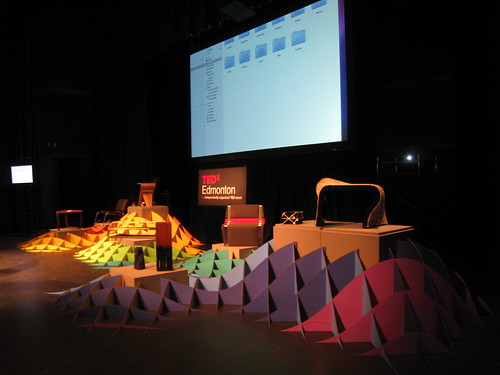
The day was broken up into four sessions. The first was “Creativity & Innovation”, hosted by Michael Brechtel. In addition to the speakers for each session, we also watched one TEDTalk, picked by the host. Michael chose Rory Sutherland’s Life lessons from an ad man, filmed in July 2009. Very entertaining!
 The first speaker of the day was Tim Antoniuk, Associate Professor in the Industrial Design Program at the University of Alberta. He talked about Creative Economic Emergence, and shared a number of statistics about creative economics around the world (mostly from the UN’s Creative Economy Report 2008). He highlighted China as the fastest growing creative economy, noting the shift from “Made in China” to “Created in China”. Tim also spent some time talking about epistemology, “social shapers”, chaos, the rise of Richard Flordia’s creative class, and waste. He noted that 60-80% of environmental impact is determined at the design stage. Tim finished by saying we need to foster emergence, and shared this Peter Drucker quote: “The basic economic resource is no longer capital, nor natural resources, nor labor. It is and will be knowledge.”
 Our second speaker was Shawna Pandya, an Edmonton-born entrepreneur working at NASA-Ames in Silicon Valley. She began with a song, stating that fostering innovation requires “thinking and acting differently.” Shawna encouraged everyone to share their ideas, saying that “life is too short to be proprietary” with them. She also talked about entrepreneurship, and noted that “anywhere you have stasis and stability, you are not going to have startups.” Perhaps her most tweeted remark was that “a crisis is not a tragedy, but an opportunity.” Shawna finished with a call to action – to shift from linear thinking to exponential thinking – and a really creative exercise called Innovation Mad-Libs. Essentially: think of a problem that is unique to Edmonton, come up with one crazy and daring way to approach it, and then ask someone for their thoughts on it.
 Andrew Hessel, a genomic scientist who founded the Pink Army Cooperative, was our third speaker. He focused on the rise of do-it-yourself biology, and compared bacterial networks to computer networks. Andrew delighted us with lots of interesting ideas, like word processors for DNA, cancer-fighting beer, DNA hacking kits, DNA printers, and “fields of chairs being grown in the future”. He said that one day we’ll be able to print new hearts and that we can already cure blindness from vitamin deficiency with goldren rice, but noted that current GMO standards scare people. Andrew also talked about 23andme, PatientsLikeMe, and discussed the sorry state of the pharmaceutical industry (it takes 10-15 years to bring a new drug to market). He closed with some thoughts on biomanufacturing, and a little bit on Pink Army, which aims to make individually-tailored cancer drugs based on an individual’s genetic makeup.
Stephani Carter hosted the second session, on “Creative Sustainability.” The TEDTalk she picked was Cameron Sinclair on open source architecture, filmed in February 2006.
 The fourth speaker of the day was Shafraaz Kaba, architect and partner at Manasc Isaac. He talked about the importance of materials, and said that what you get from combining wood magnents and glass depends on the designer! His firm recently redesigned the old Dell call centre building in the Edmonton Research Park, because the original design was horribly energy inefficient. Shafraaz showed a great heat loss visualization of the building, and pointed out the lack of natural light, both problems they were able to solve. Through his examples, Shafraaz demonstrated that great ideas almost always come from somewhere unexpected, and said we should embrace that!
 Theresa Howland, Vice President for the Western Region at Bullfrog Power, was our fifth speaker. She started by saying that 80% of our electricity comes from burning fossil fuels, the result of decisions based on the lowest cost. She then shifted into wind power, noting that Ontario, Quebec, and Alberta currently produce the most wind power in Canada (about 1,000,000 homes can be powered by wind power across the country). Theresa noted that wind power is not new, but that until economic incentives exist, it will not be fully developed. Wind power works with the natural environment, and in conjunction with existing land use (oh and it doesn’t kill birds!). She closed by encouraging us to make decisions that have a positive impact, stating that individuals really can make a difference!
After a break for lunch (featuring some yummy lasagna) Cam Linke hosted the session on “Creative Entrepreneurship”, and showed us the TEDTalk by Seth Godin on standing out (purple cows), filmed in February 2003.
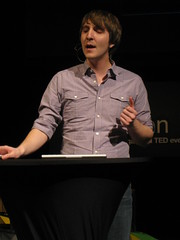 Our first speaker after lunch was Grant Skinner, a local Flash guru and “tech rockstar”. He walked us through cultivating the creative economy on a personal level, sharing some anecdotes from his own work in a very reflective talk. Grant defines success through challenge, contribution, novelty, diversity, and the people he interacts with. He encouraged us to celebrate “play” and said that passionate procrastination is a good thing. Seek inspiration outside your area of expertise, explore limits, cultivate relationships, avoid extremes, and create new things, however minor, were a few of the other thoughts Grant shared. He closed by demoing some of the really interesting projects he has worked on over the years.
 Next up was Cameron Herold, a successful business leader who created 1-800-GOT-JUNK. His topic was teaching entrepreneurship to kids. He said we should be raising kids to be entrepreneurs instead of lawyers, not because he hates lawyers, but because he feels we should treat entrepreneurship with the same level of distinction. Cameron thinks that we focus too much on teaching what they not do, and that we should do better at helping cultivate the things they are good at. A couple of Cameron’s most emphasized points were that allowances teach kids to expect a paycheck, and that we should not medicate them for attention deficit disorder (except in the most extreme medical cases). Cameron finished by sharing the fantastic video, entrepreneurs can change the world.
The driving force behind TEDxEdmonton, Ken Bautista, hosted the last session on “Creative Content”. The TEDTalk he shared was a really eclectic one from John Hodgman on aliens and love.
 The last speaker of the day was Sean Stewart, an award-winning science fiction novelist and influential writer of Alternate Reality Games (ARGs). He talked about the evolution of storytelling, and said that any way humans have invented to lie to one another should be part of your storytelling kit! The latest iteration of storytelling is transmedia, interactive, and social, according to Sean. He talked about fanfiction.net, and noted that the vast majority of words ever written about Harry Potter were not written by JK Rowling. He closed with perhaps my favorite remark of the day: “Art at this point is not about dictating to another person, it’s a dance. Hold out your hand and ask, do you want to play?”
To close out the show, award-winning soul and jazz singer-songwriter Krystle Dos Santos performed, with some help from Mitch Holtby. She sang a number of songs, and Mitch wowed the audience by playing at least four different instruments throughout the set, including a really interesting drum machine. It was a fantastic way to end the day!


Well, the formal part of the day anyway! Many people headed over to Suite 69 for drinks and appetizers, and then back to the TransAlta Arts Barns for the official TEDxEdmonton After Party. Conversations continued with drinks, music, slideshows of the day, and a photo booth. It seemed fitting to end such a great day with a party, even though I think many people were intellectually drained.

TEDxEdmonton was webcast for free online, with dozens of people watching. Twitter also played a big role in the event – we were the #1 topic in Canada for much of the day, thanks to the more than 900 tweets posted by Edmontonians during the event.


I think Ken said it nicely in his recap post:
Everyone needs to know that Edmontonians are working here and beyond, changing the world in their own ways – in science, technology, entertainment, design and more. We wanted TEDx Edmonton to be a spark that would ignite and connect the entrepreneurial and creative energy we’ve always had in our community.
It worked. TEDxEdmonton was a huge success, and I think everyone who participated in person or online felt a positive lift. I suspect there are more than a few Edmontonians with an extra jump in their step this week! Congratulations to Ken, Cam, Michael, Cindy, and everyone else who worked so hard to bring Edmonton such an incredible experience. I can’t wait until the next one!

You can see more photos here and here (some by me, and some by Jason Everitt, Aaron Pederson, and Dallas Whitley), and you can read the liveblog archive here (written by Doug van Spronsen and myself, incorporating tweets). Stay tuned to the TEDxEdmonton site and Twitter for updates, and links to the videos when they are posted.


 The City of Edmonton is hosting a workshop tomorrow at the Art Gallery of Alberta called


 Edmonton’s first
  Microsoft is planning the 2010 edition of
  On Friday afternoon, just hours before the start of the Vancouver 2010 Winter Olympics,
  As you might have
  A good thing really can get better! Amazon S3, perhaps the most well-known cloud computing infrastructure service, just got another upgrade. The simple storage service
 MasterMaq's Blog