First Look at Edmonton’s South LRT Extension (Southgate & Century Park)

On Saturday, April 24, the two newest LRT stations in Edmonton’s network are officially opening to the public, and ETS is hosting a Community Fair to celebrate (on ShareEdmonton). Yesterday, the local media got a sneak peek at the new Southgate and Century Park stations, both of which have been under construction since the Summer of 2007.

South LRT ExtensionSouth LRT Extension

The total budget for the South LRT Extension from Health Sciences station to Century Park was $690 million, the vast majority of which ($573 million) came from tax supported debt (to be repaid from the New Deal for Cities & Communities). Construction included two new tunnels: one beneath Belgravia road and one beneath the southbound lands of 111th Street. There are also two new bridges: a one-way bridge over Belgravia Road (connects South Campus to Fox Drive) and one across Whitemud Drive. A total of 26 new light rail vehicles were added to help service the extension.

The total length of the South LRT Extension is 7.361 km:

  • Health Sciences to McKernan/Belgravia: 0.9 km (roughly 1 minute, 56 seconds)
  • McKernan/Belgravia to South Campus: 1.375 km (roughly 2 minutes, 24 seconds)
  • South Campus to Southgate: 2.032 km (roughly 3 minutes, 20 seconds)
  • Southgate to Century Park: 3.324 km (roughly 3 minutes, 46 seconds)

The McKernan/Belgravia and South Campus stations opened a year ago, and at the time I complained that the media advisory encouraged driving and parking. I’m happy to report that the media advisory for yesterday’s sneak peek said this:

Please note that there is no public parking available at South Campus Station. Members of the media are urged to use LRT to travel to the event.

Much better – I hope future advisories look the same!

We boarded the train at South Campus, and headed for Southgate station (located on 111th Street between 51st Avenue and Whitemud Drive):

For another view, here’s Southgate back to South Campus. Of the two new stations, I think Southgate is my favorite. It mirrors the recent renovations done to Southgate Shopping Centre very well, so it looks like it belongs. The artwork in the station is called “Immense Mode” and was created by Dawn Detarando and Brian McArthur. We learned about all of the new safety features (including the secure washrooms) and got to wander around. Here are a few photos of the new station:

South LRT ExtensionSouth LRT Extension

South LRT ExtensionSouth LRT Extension

Next up – Century Park (located on 111th Street just north of 23rd Avenue). Unfortunately the batteries in my flip died on the way there, so I don’t have video of Southgate to Century Park. I have the return trip though:

As it is the end of the line (for a while anyway) Century Park will probably be the busiest of the new stations, housing an 1100-stall temporary Park & Ride lot, in addition to 130 existing parking stalls. When the bus routes are changed later this month to feed into the new LRT extension, Century Park will receive the bulk of the traffic. The artwork in the station is called “Continuum” and was created by Cezary and Danielle Gajeweski. Here are a few photos of the new station:

South LRT ExtensionSouth LRT Extension

South LRT ExtensionSouth LRT Extension

If you’d like to check out the new stations for yourself, don’t miss the Community Fair on the 24th. It’ll also be a great opportunity to learn more about the changes to bus routes.

What’s next? Well in addition to needing funds to expand the LRT in other directions, the City is already planning for the next south extension to Ellerslie Road. The preliminary design was approved by City Council in July 2008. You can learn more about the future extension here. The currrent LRT network was built to accommodate four-car trains, but work is underway to upgrade capacity to five-cars. The McKernan/Belgravia and Health Sciences stations are being upgraded now, work which is expected to be complete in October. South Campus, Southgate, and Century Park already support five-car trains.

In just a single year, we’ve had four new LRT stations open in Edmonton. Let’s keep it up! You can see the rest of my photos from the preview here.
West & Southeast Edmonton LRT Route Recommendations

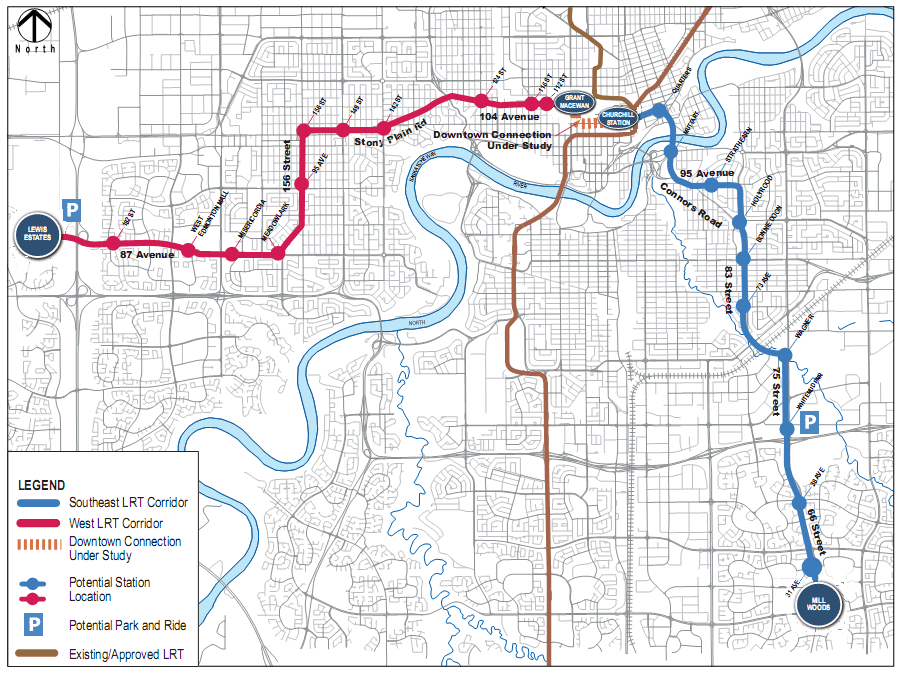
This afternoon Edmonton Transit announced its recommended routes for West and Southeast LRT lines. The routes “work towards the Transportation Master Plan’s vision to expand LRT service to all sectors of the City of Edmonton by 2040.” Back in June, City Council approved the LRT Network Plan, which identifies how the LRT system will be expanded. These two routes are part of that plan.

Here’s what the recommended routes look like (click for a larger image):

There was a lot of information shared during today’s briefing, which I did my best to live-tweet. Here are some of the highlights:

  • This is not the LRT you’re used to – it’s low floor technology with smaller, urban style stations.
  • Initially, there are seven stations planned for the West LRT route and six for the Southeast LRT route.
  • The two routes are actually part of a single line, which means you’ll be able to travel from Mill Woods to Lewis Estates without any transfers.
  • Travel time from either end to downtown will be 20-25 minutes. Both speed and carrying capacity is expected to be the same as the current LRT line.
  • The estimated cost for each route is between $900 million and $1.2 billion.
  • Short-to-medium term ridership for each line is expected to be 45,000 riders per day by 2040.
  • Though bus routes will almost certainly be eliminated, service hours will likely remain the same and will simply shift elsewhere (so in effect, the LRT is making the bus system more efficient).
  • The downtown connection still needs to be considered.

The routes were evaluated based on a new set of decision-making criteria established in December 2008 for LRT route planning. Initial screening looks at feasibility, community, and environment. The next stage is the specific evaluation criteria, with weights in brackets:

  • Land-use/Promoting Compact Urban Form (4)
  • Movement of People/Goods (3)
  • Feasibility/Construction (2)
  • Parks, River Valley and Ravine System (2)
  • Social Environment (2)
  • Natural Environment (2)

Southeast LRT

Recommended Route
Route Options

The Southeast LRT corridor travels north from Mill Woods Town Centre on 66 Street, continuing north on 75 Street. It then uses Wagner Road to extend either over or under the CP Rail line to 83 Street. From there, it proceeds along 83/85 Street north to 95 Avenue, then along 95 Avenue to Connors Road with the route crossing the North Saskatchewan River, either replacing the Cloverdale footbridge or adjacent to it, and east into downtown to connect to the proposed Quarters development, providing a surface (street level) connection to Churchill LRT station, ultimately connecting to Grant MacEwan College.

Major potential stations: Muttart Conservatory, Bonnie Doon Mall, Grey Nuns Hospital, Mill Woods Town Centre

Key benefit: Direct link to downtown, minimizes traffic impacts to Connors Road.
Key weakness: Neighbourhood disruption.

West LRT

Recommended Route
Route Options

The West LRT corridor goes from Lewis Estates east along 87 Avenue, then north on 156 Street. It connects to downtown via Stony Plain Road and 104 Avenue, providing a surface (street level) connection to Grant MacEwan College.

Major potential stations: MacEwan, Oliver Square, Jasper Gates, MacEwan Arts Campus, Jasper Place, Meadowlark Shopping Centre, Misericordia Hospital, West Edmonton Mall

Key benefit: Direct connection to downtown, opportunity to transform Stony Plain Road into a transit corridor for west neighbourhoods.
Key weakness: Impact on established neighbourhoods.

Discussion & Analysis

At this point, I’m simply happy to see this moving ahead. The South LRT expansion has been going well, and it’s important to keep momentum and interest. The West LRT route has definitely been the more controversial of the two, and I don’t see that changing (which likely means that the Southeast LRT route will get built first).

I talked to Councillor Kim Krushell this afternoon to get her thoughts on the recommended routes. While she too was happy to see progress, she had reservations about the West route, telling me that she didn’t necessarily agree with the weighting of the evaluation criteria. “Some estimates put the number of people working at the U of A at 50,000 and the number working downtown at 60,000. The recommended route bypasses a major employment centre.” While she’s “not against the Stony Plain route” she will be asking questions to better determine if the Stony Plain route is actually better, and admitted that “the Oliver connection is appealing.”

That got me thinking about the impact of the West LRT route on the University of Alberta. While many who work in the area may not replace their vehicles with the bus, there’s a good chance they’d use Park and Ride and take the train to work. Students on the other hand, will almost certainly use the bus if no other transit option is available. I called Students’ Union President Kory Mathewson to get his thoughts: “The biggest impact for students is access to afforable housing. The more transit connections we have to the University, the more options students have.”

I expect to see a number of community meetings and town halls related to the West LRT route over the next couple of months.

What’s next?

This is far from a done deal, and there are a bunch of upcoming events you should know about. First up are a series of public information sessions taking place on September 21 and 23 for the Southeast LRT route and September 29 and 30 for the West LRT route (full details here). This is your opportunity to learn more and to ask questions.

Next is a statutory public hearing on November 9th, followed by a report back in December 2009. Concept engineering, which includes working with individual neighbourhoods to site stations, complete environmental analysis, planning a new maintenance facility site, and further defining the downtown connection, will take place from November 2009 through December 2010. It is during the engineering phase that details like home expropriation will be determined.

Funding is in place for a Lewis Estates Transit Centre and Park and Ride facility (with over 800 parking stalls). The Transit Centre is expected to be completed in March 2010, and the Park and Ride in July 2010.

Beyond that, a lot depends on the direction and priorities set by City Council. We should get some indication of their thoughts at the Transportation Master Plan public hearing taking place on September 14.

To keep up-to-date on these and other LRT projects, visit http://www.edmonton.ca/LRTprojects.

UPDATE: Thinking about the West LRT a little further, does it matter that it doesn’t go directly to the University of Alberta? By the time it’s built, the Quesnell Bridge will be widened and express bus service from West Edmonton Mall to the U of A will likely be quite fast.

Highlights from the Alberta High Speed Rail report

Yesterday the Alberta government released a report assessing the potential for high speed rail service in the Calgary-Edmonton corridor. The report, which has been sitting on the shelf for about a year, was commissioned by the province and was prepared by Transportation Economics & Management Systems, Inc. (or TEMS). There are actually three parts to the report, which you can download here:

The press release included a few highlights, but nothing incredibly satisfying:

  • Nearly 10 million passenger trips took place in the Calgary-Edmonton corridor in 2006, with the breakdown as follows: 91% were by automobile, 6% were by air, and 3% were by bus.
  • The faster the high speed train, the greater the ridership and revenues.
  • People said they were willing to pay fares ranging from $56 to $120 for a one-way trip. (To compare: the lowest fare in the next month on WestJet currently is $99, or by car I can make the trip on about $20 of gas.)

I decided to dig into the report a little further. I was struck initially by the numerical nature of it – if numbers and formulas scare you, avoid reading the report. There is some useful, easy-to-understand data as well though.

The diagram above illustrates the Calgary-Edmonton corridor, and the five stations that would be part of the high speed rail system: Downtown Edmonton, Suburban Edmonton, Red Deer, Suburban Calgary, and Downtown Calgary. Each of the three major centres is called a “super zone”, and includes the surrounding communities, at least for the purposes of the report.

The images above illustrate the four types of generic train technologies used to represent various technology classes.

  • Talgo – 125 mph or 200 km/hr – diesel
  • JetTrain – 150 mph or 240 km/hr – turbine electric
  • TGV – 200 mph or 320 km/hr – overhead electric
  • Maglev – 300 mph or 480 km/hr – magnetic levitation

According to Wikipedia, the fastest conventional train in the world is the French TGV which set a speed record of 574.8 km/hr. The fastest non-conventional train in the world is the Japanese JR-Maglev which set a speed record of 581 km/hr.

This table outlines the strategies/predictions for each of the above:

  125 mph 150 mph 200 mph 300 mph
Average travel time (h:min) 2:00 1:45 1:35 1:00
Frequency (roundtrips/day) 8 10 14 17
Fare (in cents/mile) 25 35 40 60
Maximum fare one-way (Calgary-Edmonton) $56 $80 $90 $120
Maximum fare one-way from Red Deer $28 $40 $45 $60
Ridership (in thousands) in 2051 2821 4301 7656 10745
Passenger revenues (in millions of 2006 $) in 2051 137.1 269.0 610.0 1127.9
Market share (2011-2051 is constant) 1.85% 3.10% 4.84% 6.73%

Some other data points:

  • Demand for travel in the corridor is predicted to triple in the time period 2006-2051.
  • Total benefits by super zone are as follows: Calgary (40-45%), Edmonton (30-35%), Red Deer (20-25%)
  • Economic impact from building the system would range from $4.6 billion to $33.4 billion, depending on the type of technology used.
  • Growth in the economy of 0.2 to 0.5 percent, depending on the type of technology used.
  • Between 3400 and 7162 long-term (40 year) jobs would be created across the province.

There’s a lot more data available in the report if you want to take the time to read it.

What’s next? The government says it will continue to look at various options for the province’s future transportation needs, including high speed rail. No decisions have been made at this time, and the report itself makes no recommendations. There doesn’t seem to be a lot of support for the idea at the moment.

I personally think if the province is going to be spending money on transit, it should be on city and regional transit. Both Edmonton and Calgary could use the assistance to improve their respective transit systems – something akin to MoveOntario 2020 and Toronto’s Transit City.

This issue certainly has legs, however. It has been brought up and discussed many times over the years. You can follow along and participate on Twitter using the hashtag #abhsr. For more general Alberta political topics, use #ableg. There’s some great commentary up on the stream already.

Airport Passenger Statistics for Edmonton & Calgary

Earlier this evening I was a guest on The Lesley Primeau Show on 630 CHED. Along with Brittney, we talked about Twitter. That went pretty much as expected – Lesley doesn’t hate social media, but she doesn’t get it either.

While waiting for the show to get started, we were talking about the Edmonton City Centre Airport (ECCA). I’m in favor of closing “the muni” while Lesley very clearly favors the status quo, or perhaps even restoring scheduled service to ECCA. She feels that Edmonton needs an airport downtown to become a great city – I think we need density in the centre, not an airport.

Things got slightly heated when Lesley said that the only growth the Edmonton International Airport (EIA) has seen was from the consolidation back in 1995. She also said that EIA will never rival the Calgary International Airport, and that growth there has been far stronger. I challenged her on both of these assertions (and have heard others make them recently). Lesley said I needed to do my homework, that I was wrong.

So I did my homework. I wasn’t wrong.

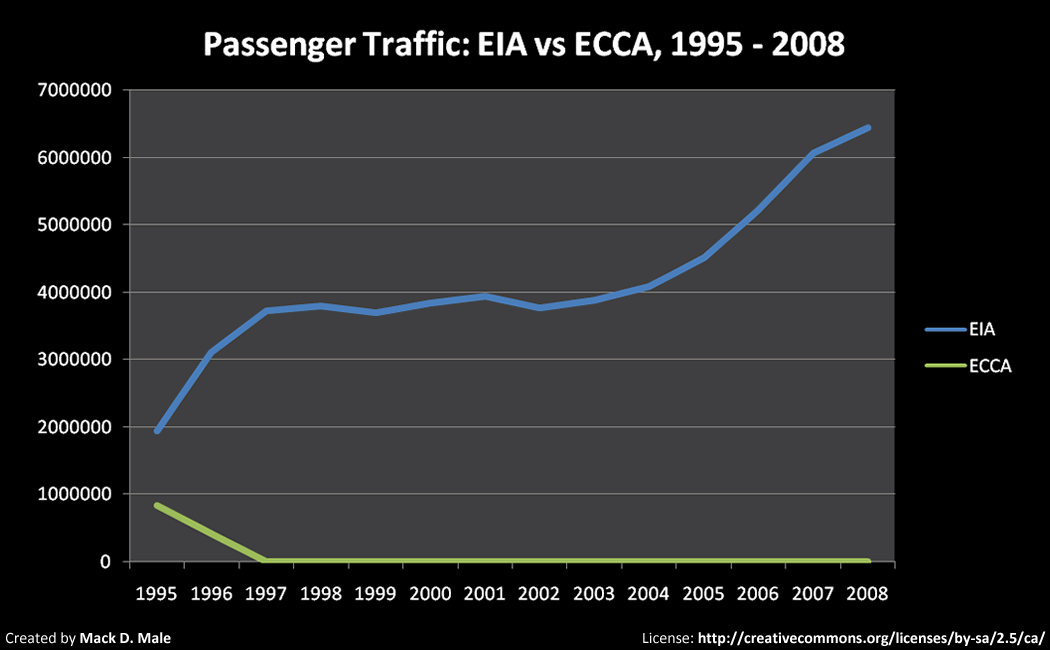
Let’s start with the first myth – that EIA’s growth has only come at the expense of ECCA. Here are the annual passenger numbers for each airport from 1995 to 2008 (I’m going with scheduled passenger numbers, which is why ECCA is 0 after 1996):

Here they are in table format:

YEAR EIA ECCA
1995 1943797 835612
1996 3104322 417002
1997 3720623 0
1998 3791574 0
1999 3700016 0
2000 3843321 0
2001 3940416 0
2002 3773800 0
2003 3882497 0
2004 4081565 0
2005 4511451 0
2006 5213992 0
2007 6065117 0
2008 6437334 0

What can learn from those numbers? The key years are 1995-97, obviously (the plebiscite vote took place on October 16, 1995). Passenger traffic at EIA, which had been stagnant since the early 1980s at about 2 million passengers per year, increased by more than the amount that passenger traffic at ECCA decreased. Passenger traffic at ECCA decreased by 835,612 from 1995 to 1997, while passenger traffic at EIA increased by 1,776,826.

Clearly there was something besides consolidation that caused traffic at EIA to increase. Growth at EIA leveled off from 1998 until 2002, but you’ll recall that was a difficult time for the airline industry – Edmonton was not alone.

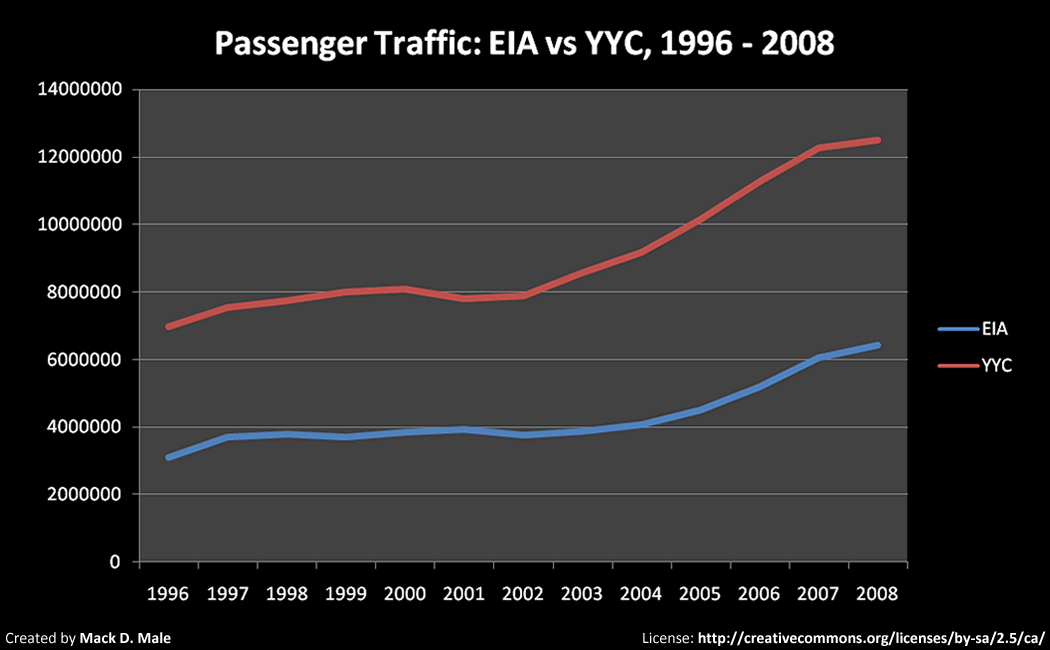
Now let’s look at the second myth – that Edmonton will always be second to Calgary. Here are the annual passenger numbers for EIA and YYC from 1996 to 2008:

Here they are in table format:

YEAR EIA YYC
1996 3104322 6967571
1997 3720623 7547156
1998 3791574 7731034
1999 3700016 8010883
2000 3843321 8090426
2001 3940416 7794519
2002 3773800 7884194
2003 3882497 8576541
2004 4081565 9174039
2005 4511451 10148718
2006 5213992 11279080
2007 6065117 12265754
2008 6437334 12507111

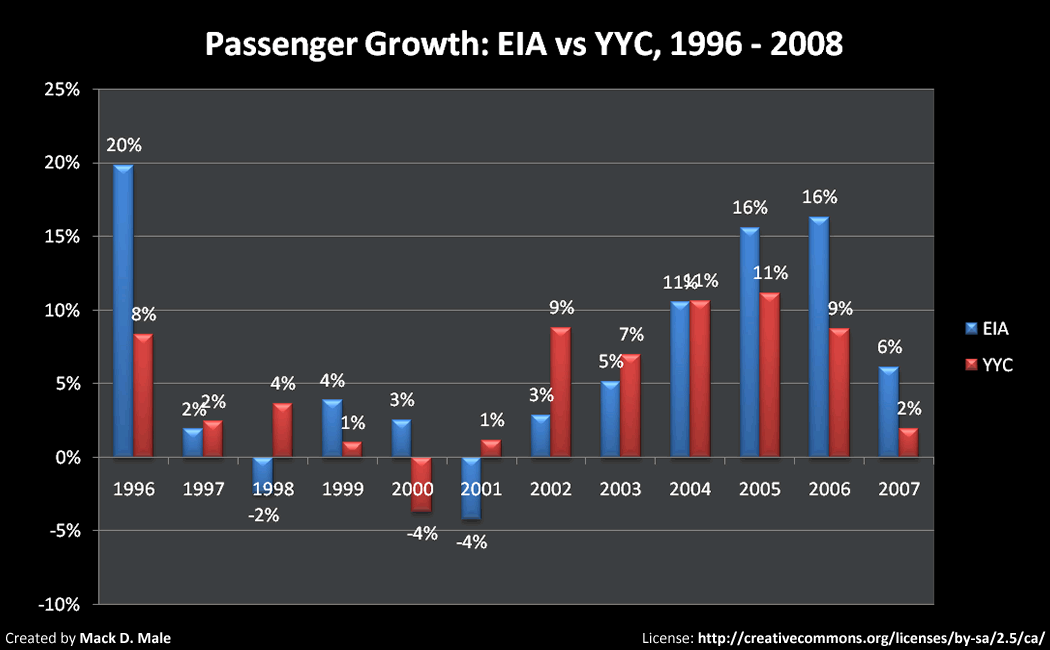
Calgary is definitely busier than Edmonton – nearly twice as busy. Edmonton is in a better position today relative to Calgary than it was in 1996, however. It’s a little difficult to tell from the graph/table above, but Edmonton’s growth overall since 1996 is actually stronger than Calgary’s. Here are the annual percentage increases:

In total, passenger traffic at EIA has increased 107% since 1996, whereas passenger traffic at YYC has increased 80% since 1996.

Is that enough to suggest that Edmonton can emerge from the shadow of Calgary, at least when it comes to their respective airports? Maybe, maybe not. But the data clearly shows that YYC isn’t light years beyond EIA as some would like to suggest.

As an aside, while doing my research I found statistics for EIA for three more years: 394000 in 1962, 755000 in 1973, and 1100000 in 1974.

The public hearing on the City Centre Airport continues tomorrow at City Hall. You can see my resources post here.

Sources: EIA Website, EIA Passenger Statistics, YYC Website, Calgary Airport Statistics, numerous EIA press releases, Wikipedia, Tourism Calgary.

Use Google Maps to find Edmonton Transit schedules and trip plans

Earlier today I stumbled across this thread on Connect2Edmonton which pointed out that Google Maps Canada now has Edmonton Transit schedules and trip planning features. I immediately jumped over to the website to check it out, and sure enough, it’s all there!

The ETS website has offered trip planning for quite some time now, of course (an average of 89,000 trips were planned each month in 2006). It works well enough, but it’s awkward to use. Everything you do seems to open a new window/tab, and it’s not the fastest service in the world. But the main drawback has always been that you have to know far too much information in advance.

When you need to get from point A to point B, you typically know the address of each, but you don’t know the bus stop number near each one and you certainly don’t know which bus to get on!

That’s where Google Maps absolutely destroys the ETS website. Here’s an example.

I need to get from my apartment building to the current Questionmark office in the west end. I live at 10350 122nd Street, and the office is at 11434 168th Street. Let’s start with the ETS Trip Planner:

  1. Date and time of travel are no problem. The “arrive by” feature is particularly nice.
  2. Enter Starting Bus Stop # or Choose a Landmark. Uh oh, what’s my bus stop number? I could go outside and look or I could try to look it up. Let’s look it up.
  3. Okay not bad, enter my address and click Get Bus Stop #. Okay wow, now I have to choose from 14 different stops! I’m not entirely sure which direction I want. The office is northwest from my house, but do I want a westbound stop or northbound? I’ll choose the first one, heading west.
  4. Now I repeat the same thing for the office address. This time I have a list of 7 stops. Again, I’ll choose the first one.
  5. Now I can get my trip plan! Or not…some sort of error just popped up – “Error in Trip Solution Results”. Excellent. Honest I’m just doing this as I write.
  6. I’m really not sure why I got that error, but I did the whole thing again and after about 30 seconds or so, I got my trip plan – six different route options. Shortest time is 46 minutes.

Now let’s do that with Google Maps:

  1. I enter my home address.
  2. On the pin that comes up, I click “From Here” and enter the office address.
  3. Next I click “Public Transit” on the left pane.
  4. That’s it! I have three suggested routes. Shortest time is 34 minutes, and each one includes walking directions too.

If you want, you can do a few more advanced things as well. Clicking “Show options” will let you choose the “Depart at” or “Arrive by” times, just like the ETS website.

directions

And it gets better! There’s no way for me to get back to that trip plan I made using the ETS Trip Planner. Unless I printed it right there, I’d have to do it again. With Google Maps however, my plan has a permalink! Very nice.

I would love to see ETS link to the Google solution. Competition might be a concern, but it’s probably a better use of resources to help Google improve their system than to continue building an inferior one. I think it’s funny that the “Local agency information” link at the bottom of the results pane is broken. You can thank the new Edmonton.ca website for that!

Of course, the Google Maps solution isn’t yet perfect. It doesn’t seem to contain as much information as ETS, nor does it include Strathcona Transit or St. Albert Transit (as Michael Wilson pointed out to me).

Still, if you need to look up transit information in Edmonton I’d highly recommend you look at Google Maps before trying your luck with the ETS Trip Planner.

UPDATE: Found the official list of cities with transit information at Google Maps. Edmonton is not on the list yet. The currently listed Canadian cities include Vancouver, Fredericton, Ottawa, and Montreal.

Carsharing with Zipcar

zipcar I first learned about Zipcar at the ALT.NET conference a couple weeks ago. I was talking with a developer from Toronto who told me a little about the company. I meant to look it up when I got back to Edmonton but of course, I forgot. Then when I was in Vancouver this past weekend, I noticed a bunch of advertisements for the service. I made a note in my Moleskine to look it up.

I think the concept of carsharing is fantastic:

Carsharing is a model of car rental where people rent cars for short periods of time, often by the hour. The organization renting the cars may be a commercial business or the users may be organized as a democratically-controlled company, public agency, cooperative, ad hoc grouping. Today there are more than six hundred cities in the world where people can carshare.

Zipcar, founded in 1999, operates in nearly two dozen cities. Currently they are available in just two Canadian cities – Toronto and Vancouver. They claim to be the world’s largest carsharing operation.

In Vancouver, there are two plans. The “pay as you zip” plan costs $55 per year, and you can then rent from $9.75 per hour, gas and insurance included. The other plan is a monthly fee for people who use the service more frequently. The way it works is you become a member, then you can reserve a car online or on the phone.

I am not sure how well Zipcar would work in a city like Edmonton, but it makes total sense in a place like Vancouver. Sharon and I took public transit everywhere we went over the weekend, and it was always really efficient. Sometimes a car is quite handy though, such as when transporting something large or awkward. In those instances, Zipcar could be really useful.

Here’s a comparison with rental cars, and here’s a comparison with owning a car. You can definitely save a lot of money with Zipcar, but I think it would work best in cities with really well-developed public transit systems. That certainly seems to have been their strategy given the cities in which they currently operate.

ETS is constantly improving, so maybe we’ll have Zipcar or something like it here in Edmonton one day.

Edmontonians flock to transit in 2008?

100 Years of ETSI never thought I’d write a headline like that, but apparently it’s true. According to an article at CBC last week, Edmonton Transit is reporting that ridership rose by 8% in the first six months of 2008 compared with the same period last year. That’s roughly equivalent to an extra 2.5 million fares. ETS called the increase “astounding”, but seemed confused about the cause:

“Buses are packed, the LRT is packed, ridership continues to increase at an astounding rate,” said Ken Koropeski, director of service development for Edmonton Transit.

The increase is almost three times the growth being experienced by other transit systems across the country, Koropeski said, a trend for the city over the past few years.

The CBC article cites three potential reasons: high gas prices, the booming economy and related influx of newcomers to our city, and the U-Pass. I suspect #2 is the biggest cause, but that’s just my gut reaction. I wonder what impact the growth will have on security calls, which have already increased 20% over the last three years.

I also wonder why ETS didn’t share any of this information back in April? You might recall that Statistics Canada released information at the time that said nearly 80% of Edmontonians get to work in vehicle. Granted the StatsCan information came from the 2006 census, but it would have been a good opportunity for ETS to dispel some myths about stagnant (or least slowly growing) ridership.

I hope the growth continues. ETS turns 100 this year, and will celebrate Centennial Week from September 12th to 20th. You can learn more at the ETS website.

Edmonton International Airport launches new brand

eia - we'll move you The Edmonton International Airport’s (EIA) new “we’ll move you” brand actually launched earlier this month on May 8th, but I didn’t see a commercial for it until this week. I haven’t had to fly anywhere either, so I’m not sure if the new brand is prominently displayed at the airport itself or not.

The new brand is meant to bring awareness to the fact that EIA is growing:

The new brand and airport expansion program reflect EIA’s shift from a small, regional airport to a medium-sized international airport serving Northwestern Canada. EIA is Canada’s fastest-growing major airport for two years in a row and now serves over six million passengers annually, a nearly 50 per cent increase in just three years.

The “we’ll move you” philosophy also underpins the $1.1-billion expansion program and current initiatives to incorporate industry-leading technologies, including common-use, self-serve check-in kiosks, Pay & Go parking stations, the expedited customs clearance program NEXUS and a host of others.

The expansion is expected to be completely by 2012 and should enable EIA to service nine million passengers annually. A key aspect to the expansion is a brand new control tower. Our airport is finally getting some food outlets too, including another Tim Horton’s and two Starbucks.

In addition to the branding, they’ve got a new URL: http://www.flyeia.com. It simply redirects to http://www.edmontonairports.com. Reminds me of Edmonton Transit’s http://www.takeets.com address, which I find far easier to remember than anything else.

I like the new logo and colors. Fresh and bright, the new design definitely makes EIA feel more modern than the old navy blue and red.

You can learn more about the changes happening at EIA here.

In Edmonton, we like to drive

Statistics Canada has released some new data from the last census that shouldn’t shock anyone who lives in Alberta’s capital city. Nearly 80% of us get to work in a vehicle:

The new data from the 2006 census found that 12.7 per cent of workers in the city of Edmonton get to work using public transit, while 79 per cent either drive or travel in a vehicle as a passenger.

Statistics Canada said the reliance on cars seems to increase with the age of the commuter. While those under the age of 25 travelled by vehicle 70.7 per cent of the time, that rate increased to 81.6 per cent for those aged 25 to 34. The rate was even higher for those aged over 35, at 87.2 per cent.

Cheap Gas?

The average Alberta commuter takes a car 84% of the time, so we’re slightly better than the rest of the province.

I guess Bob Boutilier, our city’s Transportation Department GM, wasn’t kidding at the ETS conference a few weeks ago when he said a big challenge is the “pickup truck and two car” mentality of most Albertans. Thanks to the census data, I now have a number to attach to that statement.

Some people like to suggest that we’ll never improve our public transit system until everyone experiences just how bad it is right now. Maybe there’s some truth to that after all. I wouldn’t be surprised to learn that the majority of that 80% have never been on a bus or LRT car.

That needs to change.

ETS fares could rise drastically in 2008

Post ImageIf you think a $59 monthly pass for Edmonton’s Transit System is expensive now, wait a year. A proposed fare policy would increase the cost of a monthly pass to a whopping $74:

Coun. Mike Nickel supports the hike, arguing transit has to recover more of its costs through the fare box. He rejects suggestions that the increase would lead to a drop in ridership.

“No I don’t think it will discourage ridership. Actually, people have to measure their other modes of transit against the costs of ridership. Gas is costing more for your car, insurance is costing more for your car.”

Actually insurance is getting cheaper in Alberta, is it not? And Mr. Nickel neglects to recognize that lots people (myself included) don’t replace a vehicle with public transit entirely, they use both. I save most of my money not on gas and insurance, but on parking.

Here are the prices in a few other Canadian cities:

  • Calgary: $75/month
  • Vancouver: $69/month for 1 zone, $95/month for 2 zones, and $130/month for 3 zones
  • Ottawa: $71.25/month

Compared with those cities, the proposed fare for Edmonton feels like a rip-off does it not? Calgary and Vancouver for sure have better transit systems than Edmonton does (partially as a result of geography and population density). On the other hand, a monthly pass in Red Deer is $58, so maybe it’s not such a bad deal after all.

Any fare hike would not take place until 2008, and it has to get to city council first anyway (currently it is with the council’s transportation committee).

Read: CBC News