Text messaging is not dangerous, get over it

cell phoneThe people who create violent video games must be breathing a sigh of relief at the moment – text messaging is the new enemy. Increasingly the media has been publishing fluff pieces about the apparent danger that text messaging poses. With news that the train engineer at the centre of the crash in California last week was text messaging at the time of the accident, things are only getting worse for the technology.

Maybe it’s just the natural progression of things – become popular enough and you’ll undoubtedly gain enemies. Text messaging is more popular than ever, with over 75 billion messages sent in the US in the month of June alone. That’s an awful lot of messages! In fact, Nielsen Mobile estimates that more Americans send text messages than make phone calls. I would guess the numbers are similar here in Canada and elsewhere in the world.

Of course, there are no facts that prove text messaging is dangerous:

Though there are no official casualty statistics, there is much anecdotal evidence that the number of fatal accidents stemming from texting while driving, crossing the street or engaging in other activities is on the rise.

“The act of texting automatically removes 10 I.Q. points,” said Paul Saffo, a technology trend forecaster in Silicon Valley.

I am sure Saffo is completely qualified to make such a statement as a “trend forecaster” so let me make a few statements of my own. I would venture to say that you lose I.Q. points while using the good old fashioned voice functionality of your phone. You probably lose 10 I.Q. points while rocking out to music on your iPod. You undoubtedly lose I.Q. points while stirring your Frappuccino as you cross the street too.

My point is that text messaging is no different than any other distraction. You’ve always got to remember to pay attention to the task at hand.

Pros and cons of telecommuting

telecommuting The company I work for, Questionmark, is a big believer in telecommuting. As a result, I work from home usually two days a week. We were talking about it in the office this week, and this article in the New York Times made me think about it again recently:

Gasoline has become the new workplace perk, as employers scramble to help workers cut its use and cost. A dollar a gallon ago, things like telecommuting, shortened workweeks and Internet subsidies were ways of saving time and providing workers with a little more balance in their lives. Now they have become ways to save money and to keep workers from, well, walking.

Saving money on gas is definitely a good thing about telecommuting. Not everything about it is positive though. Here are some pros and cons for me.

Pros:

  • I save money on gas, likely extend the life of my vehicle, and get to avoid traffic headaches.
  • Rolling out of bed and turning on the computer is great. No need to rush around and get ready! This also helps with really early morning meetings.
  • If I need to run a quick errand, it’s easy to do so.
  • Often there are less distractions, and I can really focus on something.

Cons:

  • It’s really easy to eat too much. With the kitchen a few steps away, I find myself snacking more than I would in the office.
  • No air conditioning in my apartment…when it’s 30 degrees outside, the A/C in the office is definitely nice.
  • Sometimes to solve a problem you simply need to talk to someone else in person.
  • Technology isn’t perfect, and sometimes the VOIP phones fail or for whatever reason I can’t connect to something I need.

You can read more about telecommuting at Wikipedia.

Another popular trend is the shortened work week, where you work four ten hour days instead of five. That would definitely save money on the commute too, but again would have pros and cons.

Seems to me that the standard 9 to 5, five day work week is becoming a bit antiquated. At the very least, more and more organizations are comfortable experimenting with alternate schedules and ways of working.

281 exabytes of data created in 2007

data I typed the title for this post into Windows Live Writer, and a red squiggly appeared under the word “exabytes”. I just added it to the dictionary, but I can’t help but think that it’ll be in there by default before long.

Either it takes three months to crunch the data or March is just the unofficial “how much did we create last year” month, because researchers at IDC have once again figured out how many bits and bytes of data were created in 2007. You’ll recall that in March of last year, they estimated the figure for 2006 to be 161 exabytes. For 2007, that number nearly doubled, to 281 exabytes (which is 281 billion gigabytes):

IDC attributes accelerated growth to the increasing popularity of digital television and cameras that rely on digital storage. Major drivers of digital content growth include surveillance, social networking, and cloud computing. Visual content like images and video account for the largest portion of the digital universe. According to IDC, there are now over a billion digital cameras and camera phones in the world and only ten percent of photos are captured on regular film.

This is obviously a very inexact science, but I suspect their estimates become more accurate with experience.

Interestingly, this is the first time that we’ve created more data than we have room to store (though one wonders if that’s simply due to a lack of historical data than anything else).

Read: ars technica

I'll say it until I'm blue in the face

Post ImageThere is no privacy on the web.

Early this morning, Robert Scoble’s Facebook account was disabled because he violated their terms of service by scraping data from the site. That caused a flood of a posts from people saying that either Scoble was wrong or that Facebook got what it deserved. Most people siding with Scoble said that as he owns his data, not Facebook, he was in the right. He should be able to do with it whatever he wishes. Except that he doesn’t own all the data. Would his friends be happy to find out that he was taking their data elsewhere without their knowledge?

Not that it matters. It should be a non-issue. If everyone realized the truth – there is no privacy on the web – no one would be up-in-arms about the whole situation.

Sure there is something to be said about Facebook only sharing data when it makes good business sense for them to do so. Some might say that’s evil, others might say that’s business. Either way, it all boils down to privacy. Facebook gives you the impression that your data is secure, but it really isn’t.

There is no privacy on the web.

Scott Karp rightly points out that data is power. He suggests a war will be fought over control of data. I wonder though, if such a war can ever have a victor? Does Scoble own the data in his account? Does Facebook? What about his friends, don’t they own some of it? What about advertisers, surely they own some of it? Other companies? I think it’s a pointless battle. There’s far too much entanglement.

Forget trying to control the data. Let it flow freely. Forget trying to keep things secret. If there’s something that must be kept private, don’t post it on the web.

There is no privacy on the web.

Don’t fool yourself into thinking you’re safe. With each passing day we give up a little bit more privacy than the last. The bottom line is that we almost always choose convenience over privacy, whether we know it or not. There’s a reason that concepts like identity theft didn’t really exist a hundred years ago. We share more information about ourselves now than individuals did back then, and we think nothing of it. Of course, accessing and distributing that information is easier than ever too, thanks in large part to the Internet.

Everything you think you know about privacy in the physical world is meaningless in the virtual world. The rules of the game are completely different.

There is no privacy on the web.

Read: Techmeme

Sucks to be a PDA

Post ImageAccording to the most recent figures from IDC, worldwide shipments of PDAs fell 43.5% from 2006 to 2007. That’s the 15th consecutive quarter of decreasing sales for the industry, according to ars technica. It’s important to note that these figures refer to PDAs, and not to smartphones (which you could argue do roughly the same thing). Ars puts the data into perspective:

In the third quarter, IDC says that 728,000 PDA shipments were made globally. To put this in perspective, consider that Apple sold one million iPhones in only half a quarter, and RIM saw sales of more than three million BlackBerrys for the quarter ended September 1.

It seems as though I was only half right when I wrote this post. Turns out smartphones are more popular than ever, but mobile devices like the Pocket PC are indeed disappearing (save for a few niche markets).

I still think that pocket computing in its current form doesn’t have much of a future. I’m more convinced than ever (thanks to virtualization and other advances) that carrying your entire computer around in your pocket on a memory stick is going to become feasible and desirable. No need for a "pocket" version of everything or synchronization with a mobile device when that arrives.

Of course, it does make sense for some mobile devices to exist. Portable media players come to mind, as do the cell phone + calendar combination devices. I’d also like to see a "OneNote" device…something to replace the pen and paper for quick note taking.

Read: ars technica

Why are blank CDs so expensive?

Post ImageI never thought I’d write something like this, but blank CDs are freaking expensive! It wasn’t long ago that I could care less about turning a CD into a coaster, but now I do care. I don’t know what changed, but for some reason CDs have become incredibly expensive relative to DVDs.
Here is the current pricing at Futureshop.ca for a brand I quite like:

More than double the price! And it’s not just Maxell either:

It’s ridiculous! Heck, you can get a 50 pack of Memorex Dual Layer DVD+Rs for only $59.99. I suppose I should point out that both the Maxell DVD and Memorex Dual Layer DVD prices are after an instant rebate, but don’t be fooled – that spindle of 100 Maxell DVDs has been $32.99 for at least six months. That’s for both DVD-R and DVD+R. This isn’t specific to Futureshop either…I’ve noticed the same trend at all computer stores here in Edmonton.

I’m obviously not an expert on this topic, but aren’t CDs and DVDs made from pretty much the same stuff? The main difference between the two seems to be the wavelength of the laser that is used, not anything with the physical discs themselves. Even if there are some differences, surely CDs shouldn’t be twice as expensive as DVDs to manufacture!

You might be thinking that this isn’t a big deal – DVDs store more data anyway. That’s entirely accurate. In fact, I really only use CDs for two reasons: burning audio CDs for my car, and burning CD images. Still, the price shocks me.

Perhaps the high price of CDs is just a reflection of marketplace pressures? These days, almost everyone has a portable media player (like an iPod) and almost all new cars have an auxiliary jack (including mine), so there’s less of a need to burn audio CDs. And on the data side, DVDs are just far more useful due to their larger capacity. All new computers come with a drive that will burn both DVDs and CDs, so it’s easy to pick DVDs over CDs.

Are CDs dead?

I don’t think CDs will be disappearing any time soon, but I do think they are on the way out. Newer technologies like DVD, HD-DVD, and Blu-ray have made the CD seem ancient and have certainly reduced its usefulness. And I think it’s safe to say that the CD will be the last physical media form the music industry will ever sell. Digital tracks over the web is the way of the future.

So long compact disc…it was nice knowing you!

Analyzing my posting habits

I have been blogging for about three and half years now, and lately I’ve been wondering about my posting habits. Do I tend to post at a certain time of day? How about a certain day of the week? I certainly don’t try to – I just post when I have something to share.

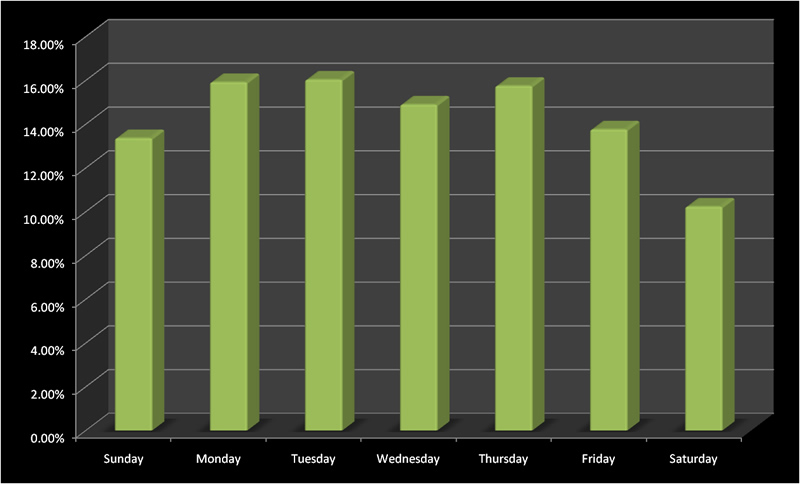
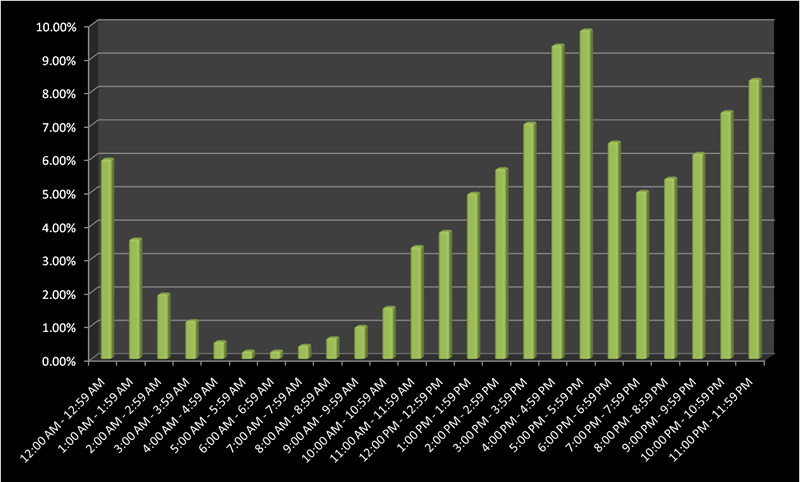
I ran the numbers tonight, and here’s what I found (click on a graph to enlarge). The percentage on the Y-axis means “percentage of my posts”. For days of the week:

Looks like my post frequency drops off on the weekend, but not as much as I thought it might. For hours of the day:

Looks like I am definitely a late-afternoon/evening blogger! This is quite a bit different than the blogosphere as a whole.

When I do these numbers again, I’ll have to figure out how many posts are made on days where I post more than once. I’d also like to find out what the average number of words/characters per post is, but that calculation is a little more involved.

Kind of a neat exercise, I have to say. It’ll be interesting to see how these statistics change in another three and a half years!

161 exabytes of data created in 2006

Post ImageThere’s a new report out from research firm IDC that attempts to count up all the zeroes and ones that fly around our digital world. I remember reading about the last such report, from the University of California, Berkeley. That report found that 5 exabytes of data were created in 2003. The new IDC report says the number for 2006 is 161 exabytes! Why the difference?

[The Berkeley researchers] also counted non-electronic information, such as analog radio broadcasts or printed office memos, and tallied how much space that would consume if digitized. And they examined original data only, not all the times things got copied.

In comparison, the IDC numbers ballooned with the inclusion of content as it was created and as it was reproduced – for example, as a digital TV file was made and every time it landed on a screen. If IDC tracked original data only, its result would have been 40 exabytes.

Even still, that’s an incredible increase in just three years. Apparently we don’t even have enough space to store all that data:

IDC estimates that the world had 185 exabytes of storage available last year and will have 601 exabytes in 2010. But the amount of stuff generated is expected to jump from 161 exabytes last year to 988 exabytes (closing in on 1 zettabyte) in 2010.

Pretty hardcore, huh? You can read about zettabytes at Wikipedia. I’m not too worried about not having enough space though, even if we were attempting to store all that data (which we aren’t). Hard drives are already approaching the terabyte mark, so who knows how big they’ll be in 2010. Then of course there’s also the ever falling costs of DVD-like media.

More importantly, I bet a lot of the storage we “have available” right now is totally underutilized. You’d be hard pressed to find a computer that comes with less than 80 GB of storage these days, and I can assure you there are plenty of users who never even come close to filling it up. Heck, even I am only using about 75% of the storage I have available on my computer (420 GB out of 570 GB) and I bet a lot of it could be deleted (I’m a digital pack rat).

Read: Yahoo! News

Most New TV Shows Require Too Much Effort!

Post ImageI don’t watch a lot of television, save for hockey, news, and Smallville. I guess I am “an Internet child” and that’s definitely where most of my time is spent. I think there’s more to it than that, however. Almost all of the new TV shows being produced require a lot of effort from the viewer. More effort than I am willing to put in.

Take 24, for example. People are crazy about this show. I mean seriously off the reservation, like this guy:

If Jack Bauer has to catch a shark with his bare hands and speed-dry the fin so he can make a soup to restore the President’s sexual potency, I’ll be watching. If Jack Bauer is caught in the path of a fiercely-lit green energy beam made of fuckton particles in a suspended gobbledygook matrix and inadvertently is wearing a shark’s tooth necklace and become half-human, half tiger shark – I’ll be watching.

I’ve never seen an entire episode of 24, so I don’t know what the fuss is all about. I just don’t get it. And therein lies the problem. There’s no way I am going to start watching 24 now – it’s too far along. I’d be an outsider, a poser almost. I would have to go back to the very beginning and watch every episode just to catch up. And that’s just too much work.

And existing fans of the show? They can’t miss an episode, no sir. They have to record it for later if they absolutely cannot be sitting down when the new episode airs. Heaven forbid they miss one. They’d be behind, lost. Can’t have that – so they put in the effort.

There’s some old shows that are guilty, like 24, but it’s the new ones that are the worst. Just look at some of the newest shows – most pretty much require that you started watching from the beginning to really understand what’s going on. Heroes? Yup. Prison Break? Yup. Friday Night Lights? Yup. Studio 60? Yup. Ugly Betty? Yup. Jericho? Yup.

I am not sure if this trend is good or bad for television. On the one hand, networks might be limiting a show’s audience by setting the barrier of entry so high. On the other hand, these kinds of shows probably sell a lot better on DVD.

Either way, I kinda miss the old shows. The shows that didn’t require a lot of effort, nor an introduction. You could just start watching any episode and you just got it. There are notable exceptions in the current most popular shows, like CSI or Law & Order or American Idol, but for the most part, I think the new shows require too much effort.

In a way, I look forward to the day these shows are cancelled so I can just get all the DVDs.

Halloween is sexy not scary!

Post ImageOver the last couple days I have had conversations with at least two friends about Halloween and how the girls dress up in revealing costumes. As you might have guessed, I am generally in favor of the trend! Then today while browsing the NYTimes, I came across this article on the phenomenon:

In her thigh-highs and ruby miniskirt, Little Red Riding Hood does not appear to be en route to her grandmother’s house. And Goldilocks, in a snug bodice and platform heels, gives the impression she has been sleeping in everyone’s bed. There is a witch wearing little more than a Laker Girl uniform, a fairy who appears to shop at Victoria’s Secret and a cowgirl with a skirt the size of a tea towel.

Anyone who has watched the evolution of women’s Halloween costumes in the last several years will not be surprised that these images — culled from the Web sites of some of the largest Halloween costume retailers — are more strip club than storybook.

Is that really so surprising? Sex sells, as they say. Halloween is basically an excuse for women to dress in something they wouldn’t normally dare admit they own, much less wear. The feminists of course don’t like the idea very much, and they are quick to point out that there aren’t many sexy costumes for guys. But you have to ask yourself why there aren’t as many for men: is it because there’s a double standard, or is it because there are more sexy females than sexy males? Or maybe it simply tells us that more people like to see sexy females, including other females, rather than sexy men.

I’ll never forget last year. I was with a bunch of friends at Denny’s at around 3 AM, so after the bars have closed and people have started to trickle into reliable old Denny’s. A group of girls walked in, with a couple of them dressed in sexy bunny costumes. They walked by our table, and one deliberately dropped something and bent down to pick it up, allowing us to have a good look if we so chose. Maybe she was drunk, or maybe she was just what I like to call an “attention whore”. Either way, it was memorable to say the least.

What are some of the sexiest costumes you’ve seen? Have you worn one, or would you consider wearing one?

Read: NYTimes