The City of Edmonton is currently developing a comprehensive City-Wide Food & Agriculture Strategy. On the surface this sounds like a great initiative. Many other cities have recognized the vital importance of food and have developed strategies and policies, and it’s about time that Edmonton follows suit. The project introduction makes a strong case for this work:
We live in a dynamic and rapidly growing metropolitan centre with a geographic location that demands a thorough consideration of what it means to be part of the food and agriculture system. We know that a resilient local food and agriculture system can contribute significantly to the local economy and to the overall cultural, financial, social and environmental sustainability of Edmonton and the Capital Region.
Developing the Food & Agriculture Strategy is an important endeavor for our city, and it deserves the time, care, and attention that any other serious policy might receive. So why are we rushing it?

Councillor Loken speaks at the Food in the City kickoff event in McIntyre Park in May 2011
The timeline is aggressive: the project officially started on May 28th, 2011 and is scheduled to go to public hearing in the fall of this year. Considering that public involvement activities did not get underway until this spring (and are already largely over), the reality is that the City is trying to develop this strategy in just a few short months with very limited input.
Other cities have certainly taken their time with similar projects. In Toronto, the Food Policy Council was created in 1991 but the Toronto Food Charter was not accepted until ten years later. The City is now in the process of developing the Toronto Food Strategy. In Vancouver, City Council got the ball rolling in 2003 by calling for the development of a “just and sustainable food system” for their city. Four years later the Vancouver Food Charter was adopted and in 2009, Council adopted urban agriculture design guidelines.
I know that whatever goes to Council in the fall isn’t the end of the road – the strategy will be further developed over time. But I don’t think that’s a reason to rush things now, especially given the apparent reason for the rush: this strategy is one of the final pieces standing in the way of land development on the edges of our city.
The Food & Agriculture Strategy is an opportunity for us to consider the importance of food in Edmonton. It’s an opportunity to increase access to local food, to reduce our ecological footprint, and to contribute significantly to the local economy. But it’s also an opportunity to consider what happens to the agricultural land surrounding Edmonton, and that is ultimately a question about the kind of city we want Edmonton to be.
The Way We Eat
During the development of our latest Municipal Development Plan (MDP), known as The Way We Grow, an organization called the Greater Edmonton Alliance caused quite a stir. On more than one occasion from 2008 to 2010, they filled City Hall with Edmontonians demanding a “vibrant and sustainable food economy.” They staged The Great Potato Giveaway, an impressive publicity stunt that brought food to the forefront of the discussion in Edmonton.

Edmontonians filled City Hall for the Second Reading of the MDP
Their efforts resulted in a key victory: the inclusion of polices related to food and agricultural land in the MDP (3.2.1.6 through 3.2.1.11). In particular, policy 3.2.1.7 which states:
Preparation of Area Structure Plans is authorized for the Northeast, Southeast and Southwest Urban Growth Areas, and shall only be approved following Council acceptance of, and adherence with the:
- Growth Coordination Strategy;
- Integrated Infrastructure Management Plan; and
- City-Wide Food and Agriculture Strategy.
In other words, they convinced Council that a food and agriculture strategy had to be in place before any further development on the edges of the city could proceed. They convinced Council that high soil quality, particularly in Northeast Edmonton, is valuable and should be considered as part of any planning and development in the area.
For a document that many critics, myself included, said lacked any sort of bite with respect to curbing sprawl, this was a remarkable achievement.
The Future Growth of Edmonton
An Area Structure Plan (ASP) is at the core of creating and developing new communities. You can think of an ASP as the link between the Municipal Development Plan, which directs and shapes Edmonton’s urban form at a high level, and Neighbourhood Structure Plans (NSPs), which get into the details about what new neighbourhoods in the area might look like (then there’s NASPs which are ASPs for a single neighbourhood). Residential ASPs generally cover an area of between 200 hectares and 2000 hectares, and provide general guidelines as to how MDP policies are to be realized within that area.
There are currently 18 ASPs/NASPs approved in the City of Edmonton, and they contain a total of 86 NSPs (as of December 2011). Of these, 29 are considered completed in terms of land supply as at least 95% of planned low density lots have been registered. Of the 57 remaining, 13 are not yet approved and are at the planned stage, while 44 are under development. This data comes from the Developing and Planned Neighbourhoods Report for 2011, which states:
As of December 2011, the potential low density residential lot supply that is available in approved ASPs is slightly more than 65,000. Based on current absorption rates, Edmonton has an average of 18 years of remaining land supply.
Land supply remaining in the approved Area Structure Plans ranges from a high of 19 years in the Southwest sector to a low of 9 years in the Northeast sector.
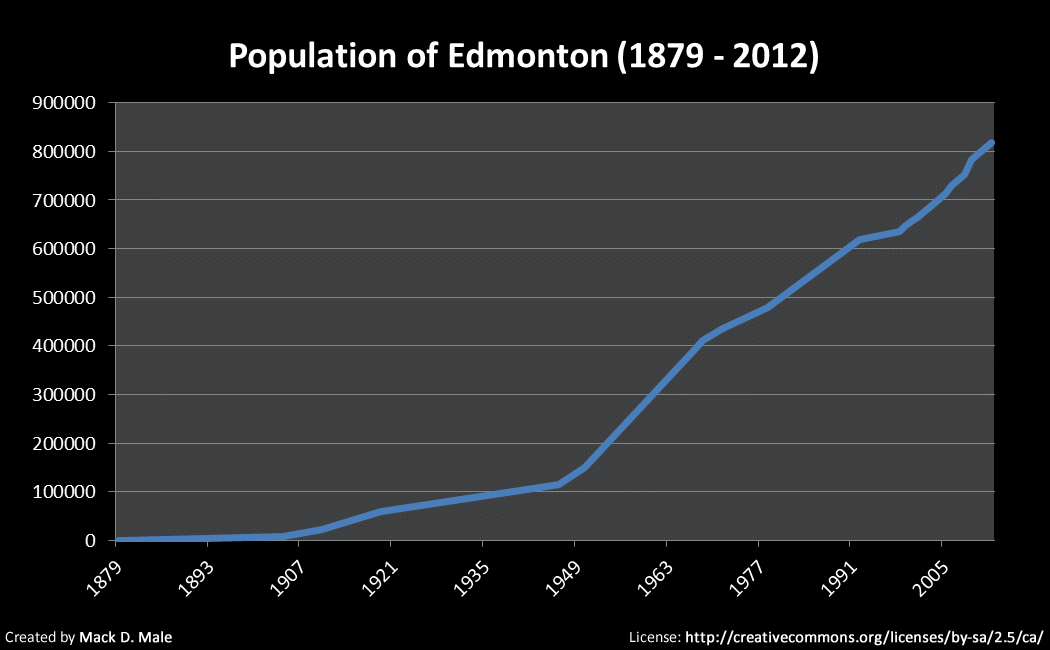
The Capital Region Board estimates that by 2040, the population of Edmonton will grow from the current 812,000 to approximately 1.2 million. They project demand for 146,000 new dwelling units by 2039. To put that into perspective, Edmonton currently has a little over 338,000 dwelling units. It’s worth noting that these estimates are based on past trends of larger suburban rather than urban growth. Councillor Iveson wrote at length about this issue during the development of the MDP, which he flippantly called ‘The Way We Sprawl’:
In other words, for fiscal, social and environmental reasons, there is a strong case against conceding to so much peripheral development. Again, I’m not calling for a halt to it, since I don’t see how we could accomplish that under current legislation. I’m calling for greater urbanization within today’s footprint. We’re told that market demand’s not there, that demand is for the suburbs, and that we can’t fight that. But I think we have to work to make urban living more family-friendly – which we’re beginning to do – and we need to make it competitive in terms of affordability. This is work worth doing, even if it’s hard.
So, you can look at those numbers for remaining lot supply and determine than we’d have a shortfall of around 81,000 units but you have to keep in mind that the 65,000 refers only to low density units on the periphery. We also need to consider the medium to high density residential capacity in approved ASPs, which totals 65,100 units, as well as redevelopment projects in the mature and established suburban areas which total an estimated 44,600 units.

The alternative is to look at the three “Urban Growth Areas” defined in the MDP (the brown areas on the map above). Rural Southeast, Rural West, and Rural Northeast would together provide an additional 15 years of low density capacity (55,000) units plus additional medium to high density capacity of 24,500 units.
So let’s do the math:
| Existing low density capacity in approved growth areas |
65,000 |
| Existing medium/high density capacity in approved growth areas |
65,100 |
| Mature & established suburban redevelopment capacity |
44,600 |
| TOTAL (excluding Urban Growth Areas) |
174,700 |
| New low density capacity in Urban Growth Areas |
55,000 |
| New medium/high density capacity in Urban Growth Areas |
24,500 |
| TOTAL |
254,200 |
As you can see our total capacity is significantly more than anticipated demand of 146,000 units. Even excluding the Urban Growth Areas, we’d have a surplus of 28,700 units. Why would we bother developing the three Urban Growth Areas when we have more than enough capacity in existing, approved areas?
Northeast Edmonton
Of the three Urban Growth Areas, changes for the Northeast seem most imminent. As mentioned above, the Northeast sector of the city has the lowest amount of land supply at an estimated 9 years. It also has the highest forecasted job growth through 2024, with an estimated 12,000 jobs being created over that time. But even with that growth, the area will only represent 2-3% of the city’s total workforce. Wouldn’t extending the LRT further into that area to serve the economic need be a better investment than building new neighbourhoods?
The ASP that is being proposed for the eastern part of the Northeast sector is known as Horse Hill. The name was recently approved by the City’s Naming Committee.
The name Horse Hill comes from the area’s historical association with Fort Edmonton. It was previously used as the home of Fort Edmonton’s horse guard (Blue 1924). During this time, as many as 800 horses were kept here , playing an important role in the maintenance and protection of Fort Edmonton.
The area is approximately 3700 hectares and is bounded by Manning Drive on the west, the North Saskatchewan River on the east, and Anthony Henday Drive on the south (some of the neighbourhoods nearby include McConachie, Gorman, Brintnell, and Kirkness). Development of the ASP is being led by Stantec Consulting and the Stakeholder Advisory Group is made up of landowners, community leagues, residents, and the City. They have already circulated a draft to dozens of departments at the City, even though they know the Food & Agriculture Strategy needs to be in place first. The audacity to move ahead with a draft ASP underscores just how pervasive the business-as-usual mentality really is.
The most unique feature of the Northeast is of course the agricultural land. You’ve probably heard of some of the farms located there: Kuhlmann’s, Norbest Farms, Visser Farms, Horse Hill Berry Farm, and Riverbend Gardens to name just a few. I had the opportunity to tour Riverbend Gardens back in 2010 and found it breathtaking. Their 120 acres of land is pretty much as far as you can go northeast and still be within the boundaries of Edmonton.
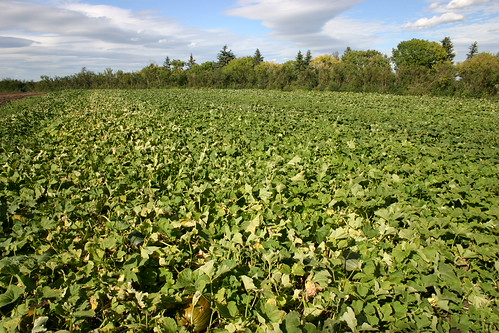
Riverbend Gardens
Roughly 17% of land in Alberta is good for farming, and the majority of that is situated along the Edmonton-to-Calgary corridor. Edmonton is lucky to have Class 1, 2, and 3 agricultural soils within the city limits, but so far we have not done a very good job of preserving it. Since 1982, Edmonton has lost 74% of its Class 1 soils. Still, in 2009 the average net profit per acre in Edmonton was $79.68, more than double any other location in the Capital Region. And in the Northeast? The average net profit per acre was $270.72. The value of the land in the Northeast needs to be recognized.
Directly to the west of this area, across Manning Drive, is the Edmonton Energy and Technology Park. That ASP was approved by Council on June 9, 2010. The intent is to capitalize on the byproducts left over from oil sands production (the area is about 15 kilometers from existing and proposed upgrader sites).
The Edmonton Energy and technology Park provides a vision for a new eco-industrial area for the city of Edmonton. The opportunity for value-added industries and significant economic spin-off activity based on the development of Alberta’s oil sands was the catalyst for the development of this industrial plan. EETP is designed to take advantage of the primary petrochemicals and products from upgrading and refining in the region.
The 4857 hectare-sized area will be developed over the next 40 years with four primary land use precincts: petrochemical, manufacturing, logistics, and research & development. This is where a lot of that job growth is expected to come from.

Partially as a result of the expected increase in industrial activity on the west side of Manning Drive, plans currently exist to connect Highway 28A with Highway 21 via an expressway that would cut right through existing farmland and cross the North Saskatchewan River. The Capital Region Board (CRB) scored a victory in December 2011 when the Province agreed to shelve plans for the Regional Ring Road, but it seems that has done little to protect agricultural land in the Northeast. The CRB’s Integrated Regional Transportation Master Plan includes the expressway as a potential high load corridor (subject to further engineering and technical review). Who knows if the road will actually be built, but the draft Horse Hill ASP includes it.

In anticipation of this development, an awful lot of land has changed hands. Some estimates suggest that just 15% of land in the area is still owned by original owners. Walton International, a land developer (some would say speculator) that has been active in the Edmonton region for many years, is now the largest landowner in the area. They purchase land at a small premium with the expectation that its value will be significantly increased as the opportunity to develop it draws near. There are a number of holdouts however, including Riverbend Gardens. Recently they and others formed the Northeast Edmonton Agricultural Producers association and launched Friends of Farmers to draw attention to the potential loss of agricultural land.
Business-as-Usual Growth
We cannot afford to grow in the future the way we have in the past. Councillor Iveson highlighted this section of the Growth Coordination Strategy after an initial read:
Although not included in the analysis at this time, operating and maintenance costs in suburban areas represents a significant operational expenditure to the City. Also a large component of capital spending, rehabilitation and replacement of infrastructure is not included in the analysis presented either. Administration is working towards the inclusion of these expenses into future versions of the Growth Coordination Strategy, but at this time the methodology for the gathering and synthesis of the data required for this is not developed sufficiently.
He then stated, “I’m concerned we may not have this full picture before the next Area Structure Plans (for the North East and South West green patches) come up for debate this fall.”
Some land developers will tell you that the City has an obligation to move forward on the three Urban Growth Area ASPs. To them, the City made a promise to develop the land when it annexed the three regions back in 1981. But can we really afford to hold the City of today to decisions that were made over thirty years ago?
I don’t know why the City pursued that annexation in 1981 – I wasn’t yet born – but the answer might be found in Doug Kelly’s book $100,000 An Acre. In Chapter 12 he writes about the development of Campbelltown (now known as Sherwood Park) in the 1950s and in Chapter 14 he elaborates on the City of Edmonton’s opposition to the development. “The city, even then, was concerned about fringe developments and its inability to tax or control development without annexation.” The McNally Report in 1956 and the Hanson Report in 1968 both recommended that Edmonton be allowed to annex St. Albert, Sherwood Park, and the industrial area of Strathcona County. “In all cases, the provincial government knuckled under to the small rural population and disallowed the annexation. It was an injustice to the citizens of Edmonton from which they have never fully recovered.”
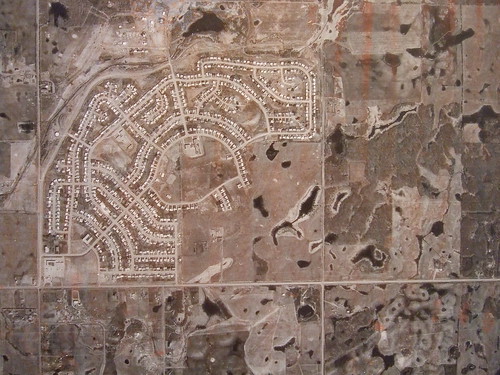
Sherwood Park in May of 1962
I wonder if that experience caused the City to become more aggressive about acquiring the surrounding land decades later. Perhaps they realized the situation for cities was not going to improve. When the province eliminated the Planning Act in 1995 and placed all legislation concerning land development into the Municipal Government Act (MGA), it didn’t come without a cost. “Now the rural municipalities can develop to the fringes of urban municipalities, greatly restricting the latter’s ability to expand for future growth,” Kelly wrote.
The relationship between urban municipalities and the province today seems poised for renewal. With the announcement last month that Calgary, Edmonton, and the province have committed to developing a big city charter, there’s hope that positive changes are on the way for Alberta’s big cities and the options they have for dealing with the unique challenges of growth.
Land developers have sunk money into the Urban Growth Areas and the only way they can get it back and make a profit is for the City to continue growing the way it has been. For sprawl to continue unabated. As a result, the City and Council are almost certainly feeling pressured to get these ASPs approved, but there is absolutely no requirement that they do so. All they must do is follow the process established under the MGA and its ASP Terms of Reference.
We must be willing to stand up and declare that the Edmonton of 2012 and beyond will be a more compact, sustainable city than the Edmonton of 1981. Change is hard, but if the will is there it can be done. We need to be willing to say that if you’ve based your business on decisions that were made over three decades ago, too bad; Edmontonians are no longer picking up the tab.
Food & Agriculture
In our haste to continue unnecessarily growing outward, I’m concerned that we’re going to end up with a Food & Agriculture Strategy that reflects the limited time and attention devoted to it. Determining the true value of the land in the Northeast is just one piece of the puzzle, there are so many other aspects to food and agriculture in the Edmonton region that should be considered.
The discussion primer for the project hits all the right notes, of course.
As part of the strategy, a comprehensive inventory of agricultural assets is being undertaken, as well as an assessment of local food business opportunities. The strategy will include a summary of this background information in order to provide a sense of the current state of food and agriculture in the city and what potential exists. Example practices from across North America are also being examined, as mentioned earlier, in order to gather ideas for what might work in Edmonton.
Assessing local food business opportunities, compiling a comprehensive inventory of agricultural assets – these are excellent ideas, but they are not things that can be completed overnight.
Consulting the right people takes time too. I had the opportunity to attend two consultation events, neither of which was very well attended. At the second such event, there was a lot of great discussion about farmers markets, food hubs, educating people about basic food skills, and much more. And yet, we barely scratched the surface.
Let’s use farmers markets as an example. Yes, everyone seems to agree that farmers markets are a great thing, but what good is a strategy if that’s all it says? Do we have the right number of farmers markets in the Edmonton region? What challenges do they face? What could the City do to help address those and other challenges? Do we have enough producers to support all the markets? These questions deserve to be explored in depth.

Shoppers at one of Edmonton’s newest markets in Highlands
Given the limited time, I’m not confident that the final strategy will be anything more than a collection of high level goals. I’m sure it’ll be a great read, but I doubt it will be so bold as to make any strong recommendations to Council on how to actually achieve the vision of having a resilient food and agriculture system in Edmonton.
I hope I’m wrong, but I fear the Food & Agriculture Strategy will be viewed as nothing more than another box checked on the road to additional sprawl.
Closing Thoughts
Both the Growth Coordination Strategy and the Food & Agriculture Strategy are slated to go to Council sometime this fall. The Horse Hill ASP is also slated to be reviewed toward the end of October. City Council will soon be on summer break until the end of August, and I’d love for them to return to a flood of messages from Edmontonians expressing their thoughts on this issue. They need to know that a significant number of people support their efforts to curb urban sprawl.
The bottom line is that the agricultural land on the edge of Edmonton is some of the best land in the province. With more than enough capacity to support anticipated population growth within existing areas, there’s no good reason to relinquish such a valuable asset, especially before a proper analysis of the land and how it fits into Edmonton’s future is completed and a strategy is approved.
This is not just a battle between land developers and farmers in the city’s Northeast. This is a battle over the kind of City we want Edmonton to be. I want Edmonton to be a economically and environmentally sustainable city that recognizes the importance of food security and the value of a more compact region. How about you?





 Today I am very excited to share with you the latest release of



 MasterMaq's Blog