Winter Light 2011: Illuminations featuring Circus Orange

It was cold outside tonight, but Churchill Square was still full of people for Winter Light’s Illuminations. This year the event featured Yukigassen, a Japanese snow battle sport, roving performers, the Illuminations Choir, and the Edmonton premiere of Circus Orange, a Toronto-based pyrotechnic circus troupe. They performed TRICYCLE, “a dramatic fusion of live music, clown, circus, dance, aerial performance, mechanics, pyrotechnics and fire arts.” It was amazing.

Winter Light Illuminations 2011
Perfect night for a stroll in Churchill Square!

Winter Light Illuminations 2011
Warming up by the fire.

Winter Light Illuminations 2011
I love the way City Hall looks at night, all lit up.

Winter Light Illuminations 2011
The tricycle in front of the Art Gallery of Alberta.

Winter Light Illuminations 2011
She got everyone’s attention then led the crowd to the tricycle.

Winter Light Illuminations 2011
The large crowd followed the tricycle throughout the square. It was great!

Winter Light Illuminations 2011
The fire looked awfully close to the trees! You can see a video of it here.

Winter Light Illuminations 2011
A few kids were scared of these guys!

Winter Light Illuminations 2011
Circus Orange takes flight!

Winter Light Illuminations 2011
Don’t you love seeing the square full of people?

Winter Light Illuminations 2011
They took the front wheel of the tricycle off and put the acrobat inside!

Winter Light Illuminations 2011
Then it lit up!

Winter Light Illuminations 2011
And there were fireworks!

You can see the rest of my photos here.

Tonight’s event did a lot of things right, in my opinion. They finally spent some of the large Winter Light budget – I can’t imagine that Circus Orange was cheap! It was a fantastic show that looked expensive, with lots of lights, fire, props, and a crane. It was worth it. Another thing I loved was that they used the entire square. The tricycle started at the Art Gallery and the large crowd followed it to Three Bananas and back through the square toward City Hall, with different stops along the way. The storytelling aspect was great too, with the scary stilt guys and the clown who never spoke in English. Lots of fun for everyone!

The temperature doesn’t matter. You know what people do when it’s cold? They dance to keep warm. It adds to the experience! And tonight, the people who stayed until the end were rewarded, with a big finale that even featured fireworks. For a few minutes, I forgot that I was cold!

Kudos to Winter Light for a great event. Let’s have more of this please!

Happy Anniversary to the Art Gallery of Alberta!

This weekend the Art Gallery of Alberta celebrates the one year anniversary of its new building in Churchill Square. It’s hard to believe that it was a year ago that the ribbon cutting took place and Edmontonians were clamoring to get a peek at the beautiful facility.

And what a year it has been! Here are some of the highlights of 2010:

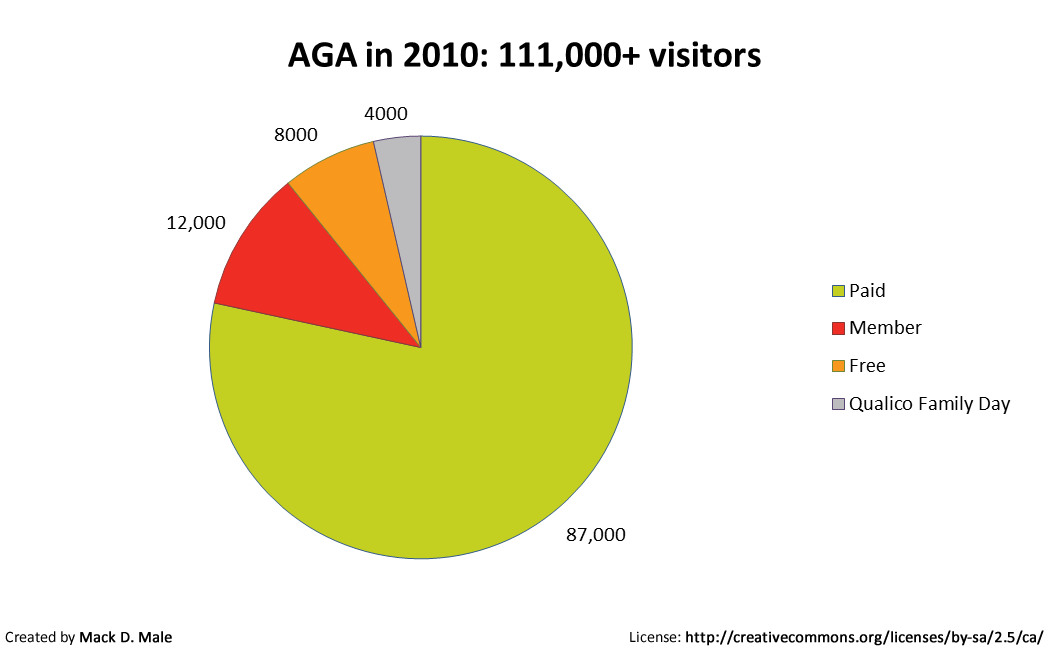
  • Attendance more than quadrupled since 2009 – more than 111,000 visitors!
  • Of that number, approximately 87,000 were paid admission, which significantly surpassed the target of 65,000.
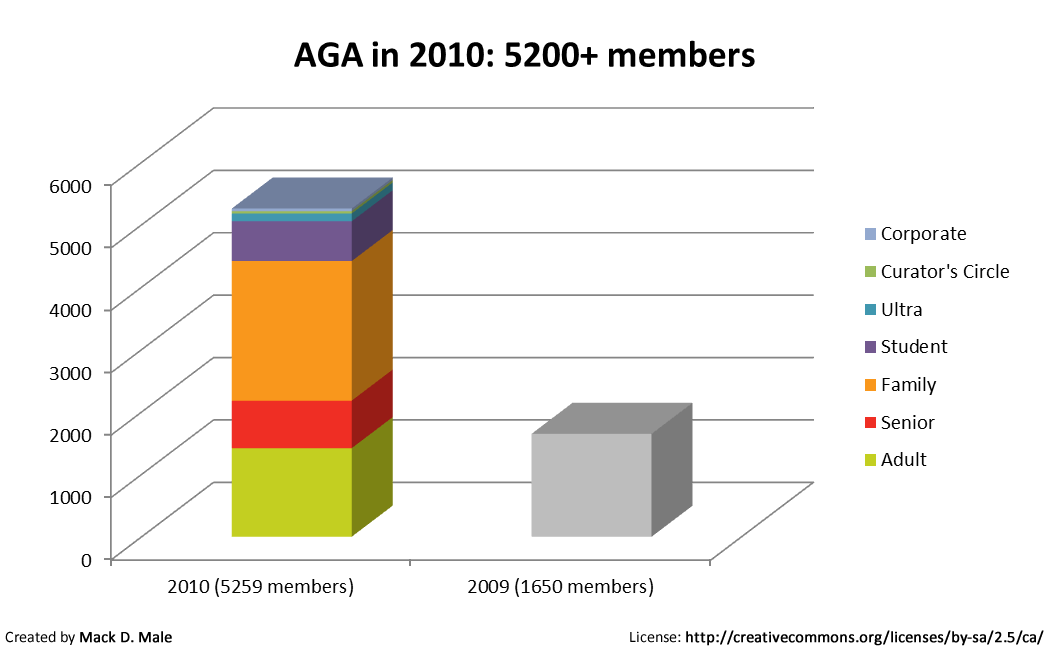
  • The number of AGA members increased from 1650 to 5300!
  • A total of 17 exhibitions were presented, 5 of which were dedicated to Alberta arists.
  • Roughly 4700 people in total attended the 395 public tours that were given. In addition, 146 private tours were given to a total of 3150 visitors.
  • School programs grew from 5000 students in 2009 to 14,500 last year.
  • A total of 367 private and corporate events, 24 wedding receptions, and 62 wedding photos sessions took place.

Here are a few graphs to help illustrate the success of 2010:

One of the highlights for me personally was the Refinery series of events. There were three in 2010, and each one was more popular than the last. Over 1700 people attended Refinery, and 800 of those were at the most recent event (it was so popular, people had to be turned away). I wrote about the second Refinery here. The 367 private and corporate events is significant as well. I attended dozens of events that took place at the AGA last year, it’s a great venue.

And who could forget the exhibitions! From Edgar Degas, Francisco Goya, and Edward Burtynsky to Warner Bros., Jonathan Kaiser, and Laura St. Pierre, we had a little bit of everything. I particularly enjoyed the Warner Bros. cartoons and Janet Cardiff & George Miller Bures’ Storm Room.

While the building was the most obvious “new” thing from 2010, let’s not forget that the AGA launched a new restaurant, logo, a new website, and established a presence in social media last year as well. All of those things helped the organization win a variety of awards:

  • Metal Construction Association Presidents Award for Overall Excellence
  • Institutional Winner: Alberta Construction Magazine 2009 Top Projects
  • 2010 Edmonton Economic Development Corporation Recognition Excellence Award
  • Best Cultural Institution 2010 by See Magazine
  • Zinc Restaurant was named one of the Best New Restaurants of 2010 by Where Magazine
  • Allan Scott was named Outstanding Volunteer Fundraiser by the Edmonton Association of Fundraising Professionals

Interview with Gilles Hébert, AGA Executive Director

The numbers for 2010 are certainly impressive. I asked Gilles to reflect on the past year. “It’s quite remarkable,” he told me. “The challenge is to maintain the momentum and continue to grow our audience.” In the first two months after the new building opened to the public, more than 30,000 people visited. “Lots of people came initially just to see the inside of the building,” Gilles said. Now he says people are coming back for the programming. “We exist because of the program, not because we have a cool building.”

Gilles said the AGA has seen the most interest in its contemporary programming, which he described as “pretty cool”. The success of the AGA’s contemporary exhibitions has driven interest nationally too. “People are looking to us for these big ambitious shows,” he told me. “They’re drawn in by the level of enthusiasm that is palpable in this community.”

Looking ahead to 2011, Gilles told me the challenge is generating buzz in places other than Edmonton. “There is no other institution like us in this province – we have a provincial mandate.” One of the ways the AGA is doing that is through social media. “We’re finding that these new forms of communication are really driving interest and allowing people to connect with what we’re doing.” He said their social media activities are actually becoming more valuable than traditional printed material and paid advertising, at least in terms of driving audience.

Gilles told me he is really looking forward to the celebration this weekend. “We are so proud to celebrate this milestone.”

Art Gallery of Alberta

Sunday Celebration

The anniversary celebration takes place on Sunday from 11am until 5pm. Here’s a brief description of what to expect:

The day includes the launch of the official AGA building book, presentations by the Citadel Theatre, Alberta Ballet and the Edmonton Opera, exhibition tours, as well as cupcakes for the first 500 visitors.

It should be a great day! You can see the event on ShareEdmonton here. And if you just can’t wait until Sunday, tonight is opening night for the Brian Jungen exhibition which features three sculptural installations.

If you’re taking photos this weekend, be sure to add them to the AGA pool on Flickr. Be sure to follow the Art Gallery of Alberta on Twitter.

You can see my photos of the AGA here. If you’d like a bit of background on the new building, check out my recap of architect Randall Stout’s talk.

Startup Weekend returns to Edmonton

Startup Weekend Edmonton is back! The weekend of February 11-13 is your opportunity to do something about that idea you’ve been thinking about – and that’s just one of the many good reasons to attend. Startup Weekend is a great opportunity to network with other people in the community, to learn something new, to gain valuable team building experience, and maybe even just to feel that sense of accomplishment we all love. Not to mention the rush of going from concept to working demo in just 54 hours!

Edmonton’s first Startup Weekend took place last June. About 30 local developers, designers, and other creative people got together and formed six teams that built some really interesting projects. You can read my recap of our last event to get a sense of how the weekend went, but here in a nutshell is the process:

  • Friday Night: Everyone shows up, we have some brief introductions, and if you have an idea you pitch it. It’s messy and fun but we then form teams out of all the ideas, and each team begins to plan and prepare for the rest of the weekend.
  • Saturday: Teams dive into building their project. Breaking it up into tasks and time management are key. Throughout the day there are lunch and dinner breaks with speakers talking about startup-related topics.
  • Sunday: It’s crunch time! Teams finish up their projects so that they can demo it in the evening. Around 6pm, all the work stops and the wider community gets to see what each team accomplished over the weekend.

Cam is going to cover all of that in more detail on the Friday evening as well. It’s a short amount of time, which is part of why it is so exciting!

One of the questions that people ask a lot is if Startup Weekend is only for programmers. The answer is no! In fact, teams need individuals with all kinds of skills to be successful. Anyone can have an idea and help flesh that out into a project. Artists and designers can help with the look and feel. Business people can help with the pitch or maybe even work on a business plan. Storytellers can help make the project compelling to customers. Of course someone needs to test the project out. I’m sure you can think of dozens of others skills that could be brought to the table. The most successful companies need more than just programmers!

There are Startup Weekend events happening all over the world. In fact, there are going to be 150 this year alone! If you’re unsure about the event, check out the Startup Weekend blog and read through some of the stories from other places. It’s really amazing what has been created, not to mention all of the relationships and other great things that have been formed as a result. Innovative ideas like Planely, which aims to make it possible to use the “lost” time we spend on airplanes to network and make friends. Also be sure to check out My Edmonton which was created at Edmonton’s first Startup Weekend has since grown and evolved into a really useful app!

Edmonton’s second Startup Weekend is taking place at the Computing Sciences Centre on the University of Alberta campus. Tickets are $99, but if you purchase yours today or tomorrow, it’s just $65. That includes food for the weekend and a Startup Weekend t-shirt. It’s a heck of a deal. You can see the event listing and other information on ShareEdmonton.

Stay tuned to Startup Edmonton (and on Twitter) for updates. We’ll be using the hashtag #SWEdmonton if you’d like to follow along on Twitter.

I hope to see you there!

Taking the City of Edmonton to another level with City Manager Simon Farbrother

Last week, on the one year anniversary of his first official day as the City of Edmonton’s new City Manager, Simon Farbrother sat down with me to reflect on the past twelve months. In addition to settling into the role and continually learning about the organization, Simon is leading the City through a major cultural shift that is fundamentally changing the way it does business.

Simon Farbrother
Coffee with Simon

Simon came to the City of Edmonton from Waterloo, where he was that city’s Chief Administrative Officer. He’s not new to the capital region however, having worked at the City of Leduc from 1988 until 1997, and at the City of Spruce Grove from 1997 until 2005. I wondered if he had thought about working in “the big city” but he said that was never the game plan, though he did admit the thought crossed his mind once or twice. “I think it’s important to stretch yourself, “ Simon told me, “when opportunities come up you grab them and away you go.” That’s how he ended up in Waterloo, and in January 2010, how he found himself here in Edmonton taking over for retiring City Manager Al Maurer.

Simon said his first year has gone by really quickly, but described it as “challenging, fun, and stimulating.” Noting the number of projects the City has on the go, Simon said “Edmonton is at a very interesting point in time.” He lives in the southwest and uses the LRT quite a bit and depending on his schedule. “The south LRT has changed the way people think about transit in our city.” Though he felt Edmonton had matured politically while he was out east, Simon said that he has “always thought Edmonton’s strength was its people, and I still do.” He thinks it’s because we have a unique sense of connection here. “We’re the big city on the prairie, we’re multicultural; the people who choose to live here are really carving out their lives.”

For the first few weeks of last year, Simon spent his time getting to know people at the City while Al continued on as Manager (though Simon actually knew quite a few people already from his previous positions). On January 18th 2010, he took over and hit the ground running. “You have to get up-to-speed quickly and bring your skills to the table.” Simon told me the ladies in the Manager’s office were “tremendously helpful” and made the transition a smooth one. “When you join, naturally there’s a lot of questions about you,” he said, recalling that it wasn’t just him that had to adjust to the new role. “Fundamentally I am about building – I always have a strong belief in a person’s abilities and general willingness to do the right thing.”

Simon Farbrother
Conversation with Simon & Extended Leadership Team

One of the first things Simon did was have an open conversation with the general managers. “Leadership is about framing,” he said. Simon made it clear that the City would be moving in a new direction, and told them, “your primary role is to lead the City, not your department.” He called it a “fundamental shift” and said there has been a lot of positive engagement from the general managers on the new approach. Discussions since have focused on how the City leads, rather than on each individual project that comes up. “We also opened the door to branch managers and directors around leadership,” Simon confirmed. The City of Edmonton currently has 6 general managers and 35 branch managers, but the number is not important. “It’s about what makes sense at the time to lead.” To reinforce the shift, the Senior Management Team (SMT) was renamed to the Corporate Leadership Team (CLT). Demonstrating leadership is more important than having worked at the organization for most of your career. “We’re trying to engage people to be leaders, everyone can do that.”

Simon’s focus for 2011 is this internal cultural conversation. He shared that the City has formed a group called Transforming Edmonton and Me (TEAM) that has been challenged to explore the question, “what do we want our culture to be?” An early activity involved the creation of a word cloud, and ‘communication’ emerged as the biggest word. There’s a desire to be more transparent, and to have meaningful conversations (no more going to the meeting then having the real conversation in the hallway). “It’s about how we agree to work as an organization,” Simon said. “If you don’t see me acting in the way I say I am going to act, you have every right to tell me.”

Most of Simon’s communication has been focused internally so far (he’s going to look into updating his pagearchived here – on the public website). “Having various ways to communicate is really valuable.” To that end, Simon has published videos every few weeks for employees, focusing not on what the City got approved but on leadership within the organization. “For example, a video might talk about our approach to the budget, rather than giving details on what was approved.” The effort has given him the opportunity to meet people across the organization. “I’ve learned to cut trees, drive a bus, I’ve been in the sewers, it has been great.” He hopes the videos reinforce the notion that all employees at the City are important. He is thinking about an internal blog too, and said the intranet is a really important tool for giving context.

Simon Farbrother
Simon getting some hands-on experience felling trees in Delwood Park

Perhaps unsurprisingly, Simon was a BlackBerry user while in Waterloo. Now he’s got an iPhone and an iPad, but doesn’t consider himself to be an early adopter. “I really like the iPad in a meeting environment,” he said, because there’s less paper to carry and the device is great for graphics. “I do lots of email and text messaging,” he told me, and while he is familiar with Twitter, he has no plans to use the service. “A lot of my emails would look like tweets though!” Simon’s day consists largely of meetings, so it’s important to communicate efficiently. He uses text messaging to stay in touch with his family throughout the day.

Turning to external communication, Simon said the City “should talk about what we’re doing and what we’re trying to achieve.” It’s the philosophy that is important, not the list of projects. “We’re part of a bigger picture, we work for the full community.” Simon thinks it is important for employees to be mindful of that broader perspective too. “You can’t disconnect being a transit driver or an accountant or even a manager from being an ambassador and a representative of the City.” In other words, employees need to be accountable not just to their boss, but to all Edmontonians.

The word accountability was mentioned alongside transparency in his introductory letter last year. When I asked for his assessment of the City’s performance on those issues, Simon replied: “I think we’re getting better.” Being accountable and transparent to the public is a challenge given the size of the organization. “We’re in the A to Z business,” Simon remarked, “and we’re the only the organization that does all of our business in the public eye.” I suggested that the City could do more on the transparency side, especially as it relates to making information available and accessible. “I don’t think we consciously hoard,” he told me. “There are legitimate reasons for some information to be confidential.” He agreed that getting information into people’s hands is important though.

Simon Farbrother
Simon with Councillor Amarjeet Sohi

I asked Simon how he has found working with Mayor Mandel and the rest of City Council over the last year. Due to the nature of the position in large cities, Simon has worked more closely with Mayor Mandel, and described him as “very committed and very driven.” He said they get along well. Though he hasn’t had as many opportunities to work with the Councillors, he said “they’re all trying to build a better City, which is a positive environment to work in.”

Looking ahead to 2011, I asked if Simon had made any personal new years resolutions – he didn’t. “For me it’s about lifelong learning,” he said. “In whatever you do, you need to be relevant and adding value.” He’s excited for the year ahead, and talked about some of the big projects that have made headlines recently. “EXPO wasn’t just a three month event, it was positioning Edmonton as an important city in North America.” Similarly he thinks we need to look at the bigger picture when it comes to topics like the downtown arena or the city centre redevelopment. “We need to be strategic and aligned as a city.”

Simon said the City of Edmonton has always had aspirations, but has never embedded that into the culture. “Being aspirational has to be a fundamental part of what we do.” When it was discovered that some material was being created internally that talked about Edmonton being successful as a “tier 2 city”, Simon and his team put a stop to it. “What would a tier 1 city do? There’s nothing stopping us from being tier 1.” It’s about having vision and not being afraid to go after it. “We shouldn’t be shy about opportunities.” For Simon, it’s about taking Edmonton to another level. “We need to up our game and galvanize around being a city.”

“It’s going to be a good year.”

Chris Moore on 2010 and the year ahead for IT at the City of Edmonton

A couple of weeks ago I sat down with the City of Edmonton’s Chief Information Officer, Chris Moore, to chat about 2010 and to get his outlook on the year ahead. I first interviewed Chris back in July 2009, when we talked about the ongoing transformation of the City’s IT branch.

Open City Workshop

The IT transformation has progressed nicely, Chris told me. Recently his department ordered coffee mugs with the “ten ways of being” printed on them, something Chris resisted initially because he wanted the words to mean something. He gave a mug with the word “open” on it to City Manager Simon Farbrother as encouragement to continue the work he has been doing.

The IT transformation is ongoing, of course. The department has approval and funding to add 35 people this year, which can be an advantage because many firms are not hiring at the moment. “We want to create a place where employees want to be,” Chris said. “We need to use technology in a unique, dynamic, future way, so that they choose the City over other opportunities.” Chris is looking for the best tech people, but they also have to be a cultural fit, something that hasn’t always been a priority. The push to hire more employees should help the IT department reduce the number of contractors it has. That number currently stands at 64, but it has been as high as 99 and as low as 45, depending on the work required. “Contractors can create a knowledge void over time,” Chris told me, because they do the work but others have to support and maintain it. Furthermore, Chris wants to find a way to get employees closer to the business users. “The best place to be is embedded with the customer.”

It’s interesting that the IT department is growing given the question Chris posed near the beginning of our conversation: “Does IT, in any organization, have a future?” It’s something Chris has been thinking about both privately and out in the open on his blog. “There are a lot of folks blind to the fact that consumerization is impacting their systems.” Users are increasingly demanding more, and the technologies they use and learn about at home are making their way into the workplace as well. “Today’s consumer electronics are tomorrow’s corporate electronics,” he said. “The future of organized IT in enterprise is going to change dramatically, and I’m intrigued by that.” As a result, he is also thinking about his own position. “The role of the CIO has to change in government,” Chris told me. He said it needs to be much more strategic, but that it’s up to the people currently in the role to make that happen through their actions.

Looking back at 2010, I asked Chris about the City’s work on open data, something I’m particularly passionate about. Chris said that he was “pleased with the fact that we listened to the community” and noted that the open data initiative has benefited from three key elements: political sponsorship, administrative leadership, and community engagement. He agreed there is more work to be done, but said that “we showed up on the map in Canada” and definitely sees momentum building. Chris told me there has been “serious interest” from planning, transportation, and traffic safety, but that all the businesses at the City have questions about how to make it sustainable. “You need leadership and resources from IT to drive it forward, but you also need businesses with the data to want to play ball.” I’m hopeful that much more progress can be made in 2011 on the open data initiative.

Chris was also busy showcasing Edmonton on the world stage last year. In fact, he travelled more than any other City employee in 2010, visiting a variety of different places (PDF, page 11). He was able to speak at conferences about the work Edmonton is doing related to open government and social media (here’s a presentation he gave in Manila at FutureGov Asia), and also had the opportunity to learn from others around the world. Edmonton is now a part of the new World e-Governments Organization of Cities (WeGO) for instance. Chris was also instrumental in bringing the world to Edmonton, with events like Beyond 2010. “Lots of people asked why we were involved in that,” he recalled. “Because we can, because it is possible.” The event was another opportunity to showcase the work that IT has been doing. “A year ago we didn’t have a goal for it, but we did know we could be leading.”

I think Chris has definitely approached his role as CIO in that way as well. He has been really active on Twitter, something he is quite proud of. “I set an example for others, and articulated that you can use Twitter safely!” Recently Chris has started using Tumblr as well, and told me he’d like to spend more time blogging in 2011. “It’s a combination of what I have encountered with my work, telling the stories of what we’re doing, but also being disruptive and challenging people.” He likes the term “government futurist” as a way to describe the position he writes from.

open city workshop planning session
Chris Moore, Edmonton’s CIO, at the planning session for the upcoming Open City Workshop (March 6th, 2010) to discuss the City’s initiatives in open data and open government.

Though IT accomplished a lot in 2010, there is always more to do. In 2009 the corporate IT audit determined that governance needed to change. “I would have liked to have had more traction in 2010 with governance, but I am not disappointed.” Chris and his team had identified culture as a risk, and they have made progress on aligning IT governance with the shifting culture of the corporation as a whole. “We will absolutely crack the nut on it in 2011.” It’s one of many projects the department is working on, and Chris said to stay tuned for some exiting announcements.

This year is the 60th year of IT at the City of Edmonton (the first project was a payroll system for Edmonton Light & Power). While they didn’t celebrate ten years ago for the big five-oh, Chris assured me they are going to do something this year. With a new vision to be western Canada’s municipal IT leader and some exciting projects on the go, 2011 looks like it’ll be a great year for the City’s IT department. “Let’s return to world class,” Chris said. It won’t be easy, but Chris is looking forward to the challenge. “If you want to lead, you need continuous outcomes.”

Be sure to check out Chris’ post for additional thoughts: Technology in Government in 2011 and Beyond.

My first week with Windows Phone 7

A week ago I finally decided to replace my aging BlackBerry Curve with a more modern smartphone. I have been talking about this for a while, and for the longest time I was pretty convinced I would join the iPhone crowd. As I thought more about what I wanted in a mobile device however, I started leaning more toward Windows Phone 7. That’s ultimately what I decided to go with.

I don’t think my decision should shock anyone – it is fairly well-established that I am a Microsoft fan! As a result of that, Windows Phone 7 made sense for me for a variety of reasons:

  • I hate iTunes. So much so that I haven’t installed it on my new computer (which means I haven’t synced my iPod touch in months). All of my music is organized on my computers using Windows Media Player, which IMHO is a much better app than iTunes.
  • I have thousands and thousands of songs, photos, and videos all organized on my Windows Home Server.
  • I have an Xbox 360 that truly is the centre of my home media experience. It plays everything from my Home Server, and is my portal into Zune, Netflix, and other services. And though I am not a huge gamer, I do use Xbox Live regularly.
  • All of my email, calendar, and contacts are in Exchange (both personal and for Questionmark).
  • I use Windows Live quite a bit, such as to sync OneNote notebooks.
  • I’m a Microsoft platform developer, so the idea of being able to easily port existing code to the phone platform is appealing.

So for those reasons, it made sense to go with a device that is definitely going to work with all of my stuff. But there were some other key reasons that I was attracted to Windows Phone 7 as well:

  • The “hub” concept made a lot of sense to me, especially the “People” hub. It integrates with both of my Exchange accounts, with Windows Live, with Gmail, and importantly, with Facebook. So far, this is the killer feature for me. I simply added all of my accounts, and now I have one master contact list, without duplicates, that is updated on-the-fly when friends update their Facebook information. It’s incredible.
  • Xbox Live integration is such a smart idea, and is really well implemented for a first version. A few simple clicks and I had Fruit Ninja on my phone, and as soon as I started playing I was earning Xbox Live achievements. That’s a big value-add.
  • Everyone has an iPhone!

Once I had decided that Windows Phone 7 was the way to go, I started looking at devices. I have to admit that it’s nice to not have to worry about this extra step in the iPhone world. I wanted to stay with Telus, so that meant I had a choice between the HTC 7 Surround or the LG Optimus 7. I went with the much more attractive-looking LG phone:

  • I would never use the SRS slide-out speakers on the Surround.
  • The Optimus 7 features Gorilla Glass, yet is still slightly lighter and smaller than the Surround.
  • Specs otherwise are mostly the same (which is the case for most Windows Phone 7 devices).
  • And importantly, the LG Optimus 7 received a positive review from Engadget.

As a nice surprise, there are a few LG-specific apps that are really cool too. Notably, the “Play To” app flawlessly plays photos or videos I capture on my phone on my Xbox. Really awesome for sharing with others without having to go to the computer. Engadget was right, the Optimus 7 feels solid and well-made. The only thing I don’t like about it is that the USB cover is hard to open.

LG Optimus 7

I’d say my first week has gone incredibly smoothly. I remember the first few weeks with my old BlackBerry Curve – figuring out how to accomplish stuff was difficult at best. But even Sharon, who swears by her “dumb” phone as I like to call them, had no problem picking up my Windows Phone and figuring it out (she loves Fruit Ninja). It’s incredibly intuitive. Here are some of the really positive things from my first week:

  • Setup was simple and painless. In a matter of minutes I had all of my accounts syncing and was on to downloading apps.
  • One of the things I hated most about my BlackBerry was notifications. If I missed a call and someone left a voice message, I would have FIVE notifications: the blinking red light (which I don’t miss at all), an entry in the call log, a message, a text message, and an icon that shows that I had voicemail. Windows Phone 7 is just simple. A simple update on the lock screen and the live tile, and that’s it. If I happen to be using the phone when a text message comes in, there’s a “toast” notification at the top. Tap it, reply, press the back button, and I’m right where I left off.
  • Wireless synching with the Zune software is awesome (podcasts sync automatically in the morning, for instance).

Of course, there have been a few negative things:

  • I would rather sync music to my phone using Windows Media Player than the Zune software. At least I didn’t have to do anything to get Zune to recognize my existing collection.
  • The volume control on the phone is annoying. I want to set the ring volume separately from the keyboard volume and separately from the alarms volume. Either it can’t be done or I am missing something.
  • Bing Maps, at least as it currently exists on the phone, sucks. I can’t ever get it to find places let alone directions. I really hope they do some work on the app.
  • The camera app doesn’t seem to remember settings, which means extra taps to get what I want.
  • There are some basic apps that should have been included, like Weather, Stocks, and a Timer. I shouldn’t have had to download them.
  • I don’t like the ringtones. Why can’t I just have a plain old ringing phone? I don’t want music.

And yes, I have a wishlist:

  • More apps! I know this will happen over time, but it is the most attractive thing about the iPhone. Most of the apps I use regularly (Twitter, Facebook, etc) exist on Windows Phone 7, but there’s not much variety right now.
  • More advanced calendar settings would be nice. For instance the ability to ignore categories from a particular calendar, or to sync multiple calendars from Google Calendar.
  • I wish the “Share” feature of the camera supported Twitter (or could be customized to support other services).
  • Opera Mini. I use Opera everywhere, and I love the ability to sync bookmarks, speed dial, and other settings across devices. I’d love to see Opera Mini on Windows Phone 7.

Overall, I’m really happy with my Windows Phone. So far at least, I can confidently say it was the right decision for me. I can’t wait to see the platform grow and evolve!

Bringing Smart Bus technology to Edmonton

On Tuesday the Transportation & Public Works Committee will receive a report on Smart Bus technology. In short, Smart Bus technology is actually a collection of technologies that will help modernize Edmonton Transit’s entire fleet of nearly 1000 buses. It includes things like automated stop announcements, automated vehicle monitoring, and yes, GPS location services.

There are a number of reasons that this technology is becoming necessary. For instance, between 2000 and 2009:

  • Annual ridership increased from 43 million to 68 million (60% increase)
  • Annual service hours increased from 1.56 million to 2.08 million (30% increase)
  • Annual passenger concerns increased from 8,327 to 13,616 (60% increase)

During the same timeframe, the number of staff to manage service and concerns increased from 25 to 30, which is just a 20% increase. In other words, “staffing has not kept pace with the growth and complexity of the increased workload.” I would add that if we really want to shift Edmonton’s transportation modes, we need to ensure our transit system is modern and efficient.

That’s where Smart Bus technology comes in. The technologies include:

  • Automatic Vehicle Location
  • Computer-Aided Dispatch
  • On-board Mobile Data Terminals
  • Real-Time Passenger Information Systems
  • Automated Stop Announcements
  • Automated Vehicle Monitoring

What will those technologies do for the day-to-day transit rider? Automated Vehicle Location and Real-Time Passenger Information Systems means no more waiting outside when it is 30 degrees below zero for a bus that is running late – you’ll be able to see the real-time location of your bus using the web or a mobile device. Computer-Aided Dispatch and On-board Mobile Data Terminals means that three buses on your route will never be running together – they’ll be evenly spaced out and thus will stay closer to the schedule because ETS control will know where they are and can provide direction. Automated Vehicle Monitoring means fewer buses broken down on the road, and fewer spare buses sitting in the garage – it’ll help ETS monitor the health of its vehicles to ensure they stay on the roads.

The other technology, Automated Stop Announcements, is really what drove this report in the first place. In some jurisdictions, calling out stops has become law, and there have been fines handed out when drivers failed to call out stops. There is no such legislation here, at least not yet, but we shouldn’t have to wait for that to happen. Automated Stop Announcements is an important accessibility feature of modern transit systems, and helps to support Edmonton’s diverse community of transit riders.

The report has been written to highlight the direct benefits to Edmontonians, but there’s important benefits for ETS itself too. The fleet size for 2011 is 959 buses, and that number is not getting any smaller. It’s amazing how much is done manually at the moment, and how “in the dark” ETS control is most of the time. There is no live telemetry from buses right now, which means any information control does receive is via radio transmission. I have heard that even on a normal day, there are a couple thousand calls into control from drivers. Furthermore, bus maintenance is difficult at best right now. There is scheduled maintenance of course, oil changes, etc., but really until a bus breaks down and must be towed into the garage, ETS doesn’t know if something is wrong. And because of the size of the fleet, the garage is packed – buses are parked nose to tail. The automated vehicle monitoring would let ETS know if something was wrong on a bus currently on the roads, and would enable them to pull problem buses into a “trouble lane” when they come back into the garage.

In the implementation details, the report says that tapping into the City’s open data catalogue “could” be possible. I think that once we have GPS technology on the buses, making that information available to citizens is vitally important and should be considered a “must”. In other cities with the technology, coffee shops have mounted LCD screens that show when nearby buses have arrived (kind of like airport display screens). Citizens always know where the bus is simply by glancing at their mobile device. ETS cannot be expected to write all of that software – Edmontonians will, as long as the data is made available (likely as an API rather than in the catalogue, because the data is “live”).

According to the report, outfitting the entire fleet with all of this technology would cost $32.7 million, and would cost $4.3 million to operate each year. It would take between three and five years to roll out completely. A pilot has been proposed (for 50 buses covering 2 routes) which would cost $3.4 million and would likely start by September 2012. For budgetary purposes, a second option has been included, which is just the Automated Stop Announcements. That would cost $11.5 million to equip the entire fleet, and would cost $1.2 million  to operate each year. The corresponding pilot would cost $2 million.

City Council likes options, but they shouldn’t have one in this case. Going with just part of the technology doesn’t make sense. It’ll deliver only partial benefits today, and will cost much more in the future to add the other technologies (which we will have to do at some point). Furthermore, if the Smart Bus technologies are separated, that opens the door for multiple vendors and thus integration problems. I really hope Council recognizes the importance of having all of the Smart Bus technology together at once and doesn’t delay unnecessarily (though I do think it would be worthwhile to figure out if/how Smart Bus technology can be deployed alongside the proposed civic smart card).

I think $33 million to make Smart Bus technology happen across the entire ETS fleet is worth it. The notion of using commodity GPS systems (like cheap cell phones) is attractive, but probably unrealistic given the harsh environment of a bus (hardware needs to be hardened and you can’t be running out to replace components all the time) and other operating requirements. The suite of Smart Bus technologies will provide major benefits to both riders and to ETS itself. And to be frank, the proposed budget is a rounding error compared to the amount of money we plan to spend on LRT, and we need buses to efficiently feed our LRT system to really get the return on investment that is possible.

Let’s bring Smart Bus technology to Edmonton!

You can see the report and attachments here, and you can follow along on Tuesday here.

Edmonton’s 2010 Grey Cup Festival Never Happened

In November 2010, Edmonton hosted the 98th Grey Cup. The Montreal Alouettes defeated the Saskatchewan Roughriders for the second straight year to capture the CFL’s top prize. Of course, the event was more than just a football game. We’re festival city, and we turned the Grey Cup into a very successful festival. There was something for everyone, and downtown was full of people, which unfortunately doesn’t happen very often. It wasn’t a perfect event, but I think you’d be hard-pressed to find an Edmontonian who would consider it anything less than a success.

2010 Grey Cup Festival Kickoff

Here’s what Todd Babiak wrote (archive):

Ten years from now, only the statisticians and the really, really heartbroken will recall the winner of Sunday’s Grey Cup game in Edmonton.

What we would like to remember, in 10 years, is that many thousands of warmly audacious people from Saskatchewan came to witness Edmonton’s transition from a cosy little prairie city to something else.

I would go further and say that we absolutely need to remember what we accomplished with the Grey Cup Festival. We need to be proud of it, we need to learn from it, and we need to improve upon it.

But, the Grey Cup Festival never happened.

If you try to visit the festival website, at http://www.greycupfestival2010.com, you’re redirected to the website of the Edmonton Eskimos. As far as the web is concerned, the festival never happened. And in 2011 and beyond, the web is all that matters. Think about it for a second – less than two months after the event took place, the most important online record of it has vanished.

Ignoring the fact that the website barely worked during the festival (which is an important, but different issue), this is troubling. I have written before about the need to preserve our local, digital, cultural artifacts. The web is the single most important platform for doing so. The web is accessible and pervasive. Too often, however, it is not permanent. We can and must do better. We also need to stop thinking of event websites as only being relevant during the event.

Now obviously the festival happened. And there are other places online that provide evidence and a record of it. There’s the Wikipedia entry, the many blog posts that were written, thousands of photos uploaded to the web, etc. But all of these should be ancillary to the event website, not a substitute for it. And there’s no guarantee that they’ll exist in the future. For instance, you can read Todd’s article today, but in six months it will no longer be available on the web (hopefully my archive link is…this is a problem the Journal is aware of and hopes to address).

The saddest part about this particular instance is that I guessed it would happen. I should have spoken up sooner. The good news is that I archived the entire site on November 27, 2010. You can see the front page here.

I don’t think this is an easy problem to solve, but I believe it is important that we do solve it. I’m going to do what I can to help educate others about why this is so important, I’ll continue learning from the very smart people we have in the “archival” business, and I’ll continue doing what I can to help archive.

Recap: DemoCamp Edmonton 13

Last night we held Edmonton’s thirteenth DemoCamp, our second in the larger space at the Telus Centre on the University of Alberta campus. It was another fantastic turnout, with close to 100 people eager to see what startups and developers in our city are working on. We had a great turn out at Original Joe’s afterward too (and if you’ve been to DemoCamp before, you know that’s where the magic happens). Snow can’t keep the local startup community down!

DemoCamp Edmonton 13

We had five demos:

  • Scott Montgomerie showed us My Edmonton, an app he originally developed with a few other people at Edmonton’s first Startup Weekend. It started life as a real estate app, but evolved to be more of a local utility, with information on events, news, property info, and nearby services. My Edmonton is available both on the web and as an iPhone app. You can learn more at the blog.
  • Our second demo was from Yegor Jbanov, who showed us Deckle, an online print job automation tool. Targeted at the professional printing industry, Deckle integrates with Adobe Creative Suite and supports precision printing, such as for cheques which have strict requirements on layout and positioning. Yegor said that if you can do it with InDesign, you can pretty much do with with Deckle.
  • Mo Hamdan was up next, to show us Promptu Manager, a tool for managing fixed assets. Promptu is a Windows application, with a user interface very reminiscent of accounting packages such as Simply Accounting or Quick Books. Unfortunately the demo didn’t go as smoothly as Mo had hoped. It’s difficult to make a series of data entry screens interesting, I guess.
  • Our fourth demo was from Trevor MacDonald, who showed us Pluggin.it. The idea is to leverage your social network to help you sell stuff. Let’s say you have a car that you want to get rid of. You can offer a reward and then get your friends to “plug” your listing, and if their assistance leads to an eventual sale, they can claim part of the reward. Pluggin.it is in beta (they are having a launch party tonight) but looks pretty polished and definitely has some potential. You can learn more at Brittney’s blog.
  • Our final demo was from Andrew Czarnietzki, who works at 3DI (here’s a profile I did in 2009). He showed us a game he developed in his spare time that makes use of some of the interesting technology available to him at 3DI, such as pureLIGHT. It was really interesting in that it used “weird geography” and light as its unique features. When you fired your weapon, for instance, the light would bend around the geometrical shapes in the game. Looks like it would be a fun game to play on Xbox Live or something like that!

DemoCamp Edmonton 13As a fan of open data and local apps, I really enjoyed My Edmonton. If you haven’t seen it before, check it out. I think Pluggin.it is a neat concept as well, and everyone really seemed to enjoy the demo. It’ll be interesting to see what kind of uptake it gets. My favorite demo was probably the game though – I love it when developers experiment with stuff just because they love it. Who knows, maybe one day Andrew’s game will be available on Xbox Live!

A few announcements:

Thanks to everyone who came out to lucky number 13. See you at DemoCamp Edmonton 14!

State of the Edmonton Twittersphere – October 2010

Welcome to the tenth State of the Edmonton Twittersphere for 2010, my look at the intersection of Twitter and Edmonton, AB. You can see the stats for September here.

For information on the data, definitions, and other background, click here.

For October 2010:

# of local users: 9621 (an increase of 433 from September)
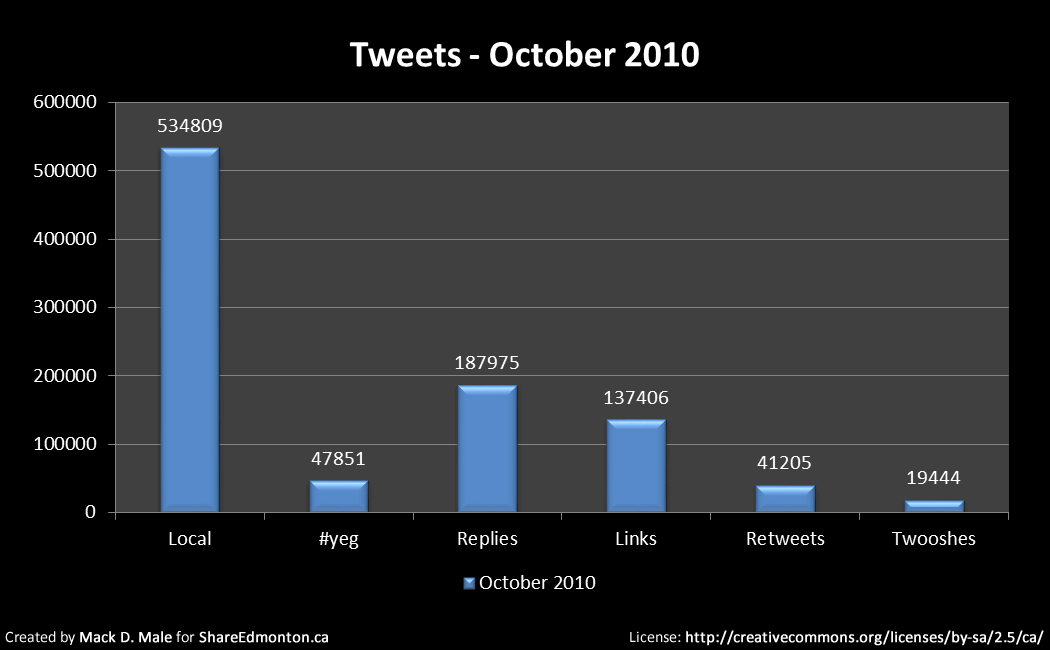
# of tweets by local users: 534809
# of tweets by local users containing #yeg: 47851 (8.9%)
# of tweets by local users that were replies: 187975 (35.1%)
# of tweets by local users containing links: 137406 (25.7%)
# of tweets by local users that were retweets: 41205 (7.7%)
# of tweets by local users that were twooshes: 19444 (3.6%)

Here are the numbers above in graphic form:

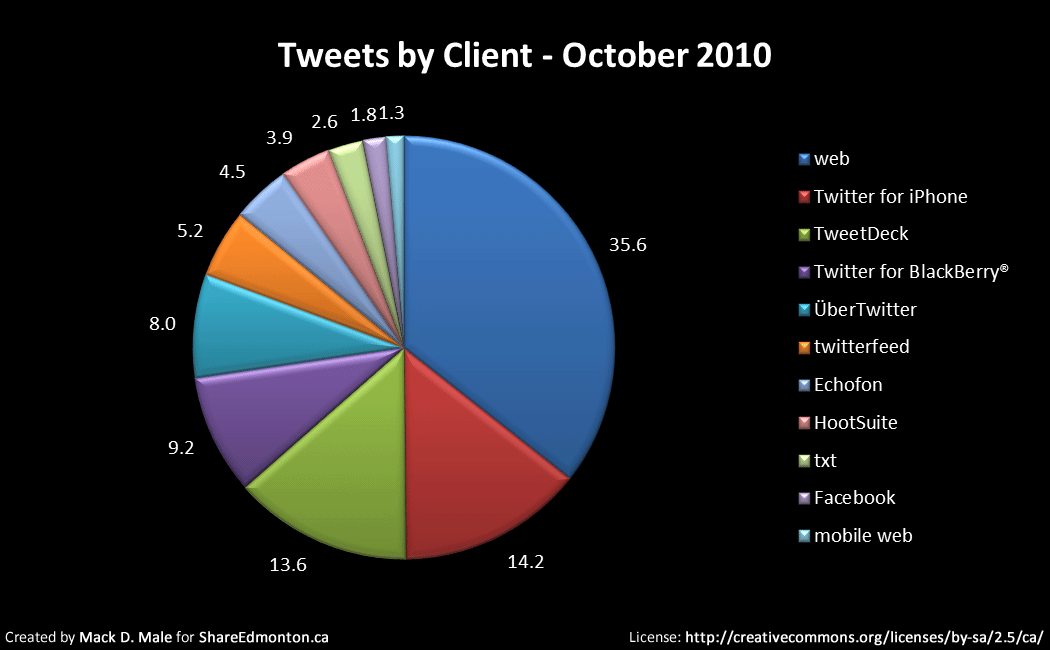
Here are the top clients used by local users for posting updates:

Some other interesting stats for the month:

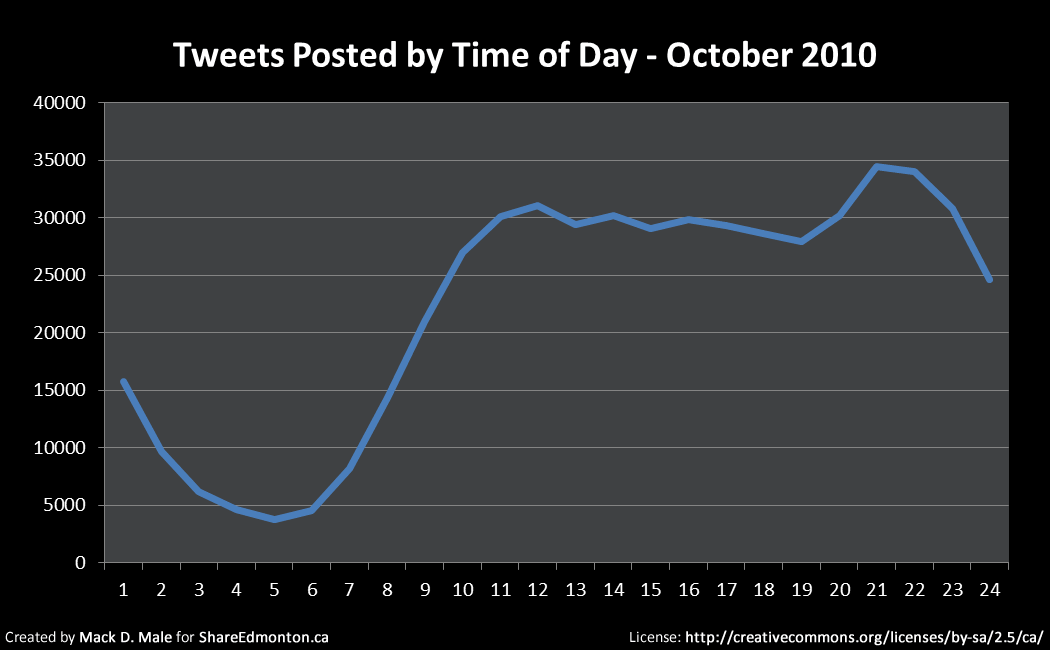
  • Just over 49% of all local tweets were posted between 9 AM and 5 PM.
  • Local users posted roughly 12.0 tweets per minute in October (compared to 11.7 tweets per minute in September).
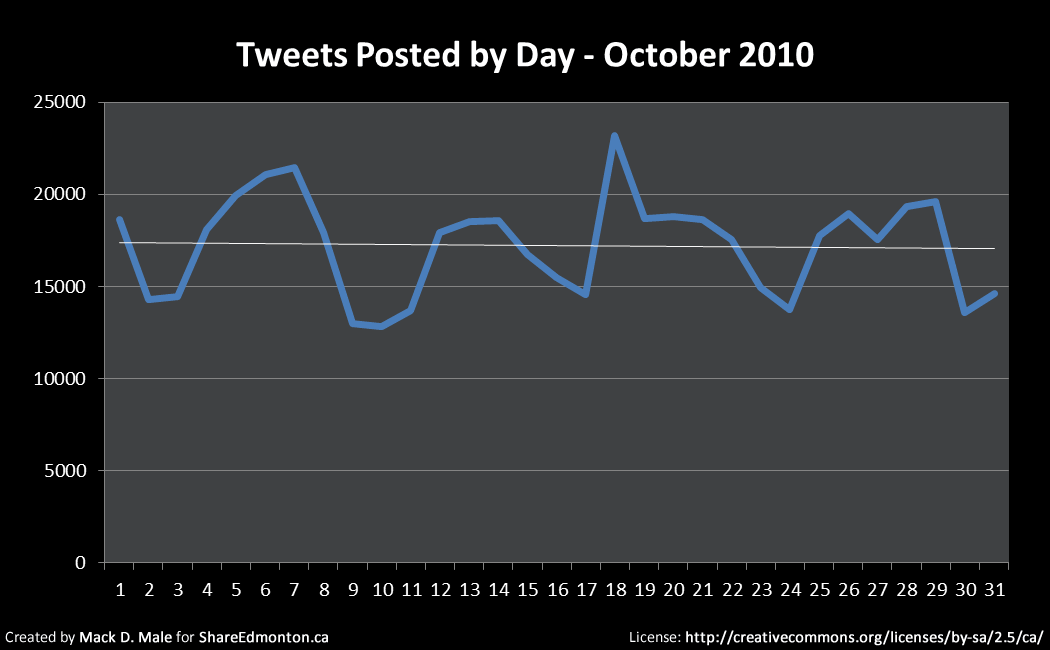
  • The day with the most local tweets posted was October 18 at 23232. On average, 17252 local tweets were posted each day (compared to 16783 in September).
  • Of the 187975 replies posted by local users this month, 74095 or 39.4% were to other local users.
  • A total of 2035 users posted 50 times or more in September. In comparison, 1323 users posted just once.


Here are the top ten most active local users (not including bots):

  1. rootnl2k
  2. PoisonLolita
  3. ZoomJer
  4. counterplot
  5. DWsBITCH
  6. Darmoon87
  7. trinamlee
  8. RyanPMG
  9. KikkiPlanet
  10. brooke_bieber_

Here are the top ten most active local users using #yeg (not including bots):

  1. Edmontonsun
  2. TamaraStecyk
  3. Sirthinks
  4. edmontonjournal
  5. iNews880
  6. ctvedmonton
  7. mastermaq
  8. cbcedmonton
  9. DebraWard
  10. BodyArchitects

Here are the top ten most replied to local users:

  1. PoisonLolita
  2. ZoomJer
  3. RockstarJodie
  4. britl
  5. Wildsau
  6. CommonSenseSoc
  7. JenBanksYEG
  8. TamaraStecyk
  9. KikkiPlanet
  10. Sirthinks

Here are the top ten most retweeted local users (by other local users):

  1. ctvedmonton
  2. mastermaq
  3. edmontonjournal
  4. NHL_Oilers
  5. JasonGregor
  6. CityofEdmonton
  7. dantencer
  8. cbcedmonton
  9. Paulatics
  10. chrislabossiere

Final Thoughts

October was a big month for Twitter here in Edmonton, thanks primarily to the municipal election. More users, more tweets, more tagged tweets, and more retweets. The busiest day of the month was election day (there’s a noticeable spike the in graph). Twitter was used to discuss the forums and other election-related events, to learn about the candidates, and to debate the issues. And on the big night, the candidates themselves used Twitter to capture the moment. You can see my election-related entries here.

Slowly catching up on my stats – I should have the rest of 2010 up soon.

As always, keep in mind that the stats above rely upon users setting the location field of their profile to something like “Edmonton”. Users who leave that field blank or who put something like “Canada” are not reflected in the above stats. More Information.