State of the Edmonton Twittersphere – September 2010

Welcome to the ninth State of the Edmonton Twittersphere for 2010, my look at the intersection of Twitter and Edmonton, AB. You can see the stats for August here.

For information on the data, definitions, and other background, click here.

For September 2010:

# of local users: 9188 (an increase of 700 from August)
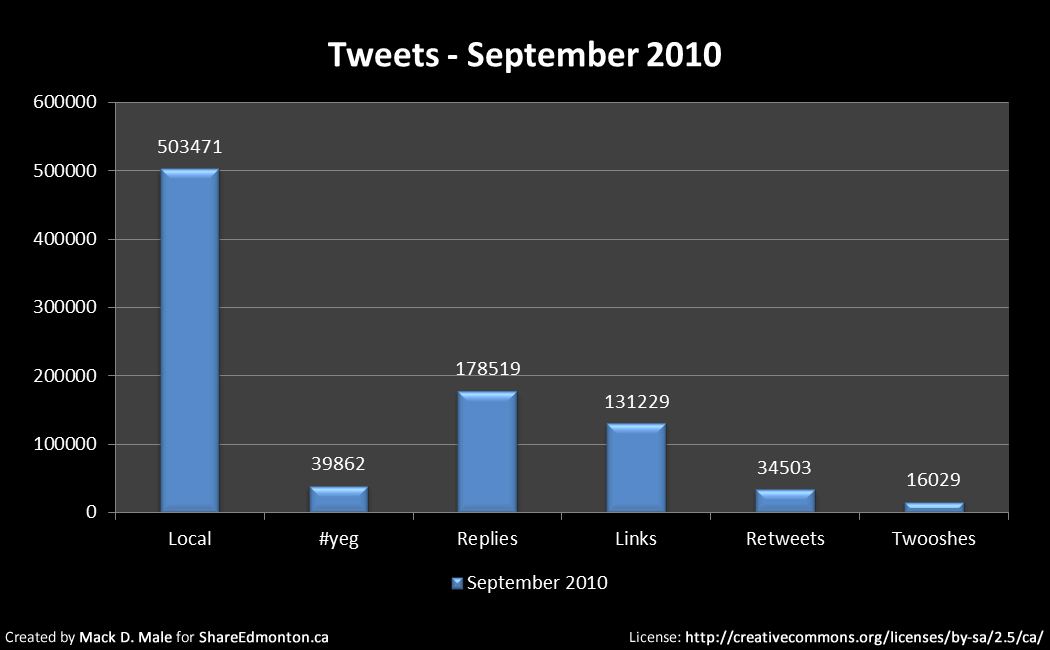
# of tweets by local users: 503471
# of tweets by local users containing #yeg: 39862 (7.9%)
# of tweets by local users that were replies: 178519 (35.5%)
# of tweets by local users containing links: 131229 (26.1%)
# of tweets by local users that were retweets: 34503 (6.9%)
# of tweets by local users that were twooshes: 16028 (3.2%)

Here are the numbers above in graphic form:

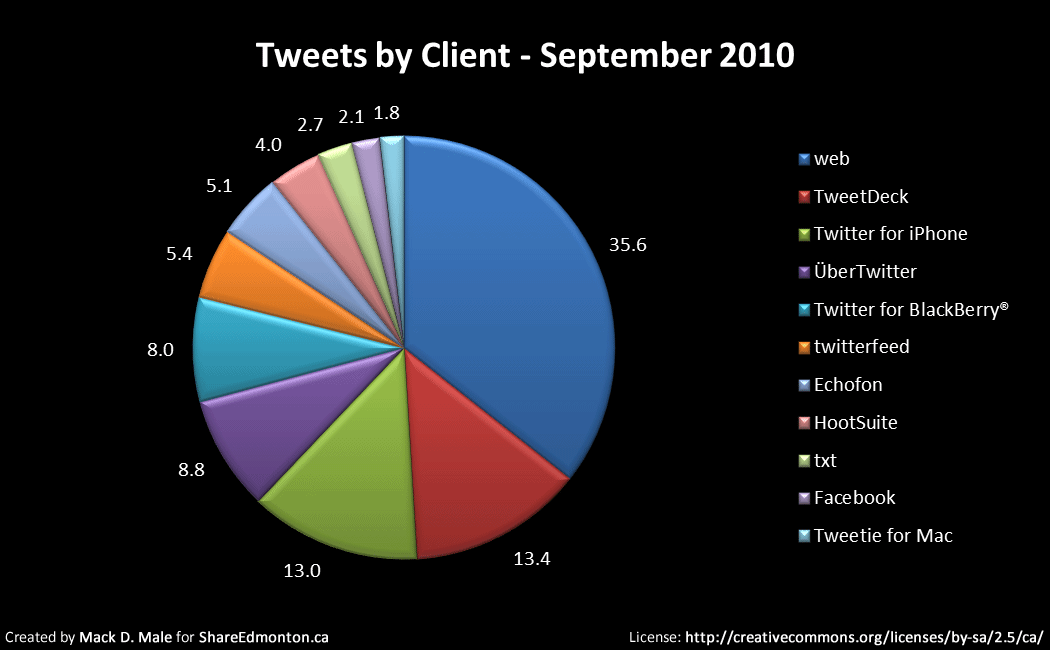
Here are the top clients used by local users for posting updates:

Some other interesting stats for the month:

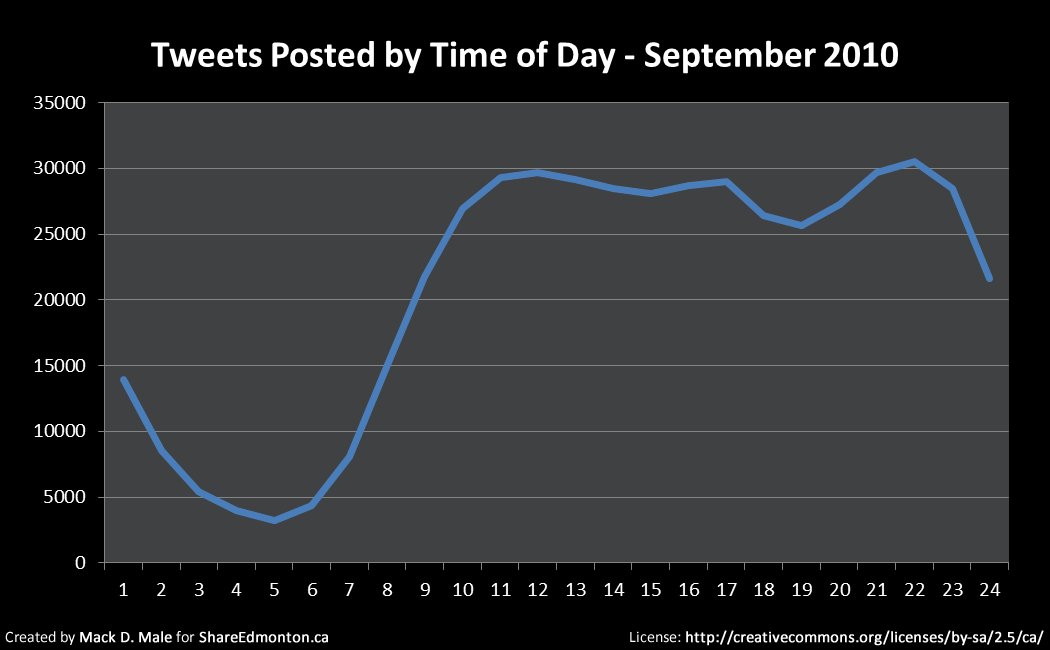
  • Just under 51% of all local tweets were posted between 9 AM and 5 PM.
  • Local users posted roughly 11.7 tweets per minute in September (compared to 10.8 tweets per minute in August).
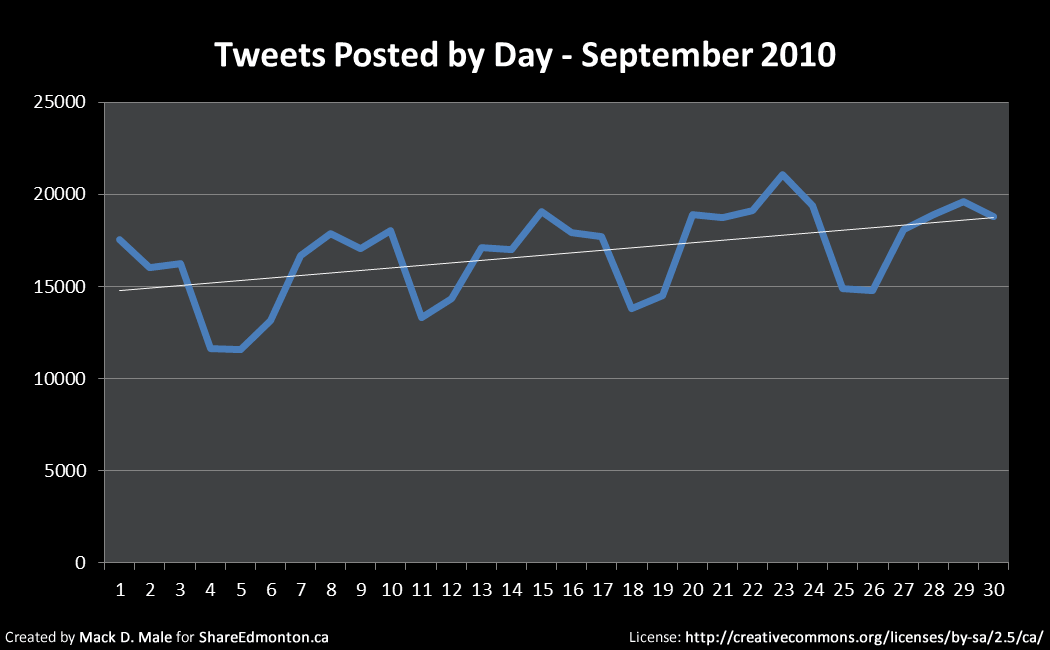
  • The day with the most local tweets posted was September 23 at 21096. On average, 16783 local tweets were posted each day (compared to 15536 in August).
  • Of the 178519 replies posted by local users this month, 69081 or 38.7% were to other local users.
  • A total of 1904 users posted 50 times or more in September. In comparison, 1233 users posted just once.


Here are the top ten most active local users (not including bots):

  1. rootnl2k
  2. Lekordable
  3. DWsBITCH
  4. DJPh03NiX
  5. SaySandra
  6. confessionality
  7. TRENCHBABE
  8. ZoomJer
  9. CommonSenseSoc
  10. Tucktovich

Here are the top ten most active local users using #yeg (not including bots):

  1. Edmontonsun
  2. edmontonjournal
  3. Sirthinks
  4. iNews880
  5. ctvedmonton
  6. cbcedmonton
  7. DebraWard
  8. mastermaq
  9. BodyArchitects
  10. edmfilmfest

Here are the top ten most replied to local users:

  1. PoisonLolita
  2. ZoomJer
  3. confessionality
  4. SaySandra
  5. Wildsau
  6. CommonSenseSoc
  7. britl
  8. RockstarJodie
  9. KikkiPlanet
  10. Sirthinks

Here are the top ten most retweeted local users (by other local users):

  1. edmontonjournal
  2. mastermaq
  3. TrafficEdmonton
  4. CityofEdmonton
  5. ctvedmonton
  6. dantencer
  7. NHL_Oilers
  8. bingofuel
  9. Paulatics
  10. iNews880

Final Thoughts

I’m not sure why there was a bit of a jump in users and in the number of tweets posted in September, except perhaps that people go from “summer” mode to “get down to business” mode. Interest in the upcoming election made have played a role as well.

As with the previous month, the number of retweets includes both new and old style, both with and without extra comments.

Slowly catching up on my stats – I should have the rest of 2010 up soon.

As always, keep in mind that the stats above rely upon users setting the location field of their profile to something like “Edmonton”. Users who leave that field blank or who put something like “Canada” are not reflected in the above stats. More Information.

DemoCamp Edmonton 13

Sick of hibernating inside because of all the snow and cold weather? Join us on Wednesday evening for Edmonton’s next DemoCamp – lucky number 13! If you’ve never been to DemoCamp before, it’s time to stop missing out. There is no better opportunity to connect with Edmonton’s technology and startup community. Here are the details:

Date: Wednesday, January 19, 2011
Time: 6:30pm (and drinks/networking afterward)
Location: Telus Centre 150, University of Alberta (map)
Cost: Freesign up
See the event on ShareEdmonton or on Facebook.

The rules for DemoCamp are simple: ten minutes to demo real, working software, followed by a few minutes for questions. No slides allowed. You can read my recap of our last DemoCamp here (the archive of recaps is here).

If you can’t make it on Wednesday, follow along online using the #democampyeg hashtag. Stay tuned to Startup Edmonton for more technology and startup events.

See you Wednesday evening!

Edmonton Notes for 1/16/2011

Check out Edmonton notes throughout the week at Edmonton Etcetera!

Here are my weekly Edmonton notes:

Edmonton skyline!
Edmonton Skyline by Edith Hoffman

IMG_2105
Check out more photos from Ice on Whyte here.

Edmontonians rank public transportation as the City’s top priority

If it were up to me, that would be the headline on the front of every newspaper and at the top of every news broadcast in Edmonton today. The result was buried in the middle of a report that goes to Council on Monday on the proposed downtown arena, but that makes it no less significant in my mind.

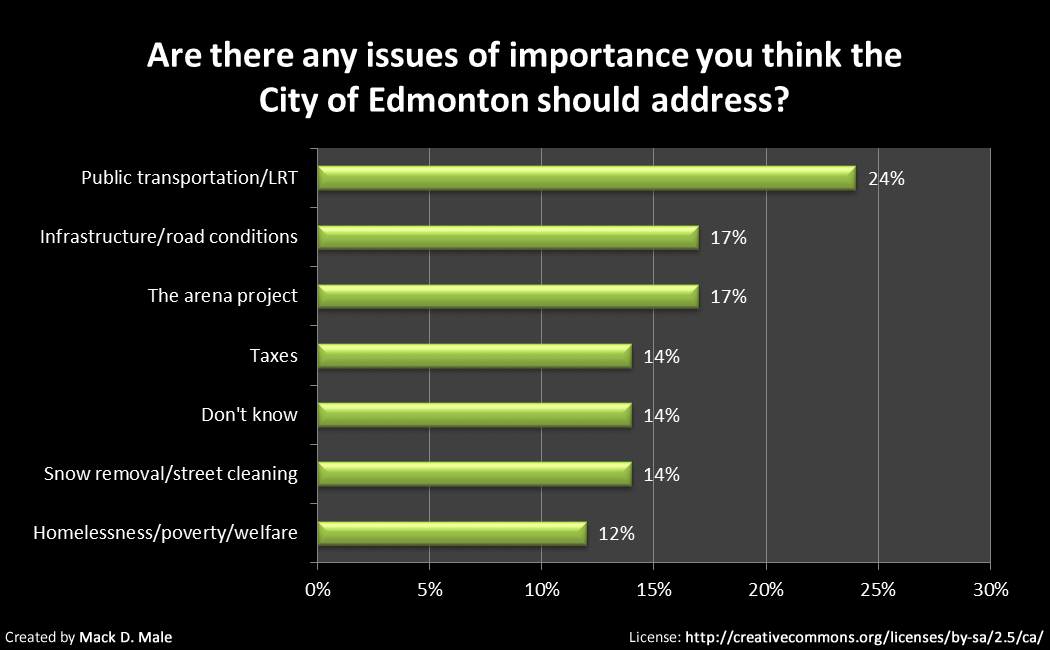
Edmontonians who participated in a statistically valid phone survey from December 20 to December 23 were asked what the key issues are that the City of Edmonton should address. Public transportation, and specifically LRT, came out on top.

The City is addressing this, of course, with an expansive plan to extend the LRT to all corners of the City. Shifting Edmonton’s Transportation Modes is also one of the goals in the City’s 10-year strategic plan, and public transportation is the key to achieving that. But we have to keep pushing. As the City’s Chief Economist John Rose said:

“[LRT is] the urban equivalent of an enabling technology – if you have it, you can do a lot of great things.”

Public transportation is costly – both to build and to operate. No question about that. But it’s worth it, and more importantly, Edmonton’s future success depends on it.

It’s important to remind ourselves, not to mention City Council, that improved public transportation is what Edmonton needs above all else.

Economics and more with John Rose, the City of Edmonton’s Chief Economist

John Rose moved to Edmonton last May to become the City of Edmonton’s Chief Economist. It’s an important role at the City, though it is one that most people know very little about. I sat down with John last week to chat about his new job and to get his thoughts on Edmonton.

John loved geography when he was younger, and wanted to work in a field where he could apply that passion. He settled on urban planning, but while studying at the University of Toronto, switched to economics. He has been in the field ever since, working for the federal Foreign Affairs department in the 1980s in West Germany and South Korea before returning to Toronto to tackle the consulting business. He most recently worked for PricewaterhouseCoopers.

The move to Edmonton was a unique opportunity for John to combine his interests in urban planning and economics. “I’m interested in what drives the economics of municipalities forward.” He brings an outsider’s perspective to the City of Edmonton, something that initially made him wary. “I thought people would just say ‘here’s another Easterner showing up, telling us what to do’, but people have been very welcoming.”

As the City’s Chief Economist, John is responsible for publishing the reports that the City relies on for budget planning and strategy, among other things. Twice a year he publishes a long-range forecast, using a statistical model of Edmonton’s economy that looks both 3 and 10 years into the future. On a quarterly basis, he publishes City Trends, which provides current information on social, economic, demographic, land development, and transportation trends (here’s the PDF for Q3 2010, the latest to be posted to the website).

The City of Edmonton uses economic models developed by The Centre for Spatial Economics (C4SE). Somewhat surprisingly, Calgary and the Province of Alberta also use models from C4SE. The models can be complex, but John said recent technology improvements are making a difference. “In the 80s, you needed a mainframe to drive even the most simplistic models,” he told me. “Now the tech required is ubiquitous.” While acknowledging that economics is abstract – “you can’t touch the economy” – John said technology is increasingly getting rid of the mystique and mystery.

If you look at the Economic & Demographic section of the City’s website, you’ll find that most of the information is out-of-date. John explained that the transition from his predecessor is the cause, but he said to expect changes. “There’s a lot of value in the information and we want to get it out there, we want it in the public realm.” John noted there currently isn’t a way to notify people when new information is posted, but said an internal effort currently underway should change that. Getting everyone on the same page is a major push for his office this year.

John would also like to see a shift toward more regional forecasting. He works with a variety of organizations outside the City of course, including EEDC, the Chamber of Commerce, and the Finance department at the Province, but sees room for improvement. “We already do regional forecasting to a degree, because we do the CMA and extract a forecast for the City from that.” John noted that most statistics are available at the Census Metropolitan Area (CMA) level, and so it makes sense to look regionally when setting up models. “With a larger economic entity, the trends smooth out a little.” John suggested the Capital Region Board might be the logical place to host a regional forecasting effort.

Speaking of the capital region, John said that while 2011 will be a strong year for Edmonton, “most of the growth will take place outside the City of Edmonton proper.” This is partly because the City itself didn’t suffer as large a setback as a result of the recent downturn. “The manufacturing sector took a big hit in Alberta and Edmonton,” a sector largely concentrated outside the city, such as in the northeast. In a recent interview with the Edmonton Journal, John said we should see an annual growth rate of nearly 4% here in Edmonton.

He was also bullish on the province. “Alberta will be ahead of the national economy as a whole in 2011,” John told me. Again, this is due in part to the way the economic slump affected the province. “The impression is that Canada came through it very well, but the truth is the province didn’t.” In 2011, John expects Alberta to post the first or second best provincial growth rate in the country, depending on how Saskatchewan does.

Turning to individual sectors in the City, John told me that construction will show growth, but mostly due to commercial projects. The residential construction sector will be somewhat sluggish because “there’s just not a big demand for a lot of new housing.” FIRE will do well, but John cautions that increased regulation will have an impact. The retail sector will also grow more slowly this year, because people are reluctant to take on more debt and as as a result savings rates are going up. “The consumer-oriented durable component in particular” will grow slowly according to John, because as people buy fewer houses, the need for new vehicles, furniture, appliances, etc. also diminishes.

John talks about trends and forecasts all the time – he has made it part of his job to do interviews, meet people, and spread the word on Edmonton’s economy. He can rattle the numbers off with ease, and is obviously very knowledgeable. As our discussion shifted toward the city more generally, John became more thoughtful. We talked about the common refrain that Edmonton’s head office situation is dismal at best, and John pointed out that the larger question is how to “attract and retain investment, and talent.” He said we should do “exit interviews” with organizations that leave the City, to try to highlight any cross-cutting themes.

I asked John about the push to revitalize downtown, and in particular, about the City Centre Airport and the proposed arena. He called the ECCA redevelopment a “good move” by the City, because making such a large piece of land adjacent to the core largely residential will have a positive impact on our downtown. “The key to developing a vibrant downtown, is to have people living, working, being entertained, doing all those things, in the core.” He doesn’t think a blanket policy on financial incentives (such as the Railtown subsidy) to attract more residents to downtown makes sense, however. “If there’s an area that we want developed in a particular way, then the City could be come active, but otherwise there’s enough opportunity already.” John didn’t take a side on the arena, but said “it depends on how the development takes place” and said his main concern is that “we don’t want to be in a situation of two competing facilities.” He cited the Air Canada Centre in Toronto and the positive changes and increased activity it brought to the area south of Front Street. “It is very nicely integrated into the city.”

I asked John what he missed about Toronto, and he quickly replied “jazz clubs.” He said while the Yardbird Suite is great, there was more variety with regard to venues back in Toronto. John joked that by moving away from Toronto when he did, he avoided the current political drama that is taking place with new mayor Rob Ford. That led us into a discussion about transit, and LRT in particular, something John considers “the urban equivalent of an enabling technology – if you have it, you can do a lot of great things.” Projects such as the LRT expansion “are a big benefit to the local economy” in the short-term and are “vital for the City’s future,” John told me. The real value to the economy is what the LRT enables, rather than the jobs it directly creates. “If you don’t have mass transit downtown, you’re going to have a hard time developing nightlife, for instance.”

I really enjoyed talking with John (and not just because when I asked him if he was now an Oilers fan he replied, “that implies I was a Maple Leafs fan before!”). Stay tuned to his section of the City’s website for future economic updates.

Yes! For Edmonton Position Statement on the Proposed Downtown Edmonton Arena

Yes! For Edmonton sent the following position statement on the proposed arena to the media this afternoon:

I have been privy to some of the discussions about this, and was opposed to the statement being released because it kind of suggests that everyone who signed up to support the group on the airport issue automatically supports this one too. I don’t believe that is the case.

There are people in the organization who wanted to make a statement on the arena, and that’s fine. The more people who share their thoughts and opinions, the better. But I don’t think it is clear who Yes! For Edmonton speaks for, and that causes me some concern as the group approaches future issues.

It’s not clear whether this position statement will be posted on the Yes! For Edmonton website or what other updates will be made.

Shifting the Alberta Advantage

The main thing we talked about yesterday at the ONEdmonton forum was economic development. In addition to breakouts and other discussion, we had two informative presentations that I hope to blog about over the next while. In her presentation on Diversifying Edmonton’s Economy, Tammy Fallowfield, EEDC’s Executive Director of Economic Development, touched on shifting the “Alberta Advantage”. Here’s what her slide said:

  • Remain relatively low tax
  • Not a low cost environment
  • Not a surplus of labour
  • Not a currency ‘bargain’

I think the phrase “Alberta Advantage” means different things to different people, but traditionally our low taxes, low cost of doing business, surplus of labour, and being attractive to investment, have all been considered important aspects. Here are a few notes on each.

Alberta’s low taxes remain a strength. From the Alberta Competitiveness Council’s 2010 report (PDF, 14 MB):

[Taxes and fiscal policy] represents the area of best performance for Alberta, with moderately low tax burdens for both corporations and individuals and a strong government financial position.

Of all the measures that report looks at, Alberta performs the best (unsurprisingly) in taxes and fiscal policy.

What about being a low-cost environment? From the same report:

Within Canada, business costs in Alberta (Edmonton) are lower than Ontario (Toronto), but higher than in each of the other provinces compared. This result is due to Alberta’s strong economy of recent years, which led to a much higher increase in business costs – especially labour, electricity, and facility costs – than seen in other provinces.

I haven’t yet found a good comparison of business costs with regions elsewhere in the world, so let me know if you come across something. I suspect the picture is not as rosy as it once was.

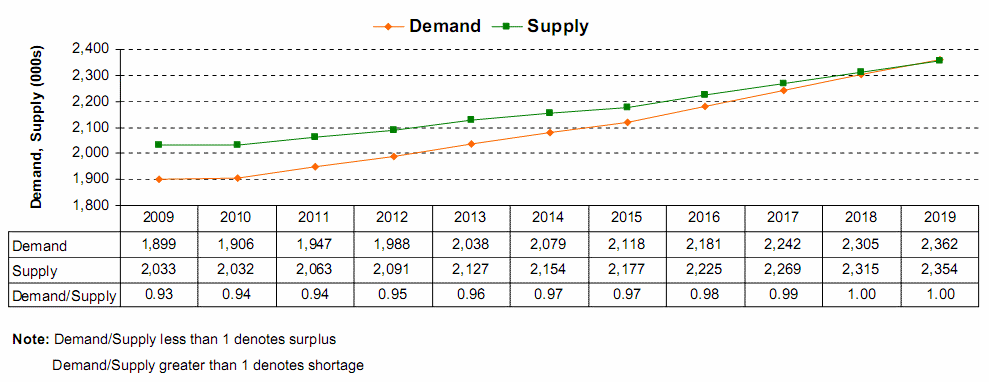
How about our labour force? All across Canada the population is aging, and that (along with our very low fertility rate) is going to lead to labour shortages. Here’s a graph from Alberta’s Occupational Demand & Supply Outlook, 2009-2019 (PDF), that shows this trend for our province:

There are many consequences as a result of this trend, not the least of which is Alberta’s challenge to attract and retain labour. Our taxes will likely also be impacted – an older population means higher costs for health care, and a slow growing labour force means a slow growing tax base.

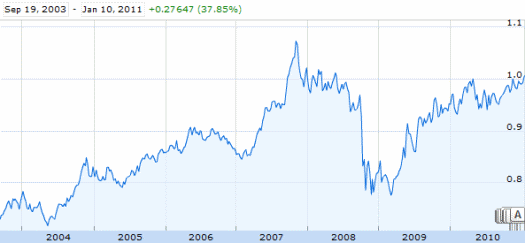
Let’s look at the Canadian dollar (compared to the US dollar).

The strength of the Canadian dollar has an impact on foreign investment, among other things. As you can see, the dollar has been quite strong in recent years (aside from the dip in late 2008/early 2009), which may not be a good thing for Alberta.

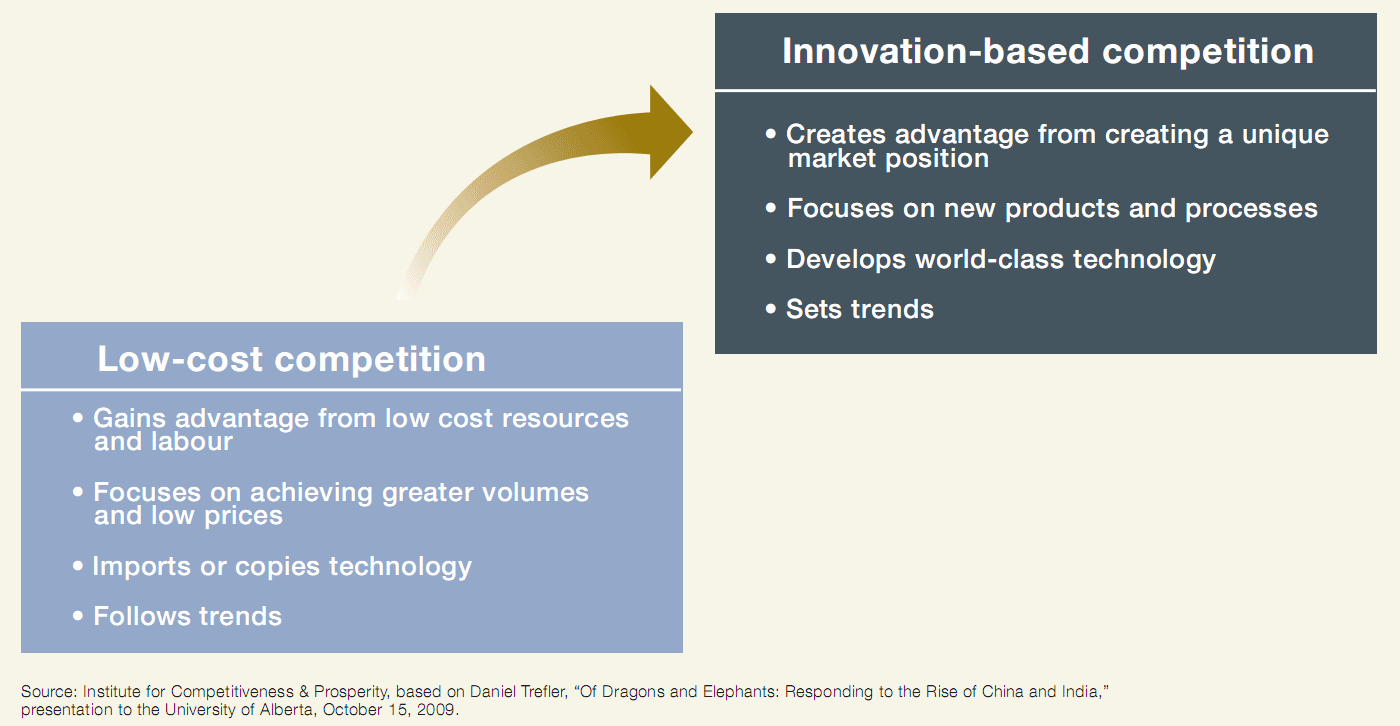
So if being low-cost, having a surplus of labour, and being a relative currency ‘bargain’ are no longer part of the Alberta Advantage, what does that mean?

This diagram comes from the Institute for Competitiveness & Prosperity, based on a presentation that Professor Daniel Trefler of the University of Toronto gave here in Alberta on October 15, 2009. The diagram was originally used to illustrate the shift that China and India have yet to make.

On the same slide that listed the four points above, Tammy included this diagram. That’s the shift we need to make here in Alberta – from being a strong low-cost competitor, to being a strong innovation-based competitor.

How are we going to do that? By making strategic choices. Here’s (more or less) what Tammy showed next:

Tammy went on to talk about the industries that are important for us to focus on here in Edmonton, and a similar exercise would apply for Alberta. I’m not sure if what I have written above is exactly what she was trying to get across, but that’s how I interpreted it.

What do you think about shifting the Alberta Advantage?

ONEdmonton Downtown Vibrancy Task Force letter to City Council regarding the Proposed Downtown Edmonton Arena and Entertainment District

ONEdmonton is a group of local leaders that have come together a few times over the last year to discuss how we can make Edmonton one of the world’s top 5 mid-size cities. The first subcommittee, called the Downtown Vibrancy Task Force, was launched in November after the larger group identified that our urban core is the top priority. I have been fortunate enough to be part of both groups.

Today, our task force sent a letter to City Council regarding the proposed Downtown Arena and Entertainment District:

The task force is a group of majority, not consensus. At the last meeting, the majority of the task force members voted the arena project as the top near-term priority in Edmonton’s downtown.

The task force members include: Chairperson Randy Ferguson (Procura), Bob Black (Katz Group), Dr. Paul Byrne (MacEwan), Carolyn Campbell (University of Alberta), Michael Janz (Public School Trustee, EFCL), Terry Kilburn (Avison Young), Bernie Kollman (IBM Canada), David Majeski (RBC), Mack Male, Doug McConnell (Dialog), Scott McKeen, Honourable Anne McLellan (Bennett Jones), Carol Neuman (Edmonton Next Gen), Simon O’Byrne (Stantec), Ian O’Donnell (Downtown Edmonton Community League) Keith Shillington (Stantec), Paul Verhesen (Clark Builders), Sheila Weatherill (EPCOR), Richard Wong (Sutton Place Hotel), and Ralph Young (Melcor). Representatives from EEDC facilitate the task force.

I don’t think anyone on the task force considers the arena project a done deal, nor do they think the issue is a simple one, and this is reflected in the letter. My read of what the task force is saying here is this: there’s potential with the arena project to positively impact our urban core, so let’s keep things moving and figure out how to make that happen.

UPDATE: I originally left out Ian O’Donnell and Sheila Weatherill, because they joined us after the first meeting. My mistake. EEDC has posted the list here.

Looking back on 35 years at the City of Edmonton with Joyce Tustian

In November, Joyce Tustian celebrated her 35th year as a City of Edmonton employee. She currently holds the position of Deputy City Manager (archive), an office that was created around her in April 2008. Last month, it was announced that Joyce would be retiring at the end of January, with most of the DCMO’s responsibilities folding back into the City Manager’s office. I sat down with Joyce just before Christmas to reflect on her time at the City of Edmonton.

When Joyce started at the City of Edmonton, she planned to work for just two years. “I had a big misconception about what the City would be like.” Like most people, she figured it would be dry and very rule-bound, but actually found that the City offered tons of opportunity. “You can do many things with the same employer,” she told me. I wonder if anyone at the City has done as many things as Joyce has! When I asked her what areas of the City she had worked in, she replied “everything but transportation and buildings.” Joyce told me she has always been interested in transit, though she has never really worked with the department. She noted that transit really impacts families and is “so integral to the kind of city you want to build.”

Joyce Tustian

Joyce started her career at the City of Edmonton in 1975, working as a public information officer in the Parks & Recreation department. On her first day, thousands of Edmontonians were streaming through City Hall to pay their respects to former Mayor William Hawrelak, who had recently died of a heart attack. Over the years she worked her way into management, and in May 1995, Joyce took over as the general manager of Community & Family Services. Just a couple of years later, it was decided that Joyce would take over as general manager of the newly formed Community Services department (her main rival for the position was another longtime City employee, Maria David-Evans, who left after the restructuring). During her time in that role, Joyce was also responsible for the Emergency Response department. After a nationwide search in 2003 to find a new general manager for Corporate Services, Joyce was selected. While in that role, Joyce led the department through the “Shared Services Business Model” review. She held the position for five years, until the Deputy City Manager’s Office was formed in 2008 (two other roles were created at the same time – Chief Financial Officer, and General Manager of Capital Construction).

Joyce has had the opportunity to lead some really interesting projects at the City of Edmonton. In 1999, when she was acting general manager of the Emergency Response department, Joyce was tasked with making sure the City survived Y2K. It was her responsibility to outline the City’s plans in case things went south. “We believe that we are ready,” she assured everyone.

Another project she spearheaded was Racism Free Edmonton. As Deputy City Manager, Joyce is responsible for the implementation of the City’s Diversity and Inclusion Policy. “I take great pride in championing the Racism Free Edmonton initiative,” she declares on the website.

Perhaps the project Joyce is best known for was the merger of Community & Family Services and Parks & Recreation to create the Community Services department in 1997. It was part of then-city manager Bruce Thom’s reorganization plan that trimmed the number of City departments from thirteen to eight. When she was interviewed about leading the new department, Joyce told the Edmonton Journal, “my bottom line is I want to make it easier for citizens to access city services without having to know the city as well as I do.” Looking back on the merger, Joyce told me it was “a really rare opportunity,” to get to set things up the way you want to. She considers it a big success, noting that many other cities have since followed Edmonton’s model.

More recently, Joyce led the web renewal and was the project sponsor for the 311 initiative. Both projects “were about transparency and ease of accessibility.” When I mentioned some of the criticism that 311 has received, Joyce acknowledged that “more needs to move to 311 and then to the web” but is confident the initiative is “past the struggles.” For Joyce, 311 is the first major citizen-facing outcome of the investment the City has made in automation (ERP systems, etc).

The behind-the-scenes automation is just one part of a larger journey the City has embarked on. Joyce described it as “moving from an organizational structure that works well for us to one that works well for citizens.” The ability to have standardization, and to break down hierarchies, will help the City make it easier for citizens to access services and information. We touched on open data, and noting that automation should help make it possible, Joyce said there’s “very little that we do that shouldn’t be accessible to the public.”

Another big, related change has been the shift away from independent units and into one organization (something that increased automation has helped make possible). Joyce said Edmonton has been considered a “municipal leader in shared services.” Though the shift had already started, a major reorganization in 1987 “really paved the way.” Subsequent reorganizations have pushed the City further toward the “one organization” vision, though Joyce made it clear that the City is “still very much on the path”.

Perhaps the biggest change has been the focus on strategy (a word that many City of Edmonton employees have come to associate with Joyce). As soon as we started talking about strategy, Joyce said “if you don’t know where you’re going, any road will get you there.” I suspect she’s fond of that statement. Joyce told me her recent work on the City’s strategic vision has been one of the most rewarding things she has done. “We have always been good operationally, but now we spend lots of time and energy on strategy.” She talked about the City’s six “Way Ahead” plans, and praised the most recent City Council for having “a willingness to commit.” Joyce also said Mayor Mandel deserves credit for aligning everyone around what kind of City we want to be.

Joyce deserves a lot of credit too. One of the biggest challenges Joyce faced was during her time with the Emergency Response department. She was only supposed to work with the department for a short time, but was “never afraid to work on the fundamental issues.” And so she did. The department was losing a lot of people to retirement, and was having difficulty recruiting. Joyce recognized that the problems had been predictable, and set about implementing a plan focused on data, intelligence, and strategy. She has been able to make this work throughout her career.

Public involvement is something that the City needs to work on, Joyce told me. She recognizes that there are lots of Edmontonians with great ideas, and agreed that “we need to get better at engaging those people.” Looking at the City Centre Airport and the public hearings that took place, Joyce noted there were at least three conversations taking place, “at the mic, in the room, and outside,” but that the City hasn’t traditionally done a good job of recognizing the latter. There’s lots of room to improve.

I asked Joyce about the people she’s worked with during her time at the City. She thought about it for a minute, and realized that there have been so many people that she’s interacted with over the years. The one who had the biggest impact, however, was Cy Armstrong. “If I had any doubt about something, I’d talk to Cy.” He was city manager in the mid-1980s, actually the first city manager we had after then Mayor Laurence Decore dismantled the council-commission government. According to the book Alberta’s Local Governments: Politics and Democracy, Armstrong was for a time the most highly paid city manager in Canada, earning an annual salary of $120,000. “Much of what I am as a manager was shaped by Cy,” Joyce told me.

Joyce told me it’s an exciting time to be a civil servant (she has enjoyed being part of the iPad pilot project). “You can see the impact you have, you’re doing real work.” She described the City as an organization where you’re very close to decision makers, and obviously one that is “never dull.” Joyce also noted the strong sense of community at the City. For example, Joyce and many other employees have made it a tradition to start the day by singing carols for the five days leading up to Christmas! “Working for the City has been the making of many people – it has certainly been the making of me.”

Joyce will continue in her role until the end of the month, and though she’ll move onto other things, she’s staying here in Edmonton. “I won’t miss budget time,” she told me, but will miss “feeling connected and always having something new” come across her desk (she recalled opening the letter from Telus that said how much they’d pay for Ed Tel).

Joyce has definitely left her mark on the City of Edmonton, and I want to both thank her for her service, and wish her all the best in her future endeavors!

Edmonton Transit (ETS) now offers schedule information via SMS text messaging

Today Edmonton Transit (ETS) officially launched its new text messaging service. You can now send an SMS text message to 31100 from virtually any cell phone to get bus schedule information for free (standard messaging rates may apply). The service is yet another example of the GTFS feed that ETS released in 2009 paying dividends.

The way it works is simple – text the bus stop number you’re interested in to 31100 and you’ll get a response like this (using 1859 as an example):

1859 (111) 01:26P 01:56P (112) 01:06P 01:36P (2) 01:08P 01:23P ETS – THE EVERY DAY WAY

That’s the stop number, followed by each route with two upcoming times for each. If you’re interested in just a particular route, say the 2, simply text the stop number followed by the route number, and you’ll get upcoming times for just that route at that stop:

1859 (2) 01:08P 01:23P 01:38P 02:08P ETS – THE EVERY DAY WAY

ETS has produced two videos that demonstrate how it works (they were filmed just before Christmas). Here’s part 1:

And here’s part 2:

Starting next week you’ll also be able to create a profile on the website to setup favorite routes and stops specific to your daily routine.

The ability to get route & stop schedules via text messaging might be new here in Edmonton, but it’s not a new concept elsewhere. Transit riders in Vancouver have had that functionality for years, first unofficially thanks to a couple of enterprising students, and later as an official service from TransLink. The story is somewhat similar here. Local developers Sean Healy and Joel Jackson hacked together a service called TXT.2.ETS back in March of last year, something they won a prize for in the Apps4Edmonton competition. They subsequently met with ETS representatives and talked about what an official service might look like.

I talked to Nathan Walters, Strategic Marketing Supervisor for ETS, about the new service yesterday. He told me the service is run by Vancouver-based Upside Wireless (presumably their Transit SMS product). Nathan confirmed that it uses the same GTFS data that anyone can download from the City of Edmonton’s open data catalogue. “The GTFS feed made things significantly easier, and brought the service to market a lot faster,” Nathan told me. He also said it “speaks to how much we stand behind that information.”

Though it is a pilot, don’t expect the service to shut down any time soon. Instead, ETS plans to monitor usage, gather feedback, and will be conducting market research later this year, and will re-evaluate and improve the service as necessary. In fact, if all goes well, the service will pay for itself and perhaps even drive an additional return to the City via the advertising service that will launch in the spring. The last 40 characters of the messages sent back to commuters will be allocated toward advertising (the “ETS – THE EVERY DAY WAY” part in the example above). I think that’s a smart move.

It turns out the service has actually been live for about a month, in testing by Upside and City of Edmonton employees. Apparently there has been quite a bit of buzz internally at the City about it. Today was not the planned launch date, but the accidental release of parts of the outdoor marketing campaign pushed things up. Nathan confirmed that we’ll see lots of advertising for the new service, including billboards, benches, and transit shelters. He sounded pleasantly surprised that they had been able to keep the service under wraps for so long (no doubt the holidays helped in that regard).

I had to ask Nathan the question he’s undoubtedly going to be asked over and over now that the text messaging service is live: scheduled information is great, but when are we going to get live information, perhaps via GPS? His answer: “The technologies that transit uses are always evolving, and the service will evolve as well.” In other words, nothing to announce, and don’t hold your breath.

I also asked about the shortcode, 31100. Nathan said they briefly considered a repeating number (such as TransLink’s 33333) or something like “txtets” but realized that using letters would be problematic considering most modern smartphones do not have traditional numeric keypads. They settled on 31100 because it offered great potential for the future. Just like 311, other departments at the City could make use of the shortcode for their services as well. Nathan confirmed that at least one business unit outside of transportation has already expressed interest in exploring that possibility.

This new service is exciting and will have a positive impact on the daily commute for thousands of Edmontonians. But it’s more than that. ETS made a decision to open up its data to anyone for free, and they continue to see a return on that very minimal investment. Releasing the GTFS data feed has resulted in Google Maps support, apps for the iPhone, and now text messaging. Importantly, all ETS had to do for all of this to happen was focus on its core competency – providing transit service. It’s a success story that other business units at the City of Edmonton should be very eager to replicate.

Having said that, I would have preferred to see a solution from a local company or even the adoption of Sean & Joel’s project, but I realize there are other considerations. As the Apps4Edmonton competition evolves, I hope we’ll see the City adopting more of the solutions that Edmonton’s talented entrepreneurs create.

The new text messaging service is a great way to start 2011. In fact, Nathan said it “sets the tone for the year” and indicated that ETS was going to be looking at additional opportunities to work with the community on other services as 2011 unfolds. I can’t wait!

You can learn more about the service here, and you can find additional Apps for ETS here. Check out the Open Data catalogue for ETS data and more, and follow the #yegtransit hashtag on Twitter for ETS-related updates.

UPDATE: Does the new text messaging service work for the LRT? The answer is yes! If you know the stop numbers, that is. The route for the LRT is always 201, but here are the stop numbers you need.

Station Name North Stop # South Stop #
Clareview 7797 7797
Belvedere 7692 7830
Coliseum 1889 1742
Stadium 1981 1723
Churchill 1691 1876
Central 1863 1935
Bay/Enterprise Square 1985 1774
Corona 1926 1891
Grandin/Government Centre 1754 1925
University 2969 2316
Health Sciences/Jubilee 2014 2019
McKernan/Belgravia 9982 9981
South Campus 2116 2115
Southgate 2114 2113
Century Park 4982 4982


Hopefully they can make it more user friendly in the future.