Media Monday Edmonton: Update #70

Here is my latest update on local media stuff:

//platform.twitter.com/widgets.js

You can follow Edmonton media news on Twitter using the hashtag #yegmedia. For a great overview of the global media landscape, check out Mediagazer.

So, what have I missed? What’s new and interesting in the world of Edmonton media? Let me know!

You can see past Media Monday Edmonton entries here.

Edmonton Notes for 3/17/2013

Happy St. Patrick’s day!

In case you haven’t heard – the seasonal parking ban that went into effect on Friday was lifted at 7pm this evening. Here are my weekly Edmonton notes:

Here are some upcoming events:

#CAPSE March to the Legislature
Photo of the #CAPSE March on Friday, in protest of post-secondary education funding cuts. Check out Dan McKechnie’s photoset here.

P3, or not P3? That’s the question as we try to fund Edmonton’s future LRT

In October of last year, Council approved the use of a public-private partnership (P3) to fund the Southeast to West LRT project. The decision came just days after the new LRT Governance Board was established, but it was largely overshadowed by the downtown arena news that week. Today Mayor Mandel announced, along with Minister of Finance Ted Menzies and Minister of Public Works and Government Services Rona Ambrose, that PPP Canada will invest up to $250 million to support the construction of the new LRT extension. While the funding is welcome, it is $150 million less than the City was hoping to receive from the federal government (the rest may come from a future Federal Infrastructure Plan).

“The City of Edmonton welcomes this important funding announcement by the federal government,” said Mayor Stephen Mandel. “The Southeast to West LRT is a key part of our transportation infrastructure. It will connect communities in Mill Woods and southeast Edmonton to the central core and is essential to our plans for building a better, more accessible city.”

The decision to apply for funding through PPP Canada was not an easy one, but Council did not have much of a choice. The City simply cannot afford to build the LRT on its own – the provincial and federal governments must come to the table. Though it hasn’t been explicitly stated as such by those involved, it seems the only way the Government of Canada would provide funding was through the P3 Canada fund. Calgary Mayor Naheed Nenshi has been vocal about his concern around being cornered into a P3, saying “the real problem is that the only dedicated federal funding at this moment is through P3 Canada.”

Let’s set aside for a moment the very big issue that the federal government is essentially dictating how municipalities should build and maintain their infrastructure. If given a choice, would we pick a P3 to build our LRT network?

What is a P3?

A public-private partnership is basically an approach to delivering and optionally operating and/or maintaining a project. Here’s how PPP Canada defines a P3:

“P3s are a long-term performance-based approach for procuring public infrastructure where the private sector assumes a major share of the responsibility in terms of risk and financing for the delivery and the performance of the infrastructure, from design and structural planning, to long-term maintenance.”

In theory, a P3 can help to ensure projects are delivered on-time and on-budget. The idea is that having the expertise of the private sector can lead to better, more innovative solutions. Another benefit of a P3 is that the private sector takes on a share of the risk, which means that there is a profit motive to ensure the project is done well (at least in theory). This is often referred to as “pay for performance”.

The other thing that is important to know about the P3 approach is that there are a variety of different delivery models. With traditional procurement, the public sector is responsible for the design of an asset like a bridge or school, with construction being contracted out to the private sector through a competitive bidding process. After construction, the asset is handed back to the public sector for operation and maintenance. This model is known as Design-Build (DB).

Using a P3 for the procurement of new assets, there are three delivery models to consider:

  • Design-Build-Finance (DBF)
  • Design-Build-Finance-Maintain (DBFM)
  • Design-Build-Finance-Operate-Maintain (DBFOM)

The level of private sector involvement goes up which each model. Under the DBF model, the private partner assumes the risk of financing the project until construction is complete and the asset is handed over to the public sector. With the DBFM model, the private sector also assumes the maintenance of the asset in exchange for payments throughout the operating period. And finally, the DBFOM model is used for projects that have long-term operation and maintenance handled by the private sector, such as roads.

The P3 model is relatively new (becoming popular in the 1980s) but is already used all around the world on a variety of different projects. PPP Canada was established in 2009 to oversee the $1.2 billion P3 Canada Fund, but that was certainly not the start of P3s here in Canada. From 1990 to 2001 more than 150 P3s were concluded throughout the country.

Can a P3 really work?

Here in Alberta, we’ve used P3s to build ring roads and schools in both Edmonton and Calgary, as well as a water treatment and wastewater treatment facility in Kananaskis (a project that EPCOR is the private partner on). It hasn’t been all smooth sailing however, as Godfrey Budd explains:

Although 18 Alberta elementary and elementary-junior high schools, built on the P3 model, opened in September, and another 10 such schools are going ahead as a P3, four high schools were dropped from what was to have been a 14-school package. In May 2009, the province, citing "the economic climate," announced that the four schools would instead go ahead on a design-build basis. Also, six months after a September 2008 provincial news release announcing the go-ahead for the 18-school package, one of the partners in the P3, Babcock and Brown, the project’s banker, collapsed under the weight of $3.8 billion of debt, and in August 2009 Deloitte was appointed liquidator.

Another issue has been the lack of transparency that seems to come with P3s – it’s not always clear whether the approach saves money or not. Some, such as Alberta Federation of Labour president Gil McGowan, are convinced that P3s rarely work:

“P3s almost never work out in the public interest. Governments around the world have had experience with P3s, and in almost all cases they end up costing taxpayers more and creating enormous headaches down the line. It may look cheaper up front, but the experience with P3s is clear. The private developers are never satisfied with the amount of money the governments put on the table in the beginning, and come back asking for more.”

For its part, PPP Canada says that a P3 can work for larger public infrastructure projects, but notes that governments can borrow money at far lower rates than the private sector can. It says that “a detailed value for money analysis is required to assess whether the costs exceed the benefits.”

The case for a P3 to build the Southeast to West LRT

A couple of weeks after Council decided to pursue funding through the P3 Canada Fund, I sat down with Nat Alampi, the Program Manager for the Southeast to West LRT project. Nat has had experience on LRT projects in the past – he managed the preliminary engineering designs for the South LRT extension and the Northeast LRT extension to Gorman. I wanted to know why the City thought using a P3 was a good idea, given the risks that seem to go along with that decision. “Every project has its challenges, regardless of whether you use a P3 or not,” he rightly stated.

Nat explained that it was EXPO 2017 that initially caused the City of Edmonton to start exploring the use of a P3. That investigation led to the adoption of the City’s policy on P3s (C555) and an assessment of the entire LRT network. “We determined there would be a net savings to using a P3,” Nat said. In its presentation to Council last October, City Administration suggested that savings could be between 3% and 10% using the DBFOM model.

A private partner operating the LRT?! “Operating the train and maintaining the infrastructure so closely intertwined,” Nat explained, “that separating them carries significant risk.” While the City did assess the feasibility of retaining the operating portion of the project, it ultimately felt it would be better served by pursuing the DBFOM model. “Typically with a P3 just for build, you get a two-year warranty,” Nat told me. “In this case, we’re getting 30-year warranty.” Of course, any contract would have provisions to allow for an extension of the operations and maintenance period, further expansion of the line itself, and there would likely also be a handback condition. For transit users, the new line will still look and feel like an ETS line (though it will use low-floor technology). “We will still set the fares, the look, and deliver security,” Nat said. The City would also be able to prescribe the level of service required, to ensure it matches the rest of the system.

Nat suggested that procuring a P3 like this could take 12-14 months and would generally require having the necessary funding secured. If all goes well, a P3 contract could be in place by the end of the year, with utility relocation and other preliminary work taking place in 2014.

The case against P3s for Public Transit

When I first learned that Council was considering a P3 for the Southeast to West LRT, I immediately thought of Taras Grescoe’s latest book Straphanger. It’s a fantastic read for anyone interested in public transportation and the impact the automobile has had on our cities. Near the end of the book, Taras addresses the notion that the private sector can successfully build and operate public transit projects:

For transit to remain sustainable, we’re going to have to ignore the zealots who call for its complete privatization, which has proven such a disaster in Britain and Australia. There is a reason that the transit network of almost every major city in the developed world was municipalized at some point in its history: while private companies can do a creditable job of operating the busiest lines, time and again they have filed to manage complex transportation networks in the public interest. The lessons of history show that public agencies with regional scope and unified planning oversight do the best job of running public transport.

Taras graciously agreed to speak with me in October, and I asked him to elaborate on this point. “I’ve seen how private lines can be fantastic in a place like Toyko where they have the revenue and density,” he told me. “But I’m skeptical that private companies can get the return in a low-density place like Edmonton.”

In the book Taras talks about the Canada Line in Vancouver, built for the 2010 Winter Olympics:

The Canada Line to the airport…was the first major piece of transit infrastructure in North America to be built with a public-private partnership, an initiative many commentators say was plagued by corner-cutting. Three stations had to be eliminated from the planned route, and the station platforms that were built were too short to allow future expansion. Thanks to cost overruns, the provincial government will be compensating the private company that operates the line with payments up to $21 million a year until 2025.

While many now point to the project as an example of a successful P3, Taras disagrees. “You’re essentially entering another system when you get on the Canada line,” he told me. The line uses the same fare system as the rest of TransLink, but there are some exceptions (such as the $5 YVR AddFare).

Another well-known P3 transit project in Canada is in Waterloo, where officials are also looking at a 30-year DBFOM contract. Much has been written about the potential issues with that project, but this post does an excellent job of summarizing everything. A few highlights:

  • “Probably the biggest problem with a P3 arrangement for Waterloo Region’s LRT is that it would result in higher barriers to expansion of the system in various ways.”
  • “On the one hand, using private companies to build and operate the line ostensibly means that expertise can be brought in when needed, and only when needed. On the other hand, this means that expertise in LRT construction, operation, and efficiencies thereof will never be gained by Waterloo Region.”
  • “Private operation as a 30-year contract is problematic because it locks us into one operator who can make extension difficult, and a contract which may become uncompetitive ten years down the line.”

Those concerns align nicely with the final thought that Taras left me with: “Transit is not about one line, it’s about a network and making it work for everybody.”

Final Thoughts

The first thing Taras said to me when we chatted was that “any transit construction of this kind is better than none.” While I’m definitely excited to see our LRT network expand, I’m not convinced that a P3 is the way to go. History suggests we should tread very carefully indeed. The City has not yet built anything using a P3, and that lack of experience could be an issue. In theory we should be able to take advantage of the lessons learned in other places, but we all know that’s easier said than done.

So long as we can secure the balance of funding required, It would seem there’s no turning back now for the Southeast to West LRT line – Edmonton will soon embark on its first P3 project. Let’s hope that doesn’t turn out to be a costly mistake.

Media Monday Edmonton: Sharing the news differently

Thursday was a big day for the local media as Alberta’s Budget 2013 was released. To share the plethora of related information the Government of Alberta did more than just put out a press release, once again building a mini-site. That site contains lots of text, but also some charts and other visualizations in the highlights section. While the news was primarily covered in traditional ways by the local media, with plain text newspaper stories and high-level radio and television interviews,they also used the opportunity to further experiment with new ways of covering the news.

Perhaps the most interesting approach was the Edmonton Journal’s collection of visualizations:

Use the visualizations to find out exactly where your tax dollars are going, what the government’s priorities are and how the "bitumen bubble" has affected the government’s spending plans.

The visualizations were built by Lucas Timmons and utilized the fantastic D3.js library. Great stuff!

CBC also went with a visualization, choosing to illustrate the so-called “bitumen bubble” in advance of the budget.

Use the interactive timeline to watch the bitumen bubble grow and follow along the news stories describing the growing fiscal crisis.

While it would have been nice to see more related stories linked, I like the timeline approach.

For coverage during the budget announcements, many outlets turned to live blogs. Both Global Edmonton and CTV Edmonton made use of Scribble to power their live blogs. The Huffington Post Alberta also did a live blog using the HuffPo’s homegrown platform. I’m not sure how successful these approaches are, especially given the widespread use of Twitter during “events” like the budget announcement.

Metro decided to go with a Storify to capture the reaction to the budget news, pulling in relevant tweets. The Huffington Post Alberta did something similar with its slideshow approach to calling out tweets. This seems to be a common approach nowadays, and it can be a great tool for those simply looking to catch up.

Finally, while I’m not a huge fan of the format, the Huffington Post Alberta created a visual slideshow to share what it saw as the highlights of the budget. It’s a bit reminiscent of a Pecha Kucha presentation, but I wish it contained more substance.

That’s a quick look at some of the interesting ways the local media covered the budget news last week. Did I miss any? What was your favorite?

You can see past Media Monday Edmonton entries here.

Edmonton Notes for 3/10/2013

Are you as annoyed as me that we lost an hour today? Actually it’s more the hassle than anything. Make sure to check your smoke alarms!

Here are my weekly Edmonton notes:

Jasper Place Library
Cool shot of the new Jasper Place Library by Nelson Webb.

Here are some upcoming events:

Icecircles
Great outdoor shot by Dejan Galetic taken in the Brookside neighbourhood of Edmonton.

Annexations in Edmonton

The City of Edmonton officially announced today its intention to annex a large area south of our current boundaries (you can listen to the press conference here). The plan would see 120 km2 west of the QEII highway annexed, an area which includes the Edmonton International Airport, and about 36 km2 east of the QEII annexed, which would include most of the area between Edmonton and Beaumont. According to Mayor Mandel, the new space would be used for both residential and industrial development. You can read much more about the news here, and be sure to check out the City’s page on the proposed annexation. It is estimated that the annexation could be completed in as little as two years. You won’t be surprised to hear that I’m less than enthusiastic about the news.

Edmonton’s Annexations

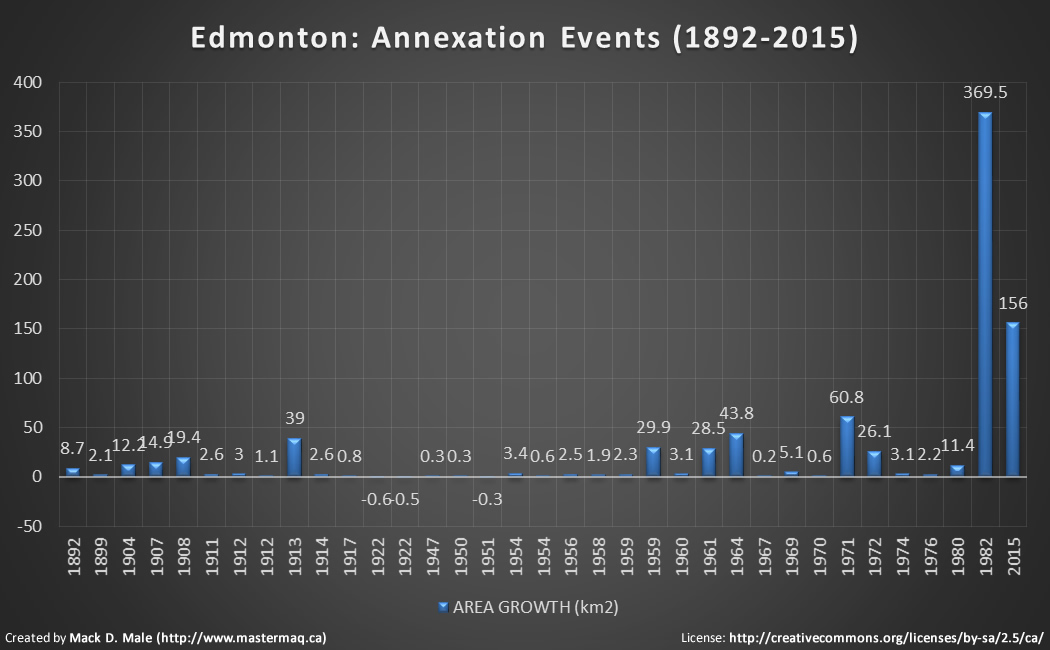
I’ll write more about that specific proposal in the future, but for now I thought it would be useful to take a look at Edmonton’s previous annexations. I have included the proposed annexation in the data below however, to give you a sense of where it fits in (I went with 2015 as the year). There have thus far been 31 annexation events in Edmonton’s history, according to a document prepared by the City’s planning department. That includes the incorporations of both Edmonton and Strathcona, as well as three temporary separations. Most of those annexations were relatively small, with an average annexation area of about 21 km2. Take out the 1982 annexation however, and the average drops to just 10 km2.

Here’s what those annexation events look like on a chart:

As you can see, the annexation in 1982 was unusually large – it doubled the size of our city. The proposed annexation in the south would handily come in as the second largest annexation in Edmonton’s history.

Here’s the list of annexation events:

YEAR DESCRIPTION CUMULATIVE AREA (km2)
1892 Incorporation of Town of Edmonton 8.7
1899 Incorporation of Town of Strathcona 10.8
1904 Incorporation of City of Edmonton 23.0
1907 Incorporation of City of Strathcona 37.9
1908 Buena Vista to Westmount, North Inglewood to Eastwood/Virginia Park 57.3
1911 Highlands, Amalgamation of Edmonton & Strathcona 59.9
1912 Belmont Park 62.9
1912 Kennedale 64.0
1913 Dominion Industrial to Quesnell Heights / Brander Gardens to Parkallen, Bonaventure to Belvedere, Forest Heights to Argyll 103.0
1914 Allendale / Duggan to Coronet / Papaschase 105.6
1917 Calder 106.4
1922 Separation of north Brander Gardens 105.8
1922 Separation of Papaschase 105.3
1947 Pleasantview 105.6
1950 Whitemud Creek 105.9
1951 Separation of part of Duggan 105.6
1954 Capilano / Fulton Place 109.0
1954 Coronet 109.6
1956 Gold Bar 112.1
1958 Davies Industrial 114.0
1959 Terrace Heights / Ottewell 116.3
1959 Terwillegar Park / Riverbend to Strathcona Industrial Park, re-annexation of separations 146.2
1960 Ottewell to Girard Industrial 149.3
1961 Beverly / Clareview to Dickinsfield 177.8
1964 Jasper Place and Southeast Industrial 221.6
1967 Clover Bar Power Plant 221.8
1969 Springfield / Callingwood 226.9
1970 Springfield – north 227.5
1971 Castle Downs / Lake District and Mill Woods 288.3
1972 West Jasper Place 314.4
1974 Kaskitayo 317.5
1976 Northwest Industrial 319.7
1980 Pilot Sound and Twin Brooks 331.1
1982 Northeast, Southeast, Southwest Urban Growth Areas 700.6
2015 Proposed South Annexation 856.6

Municipalities annex land for a variety of reasons – sometimes the goal is to acquire industrial land, other times its to start developing future residential neighbourhoods. Here’s what our land and population growth has looked like over the last 120 years:

The left axis and blue line shows the growth in Edmonton’s population, while the right axis and red line shows the growth in Edmonton’s land area. While our population has risen steadily, annexations have been much less consistent.

Impact on Population Density

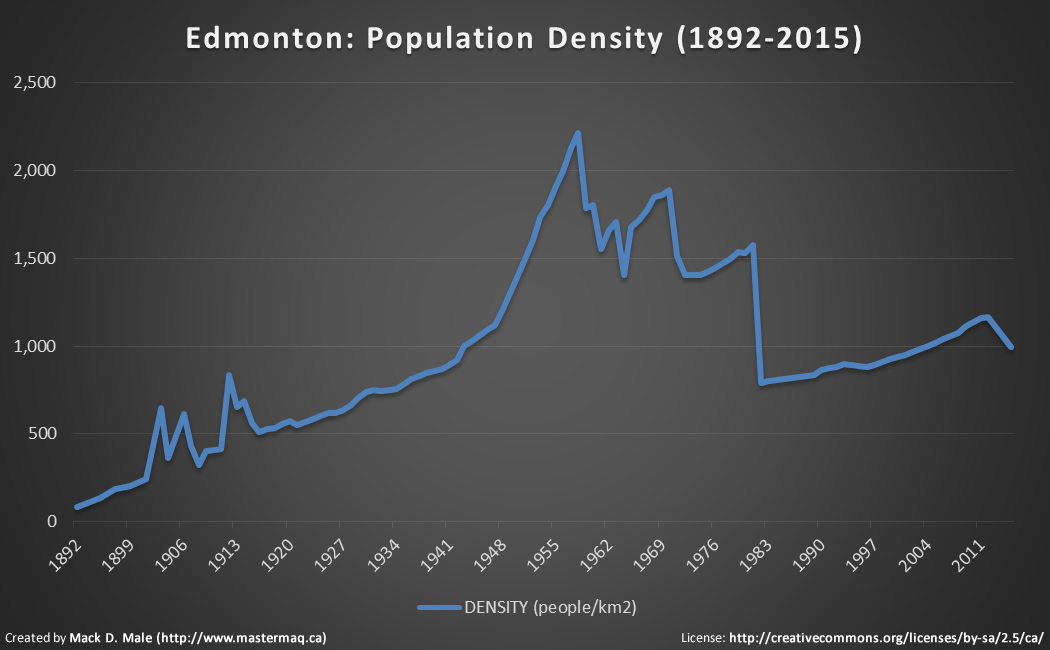
When the Town of Edmonton was incorporated in 1892 it consisted of 8.7 km2 of land and was home to about 700 people, giving us a population density of about 81/km2. Today, with a population of nearly 818,000 and a total area of about 700 km2, we have a much higher population density of roughly 1,167/km2. That’s not the highest it has ever been, however. Edmonton’s population density peaked in 1958 at about 2,212 people/km2 and has been falling ever since.

(For comparison purposes, New York City’s population density is 10,430/km2, London’s is 5,206/km2, Toronto’s is 4,149/km2, Vancouver’s is 5,249/km2, and Calgary’s is 1,329/km2. Yes, even sprawling Calgary has a higher population density than us!)

Here’s what our population density looks like on a chart:

There are a couple of key events to point out. The amalgamation of Edmonton and Strathcona in 1912 is noticeable thanks to a jump in the population. The annexations in 1959 of Terrace Heights, Ottewell, Terwillegar Park, and Riverbend marked the start of our population density decline. The jump back up in 1964/1965 was due to the annexation of Jasper Place, which brought about 38,000 residents to Edmonton in addition to more space. The large drop in 1982 is extremely apparent, and while the population density has slowly been creeping back up, you can see that the proposed annexation would cause it to decline once again.

Looking at the Capital Region

I absolutely agree with Mayor Mandel that a strong Edmonton is a strong region, but I don’t necessarily agree that Edmonton needs to acquire more land in order to remain strong. Supporters of annexation may suggest that Edmonton’s declining proportion of the region’s population is proof that buyers are not finding what they’re looking for within the city so they’re going elsewhere.

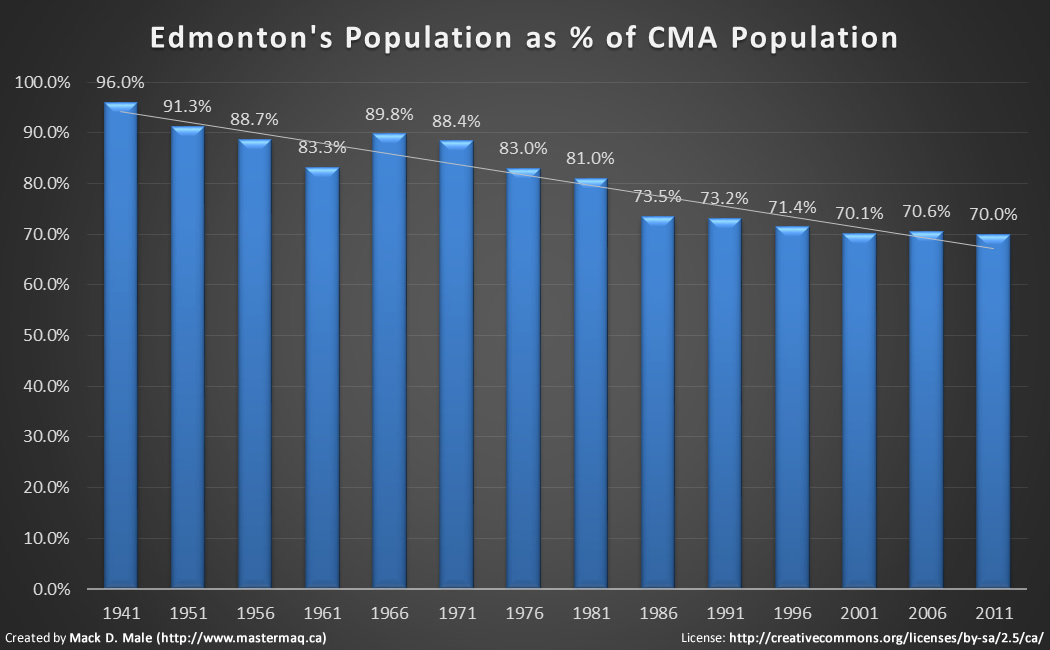
Here’s a look at the percentage of people in the Edmonton CMA who live within the city limits:

What’s clear is that there has been a decline in the proportion of people living in Edmonton-proper versus the surrounding areas. What’s less clear is why that has happened.

While Edmonton has not annexed any land since 1982, there have been 6 annexations by other municipalities in the region in the last 15 years.

Other Resources

Annexation is a big topic. Here are some additional resources that you may find useful:

Media Monday Edmonton: Update #69

Here’s my latest update on local media stuff:

Capital Ideas Event 14
Capital Ideas Edmonton’s fourteenth event: How do I find funding for my business?

Magazine Giveaway from Zinio

I don’t normally do giveaways, but I thought this one seemed relevant. Zinio bills itself as the world’s largest newsstand, with more than 5000 magazine titles available in digital editions as of 2012. They’ve got apps for most major platforms and promise publishers the ability to “increase circulation and advertising revenue” without increasing distribution costs. Zinio was named one of the 20 best iOS and Android apps of 2012.

Zinio is running two promotions at the moment. The first gives you $7.50 off your next purchase when you spend $15 (ends March 15). The second is a 50% discount on select titles (ends March 19). To help spread the word, Zinio has given me 10 free magazine subscriptions to giveaway. All you need to do to enter this contest is leave a comment below with your first and last name by March 18, after which I’ll randomly choose 10 winners. Good luck!

You can follow Edmonton media news on Twitter using the hashtag #yegmedia. For a great overview of the global media landscape, check out Mediagazer.

So, what have I missed? What’s new and interesting in the world of Edmonton media? Let me know!

You can see past Media Monday Edmonton entries here.

Edmonton Notes for 3/3/2013

Here are my weekly Edmonton notes:

Fear upon the bridge.
Fear upon the bridge, by Justin Piercy.

Here are some upcoming events:

Groat
Groat, by Darren Kirby.

Next weekend is Daylight Saving Time, so heads up that we lose an hour on March 10!

Two weeks with the Surface Pro

As a Microsoft junkie I have been looking forward to the Windows 8-led product wave for quite a while now. Reading about Windows 8, Windows Phone 8, Surface, and everything else Microsoft is doing lately has been interesting (now that those things are out, we’re reading about “Blue”). Microsoft may be the underdog right now, but don’t count them out! Their game plan is coming together a bit more each day, and it’s exciting.

Surface Pro & HTC Windows Phone 8X

I installed Windows 8 on my desktop and laptop the day it was available – it’s a solid, worthwhile upgrade from Windows 7 (on a desktop, I highly recommend adding the Logitech T650 Wireless Touchpad). I got my HTC Windows Phone 8X in early December – I’m still loving it. The only thing missing was a tablet, and I had my heart set on the Surface Pro.

I was very excited for launch day – February 9 – to arrive, basically counting down the days that week. I didn’t think I would need to line up, so I got to the Microsoft Store at West Edmonton Mall an hour or so after it opened. Turns out that was the wrong decision! All they had left was a couple 64 GB models. I decided to pass, knowing I wanted the 128 GB model. I starting looking online to see if Best Buy or Staples might have it, but I quickly learned that the launch did not go so well. Either Microsoft purposefully restricted the number of devices available or they severely underestimated the demand. I pouted for a bit and then ordered a Surface Pro and Touch Cover from the Microsoft Store online. I knew I’d have to wait a couple days, but I figured that was better than driving from store to store hoping to be lucky. Fortunately I didn’t have to wait long – it arrived around 5pm on the 12th.

I’ve had my Surface Pro for a little over two weeks now, and I wanted to share some initial thoughts and impressions. I’ll do a more complete review later.

  • The build quality is just as fantastic as you’ve heard it is. The Surface Pro feels solid, and the attention paid to details like the kickstand are really worth it once you start using it. I find the VaporMg case shows fingerprints a lot more than I anticipated, but it’s great otherwise.
  • It does feel heavier in your hands than most other tablets, but not uncomfortably so. You can hold it up with one hand, but probably not for very long – it’s a two-handed tablet.
  • One of the differences between the Surface RT and the Surface Pro is the thin ventilation strip (because it has a couple of fans inside). Aside from making the Pro slightly thicker than the RT, it hasn’t been an issue at all for me. I have only heard the fan come on once (during an hour long video Lync call) and it is never noticeable in my hands.
  • The screen is beautiful. It has an excellent resolution, it’s vibrant, and it feels as though it is right under the glass. A complaint some have had is that the kickstand isn’t configurable, it opens at one angle only. Because the viewing angles on the screen are so amazing, this isn’t as much of an issue as you might think (I constantly adjust my laptop screen, but that’s because it’s a pretty crappy screen that you basically need to be looking at straight on).
  • Depending on what I am doing, the battery life is OK. Definitely not great, but not as bad as I anticipated either. We’re talking about 4 hours or so for normal usage. It means I’ve always got my power adapter in my bag.
  • The Touch Cover definitely takes some getting used to, but it has really grown on me. I love how thin it is, and once you get a feel for it you can type pretty quickly. I’ve written a few of my previous blog posts using it, for instance.
  • The killer feature as far as I am concerned is the pen. I’ve had a Tablet PC for a number of years, but it’s heavy, slow, and awkward, so I haven’t used it much lately. When I did use it though, I was always so impressed with OneNote and I was hoping the Surface Pro would be just as delightful to write on. I can safely say it is (and it’s probably better actually). The ability to jot down notes in meetings or draw out ideas is huge for me, especially as I’m trying to go paperless.
  • The other nice thing about the pen is that it makes navigating the desktop much easier. Because the resolution is so high but the screen size is just 10.6 inches, stuff appears fairly small on the screen so it’s hard to tap with a finger. In “laptop mode” the mouse solves that problem, and I find myself using the pen when in “tablet mode” (ie. sitting on the couch).
  • I have only used the front-facing camera, and while it isn’t the best quality, it’s more than good enough for video calls. I have heard from others that there’s a bit of audio static when I first join a call, but otherwise the audio hasn’t been problematic either.
  • Disk space has not been an issue, despite what you might have heard. I did get rid of the recovery partition, but that’s the only change I made. Windows currently tells me I have 64.8 GB of free space, and that’s after installing Office and all the stuff I normally install on a new computer, plus a bunch of Metro apps, and having synced my Skydrive and Dropbox folders.
  • I’m really impressed with the performance of the Surface Pro. It resumes from sleep in seconds, and even a cold boot takes just a couple seconds extra. Everything opens quickly and Metro apps are very responsive – noticeably faster than on the RT. Wi-fi performance is also great.

There are still a bunch of things I haven’t tried yet, like hooking the Surface up to an external display. I haven’t tested the Micro SD slot either, though I have used the USB port a few times. I turned Bluetooth off right away, and haven’t tried connecting any of those devices yet either.

I can see how an updated version of the Surface using a Haswell chip would address the battery issues, and I briefly considered holding out when news first broke about the poorer-than-expected battery life. I’m glad I didn’t wait though. For me, the Surface Pro has been great!

I’ll write more in a future post or two, but for now I’d encourage you to get out to the Microsoft Store to see a Surface in action. I think you’ll be pleasantly surprised!

Media Monday Edmonton: Update #68

Here’s my latest update on local media stuff:

//platform.twitter.com/widgets.js

Meet the Media
Vassey Kapelos and Julie Matthews from Global Edmonton with Bill Fortier from CTV Edmonton at Meet the Media! Photo by Trevor Boller.

up! 99.3 FM Billboard
Cheeky billboard from up! 99.3 FM

You can follow Edmonton media news on Twitter using the hashtag #yegmedia. For a great overview of the global media landscape, check out Mediagazer.

So, what have I missed? What’s new and interesting in the world of Edmonton media? Let me know!

You can see past Media Monday Edmonton entries here.