Edmonton Notes for 2/24/2013

Here are my weekly Edmonton notes:

Downtown Morning
Downtown Morning by brardj

Here are some upcoming events:

Dawn Breaks
The Pearl Tower under construction, photo by Darren

Horse Hill ASP: More proof that Edmonton is addicted to sprawl

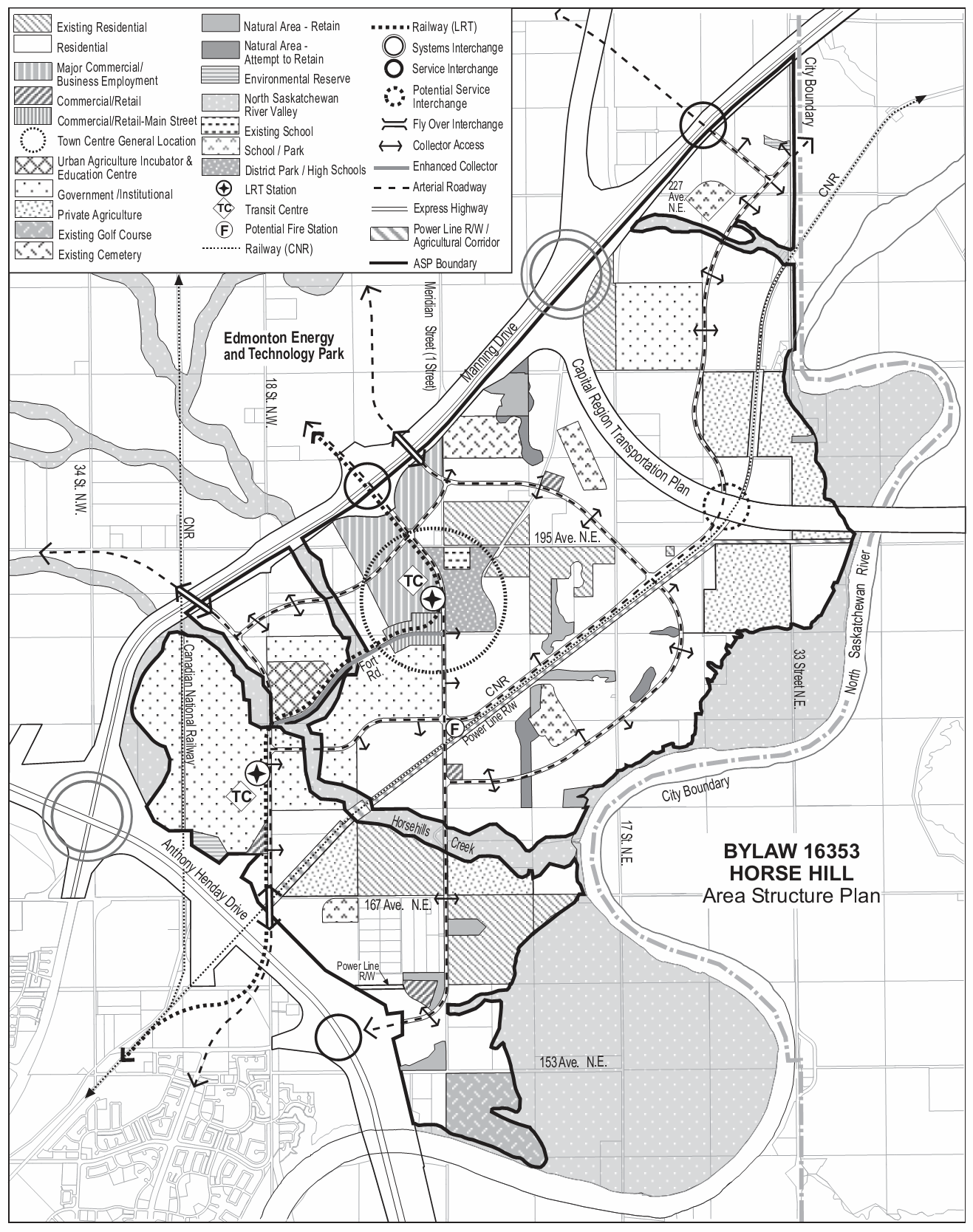
The proposed Horse Hill Area Structure Plan (ASP) will be debated at a special public hearing on Monday and Tuesday. Known as bylaw 16353, the Horse Hill ASP outlines a development framework for the area east of the Edmonton Energy & Technology Park (EETP). It encompasses roughly 2,806 hectares of land and barely meets the density target of the Capital Region Growth Plan with a proposed density of 31 units per net residential hectare based on a proposed population of about 71,000 people. Proponents would like to see the area developed over the next 30-40 years.

 
Horse Hill ASP, click for a larger version

There are many people opposed to the plan, including over 2100 who have signed an online petition asking Council to “get full information about the true costs and benefits of this current plan and alternative development scenarios”. Some are concerned with the loss of agricultural land, and others are concerned with the unsustainable sprawl of our city. I expect we’ll hear a lot from those perspectives during the public hearing. I wrote about this battle last July and I would encourage you to read or re-read that post for background.

After the public hearing has completed, the bylaw will be ready for first and second reading. Third reading will take place after the Capital Region Board has given its approval of the plan. It’s important to remember where we are in the larger process:

An ASP is a relatively high-level document. It contains more detail than the Municipal Development Plan, but less than the Neighbourhood Structure Plans (NSP). The Horse Hill ASP proposes five neighbourhoods, each of which would require an NSP.

The Horse Hill ASP falls into the Northeast Urban Growth Area, one of three identified in the Municipal Development Plan. Preparation of ASPs for these areas was authorized along with the MDP, but approval was dependent on Council accepting the Growth Coordination Strategy (GCS), the Integrated Infrastructure Management Plan (IIMP), and the City-Wide Food and Agriculture Strategy. Technically all three documents were approved in 2012, but they were not received without criticism. I wrote about some of my concerns with the documents here, here, and here. Furthermore, it’s hard to swallow that the Horse Hill ASP has been developed in adherence with those plans, considering that the Growth Coordination Committee and the Annual Growth Monitoring Report do not yet exist. Both were identified as key methods by which the GCS would be implemented.

At 135 pages, the bylaw, application, and supporting documentation for the Horse Hill ASP contains lots of information (PDF, 15.8 MB). I have slowly been digesting it, and I was particularly interested in the IIMP document that was included as attachment 2c (on pages 113-135). This is the first time such a document has been prepared for Council’s consideration.

From the background section of the IIMP:

The challenges facing the City are to balance development costs with the strategic benefits of sustainable growth, to achieve an appropriate balance of residential to commercial/industrial development. Although the City of Edmonton has achieved some success in diversifying its revenue base, property tax remains the largest component of City revenue.

The IIMP estimates that roughly $2.5 billion worth of infrastructure will need to be built, with developers contributing 66% and the City contributing 34%. The GCS reminds us however that “the City assumes ownership of developer funded infrastructure, generally two years after construction, and is responsible for ongoing maintenance, periodic rehabilitation, and eventual replacement.”

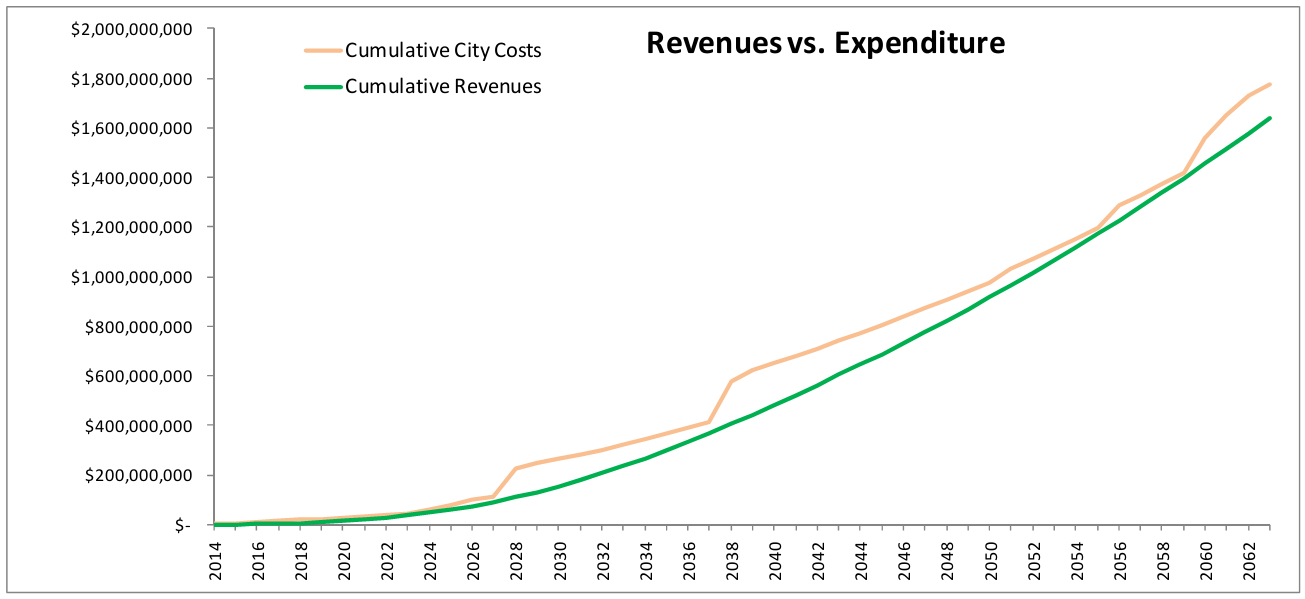
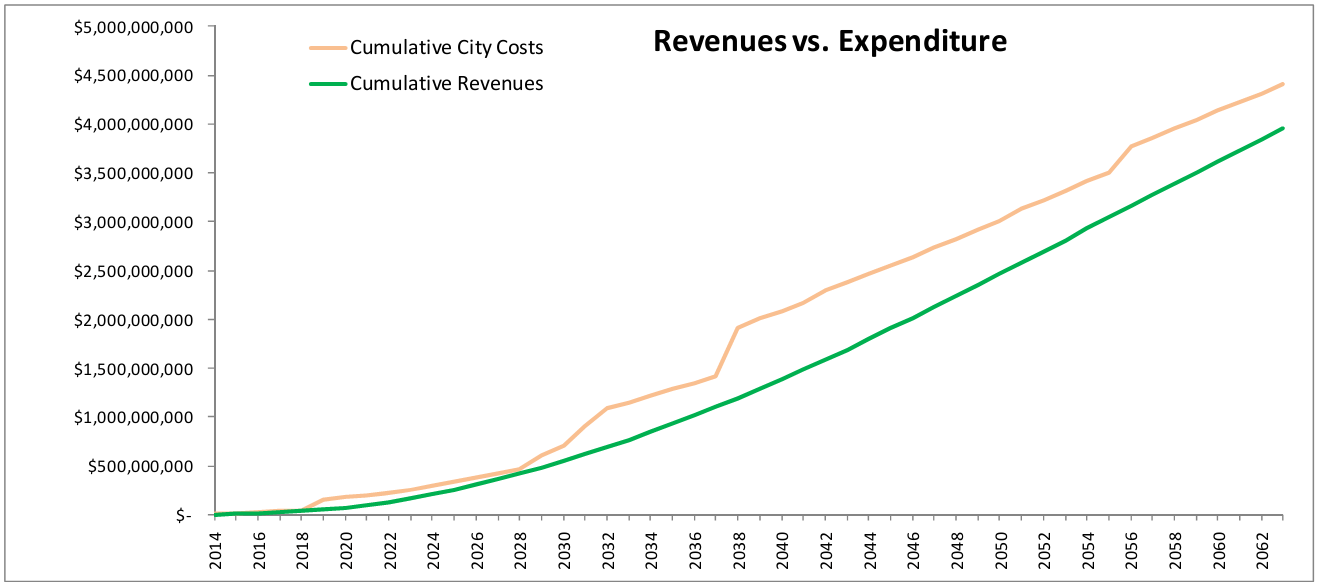
To estimate revenue and expenditures, the IIMP considers two scenarios. The first uses demographic projections from 2008 and assumes that only 52% of the population is achieved within 50 years. The second uses demographic projections from 2012 and assumes that the full population is achieved within 35 years.

Here’s the revenue vs. expenditures for the first scenario:

Here’s the revenue vs. expenditures for the second scenario:

The first takeaway is that new neighbourhoods do not pay for themselves, even (and especially) in the long-run. The IIMP notes that in comparison those charts “seem to contradict the general theory that a faster build-out time would result in a better cost recovery ratio.” It goes on to attribute this paradox to “the timing of certain large capital assets.”

What follows those two charts is a discussion about the balance of residential and non-residential land throughout the city. The IIMP notes that non-residential assessment makes up approximately 25% of the total tax base of the City.

How does the proposed development affect this balance? Generally, residential neighbourhoods have less than 25% of their assessment base as non-residential, and the proposed Horse Hill Area Structure Plan is projected to have 4.3% of its assessment as non-residential. So as the City grows this and other residential areas, it must also grow its non-residential areas to maintain balanced growth.

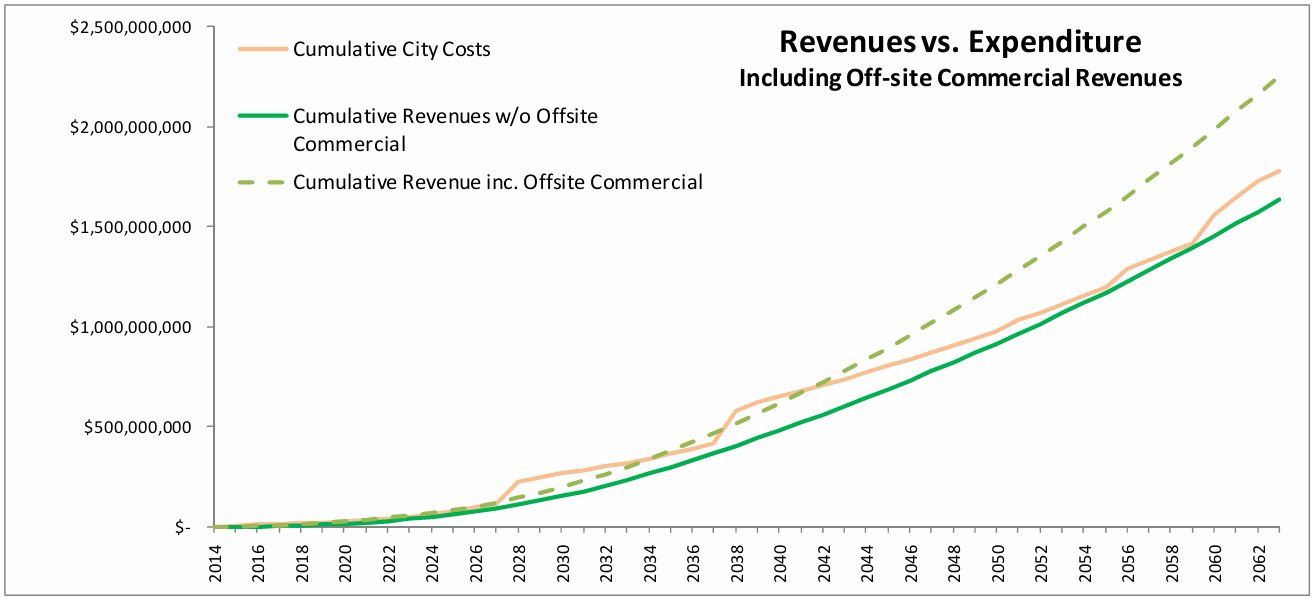
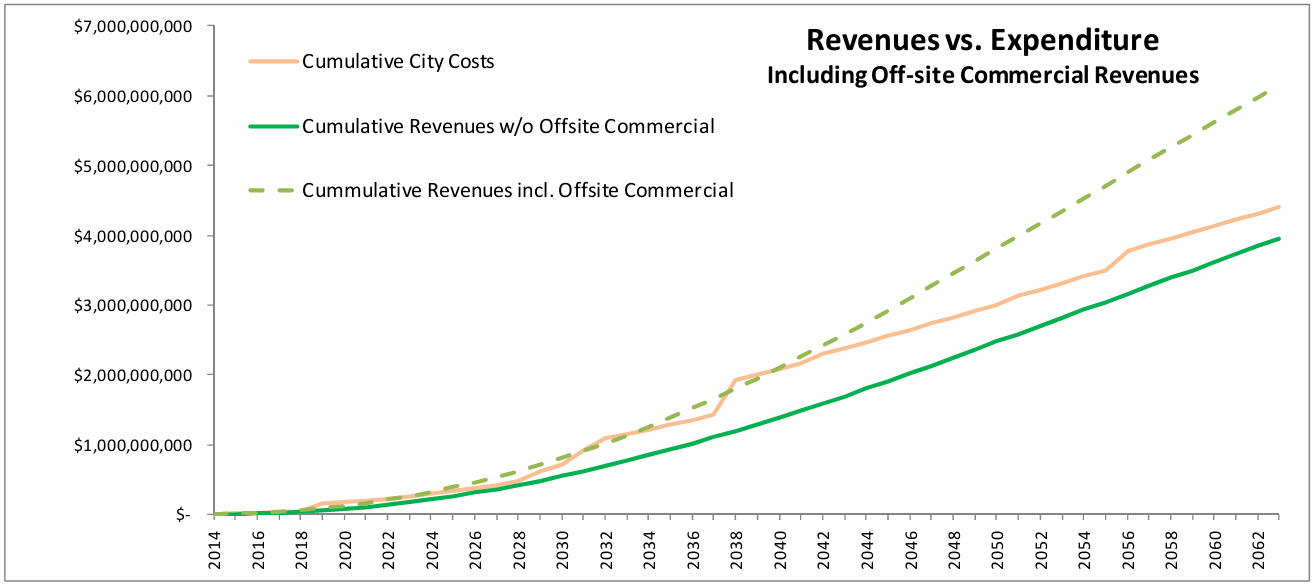
Incredibly, the IIMP then provides updated versions of the two charts above that “illustrate the importance of balanced growth and the benefit of maintaining the current non-residential assessment ratio.” The estimated revenue is combined with “off-site commercial assessment” to paint a much rosier picture of how we can afford to build out the plan as proposed.

Here’s the updated chart for the first scenario:

And here’s the updated chart for the second scenario:

The IIMP states:

The premise in these figures is that if the City maintains its current balance of 25% non-residential assessment, by developing commercial areas throughout the City, this additional revenue helps to offset the fiscal imbalance indicated by looking at the Horse Hill ASP by itself.

So we need to continue building commercial areas like the EETP to prevent residential taxes from going up dramatically. But to support those commercial areas we need to build new residential areas like the one proposed by the Horse Hill ASP. But to pay for those new residential neighbourhoods, we need to construct still more commercial areas. It’s a vicious cycle.

In other words, we’re addicted to sprawl.

The worst part is that we know this and yet we continually fail to do anything about it. From the MDP:

The Municipal Development Plan proposes a new direction for growth and it will take time to effect change. The Plan is a long term strategy and will require incremental decisions that support our commitment to saying “yes” to the things we want and need and “no” to the things that do not advance our City Vision and goals.

So far we’ve said “yes” to eight NSPs that were supposed to wait for the GCS and other documents, “yes” to a dramatically scaled back Growth Coordination Strategy, “yes” to a Food & Agriculture Strategy that lacks teeth, and we’ll likely say “yes” to the Horse Hill ASP.

We’re addicted to sprawl and we just can’t seem to say “no”.

LRT Construction Downtown: Short-term pain, long-term gain!

I’m excited about the expansion of our LRT network and what it’ll mean for Edmonton. It’s going to take a while until the entire network is completed, but work is already underway. While I would definitely fall into the YIMBY camp on LRT construction, that doesn’t mean there aren’t annoyances along the way. I just keep reminding myself – short-term pain, long-term gain!

The North LRT to NAIT is a 3.3 km extension from Churchill Station to NAIT with a total estimated cost of $755 million. Construction began in 2011 and over the last couple of years there has been a lot of activity along 105 Avenue and 105 Street in particular. The new line runs right through Sharon’s route to work, so she has experienced first-hand the inconveniences caused by the construction. The City has been proactive about meeting with affected stakeholders, and they even have an interactive map online, but that doesn’t completely make up for the ongoing issues.

North LRT to NAIT Construction

Closures might mean a slightly different route for motorists or a few extra minutes of travel time, but the impact on pedestrians is often much larger. Closed sidewalks can mean large detours into unfamiliar and poorly marked territory. When it’s cold out, a few extra minutes in a vehicle isn’t such a big deal but for a pedestrian it can be (and that makes jaywalking an attractive option). You’re also much more likely to find signs for vehicles than you are for pedestrians. Other issues include construction noise and, thanks to our up-and-down weather, treacherous and messy conditions.

North LRT to NAIT Construction

The new extension is slated to open in April 2014. Short-term pain, long-term gain!

The Central Station LRT Rehabilitation is a renewal rather than an extension. It will repair issues with the roof and ensure the station is functional for years to come. The City is also taking the opportunity to make streetscape improvements to Jasper Avenue between 100 and 102 Street. I work in the Empire Building at Jasper Avenue and 101 Street, which is basically ground zero for the project (and there’s also the First & Jasper construction right across the avenue).

Central LRT Station Construction

The construction team has been good at keeping everyone in the area up-to-date, with notices in the mail and electronic updates delivered through our property manager. That doesn’t mean the daily maze is any less annoying, however. I try to go through the back of the building to avoid the mess altogether, but every few days I need to use the front entrance for some reason, and determining how to navigate through the ever-changing array of fences gets old fast. There’s always construction noise to deal with too, though thankfully there have only been a few occasions when it has been disruptive.

Central LRT Station Construction

I know that travelling down 101 Street for vehicles sucks because traffic moves so much slower through the construction, but at worst you’re looking at a few minutes of delay. Compare that to the impact on pedestrians. Walking from the Empire Building to Scotia Place used to take a few seconds, we’re talking probably 30 steps or so. Now because of the fencing and detours, it takes probably ten times that! That’s a significant impact (though a little extra walking never hurt anyone).

The project isn’t expected to be complete until October 2013. Short-term pain, long-term gain!

Media Monday Edmonton: Update #67

Happy Family Day! Here is my latest update on local media stuff:

  • Big news for The Yeggies! The shortlist of nominees has been announced, as has the date and location for the event. Mark your calendars for May 4th at the Shaw Conference Centre! I am honored to have been nominated in the “Best in Edmonton” and “Best in Political or Current Affairs” categories.
  • Can’t wait for Meet the Media happening on Friday at The Underground Tap & Grill. Looks like it’ll be a full house with 160 people registered!
  • I have to admit, I was not familiar with #fashionfridays until Sharon pointed out this article to me: “The hashtag has since morphed into a way for Edmontonians to highlight local trends, inspire new wardrobe ideas and for the city’s designers contributing to the #fashionfridays to gain worldwide exposure.”
  • Chris Cameron is the new “midday guy” on 105.9 ShineFM.
  • The next Writer’s Corner is coming up on Sunday at the Riverbend Branch of EPL and the topic is blogging! Sharon Yeo and Dave Cournoyer are the featured guests.
  • SONiC has a new evening weekend show featuring Jason Parsons called SUBSONiC. The show will feature original songs and remixes from bands like Metric, Deadmau5, and M83.
  • Love this: RIP Jimmy the News Fish.
  • Apparently it was World Radio Day on February 13, though I’m not sure how seriously to take that after seeing the website.
  • Lucas calls out CBC for claiming they have exclusives when they really don’t. That led to a few snarky replies from Charles Rusnell. You can check out the entire back-and-forth here. I know the local media generally don’t talk about one another publicly, but I would welcome more of this.
  • I really appreciate this look at web stats in Relinked, and I enjoy the commentary too: “I have a working theory that if you printed out each and every online reader comment that stemmed from the Journal’s coverage of the bicycle lane story, the resulting paper trail would be longer than the 23 kilometres of lanes the city plans to paint this year.”
  • The Art of Conversation LXXVIII takes place on February 27 at Kelly’s Pub. “Bring a friend or two! No need to RSVP. All we ask is you stick out your hand and strike up a conversation with someone you’ve not met before. Leave your career at the door! This is not about networking, or marketing, or any such nonsense. It’s about good conversation.”
  • EPCOR was the talk of Twitter this week as word spread that they had cut off power for a senior. In response, EPCOR tried to clarify the facts, but that doesn’t appear to have had much effect on the discussion on Twitter. Linda wrote more about the story in her latest column.

You can follow Edmonton media news on Twitter using the hashtag #yegmedia. For a great overview of the global media landscape, check out Mediagazer.

So, what have I missed? What’s new and interesting in the world of Edmonton media? Let me know!

You can see past Media Monday Edmonton entries here.

What good are (bike) plans without implementation?

Bike lanes have been in the news again, largely thanks to Mayor Mandel referring to the plans as a “nightmare” on Wednesday. It’s pretty clear that our poor public consultation practices are part of the problem here, but there’s another issue at play. As a city we’re good at talking the talk, but we too often fail at walking the walk.

From The Way Ahead:

In shifting Edmonton’s transportation modes the City recognizes the importance of mobility shifts to contribute to the achievement of other related goals. To do so suggests the need to transform the mix of transport modes, with emphasis on road use for goods movement and transiting people and transit use for moving people.

From The Way We Move’s Strategic Goals:

Public transportation and active transportation are the preferred choice for more people, making it possible for the transportation system to move more people more efficiently in fewer vehicles.

From The Way We Move’s Implementation Plan:

Active transportation includes any form of human-powered transportation, the most common modes being walking and biking. A key direction of The Way We Move is to develop an integrated and sustainable transportation system in Edmonton to enable citizens to shift to these modes.

And then of course there is the Active Transportation Policy which declares, “the City of Edmonton strives to be pedestrian- and bicycle-friendly.”

Our plans and goals and policies all seem to support taking steps to make cycling in Edmonton more common. We know that doing so will help to reduce traffic congestion, preserve our road infrastructure, protect the environment, and make us healthier. Our goal of building 500 km of on-street cycling facilities in the next 10 to 20 years is achievable, and we can be confident it’ll help shift our transportation modes because just as you get more drivers when you add more roads, research suggests you get more cyclists if you add more bike lanes (pdf).

So why does it seem so difficult to make any actual progress?

Isaak Kornelsen Memorial Ride - August 31, 2012

When the 2012-2014 Capital Budget was being discussed, Active Transportation nearly missed out on funding. After lots of public feedback and discussion, Council amended the budget and did include $20 million. Now we get around to actually spending some of that money on cycling – $2 million or less this year – and we once again seem to be forced into the position of having to fight to move things forward. One step forward, two steps backward.

Without question the way the City does public consultation contributed to this mess – there’s a lot of room for improvement. But “poor public consultation” is also a convenient scapegoat for politicians and citizens opposed to the plans. There’s no conspiracy here. The notion of adding bike lanes to our streets didn’t suddenly appear one day out of thin air. These plans have been in the works for years.

All we need to do now is walk the walk.

You can learn more about Cycling in Edmonton here, and note the City is running a survey on the 2013 Bike Routes until February 27.

Two other thoughts:

  • Why wasn’t there any outrage about the loss of parking when the bike parking corrals were put in place over the summer? Was it just because they were temporary?
  • Am I the only one annoyed that we’re spending 10 to 30 times more on a “mechanized access” project for the River Valley that has no clear plan than we are on bike lanes?

Media Monday Edmonton: Update #66

Here is my latest update on local media stuff:

You can follow Edmonton media news on Twitter using the hashtag #yegmedia. For a great overview of the global media landscape, check out Mediagazer.

So, what have I missed? What’s new and interesting in the world of Edmonton media? Let me know!

You can see past Media Monday Edmonton entries here.

Edmonton Notes for 2/10/2013

Here are my weekly Edmonton notes:

6th Feb 2013
The Hamptons, photo by Fophotography.

Here are some upcoming events:

Untitled
Cool shot of the CN and EPCOR Towers by Dejan Galetic.

My Return to Podcasting: Mack & Cheese

Today I am excited to introduce a new project called Mack & Cheese. It’s a podcast that I’m doing with Graham Hicks, who I’m sure you know from his newspaper days. He’s the “cheese” in our duo, but is it because he’s cheesy or is it because he’s the big cheese? You decide!

His five-times-a-week town-crier style column “Hicks on Six” in the Edmonton Sun and the Edmonton Sun online, was considered Edmonton’s best-read newspaper column.

I approached Graham in the fall with the idea for the podcast and was thrilled when he said he wanted to take part. You can check out the first episode here. We both love talking about current affairs in Edmonton so that’s what you can look forward to on future episodes, though in our intro episode we talk entirely too much about ourselves.

Podcasting in 2004
Me podcasting way back in 2004

For me, this is a return to podcasting. I started podcasting in September 2004 actually. To give you some context, that was just a few months after Facebook initially launched and nearly two years before Twitter existed. My friends and I liked the idea of doing our own radio show, and podcasting gave us a way to do that. We created a site called BlogosphereRadio which was a series of shows that discussed various aspects of blogging. While some of our shows probably sounded like they were created just for our group of friends, some shows attempted to be more professional-sounding. We covered the first ever blog auctions for instance, and we recorded sessions for the Northern Voice conference a couple of years. It was a lot of fun, but it was also a lot of work!

Podcasting in 2004
My usual setup back in the day

So much work as a matter of fact, that I decided I could build some software to make it easier. That led to Podcast Spot, a hosting service that my business partner Dickson and I launched in September 2006 (you check out some of our features here). We had limited success with the effort, and ultimately decided to shut it down in October 2008. Podcasting had lost some of its lustre by that time, and we felt our service had come to a fork in the road. That was kind of the end of my podcasting career, if you could call it that! I look back now and am pretty happy with what we were able to accomplish (we even built some cool things like a real podcasting robot, pictured below). We were ahead of the curve in some areas, but were inexperienced and up against some stiff competition. I learned an incredible amount through the whole experience.

Finished Side View
The Podbot, which we controlled wirelessly!

While I stopped podcasting and put my effort into other projects, I never did lose my interest in it. I still think podcasting is a particularly interesting method of communication, even if it’s not as “big” as we hoped it would become. Some things are best discussed in a blog post, but I think there are plenty of things that podcasting is appropriate for. I’m looking forward to exploring that further with Mack & Cheese.

Here in Edmonton, there are now some really great podcasts to choose from. I have been completely inspired by what Adam and Scott have done with The Unknown Studio (and we use their studio for our recording…thanks guys!). If you aren’t already a regular listener, you should be! There’s also UserCreatedContent, Jay n’ J, Prairie Belles, and Product People that you should check out.

I think there’s a place for what Graham and I want to do, and I hope that some of you find it interesting enough to listen to. If you do take a listen and have some feedback, I’d love to hear it!

Edmonton should introduce online voting

City Council will decide tomorrow whether or not to go ahead with online voting in municipal elections. Executive Committee referred the item back to Council without a recommendation, but Administration’s position is clear. Their recommendation states:

  1. That an internet voting option for the 2013 General Election be approved, subject to the necessary Local Authorities Election Act regulation changes.
  2. That Administration request that Alberta Municipal Affairs make the necessary regulation changes to allow implementation of an internet voting option.
  3. That Administration bring forward amendments to Election Bylaw 15307 to address legislative requirements for internet voting.

You’ve probably heard about the Jellybean Election that was held last year to test the viability of online voting. The feedback from that and other public involvement activities was also clear:

Overall, the responses from those who participated in all of the public involvement processes indicated support for the use of internet voting as another voting option. The responses were qualified with an expectation that the City ensure that the voting option provide auditability, security, reliability, be user friendly and be provided at a reasonable cost.

With a projected cost of $400,000 to implement online voting for the 2013 General Election, I think the City can meet those qualifications. Online voting is a viable option right now, and we should offer it in Edmonton.

Voting Station
Is this the best we can do?

I could write about how pretty much everything can be done online now. We pay our bills, share our thoughts, file our taxes, buy goods and services, look for love, and much, much more, all online. I could write about how Scytl, the company we used for the online voting system in the Jellybean election, “has provided internet voting for elections all over the world including France, Madrid and Halifax.” But I’m not sure any of that would convince you more than this CNN article from 2011:

In all, 80 Canadian cities and towns have experimented with Internet voting in municipal elections. The town of Markham, in Ontario, has offered online ballots in local elections since 2003.

We’re not even close to leading the pack in Canada, let alone the world! Estonia has allowed online voting in its national elections since 2007. Online voting may be new to Edmonton, but its old hat elsewhere.

Read just about any article about online voting and amidst any concern you invariably hear that online voting is the future. The article in the Journal last week was no exception:

While Coun. Karen Leibovici feels online elections are the way of the future, she’s not sure the city can be ready to introduce this approach in less than nine months.

Online voting may be the future, but it’s not futuristic. As this Mashable article discussing online voting in the US says, “Internet voting systems are already being used in elections of consequence” and “widespread online elections will be a reality in the near future.”

Understandably, the most vocal concerns about online voting have to do with security. No system is 100% secure, but generally speaking it’s not the technology that is the weakest link, it’s us. For an eye-opening look at the human side of security, I’d encourage you to read Kevin Mitnick’s book The Art of Deception. In it, “Mitnick explains why all the firewalls and encryption protocols in the world will never be enough to stop a savvy grifter intent on rifling a corporate database or an irate employee determined to crash a system.” Or someone motivated to interfere with an election. If you really want to hack the system, you’ll find a way.

For me the question becomes, is online voting any less secure than offline voting? I don’t think it is. How do you know that that piece of paper you drop into a cardboard box ends up where it should and is counted accurately? How do you know that someone hasn’t interfered with the system somewhere in between you voting and the results being published? You don’t. A technology-based system would still require a certain amount of trust, but unlike with paper-based systems, that trust can be backed up with audit records and digital copies.

No one is suggesting that we get rid of paper-based voting and move entirely online (at least not yet). But adding online voting as an option would make the next election more accessible, and would give us the opportunity to gain some insight and knowledge on how to improve the system in the future.

The corporate outcomes section of the report going to Council states:

Providing voters with secure voting options enhances the democratic process and our citizens’ connection to their community, and supports the goals of the Way We Live.

I can’t say it any better than that. Let’s move forward with online voting in Edmonton.

Edmonton Notes for 2/3/2013

Here are my weekly Edmonton notes:

Here are some upcoming events:

Lit
I like this b&w shot of 104 Street by Darren.