
Alberta’s Community Revitalization Levy: Rivers District, Belvedere, The Quarters
This is the second part in a three-part series on Alberta’s CRL.
Armed with a better understanding of Alberta’s CRL legislation, I turned my attention to the three active CRL projects in the province. What are the projects for? Why is a CRL appropriate for them? What can we learn from the projects that will help us when exploring the idea of using a CRL in the future? That’s some of what we’re going to look at in this post.
To quickly recap the process: there is some back-and-forth between the city and the province in establishing a CRL. First, the Lieutenant Governor must approve the regulation, which includes the CRL boundary. Second, City Council must approve the plan & bylaw for the CRL (and these can be done separately). And finally, that plan & bylaw must also be approved by the province. The three projects we’re going to look at are at different stages of that process.
Calgary’s Rivers District
The first specific CRL regulation to be passed in Alberta was for the City of Calgary Rivers District, back in 2006. The Rivers District project was the catalyst for the MGA amendment that made CRLs possible in Alberta.
 City of Calgary Rivers District Community Revitalization Levy Regulation (AR 232/2006)
The Rivers District is the furthest along of all the CRLs in Alberta – everything has been approved and the City is well into implementation. It was 2007 when everything was finally approved, so the baseline for tax assessments would have been frozen to the values on December 31, 2007.
It’s worth pointing out that the CRL is just a small part of a much larger project known as The Rivers:
The vision for a revitalized Rivers district is more than a place to live, it is a lively urban destination.
This map shows the area the project covers, and as you can see, it is quite expansive. The idea is to reclaim the waterfront, and to make the area more desirable for development. In addition to infrastructure upgrades, a new riverwalk is in the works (phase 1 is now open actually).
The CRL boundary is large, but it is a small part of the overall project. Here’s what it looks like (KML):
[googlemaps https://maps.google.com/maps?f=q&source=s_q&hl=en&geocode=&q=http:%2F%2Fmastermaq.s3.amazonaws.com%2Fpublic%2FRiversDistrictCRL.kml&sll=51.040854,-114.052162&sspn=0.043228,0.13175&ie=UTF8&ll=51.040908,-114.052248&spn=0.022774,0.044975&z=14&output=embed” frameborder=”0″ width=”525″ marginwidth=”0″ scrolling=”no”>
View Larger Map
View Larger Map
The boundary covers an area of roughly 1.9 square kilometers (478 acres).
One of the big advantages to using a CRL for the Rivers District is that the City of Calgary owned much of the land within the boundary. That’s important because it means the baseline assessment for those assets would be zero, and there’s lots of potential for getting some of that all-important lift.
I spent some time talking with Kathleen Young, Development Manager for The Quarters Downtown at the City of Edmonton, and found out that she actually worked on the Rivers District CRL! Her knowledge and experience on that project was one of the reasons that she came to Edmonton. You know what they say, it’s a small world.
Kathleen pointed out that the CRL boundary for the Rivers District includes some key developments, notably The Bow (here’s a photo of the building I took back in July). When finished, The Bow will become the headquarters for EnCana, and will be the tallest office building in Canada outside Toronto. Groundbreaking for the project took place in June 2007, around the same time that the Rivers District CRL was approved, which means almost all of the incremental value realized through the development of the building will be captured by the CRL.
To work on The Rivers, the City of Calgary created a wholly owned corporation called the Calgary Municipal Land Corporation (CMLC). They have some great information on the various aspects of the project if you’d like to learn more. CMLC was actually awarded a Canadian Urban Institute Brownie Award in 2008 for the CRL:
The Canadian Urban Institute’s annual Brownie Award recognizes leadership, innovation and environmental sustainability in brownfields redevelopment across Canada. CMLC won in the category of "Financing, Risk Management and Partnership" for our work in the creation of the Rivers District Community Revitalization Levy Regulation. A "made in Alberta" version of the U.S. Tax Increment Financing (TIF)— which is a widely used financing mechanism for redevelopment of brownfield sites in the United States—provides a sustainable source of funding to finance the significant infrastructure development required in the Rivers District for a 20-year period.
It sure looks like the Rivers District CRL will be a success!
Belvedere (Fort Road)
The first CRL regulation to be passed for Edmonton was for the Belvedere redevelopment project, commonly known as the Fort Road Redevelopment project. The project has been in the works since at least 2000, and has evolved quite a bit over the last decade. It was very much in the works before CRL legislation came into effect.
City of Edmonton Belvedere Community Revitalization Levy Regulation (AR 57/2010)
The Belvedere CRL isn’t quite as far along as the Rivers District, but it is nearly there. Kathleen clarified that the borrowing bylaw (14883) has been approved, but the plan bylaw is still in the works. Armed with the $34,250,000 specified in the borrowing bylaw, the City has undertaken much of the infrastructure upgrades planned for the area.
Here’s the CRL boundary for the project (KML):
The boundary covers an area of roughly 1.3 square kilometers (324 acres).
A unique element of the Belvedere CRL is that the City owns almost all of the land within the boundary. As a result, when they sell the land all of the incremental value will be captured by the CRL, making it much less likely that the City would have to fall back on general revenue to cover the debt.
The Belvedere project is an interesting one. It is unlikely that development would have taken place in the area without the City of Edmonton stepping in to try to make the area more attractive and desirable. Through that lens, the use of a CRL makes a lot of sense. If you think back to the two basic assumptions highlighted in part one, the Belvedere CRL certainly passes the first – it’s worth the risk.
As for the second assumption – there’s a sound expectation that development will occur – that one is less certain. Especially given the challenging economy, it could be a while before anything substantial happens. Having said that, the first sale of the Station Pointe lands last year for $5.2 million is hopefully a sign of things to come (that project received $481,000 in federal funding in August). The redevelopment project is still in the early stages, and Rick Daviss at the City of Edmonton confirmed that at least a couple new conditional deals are in place, so there’s movement.
There’s more information on the Station Pointe project here – it won a Brownie Award in 2008.
You can find lots of background and other information on the Fort Road redevelopment project here.
The Quarters
The newest CRL regulation to be passed was for The Quarters Downtown, a redevelopment project here in Edmonton previously known as the Downtown East redevelopment. I wrote about The Quarters a couple weeks ago, and I’d encourage you to look at that post to get an overview of the project.
City of Edmonton The Quarters Community Revitalization Levy Regulation (AR 173/2010)
As the newest CRL project, The Quarters has the furthest to go before it is ready for implementation. The province has approved the regulation and boundary, and Administration is now working on the plan and bylaw to present to Council. That will happen sometime in 2011, according to Kathleen. Her team wants to make sure they get it right.
Here is the CRL boundary for the project (KML):
The boundary covers an area of roughly 0.93 square kilometers (229 acres).
The Quarters is a large plan that will proceed in phases. Once completed, it is anticipated that the area will accommodate a population of nearly 20,000 people, up from less than 2500 today. The project is made up of five distinct districts, the jewel of which is known as The Armature.
An important part of any CRL plan is the way in which the City will cover the cost of the project if enough development does not occur. The default fallback is always general revenue, but Kathleen said they are looking at additional funding sources as well, such as government grants.
Kathleen told me that among other things, some of the CRL money will be used for streetscape improvements, some will be used for land acquisition to consolidate parcels for resale, and lots would be used to develop The Armature. The goal is to make that part of Edmonton a much more livable area, and the redevelopment focus is on residential assets.
As I have said before, it is an exciting project for our city! You can learn more about The Quarters Downtown here.
The project will be an interesting one to pay attention to if you’re interested in CRLs, because there are still a number of steps in the process to go.
Final Thoughts
If you’ve made it this far, you should now have a better understanding of the three active CRL projects in Alberta. You can draw your own conclusions, but a few things I wanted to highlight include:
- All three boundaries are similarly sized
- Infrastructure upgrades and improvements are a major part of all three projects
- In the Rivers District and Belvedere, and to a lesser extent in The Quarters, an important consideration is the amount of City-owned land
I think it is important to look at what we already have when trying to understand how a CRL could be applied to future projects. In the next part of the series we’ll do just that, using the proposed downtown arena as our future project.
Alberta’s Community Revitalization Levy:
Alberta’s Community Revitalization Levy: Introduction
This is the first part in a three-part series on Alberta’s CRL.
Recently I decided to start learning more about Alberta’s Community Revitalization Levy (CRL), and I was initially struck by how little information was readily available. I searched and searched but didn’t find much. Maybe that’s because what we call the community revitalization levy here in Alberta is known as tax increment financing (TIF) elsewhere. It turns out that TIF has been available as a public financing method for more than 50 years! The State of California first used the approach in 1952, and now Arizona is the only state in the USA without some sort of TIF legislation.
Here’s how Wikipedia describes TIF:
When a development or public project is carried out, there is often an increase in the value of surrounding real estate, and perhaps new investment (new or rehabilitated buildings, for example). This increased site value and investment sometimes generates increased tax revenues. The increased tax revenues are the “tax increment.” Tax Increment Financing dedicates tax increments within a certain defined district to finance debt issued to pay for the project.
The idea is to use the “lift” generated by the increased tax revenues to pay for the debt that financed the project.
Alberta’s CRL
In Alberta, this legislation is relatively new. Bill 28 received Royal Assent on May 10, 2005 and amended the Municipal Government Act (PDF) to include Division 4 under Section 381, which enables municipalities to create a community revitalization levy bylaw (which must be approved by the Lieutenant Governor in Council).
Since that legislation came into effect, there have been three CRLs created in Alberta (as far as I can tell): Calgary’s Rivers District, the project for which Bill 28 was created, and the Belvedere (Fort Road) and Quarters redevelopment projects here in Edmonton. You can read more about all three projects in part two.
There are a few key aspects of the CRL to be aware of:
- The CRL only applies to a very specific area (the CRL boundary).
- The tax revenue that contributes to the CRL is split between the City and the Province.
- The maximum amount of time a CRL can exist is 20 years, starting in the year when the bylaw is approved by the Lieutenant Governor in Council.
- The Lieutenant Governor in Council can approve a CRL bylaw in whole or in part or with variations and subject to conditions.
And don’t be mislead by the name “levy” – the CRL is a tax as defined in the MGA. It’s a funding mechanism, nothing more.
From my read of the Municipal Government Act, there are no rules or restrictions on the type of area that a CRL can apply to. In theory a CRL works best in an area that is “blighted” but the legislation does not enforce this. This was the case in California as well, until it became clear that the legislation was being abused.
What’s the potential impact of a CRL?
I asked Rick Daviss, Manager of Corporate Properties at the City of Edmonton, to help me understand the CRL. He was very helpful and pointed me in the direction of some very useful information.
The first thing we looked was a hypothetical example of the impact of a CRL. Here’s the situation:
- Current use: 2.0 acre parcel of land improved with a 30,500 square foot warehouse.
- Proposed use: 2.0 acre parcel of land improved with a high rise residential condo development (proposed density of 265 units (RA9), FAR of 3.0, unit value assessed at $200/square foot).
So we’ve got an old warehouse on some land and we want to replace it with a condo. Let’s look at the assessed value:
- Current use: $1,525,000 (this is known as the assessment baseline)
- Proposed use: $44,431,200
Which gives us an increase in value of $42,906,200. Now let’s look at the tax assessment:
| Before | After | Difference | |
| 2006 Municipal Mill Rate | 5.7484 | 5.7484 | – |
| 2006 Municipal Tax | $8,766 | $255,408 | $246,642 |
| 2006 School Mill Rate | 3.6182 | 3.6182 | – |
| 2006 School Levy | $5,518 | $5,518 | $0 |
| 2006 CRL | N/A | $155,243 | $155,243 |
The mill rate is used to calculate the property tax, and you can think of it as the amount of tax required divided by the amount of tax available. So if the City needs $2 billion in taxes but only $1 billion can be generated based on the assessments, the mill rate is 2. The property tax is then calculated by multiplying the assessed value by the mill rate, and dividing by 1000. So to get $8,766 in our example above, $1,525,000 is multiplied by 5.7484 and then divided by 1000.
Let’s look at the Before column first. The total tax assessment there was $14,284, and the two bottom rows are N/A because we don’t have a CRL in the before case. Both the City and School taxes are calculated the same way: assessed value multiplied by the mill rate divided by 1000. The province gets $5,518 and the City gets $8,766, all of which goes into what’s known as “general revenue”.
Now let’s look at the After column. The total tax assessment there is $416,169. The City tax is calculated the same as before, but now that we have a much higher assessed value, we end up with $246,642 in increased tax revenue. All of this will go to the CRL. The School tax is broken into two, because only the incremental tax revenue will go toward the CRL. So the $5,518 is calculated the same as in the Before case, and this goes to the province. The provincial part of the CRL is calculated as follows: the increase in assessed value ($42,906,200) multiplied by the mill rate divided by 1000. That gives us the $155,243, all of which will go the CRL.
So now you see why the CRL is such an attractive proposition: it looks like we have $401,885 in new tax that we can contribute to the CRL. And this could happen with all developments inside the CRL boundary. There are a number of caveats, however. The first is that the CRL amount will vary from year to year based on the assessment (which makes the economy and depreciation relevant) and on the school mill rate which also changes from year to year. The second is that the type of development is important – City owned properties are tax exempt, for instance. A third is that the City tax revenues as well as a portion of the School tax revenues are dedicated to the CRL, where they would otherwise have gone into general revenue.
How is a CRL created?
Rick walked me through the process of creating a CRL, and I can tell you it sure doesn’t sound like a trivial task. In the best case, Rick estimates it would take just less than two years from concept through to the start of implementation to make a CRL reality. Here’s a high-level overview of the process:

Those five steps would include, roughly:
- Administration conducts background research, identifies the potential boundary, comes up with preliminary revenue estimates, and prepares for and asks Council for approval to make a request to the Minister of Municipal Affairs.
- The Minister of Municipal Affairs considers the request and recommends an Order in Council for an establishment regulation. This step also includes some back and forth to establish the area and other parameters.
- The Lieutenant Governor in Council considers and approves the Order in Council for the area to be established.
- Administration conducts more research, holds public hearings, drafts the proposed bylaw, has it reviewed by all relevant departments as well as the province, and acquires Council approval of the bylaw.
- The Lieutenant Governor in Council approves the bylaw.
After all that is done, the CRL can proceed. It makes sense to plan for the Lieutenant Governor in Council’s final approval as close to the start of construction as possible, in order to get the maximum possible time under the CRL legislation.
What are the risks associated with a CRL?
As others have pointed out, a CRL is not a risk-free proposition. There are a number of issues to consider.
What if a project does not lead to an increase in property values and does not result in any new development? In this case, there would be no “lift” to pay down the debt of the project. Rick noted that a plan for this kind of scenario needs to be in place before the province will approve a CRL. It can be as simple as the City swallowing the cost of the project, as long as it can specify how it will be paid for. Another option is for a third party to backstop the plan.
Another issue is the potential shift in taxes. Will the project really result in new development – development that would not have occurred in the city otherwise – or is it merely a shift in development, from areas outside the CRL to the area inside the CRL boundary? How would you know, one way or the other?
A related issue is the decrease in general tax revenue. If the property tax inside the CRL boundary is no longer going into general revenue, what does that mean for the services the City provides? In the worst case, you can imagine the entire City being covered in various CRL projects. That would result in zero general tax revenue and thus no way for the City to pay for the services it provides to citizens. What is the impact of one or two CRL projects? That’s less clear. Same goes for the school taxes. A common concern for many people is that they don’t want their school taxes going toward the CRL instead of schools. Of course, in reality the province doesn’t come up with education programs based on the amount of school tax it receives – tax revenue does go into the Alberta School Foundation Fund, but that money is combined with whatever amount of general revenues the province deems appropriate.
Can a CRL really work?
For a CRL to work, Rick says you need to make two basic assumptions:
- The project the CRL would be funding is a good thing, and is worth the risk.
- There’s a sound expectation that development will occur as a result.
If you think the project is worth the risk, and you’re confident that development will occur as a result of taking that risk, then a CRL can be a good funding source. Rick highlighted the Belvedere (Fort Road) project as meeting this basic criteria: it’s an area that needs to be redeveloped and it’s unlikely that anything would happen without some initiative by the City, plus there’s a good chance that other development will occur now as a result of the City going in and cleaning things up.
Final Thoughts
If you’ve made it this far, you should now have a better understanding of how Alberta’s Community Revitalization Levy came to be, how it works, and what the potential impacts and pitfalls of the legislation are.
In the next part of this series, we’ll look at Alberta’s three current CRL projects in more detail.
Alberta’s Community Revitalization Levy:
Edmonton Notes for 12/12/2010
Be sure to check out Edmonton Etcetera for local stuff throughout the week. Here’s the archive so far for December. Enjoy!
Here are my weekly Edmonton notes:
- City Council passed the 2011 Operating Budget this week, keeping the increase to 3.85%. Here is Councillor Iveson’s post on the budget.
- Canadian Western Bank recently celebrated its 90th consecutive quarter of profitability, and CEO Larry Pollock says he’s just getting started. See also: my post on Edmonton’s FIRE (Finance, Insurance, Real Estate) industry.
- Apparently Edmonton’s Christmas charities are feeling the pinch this year. That’s a similar story to last year, when local charities were about $3 million short of targets.
- The City is reminding you to lend a hand this holiday season if you’re able to do so.
- Kavis Reed is the new head coach of Edmonton Eskimos. In other Esks news, does anyone know who the dancing worker is?
- In 2010, the province of Alberta set a new record for beverage container recycling with a return rate of close to 83%!
- A couple of people broke into Edmonton’s Free Store. You know, the store where you can take anything for free. Yes, really.
- The University of Alberta’s medical school is launching an inner-city health strategy.
- NAIT selected Glenn Feltham as their new President this week.
- FC Edmonton named its new head coach this week: Harry Sinkgraven.
- Nokomis is closing at the end of January, after eight years and three different locations. Todd has more on the story here.
- Sherwood Park’s new $106 million Community Centre opened this week. Construction on the project began in 2007, and it covers 3.3 hectares.
- The 2010 ETS Stuff a Bus campaign was a success, with 34,643 kg of food and nearly $14,000 in cash donations collected.
- Waterloo Ford Lincoln, located at 114 Street on 107 Avenue, is staying put and is planning a major green rebuild.
- Congrats to Lauren MacDonald, a third-year human ecology student at the University of Alberta selected as one of Canada’s Breakthrough Designers for 2011.
- The remaining hurdles appear to have been cleared in the University of Alberta’s plan to switch to Gmail for email. The shift will begin in January.
- For more headlines from the past week, check out theedmontonian.com.
- Are you as excited for La Poutine as I am? That’s right – a restaurant serving nothing but poutine, coming soon to Edmonton!
- Now available in the App Store, the Edmonton Journal iPad App.
- The Oilers are in action at home tonight against the Canucks. Toronto is in town on Tuesday evening, and the Blue Jackets will visit on Thursday.
- The Oil Kings are home to the Regina Pats tomorrow evening, on Wednesday to the Swift Current Broncos, and on Friday to the Chilliwack Bruins.
- The final Winter Market Downtown takes place next Saturday!
- Looking for something festive to do? There’s a growing collection of events here.
- For more upcoming events, check out ShareEdmonton.
I’m sure everyone in Edmonton has seen Linus Omark’s very entertaining shootout winner from the other night:

‘Tis the season!

Whyte Avenue
Notes for 12/11/2010
It has been over a month since my last notes post. The mini-break wasn’t on purpose! I like the weekly notes entry, because I can go back and see what I found interesting at any given point in time. Of course, you can always see what I’m reading in my Google Reader Shared Items (they also appear on the right column).
Here are my weekly notes:
- Don Martin’s final column in the Calgary Herald. He’s been writing there for 32 years.
- I was surprised to read that Brightkite is getting rid of check-ins, deciding to focus instead on group texting. The location-space is hot right now, so it seems odd that they’d drop out. I’ve written about Brightkite a few times in the past.
- The original rules for Basketball sold for $4.3 million at auction, while the Emancipation Proclamation went for just $3.8 million.
- Here’s a great profile of Boing Boing.
- If you’re in need of some reading material for the holidays – Give Me Something To Read Best of 2010.
- Here it is: the list of lists related to 2010.
- What a fascinating idea: a time lapse of Natalie, from a baby to ten years old!
PS. I’m really into Tumblr at the moment, despite their reliability issues. I’m blogging at Edmonton Etcetera.
Northlands by the numbers
Today Northlands made a presentation to City Council. Chair Andrew Huntley and President Richard Andersen talked about the impact that the organization has in Edmonton, and answered questions related to the proposed downtown arena. Here’s an at-a-glance look at Northlands:

Most of those numbers come from the 2009 Northlands Annual Report (PDF). Northlands breaks its business into four areas: Northlands Major Events, Agriculture, Racing and Gaming, and Sales, Hospitality and Client Services. Racing and Gaming accounts for both the most revenue and the most expense – that area of the business lost over $7 million in 2009.
As David Staples noted, I don’t know how they get to 2500+ events.
Some other numbers, from the presentation this morning:
- $5.8 million is the base cost of operating Rexall Place each year
- $10.9 million is the cost of operating Rexall Place if you include hockey
- $17.1 million is the cost of operating Rexall Place after including all other events
- $1.1 million is the amount the Oilers contribute towards those operating costs
- $2.2 million is the amount the City of Edmonton contributes toward those operating costs each year (adjusted for inflation)
The Oilers pay Northlands $1 to rent Rexall Place – that agreement is set to expire on June 30, 2014. Northlands pays the City of Edmonton $1 to rent the land its facilities are located on – that agreement is set to expire in 2034.
You can learn more about Northlands here, and you can see their answers to City Council’s questions here (PDF).
Using Disqus for Comments
 Today I switched the comment system for this blog to Disqus (“discuss”). You’ve most likely already used Disqus on other websites even if you didn’t realize it – they reach over 200 million people each month. Disqus is used by CNN, Fox News, TechCrunch, and many other popular websites. Their reach is all the more impressive when you consider that the company only started in 2007. Here’s how Disqus introduces itself:
DISQUS is a comments platform that helps you build an active community from your website’s audience. It has awesome features, powerful tools, and it’s easy to install.
There are a number of features that Disqus provides that are quite compelling. As a blogger, you get threaded comments, inline media embedding, social integration, mobile support, email support, and much more all “out of the box”. All of that is now available here, on this blog.
Installation was simple – just download the plugin, activate it, and login. One of the primary reasons I felt comfortable switching to Disqus was its integration with WordPress. All new comments will appear in both Disqus and my WordPress database, which means I can remove Disqus at any time without losing any data. All existing comments are now in Disqus too. That process was somewhat trickier – the automatic importing didn’t work properly for me, so I had to manually export some comments from WordPress, and then import them into Disqus. Even that didn’t take much effort though.
Disqus also has really simple integration with Tumblr, so I am using it for comments on my Edmonton Etcetera blog as well.
You can learn more about Disqus at their blog. If you’re a developer, check out the API documentation (I’ll be looking into that more).
Hope you enjoy the new comment experience here!
Quarterly Update on the City Centre Airport Redevelopment
 Today the City of Edmonton provided an update on the City Centre Redevelopment. Phil Sande, the project’s executive director, gave a brief overview of the report (PDF) that will go to Council on Friday, and was available to the media for questions. As you can see, the project now has a logo!
Phil talked most about the process for the design competition. Submissions from the five finalists are due on January 21, 2011, and are to contain display material, a five-minute video, and written content. Each finalist must also make a case for why they should be chosen. Here are the updated dates:
- January 21, 2011: Submissions from finalists due.
- January 24/25, 2011: Submissions should be available to the public online.
- January 28 – February 6, 2011: Submissions will be on display at City Hall (and other locations).
- February 8-10, 2011: Selection Committee will review the submissions and interview each team.
- March 2011: Recommendation from Selection Committee will go to City Council.
- April/May 2011: Winning submission selected and contract negotiations begin.
The winning submission will then undergo a 15 month “master plan process” which will include extensive public involvement. After that process is complete, the City will have more reliable numbers for both number of residents and potential tax revenue from the redevelopment. Tenders for construction of the first phase of the project could go out as early as the summer of 2013, with utility work beginning around the same time.

There’s an update on the environmental analysis in the report:
The Phase II Environmental Site Assessment on the east portion of Edmonton City Centre Airport site identified three locations where there are contaminants above acceptable criteria. A risk management approach is being applied to these sites, which means no remediation is necessary until such time as the site is redeveloped.
There were lots of questions about the updated revenue estimates for the redevelopment. Here’s what the report says:
Based on current development practices, upon full build out, preliminary estimates suggest that the City Centre Redevelopment will generate annual tax revenues in excess of $20 million per year and generate net sales revenues in excess of $70 million.
Phil stressed that we’ll have better information after the master plan process, and that the estimates are conservative and very approximate. He cited a change in parameters (notably the amount of land set aside for institutional use, and an increase in the amount of residential use and thus a decrease in the more lucrative commercial space) as contributing to any differences from previous estimates.
Here’s what Economic Impact Analysis (PDF) from June 2009 said:
The overall benefit to the City of Edmonton resulting from redevelopment of the ECCA lands is estimated to total $93 million (2009 $ net present value over 35 years using a 10% discount rate). This benefit is expected to range between $55 and $168 million when the discount rate applied to future costs and revenues is varied by ±3%.
You can find all the other relevant documents here. It’ll be interesting to see how these numbers change as we learn more, but right now, they don’t seem that far off from where we were at last year.
Phil said that the redevelopment is still a vitally important project for the City of Edmonton, one that will bring a number of benefits to Edmontonians. His team has not received anything from the finalists in the design competition just yet, but it sounds like they are hard at work. I look forward to seeing what they have come up with in January!
UPDATE: Here’s a PDF document that outlines the range of redevelopment opportunities as they were envisioned in 2009. The net revenues of the options range from $91 million to $486 million.
UPDATE2: Another update from the City, received this evening:
Previous estimates of City revenues ranging from $91M to $486M remain accurate. These are based on the City acting as developer in four possible redevelopment scenarios. The anticipated revenue from the sale of the land as reported in the update is $70M. This number is based on the City selling the land to a developer, rather than acting as the developer itself, as is intended. The option for the City to simply sell the land was not one of the previous four redevelopment scenarios, and should not have been included in the quarterly update report. It is not an option the City is considering.
Looking back at the Transforming Edmonton blog’s first year
 A little over a year ago, the City of Edmonton launched its official blog, called Transforming Edmonton. Though it launched as a pilot project, the blog was meant to be another vehicle for the City to “share stories about how the City is working on transforming itself.” It remains focused on the City’s Vision and Strategic Plan, with sections on Economic Diversity, Environment, Financial Sustainability, Livability, Transportation, and Urban Form. How successful has the City of Edmonton’s foray into the world of blogging been? Let’s look back at the blog’s first year.
Let me start by saying that any blog that has made it past three months and is still updated somewhat regularly can probably be described as a success! Blogging takes commitment, so I applaud the City for sticking with it. Jas Darrah, Communications Business Partner at the City of Edmonton, was nice enough to answer my questions about the blog’s first year.
Over the last year, a total of 87 entries were posted to the blog. That’s not far off from the original goal of two new posts per category per month (which would have resulted in 144 posts). Though there are approximately 40 registered authors in the system, Jas clarified that in reality up to 100 people have collaborated on the resulting posts, as Public Information Officers and subject matter experts have worked together to craft the content. Initially, a lot of effort went into recruiting City employees to contribute to the blog, but that has become less necessary according to Jas. “The desire to participate from business units across the organization grows weekly, while in the first months we were beating the bushes to get participation.”
The blog has averaged 2400 page views per month over the year, which is respectable but quite a bit less than I expected. Of course, page views are just one piece of the puzzle. There’s also RSS feed readers (that’s how I read the blog), people who read the entries on Facebook, or who see the entries on YouTube, etc. And keeping in mind the City’s goals for the blog, engagement is a better metric than traffic statistics anyway. Slowly but surely, they’re having some success in that area. The blog has received 157 comments over the year, primarily on the two most successful posts: Bob Boutilier’s Q&A post on The Way We Move, and Phil Sande’s Q&A post on the City Centre Redevelopment Project. Jas says we’ll see more of those kinds of posts in the future.
Jas told me the blog is still being classified as a pilot, because the City is still gathering information to help evaluate it. I don’t think the public perceives it as a pilot however, and it sounds like City employees are happy for the blog to continue as well. Jas said the City’s “communications teams now see this as another vehicle to offer the City business units to reach out to the community, while offering ways to experiment with multimedia.” Many posts recently have included video and photos, such as the series on the Heads Up! campaign. While it may be just another tool in the communications arsenal, Jas confirmed the blog is “one of the most cost-effective tools in our toolkit.”
I’m a big fan of the Transforming Edmonton blog, and I’ve mentioned it numerous times in social media presentations over the last year. The design is clean, and I particularly like the simple Comment & Trackback Policy, accessible on every page. Jas said he’d regard the project as a success, even though there is still a lot of work to be done.
Raffaella Loro (the blog’s primary instigator) told me before the launch last November that she saw the blog as “encouraging a cultural shift” in the way the City operates. A year later, I think that is happening. Jas noted that “our City leadership saw that any negative comments that this project may facilitate would be outweighed by the positive reputation for facilitating those comments.” City employees like the blog as a way to share information, and according to Jas, many thought the blog was only internal when it launched! He told me the City will be launching its first internal blog in January.
I’d say the Transforming Edmonton blog has had a successful first year. There’s lots of room to grow and improve, but there’s now a strong foundation in place. I look forward to seeing it evolve.
A follow-up thought: I think the blog can become an important archive of the City’s perspectives over time. In the spirit of digital archiving, here’s what the blog looked like as of December 6.
Edmonton’s FIRE Industry: $135 billion and counting
Did you know that more than $135 billion is managed right here in Edmonton? I didn’t either until I heard someone an EEDC event I was at mention it in passing. I’m sure we’ve all heard another Edmontonian gripe about our city’s lack of head offices, about how blue-collar we are, but how many people have mentioned that billion dollar stat? Not many is my guess. I decided to learn more.
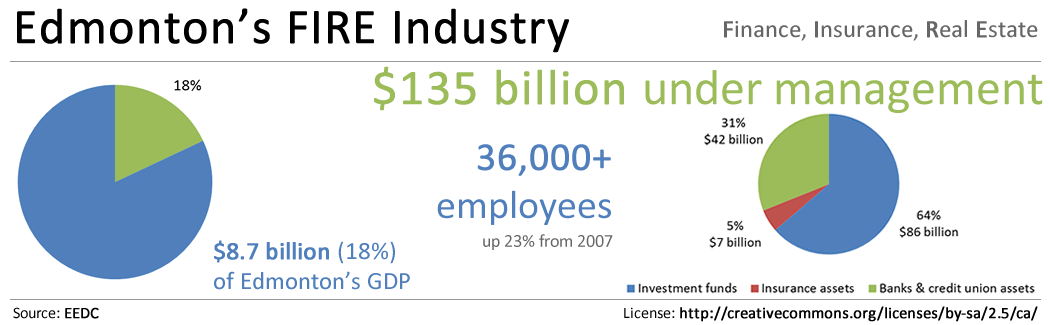
The acronym FIRE stands for Finance, Insurance, and Real Estate. It’s a big industry, with more than 36,000 employees in Edmonton (roughly 5.5% of our labour force). In 2009, the FIRE industry accounted for $8.7 billion or 18% of Edmonton’s GDP. Employment in the industry has grown 23% from 2007, and GDP created from the FIRE industry has grown 40% over the last ten years (compared to 30% overall).
Those numbers come from Greg Bainbridge and Tammy Fallowfield at Edmonton Economic Development Corporation (EEDC). They were nice enough to help me gain a better understanding of the industry.
I wanted to get a sense of just how big the industry is, compared to other places. As you might expect, it’s difficult to compare Edmonton with a population of around 1 million people to Toronto, which is four or five times our size. Comparing Alberta as a whole makes more sense. That means looking at Calgary and Edmonton together, an idea that both EEDC and the Alberta Economic Development Authority (AEDA) are promoting. Greg told me that “Calgary and Edmonton are complementary financial service centres”, something that is common in other places as well (Dallas/Houston, Geneva/Zurich, Amsterdam/Rotterdam, etc). He pointed me to AEDA’s recent report entitled Building Alberta’s Financial Services Industry (PDF). Sure enough, one of the “strengths we can build upon” listed in the report is the complementary nature of Calgary and Edmonton’s financial services sectors.
The local financial services industry in Calgary has established a reputation as among the world’s best for energy financing. Edmonton’s financial services industry, meanwhile, has established strengths in banking and risk management.
The report makes the point that as a whole, Alberta’s FIRE industry is, well, on fire. From 2004 through 2009, total capital investment in Alberta totaled almost $433 billion. Here’s what the per capita investment looked like across the country in 2009 (the national average was $9,174):

Employment growth in the financial services industry in Alberta has outpaced the national average over the last ten years as well.
We’re not without challenges, of course. The AEDA report cites economic diversification as a key challenge:
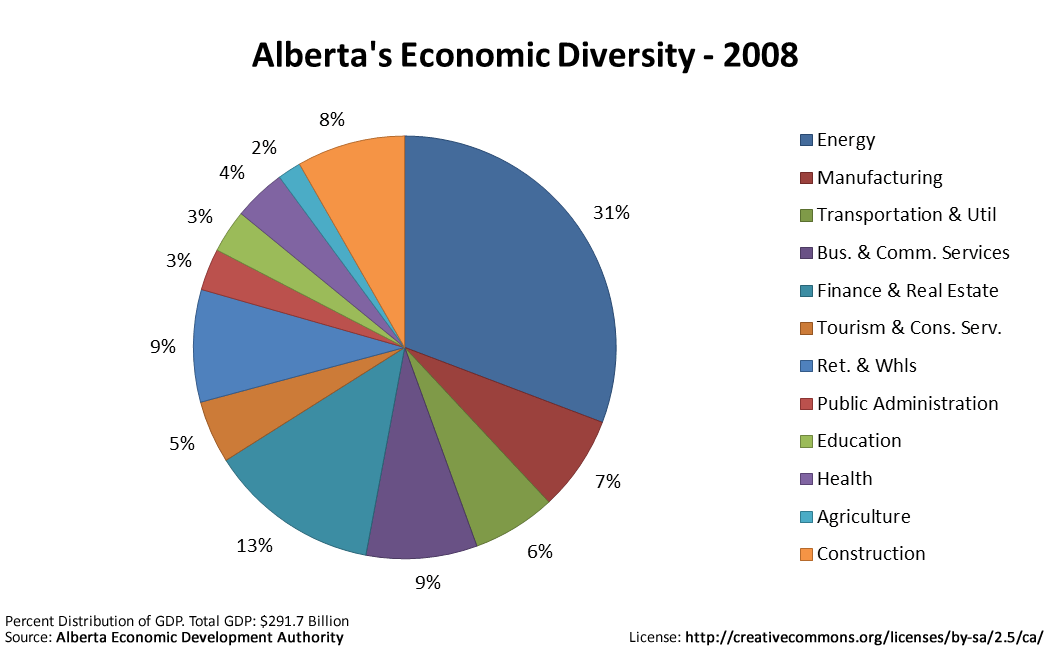
Another key challenge is a shortage of skilled labour: “compared to those of other provinces with financial centres, Alberta’s labour force includes the lowest proportion of individuals with post-secondary education.”
That’s a challenge that the industry is tackling here in Edmonton. Greg described the industry as “an industry of human capital, the foundation of which is smart people”. The University of Alberta has a number of programs of course, such as the MBA program, and NAIT offers a risk management program for insurance, but beyond that there isn’t much in the way of FIRE-specific education. Many of the industry’s senior positions have been filled by drawing expertise from elsewhere, and attracting talent has been a major focus of the industry.
That’s one of the reasons that EEDC recently formed the Financial Services Working Group here in Edmonton. Greg told me that the industry has grown quite organically and independently thus far, due at least in part to the government being located here (thinking of AIMCo and ATB, for instance), but that has meant very little coordination or working together (a mission to Toronto in June 2009 focused on recruitment was one of the first tangible examples of working together). The working group, which met for the first time in October, is brainstorming ways to further the industry, and working more closely with educational partners such as NAIT to develop relevant curriculum is a key outcome of that effort.
Continuing education of the industry’s labour force is another goal. Conferences, luncheons, and other events are all being considered. Though the University of Alberta has the only Chartered Financial Analyst (CFA) partnership in Western Canada, there isn’t a strong understanding of the designation in the industry (think of it as the CA equivalent for investment professionals). There are also opportunities to share research being done at the University of Alberta more directly with the industry.
So who are some of the key players in the FIRE industry in Edmonton?
- Canadian Western Bank – Formed as the result of a series of mergers & acquisitions, but started in 1984 as the Bank of Alberta. CWB has nearly $12 billion in assets, more than 1200 employees, and has achieved 89 90 consecutive profitable quarters.
- ATB Financial – Founded in 1938 under William Aberhart. ATB has more than $25 billion in assets and more than 5000 employees.
- Servus Credit Union – Formed as the result of a series of mergers, the largest of which was Capital City Savings, formed in 1987. Servus has nearly $10 billion in assets and more than 2000 employees.
- AIMCo (Alberta Investment Management Corporation) – Created by legislation in March 2007. AIMCo manages approximately $71 billion and ranks as one of the five largest institutional investment managers in Canada.
- Peace Hills Trust – Established in 1980. Peace Hills has nearly $500 million in assets and over 120 employees.
- Peace Hills Insurance – Established in 1982. Peace Hills has more than $270 million in assets and more than 175 employees.
- ATRF (Alberta Teachers’ Retirement Fund) – Has been administering a pension plan for Alberta teachers since 1939. ATRF has assets of roughly $5 billion.
These organizations and others in the FIRE industry will play an important role in the future economic growth of our city and province. As the AEDA report states:
The financial services industry is a critical enabler of economic growth, competitiveness, scalability, and productivity. It provides businesses and other industries across the economy with the necessary capital, financial support and advice to pursue opportunities and compete internationally. A robust financial services industry facilitates connections and access to international markets, and helps develop local entrepreneurship, equity, and wealth.
They might be large, but these organizations are also part of the community. ATB Financial, for instance, is a very active community member with thousands of volunteers hours and millions of dollars invested.
The future for the industry looks bright, and initiatives such as the working group should help to take the industry to the next level. Greater engagement with educational partners is important, but the industry will need to make even broader connections to truly succeed. Organizations such as the Edmonton Financial Literacy Society (of which Greg is the chair) can help in that regard. It’s also encouraging to see people like Larry Pollock, CEO of Canadian Western Bank, connect with young professionals like he did at the Emerging Business Leaders’ September meeting.
Edmonton’s FIRE industry is successful and growing, with over $135 billion under management. Remember that the next time someone tells you Edmonton is blue-collar!
 MasterMaq's Blog