Divertido’s Network @ The Aquatic Lounge

Tonight I finally made it out to a Divertido event! Hosted at the Eye Care Group on 104th Street and Jasper Avenue, Network @ The Aquatic Lounge was Divertido’s twelfth event since they launched in September 2008. I’ve wanted to attend one of their events for a long time now, but always had something else going on. Here’s the Divertido elevator pitch:

Divertido Urban Jaunt is redefining what networking is all about by creating extraordinary events that go beyond the typical business mixer. The possibilities are endless! Come out, experience, enjoy and expand your network the Divertido way!

What is the Divertido way? First, each event has a theme, and features related decor, lights, and other surprises. Tonight, for the aquatic theme, there were blue lights and balloons, sushi, small fish bowls, and yes, a mermaid! Second, events are held at unique venues, unlike your typical networking event. Tonight’s was at the Eye Care Group, and previous events have been held at venues like the Coney Island Candy Shop, Spinelli’s, Ginger Clothing & Apparel, and EnPrivado. Third, the vibe is informal and hip. There’s a DJ, beer and wine, and business professional dress (though there is no official dress code).

Divertido

There’s no agenda, no speeches, and interestingly, no common thread among the attendees (other than the fact that they heard about Divertido). There was a really diverse group of people there tonight – I met a realtor, financial manager, a “chief uptime officer” (love it), and many others. It’s great if you love to meet new people!

DivertidoDivertido

Divertido was created by Roberto Moreno and Elisse Heine. You can see an interview with them here. You can see the rest of my photos from tonight here. Check out the website for more information and future events.

Notes for 3/28/2010

Here are my weekly notes:

Banff
The Banff Centre (the new Kinnear Centre for Creativity & Innovation, on the left, is coming along quite nicely)

Edmonton Notes for 3/27/2010

Here are my weekly Edmonton notes:

Recap: IABC Edmonton’s Connecting the Dots Workshop

The Edmonton chapter of the International Association of Business Communicators (IABC) held a mini social media conference called Connecting the Dots yesterday the Art Gallery of Alberta. Hosted by Justin Archer and Jay Averill, the event featured three speakers and a panel. George Siemens opened the conference with a “30,000 foot view” of the social media landscape – you can take a look at his slides here. Next up was myself, talking about social media’s impact on public policy. I used the City Centre Airport debate as a case study. After me, Mary Pat Barry presented Edmonton Stories as a case study, outlining how the site came to be what the next steps are. Finally, four panelists closed out the event: Karen Unland, Norman Mendoza, Dave Cournoyer, and Chris LaBossiere.

The common thread for the day seemed to be that “the medium alters the message.” George talked about it in his keynote, and it popped up again and again throughout the day. Everyone seemed to agree that social media is still young, and there is much change and maturation on the horizon.

As for my own presentation, I think it went quite well. I tried to present the story of how social media played a role in the ECCA debate, and also attempted to pull out some lessons. The main ones were:

  • Blogs are the starts of social media! Something I’ve become fond of saying. I really think the fact that the pro-closure side used blogs so effectively had a huge impact. Blogs allow longer form content, they have great longevity (easy to find old posts, not so with tweets), and they index well in search engines.
  • Don’t reinvent the wheel. From the hashtag (#ecca) to the Facebook group, I looked for existing communities when I got involved with the debate. Too often, organizations try to start something new, when it’s often a better idea to link up with whatever already exists.
  • Translate online interest into offline action. All of the tweeting and blogging and other social media activity that happened around the airport debate wouldn’t have meant anything if it didn’t translate into people calling and emailing their councillors.

The panel was really interesting. It wasn’t very balanced, with all four panelists being pro-social media, and I think that made the tone of the discussion with the audience a little combative. There were still some really great questions asked and answers given, however. Some of my favorite quotes/highlights:

  • Organizations can’t have conversations, only people can. (Chris)
  • People who live-tweet events probably listen better. (Karen)
  • Transparency is the new objectivity. (Karen, citing Jay Rosen)
  • Recognize that people make mistakes. How you handle them is more important than the actual mistake (usually). (me, on Twitter)
  • Links are the currency of the web. Social media helps us share them faster and wider. (me, on Twitter)

Twitter played an interesting role in the panel – there was a giant screen behind the panelists showing #iabcyeg tweets on TwitterFall. It became a point of contention, actually, with some arguing that expanding the conversation beyond the room was invaluable, while others thought perhaps it was disrespectful to be tweeting while others are talking. There were also questions about credibility, about employee use of social media, about how to monitor for mentions of you or your organization, etc. Really great discussion that probably could have gone on much longer!

Thanks to IABC for allowing me to take part – it was lots of fun! If you’re looking for a social media event to attend in the future, check out the conference that George and his team are organizing in April (on ShareEdmonton). And stay tuned to IABC Edmonton on Twitter.

Recap: GalaGuru 2010

Last night was the 2nd Annual GalaGuru, “an event that celebrates the co-mingling of the creative arts and technology.” Hosted by Guru Digital Arts College at the fantastic Latitude 53, the party was very well-attended and was lots of fun! The style was “Mad Men / Stray Cats rockabilly” and while there was some discussion as to what that meant, some people just looked amazing.

The festivities got underway at 6pm, with most people arriving closer to the start of the “program” at 7pm. Guru’s Owen Brierley shared some news on Guru Digital Arts College and congratulated the school’s most recent grads. In 2008, they had 14 students. Last year, they had 28. And this year, they are aiming for 56! It’s great to see them growing here in Edmonton.

GalaGuru 2010GalaGuru 2010

The Be Arthurs, Edmonton’s official ukulele cover band, rocked out for most of the evening. Hip hop artist Steb Sly was also on hand to keep the party lively. There were computers setup around the space (which many people used to check Twitter) and in the “viewing room” attendees were treated to ZoomJer’s creepy basement videos as well as screenings of some the Guru students’ most recent work. Of course, there was also good food and local drinks!

The Be Arthurs

I was really happy that Guru decided to support Twestival this year, meaning we could have one bigger event rather than two smaller ones. The money raised last night will go to Concern Worldwide, an organization that provides education for the world’s poorest children. In addition to whatever online donations were made, we managed to raise $293 last night. Thanks everyone!

GalaGuru 2010@bingofuel

In his opening remarks, Owen did a good job of highlighting Edmonton’s various creative communities and how they are increasingly getting connected. Last night was proof of that – lots of people told me they had never been to Latitude 53 before, and that they didn’t know too much about Guru. It’s always a good thing when local people meet one another!

GalaGuru 2010GalaGuru 2010

Thanks to Guru for hosting such a great event – can’t wait until the next one! You can see a few more photos here.

Social Media and the City

We’ve all heard the stat: more than half of the world’s population now lives in cities and towns. Wellington E. Webb, former mayor of Denver, is credited as saying “The 19th century was a century of empires, the 20th century was a century of nation states. The 21st century will be a century of cities.” Urban areas are extremely important, for the allocation of resources (such as education and health care) and the creation of social and economic opportunity, among other things. As the UNFPA says: “The challenge for the next few decades is learning how to exploit the possibilities urbanization offers. The future of humanity depends on it.”

I believe that technology is vital for this challenge. It was technology that made the city possible, after all, by enabling and encouraging increased population densities. Urban settlements expose incredible network efficiencies because of this density, whether for trade, communication, or service delivery. It is these network efficiencies that, as strategy consultant and fellow Canadian Jeb Brugmann said, “make cities the world’s strategic centres of social innovation.”

Technology will be used in an endless number of ways to exploit the possibilities and to address the challenges of urbanization, but I think creating a sense of place will be key. Resilient cities, those that are sustainable, eco-efficient, and place-based, are one of the four possible outcomes for cities in a world of significant challenges like climate change, according to Dr. Peter Newman (PDF). Telling the story of a place is necessary for a city to become resilient, because creating a stronger sense of place increases the viability of the local economy and facilitates innovation. Social media is driving transparency in cities and is enabling citizens to tell the story of their place like never before.

One definition for social media comes from JD Lasica and Chris Heuer, and it goes like this: “Any online technology or practice that lets us share (content, opinions, insights, experiences, media) and have a conversation about the ideas we care about.” Put another way, you could say that social media tools and technologies are strengthening democracy.

Social media is becoming the best amplifier of a city that we’ve ever seen. True, social media makes it easy to spread the word beyond a single city and there’s definitely value in that, but it’s at the local level where social media truly shines, by taking the network efficiencies created by cities to the next level. Social media is helping to facilitate a new relationship between government and citizens, is enabling creatives inside cities to better connect with one another, and is empowering citizens like never before. In short, it improves a city’s social capital.

Natural capital is made up of the natural environment, such as the river valley here in Edmonton. On top of that we build infrastructure capital – roads, houses, buildings, lights, etc. Human capital and organizational capital refer to the individuals and organizations that use the natural and infrastructure capital to start and grow families, to build companies, and to otherwise create economic value. Social capital represents trust, social engagement, civic participation, reciprocity, and networks.

Social capital is critical for enabling innovation, making it possible to tackle tough problems. Within a city, social capital is vitally important because as Cameron Sinclair pointed out in his TED Wish, “all problems are local and all solutions are local.” Or as you’ve probably heard in the past, “think global, act local.” I think that applies quite broadly; for instance, to climate change. It’s a global problem, but it’s one that we need to approach locally. If we don’t succeed at reducing our impact on the environment at the local level, there’s no hope for solving the problem globally.

For these reasons, I’m extremely passionate about social media and the city. I’ve written a lot in the past about the impact social media is having on Edmonton and other cities, and I’ll continue to do so. Cities are increasingly important, and social media is making them stronger. I think that’s very exciting!

Related links worth clicking:

Thanks to Ted Gartside for the Creative Commons-licensed globe photo of New York.

2010 Mayor’s Celebration of the Arts

Sharon and I attended our third straight, and the 23rd annual, Mayor’s Celebration of the Arts tonight, held at the Winspear Centre. The event “celebrates some of the best artistic talents our city has to offer” and offers “sample-sized performances from some of Edmonton’s most talented artists and performers.” I’ve always enjoyed myself in the past, and tonight was no different.

Here is Mayor Mandel’s message to all Friends of the Arts, clearly inspired by the Vancouver Olympics:

Our creative culture helps make Edmonton the interesting and exciting city we are proud to call home and I’m proud to host this celebration of one of our city’s greatest assets.

Throughout the Vancouver Olympics, many of us felt inspired and proud as we watched out athletes strive for excellence. Like our Olympic athletes, Edmonton’s artists, writers and performers entertain and inspire us…stimulate and challenge us. This evening is all about Edmonton’s creative minds and their drive for excellence and achievement.

As well, during the Olympics we saw many stories of the “difference makers” – those who support our athletes as they strive to excel, and we were touched by these stories. In Edmonton, it is our businesses and community that are the difference makers to our artists – standing behind them and supporting them in their endeavours.

Tonight, we honour every member of Edmonton’s creative culture, and thank those who support it. Enjoy the show!

The full list of tonight’s nominees is available at the PACE website. Here are the winners:

The Mayor’s Award for Sustained Support of the Arts
Players de Novo, nominated by Concrete Theatre

The Mayor’s Award for Innovative Support by a Business for the Arts
Maclab Enterprises, Bruce Bentley, President & CEO, nominated by Edmonton Symphony Orchestra

John Poole Award for Promotion of the Arts
Allan E. Scott, nominated by Art Gallery of Alberta

City of Edmonton Book Prize
Waiting for Columbus, Thomas Trofimuk, McClelland & Stewart

Stantec Youth Artist Award ($2500 cash prize)
Matthew Jonah, nominated by Greg Dowler-Coltman

TELUS Courage to Innovate Award ($2500 cash prize)
Trevor Anderson, nominated by City of Edmonton, Office of the Environment

Northlands Award for an Emerging Artist ($2500 cash prize)
Raymond Biesinger, nominated by David Berry

Molson Award for Excellence in Artistic Direction ($2500 cash prize)
Greg Dowler-Coltman, nominated by Edmonton Opera

Sutton Place People’s Choice Award
Jeff Holmwood, glassworks

ATCO Gas Award for Outstanding Lifetime Achievement ($2500 cash prize)
Alice Major, nominated by John Mahon

2010 Mayor's Celebration of the Arts2010 MAyor's Celebration of the Arts

Performers included:

  • Yellow Ribbon Dancers, who opened the show
  • Good Spirit Trio, classical musicians
  • Jeremy Baumung & Kenneth Brown, who performed Homeless, a really moving story about working in one of Edmonton’s toughest homeless shelters
  • Allez Ouest, the face of Franco-Albertan music
  • 3rd Street Beat, Edmonton’s first hip hop studio, who wowed the crowd after the intermission
  • Andrew Grose, a very funny comedian who made everyone laugh with his “bed in a bag” bit
  • The Wheat Pool, who performed two songs from their new album – I definitely need to check these guys out
  • Vinok Worldance, who closed the show

My favorite performance was easily 3rd Street Beat, they really stole the show for a few minutes! I also really enjoyed The Wheat Pool, Andrew Grose, and Jeremy Baumung’s performance, which was top notch. The diversity of performances seemed to be back this year, though the second half of the night definitely had the most energy.

Sharon and I were kind of looking forward to the big dance at the end – where everyone, including the Mayor, gets up on stage as part of the final performance – but for whatever reason it didn’t happen this year. I guess the High School Musical-inspired foyer dance at the beginning made up for it though!

Congratulations to all the nominees and winners!

You can read my previous recaps here: 2008, 2009

Notes for 3/21/2010

Here are my weekly notes:

Edmonton Notes for 3/20/2010

Welcome to Spring! Here are my weekly Edmonton notes:

We had a really awesome sunrise in Edmonton this week:

Edmonton Sunrise

How much traffic do the Edmonton Journal and iNews880 get from Twitter?

Depending on who you talk to, Twitter is either killing news media or saving it. A recent analysis by Hitwise found that less than 0.2% of people who use Twitter wind up going to news and media sites (thanks to Karen for the link). Their analysis looks at Twitter as a whole though, and I’m not sure how well it accounts for local news sites. I believe very strongly that social media has the greatest impact at the local level (more on this in a future post). Given that, I have long wondered how Twitter has impacted local news media here in Edmonton. Last night, I finally did some analysis. I decided to explore how much traffic the Edmonton Journal and iNews880, Edmonton’s two top tweeting media outlets, received from Twitter last year.

@EdmontonJournal

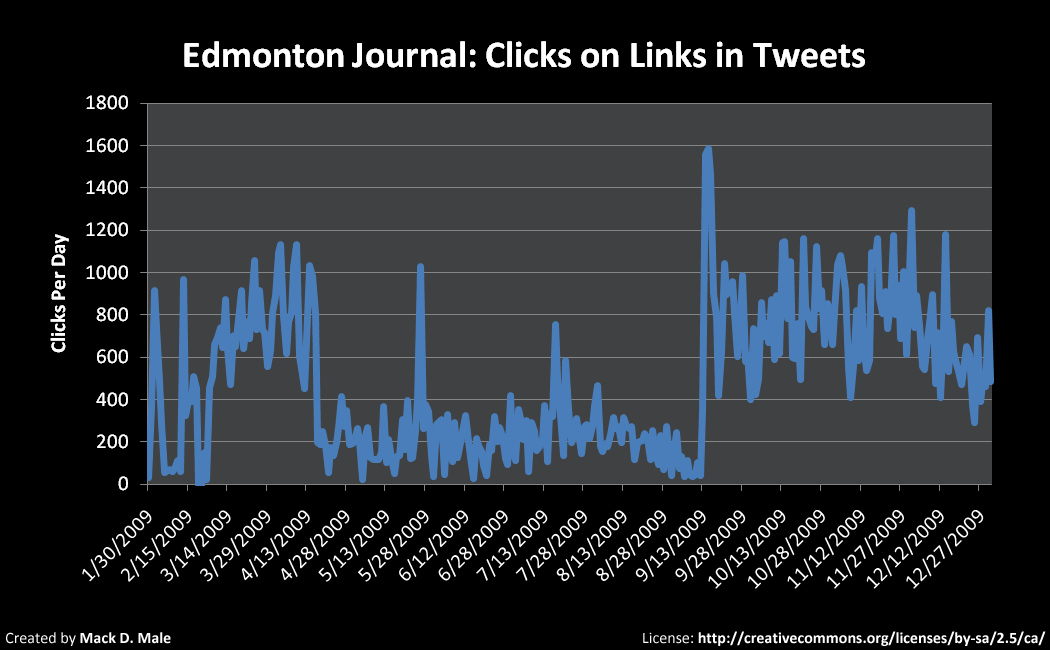
First up, the Edmonton Journal. They’ve been tweeting news articles since at least January 2009, so I had lots of data to play with. They used tweetburner to shorten links until September when they switched to bit.ly. Using the APIs available from those services, I added up all the click stats for all the links posted by The Journal. Here’s what I found:

Lots of variation, as you can see. Some of that is down to the use of two services, some of it is because of the number of Twitter users. There are probably dozens of other factors too.

For the period January 30 through December 31:

  • A total of 153,968 clicks were recorded on 4737 links.
  • That’s an average of 33 clicks per link, and an average of 15 links per day.
  • According to the stats on the bit.ly links, 95.4% of clicks come from the Edmonton Journal’s hash*.
  • The link with the most clicks (700) was this one, on May 26. It doesn’t work, because annoyingly The Journal doesn’t display old articles for some reason, but it appears it was about Edmonton’s Poet Laureate Roland Pemberton.
  • The day with the most clicks, September 14, doesn’t appear to be special…just lots of clicks that day for some reason (any ideas?).

@iNews880

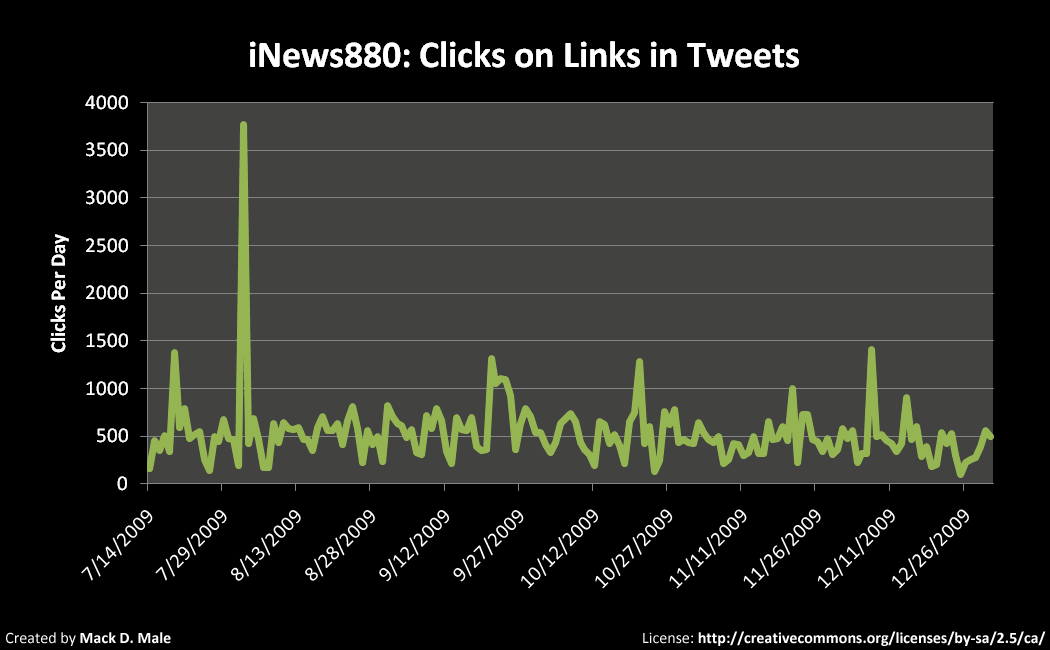
Next up, iNews880, one of the first local media organizations to join Twitter. They used tinyurl.com until July, when Twitter switched the default to bit.ly, so unfortunately I only have data for the latter half of the year:

For the period July 14 through December 31:

  • A total of 90,500 clicks were recorded on 3811 links.
  • That’s an average of 24 clicks per link, and an average of 22 links per day.
  • According to the stats on the bit.ly links, 93.8% of clicks come from iNews880’s hash*.
  • The link with the most clicks (1933) was this one, on August 2 (that’s the huge spike in the graph above). The link goes to the report on the Big Valley Jamboree stage collapse, and it was popular because it included before and after photos.

Edmonton Journal vs. iNews880

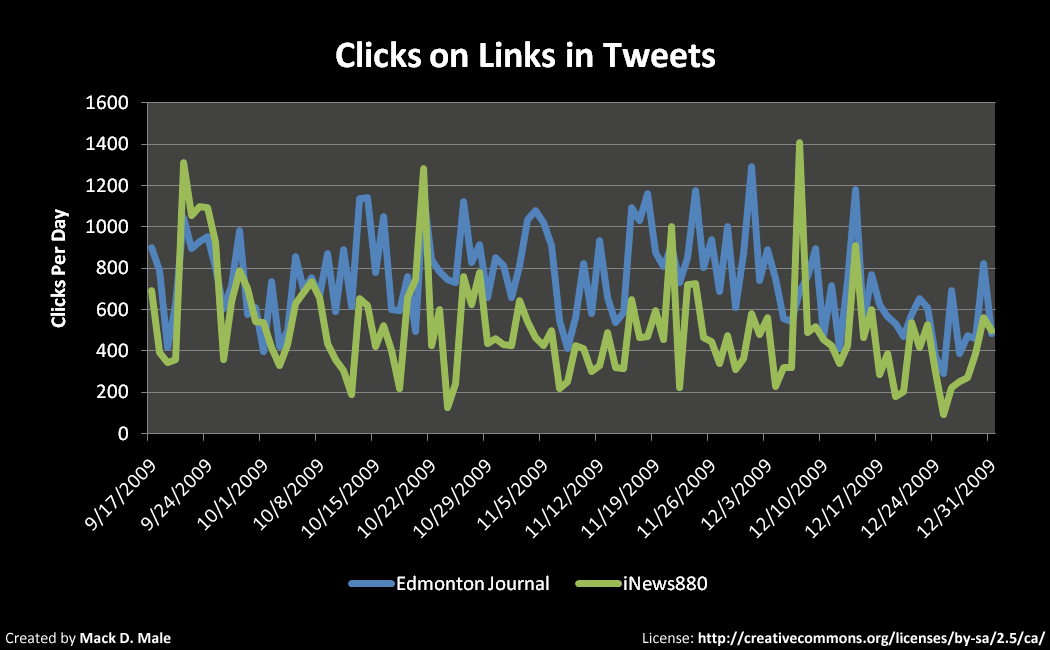
I wanted to do a quick comparison, so I chose the period September 17 through December 31, because both sites used bit.ly for links during that time. Here’s what it looks like:

During that time:

  • The Edmonton Journal posted 2369 links (23 per day) and iNews880 posted 2261 links (22 per day).
  • A total of 79,519 clicks were recorded on Edmonton Journal links (an average of 751 per day or 34 per link).
  • A total of 53,815 clicks were recorded on iNews880 links (an average of 508 per day or 24 per link).

Thoughts

That’s a lot of clicks! Clearly Twitter and other social networking sites (where most shortlinks are posted) are having an impact. But how much? According to the latest report by the Newspaper Audience Databank (NADbank), weekly online readership at EdmontonJournal.com increased by 35% last year to 115,900 from 85,800 in 2008. That’s an increase of 30,100 readers per week. According to the click stats above, The Journal received 3208 clicks per week in 2009. So what does that mean?

Roughly 10.7% of the Edmonton Journal’s online readership increase in 2009 came as a result of posting links to Twitter.

And if I had to guess, I’d say my analysis probably underestimates things. Apparently the NADbank data is based on surveys, so I’m not sure how accurate it is, but it’s probably within acceptable margins of error. I’m also not sure what exactly a “reader” is – a page view, a visit, etc.

Caveats

I’ve tried to be as accurate as possible, but I can’t make any guarantees!

  • All the click stats are current as of last night.
  • I’m suggesting that all the clicks come via Twitter, when that’s probably not entirely true. Links get passed around, displayed on websites, etc. But the shortlinks do originate at Twitter.
  • It’s possible that The Journal or iNews880 posted a link to somewhere other than their own sites, but uncommon. I did remove one link from the iNews880 dataset, because it pointed to an Environment Canada site (it was obvious, lots of total clicks as others have linked there too). For the rest, I’m making the assumption that the links point to the news sites.
  • I don’t know how reliable the stats from bit.ly and tweetburner are. I suspect they are quite a bit different than server logs or Google Analytics metrics.
  • I would assume that both services tweaked the way stats are calculated throughout the year, so 15 clicks on a bit.ly link in May is probably different than 15 clicks on a bit.ly link in December.

* – When you shorten a link using bit.ly, you get a unique hash. If I shorten the same link, I get a different hash. The stats are recorded and made available individually and in aggregate, however.