Media Monday Edmonton: Update #74

Horrible news out of Boston today with an attack on the Boston Marathon. Jeff Jarvis called it a “media attack” tonight: “The attack on the Boston Marathon was designed to maximize media coverage: a popular event with cameras everywhere and a narrative that will be sure to follow about innocent enjoyment henceforth ruined by danger.”

Here is my latest update on local media stuff:

  • The next Art of Conversation event, hosted by Graham Hicks, Rob Christie, and Audie Lynds, is scheduled to take place on April 24 at 4:30pm at The Rose and Crown Pub downtown. If you decide to attend, be prepared to put down your cell phone for at least an hour!
  • Should the City forgive property taxes on the Film Alberta Studio, formerly known as Allarcom Studios? “The next movie expected to use space at the studio is the crime drama Cut Bank, which will bring actors Ben Kingsley and John Malkovich to Edmonton in May,” according to the Journal.
  • The Journal is still looking for a Digital Media Developer. The deadline to apply is Saturday.
  • I really like this visualization of the Oilers’ history creating by the Journal’s Lucas Timmons.
  • Avenue Edmonton is looking for an Art Director. “As the Art Director for Avenue, you will shape the tastes, trends and psyche for Edmontonians.” The deadline to apply is April 30.
  • Surprise, surprise: the downtown arena dominated online discussion last week. What will we talk about when construction starts?
  • It’s okay Kevin, it happens to everyone.

  • Tomorrow is the big day: Leduc’s new radio station, 93.1 FM The One, launches at 9:31 AM! And in case you were wondering about the station’s signal strength, Mike McGuire has you covered:

You can follow Edmonton media news on Twitter using the hashtag #yegmedia. For a great overview of the global media landscape, check out Mediagazer.

So, what have I missed? What’s new and interesting in the world of Edmonton media? Let me know!

You can see past Media Monday Edmonton entries here.

Edmonton Notes for 4/14/2013

Here are my weekly Edmonton notes:

Here are some upcoming events:

Cambridge Building
The sidewalks on the north side of Jasper Avenue are open again, as you can see in this shot of the Cambridge Building by Darren.

Recap: DemoCamp Edmonton 21

Edmonton’s 21st DemoCamp took place tonight at the Telus Centre on the University of Alberta campus. DemoCamp brings together developers, creatives, entrepreneurs, and investors to share what they’ve been working on with the local tech community. Tonight’s audience seemed to be filled predominately with first-timers!

We had five demos tonight. In order of appearance:

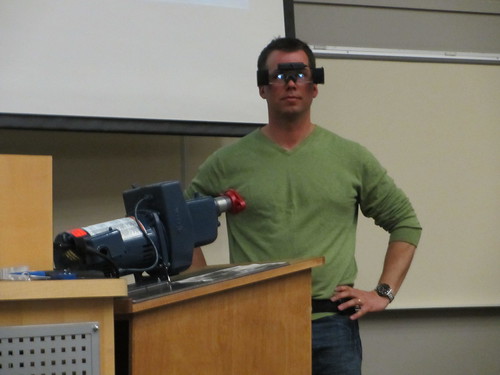
  • Opening the show was David Nedohin and Graham from Scope Technologies. They build augmented reality training systems. Tonight they demoed a pretty slick augmented reality training app for a pump assembly. Using a pair of Epson Moverio glasses outfitted with a camera, we were able to see everything David saw as he followed the on-display instructions. The app supports three modes: observe (learn what you’re supposed to do), execute (do it), and record (for auditing purposes). It of course drew comparisons to Google Glass, though the key offering here is the 3D overlay training solution, not the hardware.
  • Next up was Nolan Smits who showed us Nutrsync, a project he has been working on for the last nine months or so. After Nolan took a greater interest in his own health, he decided an app to track nutrients would be useful and he set out to build it. Written in PHP with lots of jQuery, it’s a slick looking app even if it is missing a few features still. You can quickly see how much of each nutrient you’ve eaten, and it’ll suggest foods to fill up on the ones you’re missing. For me the biggest challenge is the same as every food-tracking app: unless you’re eating pre-packaged brand name meals or fast food, it’s too much of a pain to input what you’re eating!
  • Third tonight was Ric Williams from Hungry Moose Games who demoed their new effort called 9 Lives: Casey and Sphynx. One of the neat things about Hungry Moose is that it’s a mashup of local talent, including some ex-BioWare guys and Ric who was with Empire Avenue (and was inspired the guys who built Life Goes On, demoed at DemoCamp Edmonton 18). The highlight of the work-in-progress demo was that the game was built with Unity and was running on a Kindle Fire HD, controlled with a Green Throttle Bluetooth controller. “The $60 game and $125 million investment is going the way of the dodo,” Ric told us, explaining the upheaval taking place in the gaming industry right now.
  • Next up was David Quail and Tim Fletcher who demoed Zenlike. They’re hoping to save users time by utilizing machine learning and natural language processing to automate mundane, boring tasks. Their first area of focus is meeting scheduling. You simply CC your “virtual assistant” on an email thread to setup a meeting, and it parses out the details and sets up the calendar entry and invites (kind of like the way TripIt automagically parses out your itinerary). It was really slick to see in action (it’s a combination of Mechanical Turk and algorithms). I look forward to the day when my devices just know what I want to do and do it.
  • The final demo of the evening was from Ben Zittlau and Greg Bell. They showed us a new Mover.io feature called Clonr. The idea is pretty simple: magically move things from one place to another! They’ve decided to focus on WordPress to start, and tonight they demoed the ability to completely move a WordPress site from one server to another with basically a single click. They support DreamHost, 1and1, HostGator, as well as plain old FTP, and they’ll move beyond WordPress to other platforms once they’ve got a bit more functionality in place. There’s a massive market for this kind of thing!

DemoCamp Edmonton 21
David Nedohin showing us the augmented reality demo

It was another solid night of demos, so well done to all the demoers! I think my favorite was probably Zenlike, because I can see the trajectory they’re on and it’s thrilling. I, for one, welcome our new robotic overlords. I think there’s no question that Clonr is going to be a big success for the Mover guys, and I’m looking forward to seeing that tool evolve.

Some of the announcements made tonight include:

  • Edmonton now has a Python Meetup Group! They’re planning to meet on the second Monday of each month.
  • TEDxEdmonton 2013 is coming up on June 15. Tickets are on sale now, and some of the presenters have been announced!
  • Ready to build something? Startup Weekend returns to Edmonton on April 26.
  • I hope you see you on Friday at the new Intersect event, billed as a collision of artists and geeks.

If you haven’t already done so, sign up for the Startup Edmonton newsletter to keep up-to-date on future events (you can also join the Meetup group).

See you at DemoCamp Edmonton 22!

Media Monday Edmonton: Update #73

Here is my latest update on local media stuff:

  • I attended the Spacing Edmonton launch party last week, along with a few hundred other Edmontonians packed into The Common. It was great to see Spacing’s publisher and editor Matthew Blackett back in Edmonton for the event.

Matthew at the Spacing Launch

  • Local co-editor Paul Giang spoke at the event, and published an editor’s note to kick off the website:

Indeed, Edmonton is a city undergoing transition. With rapid economic growth, emerging global/regional issues and many ambitious projects underway, we have reached a critical point where we must have a constructive public discussion about Edmonton: to explore its past and present, to understand who we are and what do we want, and to appropriately address the future. This discussion has already started with many passionate citizens and we have many great stories waiting to be told and celebrated locally and globally. Spacing Edmonton aims to accelerate just that.

You can follow Edmonton media news on Twitter using the hashtag #yegmedia. For a great overview of the global media landscape, check out Mediagazer.

So, what have I missed? What’s new and interesting in the world of Edmonton media? Let me know!

You can see past Media Monday Edmonton entries here.

Edmonton Notes for 4/7/2013

Here are my weekly Edmonton notes:

Michael Walters Campaign Launch

Here are some upcoming events:

Pillow toss
Saturday was International Pillow Fight Day! Photo by Nelson Webb.

Potholes in Edmonton

Every year the City of Edmonton spends a few million dollars to fill a few hundred thousand potholes. Are potholes just a fact of life, or can we do something about them? I think the latter. It’s time for a more sophisticated and creative discussion about potholes in Edmonton!

Pothole
Pothole photo by More Bike Lanes Please

We hear the same thing every year. As spring approaches, dozens of stories are published about Edmonton’s pothole problem. We hear all about the freeze/thaw cycle of the winter and that’s why the potholes are bad. We hear that the City has crews out all the time fixing potholes, on average about 400,000 per year. We hear that a lot of money is being spent on the problem!

Here’s what Mayor Mandel said a few weeks ago:

“If you look at this winter — we’ve had freezing and thawing, freezing and thawing way more than any other year,” said Mandel, “and we have had a little more snow than normal. It creates havoc.”

“It’s not our intention to create a pothole … but it is a fact of life in our city,” said Mandel. “It will be there forever and we’ll never catch up.”

That sounds like a challenge!

I started digging into potholes, well figuratively anyway. I started with a series of questions, and then I just began researching. I went through old council minutes, I looked at City reports, I searched through old newspaper articles, etc. What was supposed to take a few hours turned into days! After a while I realized I had better stop and share what I had gathered, so that’s what you’ll find in this post.

Here’s a video for those of you in the TL;DR camp:

Here are some of the highlights of what I found:

  • Potholes form when water and traffic are present at the same time.
  • The City has filled more than 5.6 million potholes since 2000.
  • On average, the City fills about 433,000 potholes each year, with a budget of $3.5 million.
  • Annual pothole budgets have ranged from $1.5 million to $5.9 million since 1990, for a total of about $85 million (or $104 million adjusted for inflation).
  • Edmonton seems to fill twice as many potholes as any other large Canadian city.
  • The City maintains more than 4,600 kilometers of roads. The average quality of an arterial road is 6.1 out of 10, just below the industry standard. There is not enough funding in place to prevent this from falling.

There’s a lot more information in this PDF report that I’ve put together:

I put all of the data I gathered into an Excel document that you can download here. You’ll find some data in there that is incomplete – if you have the missing information, please let me know! If you use it to generate your own analysis, I’d love to learn from you so please share!

How can we solve the pothole problem in Edmonton? I don’t know. But doing the same thing over and over isn’t going to change anything either. Here are some ideas on how to make progress:

  1. Information is only useful if we can bring it together to turn it into knowledge. I’ve started to do some of that in the report above. In the absence of good data about weather patterns or traffic patterns, it’s easy to make assumptions. I feel as though I’ve only scratched the surface – there’s a lot more information that could be correlated to develop a better picture of the pothole problem.
  2. We need to make better use of the tools and expertise that we have in Edmonton. I’m thinking of tools like the Open Data Catalogue, for instance, and expertise like the transportation engineers and soil experts we have. Edmonton is one of the few cities that tracks the number of potholes filled, let alone makes that data available online, but we can do more! We also need to do a better job of harnessing the collective power of all Edmontonians for crowdsourcing ideas and data. Potholes don’t have to be just a transportation problem.
  3. There’s lots of interesting things happening elsewhere – Edmonton is not the only city that has to deal with potholes! What can we learn from others? There are self-heating roads, nanotechnology is being used to create crack-proof concrete, and all sorts of different polymers designed to make roads less brittle. How can we apply some of that knowledge?

What if we brought together engineers, scientists, designers, programmers, and other citizens for a one-day pothole unconference? What would they come up with? I think it’s an idea worth exploring.

Splash
Splash photo by Owen’s Law

I don’t think we’ll solve the pothole problem in Edmonton just by throwing more money at it, and we certainly won’t get anywhere with cheap gimmicks. Instead I think we need to get a bit more holistic and creative in our approach.

For now, I have two calls-to-action:

  1. If you’ve never reported a pothole using the City’s online form, give it a shot here. Don’t bother with forms or maps on other sites – use the official one.
  2. If you found anything in this post valuable, please share it with others.

Thanks for reading and happy pothole dodging!

Talking open data in Edmonton with Minister Tony Clement

Tony Clement, President of the Treasury Board of Canada, was in Edmonton today as part of a cross-country tour to gather feedback from the Open Data community. The federal government is preparing to launch a revamped Open Data Portal, and Minister Clement has been given the mandate to make it happen. After stops in the morning at Startup Edmonton and TEC Edmonton, Minister Clement was at City Hall for an Open Data Roundtable, hosted by the one and only David Eaves.

"Open Data is a global movement that is really gaining momentum across the country. Our Government wants to ensure we are making it as accessible as possible so that innovators and enthusiasts can harness this rich resource," said Minister Clement. "We are getting ready to unveil the next generation Open Data Portal and the input we received from Edmonton’s vibrant Open Data community will help us build a user-friendly site that will allow users to capitalize on this opportunity."

In addition to holding face-to-face meetings, Minister Clement also hosted a Google Hangout on Open Data last month. You can watch the whole thing here:

I was fortunate enough to be invited to the roundtable today, along with roughly two-dozen other Edmontonians interested in open data. We had a very limited amount of time to chat, but I think we still discussed a wide range of topics. I hope the information gathered was indeed valuable for the team in charge of the new portal.

As host, David organized our time around a series of questions. The first was to suggest ideas for what the next generation open data portal should be. We broke into small groups and then shared ideas back with the larger group.

The first thing I suggested was that it should not look like it was designed in 1995. I find all of the Government of Canada websites lacking in the aesthetics department! Certainly there’s something to be said for consistency, and I understand there’s an initiative underway to reimagine the entire GoC web presence. On the flip side of consistency though are the preconceptions that you may not want to be carried forward. If I look at the Open Data Portal today, it looks like every other government site, which makes me think it’ll be a mess of weird hierarchies and PDFs buried away. It’s not very welcoming or inviting!

Another theme was based around the idea that we can’t build a data portal that serves all possible audiences. But, we can do more than we are currently. So my group discussed the idea of intent-based profiles. The idea is you’d login, set some criteria like whether you’re a developer or not, and maybe your location, and the portal would then give you a personalized view. Of course, anonymous access should be preserved, so it shouldn’t be a requirement that you need to login.

Three other themes that emerged included: historical data and the realization that any data we create now will at some point become historical, articulated well by Heather and Maureen; the notion that the portal should facilitate the two-way movement of data, so that citizens can publish data into the catalogue as well as get data out of it; and the fact that documentation about data is important, and it doesn’t necessarily have to be created top-down.

The second question was related to datasets, both specific datasets that we’d like, but also criteria that make datasets valuable and/or interesting. The first thing that came to mind for me was geography. I’d love to be able to see all of the datasets related to Edmonton, or to municipalities, or to Alberta, or to provinces. Right now you have to really hunt to find datasets that compare cities, for instance.

I think Matt‘s two suggestions in response this question were spot on. The first was that the data he finds interesting is the data that makes the government uncomfortable. Minister Clement jumped in to assure us that there’s no conspiracy preventing certain datasets from being released. That would suggest a level of organization that most governments just don’t have, he joked. The second suggestion was that geographical data should be a key foundational dataset. Let’s see a base map of the country, zoomable to the neighbourhood level. Or to whatever smaller regions exist, whether it’s postal code, census district, garbage collection zone, or something else. I love this idea, and my only add-on suggestion was that geographical data doesn’t necessarily have to mean maps. Knowing the list of neighbourhoods or postal codes can be incredibly valuable outside of a map as well.

A few other themes that emerged about datasets were trends and historical data (I personally love the idea of a revision history for any datasets), some sort of metadata (the first dataset any portal should have is the list of datasets it contains, David suggested), and the notion of a data management plan.

We finished up the roundtable with a brief discussion on data standards, followed by a few minutes of open time. I spoke up on data standards along with Ben and Eugene, and suggested that data standards fall squarely under the "nice to have" category. It would be great if different datasets shared a common format, but we’d rather just have the data and worry about the differences with an abstraction layer.

Final thoughts mentioned by the group included dogfooding (the government should actively use its own data portal and datasets), the idea that everyone carries a phone and could be contributing data back into the catalogue, and the future world described by Devin that I think can be summarized as the Internet of Things. "The idea that we searched a catalogue of datasets will seem just as quaint as when we searched the web using Lycos," he said.

I really enjoyed the roundtable today, and I appreciate Minister Clement and David Eaves taking the time to listen to what we had to say. Thanks also to Chris and Ashley from the City for providing the venue and helping to facilitate.

Reflecting on it now, I think what I enjoyed most about the roundtable was the opportunity to chat with people in the local open data community. I haven’t given open data as much public attention lately as I should, and when you shift your gaze elsewhere it’s easy to miss all of the incredible people doing great things.

Recap: 2013 State of the City Address

Thousands of Edmontonians filled the Shaw Conference Centre during lunch today for the Chamber of Commerce’s annual State of the City event. Featuring Mayor Mandel, the event was an opportunity for our city’s business, community, and government leaders to reflect on the past year and to talk about the challenges and opportunities that lie ahead. Or at least, that’s what we were supposed to be talking about. Instead, the only thing on the minds of those in attendance was Mandel’s decision – would he be running again in October or not?

State of the City Address 2013

Many members of Mandel’s family joined him at the head table, including his adorable grandson, and that only fueled speculation that he would be announcing his retirement. As Mandel took the stage, he received a thunderous standing ovation. It was the kind of standing-O that said, “thanks for nine great years.” But it turned out to be premature.

“I know that there is expectation in this moment – one that I set myself – that I would answer a key question today about whether I would seek re-election this fall.

And as much as I pride myself on giving clear answers – I do not have an answer today.”

There was an audible gasp as he spoke the words. Most people were expecting a yes or no – the possibility of a maybe hadn’t even registered! I’ll admit that I was fairly certain he was going to announce that the current term would be his last, but it seems Mandel had more difficulty making a decision than anticipated. “Key issues affecting the state of our City are genuinely unsettled in my mind,” he said.

While Mandel touched on Make Something Edmonton and some of our city’s successes in his slightly-longer-than-normal speech, most of his comments were directed at the Province. And they weren’t positive. Specifically, Mandel focused on spending cuts to the post-secondary sector, and the imbalance of regional costs and funding.

State of the City Address 2013

First, he addressed the post-secondary sector and it’s very large impact on Edmonton, both to our economy now and to our future competitiveness.

“We should expect nothing less than passionate, relentless defense of this sector from our provincial representatives who should know better than to just stand by. We should expect that our Minister would actually engage this sector and challenge them to find solutions.”

Mandel stated that our post-secondary institutions have the potential to be “amongst the best in the world.” He went on to discuss his concerns with short-term thinking, and called for real leadership. “It means setting a course that people can believe in, and being clear about long-term intent.”

Next, Mandel addressed regional issues. While the Capital Region Board has at least started to address the issue of collaboration and planning together, the imbalance in provincial grant allocations “has not been touched,” he told us.

“The taxpayers of a city of 850,000 cannot continue to pay an unfair share of the costs of urban services for a region of 1.2 million. Making all municipalities responsible on both sides of the ledger is the only way to make growth fair – it is also the only way Edmonton can sustain itself.”

Here again, Mandel questioned decisions made by the provincial government in its most recent budget.

“If you really want to make a difference, not just for Edmonton – but for Alberta’s bottom line – this is a great opportunity for change. Because it will cost billions less to pay for a single coordinated regional plan – than for the wish lists of 25 municipalities.”

Mandel clearly had the element of surprise on his side today, and that helped to make the speech even more impactful. Advanced Education Minister Thomas Lukaszuk reacted strongly to Mandel’s criticisms. “I don’t know who pissed into his corn flakes, and you can quote me on that,” he told the Journal.

State of the City Address 2013

Mandel very much positioned himself as the defender of Edmonton today, and his call-to-action was to speak up for the city. “You know, Edmonton is a funny city,” he said. “We are so fiercely proud of what we have, but too often scared to tell others that we have it.”

Though he acknowledged that his eventual decision about whether or not to run again will impact this year’s election, Mandel urged candidates who may want to run to make their intentions known on their own schedules, not his. That’s easier said than done, of course. No one on City Council seems willing to run against Mandel. If he were to run for an unprecedented fourth term, it’s widely expected that he would win.

Mandel’s non-announcement today has the speculation engines revving. Is there funding news about the downtown arena forthcoming? Is he considering a jump into provincial politics? Who knows, maybe he simply hasn’t made up his mind yet. My own sense is that Mandel must feel as though he can resolve a couple of those “key unsettled issues” over the next few months, otherwise, why not just announce that he’s running again?

Edmonton is a better place because Mandel has been our mayor for the last nine years. He’s given so much to this city and it must be taking a toll, but clearly Mandel feels he has more to give. “My focus remains on the job at hand, on what I owe to Edmonton, and what Edmonton needs.”

Thanks to the Chamber of Commerce for inviting me today. You can read my recap of previous State of the City events here: 2011, 2012. You can read the full transcript of Mayor Mandel’s speech here (PDF), and the rest of his speeches here.

Media Monday Edmonton: Update #72

Hope you didn’t get duped too badly today! Here is my latest update on local media stuff:

  • Prepare yourselves for a media blitz tomorrow as Mayor Mandel announces whether or not he’ll run in October’s election! Keep an eye on the #yegvote hashtag for updates.

You can follow Edmonton media news on Twitter using the hashtag #yegmedia. For a great overview of the global media landscape, check out Mediagazer.

So, what have I missed? What’s new and interesting in the world of Edmonton media? Let me know!

You can see past Media Monday Edmonton entries here.

Edmonton Notes for 3/31/2013

Happy Easter! Here are my weekly Edmonton notes:

Here are some upcoming events:

Muttart Conservatory, Edmonton
Great shot of the Muttart Conservatory by Cezary Kucharski.