Transforming Edmonton: Shifting our focus from plans to implementation

Toward the end of 2006, the City of Edmonton started to look at refreshing its visioning and planning efforts. A number of major City plans were about to be renewed, including the Municipal Development Plan, the Capital City Downtown Plan, and the Transportation Master Plan. Administration explained the importance of these reports in an update to Council:

Major plans are plans of city-wide or corporate-wide significance.  Major plans act as foundation blocks for Administration decisions and recommendations to City Council.  They are also a fundamental building block for future Council decisions.  These plans are meant to be in place for multiple years, and the review of these plans takes significant time and resources by both Administration and Council.

A report published in early 2007 provided a more detailed update and proposed a method for developing a “Vision for the City of Edmonton” that would kick off a full planning cycle. The report also included a Strategic Planning Brief. Here’s a look at the proposed strategic development cycle:

And here’s a look at the proposed framework process:

Writing in the Edmonton Journal about public information sessions held by the City in October 2008, Todd Babiak noted:

This process, which also includes the City Vision for 2040, the 10-year strategic plan, the Ecovision, and the plan for downtown, is broadly called "Transforming Edmonton." We’re admitting, as a people, that we have made expensive and dangerous mistakes for a generation or so.

Mary Ann McConnell-Boehm, who managed the Municipal Development Plan at the time, said:

"This is what we heard from our stakeholders in 2006, about the direction they wanted our city to take. A different approach, more integrated, a little braver."

That more integrated process ultimately led to the creation of the City Vision, the City’s Strategic Plan for 2009-2018 known as The Way Ahead, and the associated “Ways” plans:

Many Edmontonians have noted that the last plan to be approved, The Way We Finance, is the one that’s supposed to help us pay for the rest! Still, when its approval finally happens later this year, it’ll bring the most ambitious planning cycle in the City of Edmonton’s history to a close.

There were previous efforts at establishing a city-wide vision of course, such as the “Smart City” initiative of the late 90s, but none stuck. Why did Transforming Edmonton succeed at getting off the ground when other initiatives had failed? I think a big reason was Mayor Mandel. After winning re-election in October 2007, Mayor Mandel told the Edmonton Journal:

“The vision we have is of Edmonton being a city of the world. A city that is vibrant, environmentally sensitive and attractive. And a city that cares about people and opens its arms to them, wherever they came from.”

The importance of Mandel’s victory did not go unnoticed by the Edmonton Journal’s Scott McKeen, who wrote:

Mandel’s win, though hardly a surprise, was much more than a ho- hum victory over the fringers, fanatics and languid Koziaks who ran against him.

His approval rating on Monday narrates a turning point in Edmonton’s history. If Mandel’s first term stood for anything, it was a shift away from historic nickel-and-dime civic politics.

Edmontonians, it seems, embrace Mandel’s big-city vision.

The success or failure of an effort as broad and ambitious as Transforming Edmonton cannot be attributed to one person of course, but under Mayor Mandel’s watch, the City became a bit more integrated and much more strategic.

Edmonton’s efforts at improving the visioning and planning process are not unique. Vancouver’s CityPlan was adopted in 1995 and is slated to come to a close in 2015 (to be replaced with Green Vancouver, I think). Toronto’s Strategic Plan was approved in three stages from 1999-2001. Ottawa adopted its Official Plan in 2003 to guide the city through 2021. Montreal’s Master Plan was adopted in 2004. Calgary adopted imagineCALGARY in 2006, which sets out a 100 year vision with targets every 30 years. Winnipeg replaced its previous Plan Winnipeg 2020 initiative with OurWinnipeg in 2011, presenting a 25-year vision for the city. Long-term planning seems to be the norm for Canada’s major cities.

Today nearly every aspect of the City of Edmonton’s operations have been affected by Transforming Edmonton. For example, every budget item references one of “The Ways” and/or the strategic goals, and internal structures have changed to match the new approach. We’ve also seen efforts to describe progress, such as the new Citizen Dashboard.

While some implementation has occurred, the focus of the last five years has unquestionably been on the creation of Transforming Edmonton’s plans and associated documents. The approval of the final major plan, not to mention the expected retirement of Mayor Mandel next week and April’s unofficial kickoff of campaigning for the October municipal election, should signal a shift toward more concerted implementation efforts.

A shift in focus from planning to implementation won’t just happen, however. Edmontonians need to demand it. We as citizens need to do a better job of asking how things are going, not just how things are going to be.

Media Monday Edmonton: Update #71

Here is my latest update on local media stuff:

https://twitter.com/CapitalIdeasYEG/status/314806813696589827

And now that you’re thinking of food…

Chris Cosentino
Here’s Top Chef Master Chris Cosentino doing his thing at NAIT where he’s the latest Chef in Residence! Check out the Twitter Chat NAIT did here.

You can follow Edmonton media news on Twitter using the hashtag #yegmedia. For a great overview of the global media landscape, check out Mediagazer.

So, what have I missed? What’s new and interesting in the world of Edmonton media? Let me know!

You can see past Media Monday Edmonton entries here.

Edmonton Notes for 3/24/2013

Here are my weekly Edmonton notes:

Earth Hour Before/After
Awesome before & after shot of Earth Hour in Edmonton by Darren!

Earth Hour-Edmonton 2013
Another great Earth Hour shot, this one by Hugh.

Here are some upcoming events:

Jewels of the West
Mark shows us that all that snow can be beautiful too.

Recap: Make Something Edmonton Launch Party

Tonight a few hundred Edmontonians gathered at the Avenue Theatre on 118 Avenue to celebrate the launch of Make Something Edmonton. With lots of buzz about the initiative but few details on the launch event itself, attendees arrived both excited and curious. Something was happening, but what? How would the evening unfold?

Make Something Edmonton Launch Party

Sharon and I caught the specially chartered ETS shuttle from City Hall which dropped us off right in front of the theatre. It turns out our driver, who was just 19 years old, had only moved to Edmonton a couple of months ago. He’d always wanted to be a bus driver, he told us, and he came here to make it happen! While enjoying the ride we chatted with The Local Good’s Tad Hargrave, catching up on one another’s projects and blueskying Make Something Edmonton. That sort of set the tone for the evening.

Make Something Edmonton Launch Party

We found the Avenue Theatre already buzzing with activity when we got there just after 5:30pm. Volunteers scanned tickets, checked coats, and welcomed us. We entered the theatre and found it completely transformed. The seating was gone, and the space had been converted into a two-level open room, with tables around the edges and the stage at the front. There were lights, cameras, food, and the pleasant sounds of connections being made and ideas being spread.

We split up and said hi to as many people as we could. It was a veritable who’s-who of the hyper-engaged in attendance, and I felt like every direction I looked there were familiar faces to greet. People continued to pour in and after a few brief delays to ensure the shuttles could all make it through the snow, the formal program got underway.

Make Something Edmonton Launch Party

Mayor Mandel took the stage first to welcome everyone and to say a few things about the project. I had managed to snag a few minutes with him just before the program began, and he seemed totally pumped about Make Something Edmonton. Who cares what people outside the city think, he told us. What matters is getting Edmontonians on board with the idea that Edmonton is a great place to make something. If we can do that, the rest will come. Mayor Mandel then brought Randy Boissonnault, a local entrepreneur, literacy advocate, and public speaker, to the stage. As our MC for the evening, Randy shared a few introductory thoughts and then welcomed Todd Babiak to the stage to provide some history.

Make Something Edmonton Launch Party

I really feel like tonight was Todd’s night. He would probably tell you that Edmontonians are the ones who came up with Make Something Edmonton, but he’s the one who listened to what we had to say and helped us put our thoughts into words. Todd spoke of Edmonton’s history of collaborating and building, and of our struggles with civic identity. He framed Make Something Edmonton as our city’s story, and noted that “a story is about choice.” Some in the room had made the choice to come to Edmonton, others had made the choice to stay.

Here’s the video he showed to help tell the Make Something Edmonton story:

Next we heard from four makers. Lewis Cardinal kicked things off by discussing the importance of our city’s history. He introduced words like Pehonan and Monto. Our pehonan (“gathering place”) is where Edmonton was born, the area we now call the Rossdale Flats. Monto, which is found in our city’s name – Edmonton – refers to our spirit. You can learn more in the Spirit of Edmonton presentation.

Make Something Edmonton Launch Party

The second speaker was Dave Mowat, who shared his idea for lighting up the High Level Bridge. It would take 45,360 LED bulbs to light the bridge, he told us, and the money for the project will come not from the government, but from Edmontonians themselves. His presentation was a lot like the one he delivered at Pecha Kucha 14, but with some new visuals to help illustrate the idea.

Make Something Edmonton Launch Party

Third was Christy Morin of Arts on the Ave. She welcomed everyone to Alberta Avenue and gave some background and context to the ongoing revitalization of the area. The initiative got underway over eight years ago because she was sick of the crime and knew the community could be different. “The beauty that hides behind the crime and grime,” is what she wanted to help expose.

Make Something Edmonton Launch Party

The final presentation was from Rob and Kirk who are looking to launch the Edmonton Keg Roll. They got the idea from the annual Cheese Rolling event that takes place near Gloucester in England. So why a keg roll? “Edmonton isn’t known for its cheese making,” they told us, “but we do make fine beer.” The winner will get, appropriately, a keg of beer. Their presentation was my favorite, both for its whimsy and for its seductive simplicity.

Make Something Edmonton Launch Party

Make Something Edmonton co-chair Chris LaBossiere brought the formal program to close by thanking all of the volunteers and attendees, and by introducing the rest of the makers who were in the room. In addition to the featured makers, attendees could check out the Edmonton Bicycle Commuters, Make Jen’s Day, The Found Art Project, Gillian’s Just Right, Little Warriors, Edmonton’s Next Gen, and The Startup City Project. Chris highlighted the fact that Make Something Edmonton needs to “change the culture of our whole city,” to make it easier for projects to move forward. “Welcome to Edmonton, what are you making, how can I help?” is how he described the new approach.

Make Something Edmonton Launch Party

The new Make Something Edmonton website went live this afternoon, and it features the ability for you to add your own project and to discover other projects that Edmontonians are working on:

Explore how your neighbours are making the city more fun, more beautiful, more caring, more profitable, sillier and sassier and stupider and smarter. Join them, help them, launch your own project.

There are already a couple of dozen projects up on the site, and I’m sure we’ll see many more added over the next few days.

I left the launch party feeling energized (it didn’t take long for Sharon and I to start plotting a future project). I think Make Something Edmonton has really tapped into the core of what makes Edmonton the city it is, and I’m glad that so many people are supporting the initiative already. We’re going to need all the help we can get – moving beyond the hyper-engaged and connecting with the average Edmontonian is going to be a much bigger challenge than we’ve faced thus far. As the launch day blog post states:

A city is not like a new soap or a box of cookies or a chain of restaurants. How can you sum up the spirit of a million people in a few words, a pretty logo, a big sign at the corporate limits?

You can’t. But:

This city does have a story. It does have an identity. It does have a spirit. Make Something Edmonton is an evocation of that spirit.

I want to say a big congratulations to Toscha Turner, Thomas Scott, and the entire event subcommittee who worked really hard to make tonight happen. The “YEG Heads” were great, the livestreaming via the Edmonton Journal seemed to work well, and there were lots of volunteers on hand to ensure everything went smoothly. It feels great to have Make Something Edmonton out in the open, and tonight’s event was a great way to kick that off!

Make Something Edmonton Launch Party

Stay tuned to Make Something Edmonton on Twitter at @makeitYEG and on Facebook. You can check out more of my photos from the evening here, and you can re-watch the video here.

What are you making? How can I help?

Media Monday Edmonton: Update #70

Here is my latest update on local media stuff:

//platform.twitter.com/widgets.js

You can follow Edmonton media news on Twitter using the hashtag #yegmedia. For a great overview of the global media landscape, check out Mediagazer.

So, what have I missed? What’s new and interesting in the world of Edmonton media? Let me know!

You can see past Media Monday Edmonton entries here.

Edmonton Notes for 3/17/2013

Happy St. Patrick’s day!

In case you haven’t heard – the seasonal parking ban that went into effect on Friday was lifted at 7pm this evening. Here are my weekly Edmonton notes:

Here are some upcoming events:

#CAPSE March to the Legislature
Photo of the #CAPSE March on Friday, in protest of post-secondary education funding cuts. Check out Dan McKechnie’s photoset here.

P3, or not P3? That’s the question as we try to fund Edmonton’s future LRT

In October of last year, Council approved the use of a public-private partnership (P3) to fund the Southeast to West LRT project. The decision came just days after the new LRT Governance Board was established, but it was largely overshadowed by the downtown arena news that week. Today Mayor Mandel announced, along with Minister of Finance Ted Menzies and Minister of Public Works and Government Services Rona Ambrose, that PPP Canada will invest up to $250 million to support the construction of the new LRT extension. While the funding is welcome, it is $150 million less than the City was hoping to receive from the federal government (the rest may come from a future Federal Infrastructure Plan).

“The City of Edmonton welcomes this important funding announcement by the federal government,” said Mayor Stephen Mandel. “The Southeast to West LRT is a key part of our transportation infrastructure. It will connect communities in Mill Woods and southeast Edmonton to the central core and is essential to our plans for building a better, more accessible city.”

The decision to apply for funding through PPP Canada was not an easy one, but Council did not have much of a choice. The City simply cannot afford to build the LRT on its own – the provincial and federal governments must come to the table. Though it hasn’t been explicitly stated as such by those involved, it seems the only way the Government of Canada would provide funding was through the P3 Canada fund. Calgary Mayor Naheed Nenshi has been vocal about his concern around being cornered into a P3, saying “the real problem is that the only dedicated federal funding at this moment is through P3 Canada.”

Let’s set aside for a moment the very big issue that the federal government is essentially dictating how municipalities should build and maintain their infrastructure. If given a choice, would we pick a P3 to build our LRT network?

What is a P3?

A public-private partnership is basically an approach to delivering and optionally operating and/or maintaining a project. Here’s how PPP Canada defines a P3:

“P3s are a long-term performance-based approach for procuring public infrastructure where the private sector assumes a major share of the responsibility in terms of risk and financing for the delivery and the performance of the infrastructure, from design and structural planning, to long-term maintenance.”

In theory, a P3 can help to ensure projects are delivered on-time and on-budget. The idea is that having the expertise of the private sector can lead to better, more innovative solutions. Another benefit of a P3 is that the private sector takes on a share of the risk, which means that there is a profit motive to ensure the project is done well (at least in theory). This is often referred to as “pay for performance”.

The other thing that is important to know about the P3 approach is that there are a variety of different delivery models. With traditional procurement, the public sector is responsible for the design of an asset like a bridge or school, with construction being contracted out to the private sector through a competitive bidding process. After construction, the asset is handed back to the public sector for operation and maintenance. This model is known as Design-Build (DB).

Using a P3 for the procurement of new assets, there are three delivery models to consider:

  • Design-Build-Finance (DBF)
  • Design-Build-Finance-Maintain (DBFM)
  • Design-Build-Finance-Operate-Maintain (DBFOM)

The level of private sector involvement goes up which each model. Under the DBF model, the private partner assumes the risk of financing the project until construction is complete and the asset is handed over to the public sector. With the DBFM model, the private sector also assumes the maintenance of the asset in exchange for payments throughout the operating period. And finally, the DBFOM model is used for projects that have long-term operation and maintenance handled by the private sector, such as roads.

The P3 model is relatively new (becoming popular in the 1980s) but is already used all around the world on a variety of different projects. PPP Canada was established in 2009 to oversee the $1.2 billion P3 Canada Fund, but that was certainly not the start of P3s here in Canada. From 1990 to 2001 more than 150 P3s were concluded throughout the country.

Can a P3 really work?

Here in Alberta, we’ve used P3s to build ring roads and schools in both Edmonton and Calgary, as well as a water treatment and wastewater treatment facility in Kananaskis (a project that EPCOR is the private partner on). It hasn’t been all smooth sailing however, as Godfrey Budd explains:

Although 18 Alberta elementary and elementary-junior high schools, built on the P3 model, opened in September, and another 10 such schools are going ahead as a P3, four high schools were dropped from what was to have been a 14-school package. In May 2009, the province, citing "the economic climate," announced that the four schools would instead go ahead on a design-build basis. Also, six months after a September 2008 provincial news release announcing the go-ahead for the 18-school package, one of the partners in the P3, Babcock and Brown, the project’s banker, collapsed under the weight of $3.8 billion of debt, and in August 2009 Deloitte was appointed liquidator.

Another issue has been the lack of transparency that seems to come with P3s – it’s not always clear whether the approach saves money or not. Some, such as Alberta Federation of Labour president Gil McGowan, are convinced that P3s rarely work:

“P3s almost never work out in the public interest. Governments around the world have had experience with P3s, and in almost all cases they end up costing taxpayers more and creating enormous headaches down the line. It may look cheaper up front, but the experience with P3s is clear. The private developers are never satisfied with the amount of money the governments put on the table in the beginning, and come back asking for more.”

For its part, PPP Canada says that a P3 can work for larger public infrastructure projects, but notes that governments can borrow money at far lower rates than the private sector can. It says that “a detailed value for money analysis is required to assess whether the costs exceed the benefits.”

The case for a P3 to build the Southeast to West LRT

A couple of weeks after Council decided to pursue funding through the P3 Canada Fund, I sat down with Nat Alampi, the Program Manager for the Southeast to West LRT project. Nat has had experience on LRT projects in the past – he managed the preliminary engineering designs for the South LRT extension and the Northeast LRT extension to Gorman. I wanted to know why the City thought using a P3 was a good idea, given the risks that seem to go along with that decision. “Every project has its challenges, regardless of whether you use a P3 or not,” he rightly stated.

Nat explained that it was EXPO 2017 that initially caused the City of Edmonton to start exploring the use of a P3. That investigation led to the adoption of the City’s policy on P3s (C555) and an assessment of the entire LRT network. “We determined there would be a net savings to using a P3,” Nat said. In its presentation to Council last October, City Administration suggested that savings could be between 3% and 10% using the DBFOM model.

A private partner operating the LRT?! “Operating the train and maintaining the infrastructure so closely intertwined,” Nat explained, “that separating them carries significant risk.” While the City did assess the feasibility of retaining the operating portion of the project, it ultimately felt it would be better served by pursuing the DBFOM model. “Typically with a P3 just for build, you get a two-year warranty,” Nat told me. “In this case, we’re getting 30-year warranty.” Of course, any contract would have provisions to allow for an extension of the operations and maintenance period, further expansion of the line itself, and there would likely also be a handback condition. For transit users, the new line will still look and feel like an ETS line (though it will use low-floor technology). “We will still set the fares, the look, and deliver security,” Nat said. The City would also be able to prescribe the level of service required, to ensure it matches the rest of the system.

Nat suggested that procuring a P3 like this could take 12-14 months and would generally require having the necessary funding secured. If all goes well, a P3 contract could be in place by the end of the year, with utility relocation and other preliminary work taking place in 2014.

The case against P3s for Public Transit

When I first learned that Council was considering a P3 for the Southeast to West LRT, I immediately thought of Taras Grescoe’s latest book Straphanger. It’s a fantastic read for anyone interested in public transportation and the impact the automobile has had on our cities. Near the end of the book, Taras addresses the notion that the private sector can successfully build and operate public transit projects:

For transit to remain sustainable, we’re going to have to ignore the zealots who call for its complete privatization, which has proven such a disaster in Britain and Australia. There is a reason that the transit network of almost every major city in the developed world was municipalized at some point in its history: while private companies can do a creditable job of operating the busiest lines, time and again they have filed to manage complex transportation networks in the public interest. The lessons of history show that public agencies with regional scope and unified planning oversight do the best job of running public transport.

Taras graciously agreed to speak with me in October, and I asked him to elaborate on this point. “I’ve seen how private lines can be fantastic in a place like Toyko where they have the revenue and density,” he told me. “But I’m skeptical that private companies can get the return in a low-density place like Edmonton.”

In the book Taras talks about the Canada Line in Vancouver, built for the 2010 Winter Olympics:

The Canada Line to the airport…was the first major piece of transit infrastructure in North America to be built with a public-private partnership, an initiative many commentators say was plagued by corner-cutting. Three stations had to be eliminated from the planned route, and the station platforms that were built were too short to allow future expansion. Thanks to cost overruns, the provincial government will be compensating the private company that operates the line with payments up to $21 million a year until 2025.

While many now point to the project as an example of a successful P3, Taras disagrees. “You’re essentially entering another system when you get on the Canada line,” he told me. The line uses the same fare system as the rest of TransLink, but there are some exceptions (such as the $5 YVR AddFare).

Another well-known P3 transit project in Canada is in Waterloo, where officials are also looking at a 30-year DBFOM contract. Much has been written about the potential issues with that project, but this post does an excellent job of summarizing everything. A few highlights:

  • “Probably the biggest problem with a P3 arrangement for Waterloo Region’s LRT is that it would result in higher barriers to expansion of the system in various ways.”
  • “On the one hand, using private companies to build and operate the line ostensibly means that expertise can be brought in when needed, and only when needed. On the other hand, this means that expertise in LRT construction, operation, and efficiencies thereof will never be gained by Waterloo Region.”
  • “Private operation as a 30-year contract is problematic because it locks us into one operator who can make extension difficult, and a contract which may become uncompetitive ten years down the line.”

Those concerns align nicely with the final thought that Taras left me with: “Transit is not about one line, it’s about a network and making it work for everybody.”

Final Thoughts

The first thing Taras said to me when we chatted was that “any transit construction of this kind is better than none.” While I’m definitely excited to see our LRT network expand, I’m not convinced that a P3 is the way to go. History suggests we should tread very carefully indeed. The City has not yet built anything using a P3, and that lack of experience could be an issue. In theory we should be able to take advantage of the lessons learned in other places, but we all know that’s easier said than done.

So long as we can secure the balance of funding required, It would seem there’s no turning back now for the Southeast to West LRT line – Edmonton will soon embark on its first P3 project. Let’s hope that doesn’t turn out to be a costly mistake.

Media Monday Edmonton: Sharing the news differently

Thursday was a big day for the local media as Alberta’s Budget 2013 was released. To share the plethora of related information the Government of Alberta did more than just put out a press release, once again building a mini-site. That site contains lots of text, but also some charts and other visualizations in the highlights section. While the news was primarily covered in traditional ways by the local media, with plain text newspaper stories and high-level radio and television interviews,they also used the opportunity to further experiment with new ways of covering the news.

Perhaps the most interesting approach was the Edmonton Journal’s collection of visualizations:

Use the visualizations to find out exactly where your tax dollars are going, what the government’s priorities are and how the "bitumen bubble" has affected the government’s spending plans.

The visualizations were built by Lucas Timmons and utilized the fantastic D3.js library. Great stuff!

CBC also went with a visualization, choosing to illustrate the so-called “bitumen bubble” in advance of the budget.

Use the interactive timeline to watch the bitumen bubble grow and follow along the news stories describing the growing fiscal crisis.

While it would have been nice to see more related stories linked, I like the timeline approach.

For coverage during the budget announcements, many outlets turned to live blogs. Both Global Edmonton and CTV Edmonton made use of Scribble to power their live blogs. The Huffington Post Alberta also did a live blog using the HuffPo’s homegrown platform. I’m not sure how successful these approaches are, especially given the widespread use of Twitter during “events” like the budget announcement.

Metro decided to go with a Storify to capture the reaction to the budget news, pulling in relevant tweets. The Huffington Post Alberta did something similar with its slideshow approach to calling out tweets. This seems to be a common approach nowadays, and it can be a great tool for those simply looking to catch up.

Finally, while I’m not a huge fan of the format, the Huffington Post Alberta created a visual slideshow to share what it saw as the highlights of the budget. It’s a bit reminiscent of a Pecha Kucha presentation, but I wish it contained more substance.

That’s a quick look at some of the interesting ways the local media covered the budget news last week. Did I miss any? What was your favorite?

You can see past Media Monday Edmonton entries here.

Edmonton Notes for 3/10/2013

Are you as annoyed as me that we lost an hour today? Actually it’s more the hassle than anything. Make sure to check your smoke alarms!

Here are my weekly Edmonton notes:

Jasper Place Library
Cool shot of the new Jasper Place Library by Nelson Webb.

Here are some upcoming events:

Icecircles
Great outdoor shot by Dejan Galetic taken in the Brookside neighbourhood of Edmonton.

Annexations in Edmonton

The City of Edmonton officially announced today its intention to annex a large area south of our current boundaries (you can listen to the press conference here). The plan would see 120 km2 west of the QEII highway annexed, an area which includes the Edmonton International Airport, and about 36 km2 east of the QEII annexed, which would include most of the area between Edmonton and Beaumont. According to Mayor Mandel, the new space would be used for both residential and industrial development. You can read much more about the news here, and be sure to check out the City’s page on the proposed annexation. It is estimated that the annexation could be completed in as little as two years. You won’t be surprised to hear that I’m less than enthusiastic about the news.

Edmonton’s Annexations

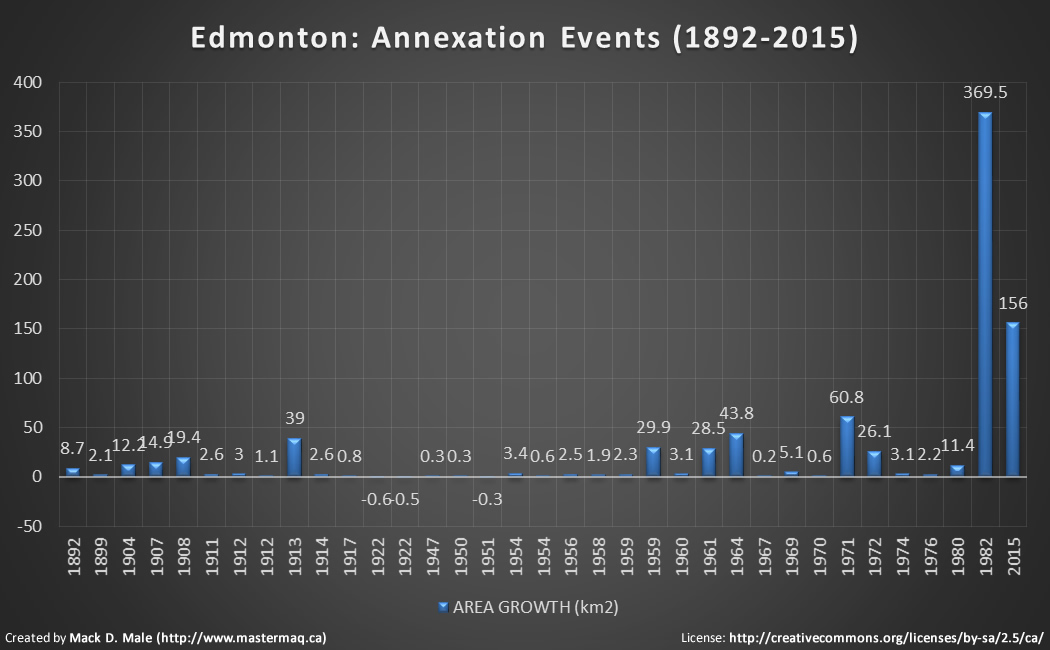
I’ll write more about that specific proposal in the future, but for now I thought it would be useful to take a look at Edmonton’s previous annexations. I have included the proposed annexation in the data below however, to give you a sense of where it fits in (I went with 2015 as the year). There have thus far been 31 annexation events in Edmonton’s history, according to a document prepared by the City’s planning department. That includes the incorporations of both Edmonton and Strathcona, as well as three temporary separations. Most of those annexations were relatively small, with an average annexation area of about 21 km2. Take out the 1982 annexation however, and the average drops to just 10 km2.

Here’s what those annexation events look like on a chart:

As you can see, the annexation in 1982 was unusually large – it doubled the size of our city. The proposed annexation in the south would handily come in as the second largest annexation in Edmonton’s history.

Here’s the list of annexation events:

YEAR DESCRIPTION CUMULATIVE AREA (km2)
1892 Incorporation of Town of Edmonton 8.7
1899 Incorporation of Town of Strathcona 10.8
1904 Incorporation of City of Edmonton 23.0
1907 Incorporation of City of Strathcona 37.9
1908 Buena Vista to Westmount, North Inglewood to Eastwood/Virginia Park 57.3
1911 Highlands, Amalgamation of Edmonton & Strathcona 59.9
1912 Belmont Park 62.9
1912 Kennedale 64.0
1913 Dominion Industrial to Quesnell Heights / Brander Gardens to Parkallen, Bonaventure to Belvedere, Forest Heights to Argyll 103.0
1914 Allendale / Duggan to Coronet / Papaschase 105.6
1917 Calder 106.4
1922 Separation of north Brander Gardens 105.8
1922 Separation of Papaschase 105.3
1947 Pleasantview 105.6
1950 Whitemud Creek 105.9
1951 Separation of part of Duggan 105.6
1954 Capilano / Fulton Place 109.0
1954 Coronet 109.6
1956 Gold Bar 112.1
1958 Davies Industrial 114.0
1959 Terrace Heights / Ottewell 116.3
1959 Terwillegar Park / Riverbend to Strathcona Industrial Park, re-annexation of separations 146.2
1960 Ottewell to Girard Industrial 149.3
1961 Beverly / Clareview to Dickinsfield 177.8
1964 Jasper Place and Southeast Industrial 221.6
1967 Clover Bar Power Plant 221.8
1969 Springfield / Callingwood 226.9
1970 Springfield – north 227.5
1971 Castle Downs / Lake District and Mill Woods 288.3
1972 West Jasper Place 314.4
1974 Kaskitayo 317.5
1976 Northwest Industrial 319.7
1980 Pilot Sound and Twin Brooks 331.1
1982 Northeast, Southeast, Southwest Urban Growth Areas 700.6
2015 Proposed South Annexation 856.6

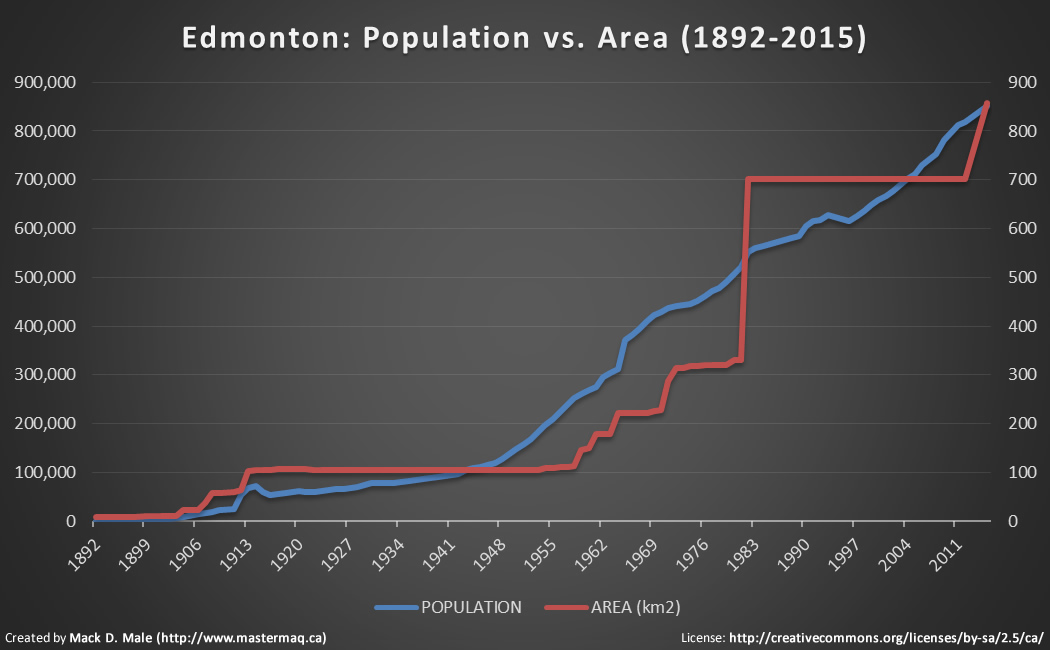
Municipalities annex land for a variety of reasons – sometimes the goal is to acquire industrial land, other times its to start developing future residential neighbourhoods. Here’s what our land and population growth has looked like over the last 120 years:

The left axis and blue line shows the growth in Edmonton’s population, while the right axis and red line shows the growth in Edmonton’s land area. While our population has risen steadily, annexations have been much less consistent.

Impact on Population Density

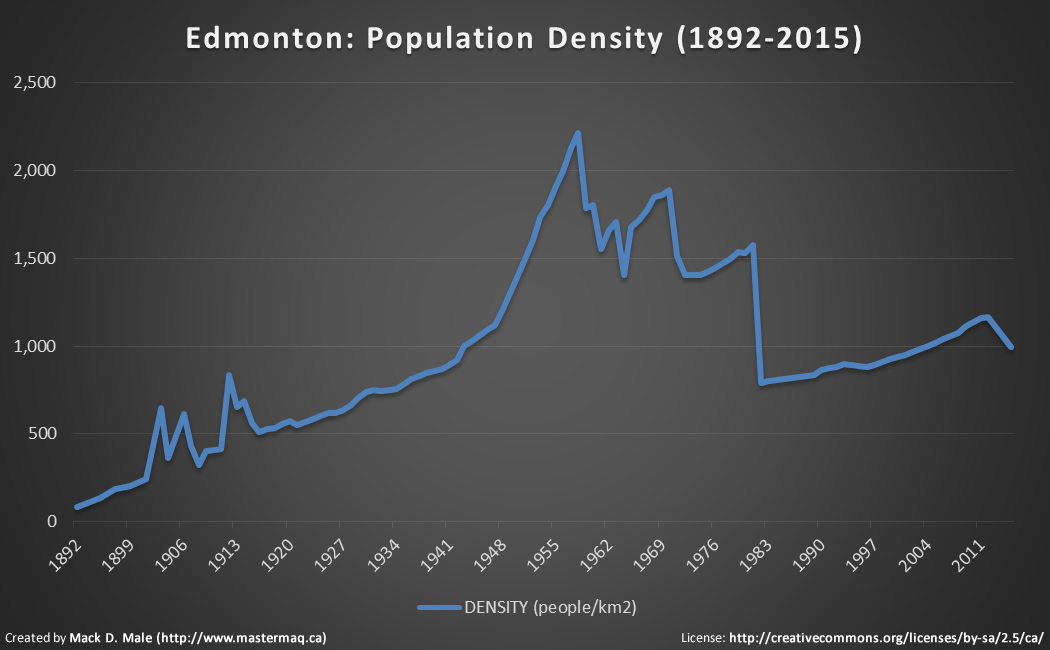
When the Town of Edmonton was incorporated in 1892 it consisted of 8.7 km2 of land and was home to about 700 people, giving us a population density of about 81/km2. Today, with a population of nearly 818,000 and a total area of about 700 km2, we have a much higher population density of roughly 1,167/km2. That’s not the highest it has ever been, however. Edmonton’s population density peaked in 1958 at about 2,212 people/km2 and has been falling ever since.

(For comparison purposes, New York City’s population density is 10,430/km2, London’s is 5,206/km2, Toronto’s is 4,149/km2, Vancouver’s is 5,249/km2, and Calgary’s is 1,329/km2. Yes, even sprawling Calgary has a higher population density than us!)

Here’s what our population density looks like on a chart:

There are a couple of key events to point out. The amalgamation of Edmonton and Strathcona in 1912 is noticeable thanks to a jump in the population. The annexations in 1959 of Terrace Heights, Ottewell, Terwillegar Park, and Riverbend marked the start of our population density decline. The jump back up in 1964/1965 was due to the annexation of Jasper Place, which brought about 38,000 residents to Edmonton in addition to more space. The large drop in 1982 is extremely apparent, and while the population density has slowly been creeping back up, you can see that the proposed annexation would cause it to decline once again.

Looking at the Capital Region

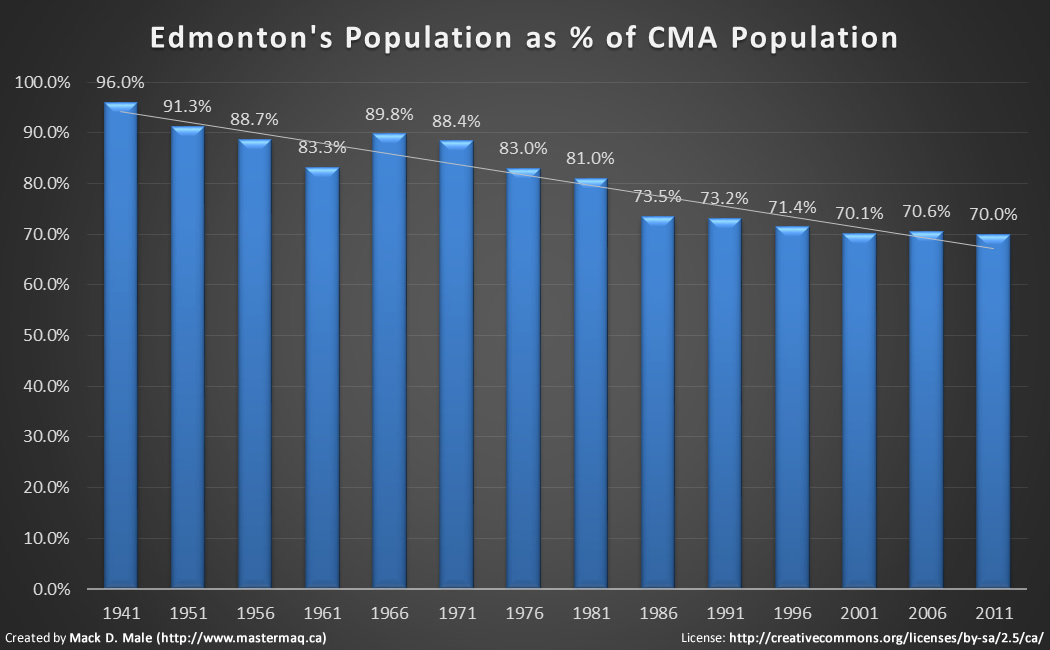
I absolutely agree with Mayor Mandel that a strong Edmonton is a strong region, but I don’t necessarily agree that Edmonton needs to acquire more land in order to remain strong. Supporters of annexation may suggest that Edmonton’s declining proportion of the region’s population is proof that buyers are not finding what they’re looking for within the city so they’re going elsewhere.

Here’s a look at the percentage of people in the Edmonton CMA who live within the city limits:

What’s clear is that there has been a decline in the proportion of people living in Edmonton-proper versus the surrounding areas. What’s less clear is why that has happened.

While Edmonton has not annexed any land since 1982, there have been 6 annexations by other municipalities in the region in the last 15 years.

Other Resources

Annexation is a big topic. Here are some additional resources that you may find useful: