2010-2013 Edmonton City Council Swearing-in Ceremony & Inaugural Meeting

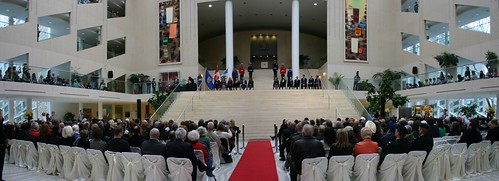
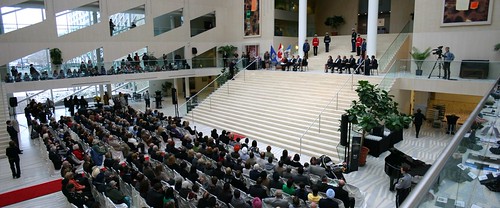
Edmonton’s new City Council was officially sworn into office this afternoon at City Hall. Following the ceremony, they held what will undoubtedly be the quickest meeting of the term, to approve council chamber seating arrangements, standing committee membership, and the meeting schedule for the next year. Nearly 400 people attended, including many of the Mayor’s and Councillors’ friends, family, and supporters.

Edmonton City Council Swearing in Ceremony 
Organized by Communications & the City Clerk, the event had a very nice printed program!

Edmonton City Council Swearing in Ceremony
Staff Sergeant Langford Bawn piped council members into the City Room, accompanied by members of the Edmonton Police Service, Fire Rescue, and Alberta Paramedics Guards of Honour.

Edmonton City Council Swearing in Ceremony
Council members smiled and waved as they entered. Lynda Steele served as the Master of Ceremonies. Matt Day played the piano, and Amanda Clark led the singing of O Canada.

Edmonton City Council Swearing in Ceremony
The Honourable Don Manderscheid, Justice of the Court of Queen’s Bench, administered the oath to the Mayor and Councillors.

Edmonton City Council Swearing in Ceremony
After Mayor Mandel was sworn in, he received the Chain of Office from City Manager Simon Farbrother. After all the Councillors were sworn in, Mayor Mandel spoke about the work ahead.

Edmonton City Council Swearing in Ceremony
Students from the City Hall School lined the second floor of the City Room, while friends and family filled the seats below.

Edmonton City Council Swearing in Ceremony
Council Chambers was packed for the inaugural meeting! By the time everyone had piled in, the meeting was finished! A reception was held following the meeting.

Edmonton City Council Swearing in Ceremony
2010-2013 Edmonton Mayor & City Council

You can see the rest of my photos from the event here.

UPDATE: Courtesy of Dave, here are some photos from the 2007 swearing-in ceremony.

Edmonton Notes for 10/24/2010

Here are my weekly Edmonton notes:

Edmonton

The Edmonton Journal has teamed up with Transcend Coffee for the i ❤ #yeg contest!

Edmonton

It was a wet, cold day in Edmonton today. Better than snow though!

UPDATE (9 hours later): Guess I spoke too soon on the snow! And really, it isn’t so bad!

First Snow

Edmonton Notes for 10/17/2010

Here are my weekly Edmonton notes:

Edmonton’s fifth Homeless Connect took place today the Shaw Conference Centre. The most popular service among guests, dentistry, was back this time. More volunteers showed up this morning than there were jobs for, which is great news considering the line-up for guests to enter was solid right through 1pm. Congrats to the Homeward Trust organizers and all the volunteers for making this important event happen again!

Homeless Connect Edmonton 5

Homeless Connect Edmonton 5

Edmonton Notes for 10/9/2010

Here are my weekly notes:

City Market Final DayCity Market Final Day

City Market Final Day
Today was the final day for the City Market on 104 Street, at least for this season. The market will be back at Olde Time Fair on the Square, as well as for a few winter dates in Churchill Square.

Edmonton
It’s definitely fall in Edmonton.

TechDays 2010: Edmonton

This year Microsoft finally brought TechDays, its Canadian technical training conference, to Edmonton. Some of us had been asking Microsoft to add our city to the cross-Canada tour for a while, and when enough people spoke up, they listened. And it paid off too. Initially Microsoft was expecting 250-300 people to register for the Edmonton event, but we blew that out of the water! Nearly 500 people registered! And judging by the large crowds, I’d say that most of those people attended too (it’s probably quite uncommon pay the registration fee and then not attend).

There is always criticism of the sessions offered at TechDays, but I think they had a decent mix this time around. Lots of introductory stuff I suppose, but that seemed to match the makeup of the audience. The addition of the Local Flavours track was a good start toward including some more diverse content as well. I was the track host for the “Optimizing the Development Process” track, and I did two presentations of my own.

TechDays 2010

My first presentation was Top 10 Mistakes in Unit Testing, adapted from a similar talk that was done at TechEd. The goal of the session was really to get people thinking about the little things that can help them be more successful with unit testing. I included three demos: a simple MS Test demo, a more involved demo using Ninject and Moq, and finally a demo showing JavaScript unit testing. Here are some resources for the session:

For my second presentation, I teamed up with Devin Serink to present A More Programmable World with OData. We talked about open data in general, about the work the City of Edmonton is doing, and then showed how easy it is to create and consume OData services. We spiced things up by using some PHP and Google Charts in the demos! Here are some resources for the session:

I thought both talks went well, and I hope people found them useful!

TechDays 2010

Given the success of the inaugural TechDays in Edmonton, I’m sure they’ll be back again next year. You can follow along as TechDays continues to travel across the country using #techdays_ca on Twitter.

Joey wrote about Day 1 here, and you can see the rest of my photos here.

Recap: CloudCamp Edmonton

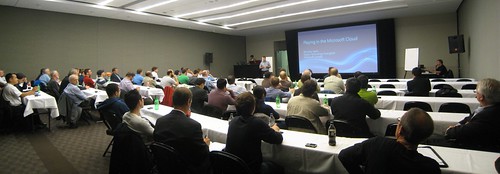
Tonight was the first-ever CloudCamp here in Edmonton, an unconference focused on cloud computing. Held at the Shaw Conference Centre, kind of in conjunction with Microsoft’s Tech Days (happening tomorrow and Wednesday), around 60 people attended. Here’s the brief overview:

CloudCamp is an unconference where early adopters of Cloud Computing technologies exchange ideas. With the rapid change occurring in the industry, we need a place where we can meet to share our experiences, challenges and solutions. At CloudCamp, you are encouraged to share your thoughts in several open discussions, as we strive for the advancement of Cloud Computing. End users, IT professionals and vendors are all encouraged to participate.

The format was similar to other unconference events. Moderated by Larry Carvalho, we started with six lightning talks:

  • Barnaby Jeans went first and gave an overview of Microsoft’s cloud computing strategy and offerings.
  • Associate Professor Paul Lu from the University of Alberta was up next and talked about the university’s proposed adoption of Gmail, its experimentation with Google’s Fusion Tables, and its research work on virtualized RAM.
  • Third was Rob Bissett from 6fusion. He talked more about infrastructure-as-a-service as well as the need for consistent price-per-compute units across the industry.
  • Li-Yan Yuan, a Professor at the University of Alberta, talked about LogicSQL, which is basically a grid architecture for a DBMS.
  • Fifth was Sean Ouimet, who dared to be different and used a flipchart instead of slides to talk about how to design your applications for the cloud so that they scale.
  • Last but not least was Timothy Dalby, winner of Make Web Not War, who discussed his application Find-A-Home.
CloudCamp Edmonton

After the lightning talks, Larry asked everyone in the audience to raise their hands if they thought they were an expert in cloud computing. The four guys that raised their hands become the panelists on the “unpanel” (and it was guys…I think there was maybe one woman in the whole audience). Everyone in the audience then had the opportunity to ask questions, which the panel fielded. Larry took notes, and the questions eventually formed the basis for the breakout sessions.

Some of the topics that came up included: geography (where is your data located), multi-tenancy, cost, building a cloud application, and startup opportunities. We ended up breaking into just two separate groups though, one more focused on the business side and one focused more on the technical side.

I decided to join the business group, and for an hour or so we had a really great (not to mention really broad) discussion about the impacts of cloud computing. I had to leave before the two groups came together again, but that was to be the final part of CloudCamp.

One of the more basic questions that arose throughout the evening was the difference between the various “as-a-service” offerings:

  1. Software-as-a-Service
  2. Platform-as-a-Service
  3. Infrastructure-as-a-Service

I think the Wikipedia articles do a good job of explaining each one, so I won’t expand on that here. I tend to think of it like this: SaaS is something like hosted Exchange, PaaS is something like Azure (which hosted Exchange runs on), and IaaS is something like Amazon S3 (which could host the Azure data).

It was great to see so many people interested in discussing cloud computing! You can see a few more photos from the evening here.

Heritage, Innovation & the Livable City: A Heritage of Local Food

The final session at the Edmonton Heritage Council’s symposium was on the heritage of local food. I thought it was a great idea to include a topic like food, something we don’t always associate with heritage, though obviously it makes sense to do so. The session was moderated by Liane Faulder, and panelists included Kathryn Chase Merrett, Jessie Radies, and Patricia Myers.

How might the history of local food production and marketing in Edmonton relate to people’s contemporary interest in local food? This session will discuss how this history connects to current concerns and developments on sustainable food systems.

Here are my notes:

  • In addition to moderating, Liane was also a panelist. She started by sharing some recent local food stories. She talked about three local producers: Donna & Bohdan Borody (The Jam Lady), May Ellen & Andreas Grueneberg (Greens, Eggs & Ham), and Gordon Visser (Norbest Farms). She also mentioned the Culina family of restaurants.
  • Liane noted the recent desire that many people have to reconnect with their food producers. She also talked about the importance and popularity of farmers’ markets, saying “the farmers market is the new church”.
  • Kathryn, who has literally written the book on the history of the Edmonton City Market, talked a lot about her view that food is a big part of what makes a city livable.
  • It might be hard to visualize but from 1900 until 1965, market square was where the current Stanley Milner library sits.
  • She said the market has not always been seen as a positive thing in Edmonton, at least not by those in power. Old city councils viewed it negatively, and tried a number of times to displace it. Nothing has ever really worked though, because citizens and food producers have always loved the market.
  • Kathryn also touched on foods which used to be plentiful in Edmonton, such as strawberries. She read a passage from an 1894 Edmonton Bulletin article that described the “crimson trail” left behind as you walked, because there were so many strawberries.
  • To Kathryn, a livable city is one that can feed all of its people, but which also takes the time to enjoy and to share.
  • Jessie recounted her experiences of growing up on the farm, describing the various skills she learned, such as canning. It was a great story.
  • She also talked about her recent work with Original Fare and Live Local. She said that both the local and global food systems are necessary, and must be strong.
  • Patricia collects antique cookbooks and shared some of the reasons behind her hobby.
  • She said she doesn’t care so much about having particular editions, but she loves acquiring different books to see what she can learn from them.
  • Patricia said she views the cookbook as a repository of women’s history. Typically cookbooks are dismissed as historical works, and Patricia is trying to change that.
  • She said you can learn about the technology and cultural norms through the cookbooks. For example, she said books that contain lots of sandwich filling recipes were likely from a time when picnics, fundraisers, and other activities were quite common.

I was really intrigued by Patricia’s idea that you can trace technology through the cookbooks. It made me wonder what else is out there that we don’t typically think of as being important heritage pieces.

Heritage, Innovation & the Livable City: Edmonton’s (Lost) Spaces, Places, & Neighbourhoods

This session sounded interesting and I was hoping it would provide me a neat list of places to check out. That didn’t happen, unfortunately, but I still learned quite a few things. The panelists included: Tyler Dixon, intern architect with ziola newstudio architects; David Holdsworth, one of the two heritage planners at the City of Edmonton; and Ken Tingley, Edmonton’s first historian laureate.

Edmonton could be described as a city in the habit of remaking itself. As a result, historic spaces, places and events are obscured, lost or ignored. Panelists will discuss this heritage of “remaking” and what has been ignored, overlooked or misunderstood and how it might be reclaimed.

Here are my notes:

  • Ken started by showing pictures of early Edmonton and describing the disappearance of First Nations people from the urban setting.
  • He described an effort in 1911 to eliminate First Nations as an attraction from western exhibitions, something Edmonton complied with the following year.
  • Ken also talked about some of racial incidents from our past, such as when local hotel and restaurants banded together to get rid of non-white labour.
  • David spent most of his time talking about heritage areas. The City of Edmonton has just three official heritage areas: Westmount, 104 Street, and Whyte Avenue.
  • Heritage areas must have regulations and guidelines for development, must allow new or alternative uses, and must have community support.
  • David described the Edmonton trend of breaking from the past – tearing down the old to make way for the new.
  • He showed one slide with photos of what looked like the same house, except that each photo was from a different city, all around the world. David say that both now and 100 years ago, there’s not much architecture unique to Edmonton.
  • Much of his discussion centered around “theming” and whether that is a good thing or not. Think of the warehouse buildings on 104 Street for instance, and how the new Icon towers were built to mimic that design.
  • David said he never asks for duplication, but wants to prevent building another “anywhere place”.
  • The Edmonton Design Committee will be considering the 81 Avenue area as another potential heritage area (most of the buildings there have false facades).
  • Tyler talked about aging and the stories that aging buildings can tell.
  • He also touched on urban sprawl, saying Edmonton is filled with holes (parking lots), and that the boom-bust cycle has nudged us toward certain building materials and styles.
  • Tyler was much less enthusiastic about the theming David talked about, saying he fears it leads to “just-add-water” instant heritage.
  • Ken had said during his talk that Edmonton is caught between progress and nostalgia. Tyler picked up on that, and said that both can be beautiful.

I thought David’s introduction to heritage areas was really good, and that’s a topic I’ll likely try to follow-up on. Another thing that was discussed that I didn’t mention in my notes was the importance of intangible heritage. After all, out of sight, out of mind.

Edmonton Notes for 10/2/2010

Here are my weekly Edmonton notes:

Edmonton Heritage Council
The first ever Edmonton Heritage Council symposium was held this weekend at the Sutton Place Hotel.

Heritage, Innovation & the Livable City: A Northern City

There were three concurrent panel sessions this morning, which means we had to choose. I ended up going to the one called A Northern City. The panelists included: Rod Macleod, retired professor of History & Classics at the University of Alberta; Mark Nuttall, professor and Henry Marshall Tory Chair in the Department of Anthropology at the University of Alberta; and Heather Zwicker, associate professor of English at the University of Alberta.

Tagged as the “Gateway to the North”, Edmonton has also been described as “a northern city of art and ideas”. Yet its northernness is often overlooked in understanding the city and region, as well as its connection to the “south” and other northern places.

As someone who grew up primarily in Inuvik, NT, this panel caught my eye. I was quite familiar with the idea of Edmonton as “a northern gateway to the south” – something the panelists talked about. Here are my notes:

  • Rod started by highlighting the two things that we think about as a northern city. The first, climate, gets a lot of attention. The second, isolation, is something we think about far less. Rod says to draw a 500km circle around northern cities. With the exception of Edmonton and Moscow, you’ll find lots of other places in those circles.
  • Despite the creation of the rival city of Strathcona, the construction of the railroad from Calgary had surprisingly little effect on our northern orientation, according to Rod.
  • He talked at length about our history as a transportation hub more than a trading post, noting that the air freight industry was practically invented here. He talked about the arrival of the airplane, and how it replicated the region’s previous economy: bringing furs south, taking supplies north.
  • Something to look up: the Aerosmith map of 1832, which has great detail north of Edmonton but not much south.
  • Rod suggested that while “facing north” has made us culturally self-sufficient, being a part of the northern frontier has ingrained in Edmonton a reluctance to plan and build for the long-term.
  • Mark picked up here, nothing that although there are lots of places further north than us on the globe, northernness actually has very little to do with latitude.
  • He noted that in Canada, the term “north” has often been synonymous with “marginalized”. That’s not the case in other places. He also observed that as places develop, “north” seems to move further north. When a Walmart arrives in Whitehorse, is still the north?
  • Mark finished by discussing the Arctic Council and how the north is becoming centre stage, thanks to climate change and other global issues. Canada assumes the chair of the council in three years, which provides an opportunity for Edmonton.
  • Heather discussed the literature surrounding Edmonton as a northern city, starting with Alice Major’s Contemplating the City, and Erin Knight’s Bribing the Boundary God.
  • She said the river plays a key role in most of the literature, either positively or negatively – is the river an obstacle, or a way in and out of the city?
  • I thought the notion of Edmonton as “the cosmopolitan north” was quite interesting. Heather said the notion of “cosmopolitan” is up for grabs, saying that “Brooklyn is the new Manhattan”.

Another interesting concept came up in the questions. Mark had said that before moving to Edmonton, he had never lived away from the sea. And while Edmonton doesn’t have a traditional port, we are something of a “port city” thanks to Fort McMurray and other northern communities. I immediately thought of the Port Alberta initiative as well.

What I took away from the session is that being a northern city is much more a mindset than anything else. There are physical elements of course, but it’s the intangible part of being in “the north” that has probably had the biggest impact on Edmonton’s development.