Clean & Hackable URLs

Post ImageA week ago, Roland Tanglao reiterated his love for clean URLs. Or perhaps more accurately, his hatred of dirty (?) URLs. Here’s what he wrote:

URLs with question marks, ampersands, etc should be banished to the Web 1.0 h*ll where they belong. I’ve been preaching the clean URL gospel for years but if I see one more WordPress blog with “?p” or one more Drupal site with “?q”, I’ll scream 🙂 Seriously if your webhost or your tech gal/guy can’t figure out how to use clean URLs, find somebody else. It’s 2007!

I couldn’t agree more. Here’s an example of what he means:

Dirty: http://example.com/articles.html?articleid=123&tag=rss
Clean: http://example.com/articles/123/rss

Clearly I prefer the second one, and I’m guessing you do too. I’m going to go one step further though, and say that not only should URLs be clean, they should be hackable! What does that mean? Let me give you an example:

http://mastermaq.podcastspot.com/episodes/FF7962/license
http://mastermaq.podcastspot.com/episodes/FF7962
http://mastermaq.podcastspot.com/episodes
http://mastermaq.podcastspot.com

The first link is for the licensing information of an episode. All you’ve got to do is “hack” off the end and you get the episode itself. One more hack and you get all the episodes. And finally, you’re left with the entire podcast. It’s pretty logical right? And it would be trivial to replace the episode ID with another one, or /episodes with /tags, etc. That’s what I mean by hackable – they are easily modified to get you where you want to go.

Here’s another example:

http://mastermaq.podcastspot.com/episodes/archive/2007/02/24

That will show you all episodes for February 24th, 2007. The URL is readable, and immediately you understand what it is doing. What if you want a different day? Replace 24 with something else. Just the month? Hack off the 24. You get the idea.

Clearly I am drinking the clean & hackable URLs koolaid, and as a result Podcast Spot has nothing but clean, hackable URLs. If you’re working on a web project, consider doing the same – your users will thank you for it.

10 Reasons To Love Opera (the browser)

Post ImageI love Opera, I really do. It’s an awesome web browser, and it’s a shame that it doesn’t have more market share (most stats put it around 1% or less). I could go on for days about the many different reasons that Opera rocks, but here are my favorite ten (in no particular order, based on the latest version, 9.1):

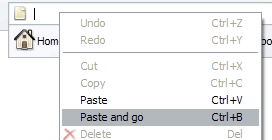
Paste and go (Screenshot)
This one really shows the attention to detail that the Opera team has. How many times have you copied a URL to the clipboard, only to go paste it in the address bar of your browser? Then you have to click go or press enter. With this handy feature, Opera saves you that second step. As the name suggests, you can paste and go all in one step!

Instant back and forward
I don’t think this is listed as an official feature, but it should be! In IE or Firefox, clicking back will usually take a few seconds for the previous page to reload – not so in Opera. As soon as you press back (or forward) the previous (or next) page is instantly there. Firefox is pretty good at this too, but Opera is quite simply superior.

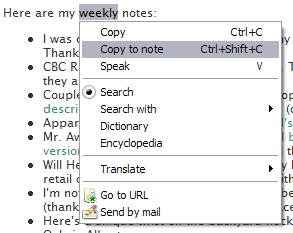
Highlighted Text Context Menu (Screenshot)
As soon as you highlight some text in Opera, a context menu appears with a bunch of useful commands at the ready. Again, it saves that extra step of right clicking after you have highlighted text. It might sound inconsequential, but it makes a huge difference.

Top 10 Sites (Screenshot)
Everyone has a set of websites they regularly visit. Opera is smart enough to keep track of these sites, and gives the ten most visited sites a special and easy-to-access menu. It’s kind of like automatic favorites. Very handy.

Notes
After experiencing this feature, you’ll wonder how you ever got by without it. Ever keep notepad open while browsing so you can copy things you might need later? No need to do so with Opera! Highlight any text and you can then turn it into a note, or you can manually create a note with whatever text you want. Notes are associated with a website too, so you can quickly see your notes for a given page. Incredibly useful feature.

Better Tabbed Browsing
All modern browsers have tabbed browsing, but none of them do it as well as Opera does. For one thing, tabs are ordered (say you have three tabs, A, B, C. Click on A, then click on C, then close C. Opera goes back to A, the other browsers go to B). Again with the attention to detail, right click on any link and you have two options: open in a new tab (which brings it to the front) or open in a new background tab (which does not). Awesome.

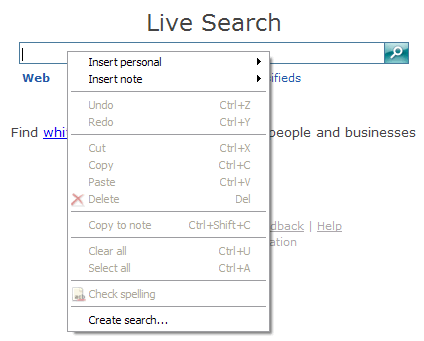
Search Keywords & Create Search (Screenshot)
IE and Firefox handle search engines pretty well (with the search box I mean), but it’s pretty much up to the site developer to help the browsers recognize the search engine. Not so in Opera. Right click in any search box and choose “Create search…” and automagically you have a new entry in your search engines. You can also associate keywords with engines. So for dictionary.com, you might associate “d”. Then you can type “d word” in the address bar, and Opera will take you there.

Mouse Gestures
Of all my favorite features, this one takes the most getting used to. Essentially mouse gestures allow you to navigate or modify the window using only the mouse. Just another small feature that can save you a bunch of time.

Trash Can
Have you ever closed a tab, only to realize a few moments later that you still need it? In other browsers you have to try to get back to the page again. In Opera, just click on the Trash Can, and choose the tab you closed. So damn handy.

Site Preferences
This feature gives you the ability to modify preferences only for a given site. Want to turn off javascript just for one site? Opera lets you do it. Not a feature you’ll use daily, but it can definitely come in handy.

Like I said, I could go on! If you like what you see, you should definitely try Opera. It’s completely free, and there are no advertisements inside (much older versions had a banner). And if you’re afraid your favorite sites won’t load correctly, don’t worry. It’s increasingly rare to find a site that doesn’t work correctly in Opera. And actually, Opera is the only Acid2-compliant browser for Windows!

In fact, I have just one problem with Opera – my del.icio.us page loads incredibly slowly. I have no idea why, but I’d like to get it fixed. If you have any ideas, let me know!

UPDATE: It appears Opera simply doesn’t like my huge list of tags. I changed my del.icio.us preferences to display as a cloud, and only tags with at least 5 items, and now it loads very quickly!

Read: Opera

My love-hate relationship with Twitter

Post ImageI have a love-hate relationship with Twitter going on. Actually, in a lot of ways, it’s quite similar to my love-hate relationship with Outlook 2007. They’re both extremely useful, yet both horribly slow. Let me explain.

Twitter is great for quick status messages, or jotting down thoughts that don’t deserve an entire blog post. I love that Twitter allows me to use it however I want to. For example, I went to get my free coffee from Starbucks earlier, and wanted to Twitter it. Except I couldn’t. The first problem is that for some reason, Twitter seems to ignore my cell phone. Then it will magically start working, only to stop again a couple days later. Worse still, the Twitter website is inaccessible far too often. Like right now, I can’t get the site to load. It totally sucks, I hate it.

The question of whether Twitter would be useful during an earthquake makes me laugh – it can’t be useful if it’s not up! And thus far, it seems to have a hard time accepting my random coffee-related messages, let alone important messages sent during a disaster.

I would use Twitter so much more if it actually worked as expected.

Podcast Advertising Report Roundup

Post ImageeMarketer has managed to garner a ton of buzz today about their forthcoming report on podcasting and marketing in which they estimate that $400 million will be spent in the space by 2011. My only real comment on the report (since I haven’t seen it) is this wonderful quote from NewTeeVee (on an unrelated post):

“The great thing about forecasts is that no one remembers the exact amount when the future finally rolls around.”

Here is a quick roundup of some great quotes from posts discussing the report:

“If you build it, they will come! Or in other words, concentrate on bringing podcasts to a bigger audience, only then can you make advertising work.”
Marketing Pilgrim

“The increase of video podcasts, which lend themselves to the kind of video ads that marketers are accustomed to developing for television, has also increased advertiser interest.”
BusinessWeek

“Show me an advertiser that wants to generically market to Podcasts with listening audiences of dozens.”
Paul Colligan

“Currently, despite some 90,000 podcasts available on the Web and close to 90 million iPods in the market, podcasting is universally thought of as a supplemental medium by advertisers.”
Mediaweek

“Every once in a while someone accidentally runs into a magic lamp and a guru pops up telling us that Podcasting has already had its 15 minutes and is a fad that is ready to pass.”
901am

“Unfortunately, for all you indy podcasters out there, this does not bode well. With all of that competition for ad dollars, the money is going to flow to folks who have ad sales reps.”
Micro Persuasion

“While I would love to see 400 Million dropped annually into the space, the podcasting listening and producing community is going to have to get a lot bigger.”
Geek News Central

“As I’ve said before, I think the bigger growth could come from simply making the entire creation process easier.”
The Viral Garden

I like the last two comments best – they are spot on.

A Rant About MySpace

Post ImageI hate MySpace. I simply cannot stand it. The navigation is horrible. The design is ugly. Their URLs are the most unfriendly ever. Random people add me to their “friends” list. Users have too much control over the look of the pages…which usually means that they end up making the pages painful to look at. Dancing text, repeating background images that were never meant to repeat, music that starts playing automatically, etc. I really cannot fathom how so many millions of people use MySpace on a daily basis.

Quite possibly the only thing I like about MySpace is that it runs on .NET and is therefore an excellent case study/example. But that would be the only reason.

Every single time I look at MySpace I cringe. Maybe I just don’t get it?

Thoughts on Digg Podcasting

Post ImageOver at Geek News Central today Todd Cochrane had some harsh words for Digg’s newest feature, their podcast portal. Most of his argument is based on the traffic he apparently isn’t receiving from Digg:

Lately though I have come to the conclusion that for all the traffic Digg gets very little if any of that traffic in the way of downloads or pure referals [sic] comes from that site.

He goes on to offer some advice to podcasters:

My advice to podcasters is this, look at the directories you are listed in and figure out if they are doing anything to build your audience or giving you equal exposure on the front of their respective websites. If they are not find sites that are and support them in your shows.

That plan of attack might have worked when podcasting was just getting started, but we’re beyond that now. I would suggest that podcasters do in fact add themselves into Digg’s directory, flawed as it might be. Why pick one directory over another? The idea isn’t to play favorites, it’s to help the audience find what they want, wherever they might be looking. There’s more to being in a directory than just getting listed on the front page.

As for Digg’s podcast portal, here are my thoughts:

  • The way you add a podcast into the directory sucks. Sometimes it works, sometimes it doesn’t, and the feedback you get is really unhelpful.
  • Only iTunes-compatible feeds may be added into the directory. Why Digg felt the need to perpetuate Apple’s hegemony is beyond me.
  • It would be better if episodes had a “front page” as well, instead of just podcasts. Right now you can only look at episodes for a particular podcast.

The podcast section of Digg hasn’t been around very long, so I’m pretty sure they’ll be making changes over time. There’s definitely room for improvement, but the directory is not useless.

Read: Geek News Central

Google Video searches YouTube

Post ImageGoogle announced today that it has integrated YouTube results into Google Video. This is the beginning of a transition for Google Video from hosting provider to search. Liz over at NewTeeVee wonders if this is necessary:

In thinking about video search, we’ve been concerned that with the huge number of videos coming into and and video streams coming out of YouTube, there would be little need for — well — video search.

I think there’s a huge need for video search. Just because most of the videos are in one place doesn’t make the search good or effective. There’s lots of things Google can do with it’s video search product to make it the destination. I’m thinking about speech and visual recognition to improve accuracy, and other really complex things.

When it acquired YouTube, Google got more than just a video hosting site. It got unfettered access to one of the largest test beds for video search around. That’s a big asset to have when you’re trying to build an excellent search engine.

Read: NewTeeVee

Most New TV Shows Require Too Much Effort!

Post ImageI don’t watch a lot of television, save for hockey, news, and Smallville. I guess I am “an Internet child” and that’s definitely where most of my time is spent. I think there’s more to it than that, however. Almost all of the new TV shows being produced require a lot of effort from the viewer. More effort than I am willing to put in.

Take 24, for example. People are crazy about this show. I mean seriously off the reservation, like this guy:

If Jack Bauer has to catch a shark with his bare hands and speed-dry the fin so he can make a soup to restore the President’s sexual potency, I’ll be watching. If Jack Bauer is caught in the path of a fiercely-lit green energy beam made of fuckton particles in a suspended gobbledygook matrix and inadvertently is wearing a shark’s tooth necklace and become half-human, half tiger shark – I’ll be watching.

I’ve never seen an entire episode of 24, so I don’t know what the fuss is all about. I just don’t get it. And therein lies the problem. There’s no way I am going to start watching 24 now – it’s too far along. I’d be an outsider, a poser almost. I would have to go back to the very beginning and watch every episode just to catch up. And that’s just too much work.

And existing fans of the show? They can’t miss an episode, no sir. They have to record it for later if they absolutely cannot be sitting down when the new episode airs. Heaven forbid they miss one. They’d be behind, lost. Can’t have that – so they put in the effort.

There’s some old shows that are guilty, like 24, but it’s the new ones that are the worst. Just look at some of the newest shows – most pretty much require that you started watching from the beginning to really understand what’s going on. Heroes? Yup. Prison Break? Yup. Friday Night Lights? Yup. Studio 60? Yup. Ugly Betty? Yup. Jericho? Yup.

I am not sure if this trend is good or bad for television. On the one hand, networks might be limiting a show’s audience by setting the barrier of entry so high. On the other hand, these kinds of shows probably sell a lot better on DVD.

Either way, I kinda miss the old shows. The shows that didn’t require a lot of effort, nor an introduction. You could just start watching any episode and you just got it. There are notable exceptions in the current most popular shows, like CSI or Law & Order or American Idol, but for the most part, I think the new shows require too much effort.

In a way, I look forward to the day these shows are cancelled so I can just get all the DVDs.

Podcasting will win big thanks to the iPhone

Post ImageThe iPhone has already had a big impact on the technology industry, what with the stock prices of both RIM and Palm falling sharply today, and it will continue to have an impact over the next couple years. Certainly when it launches this summer, we’ll find out if all the hype is justified. And there will most certainly be copycat designs.

In any case, I think the launch of the iPhone bodes well for podcasting.

Apple describes the iPhone as “a breakthrough Internet communications device” thanks to its support for Wi-Fi and EDGE. We know that it runs OS X under the hood, and that it supports Widgets. It isn’t entirely clear just yet if it’ll be possible to get a podcatcher running on the iPhone, at least from everything I have read, but the idea certainly seems plausible.

Apple’s iPhone will let you walk around with Wi-Fi Internet access in your pocket. Even if it can’t podcatch all by itself, other device manufacturers and future editions of the iPhone most certainly will. The iPhone will open up the “pocket Wi-Fi device floodgates”, so to speak.

Heck, maybe it will even prompt Microsoft to open up the Zune’s Wi-Fi capabilities.

It might not be apparent for quite a while, but I am confident that the iPhone will have nothing but a positive impact on podcasting.

Thoughts About Online Privacy

Post ImageI just did a quick search of my blog and found to my surprise that I haven’t really written about privacy before. It’s a topic that is often discussed, especially as more and more of our lives move online, so I figured I’d have said something about it in the past. Oh well, now is as good a time as any. I’d have to say that my opinion about online privacy is different than most. First, here’s the usual perspective:

Chuck Sanchez, a 25-year-old Chicagoan, recently deleted references to his public relations firm on his MySpace page after everyone from a job applicant to his fiancee’s mother found the page.

“It’s simply not worth it,” he says. “I want my personal site to be just that: personal.”

I agree it’s smart (and let’s be honest, common sense) to be careful about what you post online. But attempting to remove references is futile. It’s almost as stupid as thinking that if you never post about something that it’ll never get online. That’s just a dangerous way to think about privacy.

When it comes to online privacy, I keep these two things in mind:

  1. Eventually, despite your best efforts, any information (personal or otherwise) could become universally accessible.
  2. The only way to protect yourself from the potentially negative effects related to information disclosure is to contribute to the stream of information, to maintain an active online voice.

That voice can be a website, a blog, a profile at a social networking site, or anything else that works for you, even a combination of these things. As long as you can continually contribute positive information to the stream of information, you should be fine.

Everyone makes mistakes. Usually you learn from your mistakes. Unfortunately, it’s primarily the mistakes that make it online and not the learning experiences that follow. When it comes to online privacy, you just need to maintain a balance between disclosure of the mistakes and your sharing of the learning experiences. If you do that, it’s much less likely that you’ll run into disclosure problems.

Another thought. Imagine a world in which all personal information was kept private. How would you know who to trust? It’s often the personal information that allows us to make decisions about a person. This happens consciously (such as when you are reading a resume) and subconsciously (such as when your opinion of someone changes based on their clothing). Now imagine a world in which all personal information is publicly disclosed. With complete information, it becomes trivial to make decisions about whom to trust, based on what is essentially pattern recognition. Of course, having complete information could have severe social consequences.

I don’t think either extreme is ideal, though I learn towards the side of full disclosure. And if that changes, you’ll be able to read about it here.

One more thing: in general, I’d say people are pretty lazy. If your “information stream” is pretty full, potential employers or other interested individuals will be much less likely to spend the time reading it all. And if they do, your contributions to the information stream should come in handy!

Read: Yahoo News