Millions of dollars for shorter links

So much for the recession – bit.ly, a URL shortening service, has raised $2 million in funding. TechCrunch did the math (back of the napkin, natch) and figures that bit.ly is worth about $8 million, while its more well-known competitor TinyURL is worth at least $46 million. Who knew there could be so much money in building a simple service to shorten really long web addresses and perform automatic redirects?

I used to be a TinyURL user, but switched a few months ago to bit.ly in order to get better analytics about the links I post to Twitter. These services are really a dime a dozen, however. I’m pretty amazed that investors would sink that much money into bit.ly.

Here’s what Peter Kafka wrote about the deal today:

So where’s the money? bit.ly is free to users, and the company says it doesn’t plan on selling its analytics or other tools to publishers. Team bit.ly says revenue will come sometime down the road, from something else–when they figure out what that is.

This is great news for bit.ly, obviously. And for me it means that my favorite URL shortener will be around for a while. Beyond that, I’m not sure what to think. Do the investors see a buy-out in the future, or do they really think bit.ly will be able to generate revenue at some point?

It also makes me wonder what kind of service will get some investor love next. A simple copy-paste service? TwitPic?

Twitter’s Business Model: featured links? Probably not.

A new site called ExecTweets launched recently. It aggregates tweets from executives, and organizes them by industry. For example, you can see tweets from the tech industry’s top execs here. This is very much in line with the kind of thing I expected Twitter to launch as a way to monetize their service. Except that Twitter didn’t launch ExecTweets, Federated Media did.

VentureBeat wrote about the site today and claims that FM and its partner Microsoft are going to pay Twitter for a featured link on the Twitter site:

…FM and Microsoft are undoubtedly paying Twitter a pretty penny to launch their service in this featured area.

So how much? Well, Federated Media won’t say exactly, but it did bring up revenue sharing. “We can’t talk about terms of the deal, but we did want to share some of the revenue with Twitter to support them,” Federated Media’s John Battelle tells me.

How generous of FM.

Seriously, that’s it? That’s the business model? I really doubt it. I think VentureBeat is trying a bit too hard to nail the “we know what Twitter’s business model is” story. I have to believe that Twitter has more planned than a lousy link on the main interface. Which, thanks to the Twitter API and mobile clients, probably won’t be seen by most users anyway.

I still think Twitter will make money by somehow helping businesses (and potentially individuals willing to pay) make sense of the noise, but I don’t think they’ll do that by simply featuring links to sites built by others. TechCrunch posted today about job openings at Twitter, noting the focus on Search and the Platform API which I think supports my theory.

So far I’ve seen featured links for Twitter’s widgets, Twitter Search, and Tweetie (did they pay?). None for ExecTweets.

What do you think? Is this really the start of Twitter’s business model?

Talking Twitter with CTV Edmonton

It’s no secret that the local media have jumped aboard the Twitter train in recent weeks. They seem completely smitten with it! Almost all the media outlets in Edmonton are now on Twitter in some capacity. The two big television stations, Global and CTV, have been really great about accepting feedback and assistance as they figure out how Twitter can best work for them. A couple weeks ago Karl Kovacs spoke to the Global Edmonton newsroom, and yesterday, I was fortunate enough to speak at CTV (there were also some folks from Access and 91.7 The Bounce in attendance).

I guess “speak” isn’t really the right term. I started with a bullet list of some key concepts (such as terminology and that Twitter Search rocks) but didn’t have any prepared slides or remarks. Instead, I had a browser open and encouraged everyone to fire away with questions. And fire away they did!

Questions ranged from “why do people follow other people” to “how can we best use Twitter during our newscast”. We also took some time to talk about the #teachctv discussion I had started on Twitter in the morning. I think it was a good eye-opener for most in the room to see how quick and easy it was for me to gather a bunch of feedback from the Twitter community. Thanks to everyone who posted a tweet in response.

I don’t know what CTV is going to do with the things we talked about, but the feedback I got was that everyone found the “primer” useful. I think I was able to start some interesting discussions, and I look forward to seeing what they come up with in the weeks ahead.

What I hope they took away from our chat was the following:

  • Links are important! I’d rather see a link than “coming up at 6” and I think most others on Twitter would also.
  • You’ve got to be willing to experiment. Some things will work, others won’t.
  • Twitter will not replace the TV or website, it is simply another tool. If used correctly, it can compliment CTV’s other channels.
  • Twitter is about people and relationships. You’ve got to show that there are humans behind the Twitter accounts! Be personable.

Those points are valid for any business on Twitter of course, not just for CTV.

Thanks to Carrie Doll and her team for the opportunity to discuss my favorite topic! I think it’s great that CTV Edmonton is so keen to utilize Twitter. Exciting times ahead!

To follow CTV on Twitter: @ctvedmonton, @carriedoll, @darylmcintyre, @joshclassen, @JoelGotlib, @robbywilliams, @ErinIsfeld, @davidjamesgreen, @crnkylttlmnky

Blog posts have staying power

Fascinating post over at TechCrunch today by Brian Solis. He talks about the declining authority of blogs and attributes the loss to the “statusphere” – essentially micromedia services like Twitter and FriendFeed. This is the key passage:

Links from blogs are no longer the only measurable game in town. Potentially valuable linkbacks are increasingly shared in micro communities and social networks such as Twitter, Facebook, and FriendFeed and they are detouring attention and time away from formal blog responses.

Ignoring the fact that he talks about Technorati a lot (I never use it anymore), I think Brian makes a good point. Even just looking at my own activities, I definitely respond less to other blog posts using my own blog than I used to. Instead, I tweet about them. Actually, I would say Twitter is affecting my social bookmarking activities too! I save things in Delicious far less frequently now, choosing instead to tweet them.

What does this mean for bloggers? Mainly that it’s more difficult to track the discussion about a blog post. Brian mentions a number of services in his post that you can use, but they’re not yet what I would call foolproof. They are getting better though.

This trend toward micro-responses doesn’t make blogs any less important, however. Probably the opposite, actually. I could tweet all day about a topic, but my tweets would be largely lost the next day. Blog posts have staying power. That’s probably why I still get more traffic from Google than from Twitter.

Anyway, give Brian’s post a read.

Twitter 101

On Saturday at IDEAfest, I gave a short presentation on Twitter. I wasn’t sure who would be in the audience, so I decided to do some very introductory slides. Some of the content was based on a post I wrote back in November – suggestions for getting started with Twitter. I’d still recommend looking at that post as it has more detail than the presentation on some points.

Here are the slides for my “Twitter 101” talk:

You can download the presentation in PDF here.

If you have any feedback, let me know! Thanks to everyone who came out to my talk.

Edmonton Media Organizations on Twitter

Given the recent interest in Twitter from the local media, I thought it would be a good idea to take a look at which of the organizations are on Twitter and how they use it. Back in November I wrote about local news organizations and their use of social media. At that time, only the Edmonton Journal and iNews880 were on Twitter.

Things have definitely changed!

Here are the local news organizations (and their representatives) I know about on Twitter (numbers retrieved on 3/3/2009 at 12:30 AM):

Which media organizations are missing? Lots:

  • Edmonton Sun
  • CityTV Edmonton – though there are @axfergie, @meagankelly, and @KMPhotographer
  • Edmonton Examiner
  • Vue Weekly – I setup a placeholder account: @vueweekly
  • SEE Magazine
  • Avenue Edmonton
  • 24 Hours
  • 630 CHED – there is a placeholder account, @630CHED, but their efforts are focused on the iNews880 account
  • CKUA – though there is @kevinckua
  • Most other radio stations: Team 1260, 91.7 The Bounce, 96.3 Capital FM (added above), EZ Rock 104.9, CISN Country 103.9, 100.3 The Bear, Magic 99, etc.
  • Edmontonians Magazine
  • Venture Publishing magazines (maybe) – though there is @VentureMags, @RachelatVenture and @RuthatVenture

From this we can identify a few trends:

  • Most accounts were only recently created, and there are still lots of organizations not yet on Twitter.
  • Most of the active accounts are updated automatically using twitterfeed.
  • Most organizations have an “official” account that is treated like a bot, and employees have the more personal, interactive accounts.
  • Most accounts don’t follow back. The one notable exception is @iNews880.

I’m not sure how long I’ll wait before revisiting this list, but I’m pretty sure the number of local media organizations using Twitter will continue to increase. There’s definitely some concern in the community that by simply broadcasting, the local media aren’t using Twitter as effectively as they could be. I still think there’s value in having them on Twitter though.

UPDATE (3/5/2009): Very quickly others are joining! Here’s 91.7 The Bounce: @917thebounce, @onair1980, @carlykincaid

State of the Edmonton Twittersphere – February 2009

Welcome to the second State of the Edmonton Twittersphere, my look at the intersection of Twitter and Edmonton. You can see last month’s stats here.

The source of this data remains the same. Using Twitter Search I collected anything posted by Edmontonians, or about Edmonton. If a user has his or her location set to Edmonton, St. Albert, Sherwood Park, Leduc, Nisku, Stony Plain, or matching lat/long coordinates, they are considered an Edmontonian. If a tweet is “about Edmonton” it contains either the word Edmonton, the #yeg hashtag, or both.

There was confusion about which numbers were local or general in last month’s post, so I’ve focused in on local numbers this time. For February 2009:

# of local users: 1314 (an increase of 54% over January)

To clarify, that means there were 1314 users who posted at least one tweet in February 2009 with their location set to something that makes them an Edmontonian as described above.

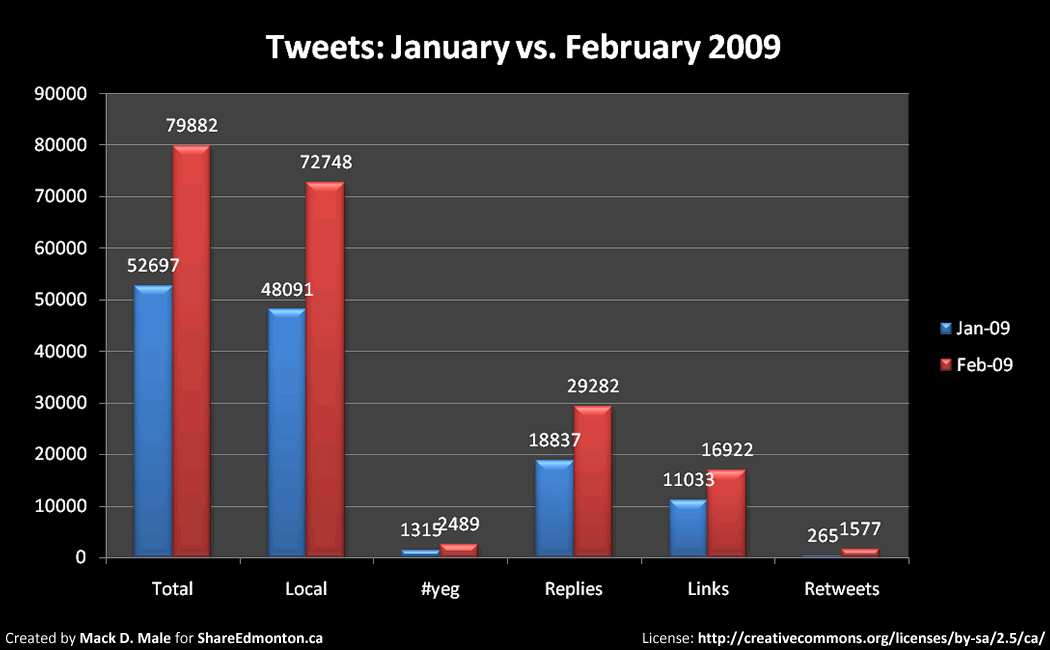
# of tweets by local users: 72748
# of tweets by local users containing #yeg: 2489 2231
# of tweets by local users that were replies: 29282 28212
# of tweets by local users containing links: 16922 13318
# of tweets by local users that were retweets: 1577 1468

This graph shows the (incorrect) above numbers compared to the same numbers from last month:

Of the 463 additional local users I identified in February, only 320 were new accounts created during the month. The other 143 users had existing accounts and either didn’t post in January, or only changed their location to something matching a local user in February. This graph shows the new user creation by day:

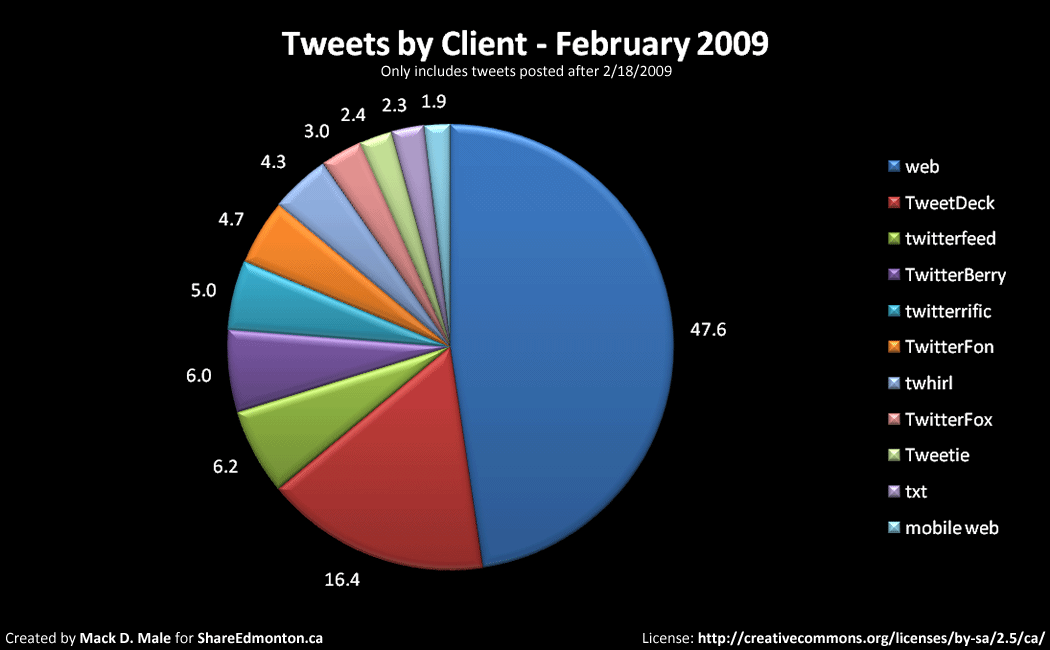
On the 18th, Twitter added a new property to the results returned by Twitter Search – the source. That means I was able to identify the clients that local users use most when posting updates. The top five are: web, TweetDeck, twitterfeed, TwitterBerry, and twitterrific. Note that web source actually includes all unidentified API calls too.

Some other interesting statistics for the month:

  • The ten most active local users (most tweets first): fcedmonton, angelzilla, britl, mastermaq, justNICKI, adampatterson, Pat_Lorna, foomanizer, AndyGroenink, and JodieGiese.
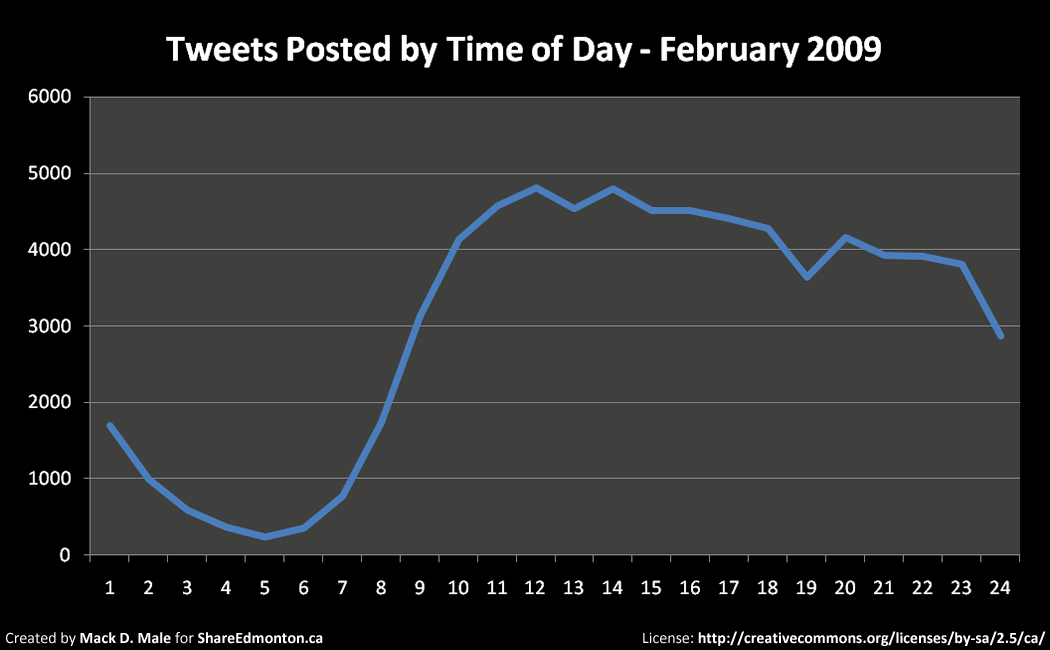
  • Just over 55% of all local tweets were posted between 9 AM and 5 PM.
  • Local users posted roughly 1.8 tweets per minute in February.
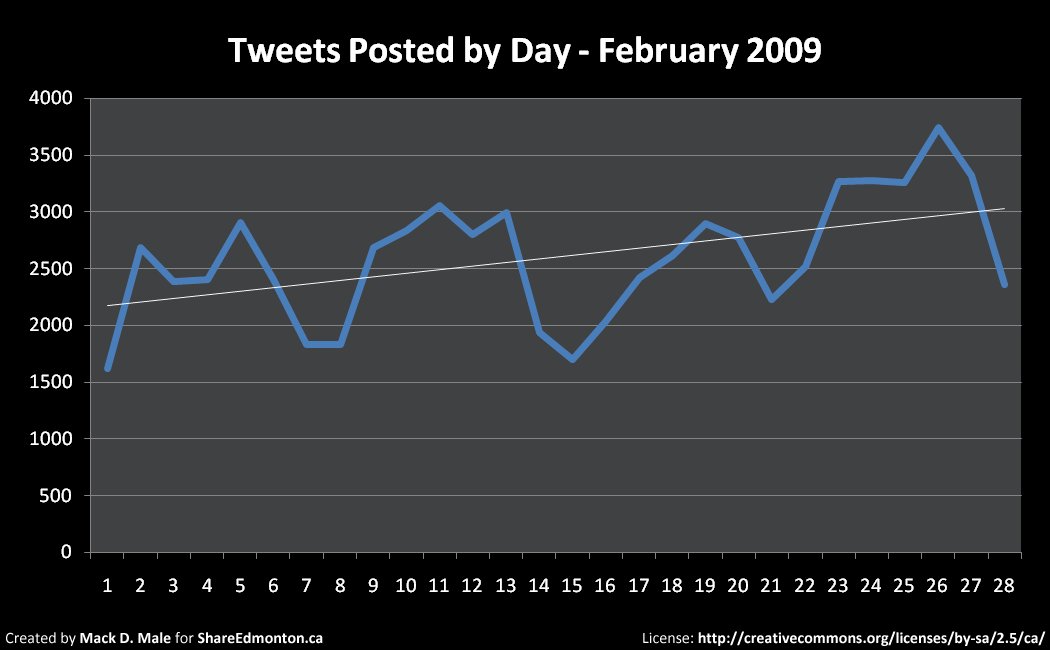
  • The day with the most local tweets posted was February 26th at 3742. On average, 2598 local tweets were posted each day. 
  • Of the 29282 replies posted by local users this month, 13141 or 45% were to other local users.
  • Just 343 local users posted 50 times or more this month. In comparison, 164 local users posted just once this month.

And finally, the top ten users in Edmonton (as of March 1st) by # of followers: Pat_Lorna, mastermaq, LesM, redneckmommy, cleversimon, melanienathan, babyrumps, saralees, jerryreeder, revtrev

I knew the number of local users would increase this month, but I had no idea by how much. With a sudden interest in Twitter in the local media, I expect the growth for March to be even larger.

I hope you enjoyed this unscientific look at the Edmonton Twittersphere! I have done my best to provide accurate numbers, but I can’t give any guarantees. If you have any suggestions or other feedback, please let me know.

UPDATE: Great suggestion from @britl – the total number of twooshes (tweets that are exactly 140 chars) posted by local users in February 2009: 2233

Twitter, Google, and search

For some reason, the “Twitter is a Google killer” hyperbole has sprung up again in the last week or so. And this time, there are some important thought leaders like John Battelle chiming in. Here’s what he wrote in a post called “Twitter = YouTube”:

So why did Google really buy YouTube? My answer, which of course looks brilliant given it’s 20/20 hindsight: YouTube was a massive search asset. Fast forward to today. What’s the most important and quickly growing form of search on the web today? Real time, conversational search. And who’s the YouTube of real time search? Yep. Twitter.

I’ve been writing about Twitter Search since the early days of Summize – I’ve always loved it. It’s no surprise to me that others are finally starting to see the value in it. Here’s what I wrote in October, for instance:

Lots of people already contribute to the noise on Twitter, and I think their user base will only continue to grow. So they’ve got that covered. Increasingly it seems that Twitter is working to extract value from that noise. That’s the area they need to focus on most.

The improvements to Twitter Search have been minimal – the addition of the “source” parameter to results, and testing integrated search on the main website. I’d love to see some additional improvements to the service.

Others who have discussed the “Twitter threat to Google” idea include: San Jose Mercury News, Fimoculous, Search Engine Journal, and The Blog Herald. AllFacebook looks at it from another angle.

What should you take away from this? Essentially, that Twitter Search is becoming increasingly important. If you’re not already using it, start now. And don’t expect Google and others to ignore it forever.

State of the Edmonton Twittersphere – January 2009

I love Twitter, Edmonton, and pretty graphs. In this post, I combine all three! Welcome to the first State of the Edmonton Twittersphere, my look at the intersection of Twitter and Edmonton.

As some of you know, I’ve been working on a new side project for a couple months now called ShareEdmonton. I’ll post more details on that later, but for now all you need to know is that tracking Twitter usage in Edmonton is a big part of the project. As a result, I’ve gathered lots and lots of data over the last month, and I thought I’d dig into a little.

All of the data I am sharing in this post was collected from Twitter Search. It’s a fairly broad set of updates – anything posted by Edmontonians, or about Edmonton. The data set is incomplete (I’m sure I didn’t capture all tweets, and I improved the algorithm for the second half of the month), and is subject to certain restrictions. For instance, unless someone puts “Edmonton” or something similar (lat/long, Sherwood Park, etc) in the Location field of their profile, I have no way of reliably knowing whether or not they are a local user. That said, I feel that the data set I do have is very representative of Twitter usage in the Edmonton area. Going forward, I’ll try to keep the methodology consistent.

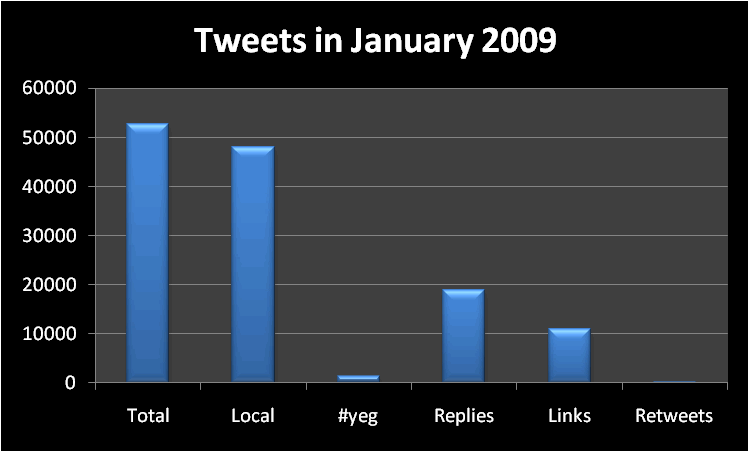
Enough preamble – on to the statistics! For January 2009:

# of users: 1948
# of tweets: 52697

# of local users: 851 (43.69%)
# of tweets by local users: 48091 (91.26%)

# of tweets containing #yeg: 1315 (2.50%)
# of tweets that were replies: 18837 (35.75%)
# of tweets containing links: 11033 (20.94%)
# of tweets that were retweets: 265 (0.50%)

And some other interesting statistics for the month:

  • Ten most active users (most tweets first): fcedmonton, angelzilla, britl, zoocasaedmonton, mastermaq, justNICKI, Pat_Lorna, iNews880, foomanizer, bgrier
  • If you ignore the three “bots”, then alainsaffel, GuitarKat, and fusedlogic also make the list.
  • Those thirteen users account for just over 21% of all tweets in the data set.
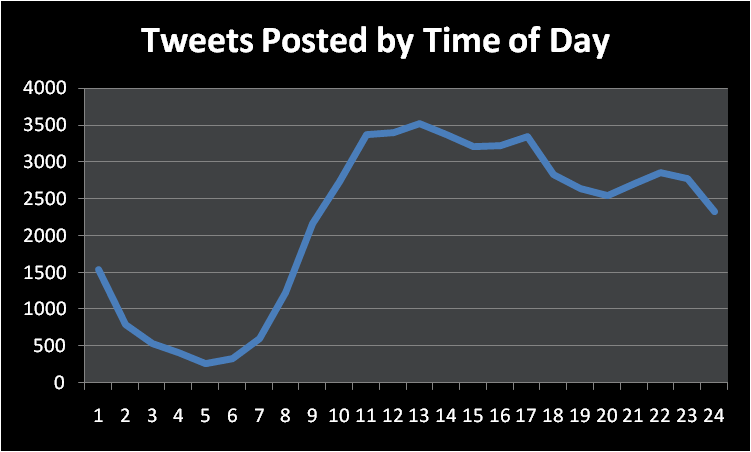
  • Nearly 45% of all tweets were posted between 10 AM and 4 PM.
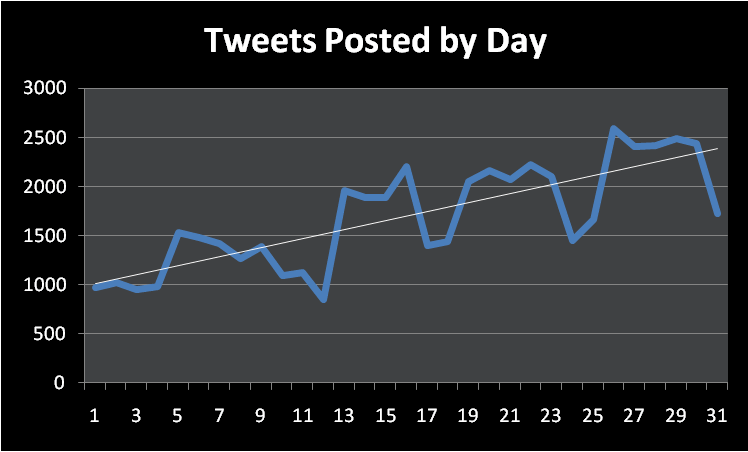
  • The number of tweets posted per day generally increased throughout the month (though this is at least partially due to improvements to my code over the month). Monday, January 26th had the most tweets posted (2592).
  • Local users posted 18042 replies. Of those, 7406 (41.05%) were to other local users.
  • Most aren’t frequent posters: 293 local users posted 31 times or more this month.

And finally, the top ten users in Edmonton (as of January 31st):

In the future, I hope to look at trending topics for the month to get a better idea of just what Edmontonians were talking about. Numbers are one thing, content is quite another.

I’m surprised to see that 851 local users updated this month (all but 110 updated more than once). I would have guessed there were about that many local users in total, not active! So that’s good. It’ll be interesting to see how that number grows over the next few months.

I hope you enjoyed this quick, completely unscientific look at the Edmonton Twittersphere! If you have any suggestions on other things I could include in future posts (or potentially as an update to this one) please let me know.

See you at Edmonton Twestival on February 12th!

Twitter and the future of journalism

twitter logo On Friday, David Schlesinger from Reuters posted an entry to his blog discussing Twitter and the future of journalism. David had been tweeting from the World Economic Forum, and found that his updates beat the Reuters newswire. No big surprise, but it prompted a bunch of questions:

Is it journalism?

Is it dangerous?

Is it embarrassing that my tweets even beat the Reuters newswire?

Am I destroying Reuters standards by encouraging tweeting or blogging?

David’s answers are: Yes, Potentially, No, and No. I love that someone in the “mainstream” media is able to answer these questions honestly and openly!

His entire post is filled with wonderful quotes, such as:

I have no idea what journalism will look like in five years except that it will be different than it is now. That’s a great thing, I believe.

Fantastic outlook on things, in my opinion. Twitter is changing journalism and news media for the better. Ignore it at your own peril. I can’t say it any better than David himself:

If I don’t beat the Reuters wire with a live tweet because I deliberately hold back, someone else will. If I don’t beat the Reuters wire because I’m slow or inattentive, someone else will.

There’s something to be said for holding back, providing context, and thoughtfully articulating a story or idea. But when you’re talking about breaking and spreading the news, speed is the name of the game, and nothing at the moment does it faster or more effectively than Twitter.

Another way to look at it is chunking. Give me bite-sized chunks as the news happens, and when I have time later, I’ll explore the topic in more detail. Twitter is perfect for chunking news.

Take a couple minutes and read the entire post. I’m looking forward to reading it again in a year – I suspect it won’t seem so unique and refreshing by then!