How open data could help the City of Edmonton save at least $197,500 on 311-related expenses

While researching 311 for my previous post, I consulted the 2009-11 Capital Budget (PDF). The Capital Budget pays for both maintaining existing infrastructure and undertaking new projects (in contrast, the Operating Budget is a one-year budget for services and programs – you can find both here). In it, I discovered a Corporate Services (read: IT) project called “e-Business”, described as follows (on page 382 if you want to look it up):

The purpose of this funding is to put 311 statistics on our websites. First for internal staff then to public. The objective is to present 311 statistics in a manner similar to the what New York City does. Their 311 activity is presented by neighborhood or ward, in text form in a table as well as on a map. This project is being presented as a phase in of sophistication. This enhancement can be implemented based on what can be funded.

I went to check out New York’s site for 311 statistics, and it is indeed quite useful. If you type in an address and select a borough, you get a wide assortment of statistics, presented in tabular form or on a map. The bad news is that most of the tables and maps are in PDF form. The good news is that you can export all the data to CSV, which means you can map it yourself! Very cool.

The project description continues:

The e-Business program is driven by three primary factors. Our citizens are demonstrating increased use of the Internet and the City’s Web site, our population is growing, resulting in a projected need for increased services, and citizens and other stakeholders are demanding new and more extensive self-service access to government.

If you’re not thinking of open data and ChangeCamp by now, you should be! Here are some justifications for the project as outlined in the Capital Budget:

  • Program Managers would use this as an additional tool for monitoring service activity.
  • Residents and potential residents could find out what the issues are in specific neighbourhoods.
  • The Mayor and City Council could quickly determine what the major issues are, without having to make a request.
  • The project will help make the City more transparent to its public.

Sounds great to me!

So what’s the problem? Cost.

The justification section of the project description says: “At the City of Edmonton, e-Business is about business first – providing the services our citizens need and want at a justifiable cost.”

I wouldn’t call these costs justified, I’d call them outrageous:

Phase 1 Table display of 311 Statistics reports $27,000
Phase 2 Option to display of reported statistics by business area $27,000
Phase 3 Option to display of reported statistics by neighborhood $37,000
Phase 4 Option to display reported statistics on a map $133,500
Phase 5 Include statistics that are stored in other applications $974,000
  TOTAL: $1,198,500

This is why we need a policy on open data, so that projects like this one don’t get funded, wasting taxpayer dollars.

The first item consists of automating the conversion of reports generated by the 311 system to web content, presumably HTML. I think $27,000 sounds justified for that task. It’s potentially quite difficult and error-prone, depending on what the reports look like, what format they are in, etc. The rest of the items are ridiculously overpriced, however.

What the City should do instead

Spend the $27,000 to automate the conversion of the reports to CSV format. Then make those CSV files available for free to the public. I promise you the City would get the next three phases for free. If I had the data I’d gladly do it, and I’m sure there are others who would too. On top of that, the community is more likely to use standard/open tools and technologies (such as Google Maps) rather than proprietary, awkward ones (such as the City’s SVG maps). We’d probably get it done faster too. The City can then put money to more useful things, such as an open 311 API similar to what Washington, D.C. has.

I think Phase 5, which would include data from POSSE, CLASS, and other internal systems, is too big and broad currently (hence the very large cost). It could be approached in the same way though – spend a little bit of money to make the data available in an open format, and give it to the community to do the rest.

I should point out that the above total ($1,198,500) has no approved funding. Rather, it is the amount the project would cost if City Council approved the entire thing. They could choose to approve only one phase, a couple phases, or none. The reason I put $197,500 in the title is that only the first four phases seem reasonable to me given the information available, and I think the first one is a justified cost as-is.

If the City of Edmonton could save nearly $200,000 on this one project alone by embracing open data (not to mention the indirect benefits that will come along with that cost-savings), imagine what the benefits of embracing open data across the board would be!

Open Data in Edmonton? Follow Vancouver’s lead

Last week Vancouver launched an open data portal, providing one-stop-shopping for open data provided by the city. David Eaves called the launch “a major milestone for Vancouver” and explained:

The Data Portal represents an opportunity for citizens, especially citizen coders, to help create a City that Thinks Like the Web: a city that enables citizens to create and access collective knowledge and information to create new services, suggest new ideas, and identify critical bugs in the infrastructure and services, among other a million other possibilities.

He was also quick to point out that getting access to the data is just the beginning. Citizens have to use it, or risk losing it. The next day he launched VanTrash, an application to make garbage collection sexier. Use it or lose it indeed!

I think it’s interesting that he started with garbage collection, because I too identified that as an area that could use some innovation. A couple months ago, I spent about an hour on the phone with a manger in the Waste Management department at the City of Edmonton, trying to get access to the data behind the garbage collection schedules. Currently you can enter your address here to download your collection schedule in PDF. But if you want to find the schedule for a different part of the city, you’re out of luck. And even if you manually tried enough addresses to find all the zones and collection schedules, they’d be in PDF, which means you can’t easily add them to a calendar.

By the end of the call, I think he finally understood what I was after, and he said he’d have to get back to me. He never did, unfortunately. I can only hope that my request had an impact and that it will eventually help to open the data floodgates in Edmonton.

Open Data doesn’t have to be difficult!

Take a look at the data available at Vancouver’s data portal. Most of the data there is simple and exists elsewhere, in a less “creative friendly” format. A good example is the list of libraries. You can download the data in CSV, XLS, or KML formats, but it really just comes from the Vancouver Public Library website. The CSV contains the library name, it’s latitude, longitude, and address. Simple stuff, but potentially really useful if combined with other data sets.

Here’s an example in Edmonton. Let’s say I want to know how the crime rate of neighbourhoods with libraries compares to those without. What data would I need for that?

  • A list of libraries, with their locations (see below)
  • A list of neighbourhoods, with their boundaries
  • Crime statistics by neighbourhood
  • Census data for neighbourhoods to find comparable ones without libraries

Could you find this today? Yes, but it’s definitely not easy! The EPL website lists the libraries with addresses, so you’d need to figure out the lat/long on your own. The City of Edmonton website lists the neighbourhoods, but you’d need to figure out the boundaries on your own. The EPS website provides reported crimes by neighbourhood. And finally, the City of Edmonton provides census data for neighbourhoods in PDF.

If I could get all the above data in CSV format, it would have taken a matter of minutes to find the answer (I should point out that not all of that data exists at Vancouver’s portal either). Instead, I had to do a lot more work. The very rough result (because I compared with a random sample of similarly populated neighbourhoods) is that neighbourhoods with libraries were 1.5 times more likely to have crime than neighbourhoods without libraries in 2008. Though if you don’t count Downtown, then the crime rate is about the same for neighbourhoods with libraries and those without.

Maybe you’re thinking “what a useless example” and that’s fine – it is one of just hundreds or thousands of possible uses for that data! Just imagine what would be created if software developers and other creatives in Edmonton had access to the data.

Libraries Data

All this talk of open data, why not give you some? I’ve created a CSV of the Edmonton Public Library locations in the exact same format as the Vancouver Public Library data (minus eplGO in the Cameron Library). Enjoy!

Download the Edmonton Public Library location data in CSV

Onward in Edmonton

I’ve heard rumblings that the City of Edmonton will be doing some stuff in the open data space in the next couple of months, but I’m not holding my breath. There haven’t been enough conversations taking place. I’m hopeful that the right people are envious of the progress that has been made in Vancouver, however. I sure am!

Data on Edmonton’s new 12-ward system

Last night City Council voted in favor of changing from the current 6-ward system to the more common 12-ward system used throughout North America. The change will take effect for next year’s municipal election. For more background, check out Dave’s post. You can also check out the City of Edmonton’s page for more information.

As an advocate of open data, I thought I’d share with you some data related to the new wards below. All of the data is available on the City website somewhere, but not in an easily consumable form. I’ve done the legwork to make it accessible.

Amendments made to the motion last night affected the wards a little:

  • Grovenor and McQueen neighbourhoods moved from Ward 1 to Ward 6.
  • CPR West moved to Ward 8 from Ward 10.
  • Calgary Trail North and Calgary Trail South moved from Ward 11 to Ward 10.
  • Some ravine boundaries were changed from “in-the-middle” to “top-of-bank”.

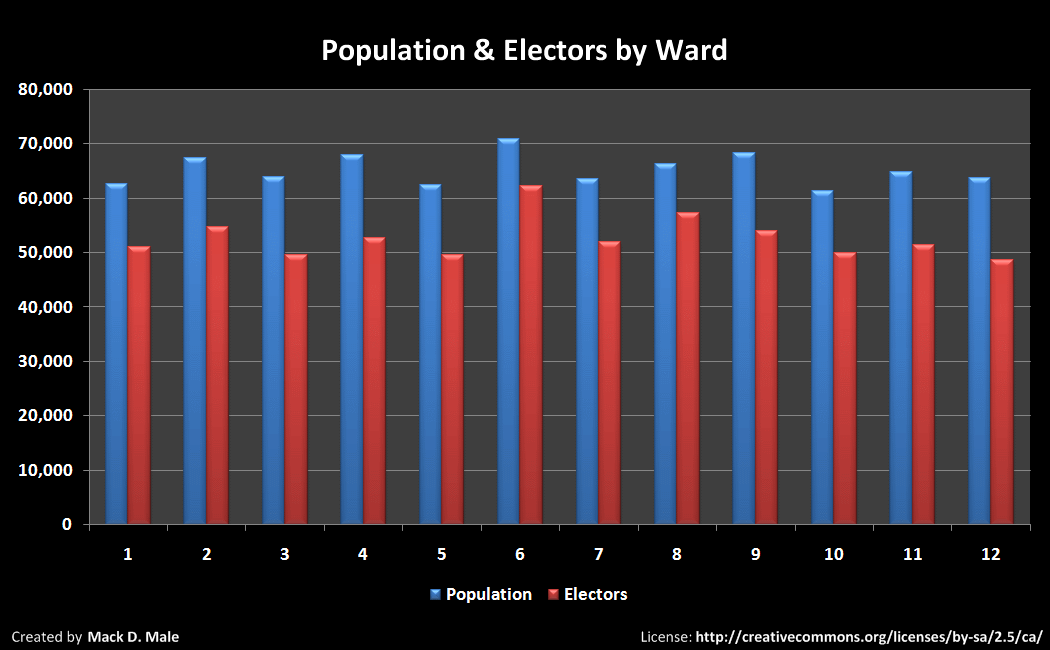
Here are the stats on the new wards:

In a table (download CSV file here):

Ward Population Electors
1 62,625 51,061
2 67,306 54,704
3 63,819 49,465
4 67,811 52,666
5 62,424 49,615
6 70,840 62,152
7 63,549 51,865
8 66,196 57,189
9 68,214 53,889
10 61,276 49,935
11 64,770 51,329
12 63,609 48,529

The average population of each ward is 65,203 and the average number of electors for each ward is 52,700. This data comes from the 2009 Municipal Census.

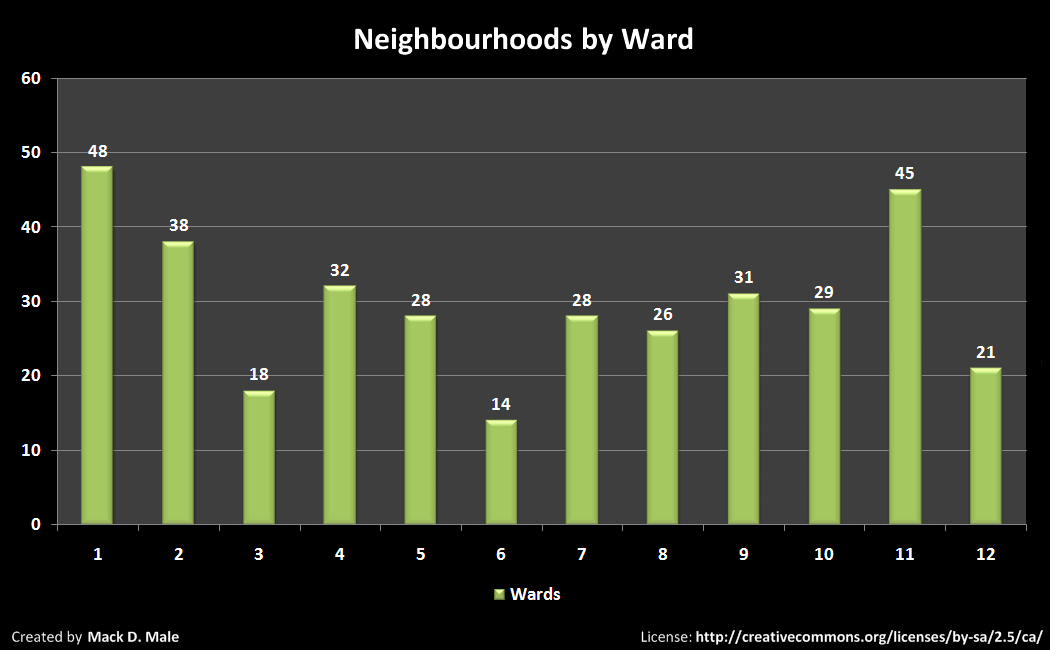
Here are the number of neighbourhoods in each ward:

I’ve also compiled a list of neighbourhoods in each ward which you can download in CSV here. Or if you’d rather just look, you can download the list in PDF here.

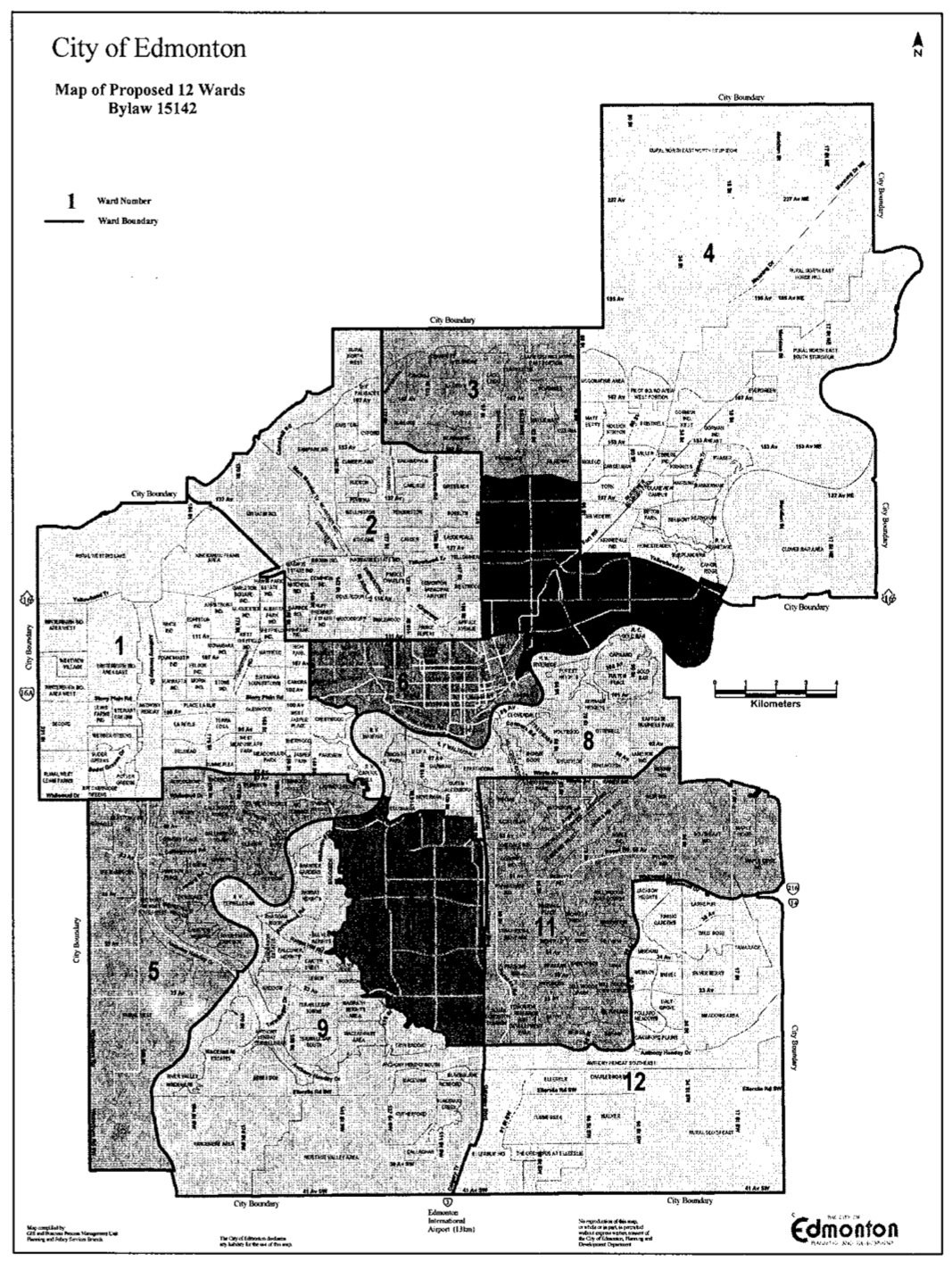
I’m trying to track down or create a good quality map of the 12 wards, but this’ll have to do for now. What I’d really love is lat/long coordinates for each ward. If you have something better than that graphic, let me know!

Go do something useful or interesting with this data, and then tell me about it. I’m looking to collect local examples to strengthen the case for open data at the City of Edmonton!

UPDATE: Here’s a better map in PDF format.

UPDATE2: Here’s an even better color map showing the wards and neighbourhoods in PDF format.

Calgary takes first steps toward becoming an Open City

A motion will go before Calgary’s City Council next week that outlines the first steps in the process of making Calgary an Open City. Calgary follows in the footsteps of Vancouver, which passed a similar motion back in May. DJ has all the details on the Calgary motion here. I think it’s pretty cool that the news is first announced on a blog!

Calgary’s motion will result in a report from City Administration to be presented to Council no later than December 2009, outlining the overall strategy for making Calgary an open city. In particular, the report will identify “opportunities to make more of The City’s data open and accessible while respecting privacy and security concerns , and ensuring that data is available through use of open standards, interfaces and formats.” Other aspects of the strategy will include increasing online citizen participation, procuring and supporting open source technologies, and increasing the number of City services available online.

This is exciting news for developers and other creative professionals in Calgary and elsewhere. I’ve been pushing for open data in Edmonton recently, and I really hope we’re not too far behind our southern neighbours on this issue. There are a number of advantages to making data available in open standards and formats:

  • Citizens can subscribe to data that is of interest to them
  • Data can be mashed together in new ways, revealing new information
  • Visualization of data can help citizens make better decisions
  • Citizens can work together to organize data
  • Government can learn more about its data from citizen contributions

Additionally, using well-understood, open formats such as XML or CSV helps to “future-proof” the data. You don’t need proprietary technology to read a CSV file – any programming language or software platform will work.

One issue that isn’t mentioned in Calgary’s motion but which is very important, is licensing. It’s important that when Calgary does make data available, that it does so in the least restrictive way possible. Either public domain, or creative commons, or something similar. It would be a shame if they made a ton of data available and then had ridiculous terms of use around it.

Open data is about empowering citizens to work with their governments. I’m encouraged by the recent interest among municipalities in Canada, and I hope the trend continues.