Recap: Edmonton NextGen’s Up{date}

Tonight Edmonton NextGen hosted an event called Up{date} at the Art Gallery of Alberta. Here’s what it was all about:

Up{date} 2011 brings together city councillors and key civic leaders in a speed dating style format for you to directly ask how their visions for Edmonton’s future are coming to life a year since the election. First introduced in the 2010 municipal election, Candi{date} is a made-in-Edmonton NextGen event that connects Next Gen voters to election candidates. Candi{date} is a casual, informal and fun way for voters to meet candidates, find out who they are and what they stand for, and to ask the questions that matter to them.

I wrote about the second Candi{date} event here. I think it is great that NextGen is creating opportunities to connect with our civic leaders, so I was excited to check out Up{date}. I was disappointed in the turnout tonight though, with only 20 to 30 people in attendance. I’m equally disappointed that more of my peers don’t seem to take advantage of opportunities like this (though tonight there was stiff competition from the Crate & Barrel grand opening at Southgate, with catering by D’lish, that’s where Sharon was). Clearly there is work to be done!

Up{date}

Mayor Mandel came for a brief period, but Councillors Batty, Henderson, Iveson, Krushell, and Sohi were in attendance most of the evening. Also joining them was Edmonton’s Fire Chief Ken Block. Here are my notes from the discussions I had!

Councillor Henderson

  • “Our long-term health depends on building a city that people want to live in, not one they have to live in.”
  • Unsurprisingly, his least favorite issue right now is the arena. He talked about the issues that people like to focus on – potholes, taxes – and said that “they are important, but they often get in the way of city building.” He made the point that “no one moves to a city because it has no potholes.”
  • He also spent some time talking about aboriginal issues in Edmonton, and the need to make progress. He mentioned Edmonton’s Urban Aboriginal Accord (PDF) and called it “an important document.” Another point he made was that we haven’t done a lot to recognize or celebrate that aspect of our city’s history.
  • On the topic of urban sprawl, he expressed concern that “maybe we don’t mean what we say.” He said that Council has said they want to stop urban sprawl, but have actually done little to achieve that.
  • When the discussion turned to crime, he mentioned that “putting more police on the street is just a band-aid solution” and that we need to focus on making changes for the future.

Councillor Krushell

  • On downtown: “it needs work.”
  • We talked quite a bit about the proposed Shaw Conference Centre expansion. Krushell was on the expansion committee that evaluated the business case. “I disagree with the Mayor on this one” she told us, explaining that her preference is to have the SCC expand into the river valley rather than across Jasper Avenue.
  • “We somehow haven’t figured out how to utilize our riverfront.”
  • We of course talked quite a lot about the City Centre Redevelopment. “When we say to young people, ‘don’t spread out and buy single family homes in the suburbs’, what product do we offer as an alternative?” She sees the ECCA lands as an opportunity to provide that alternative product.

Up{date}

Councillor Sohi

  • He started out with a couple of stories about his days as a bus driver with ETS. On his very first day, he was driving route 30 and on the 3rd or 4th stop the door wouldn’t close. He managed to get it closed but it kept happening! Ultimately he had to call control and they sent a a new bus, but it was a stressful start! “Be nice to the drivers!” he told us.
  • I asked him about the arena and if there was anything Council could have done differently. His response: “In hindsight we should have been in the driver’s seat rather than letting the Katz Group drive the process.”
  • Sohi said he believes Edmonton can become a centre of excellence when it comes to diversity, and he hopes to see more coverage of multicultural issues in our city. “We also can’t forget that we will soon have the largest aboriginal population.”
  • “I always look around at events like this and ask, ‘is Edmonton being represented?’”

Chief Block

  • “It’s an absolute honor to be the chief.”
  • He started at Fire Rescue Services in 1980, so he’s certainly a veteran!
  • Block mentioned he was particularly proud that Edmonton Fire Rescue was approved by The Commission on Fire Accreditation International as an accredited agency last year. “We were the 138th out of around 36,000 fire services across North America to get full accreditation, and just the 3rd in Canada.”
  • On a day-to-day basis, budgetary issues are one of the major challenges. He praised Council however, telling us that two additional stations are opening at the end of the year.
  • Fire Rescue Services responds to 34,000 events per year, about 65% of which are medical events. There are typically between 900 and 1300 fires per year, but there’s a lot of variation with regards to when and where.
  • I asked him about succession planning, and while noting that there are a large number of firefighters close to retirement, he did say they were having success with recruiting. “We see between 900 and 1400 applicants per year.” He explained that there’s not a lot of movement out of the department – firefighters generally remain firefighters for their entire careers.
  • Another long-term challenge he talked about was building codes and building materials. “There are almost no solid wood products anymore,” he told us, and explained that the newer combination products burn faster and hotter.
  • Arson accounts for roughly 30% of fires across Canada, and that’s no different in Edmonton, he said. “We’re trying to work closer with police, because there are very few convictions with arson.”
  • Another interesting point he made was about the need to serve the river valley. “The public is being invited to make use of the river valley more and more, and we need to be able to handle emergencies there.”
  • On getting information to citizens digitally: “That’s an area we need to improve upon.”

Up{date}

I enjoyed talking to Chief Block most tonight. It was great to connect with one of our civic leaders who isn’t always in the spotlight. I think it might be interesting to have similar events in the future with other less-visible civic leaders.

Kudos to NextGen for creating the opportunity – now we need to work on getting people to take advantage of it. If you haven’t already done so, check out Edmonton NextGen’s annual report for 2010. You can also subscribe to the NextGen newsletter to stay on top of events like Up{date}.

Edmonton’s downtown revitalization: now linked to the arena more than ever?

Back in May, the City of Edmonton and the Katz Group agreed on an agreement framework. A month later, City Council asked a number of questions about that agreement, which Administration answered in a report (PDF) that went back to Council on July 20, just before the summer break. Unsurprisingly, a few of those questions were related to the Community Revitalization Levy (CRL). The answer was that Administration would return to Council with more information, including the new CRL boundary, with a target date of August 31.

Today, that date became official, not to mention a whole lot more complicated. Here’s what a media advisory titled “Proposed Downtown CRL could fund revitalization” said:

A vibrant downtown is a key ingredient of a great city. Gary Klassen, General Manager for Sustainable Development, will be available to speak about a report on an option for a boundary for a downtown Community Revitalization Levy which could fund revitalization.

That media conference will take place tomorrow at noon (right in the middle of the I (heart) yegdt BBQ taking place right outside City Hall in Churchill Square). The report itself will be made available at 11am.

The gist of it is this: the City is proposing a larger, downtown-wide CRL to fund not only the arena but also a number of other “catalyst” projects in the downtown (as outlined in the Capital City Downtown Plan). I can’t confirm this just yet, but my understanding is that the proposed CRL is big – as in $320 million big. It’s a smart piece of political maneuvering, when you think about it. How do you get councillors who are opposed to or on the fence about a CRL for the arena to support one? Add in a whole bunch of other stuff they would likely support. It’ll be especially interesting because with the summer break a number of the councillors have no idea this is coming.

I think there are two ways to look at this proposal.

One perspective is that the proposed CRL is a good thing because the catalyst projects will finally receive funding. Projects like the Jasper Avenue New Vision, At-Grade LRT, the High Profile Bikeway System, and the Warehouse Campus Central Park all sound great, but don’t have any funding attached to them. The proposed CRL could be used to fund all of these in addition to the arena. Some projects would certainly benefit as they’d sort of “catch a ride with the arena” and would get their funding without too much added trouble. And since they are all part of the plan to revitalize downtown, the CRL is a good fit. That’s what it was intended for, after all.

The other perspective is that the proposed CRL is a bad thing because it basically holds downtown revitalization hostage. You could see the proposed CRL as a message that either Council agrees to fund the arena, or the other projects don’t receive funding. The 2012-2014 Capital Budget is coming up for discussion later this year, and some of these projects (or elements of them) would have been part of the budget discussions. Now it seems they would just come along with the arena, or….what? It’s not clear what the alternative might be. Additionally, projects funded through the CRL might not actually receive any money for years (a CRL takes time to approve), whereas if they were funded through the budget process they could receive funding as early as January.

Take the Alley of Light project, for instance. It was slated to be up for discussion as part of the Capital Budget, with a line item of $500,000. Now it would fall under the Green & Walkable Downtown catalyst project. In a way this is a good thing – the Alley of Light might receive the funding under the CRL without too much debate. On the other hand, don’t we want Council to be clear about what they’re funding? I want Council to stand up for the Alley of Light, to say that it is absolutely worth the $500,000, and that it will have a positive impact on our downtown. I don’t want it to get funded “under the radar” just because the arena did. Likewise I don’t want the arena to get funded just because we want the other projects.

Not to mention that the proposed CRL is especially risky given that The Quarters CRL is immediately to the east. How likely is it that the required development will take place in both areas to generate enough tax “lift” for the CRL to work?

Ever since the beginning, the Katz Group has made it clear that this project is about downtown revitalization. To them, downtown revitalization doesn’t really happen unless the arena happens. Now with the proposal of a downtown-wide CRL, it seems that the City has bought into that idea wholeheartedly. Next Wednesday, we’ll find out if City Council has as well.

UPDATE: The report is now available. Details: “over the 20 year term of the levy is expected to generate an additional $1.18 billion in new tax dollars (net present value of $600 million) of which $788 million is based on appreciation of the existing assessment base (net present value of $385 million).”

The City of Edmonton’s transformation continues with latest reorganization

The City of Edmonton’s internal transformation efforts continued this month with a reorganization taking effect on June 1. City administration has now realigned into six departments, plus the Office of the City Manager, in a bid to improve communications and to better align with strategic direction.

While I wouldn’t call the reorganization a “major” one – it’s certainly not like City ‘97 which streamlined 14 departments to just 8 and saved millions of dollars – it nevertheless is a significant step for the current City administration. Under the leadership of City Manager Simon Farbrother, the City of Edmonton has embarked on a major cultural shift known as Transforming Edmonton and Me.

Here are the details on the latest reorganization.

Old departments:

  • Asset Management & Public Works
  • Capital Construction
  • Community Services
  • Corporate Services
  • Finance & Treasury
  • Office of the City Manager
  • Planning & Development
  • Transportation

New departments:

Here’s the new organizational chart (PDF):

Community Services now includes the Parks and Community Standards branches in addition to Fire Rescue Services, Neighbourhood & Community Development, Community Facility Services, and Community Strategies.

Corporate Services remains largely unchanged, consisting of the Human Resources, Information Technology, Law, Materials Management, Fleet Services, and City Clerk branches. There’s also a new Customer Information Services branch, which is responsible for 311 and the website.

Finance & Treasury is now Financial Services, and consists of the Strategic Management, Client Financial Services, Corporate Accounting, and Assessment & Taxation branches. The former Transformation Management branch appears to no longer exist as a separate entity.

Asset Management & Public Works has become Infrastructure Services, and includes all above and below ground infrastructure. It now consists of three branches (Buildings & Landscape Services, Drainage Services, Waste Management Services) instead of four (Corporate Properties, Drainage Services, Parks, Waste Management). It will also contain the Project Management Office.

The Office of the City Manager has not changed since it adopted pieces of the old Deputy City Manager’s Office (DCMO) last year. Corporate Communications and Intergovernmental & External Affairs both report to the City Manager.

Planning & Development has become Sustainable Development, and now consists of four branches (Current Planning, Housing & Economic Sustainability, Urban Planning & Environment, Corporate Properties) instead of five (Assessment & Taxation, Community Standards, Current Planning, Housing, Planning & Policy). There’s also a new area called Transformational Projects, which will be responsible for projects like the proposed downtown arena and the City Centre Redevelopment. Urban Planning & Environment is now responsible for Parks Planning.

Transportation Services has gone from three branches (Transportation Planning, Transportation Operations, ETS) to at least five (Transportation Planning, Transportation Operations, ETS, LRT Design & Construction, Road Design & Construction). This is basically the adoption of the old Capital Construction department. The web page for the department also lists a new LRT Expansion branch, though it doesn’t appear on the org chart. The changes in this department are intended to put The Way We Move into a single area.

Final Thoughts

I think the changes, while mostly cosmetic, are important. Most of the departments now contain “services” right in the name, which better reflects their purpose and mission. The changes also reflect a desire by administration to better align with The Way Ahead, the strategic direction set by City Council. It’s not clear whether any jobs will be lost as a result of the reorganization, but I don’t think so. I also don’t believe it is in any way connected to the projected $31 million deficit the City is facing. The wheels were in motion for this reorganization some time ago.

The Alberta Party’s Big Idea Night (and new brand)

Earlier today the Alberta Party unveiled its new logo and brand package. I’ll admit that I wasn’t an immediate fan of the new logo. Putting speech bubbles inside the provincial shield feels more obvious than clever, at least at first blush. I’ve been thinking about it though, and I actually kind of like how direct it is. The logo conveys its message in a clear and very to-the-point fashion. And I do have to admit that the speech bubble element itself is rather smart, as Chris pointed out:

My favourite part of this brand strategy, is the “Speech Bubble”.  The pull-apart element of the logo will become part of how our supporters will be able to make this brand their own. The number of ways that this can become personalized to each member, constituency association, community or neighborhood, are endless.

As I descended the steps at the Shaw Conference Centre tonight on my way to the Big Idea event (I attended as media), I passed a number of volunteers wearing black tee shirts featuring the new visual identity. Set against a dark background, the new logo is definitely attractive. The fonts used are Avant Garde Gothic Bold and Book.

Here’s how the Big Idea Night was described on the Alberta Party website:

Join us for an evening of fast-paced, fun, thought-provoking and inspiring presentations from our members, supporters and friends. Do you have a great idea for our province? An innovative way of doing something? A vision for Alberta in 20 years?

Think “mini-Pecha Kucha”. Each speaker got five minutes to share their “big idea” with no time for questions (but plenty of time for networking afterward). The speakers tonight were, in order of appearance:

  1. Dennis Lenarduzzi – Logo
  2. Everett Smith – Vision 2031: Rewarding civic duty & community service
  3. Danielle Klooster – Community culture by design: Penhold on purpose
  4. Connie Jensen – A few tips for a proactive campaign
  5. Lisa Maria Fox – Brining public to policy
  6. Glenn Taylor – This is my voice
  7. Jesse Row – My big idea
  8. Wade Ferguson – Welcome to Vermillion: accelerating innovation in sustainability

It just so happened that one of the first people I ran into at the event was Dennis Lenarduzzi, Associate Creative Director at Red The Agency. He’s the man behind the new logo, and he shared with me that he was particularly excited to see people using the logo in new ways already. He was also the first presenter tonight, and I thought he did a great job discussing the “common ground. common sense.” slogan and other new brand elements. He emphasized that the logo is for all Albertans, not just the Alberta Party.

Alberta Party Big Idea Night
Dennis Lenarduzzi

Everett Smith talked about his vision for Alberta, and focused on volunteers. He suggested adjusting taxes to reward Albertans that volunteer. Danielle Klooster talked about community culture, and had an intriguing slide labeled “Bad Stuff in the ‘Burbs”. Connie Jensen suggested Alberta Party members should organize their own “Concerned Citizens for Democracy” groups. She also said she wants to see 40+ seats go to the Alberta Party or she’ll be disappointed! Lisa Maria Fox talked about policy and the public, and spent a bit of time discussing deliberative democracy, crowdsourcing, and other ideas. Glenn Taylor started off by talking about Shane Koyczan and how his poetry slams had inspired him, then he left the stage while he showed a video of Koyczan’s “This is my Voice”. Jesse was a good speaker and had some interesting ideas, such as an American Idol or Star Search-like competition for selecting candidates. Finally, Wade (who’s last name I didn’t catch) talked about Vermillion Canada.

Alberta Party Big Idea Night Alberta Party Big Idea Night

Remember I said to think mini-Pecha Kucha? Tonight reminded me of PKN in both style and content. There was definitely a range of presentations – from solid, on-point ones like Dennis’ to totally-ignoring-the-concept ones like Glenn’s to pitches like Wade’s. I didn’t feel overwhelmed with big ideas. In that respect, I found the evening a little disappointing. Of course it takes guts to get up in front of a crowd and talk for five minutes, so kudos to the presenters for that.

That said, what other political party is embracing this kind of approach? It may not have been perfect, but the Alberta Party’s Big Idea Night is exactly the kind of thing I’d like to see more of. I hope they do it again (after learning from tonight’s experience, of course).

Alberta Party Big Idea Night

Tonight’s event was the kickoff for the Alberta Party Leadership Convention which takes place all day tomorrow at the Shaw Conference Centre. You can learn more about the candidates here and you can follow along on Twitter using the #abpleader hashtag. You can see the rest of my photos from the evening here.

City Centre Redevelopment ‘shorter-listing’ reveals problems that must be addressed

Last week City Council shorter-listed three of the five finalists in the City Centre Redevelopment Master Plan Design Competition, with the winner set to be named on June 22. The decision to narrow the field to three after a botched media conference was unexpected and was largely overshadowed by last week’s arena news.

The media conference was set to take place on Wednesday afternoon. The advisory had gone out less than 24 hours earlier:

Join City Manager Simon Farbrother for the announcement of City Council’s selected design team to transform the City Centre Redevelopment project into a world leading, environmentally sustainable community. The announcement completes a year-long international competition to select the best team to deliver a master plan to develop this centrally-located land which is approximately 266 CFL football fields in size. A representative from the winning team will be on hand for media interviews after the formal portion of the announcement.

Members of the local media filled the Councillor’s Boardroom at City Hall which had been setup with chairs and the competing teams’ display boards. Mayor Stephen Mandel, City Manager Simon Farbrother, City Centre Redevelopment Executive Director Phil Sande, Fairness Advisor James McKellar, and a representative from each of the five finalists were set to be in attendance. We chatted amongst ourselves as we waited for the proceedings to begin.

ECCA Announcement

Just before four o’clock, Mayor Mandel and Simon Farbrother entered the room, nearly half an hour after the media conference was supposed to begin. The mayor took the podium and revealed that City Council had been discussing the proposals in camera (in private) and still had too many questions outstanding to make a decision. I tweeted the news at 3:57 PM, along with The Charrette and a few other people. Simon Farbrother also said a few words, and said the media would be given an update by the following morning. The whole thing lasted just five minutes.

I remember thinking as I left City Hall that someone must have screwed up. I mean, since when does Council discuss anything quickly? It’s their job to make an informed decision, and that usually takes time. I found out later that inconveniencing the media was just the tip of the iceberg.

Mayor Mandel ECCA Announcement

When Mayor Mandel had told the media that Council still had questions, I assumed they were questioning the finalists directly. Not so, Shafraaz Kaba of Manasc Isaac told me. While the media were sitting in the Councillor’s Boardroom waiting for the announcement, the five finalists were sitting in a windowless room in the City Clerk’s office. Shafraaz said they had been taken there while Council was discussing the selection committee’s recommendation. They were not told how long they’d be waiting. “They provided coffee and drinks, and some fruit and dessert that basically no one touched,” Shafraaz told me. He recalled that everyone was starting to get impatient as they watched the minutes slowly tick by. Finally after an hour and a half they sent someone to find out what was going on. Soon everyone had left the room and was waiting outside the clerk’s office for some kind of update. “That’s when I saw your tweets, about Council not being able to make a decision,” he told me. A few minutes later, Phil Sande arrived and told them that Council would not be making a decision after all. When Shafraaz told him that they already knew that, Phil seemed surprised and asked how they had found out. “It was like he didn’t seem to know that there was a press conference going on,” Shafraaz said.

The next morning, Phil called Shafraaz and told him that their team’s submission had not been chosen as one of the three to move ahead. It was clarified that the Mayor and City Council will make the final decision on the winning team. At the Downtown Business Association’s Spring Luncheon later that day, representatives from all five teams were introduced and then a short, pre-recorded video with Mayor Mandel was shown. In the video, Mandel made reference to “the decision” which brought chuckles to the packed room. Simon Farbrother then made the official announcement about the shortlisting of three teams.

City Centre Airport Design Competition Finalists

The way the finalists were treated last week is completely inexcusable. Five world-class teams are competing to help shape the future of Edmonton and we lock them in a room with no information about what’s going on? It’s completely unacceptable. What are the chances that they’re going to want to work with the City again after being treated like that?

The worst part is that Wednesday was just more of the same, according to Shafraaz. There has been confusion and some disappointing decisions made ever since the start of the competition. “We asked early on who had the final decision, the ‘jury of distinguished experts’ or City Council,” Shafraaz told me. The response from the City was that Council had the final decision but that hopefully they would respect the jury’s decision. The RFP stated that “the jury will ultimately recommend a winning Submission or combination of Submissions to City Council for adoption” and that “City Council reserves the right to accept or reject the recommendation of the jury.” It certainly seemed as though Council’s role was not to conduct its own analysis but was instead to ratify the recommendation of the jury. Why have an independent jury if that wasn’t the case?

There were other bumps along the road too. “It was unclear what the deliverables for a ‘master plan’ should be,” Shafraaz told me. With no guidance, each team likely interpreted the amount of work involved differently. That’s especially problematic given that 25% of the evaluation scoring was price (vision & team philosophy was 30%, primary requirements was 25%, and master plan principles was 20%). “Is it about design or is it about cost?” Shafraaz wondered. “If you want the best design, you pay for it; it should never have been about cost.”

Unsurprisingly, the finalists also had to dig for details on the public involvement aspect of the competition. “We had to ask how much information we could present, how many boards we could have, how long the videos could be,” Shafraaz said. The jury was supposed to consider how the public responded, but teams were given no information about how that would be done. I saw some great coverage at The Charrette, but what little buzz there was about the videos didn’t seem to be sustained or capitalized on by the City, let alone factored into any evaluation.

Shafraaz is obviously disappointed that his team wasn’t shorter-listed, but he doesn’t regret taking part in the competition. “What made losing worth it, in terms of time and energy and all of the hours put in, is the experience of working with amazing designers, engineers, and other consultants that have done this kind of work in other projects.” He hopes other local participants also learned from the experience.

Ultimately, the real work will begin after a winning team is finally selected next month. Shafraaz thinks the project can gain some momentum after that decision is made, “but they’re going to have to work at it.” I don’t think it’s enough to simply hope that the City does indeed work at it. There are clearly some issues that must be addressed. We need to hold the City accountable and we need to ensure the mistakes that have been made so far are not repeated. This project is too important.

Edmonton’s Downtown Arena moves ahead with agreement framework

The Katz Group scored a major victory tonight as City Council voted in private to approve an “agreement framework” for the proposed downtown arena. The framework is the basis for the two sides to negotiate a formal Master Agreement, which will require final approval by City Council. While not a final binding agreement, tonight’s deal nevertheless allows the project to move forward.

Here is the full motion and amendments as voted on back on April 6 (tonight’s was largely the same – see here):

Edmonton Downtown Arena Motion(function() { var scribd = document.createElement(“script”); scribd.type = “text/javascript”; scribd.async = true; scribd.src = “http://www.scribd.com/javascripts/embed_code/inject.js”; var s = document.getElementsByTagName(“script”)[0]; s.parentNode.insertBefore(scribd, s); })();

The vote tonight succeeded 8-5. Who voted in favor of the framework? Who voted against?

For: Mandel, Krushell, Loken, Leibovici, Batty, Henderson, Anderson, Sohi
Against: Sloan, Gibbons, Caterina, Iveson, Diotte

The document outlines $350 million in funding for a $450 million arena. Where does the other $100 million come from?

Answering questions from the media tonight, Mayor Mandel would only say “other orders of government.” There is no confirmation on where the remaining amount will come from, but it is hoped that the Province will support the project.

How much of the total cost will be funded by a CRL?

The motion only states that $20 million be directed at the arena from a CRL. The remaining $105 million (the City’s maximum contribution will be $125 million) could come from direct tax revenues. However, the agreement framework page states that $45 million would come from a CRL. The final mix is likely to change.

What happens to Rexall Place and Northlands?

The motion specifies that City administration will continue “to work with Northlands to ensure the City understands their financial challenges and how these can be addressed.” Answering questions this evening, City Manager Simon Farbrother said that Edmonton cannot sustain two arenas. It would appear that Northlands has lost its seat at the table.

Will the City own the arena? Will it receive the revenue?

Under the agreement, the City would own the building and land. The Katz Group would be responsible for all maintenance, upgrades, operating and capital expense costs. The City also retains the right to access the facility four weeks a year. As for revenue, the motion only states that the City “negotiate options for potential revenue sharing.”

What will the arena look like?

The City stated tonight that the arena will contain 18,500 seats and 350 parking stalls. The design process will still need to happen once the project moves ahead.

What are the next steps?

The City and the Katz Group will now work to complete the Master Agreement. They’ll also be working to secure the remaining $100 million, likely from the Province.

Twitter was buzzing with the news tonight. Here are a few of the tweets that caught my eye:

#yegcc just came back in public – voted on a motion to approve a framework for #yegarena deal – details to be kept in private. Passes 8-5.

News conference upcoming at City Hall for major #yegarena announcement.

City announces framework to build arena!

City and Katz Group agree on agreement framework to build arena http://bit.ly/ipraRy #yegarena #yeg

The City of Edmonton and Katz Group agree to framework that “sustains NHL hockey in #yeg for 35 years.” #yegarena #Oilers

Mandel stresses optimism, forward momentum, believes holes in plan will come together now that framework of deal in place. #yegarena

This arena will built just when the construction labour and materials market explodes. I’m guessing it comes in at $700 million. #yegarena

This arena situation is just like the airport situation; everyone knew it was going to happen, it was just a matter of when. #yegarena #yeg

NOTE: #yegarena dissenters. A friendly reminder; you have until JULY 17th to file your plebiscite application. Just saying.

It’ll be interesting to see what happens next! Much more to come, stay tuned.

Youth Roundtable with Paul Martin & Mary MacDonald

I guess you could say that today is “federal Liberals day” here in Edmonton. Former Prime Minister Paul Martin is in town to lend his support to local candidates. He spent the day with Mary MacDonald, the Liberal candidate for Edmonton-Centre, and will join Liberal leader Michael Ignatieff at a public rally tonight. This afternoon Martin and MacDonald hosted a youth roundtable discussion that I was invited to and attended.

Paul Martin & Mary MacDonald

I was a little hesitant about attending a “youth” roundtable, because I didn’t want to be pigeonholed into discussing “youth” issues. I really liked that there was a mix of ages at Mike Lake’s roundtable. Why can’t an old person care about voter apathy and a young person care about foreign policy? The first topic on the invitation for today’s event was “youth engagement” and that’s actually what organizers suggested as a topic to start the discussion. I’m happy to report that it was a free-flowing discussion after that however, with some healthy back and forth.

We actually spent a lot of time talking about social media. Twitter came up, of course, and I learned that Mary’s tweets are written by both her and her staff. She said she has been enjoying tweeting so far, and vowed to keep it up after the election is over. I also thought it was interesting that she said she has learned a lot via Twitter. It’s a great tool for staying connected and finding information, so I was happy to hear that Mary is using it for that purpose as well as for getting her message across. Paul said he thinks there are definitely generational aspects to social media use, but conceded that it won’t be long until Twitter and Facebook are mainstream (I challenged that and said Facebook is already mainstream). What impressed me most throughout the discussion was that Paul asked a lot of questions of us. He seemed genuinely interested in learning more about how we would use social media. He brought up Canada’s aboriginal issues and asked how social media might be used, perhaps at first simply to build awareness. There were some great suggestions from others in the room – my advice was to resist the temptation to create new communities online, and instead to try to connect with existing ones. I also cautioned against thinking that only young people use social media.

We discussed a few other issues such as the arts, Internet voting, and Canada’s competitiveness. It was interesting to hear Paul share a few stories about his work in Africa throughout the various discussions as well. Given that so much of our discussion was related to the Internet, I thought it was appropriate to bring up the CRTC and the fact that Canada is an Internet backwater. Mary said their name is an indication of how out-of-touch the CRTC is, but said that it’s more than an issue of Canada having slower or more expensive Internet access than other parts of the world. She pointed out that literacy skills are perhaps more important than ever, and that Canada definitely has work to do in that regard. Digital Policy is listed as one of the Liberals’ top issues, so I was expecting Paul and Mary to talk a little more about it, but to be fair it came up right at the end of the time we had available.

Overall it was an enjoyable discussion, and I definitely appreciated the opportunity to meet Paul Martin! You can learn more about the Liberal platform here, and you can visit Mary’s website here.

If you’d like an opportunity to talk with Mary MacDonald, don’t miss candi{date} taking place from 5pm to 7pm on April 20 at Metro Billiards downtown. She’ll be there along with the other candidates for Edmonton-Centre: Laurie Hawn, David Parker, Peggy Morton, Lewis Cardinal, and Mikkel Paulson.

Recap: Mayor Mandel’s 2011 State of the City Address

Today I had the opportunity to attend the Edmonton Chamber of Commerce’s annual State of the City Luncheon at the Shaw Conference Centre. Hall D was absolutely packed with government, business, and community leaders – it was a really great turnout! The keynote speaker was of course Mayor Stephen Mandel, who delivered his latest State of the City Address, which you can read in PDF here (the archive of speeches is here).

2011 State of the City
Bella Rouge performed right before Mayor Mandel delivered his address.

Mayor Mandel started off talking about the “amazing arts community in Edmonton”. He talked about the importance of cultivating and investing in our arts industry, and made it clear: “Yes arts are an industry.” He talked about a new arts visioning committee that has been struck, co-chaired by Brian Webb and Diane Kipnes, to focus on raising the profile of arts in Edmonton.

He moved on to discuss working with citizens, something I have been thinking about a lot lately. He said:

And as much as I know we have more to learn in the area of citizen input, we have undertaken more citizen discussion in the last six years than at any other point in our city’s history.

I think Mayor Mandel understands that the way we’ve been doing things isn’t working. The expectations are greater, from both citizens and from the City of Edmonton employees that work so hard on their behalf. We can definitely improve when it comes to public involvement, and I think Mayor Mandel would absolutely be supportive of any such improvements.

2011 State of the City

The big news came about halfway through the address as Mayor Mandel was thanking Premier Stelmach for his support of the city. The Province has committed $497 million in new capital funding (through Green Trip) that will enable us to finish the LRT extension to NAIT.

And today, I am very privileged to say we have received assurances from the Province that money for our NAIT line – almost $500 million in new capital funding – has been secured through Green Trip. This new capital pay-on-progress money has already started to flow with $70 million advanced in 2010 through Green Trip. The balance of the province’s commitment is now confirmed which means LRT to NAIT is right on schedule.

The official Government of Alberta news release is here.

With the approval of the City’s submission for this LRT project, the province has provided $70 million from budget 2010-11 to the City of Edmonton to cover project costs already incurred. The remaining payments will be allocated to the City as progress on construction is made.

This is a big deal in my opinion, and while it did receive a pause and applause during the address, I wish a little more time had been spent on the issue. We cannot understate the impact transit will have on transforming Edmonton into the kind of city we want and need. Mayor Mandel did acknowledge the lack of support Edmonton has received from the federal government, saying that “what’s missing is full engagement of Ottawa on the big city file.” He called for citizens to speak out on the need for an urban agenda, something I can definitely get behind.

Mayor Mandel next spent a few minutes talking about the proposed downtown arena, expressing his “sincere hope that Council will take some constructive steps forward” when the issue is discussed at tomorrow’s Council meeting. “This is a project that has the potential to accelerate our efforts to bring more people, more energy and more activity to our core,” he said.

He lost me a little as he continued talking about the other opportunities we have in the downtown core, such as the Jasper Avenue revitalization and the Walterdale Bridge replacement, saying:

Within this context a broad-based CRL becomes a tool to support our efforts across our entire downtown plan – from Jasper Ave to the Quarters, to our warehouse district. So if we move forward tomorrow on the next steps towards a new arena and entertainment district we are moving forward with this entire vision.
 
I do want to frame what moving forward means. It means that we establish a baseline for a lead investment in a downtown arena project by the City of Edmonton, through a portion of any combination of CRL and a user-fee, both of which can be applied to building capital. 

Tying the future of downtown to the arena project’s CRL sounds risky to me. I’m not sure if that was the intent of his remarks, but that’s what it sounded like. It’ll be interesting to see what Council decides tomorrow (if anything).

2011 State of the City

Mayor Mandel next turned his attention to the economy, noting that efforts are underway to “reconsider the role of agrifood and urban agriculture in our region.” He also suggested that our local food economy may “become the seed of a broader economic effort.” He declared Edmonton’s economic future as “bright” but noted that we need to work hard to ensure we realize those opportunities.

He concluded by focusing on his key message, “that there is so much incredible opportunity here.” In particular, I really like his statement:

The best plans in the world, are really only this, until they are realized.

We actually have to do something about them (hence the second pillar of The Edmonton Champions Project: Connect, Do, Win). I think under Mayor Mandel’s leadership we have gotten better at this, but there’s still room for improvement.

2011 State of the City2011 State of the City

Throughout his speech, Mayor Mandel talked about the need for “a higher level of integration and collaboration.” He mentioned it a few times, almost more than “creativity” which seems to be his usual favorite word. I thought he did a good job of highlighting how working together can really make a difference, citing examples such as the Homeless Commission, REACH Edmonton, and the progress the Capital Region Board has made.

Given that there’s a federal election going on, I was particularly interested in Mayor Mandel’s comments on the relationship with the federal government, which we know has been strained at times. To start, he talked about the partnership with the Province and the success it has achieved:

It is based on understanding that municipal government, which is closest to the people is best to lead on key projects and that choosing an aligned path is better for our common citizen.

Then he made it clear – “it is also the message that our City must send to Ottawa through all parties and all MPs.”

All in all it was a great lunch and an uplifting address. My thanks to Robin Bobocel and the Edmonton Chamber for allowing me to join them for lunch today! You can see my photos from today here.

The City of Edmonton is failing at public involvement

In my opinion, the City of Edmonton needs to completely transform its public involvement practices. Over the last few years there has been the odd glimmer of hope that things are changing for the better, but I don’t think progress is actually being made. Sometimes it even feels like we’re moving backwards.

Here’s an excerpt from Mayor Mandel’s Swearing-In Address on October 26, 2010 (PDF):

Looking ahead to some of the major projects entering the consultation stage – the arena, LRT design and EXPO 2017 – it’s clear that we need to refine our consultation process and vastly improve how we communicate with our citizens.

Methods are changing, people contribute their opinions and receive information in different ways, and we are not keeping pace.

A City with a bold creative vision has to be able to communicate clearly with its citizens – we simply must do better here.

And from better process will come better solutions – ones where our citizens can witness their impacts and know that together we’ve all done the best for Edmonton.

Nothing has changed in the five months since he gave those remarks, and there’s no indication that anything is going to change.

The most recent example is the Walterdale Bridge project. There are so many issues I almost don’t even know where to begin. It’s a good illustration of some of the larger issues plaguing the public involvement process.

Oh look City of Edmonton, a dictionary!

The terminology used for public involvement is inconsistent and confusing. What’s the difference between an open house, an information session, and a community consultation? All three have been used on the Walterdale Bridge project, and I’m sure you have seen other terms used for other events. Can I always give feedback? Are some events more heavily geared toward sharing information than others? Does the name imply a certain stage of the process? There’s absolutely no way to tell based on the terminology used.

There are a bunch of other terms that are poorly defined as well. Who’s a stakeholder, for instance?

No consultation on the consultation itself?

Why doesn’t anyone ever ask how we’d like to be consulted on something? Is a bunch of private meetings with “important stakeholders” followed by an information sharing session open to the general public always the best approach? Why don’t more consultations make use of the vast array of effective technologies we have at our disposal? It wasn’t without fault, but at least the online questionnaire on the arena project was different. I think one of the simplest ways we could improve the public involvement process would be to gather feedback on how the process should work before starting it.

What’s happening?

Do you know when the public involvement process for the Walterdale Bridge started? Me neither. The first time the public became aware of the process was on November 15, three days before the first open house. Some “selected stakeholder groups” were interviewed prior to that event, but when? A couple of weeks before? Or years before as the issue popped up with each rehabilitation?

I went to the open house on November 18, and wrote about it here. At the bottom of that post, I captured the “next steps” as they were presented. There would be an interim plan in January, followed by a public information session (different from an open house apparently) in February or March, and then the final plan would go to Council in April. I added my email to the contact sheet at that event.

The update that was presented to TPW on January 25, 2011 came and went without any notice. No press release, no email. Unless you’re checking the agenda of each Council and committee meeting, there’s almost no way you’d have found out about that update. Part of the information shared at that meeting was an update on the public involvement process. The report mentioned the stakeholder interviews and the open house, then finished with this:

The balance of the Public Involvement Plan, to be undertaken in February and March, will be comprised of a series of meetings with key stakeholder groups to further discuss options and recommendations that will have been developed since the November Open House, in addition to another widely publicized public Information Session.  The purpose of this Information Session will be to communicate the content of the final report to City Council.  This Information Session will be held in late March.

So basically if you wanted to provide input but you didn’t attend the November open house, too bad. Unless of course you’re part of those secretive stakeholder groups that may or may not have taken place – no update on those was ever provided.

Finally we come to yesterday’s “widely publicized public information session”. The open house in November got a press release, this one didn’t. The only notice that went out about the event, in addition to a tweet the day of, was an email sent on March 14 to people who signed up at the November open house. That and the web page was updated, though unless you constantly check it, you’d never know that. Hardly a “widely publicized” event, if you ask me.

Actually there is one other way you could have found out about the event – at the City of Edmonton’s Public Involvement Calendar. That would be the calendar without email or text notifications, no RSS feeds, and no ability to search by keyword. None of those events show up in the much more functional Events Calendar, for some unacceptable reason.

You mean you didn’t see my tweet?

Sometimes there are comment forms, other times there are sticky notes, sometimes you participate in a group discussion with someone recording notes, and other times you fill out a survey. There are two problems. First, it’s not clear what I need to do to ensure my comments are going to be read and considered. Second, nearly all of those mechanisms for providing input require me to physically attend an event!

There are so many tools that we’re simply not making use of. It doesn’t even have to be Twitter or whatever the popular online service at the moment is. Why can’t I just send an email? Why can’t I fill out the survey online? Why can’t I just send a link to my blog post?

The very, very, very few speaking for many.

The January update boasted that the November open house was “heavily attended” at 225 participants. Just 80 comment forms were submitted, and there’s no word on how many sticky notes were written. Yesterday’s event apparently had around 150 attendees. Just 15 interviews of “stakeholder groups” were conducted.

We’re a city of nearly 800,000 people, and we’re basing the public involvement part of the decision on 80 comment forms and 15 interviews? I truly believe more people want to provide feedback, it’s just too difficult to do so at the moment.

At the November open house, the City shared a number of alignment and style options for a replacement bridge. Yesterday, they declared they had chosen the arch. There’s no opportunity to question this. It’ll go to Council without any additional public involvement.

Just going through the motions…

I want to be engaged. I want to contribute and help to make the outcome a better one for Edmonton. But all too often it feels like the City is simply going through the motions when it comes to the public involvement process. I can see why the vast majority of citizens find it hard to get engaged. Look at how much work it took to keep up-to-date on the Walterdale Bridge project!

The Walterdale Bridge Public Involvement Plan violated City policy.

Did you know the City of Edmonton actually has a policy on public involvement? Policy C513 (Word) outlines how administration should involve the public when making recommendations to Council. Let’s ignore for a minute that the policy itself absolutely needs to be improved (“…designed to involve the appropriate people at the appropriate time in the appropriate way…”). The trademarks of any City of Edmonton public involvement process are meant to be: clear purpose, consistent approach, and commitment to involve. The “commitment to involve” is pretty hard to get wrong as it is described in the policy, but the Walterdale Bridge public involvement process completely missed the boat on the first one, in my opinion, and we have to trust that the consistent approach was achieved.

Clear purpose is achieved by using the “Continuum of Public Involvement” which essentially states that you start by sharing information to raise awareness, then you consult people to test ideas and build commitment, then you share decision making with stakeholders.

  1. Sharing Information
  2. Consultation
  3. Active Participation

This was not followed with the Walterdale Bridge project. There was no information sharing or awareness building at the start, instead there were consultations with stakeholders. That’s supposed to be the third step of the continuum, not the first! Then we got the November open house, which combined steps one and two. It doesn’t seem like steps four or five, partnering with stakeholders to make a decision, ever took place.

Consistent approach is meant to be achieved using the City of Edmonton Public Involvement Roadmap:

  • Understanding the overall project
  • Defining the purpose and outcomes of public involvement
  • Clarifying the public involvement commitment
  • Public involvement process details
  • Developing the public involvement plan

Did this happen? Maybe, but it was never shared. The public doesn’t know the purpose or outcomes of the public involvement, nor did we know the process details. There was no plan available.

We simply must do better.

The Walterdale Bridge project is not unique. The same problems plague the vast majority of Edmonton’s public involvement efforts. I’ve been to so many open houses, or information sessions, or whatever you want to call them, where attendees have expressed their frustration at the lack of clarity about the process, or the fact that they feel the consultation is happening too late in the process.

In October 2009, I wrote about the proposed Centre for Public Involvement. I’m going to repeat the opening statement of the prospectus:

The timing is right for establishing the proposed Centre. In reality, the timing is probably late by ten years.

Toward the end of 2010, there was finally some movement and the Centre is now being organized. It took more than a year to get started, when we’re already so far behind.

Is this really the best we can do? I think we can do better. We simply must do better.

First look at Canada’s new Open Data portal: data.gc.ca

Yesterday the Government of Canada launched its open data portal at data.gc.ca. Open Data is one of three Open Government Initiatives, the other two being Open Information and Open Dialogue. Stockwell Day, President of the Treasury Board and Minister for the Asia-Pacific Gateway, issued a statement today on the launch:
“Today, I am pleased to announce the next step in our government’s commitment to enhancing transparency and accountability to Canadians. The expansion of open government will give Canadians the opportunity to access public information in more useful and readable formats, enable greater insight into the inner workings of the Government and empower citizens to participate more directly in the decision-making process.”

He goes on in the statement to say that Canada has historically led the way in providing information to citizens. Lately though, we’ve definitely fallen behind. I’m glad to see us moving forward once again. This development is no doubt the result of lots of work by many passionate Canadians, such as David Eaves. Here’s what he posted yesterday:

The launch of data.gc.ca is an important first step. It gives those of us interested in open data and open government a vehicle by which to get more data open and improve the accountability, transparency as well as business and social innovation.

David does a good job in that post of highlighting some of the issues the site currently faces, such as some problematic wording in the licensing, so I won’t repeat that here. Instead, I figured I’d do what I always do when I get new datasets to play with – make some charts!

The open data portal says there are 261,077 datasets currently available. Just 781 of those are “general” datasets, the rest are geospatial. That’s an impressive number of geospatial datasets, but they are somewhat less accessible (and perhaps less interesting) to the average Canadian than the general datasets. It looks like you need to be able to work with an ESRI Shape File to use most of them.

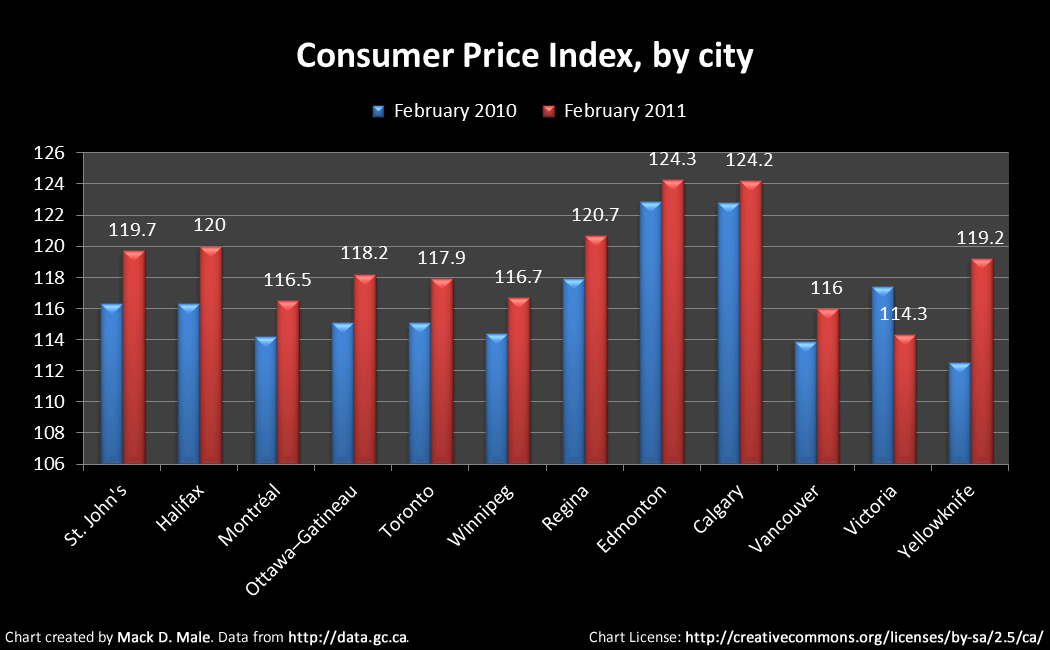
There are lots of general datasets you might find interesting, however. For example, here’s the Consumer Price Index by city:

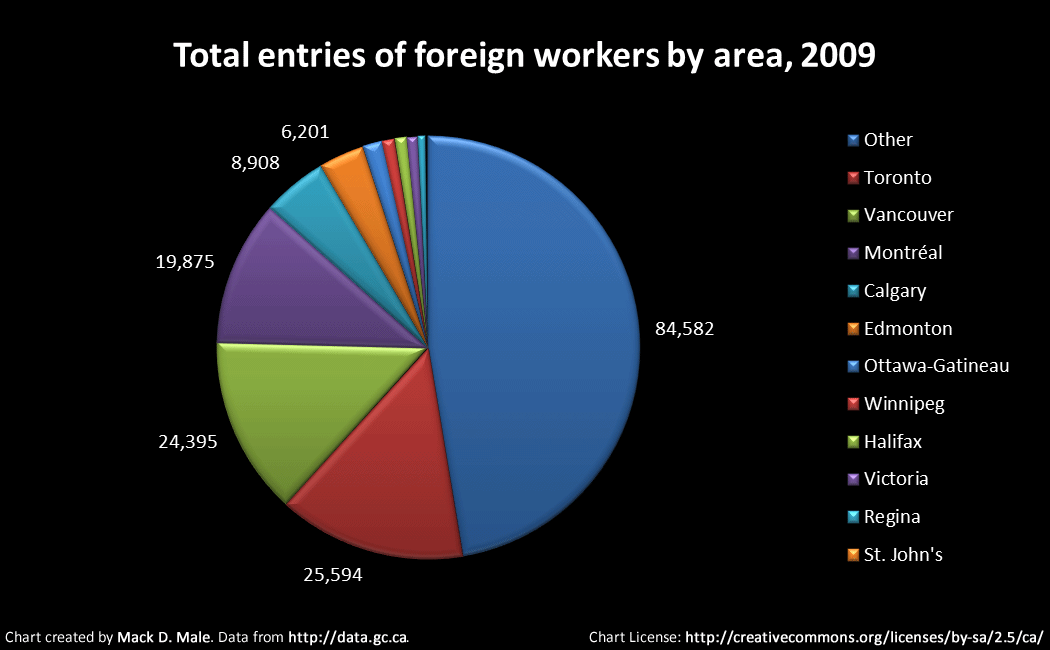
Here’s another dataset I thought was interesting – the number of foreign workers that have entered Canada, by region:

Have you ever wondered how much of each type of milk Albertans consume? You can find that out:

There’s actually a fairly broad range of datasets available, such as weather, agriculture, economics, and much more. As David said, it’s a good first step.

I’m excited to see more ministries get involved, and I hope to see the number of datasets available increase over time. I’d also love to see the licensing change, perhaps by adopting the UK Open Government License as David suggested. Exciting times ahead!