Roundtable with Edmonton Members of Parliament

Like Dave, I was invited to a roundtable discussion with Edmonton’s MPs earlier this week. Edmonton-Mill Woods-Beaumont MP Mike Lake has been holding constituent roundtables for a while now, and as the new chair of the Edmonton CPC Caucus Mike wanted to try the approach with his colleagues and a wider group of constituents. Here’s how Mike describes the roundtable approach:

Generally attended by ten to fifteen constituents, each meeting is designed to facilitate discussion about issues specifically raised by those at the table. In contrast to a typical town hall meeting, the roundtable, with its smaller group format, allows for greater interaction among the participants.

Mike made sure to invite a broad group for this first roundtable – there were lots of different viewpoints represented at the table! The MPs introduced themselves first (Tim Uppal, Peter Goldring, Brent Rathgeber and Mike were present for the whole meeting, Laurie Hawn had to step out shortly after we began), and then we went around the table. Each constituent provided a brief introduction and was asked to raise up to three issues that they wanted to discuss. I decided to mention two issues, one of local importance and one more applicable to Canada as a whole:

  1. LRT. As I have said many times before, LRT is perhaps the most important thing we need here in Edmonton to become the city we want to be. A strong, effective, and healthy public transit system is at the heart of becoming a more vibrant, sustainable city. So far, I don’t think Edmonton has received the support we require from the federal government.
  2. Internet. The usage based billing debate will rage on, though the federal government has said it will overturn any decision by the CRTC to move ahead with the plan. I think we need to shift the discussion, however. Canada’s competitiveness when it comes to telecommunications is abysmal at best. The cost of Internet and mobile service in Canada is far higher than most of the rest of the world, and that is negatively impacting our ability to compete globally.

It turns out that Mayor Mandel and City Council met with the MPs right before we did, and they talked a lot about LRT. We didn’t discuss it much in our roundtable, so I hope Council got the message across.

As the Parliamentary Secretary to the Minister of Industry, Mike has had a lot of exposure to the usage based billing issue (he’s also on the Industry, Science and Technology committee). Dave and I shared our thoughts (he raised the same issue I did) and Mike did a nice job of explaining the issues to some of the other people in attendance. We did get into a brief side discussion on the CRTC that was rather interesting. I made some notes to do some additional research.

Some of the other topics that our group of nine constituents talked about included:

  • Our lack of a national homelessness strategy.
  • The size of government, and government debt.
  • The F-35 Joint Strike Fighter (Laurie Hawn aggressively took on the issue, stating that the information in the media is wrong).
  • The federal impact on health care.
  • Immigration, foreign trained professionals, and temporary foreign workers.
  • The justice system and the continual problem of criminals getting back onto the streets.
  • Western alienation.
  • Student finance and the cost of tuition.

I thought Mike did an excellent job of keeping us on track and on topic. We went just five minutes over our scheduled time, after everyone agreed to extend the discussion slightly. Initially I felt that Mike was being somewhat defensive, talking about what the government is doing as he went down the list of issues, but that feeling soon passed as it became clear he was providing some context to the discussions. As much as it was an opportunity for us to talk about our issues, it was also an opportunity for the MPs to tell us about the work they are doing, and I appreciated hearing it from them directly. I just wish the other MPs spoke up a little more often (Mike did a lot of the talking).

I enjoyed the discussion, and the two hours flew by as a result. I hope Mike and his fellow Edmonton MPs found the session useful and that they do it again in the future! Thanks to Mike for the invite!

Will Edmonton be a second-class city without the new arena?

Last week City Council was again discussing the proposed downtown arena. Though Administration provided an update at the Wednesday meeting, it certainly didn’t feel like much new information was brought forward. Details on the proposed Community Revitalization Levy (CRL) were delayed yet again, this time until the first week of April. The meeting did not go well.

Mayor Mandel seemed to be upset that progress had stalled. He wants Council to make a decision in the next month or so:

“It’s enough already. I think we’re going around too many circles and let’s make a decision.”

But there was another comment he made that stood out:

“Either we build a new arena or we become a second-class city, which in my mind we don’t want to be.”

I’ll admit that comment even surprised me. Does Mandel really think we can’t be a first-class city without building the new arena? Is the project really a make-or-break one for Edmonton? Boosterism has long been a part of this debate, something Dave covered back in January. And as our Mayor I think Mandel needs to be Edmonton’s greatest champion, a role he has definitely not shied away from while in office. But is there no hope for Edmonton if the arena project doesn’t go ahead?

“My choice of words probably wasn’t right,” Mandel admitted when I asked him about it. “It’s just that when opportunities come up, you have to make a decision. Edmonton in the past hasn’t made an effort to seize opportunities that have come up.” It’s a good point, I think. You can’t simply wait for things to come along, you have to go out and get them. If we want to take Edmonton forward, we need to make a concerted effort to do so. “You’ve got to fight for things,” Mandel said.

Mandel stressed the need to improve our downtown. “Cities are evaluated by their downtowns, not their suburbs. Edmonton’s downtown has a long way to go.” I asked if that meant we had to have the arena. “There’s millions of ingredients that go into it,” he said. The arts community and our IT sector were just a few of the examples he cited. He of course thinks the arena is one of those ingredients, however. “The arena with a good financial deal will make Edmonton better.”

Stephen Mandel at Candi{date} Sept 29, 2010

When discussions get intense, people say things without fully thinking them through. I think that’s what happened to Mandel last week with the second-class comment, but he’s certainly not the only one who has made regrettable comments. Is it true that “the anti-arena faction is out in full force” as David Staples suggested (archive) a couple of weeks ago? I think it is, and there have certainly been some puzzling comments from them as well. The debate needs people on both sides, to help us tease out the details and ultimately arrive at the best decision for Edmonton. Mandel has decided to support the arena. Others have decided to fight it. A good debate is healthy for Edmonton.

On Saturday, Gary Lamphier writing in the Edmonton Journal reminded us that there are many key questions about the project that have yet to be answered (archive):

Although Mayor Stephen Mandel seems determined to wrap up the Seinfeldian arena "debate" — such as it is — in early April and push the project ahead at Mach speed, it’s hard to see why with so many key questions unresolved.

With weeks to go before a pivotal report on the project is presented to city council — following which councillors may have little time to reflect on it before they vote — it’s puzzling that so many key questions remain unanswered.

Today, Danny Hooper writing in the Edmonton Sun offered some compelling reasons to move ahead with the project (archive):

We are not the arctic outpost some think of us. This is a vibrant, energetic, resourceful, caring, and fun community, yet I don’t think our downtown best makes that statement. And I think it should.

Where some see a downtown that feels dull, disjointed, and at times lifeless, I see a blank canvas. The Katz group have at least brought out the paint and offered their vision of what our city centre could be. Of what it should be. And we’re all welcome to pick up a brush.

Maybe it comes down to perspective, as is so often the case with difficult questions such as this one. Do you choose to see the arena as Mayor Mandel does, as an opportunity to enhance our downtown that we should at least make an effort to capitalize on? Or do you choose to see the arena as those against the project do, as an expensive pet project that will do little to help Edmonton’s core?

There are no guarantees in this debate. Edmonton will not be relegated to “second-class” status if the project dies, nor will Edmonton automatically be world-renowned if it goes ahead. There’s obviously no secret recipe either, or we’d have already turned downtown around. Whether you support the arena or not, it’s important to recognize that revitalizing our downtown and becoming the city we want to be will take much more than any single project.

City’s Standing As Metropolis Declared To Hinge On Coliseum

Recently I have been doing some research on the history of Rexall Place. I thought it would be useful to understand what happened in the past when trying to make sense of our current downtown arena debate. As part of that research, I spent some time at the City of Edmonton archives. I wasn’t sure what to expect or how to approach my research, so I simply asked for anything related to the construction of the Coliseum. Sherry Bell, Reference Archivist at the Archives, was incredibly helpful and came back with a thick file folder labeled “File 1, 1963-1974”. She told me it was the first of many, just the tip of the iceberg.

Coliseum History at the Archives

I read through the entire folder, taking notes as I went. The documents inside, mostly clipped Edmonton Journal articles, tell the story of how the Coliseum came to be, from the push for a downtown arena in the early 1960s through to the construction of what we now call Rexall Place in the early 1970s.

The title of this post comes from an article in the Edmonton Journal published on September 12, 1963. In it, Alderman Les Bodie made his case for the proposed downtown coliseum of the day, saying:

“I think the successful city will be the one with a stable economic base combined with a stimulating economic climate, and the coliseum will be a major factor in attracting interest in our city.”

It was one of many gems I found in the file, some of which I have shared below, and some of which I’ll share in future posts.

In total, I recorded 93 headlines (I skipped some). Here’s the breakdown of the articles I looked at by year:

Lots was written early on in the debate, and less was written as construction got underway and progressed. Here’s a sample of the headlines:

  • Coliseum Site Studied – May 11, 1963
  • City Approves $10 Million Coliseum Plan – June 25, 1963
  • City Has ‘Escape Hatch’ If Coliseum Voted Down – August 29, 1963
  • City’s Standing As Metropolis Declared To Hinge On Coliseum – September 12, 1963
  • Mayor Hits Coliseum Critics – September 24, 1963
  • Coliseums Seem To Spark Growth – September 28, 1963
  • Coliseum Complex Rejected By Almost Half Ratepayers – October 17, 1963
  • Mayor Anticipates Verdict On New Coliseum Proposal – March 1, 1965
  • A Coliseum Or A New Arena? – March 25, 1965
  • Alderman Warns City Taxpayers Will Have To Subsidize Coliseum – July 20, 1966
  • Ex arena to be constructed just north of Gardens – April 22, 1972
  • Oilers won game but public the real winner – November 11, 1974

I was immediately struck by how similar today’s debate is to the debate in the 1960s. In short: a downtown arena is proposed and tied to the future of the city, people argue over the location and other details, but the process really gets stuck on the money.

One of the first documents I found in the file was a pamphlet published by The Hamly Press (which as far as I can tell no longer exists) entitled, “the Coliseum Plebiscite: a test of our Faith in Edmonton as a Great Metropolis of the North West”. Here are some of the statements found inside:

  • “A downtown showplace that will publicize Edmonton as a progressive, positive-thinking city, developing rapidly in all phases of modern city live and endeavor.”
  • “The Coliseum Complex will lead the way in revitalizing downtown activity.”
  • “A Vital Necessity for Downtown Development!”
  • “Construction of the Coliseum Complex will be the city’s first step in the fulfilment of Edmonton’s remarkable plan for the renewal of the downtown city centre. There is little doubt that perseverance with this project now will be a decisive factor in the eventual completion of the entire Civic Centre plan.”
  • And a quote from Mayor Roper: “This plebiscite will be a test of the vision of the ratepayers of our city. How much do we want Edmonton to lead all Canada in bold, imaginative downtown development?”

Edmonton Journal writer Ben Tierney, working in the City Hall Bureau, wrote a lot about the proposed project. In a September 24, 1963 article entitled “Other Cities Find Value in Coliseums” he highlighted what he saw as “three basic benefits”:

  1. Attraction of major sports, entertainment and cultural events that the city could not otherwise hope to obtain.
  2. Attraction of outside dollars to the city through increased convention activity as well as non-local attendance at coliseum events.
  3. Increased tax revenue for the city through construction of new downtown building encouraged by the coliseum’s construction, and a revitalized city centre.

Sounds familiar, doesn’t it?

Of course, the initial plan never came to fruition, and subsequent attempts to rescue it failed also. On October 17, 1963 the Edmonton Journal reported the results of the plebiscite that would have authorized the City to borrow $14,250,000 to finance the coliseum:

“The coliseum complex was strongly backed by the former city council, the Edmonton and District Labor Council, the Edmonton Chamber of Commerce and Jaycees, the Edmonton Exhibition Association, the Edmonton Area Civic Centennial Committee, and the Edmonton Building and Construction Trades Council.”

“55% of voters favored the two money bylaws…but a 2/3 majority was required. Opposition to the project centered on the costs involved.”

Over the next ten years, various attempts to salvage the idea were made, but ultimately the cheaper Edmonton Coliseum was built instead. I wonder how different things might have been had the downtown complex gone ahead?

Expanding the Shaw Conference Centre (again)

The Shaw Conference Centre is once again in the news. City Council’s Executive Committee will receive a report tomorrow that suggests the facility needs to be expanded. That recommendation should not be a surprise. On July 22, 2009, City Council passed this motion:

That Edmonton Economic Development Corporation prepare for Council’s approval a long-term (30 – 40 year) development plan to address the needs of the convention market in Edmonton.

If you ask EEDC what should happen with the convention market, of course they’re going to focus on the facility that they operate.

Shaw Conference Centre

The Edmonton Journal’s editorial board published a piece on the issue today. Here’s the key paragraph, in my opinion:

But there are plenty of reasons for caution. Taxpayers have just spent $150 million to expand Northlands’ rival convention and trade show facility, the new Expo Centre. Is there really an economic case to be made for two competing super-facilities, each publicly funded, run by two competing civic agencies?

Competition is a generally a good thing, but increasingly I find myself wondering why we have both Northlands and EEDC. Two organizations, both largely funded by taxpayers. If they weren’t competing, would things have turned out differently? Would the above recommendation have been different? Would we still have gone ahead with the Edmonton Expo Centre when we did? The success of that facility, which is still being paid off, has been questioned by many. Though as the City’s Chief Economist told me, that skepticism might be a little unfair. “It was developed and then we ran into a sour economy. You need to give them a full business cycle.”

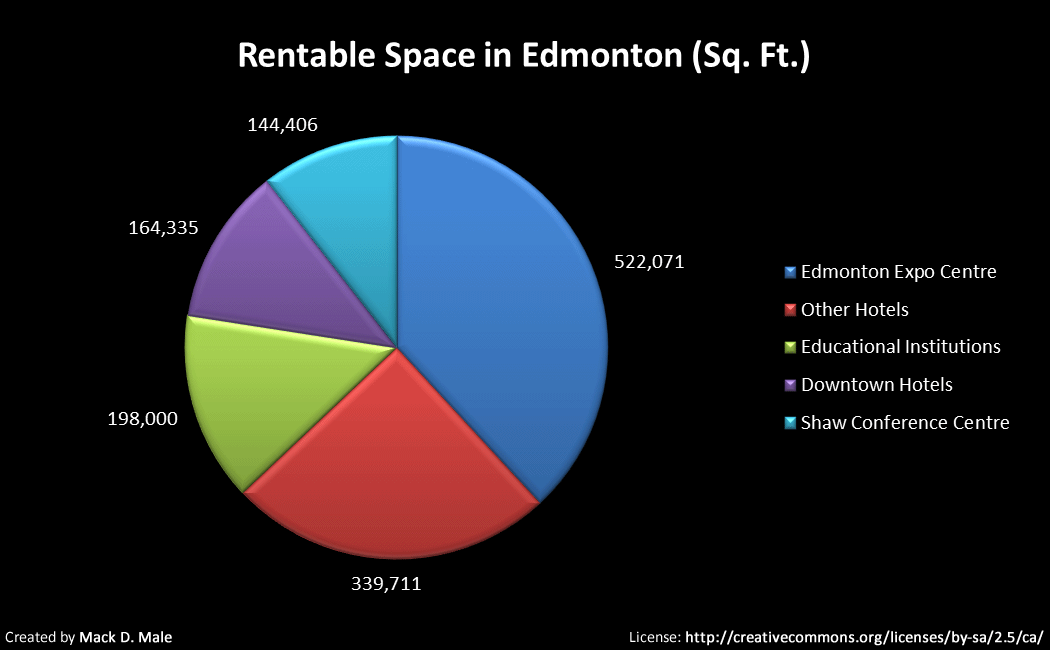
Here’s what the current breakdown of rentable convention space looks like in Edmonton, according to the report:

There’s no denying that the amount of space at the Shaw Conference Centre (SCC) is significantly less than at the Expo Centre. But that alone is not reason enough to expand the facility. Here are the most up-to-date statistics on SCC usage, provided to me by EEDC:

  • In an average year, SCC receives 330,230 visitors (based on the last five years). A visitor is a person who has attended a function at SCC.
  • The split in visitors is roughly 70% regional versus 30% non-regional.
  • There are 20 to 25 days per year where SCC has no or the least number of bookings.
  • Using 2006 as a typical year and defining 75% occupancy as full, SCC was fully booked 115 days out of the year.

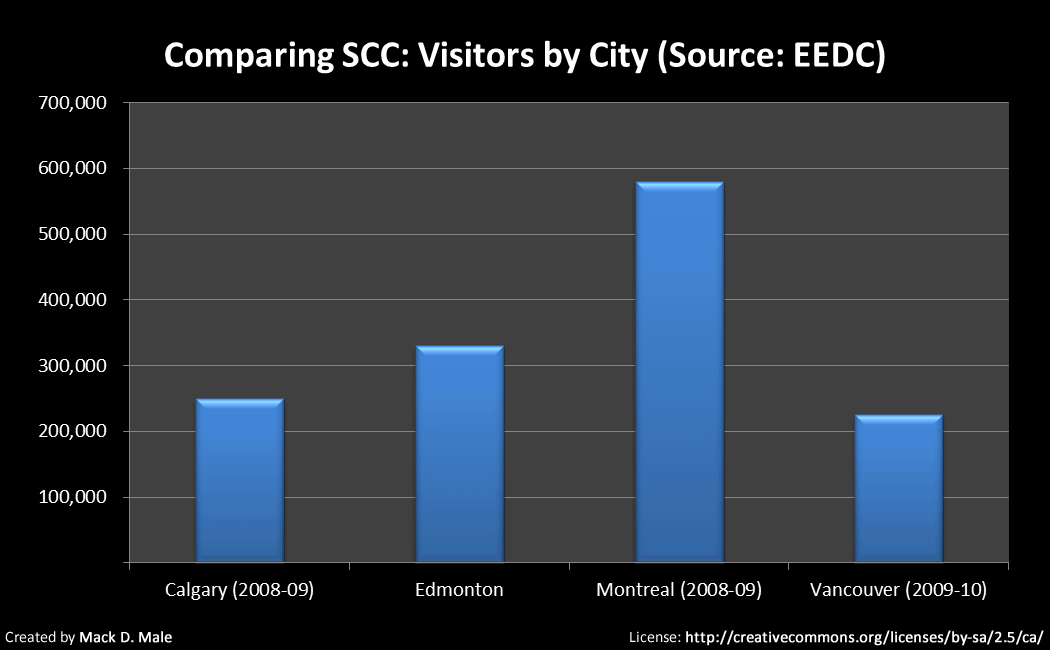
Compared to a few other Canadian conference venues, SCC’s visitor stats stack up quite nicely:

I’m not sure exactly which facilities they were comparing with, but clearly SCC is being used. EEDC says that over the last two and half years, it has turned away approximately 40 conventions and trade shows for future years. And apparently none of those have decided to go with the Expo Centre instead, which should have had the necessary space, presumably because they wanted to be downtown.

If we’re going to add more convention space, I think downtown is the place to do it. But I agree with the Journal’s position, “it’s also important that we not simply assume that if we build it, they will come.” So I guess I am left with a few key questions:

  • Why was the Hall D expansion so limited? If we got the forecasting wrong then, are we going to get it right this time? Are we really looking ahead 30 years?
  • Is expanding SCC really the best way to add more convention space downtown?
  • Despite the lip service paid to cooperation in the report, can Northlands and EEDC really work together to grow Edmonton’s convention market?

The next steps outlined in the report include finalizing the business case for the expansion. According to EEDC’s own backgrounder, the earliest an expansion would be completed is at least seven years from now.

Aside #1: Think back to 2004 and consider all of the technology that didn’t exist. Will large conventions as we think of them today still happen in 2018?

Aside #2: The report contains what might just be my least favorite phrase ever: “Festival City in a Box”.

Aside #3: It turns out I have an Edmonton Journal article on my desk from September 12, 1963 (I’ll explain later). Apparently we held just 42 conventions in 1962, far behind Toronto’s 657, Calgary’s 172, or even Regina’s 57. Even Moncton had more conventions than we did at 48. Our conventions in 1962 attracted 17,932 visitors who spent a total of $1,869,000, or $104 per person.

Taking the City of Edmonton to another level with City Manager Simon Farbrother

Last week, on the one year anniversary of his first official day as the City of Edmonton’s new City Manager, Simon Farbrother sat down with me to reflect on the past twelve months. In addition to settling into the role and continually learning about the organization, Simon is leading the City through a major cultural shift that is fundamentally changing the way it does business.

Simon Farbrother
Coffee with Simon

Simon came to the City of Edmonton from Waterloo, where he was that city’s Chief Administrative Officer. He’s not new to the capital region however, having worked at the City of Leduc from 1988 until 1997, and at the City of Spruce Grove from 1997 until 2005. I wondered if he had thought about working in “the big city” but he said that was never the game plan, though he did admit the thought crossed his mind once or twice. “I think it’s important to stretch yourself, “ Simon told me, “when opportunities come up you grab them and away you go.” That’s how he ended up in Waterloo, and in January 2010, how he found himself here in Edmonton taking over for retiring City Manager Al Maurer.

Simon said his first year has gone by really quickly, but described it as “challenging, fun, and stimulating.” Noting the number of projects the City has on the go, Simon said “Edmonton is at a very interesting point in time.” He lives in the southwest and uses the LRT quite a bit and depending on his schedule. “The south LRT has changed the way people think about transit in our city.” Though he felt Edmonton had matured politically while he was out east, Simon said that he has “always thought Edmonton’s strength was its people, and I still do.” He thinks it’s because we have a unique sense of connection here. “We’re the big city on the prairie, we’re multicultural; the people who choose to live here are really carving out their lives.”

For the first few weeks of last year, Simon spent his time getting to know people at the City while Al continued on as Manager (though Simon actually knew quite a few people already from his previous positions). On January 18th 2010, he took over and hit the ground running. “You have to get up-to-speed quickly and bring your skills to the table.” Simon told me the ladies in the Manager’s office were “tremendously helpful” and made the transition a smooth one. “When you join, naturally there’s a lot of questions about you,” he said, recalling that it wasn’t just him that had to adjust to the new role. “Fundamentally I am about building – I always have a strong belief in a person’s abilities and general willingness to do the right thing.”

Simon Farbrother
Conversation with Simon & Extended Leadership Team

One of the first things Simon did was have an open conversation with the general managers. “Leadership is about framing,” he said. Simon made it clear that the City would be moving in a new direction, and told them, “your primary role is to lead the City, not your department.” He called it a “fundamental shift” and said there has been a lot of positive engagement from the general managers on the new approach. Discussions since have focused on how the City leads, rather than on each individual project that comes up. “We also opened the door to branch managers and directors around leadership,” Simon confirmed. The City of Edmonton currently has 6 general managers and 35 branch managers, but the number is not important. “It’s about what makes sense at the time to lead.” To reinforce the shift, the Senior Management Team (SMT) was renamed to the Corporate Leadership Team (CLT). Demonstrating leadership is more important than having worked at the organization for most of your career. “We’re trying to engage people to be leaders, everyone can do that.”

Simon’s focus for 2011 is this internal cultural conversation. He shared that the City has formed a group called Transforming Edmonton and Me (TEAM) that has been challenged to explore the question, “what do we want our culture to be?” An early activity involved the creation of a word cloud, and ‘communication’ emerged as the biggest word. There’s a desire to be more transparent, and to have meaningful conversations (no more going to the meeting then having the real conversation in the hallway). “It’s about how we agree to work as an organization,” Simon said. “If you don’t see me acting in the way I say I am going to act, you have every right to tell me.”

Most of Simon’s communication has been focused internally so far (he’s going to look into updating his pagearchived here – on the public website). “Having various ways to communicate is really valuable.” To that end, Simon has published videos every few weeks for employees, focusing not on what the City got approved but on leadership within the organization. “For example, a video might talk about our approach to the budget, rather than giving details on what was approved.” The effort has given him the opportunity to meet people across the organization. “I’ve learned to cut trees, drive a bus, I’ve been in the sewers, it has been great.” He hopes the videos reinforce the notion that all employees at the City are important. He is thinking about an internal blog too, and said the intranet is a really important tool for giving context.

Simon Farbrother
Simon getting some hands-on experience felling trees in Delwood Park

Perhaps unsurprisingly, Simon was a BlackBerry user while in Waterloo. Now he’s got an iPhone and an iPad, but doesn’t consider himself to be an early adopter. “I really like the iPad in a meeting environment,” he said, because there’s less paper to carry and the device is great for graphics. “I do lots of email and text messaging,” he told me, and while he is familiar with Twitter, he has no plans to use the service. “A lot of my emails would look like tweets though!” Simon’s day consists largely of meetings, so it’s important to communicate efficiently. He uses text messaging to stay in touch with his family throughout the day.

Turning to external communication, Simon said the City “should talk about what we’re doing and what we’re trying to achieve.” It’s the philosophy that is important, not the list of projects. “We’re part of a bigger picture, we work for the full community.” Simon thinks it is important for employees to be mindful of that broader perspective too. “You can’t disconnect being a transit driver or an accountant or even a manager from being an ambassador and a representative of the City.” In other words, employees need to be accountable not just to their boss, but to all Edmontonians.

The word accountability was mentioned alongside transparency in his introductory letter last year. When I asked for his assessment of the City’s performance on those issues, Simon replied: “I think we’re getting better.” Being accountable and transparent to the public is a challenge given the size of the organization. “We’re in the A to Z business,” Simon remarked, “and we’re the only the organization that does all of our business in the public eye.” I suggested that the City could do more on the transparency side, especially as it relates to making information available and accessible. “I don’t think we consciously hoard,” he told me. “There are legitimate reasons for some information to be confidential.” He agreed that getting information into people’s hands is important though.

Simon Farbrother
Simon with Councillor Amarjeet Sohi

I asked Simon how he has found working with Mayor Mandel and the rest of City Council over the last year. Due to the nature of the position in large cities, Simon has worked more closely with Mayor Mandel, and described him as “very committed and very driven.” He said they get along well. Though he hasn’t had as many opportunities to work with the Councillors, he said “they’re all trying to build a better City, which is a positive environment to work in.”

Looking ahead to 2011, I asked if Simon had made any personal new years resolutions – he didn’t. “For me it’s about lifelong learning,” he said. “In whatever you do, you need to be relevant and adding value.” He’s excited for the year ahead, and talked about some of the big projects that have made headlines recently. “EXPO wasn’t just a three month event, it was positioning Edmonton as an important city in North America.” Similarly he thinks we need to look at the bigger picture when it comes to topics like the downtown arena or the city centre redevelopment. “We need to be strategic and aligned as a city.”

Simon said the City of Edmonton has always had aspirations, but has never embedded that into the culture. “Being aspirational has to be a fundamental part of what we do.” When it was discovered that some material was being created internally that talked about Edmonton being successful as a “tier 2 city”, Simon and his team put a stop to it. “What would a tier 1 city do? There’s nothing stopping us from being tier 1.” It’s about having vision and not being afraid to go after it. “We shouldn’t be shy about opportunities.” For Simon, it’s about taking Edmonton to another level. “We need to up our game and galvanize around being a city.”

“It’s going to be a good year.”

Chris Moore on 2010 and the year ahead for IT at the City of Edmonton

A couple of weeks ago I sat down with the City of Edmonton’s Chief Information Officer, Chris Moore, to chat about 2010 and to get his outlook on the year ahead. I first interviewed Chris back in July 2009, when we talked about the ongoing transformation of the City’s IT branch.

Open City Workshop

The IT transformation has progressed nicely, Chris told me. Recently his department ordered coffee mugs with the “ten ways of being” printed on them, something Chris resisted initially because he wanted the words to mean something. He gave a mug with the word “open” on it to City Manager Simon Farbrother as encouragement to continue the work he has been doing.

The IT transformation is ongoing, of course. The department has approval and funding to add 35 people this year, which can be an advantage because many firms are not hiring at the moment. “We want to create a place where employees want to be,” Chris said. “We need to use technology in a unique, dynamic, future way, so that they choose the City over other opportunities.” Chris is looking for the best tech people, but they also have to be a cultural fit, something that hasn’t always been a priority. The push to hire more employees should help the IT department reduce the number of contractors it has. That number currently stands at 64, but it has been as high as 99 and as low as 45, depending on the work required. “Contractors can create a knowledge void over time,” Chris told me, because they do the work but others have to support and maintain it. Furthermore, Chris wants to find a way to get employees closer to the business users. “The best place to be is embedded with the customer.”

It’s interesting that the IT department is growing given the question Chris posed near the beginning of our conversation: “Does IT, in any organization, have a future?” It’s something Chris has been thinking about both privately and out in the open on his blog. “There are a lot of folks blind to the fact that consumerization is impacting their systems.” Users are increasingly demanding more, and the technologies they use and learn about at home are making their way into the workplace as well. “Today’s consumer electronics are tomorrow’s corporate electronics,” he said. “The future of organized IT in enterprise is going to change dramatically, and I’m intrigued by that.” As a result, he is also thinking about his own position. “The role of the CIO has to change in government,” Chris told me. He said it needs to be much more strategic, but that it’s up to the people currently in the role to make that happen through their actions.

Looking back at 2010, I asked Chris about the City’s work on open data, something I’m particularly passionate about. Chris said that he was “pleased with the fact that we listened to the community” and noted that the open data initiative has benefited from three key elements: political sponsorship, administrative leadership, and community engagement. He agreed there is more work to be done, but said that “we showed up on the map in Canada” and definitely sees momentum building. Chris told me there has been “serious interest” from planning, transportation, and traffic safety, but that all the businesses at the City have questions about how to make it sustainable. “You need leadership and resources from IT to drive it forward, but you also need businesses with the data to want to play ball.” I’m hopeful that much more progress can be made in 2011 on the open data initiative.

Chris was also busy showcasing Edmonton on the world stage last year. In fact, he travelled more than any other City employee in 2010, visiting a variety of different places (PDF, page 11). He was able to speak at conferences about the work Edmonton is doing related to open government and social media (here’s a presentation he gave in Manila at FutureGov Asia), and also had the opportunity to learn from others around the world. Edmonton is now a part of the new World e-Governments Organization of Cities (WeGO) for instance. Chris was also instrumental in bringing the world to Edmonton, with events like Beyond 2010. “Lots of people asked why we were involved in that,” he recalled. “Because we can, because it is possible.” The event was another opportunity to showcase the work that IT has been doing. “A year ago we didn’t have a goal for it, but we did know we could be leading.”

I think Chris has definitely approached his role as CIO in that way as well. He has been really active on Twitter, something he is quite proud of. “I set an example for others, and articulated that you can use Twitter safely!” Recently Chris has started using Tumblr as well, and told me he’d like to spend more time blogging in 2011. “It’s a combination of what I have encountered with my work, telling the stories of what we’re doing, but also being disruptive and challenging people.” He likes the term “government futurist” as a way to describe the position he writes from.

open city workshop planning session
Chris Moore, Edmonton’s CIO, at the planning session for the upcoming Open City Workshop (March 6th, 2010) to discuss the City’s initiatives in open data and open government.

Though IT accomplished a lot in 2010, there is always more to do. In 2009 the corporate IT audit determined that governance needed to change. “I would have liked to have had more traction in 2010 with governance, but I am not disappointed.” Chris and his team had identified culture as a risk, and they have made progress on aligning IT governance with the shifting culture of the corporation as a whole. “We will absolutely crack the nut on it in 2011.” It’s one of many projects the department is working on, and Chris said to stay tuned for some exiting announcements.

This year is the 60th year of IT at the City of Edmonton (the first project was a payroll system for Edmonton Light & Power). While they didn’t celebrate ten years ago for the big five-oh, Chris assured me they are going to do something this year. With a new vision to be western Canada’s municipal IT leader and some exciting projects on the go, 2011 looks like it’ll be a great year for the City’s IT department. “Let’s return to world class,” Chris said. It won’t be easy, but Chris is looking forward to the challenge. “If you want to lead, you need continuous outcomes.”

Be sure to check out Chris’ post for additional thoughts: Technology in Government in 2011 and Beyond.

Yes! For Edmonton Position Statement on the Proposed Downtown Edmonton Arena

Yes! For Edmonton sent the following position statement on the proposed arena to the media this afternoon:

I have been privy to some of the discussions about this, and was opposed to the statement being released because it kind of suggests that everyone who signed up to support the group on the airport issue automatically supports this one too. I don’t believe that is the case.

There are people in the organization who wanted to make a statement on the arena, and that’s fine. The more people who share their thoughts and opinions, the better. But I don’t think it is clear who Yes! For Edmonton speaks for, and that causes me some concern as the group approaches future issues.

It’s not clear whether this position statement will be posted on the Yes! For Edmonton website or what other updates will be made.

Shifting the Alberta Advantage

The main thing we talked about yesterday at the ONEdmonton forum was economic development. In addition to breakouts and other discussion, we had two informative presentations that I hope to blog about over the next while. In her presentation on Diversifying Edmonton’s Economy, Tammy Fallowfield, EEDC’s Executive Director of Economic Development, touched on shifting the “Alberta Advantage”. Here’s what her slide said:

  • Remain relatively low tax
  • Not a low cost environment
  • Not a surplus of labour
  • Not a currency ‘bargain’

I think the phrase “Alberta Advantage” means different things to different people, but traditionally our low taxes, low cost of doing business, surplus of labour, and being attractive to investment, have all been considered important aspects. Here are a few notes on each.

Alberta’s low taxes remain a strength. From the Alberta Competitiveness Council’s 2010 report (PDF, 14 MB):

[Taxes and fiscal policy] represents the area of best performance for Alberta, with moderately low tax burdens for both corporations and individuals and a strong government financial position.

Of all the measures that report looks at, Alberta performs the best (unsurprisingly) in taxes and fiscal policy.

What about being a low-cost environment? From the same report:

Within Canada, business costs in Alberta (Edmonton) are lower than Ontario (Toronto), but higher than in each of the other provinces compared. This result is due to Alberta’s strong economy of recent years, which led to a much higher increase in business costs – especially labour, electricity, and facility costs – than seen in other provinces.

I haven’t yet found a good comparison of business costs with regions elsewhere in the world, so let me know if you come across something. I suspect the picture is not as rosy as it once was.

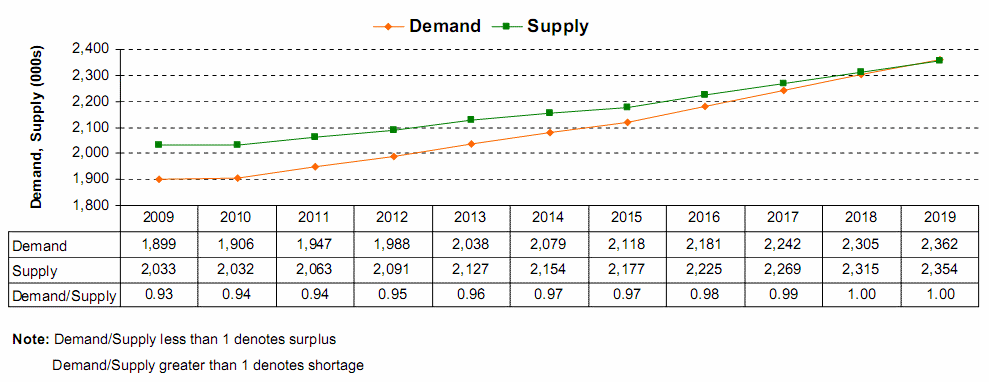
How about our labour force? All across Canada the population is aging, and that (along with our very low fertility rate) is going to lead to labour shortages. Here’s a graph from Alberta’s Occupational Demand & Supply Outlook, 2009-2019 (PDF), that shows this trend for our province:

There are many consequences as a result of this trend, not the least of which is Alberta’s challenge to attract and retain labour. Our taxes will likely also be impacted – an older population means higher costs for health care, and a slow growing labour force means a slow growing tax base.

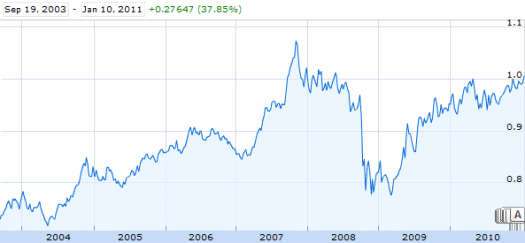
Let’s look at the Canadian dollar (compared to the US dollar).

The strength of the Canadian dollar has an impact on foreign investment, among other things. As you can see, the dollar has been quite strong in recent years (aside from the dip in late 2008/early 2009), which may not be a good thing for Alberta.

So if being low-cost, having a surplus of labour, and being a relative currency ‘bargain’ are no longer part of the Alberta Advantage, what does that mean?

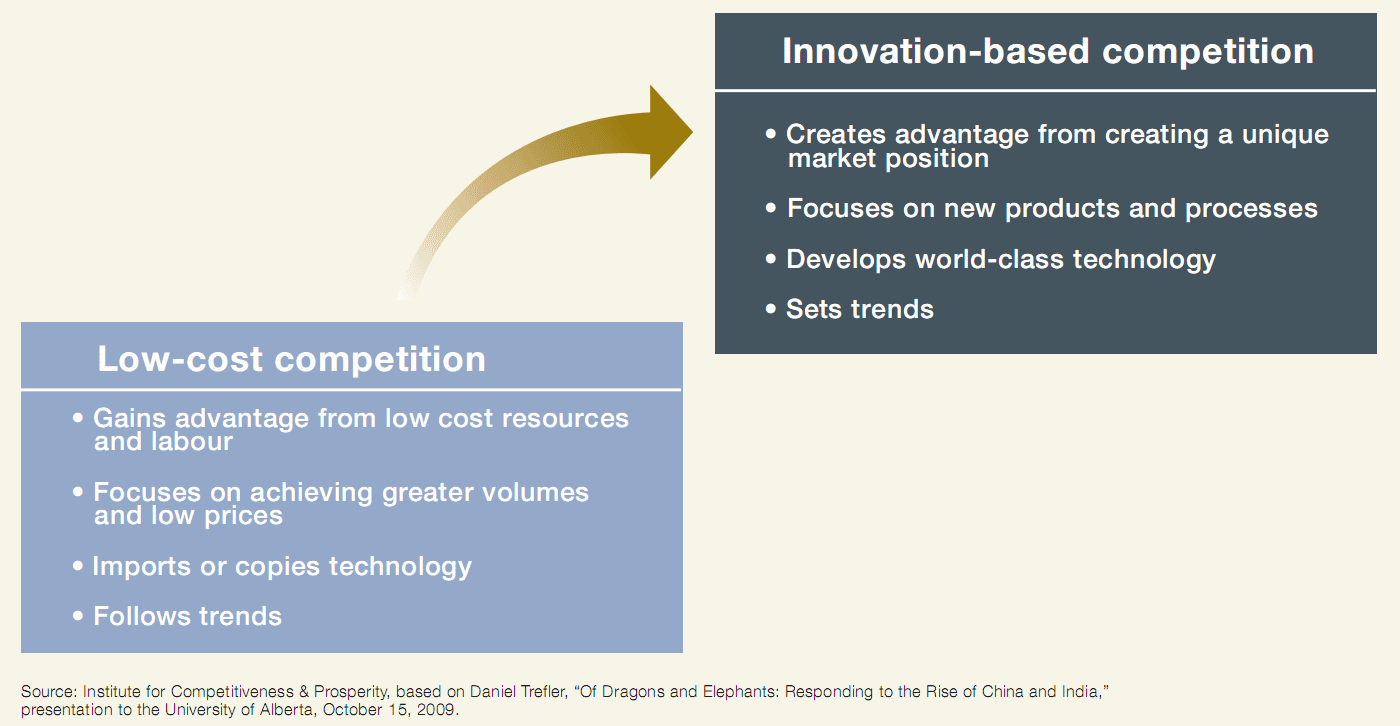
This diagram comes from the Institute for Competitiveness & Prosperity, based on a presentation that Professor Daniel Trefler of the University of Toronto gave here in Alberta on October 15, 2009. The diagram was originally used to illustrate the shift that China and India have yet to make.

On the same slide that listed the four points above, Tammy included this diagram. That’s the shift we need to make here in Alberta – from being a strong low-cost competitor, to being a strong innovation-based competitor.

How are we going to do that? By making strategic choices. Here’s (more or less) what Tammy showed next:

Tammy went on to talk about the industries that are important for us to focus on here in Edmonton, and a similar exercise would apply for Alberta. I’m not sure if what I have written above is exactly what she was trying to get across, but that’s how I interpreted it.

What do you think about shifting the Alberta Advantage?

ONEdmonton Downtown Vibrancy Task Force letter to City Council regarding the Proposed Downtown Edmonton Arena and Entertainment District

ONEdmonton is a group of local leaders that have come together a few times over the last year to discuss how we can make Edmonton one of the world’s top 5 mid-size cities. The first subcommittee, called the Downtown Vibrancy Task Force, was launched in November after the larger group identified that our urban core is the top priority. I have been fortunate enough to be part of both groups.

Today, our task force sent a letter to City Council regarding the proposed Downtown Arena and Entertainment District:

The task force is a group of majority, not consensus. At the last meeting, the majority of the task force members voted the arena project as the top near-term priority in Edmonton’s downtown.

The task force members include: Chairperson Randy Ferguson (Procura), Bob Black (Katz Group), Dr. Paul Byrne (MacEwan), Carolyn Campbell (University of Alberta), Michael Janz (Public School Trustee, EFCL), Terry Kilburn (Avison Young), Bernie Kollman (IBM Canada), David Majeski (RBC), Mack Male, Doug McConnell (Dialog), Scott McKeen, Honourable Anne McLellan (Bennett Jones), Carol Neuman (Edmonton Next Gen), Simon O’Byrne (Stantec), Ian O’Donnell (Downtown Edmonton Community League) Keith Shillington (Stantec), Paul Verhesen (Clark Builders), Sheila Weatherill (EPCOR), Richard Wong (Sutton Place Hotel), and Ralph Young (Melcor). Representatives from EEDC facilitate the task force.

I don’t think anyone on the task force considers the arena project a done deal, nor do they think the issue is a simple one, and this is reflected in the letter. My read of what the task force is saying here is this: there’s potential with the arena project to positively impact our urban core, so let’s keep things moving and figure out how to make that happen.

UPDATE: I originally left out Ian O’Donnell and Sheila Weatherill, because they joined us after the first meeting. My mistake. EEDC has posted the list here.

Looking back on 35 years at the City of Edmonton with Joyce Tustian

In November, Joyce Tustian celebrated her 35th year as a City of Edmonton employee. She currently holds the position of Deputy City Manager (archive), an office that was created around her in April 2008. Last month, it was announced that Joyce would be retiring at the end of January, with most of the DCMO’s responsibilities folding back into the City Manager’s office. I sat down with Joyce just before Christmas to reflect on her time at the City of Edmonton.

When Joyce started at the City of Edmonton, she planned to work for just two years. “I had a big misconception about what the City would be like.” Like most people, she figured it would be dry and very rule-bound, but actually found that the City offered tons of opportunity. “You can do many things with the same employer,” she told me. I wonder if anyone at the City has done as many things as Joyce has! When I asked her what areas of the City she had worked in, she replied “everything but transportation and buildings.” Joyce told me she has always been interested in transit, though she has never really worked with the department. She noted that transit really impacts families and is “so integral to the kind of city you want to build.”

Joyce Tustian

Joyce started her career at the City of Edmonton in 1975, working as a public information officer in the Parks & Recreation department. On her first day, thousands of Edmontonians were streaming through City Hall to pay their respects to former Mayor William Hawrelak, who had recently died of a heart attack. Over the years she worked her way into management, and in May 1995, Joyce took over as the general manager of Community & Family Services. Just a couple of years later, it was decided that Joyce would take over as general manager of the newly formed Community Services department (her main rival for the position was another longtime City employee, Maria David-Evans, who left after the restructuring). During her time in that role, Joyce was also responsible for the Emergency Response department. After a nationwide search in 2003 to find a new general manager for Corporate Services, Joyce was selected. While in that role, Joyce led the department through the “Shared Services Business Model” review. She held the position for five years, until the Deputy City Manager’s Office was formed in 2008 (two other roles were created at the same time – Chief Financial Officer, and General Manager of Capital Construction).

Joyce has had the opportunity to lead some really interesting projects at the City of Edmonton. In 1999, when she was acting general manager of the Emergency Response department, Joyce was tasked with making sure the City survived Y2K. It was her responsibility to outline the City’s plans in case things went south. “We believe that we are ready,” she assured everyone.

Another project she spearheaded was Racism Free Edmonton. As Deputy City Manager, Joyce is responsible for the implementation of the City’s Diversity and Inclusion Policy. “I take great pride in championing the Racism Free Edmonton initiative,” she declares on the website.

Perhaps the project Joyce is best known for was the merger of Community & Family Services and Parks & Recreation to create the Community Services department in 1997. It was part of then-city manager Bruce Thom’s reorganization plan that trimmed the number of City departments from thirteen to eight. When she was interviewed about leading the new department, Joyce told the Edmonton Journal, “my bottom line is I want to make it easier for citizens to access city services without having to know the city as well as I do.” Looking back on the merger, Joyce told me it was “a really rare opportunity,” to get to set things up the way you want to. She considers it a big success, noting that many other cities have since followed Edmonton’s model.

More recently, Joyce led the web renewal and was the project sponsor for the 311 initiative. Both projects “were about transparency and ease of accessibility.” When I mentioned some of the criticism that 311 has received, Joyce acknowledged that “more needs to move to 311 and then to the web” but is confident the initiative is “past the struggles.” For Joyce, 311 is the first major citizen-facing outcome of the investment the City has made in automation (ERP systems, etc).

The behind-the-scenes automation is just one part of a larger journey the City has embarked on. Joyce described it as “moving from an organizational structure that works well for us to one that works well for citizens.” The ability to have standardization, and to break down hierarchies, will help the City make it easier for citizens to access services and information. We touched on open data, and noting that automation should help make it possible, Joyce said there’s “very little that we do that shouldn’t be accessible to the public.”

Another big, related change has been the shift away from independent units and into one organization (something that increased automation has helped make possible). Joyce said Edmonton has been considered a “municipal leader in shared services.” Though the shift had already started, a major reorganization in 1987 “really paved the way.” Subsequent reorganizations have pushed the City further toward the “one organization” vision, though Joyce made it clear that the City is “still very much on the path”.

Perhaps the biggest change has been the focus on strategy (a word that many City of Edmonton employees have come to associate with Joyce). As soon as we started talking about strategy, Joyce said “if you don’t know where you’re going, any road will get you there.” I suspect she’s fond of that statement. Joyce told me her recent work on the City’s strategic vision has been one of the most rewarding things she has done. “We have always been good operationally, but now we spend lots of time and energy on strategy.” She talked about the City’s six “Way Ahead” plans, and praised the most recent City Council for having “a willingness to commit.” Joyce also said Mayor Mandel deserves credit for aligning everyone around what kind of City we want to be.

Joyce deserves a lot of credit too. One of the biggest challenges Joyce faced was during her time with the Emergency Response department. She was only supposed to work with the department for a short time, but was “never afraid to work on the fundamental issues.” And so she did. The department was losing a lot of people to retirement, and was having difficulty recruiting. Joyce recognized that the problems had been predictable, and set about implementing a plan focused on data, intelligence, and strategy. She has been able to make this work throughout her career.

Public involvement is something that the City needs to work on, Joyce told me. She recognizes that there are lots of Edmontonians with great ideas, and agreed that “we need to get better at engaging those people.” Looking at the City Centre Airport and the public hearings that took place, Joyce noted there were at least three conversations taking place, “at the mic, in the room, and outside,” but that the City hasn’t traditionally done a good job of recognizing the latter. There’s lots of room to improve.

I asked Joyce about the people she’s worked with during her time at the City. She thought about it for a minute, and realized that there have been so many people that she’s interacted with over the years. The one who had the biggest impact, however, was Cy Armstrong. “If I had any doubt about something, I’d talk to Cy.” He was city manager in the mid-1980s, actually the first city manager we had after then Mayor Laurence Decore dismantled the council-commission government. According to the book Alberta’s Local Governments: Politics and Democracy, Armstrong was for a time the most highly paid city manager in Canada, earning an annual salary of $120,000. “Much of what I am as a manager was shaped by Cy,” Joyce told me.

Joyce told me it’s an exciting time to be a civil servant (she has enjoyed being part of the iPad pilot project). “You can see the impact you have, you’re doing real work.” She described the City as an organization where you’re very close to decision makers, and obviously one that is “never dull.” Joyce also noted the strong sense of community at the City. For example, Joyce and many other employees have made it a tradition to start the day by singing carols for the five days leading up to Christmas! “Working for the City has been the making of many people – it has certainly been the making of me.”

Joyce will continue in her role until the end of the month, and though she’ll move onto other things, she’s staying here in Edmonton. “I won’t miss budget time,” she told me, but will miss “feeling connected and always having something new” come across her desk (she recalled opening the letter from Telus that said how much they’d pay for Ed Tel).

Joyce has definitely left her mark on the City of Edmonton, and I want to both thank her for her service, and wish her all the best in her future endeavors!