
Tag: politics
Alberta’s Community Revitalization Levy: Rivers District, Belvedere, The Quarters
This is the second part in a three-part series on Alberta’s CRL.
Armed with a better understanding of Alberta’s CRL legislation, I turned my attention to the three active CRL projects in the province. What are the projects for? Why is a CRL appropriate for them? What can we learn from the projects that will help us when exploring the idea of using a CRL in the future? That’s some of what we’re going to look at in this post.
To quickly recap the process: there is some back-and-forth between the city and the province in establishing a CRL. First, the Lieutenant Governor must approve the regulation, which includes the CRL boundary. Second, City Council must approve the plan & bylaw for the CRL (and these can be done separately). And finally, that plan & bylaw must also be approved by the province. The three projects we’re going to look at are at different stages of that process.
Calgary’s Rivers District
The first specific CRL regulation to be passed in Alberta was for the City of Calgary Rivers District, back in 2006. The Rivers District project was the catalyst for the MGA amendment that made CRLs possible in Alberta.
 City of Calgary Rivers District Community Revitalization Levy Regulation (AR 232/2006)
The Rivers District is the furthest along of all the CRLs in Alberta – everything has been approved and the City is well into implementation. It was 2007 when everything was finally approved, so the baseline for tax assessments would have been frozen to the values on December 31, 2007.
It’s worth pointing out that the CRL is just a small part of a much larger project known as The Rivers:
The vision for a revitalized Rivers district is more than a place to live, it is a lively urban destination.
This map shows the area the project covers, and as you can see, it is quite expansive. The idea is to reclaim the waterfront, and to make the area more desirable for development. In addition to infrastructure upgrades, a new riverwalk is in the works (phase 1 is now open actually).
The CRL boundary is large, but it is a small part of the overall project. Here’s what it looks like (KML):
[googlemaps https://maps.google.com/maps?f=q&source=s_q&hl=en&geocode=&q=http:%2F%2Fmastermaq.s3.amazonaws.com%2Fpublic%2FRiversDistrictCRL.kml&sll=51.040854,-114.052162&sspn=0.043228,0.13175&ie=UTF8&ll=51.040908,-114.052248&spn=0.022774,0.044975&z=14&output=embed” frameborder=”0″ width=”525″ marginwidth=”0″ scrolling=”no”>
View Larger Map
View Larger Map
The boundary covers an area of roughly 1.9 square kilometers (478 acres).
One of the big advantages to using a CRL for the Rivers District is that the City of Calgary owned much of the land within the boundary. That’s important because it means the baseline assessment for those assets would be zero, and there’s lots of potential for getting some of that all-important lift.
I spent some time talking with Kathleen Young, Development Manager for The Quarters Downtown at the City of Edmonton, and found out that she actually worked on the Rivers District CRL! Her knowledge and experience on that project was one of the reasons that she came to Edmonton. You know what they say, it’s a small world.
Kathleen pointed out that the CRL boundary for the Rivers District includes some key developments, notably The Bow (here’s a photo of the building I took back in July). When finished, The Bow will become the headquarters for EnCana, and will be the tallest office building in Canada outside Toronto. Groundbreaking for the project took place in June 2007, around the same time that the Rivers District CRL was approved, which means almost all of the incremental value realized through the development of the building will be captured by the CRL.
To work on The Rivers, the City of Calgary created a wholly owned corporation called the Calgary Municipal Land Corporation (CMLC). They have some great information on the various aspects of the project if you’d like to learn more. CMLC was actually awarded a Canadian Urban Institute Brownie Award in 2008 for the CRL:
The Canadian Urban Institute’s annual Brownie Award recognizes leadership, innovation and environmental sustainability in brownfields redevelopment across Canada. CMLC won in the category of "Financing, Risk Management and Partnership" for our work in the creation of the Rivers District Community Revitalization Levy Regulation. A "made in Alberta" version of the U.S. Tax Increment Financing (TIF)— which is a widely used financing mechanism for redevelopment of brownfield sites in the United States—provides a sustainable source of funding to finance the significant infrastructure development required in the Rivers District for a 20-year period.
It sure looks like the Rivers District CRL will be a success!
Belvedere (Fort Road)
The first CRL regulation to be passed for Edmonton was for the Belvedere redevelopment project, commonly known as the Fort Road Redevelopment project. The project has been in the works since at least 2000, and has evolved quite a bit over the last decade. It was very much in the works before CRL legislation came into effect.
City of Edmonton Belvedere Community Revitalization Levy Regulation (AR 57/2010)
The Belvedere CRL isn’t quite as far along as the Rivers District, but it is nearly there. Kathleen clarified that the borrowing bylaw (14883) has been approved, but the plan bylaw is still in the works. Armed with the $34,250,000 specified in the borrowing bylaw, the City has undertaken much of the infrastructure upgrades planned for the area.
Here’s the CRL boundary for the project (KML):
The boundary covers an area of roughly 1.3 square kilometers (324 acres).
A unique element of the Belvedere CRL is that the City owns almost all of the land within the boundary. As a result, when they sell the land all of the incremental value will be captured by the CRL, making it much less likely that the City would have to fall back on general revenue to cover the debt.
The Belvedere project is an interesting one. It is unlikely that development would have taken place in the area without the City of Edmonton stepping in to try to make the area more attractive and desirable. Through that lens, the use of a CRL makes a lot of sense. If you think back to the two basic assumptions highlighted in part one, the Belvedere CRL certainly passes the first – it’s worth the risk.
As for the second assumption – there’s a sound expectation that development will occur – that one is less certain. Especially given the challenging economy, it could be a while before anything substantial happens. Having said that, the first sale of the Station Pointe lands last year for $5.2 million is hopefully a sign of things to come (that project received $481,000 in federal funding in August). The redevelopment project is still in the early stages, and Rick Daviss at the City of Edmonton confirmed that at least a couple new conditional deals are in place, so there’s movement.
There’s more information on the Station Pointe project here – it won a Brownie Award in 2008.
You can find lots of background and other information on the Fort Road redevelopment project here.
The Quarters
The newest CRL regulation to be passed was for The Quarters Downtown, a redevelopment project here in Edmonton previously known as the Downtown East redevelopment. I wrote about The Quarters a couple weeks ago, and I’d encourage you to look at that post to get an overview of the project.
City of Edmonton The Quarters Community Revitalization Levy Regulation (AR 173/2010)
As the newest CRL project, The Quarters has the furthest to go before it is ready for implementation. The province has approved the regulation and boundary, and Administration is now working on the plan and bylaw to present to Council. That will happen sometime in 2011, according to Kathleen. Her team wants to make sure they get it right.
Here is the CRL boundary for the project (KML):
The boundary covers an area of roughly 0.93 square kilometers (229 acres).
The Quarters is a large plan that will proceed in phases. Once completed, it is anticipated that the area will accommodate a population of nearly 20,000 people, up from less than 2500 today. The project is made up of five distinct districts, the jewel of which is known as The Armature.
An important part of any CRL plan is the way in which the City will cover the cost of the project if enough development does not occur. The default fallback is always general revenue, but Kathleen said they are looking at additional funding sources as well, such as government grants.
Kathleen told me that among other things, some of the CRL money will be used for streetscape improvements, some will be used for land acquisition to consolidate parcels for resale, and lots would be used to develop The Armature. The goal is to make that part of Edmonton a much more livable area, and the redevelopment focus is on residential assets.
As I have said before, it is an exciting project for our city! You can learn more about The Quarters Downtown here.
The project will be an interesting one to pay attention to if you’re interested in CRLs, because there are still a number of steps in the process to go.
Final Thoughts
If you’ve made it this far, you should now have a better understanding of the three active CRL projects in Alberta. You can draw your own conclusions, but a few things I wanted to highlight include:
- All three boundaries are similarly sized
- Infrastructure upgrades and improvements are a major part of all three projects
- In the Rivers District and Belvedere, and to a lesser extent in The Quarters, an important consideration is the amount of City-owned land
I think it is important to look at what we already have when trying to understand how a CRL could be applied to future projects. In the next part of the series we’ll do just that, using the proposed downtown arena as our future project.
Alberta’s Community Revitalization Levy:
Alberta’s Community Revitalization Levy: Introduction
This is the first part in a three-part series on Alberta’s CRL.
Recently I decided to start learning more about Alberta’s Community Revitalization Levy (CRL), and I was initially struck by how little information was readily available. I searched and searched but didn’t find much. Maybe that’s because what we call the community revitalization levy here in Alberta is known as tax increment financing (TIF) elsewhere. It turns out that TIF has been available as a public financing method for more than 50 years! The State of California first used the approach in 1952, and now Arizona is the only state in the USA without some sort of TIF legislation.
Here’s how Wikipedia describes TIF:
When a development or public project is carried out, there is often an increase in the value of surrounding real estate, and perhaps new investment (new or rehabilitated buildings, for example). This increased site value and investment sometimes generates increased tax revenues. The increased tax revenues are the “tax increment.” Tax Increment Financing dedicates tax increments within a certain defined district to finance debt issued to pay for the project.
The idea is to use the “lift” generated by the increased tax revenues to pay for the debt that financed the project.
Alberta’s CRL
In Alberta, this legislation is relatively new. Bill 28 received Royal Assent on May 10, 2005 and amended the Municipal Government Act (PDF) to include Division 4 under Section 381, which enables municipalities to create a community revitalization levy bylaw (which must be approved by the Lieutenant Governor in Council).
Since that legislation came into effect, there have been three CRLs created in Alberta (as far as I can tell): Calgary’s Rivers District, the project for which Bill 28 was created, and the Belvedere (Fort Road) and Quarters redevelopment projects here in Edmonton. You can read more about all three projects in part two.
There are a few key aspects of the CRL to be aware of:
- The CRL only applies to a very specific area (the CRL boundary).
- The tax revenue that contributes to the CRL is split between the City and the Province.
- The maximum amount of time a CRL can exist is 20 years, starting in the year when the bylaw is approved by the Lieutenant Governor in Council.
- The Lieutenant Governor in Council can approve a CRL bylaw in whole or in part or with variations and subject to conditions.
And don’t be mislead by the name “levy” – the CRL is a tax as defined in the MGA. It’s a funding mechanism, nothing more.
From my read of the Municipal Government Act, there are no rules or restrictions on the type of area that a CRL can apply to. In theory a CRL works best in an area that is “blighted” but the legislation does not enforce this. This was the case in California as well, until it became clear that the legislation was being abused.
What’s the potential impact of a CRL?
I asked Rick Daviss, Manager of Corporate Properties at the City of Edmonton, to help me understand the CRL. He was very helpful and pointed me in the direction of some very useful information.
The first thing we looked was a hypothetical example of the impact of a CRL. Here’s the situation:
- Current use: 2.0 acre parcel of land improved with a 30,500 square foot warehouse.
- Proposed use: 2.0 acre parcel of land improved with a high rise residential condo development (proposed density of 265 units (RA9), FAR of 3.0, unit value assessed at $200/square foot).
So we’ve got an old warehouse on some land and we want to replace it with a condo. Let’s look at the assessed value:
- Current use: $1,525,000 (this is known as the assessment baseline)
- Proposed use: $44,431,200
Which gives us an increase in value of $42,906,200. Now let’s look at the tax assessment:
| Before | After | Difference | |
| 2006 Municipal Mill Rate | 5.7484 | 5.7484 | – |
| 2006 Municipal Tax | $8,766 | $255,408 | $246,642 |
| 2006 School Mill Rate | 3.6182 | 3.6182 | – |
| 2006 School Levy | $5,518 | $5,518 | $0 |
| 2006 CRL | N/A | $155,243 | $155,243 |
The mill rate is used to calculate the property tax, and you can think of it as the amount of tax required divided by the amount of tax available. So if the City needs $2 billion in taxes but only $1 billion can be generated based on the assessments, the mill rate is 2. The property tax is then calculated by multiplying the assessed value by the mill rate, and dividing by 1000. So to get $8,766 in our example above, $1,525,000 is multiplied by 5.7484 and then divided by 1000.
Let’s look at the Before column first. The total tax assessment there was $14,284, and the two bottom rows are N/A because we don’t have a CRL in the before case. Both the City and School taxes are calculated the same way: assessed value multiplied by the mill rate divided by 1000. The province gets $5,518 and the City gets $8,766, all of which goes into what’s known as “general revenue”.
Now let’s look at the After column. The total tax assessment there is $416,169. The City tax is calculated the same as before, but now that we have a much higher assessed value, we end up with $246,642 in increased tax revenue. All of this will go to the CRL. The School tax is broken into two, because only the incremental tax revenue will go toward the CRL. So the $5,518 is calculated the same as in the Before case, and this goes to the province. The provincial part of the CRL is calculated as follows: the increase in assessed value ($42,906,200) multiplied by the mill rate divided by 1000. That gives us the $155,243, all of which will go the CRL.
So now you see why the CRL is such an attractive proposition: it looks like we have $401,885 in new tax that we can contribute to the CRL. And this could happen with all developments inside the CRL boundary. There are a number of caveats, however. The first is that the CRL amount will vary from year to year based on the assessment (which makes the economy and depreciation relevant) and on the school mill rate which also changes from year to year. The second is that the type of development is important – City owned properties are tax exempt, for instance. A third is that the City tax revenues as well as a portion of the School tax revenues are dedicated to the CRL, where they would otherwise have gone into general revenue.
How is a CRL created?
Rick walked me through the process of creating a CRL, and I can tell you it sure doesn’t sound like a trivial task. In the best case, Rick estimates it would take just less than two years from concept through to the start of implementation to make a CRL reality. Here’s a high-level overview of the process:

Those five steps would include, roughly:
- Administration conducts background research, identifies the potential boundary, comes up with preliminary revenue estimates, and prepares for and asks Council for approval to make a request to the Minister of Municipal Affairs.
- The Minister of Municipal Affairs considers the request and recommends an Order in Council for an establishment regulation. This step also includes some back and forth to establish the area and other parameters.
- The Lieutenant Governor in Council considers and approves the Order in Council for the area to be established.
- Administration conducts more research, holds public hearings, drafts the proposed bylaw, has it reviewed by all relevant departments as well as the province, and acquires Council approval of the bylaw.
- The Lieutenant Governor in Council approves the bylaw.
After all that is done, the CRL can proceed. It makes sense to plan for the Lieutenant Governor in Council’s final approval as close to the start of construction as possible, in order to get the maximum possible time under the CRL legislation.
What are the risks associated with a CRL?
As others have pointed out, a CRL is not a risk-free proposition. There are a number of issues to consider.
What if a project does not lead to an increase in property values and does not result in any new development? In this case, there would be no “lift” to pay down the debt of the project. Rick noted that a plan for this kind of scenario needs to be in place before the province will approve a CRL. It can be as simple as the City swallowing the cost of the project, as long as it can specify how it will be paid for. Another option is for a third party to backstop the plan.
Another issue is the potential shift in taxes. Will the project really result in new development – development that would not have occurred in the city otherwise – or is it merely a shift in development, from areas outside the CRL to the area inside the CRL boundary? How would you know, one way or the other?
A related issue is the decrease in general tax revenue. If the property tax inside the CRL boundary is no longer going into general revenue, what does that mean for the services the City provides? In the worst case, you can imagine the entire City being covered in various CRL projects. That would result in zero general tax revenue and thus no way for the City to pay for the services it provides to citizens. What is the impact of one or two CRL projects? That’s less clear. Same goes for the school taxes. A common concern for many people is that they don’t want their school taxes going toward the CRL instead of schools. Of course, in reality the province doesn’t come up with education programs based on the amount of school tax it receives – tax revenue does go into the Alberta School Foundation Fund, but that money is combined with whatever amount of general revenues the province deems appropriate.
Can a CRL really work?
For a CRL to work, Rick says you need to make two basic assumptions:
- The project the CRL would be funding is a good thing, and is worth the risk.
- There’s a sound expectation that development will occur as a result.
If you think the project is worth the risk, and you’re confident that development will occur as a result of taking that risk, then a CRL can be a good funding source. Rick highlighted the Belvedere (Fort Road) project as meeting this basic criteria: it’s an area that needs to be redeveloped and it’s unlikely that anything would happen without some initiative by the City, plus there’s a good chance that other development will occur now as a result of the City going in and cleaning things up.
Final Thoughts
If you’ve made it this far, you should now have a better understanding of how Alberta’s Community Revitalization Levy came to be, how it works, and what the potential impacts and pitfalls of the legislation are.
In the next part of this series, we’ll look at Alberta’s three current CRL projects in more detail.
Alberta’s Community Revitalization Levy:
Quarterly Update on the City Centre Airport Redevelopment
 Today the City of Edmonton provided an update on the City Centre Redevelopment. Phil Sande, the project’s executive director, gave a brief overview of the report (PDF) that will go to Council on Friday, and was available to the media for questions. As you can see, the project now has a logo!
Phil talked most about the process for the design competition. Submissions from the five finalists are due on January 21, 2011, and are to contain display material, a five-minute video, and written content. Each finalist must also make a case for why they should be chosen. Here are the updated dates:
- January 21, 2011: Submissions from finalists due.
- January 24/25, 2011: Submissions should be available to the public online.
- January 28 – February 6, 2011: Submissions will be on display at City Hall (and other locations).
- February 8-10, 2011: Selection Committee will review the submissions and interview each team.
- March 2011: Recommendation from Selection Committee will go to City Council.
- April/May 2011: Winning submission selected and contract negotiations begin.
The winning submission will then undergo a 15 month “master plan process” which will include extensive public involvement. After that process is complete, the City will have more reliable numbers for both number of residents and potential tax revenue from the redevelopment. Tenders for construction of the first phase of the project could go out as early as the summer of 2013, with utility work beginning around the same time.

There’s an update on the environmental analysis in the report:
The Phase II Environmental Site Assessment on the east portion of Edmonton City Centre Airport site identified three locations where there are contaminants above acceptable criteria. A risk management approach is being applied to these sites, which means no remediation is necessary until such time as the site is redeveloped.
There were lots of questions about the updated revenue estimates for the redevelopment. Here’s what the report says:
Based on current development practices, upon full build out, preliminary estimates suggest that the City Centre Redevelopment will generate annual tax revenues in excess of $20 million per year and generate net sales revenues in excess of $70 million.
Phil stressed that we’ll have better information after the master plan process, and that the estimates are conservative and very approximate. He cited a change in parameters (notably the amount of land set aside for institutional use, and an increase in the amount of residential use and thus a decrease in the more lucrative commercial space) as contributing to any differences from previous estimates.
Here’s what Economic Impact Analysis (PDF) from June 2009 said:
The overall benefit to the City of Edmonton resulting from redevelopment of the ECCA lands is estimated to total $93 million (2009 $ net present value over 35 years using a 10% discount rate). This benefit is expected to range between $55 and $168 million when the discount rate applied to future costs and revenues is varied by ±3%.
You can find all the other relevant documents here. It’ll be interesting to see how these numbers change as we learn more, but right now, they don’t seem that far off from where we were at last year.
Phil said that the redevelopment is still a vitally important project for the City of Edmonton, one that will bring a number of benefits to Edmontonians. His team has not received anything from the finalists in the design competition just yet, but it sounds like they are hard at work. I look forward to seeing what they have come up with in January!
UPDATE: Here’s a PDF document that outlines the range of redevelopment opportunities as they were envisioned in 2009. The net revenues of the options range from $91 million to $486 million.
UPDATE2: Another update from the City, received this evening:
Previous estimates of City revenues ranging from $91M to $486M remain accurate. These are based on the City acting as developer in four possible redevelopment scenarios. The anticipated revenue from the sale of the land as reported in the update is $70M. This number is based on the City selling the land to a developer, rather than acting as the developer itself, as is intended. The option for the City to simply sell the land was not one of the previous four redevelopment scenarios, and should not have been included in the quarterly update report. It is not an option the City is considering.
Edmonton Election 2010: Visualizing Results by Polling Station
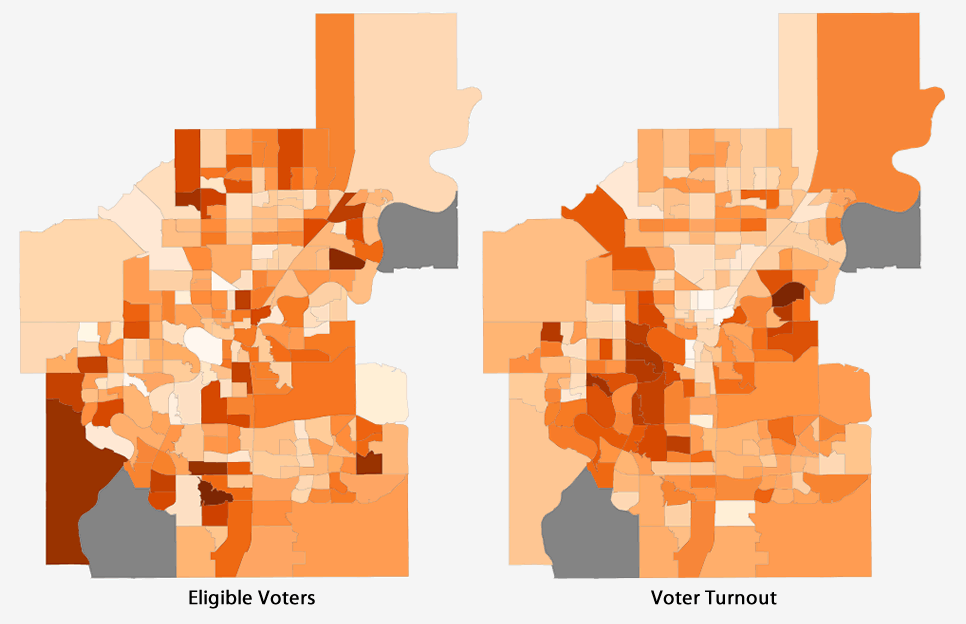
Ever wonder where the candidates in last month’s municipal election received the most support? Which parts of the city supported which mayoral candidates? After seeing the maps that were created for Calgary’s top three mayoral candidates, I wondered about the same kind of thing here. Local software developer Josh Kjenner was also interested, and he has been busy visualizing the results by polling station ever since.
Josh wrote an application called Metroview for the City of Edmonton’s Apps4Edmonton competition, a project which he spent about 60 hours on. The tool is implemented in Processing, a programming language and environment that Josh called “a really really intense Java library.” He returned to the project after the City of Edmonton released the final election results by polling station, and spent another 20 hours or so improving it. Josh told me the biggest challenge he faced was conditioning the KML files from the open data catalogue (a common challenge that open data developers face…getting the data and the tools/technology working together).
The result is an interactive application that lets you visualize candidate support and other data on a map of Edmonton.
Here are a few of the data visualizations you can see in Josh’s metroview yegvote 2010 app (requires Java).
Eligible voters versus voter turnout:
Support for Stephen Mandel:

Support for David Dorward:

Support for Daryl Bonar:
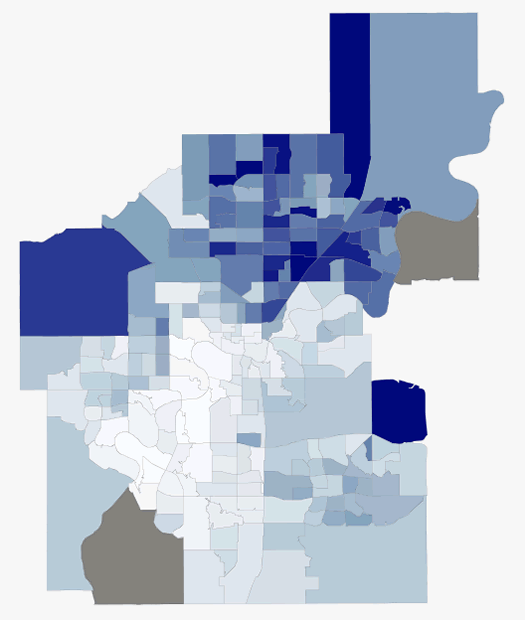
You can see that Mandel received most of his support from the south part of the city, while Dorward received the most support from the north part. You can use the metroview tool to see similar results for every ward, public school ward, and catholic school ward too.
Thanks Josh for creating this tool! This is another great example of what can be created when the data is open and available.
UPDATE: It should be noted that you can’t really compare Mandel’s graph to Dorward’s. A dark area in Mandel’s is not equivalent to a dark area in Dorward’s, for example, because of the difference in the number of overall votes that each candidate received. The colors on each graph are in relation to the other areas on that graph for that candidate only. If you look at Josh’s app, you get the raw values as you hover over each area, and you can choose absolute instead of relative for the drawing mode.
LRT Expansion was never just icing on the Edmonton EXPO 2017 cake
Allow me to begin with a passage from the executive summary of The Way We Move, the City of Edmonton’s current Transportation Master Plan:
We are building a 21st century city, shaping an Edmonton that will meet the needs of our diverse and growing urban and regional population. Growing environmental concerns, acknowledgment of the ongoing investment needed to maintain our transportation infrastructure and the rapid growth of our city demand a shift in transportation priority setting. It is a shift from single passenger vehicle use to more public transit; from building outward to a compact urban form. From an auto oriented view of transportation to a more holistic view of an interconnected, multi-modal transportation system where citizens can walk, bike, bus and train efficiently and conveniently to their desired location.
The City of Edmonton is working to achieve this vision through the LRT Network Plan, as well as other initiatives. This vision does not ignore automobiles, but it certainly places greater emphasis on public transit.
At the top of the list of benefits that EXPO 2017 could have brought to Edmonton was funding for infrastructure. Was it the best way to try to get higher levels of government to commit to funding something that Edmonton so desperately needs? Perhaps not. But make no mistake about it: funding for LRT expansion was never just icing on the EXPO 2017 cake. Expanding our LRT network is vital for Edmonton’s future. Here’s what Councillor Don Iveson wrote nearly a year ago:
Projects like this require the alignment of at least two and, properly, three orders of government. It will require the relentless pressure of citizens on Councillors, but more particularly on MLAs and MPs.
He was right then and still is today. Our quest to be Canada’s host city for EXPO 2017 might have failed, but we cannot allow our plans for LRT expansion to fail as well.
At a news conference yesterday, Transportation GM Bob Boutilier questioned why Edmonton had not received the same level of federal support as Toronto has when it comes to funding for public transit, saying “I just think we’re owed. It’s time.” But he also suggested that LRT expansion plans would be delayed by a year or two now that EXPO is no longer in the picture, something that would potentially save money.
This is unacceptable.
It’s unacceptable that the expansion is being delayed, and it’s unacceptable that it’s Boutilier and not Council questioning the federal government’s support.
Why would LRT expansion have been fast-tracked with EXPO 2017 but not without it? Back in April, Boutilier said that meeting the deadline of 2017 was “do-able” with some creativity, noting that “we cannot use the conventional approach to building transit that we’ve used in the city up to this point.” A few weeks later, he suggested a board of directors to oversee the construction as a way to speed up the project. At the time, the cost of the expansion was pegged at “more than $3 billion”. It has since been narrowed down to $3.4 billion. So either it was going to cost significantly more than Boutilier was letting on, or the cost savings of delaying by a year or two are negligible.
I think Boutilier has one of the toughest jobs at the City of Edmonton, overseeing one of the most vital and controversial parts of the business, so I don’t envy the tough decisions he has to make. Boutilier should definitely be willing to make noise about the lack of resources he has, but in the same week that we lost EXPO, I would have liked to have heard some Councillors speak up for LRT as well. Instead, that job has been left to Boutilier and to EXPO bid committee chair Tony Franceschini. I’ve seen only Councillor Ben Henderson comment, saying “I personally don’t want to see us slow down.” Councillor Kerry Diotte also remarked on funding, “With the feds these days, who knows?”
I want my City Council to stand up for The Way We Move. If there’s a window of opportunity with regards to the federal government as a result of the EXPO decision, take advantage of it. Ask Administration to keep going, not to slow down. Make some noise. Show some of the emotion that Mayor Mandel showed on Monday.
The loss of EXPO shouldn’t be an excuse for us to slow down with LRT expansion. It should be a catalyst for increased pressure to get the job done.
Government of Canada denies Edmonton EXPO 2017
 As you’ve no doubt heard by now, the federal government has announced that it will not support Edmonton’s bid to host EXPO 2017. A short note on the Edmonton EXPO 2017 website announced the news:
In a meeting with Mayor Stephen Mandel earlier today, Canadian Heritage Minister James Moore announced that the Government of Canada will not support Edmonton’s bid to host EXPO 2017. The key reason given was the unknown future costs of security. This decision comes in light of November survey results that showed 79 per cent of Albertans supported the bid for EXPO 2017 with 46 per cent indicating strong support. Almost 1800 Canadians were surveyed. On behalf of the EXPO 2017 Bid Committee thank you to all Albertans and Canadians for their interest, effort and support of EXPO 2017.
Here’s the letter from James Moore, Minister of Canadian Heritage & Official Languages, courtesy of the Edmonton Journal:
Expo 2017 – Letter from Minister James Moore to Mayor Stephen Mandel http://d1.scribdassets.com/ScribdViewer.swf?document_id=43676851&access_key=key-2h178gmnxgtm0wnv74ui&page=1&viewMode=list
This afternoon, Mayor Stephen Mandel held a press conference at City Hall to discuss the news. Here are some notes, including the ones I live-tweeted:
- Mandel started by talking about the 2010 Grey Cup Festival, saying he was confident it would be a big success and that Edmonton would shine.
- Flanked by members of City Council and members of the EXPO 2017 bid committee, Mandel confirmed that the Government of Canada will not support Edmonton EXPO 2017. Mandel was quick to praise the solid work of the bid committee and all EXPO 2017 volunteers.
- Mandel said a recent survey of Albertans showed that 79% supported the project.
- Mandel singled out MP Rona Ambrose as the specific reason that Edmonton failed to gain federal support. When pressed for a reason, he said others in the federal government looked to Ambrose for direction, and she just failed to commit.
- MPs Laurie Hawn and James Rajotte were cited as supporters of the bid.
- Mandel: “This [federal] government has far too easily ignored the needs of this province.”
- The only immediate ask of the federal government was $10 million, to continue with the bid process.
- Mandel said the federal government’s “apparent sincerity in exploring” EXPO 2017 was completely false.
- Mandel: “When it comes to Edmonton’s growth and ambition, our federal government simply isn’t interested.”
- Randy Ferguson, member of the bid committee, said “Albertans took a kick in the teeth today from the federal government.” In the media scrum afterward, Ferguson, a card-carrying Conservative, said “the prime minister is no longer my prime minister.”
- Ruth Kelly, another bid committee member, was just as angry but said we’ll find other ways to showcase Edmonton.
- Mandel made it clear that he feels the federal government decided not to support Edmonton because we’re in the west.
- Ferguson was more to the point, saying that Edmonton is paying for the security budget overruns that happened at the Vancouver 2010 Winter Olympics, and the G8/G20 summits.
- Mandel: “The proof is in the pudding, when it comes to delivering the goods in our city, [the federal government] failed.”
- Mandel: “I’ve never been as mad at anything, I’m so disappointed in the lack of vision from this government.”
- Asked about what this means for LRT, Mandel said “we’ll continue to push forward” and said “we have a strong partner in the province.”
- Ferguson said that because of the way the due diligence worked, the federal government had already signed off on the budget and security plan for the Edmonton bid.
I’ve never seen Mandel so upset, his voice shaky as the passion and anger poured out. Afterward, when asked what was next, Ferguson said “cooler heads must prevail” and said the team will digest the news more fully before any other action is taken.


Technically, all Edmonton needs to move ahead with the bid is the federal government’s consent. If Edmonton could come up with another way to fund the project, there’s a chance that they could go back to the federal government to ask for just consent and no funding. That, obviously, is very unlikely to happen.
For some reason, there’s a big disconnect between the amount of money Edmonton is asking for, and the amount of money the federal government thinks they will have to spend. Moore specifically cited the cost of security in his letter, a point on which Ferguson was very blunt: “The cost of security ballooned for the Olympics and for the G8/G20 and Edmonton is paying the price.”
When pressed, Mandel said he didn’t think the lack of federal support was about money. It was clear that he feels slighted by the government. There are indications that the announcement was related to a decision to deny money for a Quebec arena. I’m sure it will all come out in the wash.
Edmonton needs to focus right now on making sure the 2010 Grey Cup Festival is a big success. Let’s remind everyone that we excel at hosting big events. We’ll find another way to showcase our great city. We’ll make it happen.
What’s less clear is how we’ll acquire the infrastructure funding that EXPO 2017 would have brought to this city. Mandel talked about this during the press conference as well, noting that Edmonton (and indeed Alberta) often gets the short end of the stick. I’m not sure what it’ll take, but we need to make a solid ask for funding. As disappointing as it is to lose EXPO 2017, it would be much, much worse to lose the ability to make our City Vision a reality.
You can follow the news with #expo2017 on Twitter.
UPDATE: Here is Mayor Mandel’s full statement.
The Alberta Party’s Big Listen
 It’s hard to believe that nearly two months have passed since my Big Listen experience, but such is life. I meant to write something about it a long time ago, but that obviously didn’t happen! Given that the Alberta Party’s policy convention took place this past weekend, I thought now was as good a time as any to finally write something.
At the end of September, I took part in a Big Listen event. I was invited by Elaine Hyshka, VP of Communications for the Alberta Party. I’m interested in politics, obviously, and as a result I had some knowledge about the Alberta Party, but I didn’t know anything about the Big Listen process. I was told the evening would be “simply a gathering of friends to talk about their experiences, concerns and hopes related to living in Alberta.” Thankfully, that’s what it was.
The session was moderated by Michael Walters, the Alberta Party’s Provincial Organizer, and I can say with certainty that he made the evening for me. Michael is a gifted “people person”, and I thought he did a great job of facilitating our discussions. He got the Big Listen process started in March, and guided the team toward holding 100 Big Listen events reaching more than 1000 Albertans by the end of September, something they achieved.
The first activity was to break off into pairs to talk about our Alberta story. I was born here in Edmonton, but actually grew up elsewhere, primarily in Inuvik, NT. I came back for high school and university and have been here ever since. I think it’s interesting to consider why we’re here. Before I was old enough to decide for myself, I lived in Alberta because my family lived here. Now that I have the ability to go elsewhere, why do I stay? It was an intriguing way to start the event.
Next we got to the heart of the evening. We had three main discussion points. The first was to share some of the pressures we’re feeling here in Alberta. The next was to share our hopes and dreams for Alberta. And finally, we were asked to share what about Alberta we’re thankful for. All three were really enlightening and generated some great discussion. A really common pressure seemed to be the inability to share opinions about potentially controversial topics here in Alberta. Economic diversification was a common hope for the province. And most people agreed that Alberta’s future looks positive, so long as we stay focused and take advantage of the opportunity before us.
That, in a nutshell, was the event. It was a small part of a much bigger process. Here’s how it works:

The event I attended was on the left side of that picture, and this past weekend’s policy convention was on the right side. All of the Big Listen events contributed toward draft policy that was ratified at the convention. The specific policy resolutions will be posted to the website this week, but here are some of the highlights. I thought Dave Cournoyer’s quote summed up the whole process quite nicely:
“This weekend demonstrated how Albertans with different political backgrounds, or no political experience at all, can work together to develop meaningful and positive goals,” said new Alberta Party member, David Cournoyer. “It’s not about leaning left or right, it’s about moving forward and ensuring the province achieves it’s full potential.”
You can read Dave’s closing remarks from the convention here, and he’s got some great photos from the weekend here.
It is my understanding that this process will continue, and that there will be additional Big Listen events in the future. As party President Chris LaBossiere said, “The listening isn’t done – in fact, it won’t ever be done.”
Adam Rozenhart, who was also at the Big Listen event I attended, recorded some of it for The Unknown Studio. You can listen to that here.
You can keep up with the Alberta Party on Twitter, Facebook, or their blog.
A closer look at the City of Edmonton’s Downtown Arena Questionnaire
The City’s online questionnaire for the proposed downtown arena has received quite a lot of criticism, especially online. Twitter users have not been shy about calling it “leading” and questioning its intent. And that criticism has come up in face-to-face conversations I’ve had with people at arena consultation sessions and other events as well.
At the consultation sessions, officials have made it very clear that the questionnaire is meant simply to gather feedback, and is not intended to be a statistically valid survey. It feels like a survey though, so it’s no surprise that people treat it that way.
The introduction of the questionnaire reads:
This questionnaire is one of several methods being used to gather thoughts and concerns about a proposed downtown sports and entertainment facility. The feedback received will be provided to City Council to assist in their decision-making.
And it explicitly asks that you only fill it out once, though technically there’s nothing stopping you from filling it out dozens of times. There’s also no way to ensure that only people who live in Edmonton fill out the questionnaire.

I emailed the City with some questions on the survey, and they wrote back with detailed responses.
Was the questionnaire written by City staff? Calder Bateman staff?
A team worked on the online questionnaire. It was one of the early elements developed to support public input and was meant to be a quick and convenient way people could share their thoughts. It was never intended and not designed as a statistically valid, formal survey – but a technology-based tool for use by those who might not make the open houses in person. It means we will have a richer range of input to report on.
While other elements of the open house and discussion forums have evolved based on the input and suggestions we’ve received, we didn’t feel it appropriate to adjust the online questionnaire – so it has remained consistent with what was originally posted.
How many entries have you received to-date?
As of 4:00 p.m. Nov 9 we had 17,030 directly through the online questionnaire plus another 60 from those who called 311. We’re pleased with these results. It’s likely that people are seeing the online questionnaire as an option to attendance at the open house.
Any indication of how many received entries are duplicates?
No. At this point, we haven’t done an analysis on the questionnaire submissions. We really need to wait until the entire process concludes to get the full picture. There are a number of ways people are providing input including email, sticky notes, completion of the discussion feedback forms and the questionnaires. The inputs from all areas will be consolidated into the final report.
Are there any plans for a follow-up questionnaire later in the process?
There will be other opportunities for public involvement and input throughout the process, and another questionnaire might well be an option.
Are there any plans for a statistically valid survey?
We realize the online questionnaire only reflects the opinion of the people who complete it – it is not a representative analysis of what the population of Edmonton might think. The City will be very clear when presenting the results to ensure they are not considered a statistically valid sample of opinion.
A statistically valid survey continues to be a possibility. Our focus right now is on the current suite of public involvement opportunities.
I also asked my colleague Greg Pope, Analytics & Psychometrics Manager for Questionmark, for his thoughts and feedback on the questionnaire. He suggested this best practice guide (PDF) for good survey design as a starting point. Here are some of the comments & suggestions he had:
- The current 1-5 “definitely” likert scale is unclear (no label for 2,3,4). Greg suggested an even number of choices (1-4) so that there is no “maybe” or “unsure” category.
- “A rule of thumb is to try and keep all the questions on the same scale with the same values, so converting all questions to statements with a 4 point agreement scale would work well.”
- “Another rule of thumb is to phrase the questions all the same way. It is not leading or misleading to ask “I want a new downtown arena built in Edmonton.” Because you are asking whether they agree or not with the statement. “
- If the responses were going to be analyzed in any way, Greg said he would have asked some demographic questions. As a simple questionnaire, that’s probably not as important.
- Another suggestion Greg had was to combine the open-ended fields into one at the end, to make it quicker to complete the questionnaire. He said there’s often sorting that has to happen anyway.
Good feedback to keep in mind if a survey is created in the future. Thanks to both Greg and the City of Edmonton for helping me out with this.
I think there are two key takeaways here. First, the online questionnaire is not a survey. Second, the City of Edmonton is consistent in treating the questionnaire as just another way for people to provide input. If you think the questions are leading, don’t fill it out. There’s nothing stopping you from emailing the City with your thoughts or calling 311. And if you can, attend one of the public consultation sessions.
Recap: Downtown Arena Public Consultation Session
Last night was the first of four City-hosted public consultation sessions on the proposed downtown arena. The sessions aim to gather input that will be provided to City Council. Roughly 150 people visited the Robbins Health Learning Centre throughout the evening, though only about a third of those stayed for the facilitated part of the session.

The first two hours of the session followed an open house format, with information displays, handouts such as a backgrounder (PDF), City officials available to answer questions, and opportunities for individuals to write questions or comments on sticky notes or in drop boxes. Promptly at 7pm, Margaret Bateman made a brief presentation (PDF) on the consultation process. The next two hours were facilitated discussion groups, where everyone had the opportunity to provide specific feedback on five key questions. Here are the questions as they were presented this evening:
- What’s your position on building a downtown arena?
- If supportive, why?
- If not, why not?
- If conditional, why?
- If a new downtown arena project were to proceed, what do you think is important to consider in terms of:
- Design?
- Downtown connection and impact?
- Impact on surrounding communities?
- Community benefits/engagement?
- Impact on the future of Rexall Place?
- Any other issues?
- What about using a mix of private and public funding to fund a downtown arena?
- Are you open to this? Why?
- Not open to this? Why not?
- Open under certain circumstances or conditions? If so, what are they?
- What do you think about other possible funding sources to cover arena costs? (some or all of these are options)
- A ticket tax
- A personal seat license or luxury box license
- A community revitalization levy (which would require the facility be publicly owned)
- Funding for non-arena infrastructure from other levels of government
- Additional private investment
- Any other sources?
- Do you have any final thoughts or views for Council?
I attended a “stakeholder” consultation last Thursday that followed a similar format, but asked slightly different questions. The first question in that session was: “Do you support building an arena to revitalize Edmonton’s downtown? If yes, why? If no, why not?” Talk about a leading question with a big assumption! Needless to say I was very pleased to see that the City (along with consultation partner Calder Bateman) had tweaked the questions this time around.


My discussion group started off fine, but quickly descended into disagreement as a few very vocal members wanted to skip to the funding question right away. The City officials on hand handled the situation very well, and before long our group was back on track generating some useful discussion (the other groups didn’t seem to have any issues). Here are some of the comments from the group that I wrote down:
- Unclear that the arena would actually bring people downtown
- The arena will not generate tourism
- Skepticism about an influx of commercial development surrounding the arena
- Transit would need to be greatly improved, concern about the lack of an LRT stop right at the arena
- What would happen to Rexall Place?
- General feeling we would lose Canadian Finals Rodeo and maybe other events
- Lots of concern over traffic congestion, some concern over parking
- Feeling that the current ticket prices are already too high
- Quite a bit of skepticism about the effectiveness of a CRL
- Thought that spending the money on existing recreation centres would result in higher benefit to the community
As far as I could tell, my group was the most negative about the arena. The others seemed cautiously optimistic, and when everyone came together at the end of the evening for Margaret Bateman’s recap, that seemed to be the consensus. There was concern over treating the arena as the key to revitalizing downtown, and there was obviously lots of concern over the funding model, but there also seemed to be some optimism that the project could be a very good thing.

There are three more public consultation sessions currently planned:
- Wednesday, November 10 – 5pm at the Santa Maria Goretti Centre
- Monday, November 15 – 5pm at the Robbins Health Learning Centre
- Wednesday, November 17 – 5pm at the Robbins Health Learning Centre
If you can’t make it to any of those sessions, you can fill out the online questionnaire, call 311, or email downtownarena@edmonton.ca.
For more information, check out the City of Edmonton’s site, the Katz Group’s site, and the Why Downtown? site. You can follow updates on Twitter using #yegarena.
Whether you’re for or against the arena, or even if you’re unsure, it’s important to make your voice heard!
 MasterMaq's Blog