Reboot Alberta: Tweets & Blogs

A very interesting event took place in Red Deer this weekend called Reboot Alberta. Participants discussed the state of politics in Alberta, and explored ways to “reboot” things. I was invited, but decided to stay home. I’m not as well-versed in provincial politics as others and I was unsure what I would be able to contribute. Perhaps it would have been a good learning opportunity for me, but I got the impression that Reboot Alberta was (like ChangeCamp) looking for participants rather than observers. That said, I think I’ll start participating now!

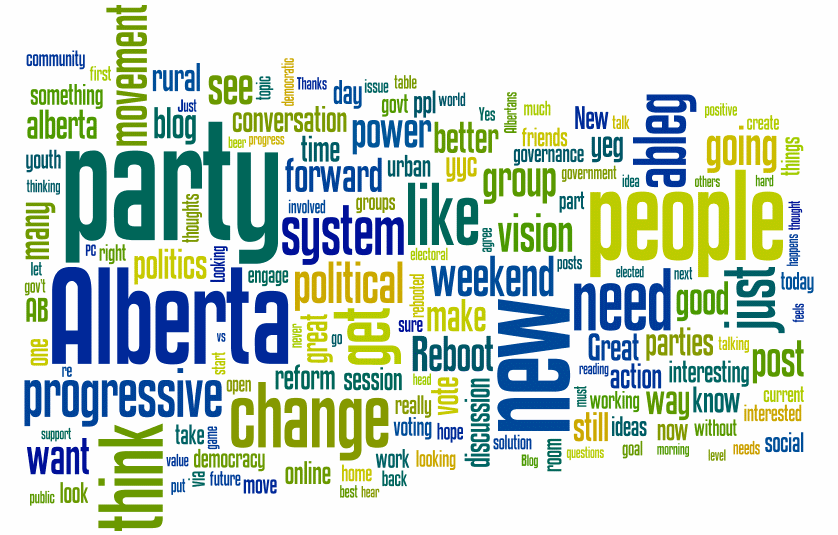
There were a lot of tweets and blog posts written over the weekend, and during the week leading up to the event. I counted 1243 tweets with the #rebootab hashtag from November 21 until last night around midnight. After removing the hashtag, RT, and usernames, this is what you get if you combine them into a Wordle:

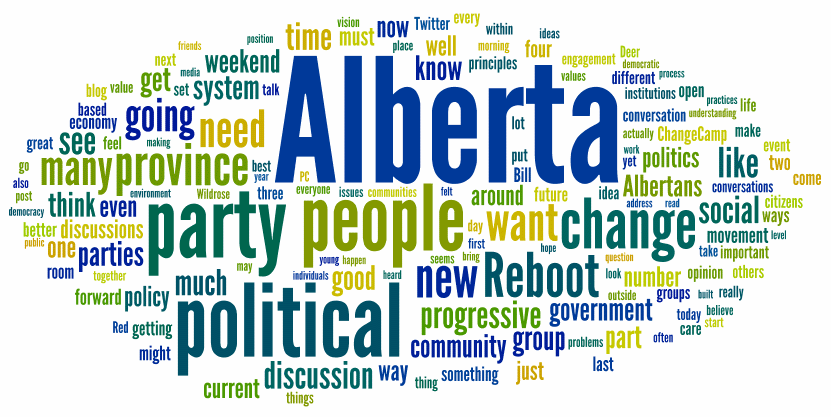
Likewise, there were a lot of blog posts written, with many more on the way I’m sure. Here’s a Wordle for them:

And here are the blog posts I included for that:

Watch for many more posts from participants and others, and be sure to check out Reboot Alberta.

2009 Edmonton Citizen Satisfaction Survey Results

The results of the 2009 Citizen Satisfaction Survey are being presented to City Council today. The survey was once again conducted by Banister Research & Consulting Inc. Some quick facts:

  • The total cost of the survey was $13,650.
  • A total of 800 telephone interviews with Edmonton residents aged 18 or older were completed between June 2 and June 14, 2009.
  • A total of 7989 calls were attempted, 2328 of which resulted in refusals.
  • 50% of respondents were male, 50% were female.
  • 79% of respondents have lived in Edmonton for more than 10 years.
  • 69% of respondents were aged 45 or older.
  • 76% of respondents reported average household income of less than $150,000
  • City-wide results provide a margin of error no greater than +/- 3.5% at the 95% confidence level, 19 times out of 20.

There’s lots of great information in the report, which you can download in PDF here. Or if you prefer, you can just download the highlights, also in PDF.

One of the survey questions is the following:

Now, taking into consideration all City of Edmonton services and programs, overall, how satisfied are you with the services and programs provided by the City of Edmonton to residents?

And here are the results:

In the report, Banister explains:

It is important to note that in 2007, 2008 and 2009 this overall satisfaction question was asked following the satisfaction ratings for specific City services. This was done in order to allow respondents to think of all facets of the service provided by the City of Edmonton, thereby providing a cumulative and overall rating.

I thought it would be interesting to check how effective that is. Unfortunately, the results of the survey are in PDF, not the easiest format to work with. Fortunately for you, that didn’t stop me!

Download the Satisfaction Results by Area in XLS

(I recognize that Excel isn’t the ideal open format, but it was quicker than creating 18 different CSV files. And hopefully this data will be made available as part of the open data initiative anyway.)

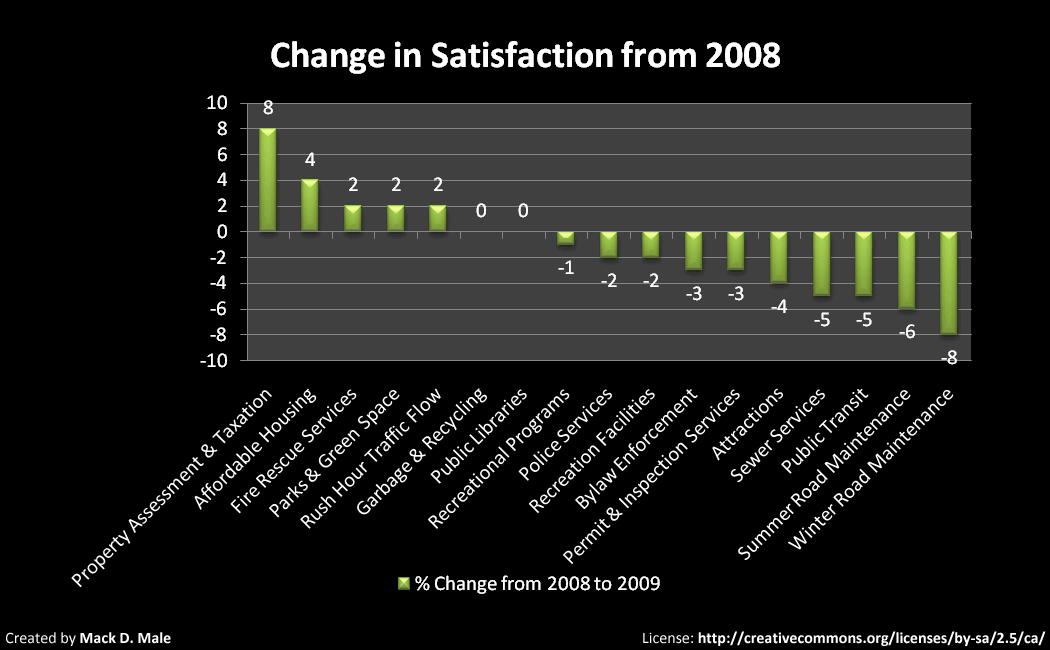
Citizens were asked how satisfied they were with 18 different service areas (one, environmental programs, was new this year so I ignored it). The data is available for each area for 2009, 2008, 2007, and 2003. I added up the “very satisfied” and “somewhat satisfied” percentages for each and compared it with previous years. Here is the percentage change in satisfaction for each area from last year:

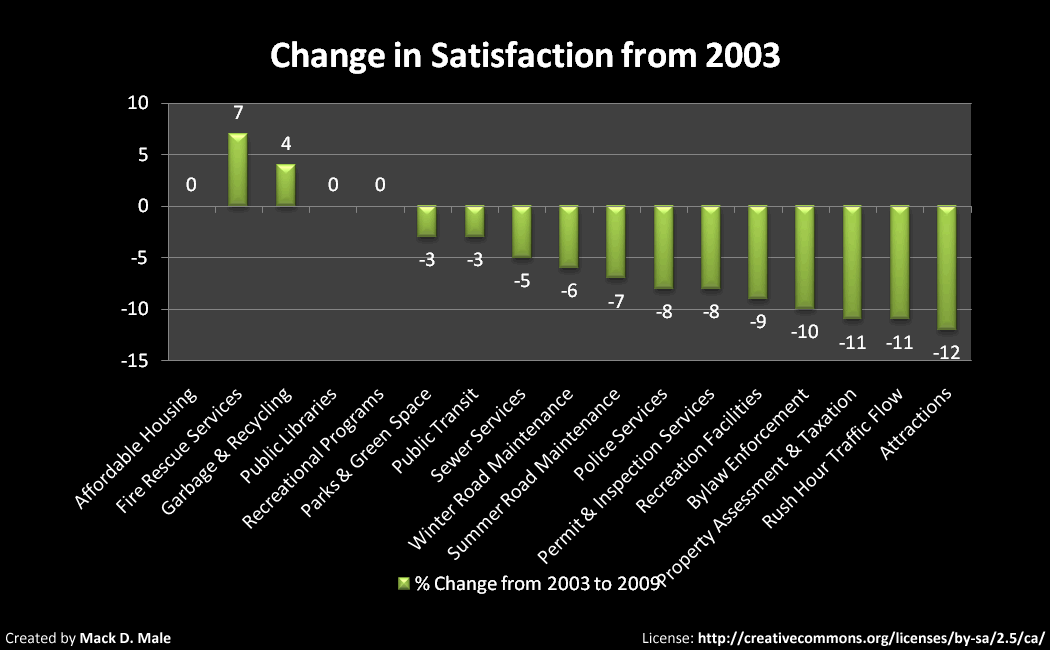
And here is the percentage change in satisfaction for each area from 2003 (affordable housing was not scored in 2003):

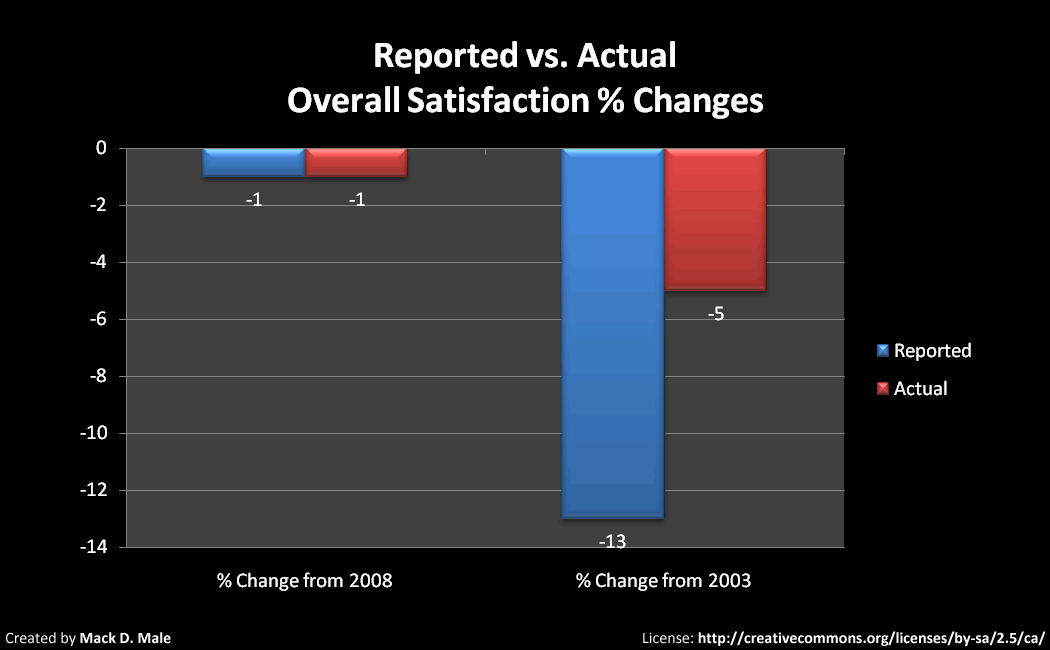
Now we can compare the reported and actual change:

Respondents reported a 1% decrease in overall satisfaction from 2008, and the average change of all the services was the same. Compared with 2003 however, respondents reported a 13% decrease in overall satisfaction, but the average change of all services was a decrease of just 5%.

See how much fun you can have with open data? Now imagine combining this dataset with other datasets! I’d love to compare the results of the satisfaction survey with 311 call volumes, for instance.

Open Data at ChangeCamp Edmonton

Tomorrow morning local politicians, bureaucrats, and ordinary citizens will gather at the University of Alberta for ChangeCamp Edmonton. I’m encouraged by the number of people that have registered, and by the conversations that have already started. That’s what tomorrow is all about: getting people together to discuss ideas and solutions.

I don’t know exactly which topics people will want to discuss tomorrow, but I know for sure that open data will be one of them. There’s significant momentum building for the concept, and we’re starting to see progress on making it happen throughout Canada (and elsewhere).

Open data here in Edmonton received a nice boost this week from Councillor Don Iveson when he submitted a formal inquiry to City administration:

In local, national and sub-national governments around the world there is a trend toward making up-to-date government information freely available on-line in generically accessible data formats as so-called ‘Open Data’.

  1. What level of awareness does the City Administration have regarding Open Data in municipal government?
  2. What current initiatives are underway within City Administration that might qualify under the spirit of Open Data?
  3. What further initiatives are under consideration within the city, and on what basis are they being evaluated?
  4. Is Administration monitoring any successes and or challenges with this trend in other jurisdictions, especially large Canadian cities, and if so what can be shared with Council?
  5. What would City Administration’s recommendation be on next steps regarding Open Data plans or strategies?

I know there was already some things going on behind the scenes at the City of Edmonton, but Don’s inquiry should expedite and give credibility to those things. This is an important step.

I’ve been pushing for open data in Edmonton for a while now, along with many others. I think ChangeCamp will be a great opportunity to further discuss the concept and next steps. I generally think about open data in the context of a municipality, but there’s room for discussion at the provincial and federal levels too. Here are some of the key things I think we can cover:

  • Let’s make sure everyone (citizens, politicians, City administration) is on the same page about what we mean by “open data”. This could be high level (what kinds of data are open) and low level (what formats are considered open).
  • What is the City working on? What are citizens working on? Let’s get a status report from both sides.
  • What kinds of data could be made open? Which data is most in demand by citizens? What data has been made available in other cities, such as Vancouver or Toronto?
  • Licensing is vital for open data to work. We need to ensure data is licensed as permissively as possible, otherwise we’re restricting its utility. Which licenses make sense? What have other municipalities used?
  • Often lost in the discussion about what data to make available is how to be notified of changes to that data. RSS feeds, email subscriptions – how should citizens be notified when data is updated or otherwise changed?
  • Another aspect that we need to consider: the creation of data. There is lots and lots of data that our governments can start making available in open formats, but there’s even more data created on a daily basis. What can we do to ensure that it is open data also? How about APIs or other mechanisms for citizens to provide input/data? Open 311 comes to mind.

Here are some links that might be useful tomorrow:

See you in the morning!

Edmonton’s new Centre for Public Involvement

One of the items that was discussed at today’s Executive Committee meeting (agenda in Word) was the proposed Centre for Public Involvement, a joint venture of the City of Edmonton and the University of Alberta. The idea is to combine the strengths of both organizations to “intentionally consider and apply the most effective means to undertake public involvement.” Here’s the proposed mission:

To provide leadership in understanding and applying innovative practices and new technologies for citizen participation, engagement, and deliberation.

The centre would try to strike a balance among research, best practices, and consulting. Annual operating costs would be $300,000, split equally between the City and the University. Other partners may join at some point in the future.

I really like the idea. That said, I want to echo the opening statement of the prospectus:

The timing is right for establishing the proposed Centre. In reality, the timing is probably late by ten years.

Both the City and the University have already started exploring new forms of public involvement. The City has been quite successful with its social media endeavors, and the University is starting to experiment as well. It seems there’s a new U of A account on Twitter each week (the latest I’ve come across is the International Centre)!

While it is true that there is some frustration among the public with regards to being able to impact decision-making, not everyone has become angry and complacent. Initiatives such as ChangeCamp are proof that some citizens are already engaged in re-imagining public involvement.

I think there’s a great opportunity here for the City, the University, and the public to work together to explore the future of public involvement. I think Raffaella nailed it in a recent post discussing the new City of Edmonton blog she’s been working on:

We seek to create informed communities, engaged citizens, and generally make our lives better.

You can download the Centre for Public Involvement Prospectus in PDF here.

Edmonton City Centre Airport closure delayed

Back in July, City Council voted in favor of phased closure for the City Centre Airport. The first runway (16-34) was scheduled to be closed by April 30, 2010, but today Council voted to delay that until October 2010 so that the Rexall Edmonton Indy can be held next year (only Councillor Batty voted against the decision). You know, the race that cost taxpayers $5.3 million last year (figures for the 2009 race haven’t yet been released). I guess this means the design competition will also be delayed.

Just last week a report suggested that air traffic may be closed for four weeks to accommodate the Indy. The only other alternative that was presented was to spend the money on a new track, a decision that probably wouldn’t have gone over very well with anyone.

The current contract with the Indy Racing League expires after the 2010 race, but City Manager Al Maurer says that discussions about a longer term agreement are underway. If the 2009 figures don’t show a big improvement from 2008, it’ll be hard for City Council to justify a renewal.

I think City Council missed an important opportunity today to reinforce their decision to close the City Centre Airport. Additionally, they’re in danger of setting a bad precedent of delays. What happens the next time Tom Hendricks or someone else goes to Council to ask for more time?

I hope this is the first and last delay in the closure process. We’re watching you City Council.

UPDATE: The Journal reports that the delay would be until July 31, 2010 not October 2010.

UPDATE2: The text of the motion is as follows:

That the City of Edmonton cooperate with Edmonton Regional Airports Authority to ensure that any closure of Runway 16-34 would not take effect until after the 2010 Edmonton Indy and Alberta Aviation Museum’s Airfest 2010.

You can download the minutes in Word here.

How open data could help the City of Edmonton save at least $197,500 on 311-related expenses

While researching 311 for my previous post, I consulted the 2009-11 Capital Budget (PDF). The Capital Budget pays for both maintaining existing infrastructure and undertaking new projects (in contrast, the Operating Budget is a one-year budget for services and programs – you can find both here). In it, I discovered a Corporate Services (read: IT) project called “e-Business”, described as follows (on page 382 if you want to look it up):

The purpose of this funding is to put 311 statistics on our websites. First for internal staff then to public. The objective is to present 311 statistics in a manner similar to the what New York City does. Their 311 activity is presented by neighborhood or ward, in text form in a table as well as on a map. This project is being presented as a phase in of sophistication. This enhancement can be implemented based on what can be funded.

I went to check out New York’s site for 311 statistics, and it is indeed quite useful. If you type in an address and select a borough, you get a wide assortment of statistics, presented in tabular form or on a map. The bad news is that most of the tables and maps are in PDF form. The good news is that you can export all the data to CSV, which means you can map it yourself! Very cool.

The project description continues:

The e-Business program is driven by three primary factors. Our citizens are demonstrating increased use of the Internet and the City’s Web site, our population is growing, resulting in a projected need for increased services, and citizens and other stakeholders are demanding new and more extensive self-service access to government.

If you’re not thinking of open data and ChangeCamp by now, you should be! Here are some justifications for the project as outlined in the Capital Budget:

  • Program Managers would use this as an additional tool for monitoring service activity.
  • Residents and potential residents could find out what the issues are in specific neighbourhoods.
  • The Mayor and City Council could quickly determine what the major issues are, without having to make a request.
  • The project will help make the City more transparent to its public.

Sounds great to me!

So what’s the problem? Cost.

The justification section of the project description says: “At the City of Edmonton, e-Business is about business first – providing the services our citizens need and want at a justifiable cost.”

I wouldn’t call these costs justified, I’d call them outrageous:

Phase 1 Table display of 311 Statistics reports $27,000
Phase 2 Option to display of reported statistics by business area $27,000
Phase 3 Option to display of reported statistics by neighborhood $37,000
Phase 4 Option to display reported statistics on a map $133,500
Phase 5 Include statistics that are stored in other applications $974,000
  TOTAL: $1,198,500

This is why we need a policy on open data, so that projects like this one don’t get funded, wasting taxpayer dollars.

The first item consists of automating the conversion of reports generated by the 311 system to web content, presumably HTML. I think $27,000 sounds justified for that task. It’s potentially quite difficult and error-prone, depending on what the reports look like, what format they are in, etc. The rest of the items are ridiculously overpriced, however.

What the City should do instead

Spend the $27,000 to automate the conversion of the reports to CSV format. Then make those CSV files available for free to the public. I promise you the City would get the next three phases for free. If I had the data I’d gladly do it, and I’m sure there are others who would too. On top of that, the community is more likely to use standard/open tools and technologies (such as Google Maps) rather than proprietary, awkward ones (such as the City’s SVG maps). We’d probably get it done faster too. The City can then put money to more useful things, such as an open 311 API similar to what Washington, D.C. has.

I think Phase 5, which would include data from POSSE, CLASS, and other internal systems, is too big and broad currently (hence the very large cost). It could be approached in the same way though – spend a little bit of money to make the data available in an open format, and give it to the community to do the rest.

I should point out that the above total ($1,198,500) has no approved funding. Rather, it is the amount the project would cost if City Council approved the entire thing. They could choose to approve only one phase, a couple phases, or none. The reason I put $197,500 in the title is that only the first four phases seem reasonable to me given the information available, and I think the first one is a justified cost as-is.

If the City of Edmonton could save nearly $200,000 on this one project alone by embracing open data (not to mention the indirect benefits that will come along with that cost-savings), imagine what the benefits of embracing open data across the board would be!

Edmonton’s 311: six month status report

As you’ve probably heard by now, the City’s 311 service is not performing as well as expected. The Sun first reported the story last week, and the Journal followed up with an article yesterday. They key point mentioned in both is that wait times to connect to an operator are far longer than originally anticipated. As a result, an interactive voice response system is being considered for next year. I can’t imagine that will make callers any happier, even if it does make their calls slightly faster.

I personally think they should put more resources into 311 online. How many citizens even realize that they get online access to a lot of the information and services that 311 provides? The best way to reduce call times is to increase self-service options and quality so that citizens can bypass the phone altogether.

Fortunately, there are new self-service features being developed for release in October. The City will still need to communicate their existence effectively, however.

Background

The CRTC approved the use of the 311 phone number for municipal services back in November 2004, and Calgary became the first city to launch 311 on May 8, 2005. Here in Edmonton, City Council approved the service at its May 9, 2006 meeting. Edmonton became the first city in North America to use SAP’s CRM application to deliver 311.

The 311 service officially launched on December 16, 2008. Implementation was approved at a cost not to exceed $10 million (and it is on track to come in about $1.5 million under budget). Half of that amount came from an internal loan, which is to be repaid from operating savings (the other half came from a special dividend in 2005).

Six Months In

The report that went to the Executive Committee this week isn’t incredibly long at 7 pages, but it does have lots of information. Here are some graphics to help make it easier to understand the first six months of 311 operation in Edmonton.

Call lengths are one of the reasons everyone is complaining:

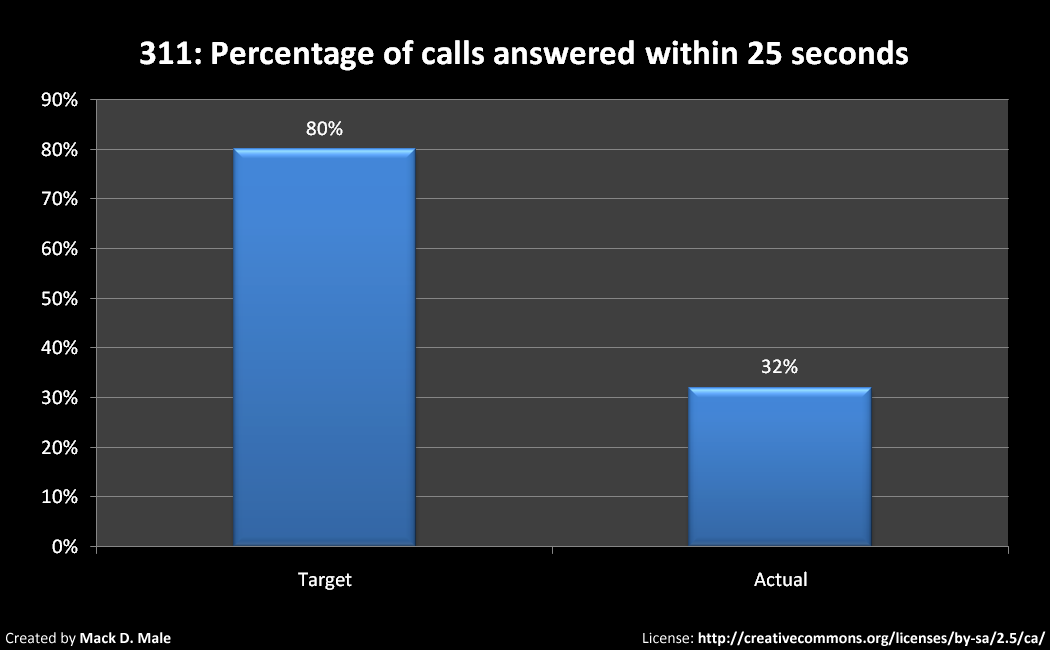
Wait times to get through to an operator are another concern:

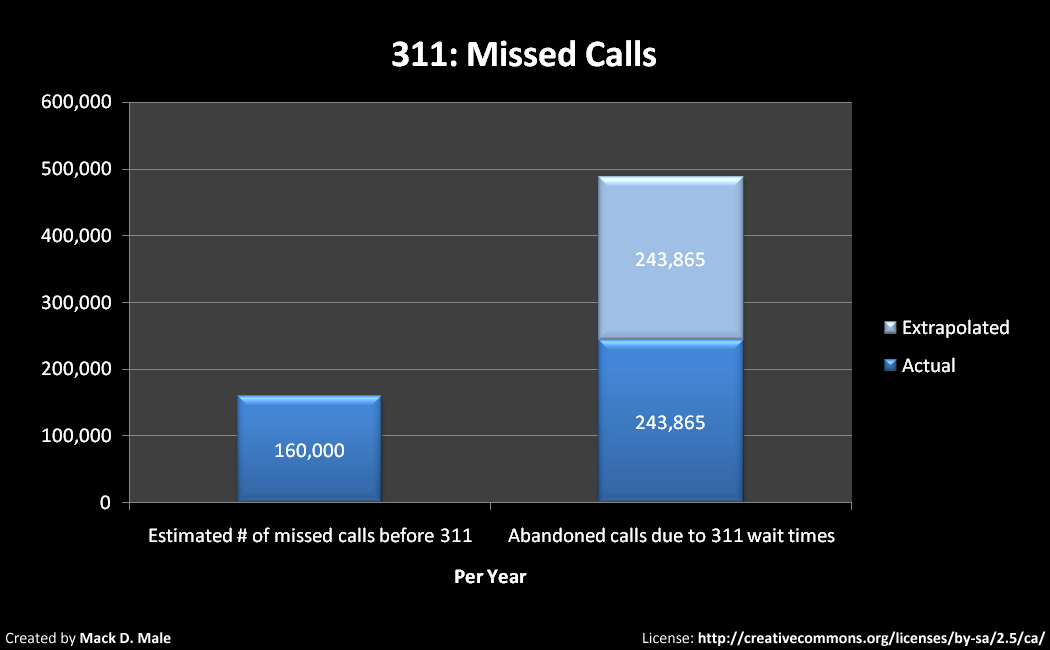
The 311 system was supposed to help the City capture the estimated 160,000 missed calls each year, but so far it is on track to make things much worse:

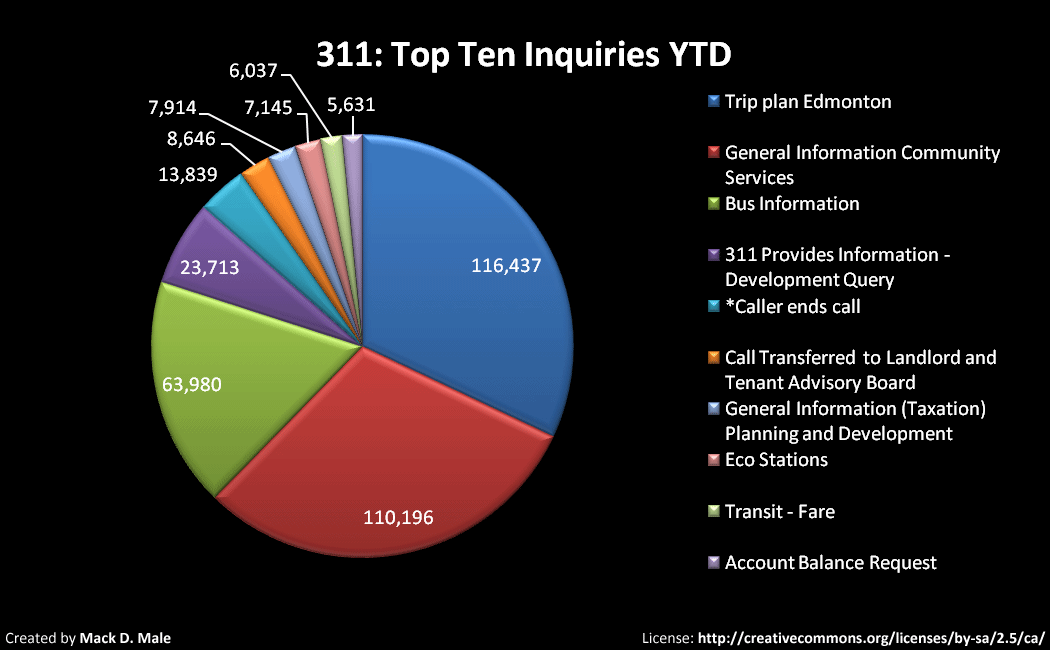
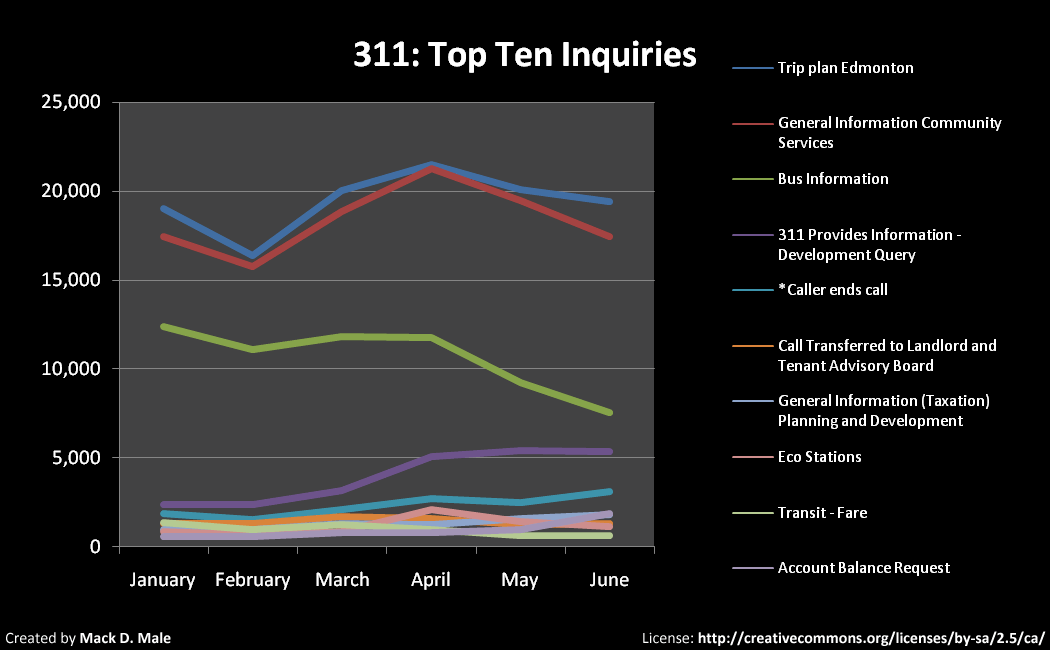
The report contains information about the top ten services:

Transit inquiries make up a significant portion of all 311 calls, followed by Community Services inquiries. There’s a clear opportunity for transit to do more to reduce the number of calls going through 311. I find it odd that trip planning is such a common request actually, given that there’s a separate number for that (BusLink) not to mention the online trip planner and Google Maps.

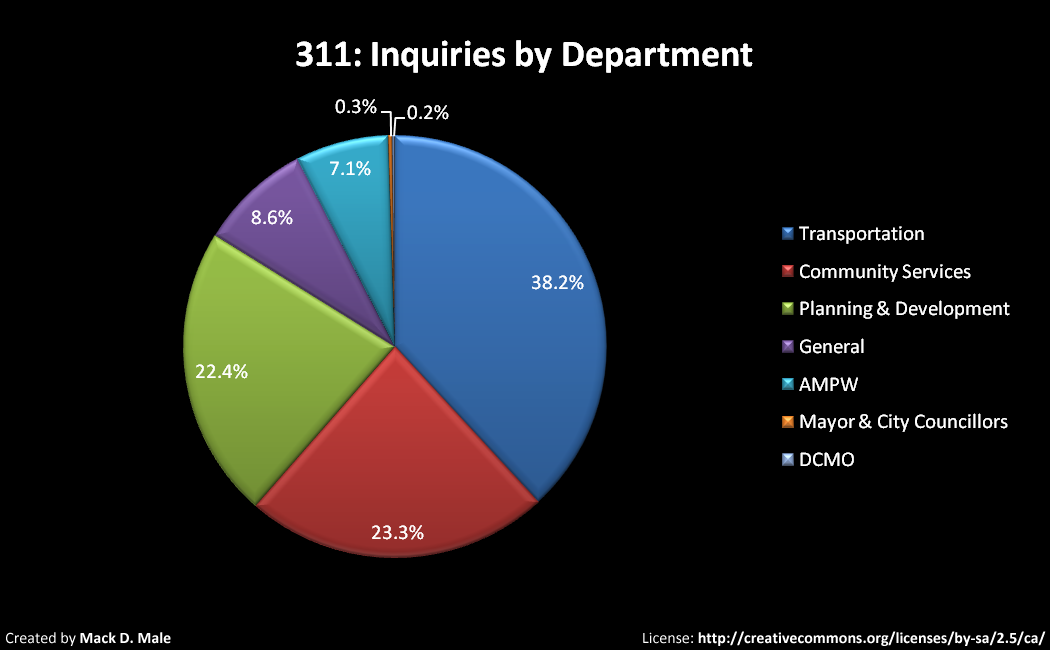
Here’s the breakdown by department:

There are a few more graphs (without data values unfortunately) in the report, so take a look at those too. They show that the number of calls answered within 25 seconds is on the rise, and that the time it takes to get through to someone is declining.

Does this report suggest that 311 is “a disaster”? I don’t think so. All it shows is that there is work to do, and it sounds like the 311 team is on the case. Hopefully the departments they serve are as well.

Open Data in Edmonton? Follow Vancouver’s lead

Last week Vancouver launched an open data portal, providing one-stop-shopping for open data provided by the city. David Eaves called the launch “a major milestone for Vancouver” and explained:

The Data Portal represents an opportunity for citizens, especially citizen coders, to help create a City that Thinks Like the Web: a city that enables citizens to create and access collective knowledge and information to create new services, suggest new ideas, and identify critical bugs in the infrastructure and services, among other a million other possibilities.

He was also quick to point out that getting access to the data is just the beginning. Citizens have to use it, or risk losing it. The next day he launched VanTrash, an application to make garbage collection sexier. Use it or lose it indeed!

I think it’s interesting that he started with garbage collection, because I too identified that as an area that could use some innovation. A couple months ago, I spent about an hour on the phone with a manger in the Waste Management department at the City of Edmonton, trying to get access to the data behind the garbage collection schedules. Currently you can enter your address here to download your collection schedule in PDF. But if you want to find the schedule for a different part of the city, you’re out of luck. And even if you manually tried enough addresses to find all the zones and collection schedules, they’d be in PDF, which means you can’t easily add them to a calendar.

By the end of the call, I think he finally understood what I was after, and he said he’d have to get back to me. He never did, unfortunately. I can only hope that my request had an impact and that it will eventually help to open the data floodgates in Edmonton.

Open Data doesn’t have to be difficult!

Take a look at the data available at Vancouver’s data portal. Most of the data there is simple and exists elsewhere, in a less “creative friendly” format. A good example is the list of libraries. You can download the data in CSV, XLS, or KML formats, but it really just comes from the Vancouver Public Library website. The CSV contains the library name, it’s latitude, longitude, and address. Simple stuff, but potentially really useful if combined with other data sets.

Here’s an example in Edmonton. Let’s say I want to know how the crime rate of neighbourhoods with libraries compares to those without. What data would I need for that?

  • A list of libraries, with their locations (see below)
  • A list of neighbourhoods, with their boundaries
  • Crime statistics by neighbourhood
  • Census data for neighbourhoods to find comparable ones without libraries

Could you find this today? Yes, but it’s definitely not easy! The EPL website lists the libraries with addresses, so you’d need to figure out the lat/long on your own. The City of Edmonton website lists the neighbourhoods, but you’d need to figure out the boundaries on your own. The EPS website provides reported crimes by neighbourhood. And finally, the City of Edmonton provides census data for neighbourhoods in PDF.

If I could get all the above data in CSV format, it would have taken a matter of minutes to find the answer (I should point out that not all of that data exists at Vancouver’s portal either). Instead, I had to do a lot more work. The very rough result (because I compared with a random sample of similarly populated neighbourhoods) is that neighbourhoods with libraries were 1.5 times more likely to have crime than neighbourhoods without libraries in 2008. Though if you don’t count Downtown, then the crime rate is about the same for neighbourhoods with libraries and those without.

Maybe you’re thinking “what a useless example” and that’s fine – it is one of just hundreds or thousands of possible uses for that data! Just imagine what would be created if software developers and other creatives in Edmonton had access to the data.

Libraries Data

All this talk of open data, why not give you some? I’ve created a CSV of the Edmonton Public Library locations in the exact same format as the Vancouver Public Library data (minus eplGO in the Cameron Library). Enjoy!

Download the Edmonton Public Library location data in CSV

Onward in Edmonton

I’ve heard rumblings that the City of Edmonton will be doing some stuff in the open data space in the next couple of months, but I’m not holding my breath. There haven’t been enough conversations taking place. I’m hopeful that the right people are envious of the progress that has been made in Vancouver, however. I sure am!

ChangeCamp Edmonton – October 17th

As you may have heard, we recently picked a date, time, and place for ChangeCamp Edmonton! We’ve been talking about it for months now, and for a while it really felt like we’d never make any progress. We had a really hard time defining the event, though it sounds simple in concept:

Let’s get as many citizens, politicians, policy-makers, technologists, design-thinkers, change agents, and media creators as possible together in the same room to explore one central question: “How do we re-imagine government and citizenship in the age of participation?”

Was it a single day or many? Physical or virtual? A spark or a process? How much should we define up front? How do we get people interested? Should we borrow from cities that have already held ChangeCamps or try something completely different?

We still don’t have all the answers, but we’ve decided to move forward anyway. In the spirit of ChangeCamp and other unconferences, we’re going to have a conversation, and you’re invited! Here are the details:

WHO: You, everyone!
WHAT: ChangeCamp Edmonton
WHEN: Saturday, October 17th, 2009 from 8am to 4pm
WHERE: Lister Conference Centre, University of Alberta (map)
WHY: To start a conversation about re-imagining government and citizenship in Edmonton, Alberta

We are still working on defining how the day will unfold, but it’ll be similar to ChangeCamps in other cities. Stay tuned to the official website as well as our Google Group for updates.

If you’d like to help out, just let us know! Right now we need help spreading the word, more than anything else. Tell your friends, tell your colleagues, tell your elected representatives. Let’s make October 17th a day to remember in Edmonton!

Visualizing Edmonton’s Municipal Development Plan

The Municipal Development Plan (MDP), also known as “The Way We Grow”, is the City of Edmonton’s strategic land use plan. You can think of it as the implementation of the City Vision for the next ten years (along with its sister document, the Transportation Master Plan). The next public hearing on the draft MDP takes place tomorrow (you can download the agenda in Word here).

From the Executive Summary:

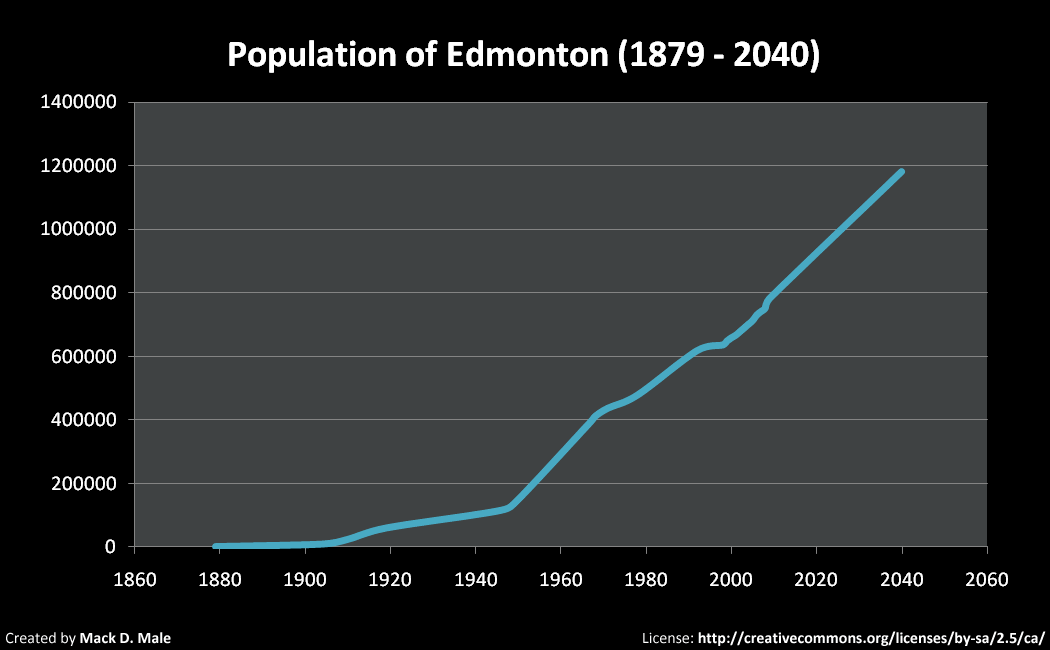
By the year 2040, Edmonton will be home to more than 1 million people. To accommodate our growth and to aid Edmonton’s evolution to a more sustainable, healthy and compact city, this plan takes a holistic city building approach to managing growth and development. Success will give Edmonton a grater range of housing, living and work place choice, greater financial sustainability, an ecological system throughout the city and a fully functioning integrated transit and land use system.

Though a plan like this is probably just good to have, it’s also required by the Municipal Government Act – all municipalities in Alberta with populations greater than 3,500 are required to prepare a Municipal Development Plan.

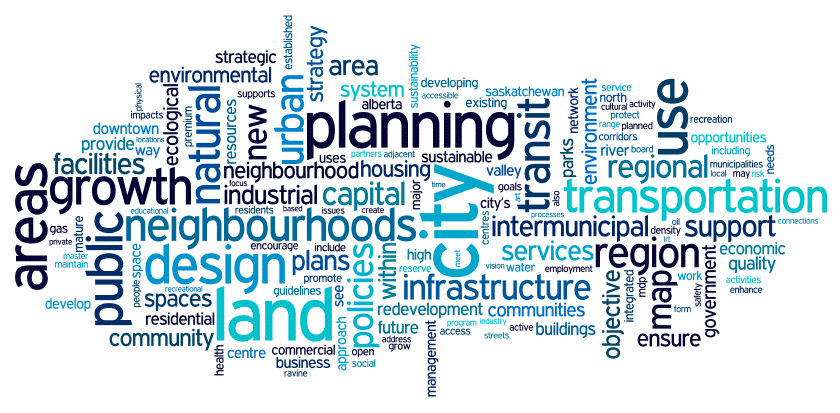
The draft MDP is a hefty document, so I like to start by trying to visualize it. Here’s a Wordle of the entire 141 page draft document (which you can download in PDF here), with common terms (such as Edmonton or Municipal Development Plan) removed:

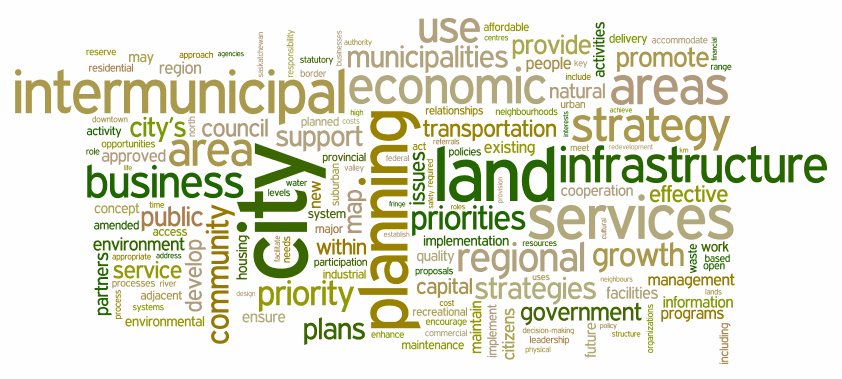
I thought it would be interesting to compare that with the current 109-page MDP (which you can download in PDF here):

Not surprisingly, they are fairly similar. The three that jump out at me are “neighbourhoods”, “transportation”, and “transit” in the draft plan – all are much smaller in the current plan. On the flip side, “business” and “services” are much larger in the current plan.

The key bullet points from the draft plan describe what the City of Edmonton is attempting to achieve:

  • Emphasizing the role urban design plays in a world class city.
  • Recognizing the need to address Edmonton’s financial sustainability by integrating land use and transportation decisions with city infrastructure and lifecycle costing.
  • Shifting from an auto-oriented transportation system to a system offering citizens more choice of transportation modes.
  • Focusing investment to transportation corridors that facilitate the movement of goods within the City and throughout the region.
  • Promoting integration of ecological networks and biodiversity in our approach to land use.

I haven’t read the entire thing, but two themes seem to be common throughout the draft MDP – population growth and financial sustainability. Edmonton’s current population of 782,439 is expected to grow by 400,000 people by 2040. Here’s what that looks like:

Looks a bit like the classic hockey stick curve! It takes a lot of infrastructure to support that many people. The City of Edmonton currently has more than $32.6 billion of City-owned infrastructure, most of which has a life cycle of 50 years. That’s a big number, so here’s a visualization to hopefully help you make sense of it:

I tried to pick items related to Edmonton in some way. It’ll be interesting to see how that number grows over time.

Proposed revisions and amendments to the draft will be considered by City Council tomorrow. The next public hearing is currently scheduled for November 12th. That gives you lots of time to scan through the document if you’re up to the challenge!

I’ll have more on the MDP over the next few weeks.