Downtown Edmonton requires infill development

One of the things I’ve heard time and time again during and since the City Centre Airport debate earlier this month is the argument that closing the airport and making the lands available for redevelopment threatens the infill that is required throughout downtown. If you highlight all the surface parking lots, downtown Edmonton (97th Street to 109th Street, 99th Avenue to 104th Avenue) looks something like this:

That doesn’t take into account parkades or any lots that I missed (I put it together pretty quickly just looking at the satellite view). It’s also a relatively small area (there are far more on the other side of 109th and 104th) I don’t think anyone would look at that and say, “it’s fine the way it is.” The fact is, we definitely need infill development if we want to have a sustainable, vibrant city. I would suggest that the individuals who supported closing the City Centre Airport likely also strongly support infill development. Both are steps toward the same end.

The first and probably most important thing to consider with this issue is that the whole of the ECCA lands did not go on the market the day Council voted to close the airport. It’s a long-term proposition, and redevelopment will take time.

The second thing to consider is that we may in fact need that space eventually, even if all of the current infill development happens. A few questions were asked about this very topic in Council’s Q & A. Here is the key response, prepared by Gordon Easton from Colliers:

Development pressure in the City of Edmonton is coming from the dual processes of population growth and population change. The population of Edmonton is expected to increase by approximately 400,000 people by 2041. The population is also aging, which creates demand for additional dwelling units, including high density. Our housing demand report showed that between 2016 and 2041 there will be a minimum of 45,107 apartments and 16,212 other multi family homes required to house the expected population. Certainly there are other developments and other sites that can and will accommodate some of this growth. Armin Preiksitis & Associates estimates that the current major development sites underway or expected in the City will contribute almost 35,000 multi-family units. If no other developments come on-line, those units will be completely absorbed in 2019, and there will be 2,453 multi family units needed each year thereafter. That is the equivalent of over 8 30-story condo towers and 650 townhouses per year. As part of the City’s multi family dwelling supply, the ECCA lands would reduce the rate of absorption at competing properties and lengthening the development timing. If ECCA were not developed with multi family residential, the rate of absorption at other sites would be higher, and development pressures (prices) on other sites throughout the city would increase as the market responds to the demand.

We need infill development in downtown Edmonton whether the airport disappears or stays. Closing the airport doesn’t mean that such infill development can’t or won’t happen, and to suggest otherwise is misleading and dishonest.
Data on Edmonton’s new 12-ward system

Last night City Council voted in favor of changing from the current 6-ward system to the more common 12-ward system used throughout North America. The change will take effect for next year’s municipal election. For more background, check out Dave’s post. You can also check out the City of Edmonton’s page for more information.

As an advocate of open data, I thought I’d share with you some data related to the new wards below. All of the data is available on the City website somewhere, but not in an easily consumable form. I’ve done the legwork to make it accessible.

Amendments made to the motion last night affected the wards a little:

  • Grovenor and McQueen neighbourhoods moved from Ward 1 to Ward 6.
  • CPR West moved to Ward 8 from Ward 10.
  • Calgary Trail North and Calgary Trail South moved from Ward 11 to Ward 10.
  • Some ravine boundaries were changed from “in-the-middle” to “top-of-bank”.

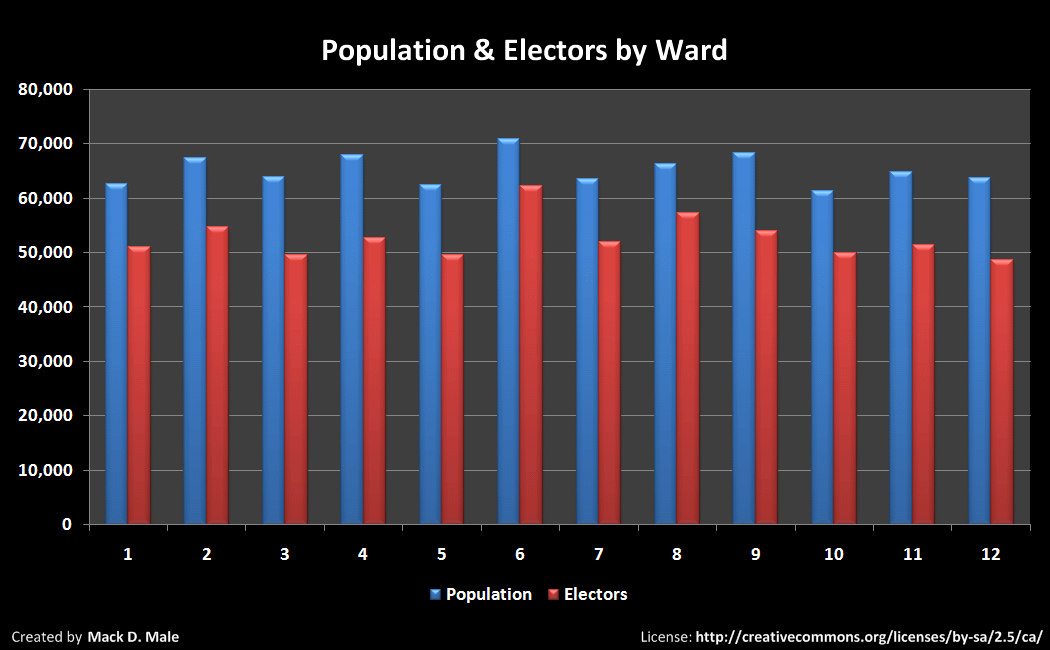
Here are the stats on the new wards:

In a table (download CSV file here):

Ward Population Electors
1 62,625 51,061
2 67,306 54,704
3 63,819 49,465
4 67,811 52,666
5 62,424 49,615
6 70,840 62,152
7 63,549 51,865
8 66,196 57,189
9 68,214 53,889
10 61,276 49,935
11 64,770 51,329
12 63,609 48,529

The average population of each ward is 65,203 and the average number of electors for each ward is 52,700. This data comes from the 2009 Municipal Census.

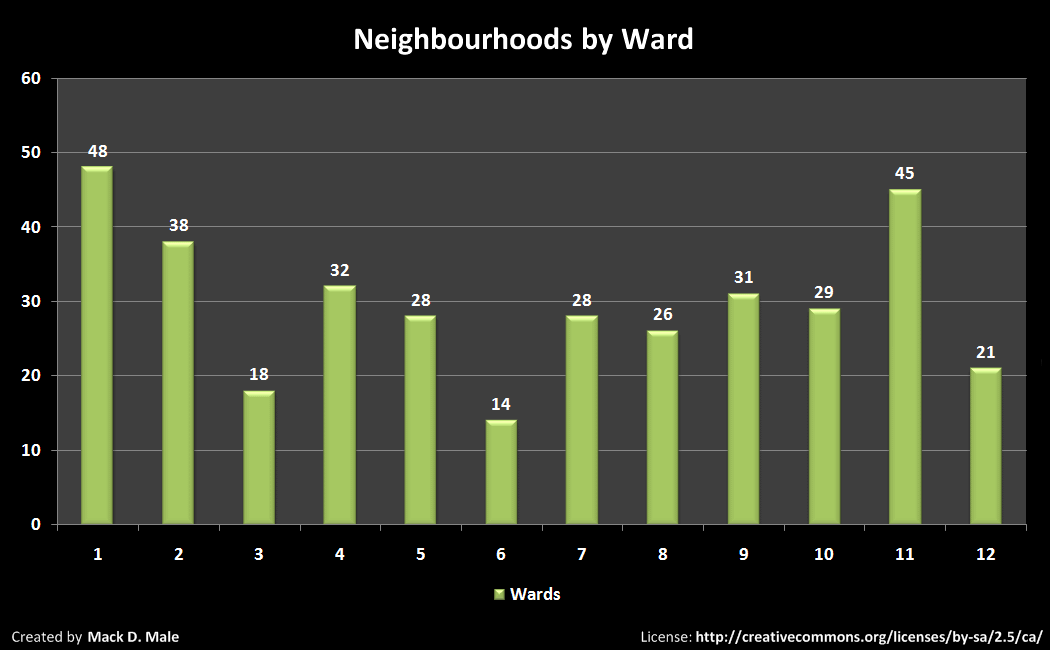
Here are the number of neighbourhoods in each ward:

I’ve also compiled a list of neighbourhoods in each ward which you can download in CSV here. Or if you’d rather just look, you can download the list in PDF here.

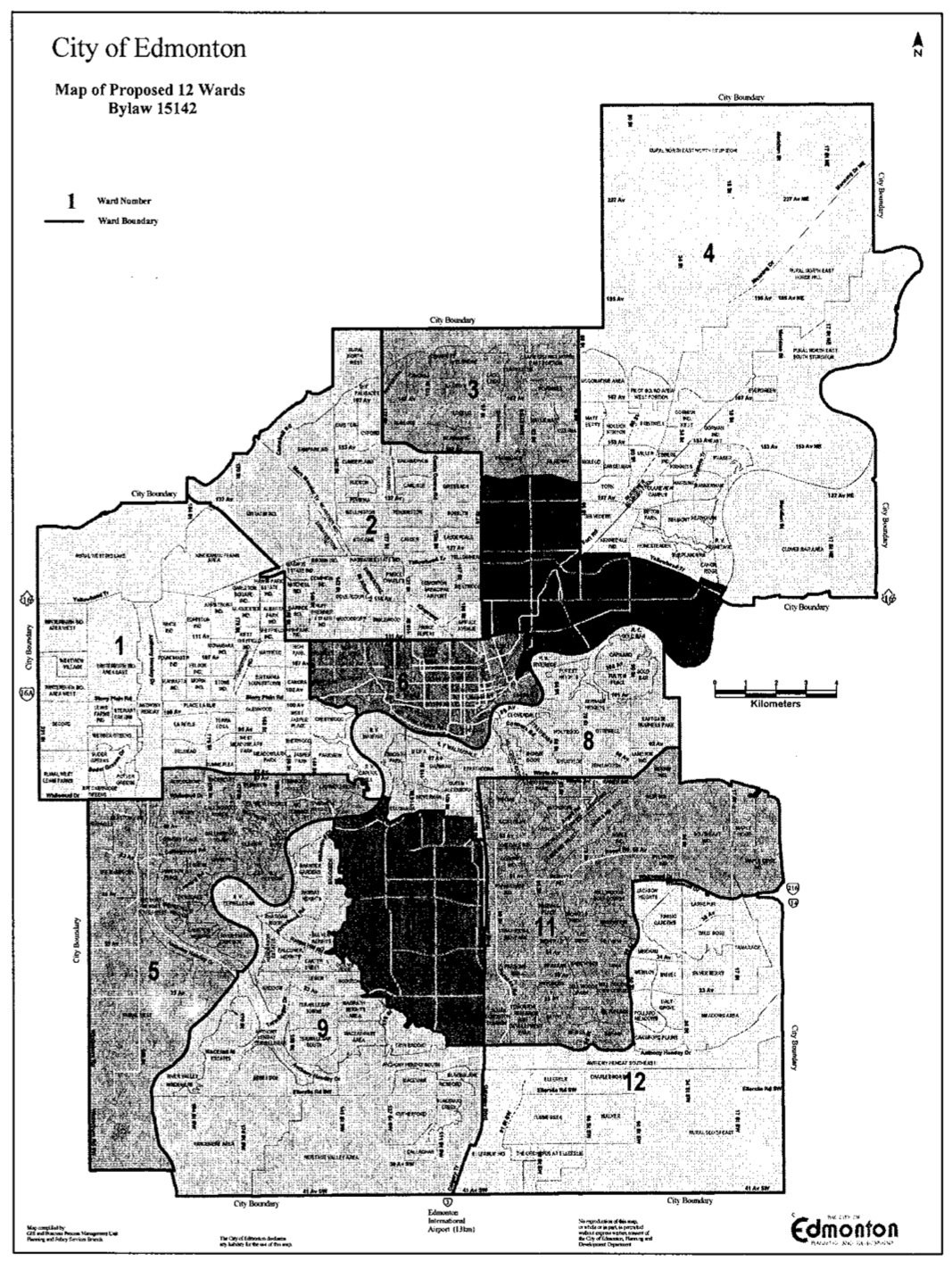
I’m trying to track down or create a good quality map of the 12 wards, but this’ll have to do for now. What I’d really love is lat/long coordinates for each ward. If you have something better than that graphic, let me know!

Go do something useful or interesting with this data, and then tell me about it. I’m looking to collect local examples to strengthen the case for open data at the City of Edmonton!

UPDATE: Here’s a better map in PDF format.

UPDATE2: Here’s an even better color map showing the wards and neighbourhoods in PDF format.

Calgary takes first steps toward becoming an Open City

A motion will go before Calgary’s City Council next week that outlines the first steps in the process of making Calgary an Open City. Calgary follows in the footsteps of Vancouver, which passed a similar motion back in May. DJ has all the details on the Calgary motion here. I think it’s pretty cool that the news is first announced on a blog!

Calgary’s motion will result in a report from City Administration to be presented to Council no later than December 2009, outlining the overall strategy for making Calgary an open city. In particular, the report will identify “opportunities to make more of The City’s data open and accessible while respecting privacy and security concerns , and ensuring that data is available through use of open standards, interfaces and formats.” Other aspects of the strategy will include increasing online citizen participation, procuring and supporting open source technologies, and increasing the number of City services available online.

This is exciting news for developers and other creative professionals in Calgary and elsewhere. I’ve been pushing for open data in Edmonton recently, and I really hope we’re not too far behind our southern neighbours on this issue. There are a number of advantages to making data available in open standards and formats:

  • Citizens can subscribe to data that is of interest to them
  • Data can be mashed together in new ways, revealing new information
  • Visualization of data can help citizens make better decisions
  • Citizens can work together to organize data
  • Government can learn more about its data from citizen contributions

Additionally, using well-understood, open formats such as XML or CSV helps to “future-proof” the data. You don’t need proprietary technology to read a CSV file – any programming language or software platform will work.

One issue that isn’t mentioned in Calgary’s motion but which is very important, is licensing. It’s important that when Calgary does make data available, that it does so in the least restrictive way possible. Either public domain, or creative commons, or something similar. It would be a shame if they made a ton of data available and then had ridiculous terms of use around it.

Open data is about empowering citizens to work with their governments. I’m encouraged by the recent interest among municipalities in Canada, and I hope the trend continues.

Social Media and the City Centre Airport Debate

Where there’s smoke, there’s fire.

On Thursday morning Jeff Samsonow and I chatted about the City Centre Airport for a few minutes on CBC Radio. During the interview I was asked if I thought social media played a role in the debate. I answered, “absolutely”.

Also on Thursday, Graham Hicks mentioned the “rise of youth” in his column, observing that “the younger demographic flexed its muscle” and that “the "social media" was solidly anti-airport”. He specifically mentioned myself, Jordan Schroder, Dave Cournoyer, and Michael Janz.

Scott McKeen got things rolling on Friday with his column in the Edmonton Journal, stating that “a new reality emerged along with a new establishment.” He too mentioned age:

Blogger Mack Male used Twitter to go live from council chambers during the final debate. In one Twitter post, he wrote: "There is a silver-haired guy in the audience shaking his head during Don Iveson’s remarks."

Global Edmonton’s Linda Nguyen interviewed me Friday for a piece that aired during the evening news (click on “silent majority” because their video system sucks). Councillors Iveson and Krushell were also interviewed for the story, and cited the use of social media by young people as a trend to keep an eye on.

On Saturday, Todd Babiak’s column in the Edmonton Journal took the story to another level. He interviewed both myself and Jordan Schroder, and said:

It must have been devastating for the city’s most powerful men and women to watch a group of virtually connected–but politically unconnected–young people creating and controlling public debate with speed, elegance and respect.

Is it just coincidence that so many stories on the same topic appeared over the last few days? Were they all just trying to avoid another negative comment from Cal Nihols and his side? Maybe, but I think there’s more to it than that.

Social Media Lessons

Social media definitely played a large role in the City Centre Airport debate, on both sides. As I mentioned in my post introducing NotMyAirport.ca, AEG made use of social media for its campaign too, though the local media seems to have glossed over this fact. David MacLean was active on Twitter, and actually was the first to use the #ecca hashtag that has become so popular. You may know that I didn’t create the Not My Airport group on Facebook, Jordan Schroder did. I just looked for the largest pro-closure group and linked to it – Jordan then renamed it and made me an admin. David told me a similar thing happened with their side’s Facebook group. David and I both took part in the web debate hosted by FusedLogic, and we both encouraged others to email their councillors.

All of which begs the question, if both sides had such similar stories, why were the pro-closure side’s social media efforts so much more effective? The fact that, at least in my opinion, we had a stronger case notwithstanding, I believe the following reasons are key:

  1. Blogging

    Blogs are still the stars of social media. The pro-closure side made use of blogs quite extensively. Myself, Dave, Michael, Adam, Adam, and Jeff all blogged about the issue numerous times, and I’m sure there were others too. A blog has many benefits, but three in particular played a role here: a place to expand on thoughts and to lay out facts, a good ranking in search engines, a place for others to leave comments and have a conversation. The pro-Muni side didn’t have any blogs, and they missed out accordingly.

  2. Consistency

    Perhaps the most important thing you can do when you have a blog is to post regularly. I did that, as did others. We were also consistent with other tools. We kept the Twitter stream updated, and we regularly sent messages to our Facebook group and posted on the wall. The debate seemed more alive because we were consistent with our communications.

  3. Using the right tool for the job

    Blogs are great for sharing a relatively large amount of information. Twitter is great for short, real-time bits of info. Here’s an example: I listened to the live stream for the public hearings, and Twittered about it in real-time. The pro-Muni side was nowhere to be found. Similarly, I live tweeted the final decision, because that’s what Twitter is good at. The pro-Muni side again was silent. Even the web debate is a good example – I suggested it because I knew it would give us time to explore the issues and a chance for others to converse online.

  4. No distractions

    You might call it grassroots or simply having no money, but the pro-closure social media efforts were not affected by other “distractions”. The billboards, lawn signs, etc. all have an impact – in this case, they made the pro-Muni side seem like it had some money, and that took away from the authenticity of their social media efforts.

Over the weekend, Adam and Dave wrote about Babiak’s story. Both suggested that there’s more to the story than just young people using social media. I agree with them. If age played any role, it’s that young people are more comfortable with social media tools and thus used them more effectively. That’s a bit of a generalization, however. There were young and old people on both sides of the debate.

Final Thoughts

There’s no doubt in my mind that the City Centre Airport debate and the role social media played in that debate will have a lasting impact on politics in Edmonton. Having said that, it’s important to realize that change doesn’t often happen overnight. Just as it will take years for the airport itself to give way to something new, political decisions will continue to be made the way they always have been, at least for the foreseeable future.

The difference now, I hope, is that social media has been legitimized in the eyes of our local political system and should see greater use in the future.

I think that’s something to be proud of.

Edmonton City Centre Airport Decision: Phased Closure

City Council voted today to implement a phased closure of the City Centre Airport. The motion put forward by Councillor Gibbons described two phases and passed by a vote of 10-3. I’m happy with the decision that was made today, and I commend Council for taking a courageous step toward ensuring the City’s Vision and Strategic Plan are realized.

Here is the vote breakdown for adopting the motion (which you can download here):

Councillor Karen Leibovici (Ward 1) Yes
Councillor Linda Sloan (Ward 1) No
Councillor Ron Hayter (Ward 2) No
Councillor Kim Krushell (Ward 2) Yes
Councillor Ed Gibbons (Ward 3) Yes
Councillor Tony Caterina (Ward 3) No
Councillor Jane Batty (Ward 4) Yes
Councillor Ben Henderson (Ward 4) Yes
Councillor Bryan Anderson (Ward 5) Yes
Councillor Don Iveson (Ward 5) Yes
Councillor Amarjeet Sohi (Ward 6) Yes
Councillor Dave Thiele (Ward 6) Yes
Mayor Stephen Mandel Yes

Council started discussing the issue at 1:30pm, and didn’t wrap up until nearly 6pm. There were at least four rounds of questioning, driven largely by Councillors Caterina and Sloan who were vehemently opposed to the motion. After the questioning finally ended, Councillor Caterina put forward a motion to refer the issue to Administration which was soundly defeated.

Three amendments were made to the original motion. Councillor Iveson’s two amendments were “friendly”. Councillor Krushell’s amendment stated that after scheduled service licenses expire at ECCA in June of 2012, that they not be renewed. All three amendments were approved, and as soon as the final motion is online I’ll link to it which you can download here (PDF).

It became clear as Councillors gave their final remarks that the motion was going to pass. I thought Councillors Henderson, Iveson, and Krushell made excellent comments about why this decision needed to be made, speaking in particular about the future. Councillor Leibovici mentioned the role of social networking in this debate (more on that in a future post). Mayor Mandel used his time to make it clear that “this is a closure motion.” Councillor Gibbons used his time to get a dig in at Councillor Caterina, saying “if you can’t win, don’t bring it forward.”

After the vote passed, a motion from Councillor Sloan was brought forward that called into question the legality of Councillor Gibbons’ motion (the City’s legal counsel gave the OK hours earlier). It also requested that quarterly updates be provided to Council on legal issues related to the City Centre Airport. The motion was split – the first part was defeated, the second part (quarterly updates) passed.

What happens next?

The following will happen immediately:

  • Runway 16-34 will be closed. General aviation business activities will be adjusted to accommodate a one-runway airport. Medivac service will be maintained.
  • As a result, a GPS landing system will likely be added to runway 12-30.
  • The parcel of lands adjacent to runway 16-34 that can be surrendered to the City once the runway is closed will be identified.
  • Negotiations will begin with NAIT and the Province of Alberta to allow for NAIT expansion.
  • The City of Edmonton will create a development office and will work to set out long-term visioning plans for the ECCA lands in their entirety. The plan will be presented to Council by November 2009.
  • Plans for realignment of the NAIT LRT line based on the closure of 16-34 will be provided to Council no later than September 2009.
  • The downtown plan will be adjusted to take into consideration the immediate removal of the overlay height restrictions.
  • The City of Edmonton will develop a communications strategy to inform the public about the impact of this decision.
  • The City Manager will negotiate with Edmonton Regional Airport Authority (ERAA) to make mutually acceptable lease amendments.

The following will happen sometime in the future:

  • ERAA will work with Alberta Health Services on a long-term system design to facilitate Medivac operations at the Edmonton International Airport or other regional airports.
  • The final closure date will be determined by City Council with input from ERAA when the lands are required to support the long-term land development plan.
  • After the final closure date is set, environmental remediation will take place.

What does this mean?

Council decided today to close the City Centre Airport. They stopped short of attaching dates however, which makes the motion much weaker than it could have been (during my live-tweeting I called it “gutless”). Both Mayor Mandel and Councillor Henderson addressed this in their final remarks, stating that Council’s intentions should not be misinterpreted – the intention is to close the airport.

I fear the lack of a timeline will open the door for this to be discussed again in the future, however. At what point are the lands “required to support the long-term land development plan”? Who decides that and brings it forward, especially if the City is to be the developer of those lands? I do believe that the direction is clear, that the airport is to be closed, but the lack of a final closure date makes me uncomfortable.

It’s important to realize that we’re a long way from seeing the airport completely closed. New communities are not developed overnight, and especially not world-class, transit-oriented ones. The City needs to take the time to come up with a solid, exciting plan that Edmontonians readily support.

Final Thoughts

I think Council made a bold statement today. By voting to close the City Centre Airport, Council made it clear that they’re willing to do what it takes to ensure Edmonton’s future is bright. I think today’s decision was an important step in the push to create a more vibrant, sustainable, innovative, and livable Edmonton.

The City Centre Airport will be closed, and that’s good for Edmonton.

UPDATE (7/9/2009): You can download the final version of the motion here (PDF).

Council’s Q & A on the City Centre Airport

I know I’ve been writing a lot about ECCA lately, but with the Council meeting taking place tomorrow afternoon, it’s crunch time. I think the most likely outcome is that Council will vote for a staged closure of the airport (shutting one runway down initially, with the rest to follow at a later date). The only other outcome that I think has a chance is that Council will somehow delay the process, likely by asking for additional information.

During the public hearings last week, Council asked a number of questions (75 to be exact). This afternoon, the answers were published online (you can download the Word doc here). It’s worth reading the entire thing (50 pages, which includes the ECCA 2007 Annual Report) but I thought I’d highlight a few here.

On height restrictions:

Examples of major past projects that were reduced in height or could have developed higher were it not for the Airport Protection Overlay (APO) height limitations include the EPCOR Tower (101 Street/105 Avenue), the AMA Building (109 Street/118 Avenue, the Royal Alexandra Hospital Expansion, two residential towers in Railtown, and Aurora Developments (105 Avenue/101 Street).

On medivac (there’s not as much in the answers as you might think):

Many stakeholders noted that the medevac system needs improvement, whether or not there are changes to ECCA. They also noted with all ambulances (ground, fixed wing and rotary wing) potentially being managed by Alberta Health Services, an opportunity exists for improvement of patient care.

On a third party managing the airport:

The Board of Directors of Edmonton Airports approved a resolution on June 20, 2009 that “For as long as the Edmonton City Centre Airport lands are used as an airport, Edmonton Airport is committed to manage the Edmonton City Centre Airport as an airport in accordance with the lease to the expiry of the lease term.” Therefore, the option of having the ECCA separately managed is not available for consideration.

On competition for development throughout the City:

Armin Preiksitis & Associates estimates that the current major development sites underway or expected in the City will contribute almost 35,000 multi-family units. If no other developments come on-line, those units will be completely absorbed in 2019, and there will be 2,453 multi family units needed each year thereafter. That is the equivalent of over 8 30-story condo towers and 650 townhouses per year. As part of the City’s multi family dwelling supply, the ECCA lands would reduce the rate of absorption at competing properties and lengthening the development timing.

On the timeline for closure:

It needs to be recognized that potential redevelopment of the ECCA lands is a mid-term to long-term proposition. If you refer to the report (Report 2009DCM032, Attachment 2, pages 10 of 299 and) it is assumed that the earliest redevelopment on the ECCA lands would begin in 2016 – seven years from now. Colliers International, based upon market conditions and competing developments, estimates a 23-28 year build out period.

On the creation of economic activity:

To say that Airports Create Jobs, leaves you with the wrong impression, that if you develop an airport, you will create economic activity. This is only true to the extent that the demand for these services already exists. If you took the statement that aviation creates jobs at face value, you would consider building another airport in Edmonton as a measure for generating economic growth. This of course is not something anyone would actively promote.

On how much the City will have to pay to maintain ECCA:

Like most general aviation airports, the City Centre Airport cannot fully pay for its capital costs. Those costs are subsidized by the users of EIA. Also, the ten year capital requirements of the airport approximate $35M and one of the more significant items is storm water improvements. It is expected that the city’s contribution towards the completion of that component is up to $10M.

One of my favorite sections rips apart the Ascend report put forward by AEG (question 31). Definitely worth a look.

I’ll be tweeting live from the City Council meeting tomorrow afternoon (July 8th) at 1pm. You can follow along with the #ecca hashtag. I hope they make the right decision.

Highlights from the Alberta High Speed Rail report

Yesterday the Alberta government released a report assessing the potential for high speed rail service in the Calgary-Edmonton corridor. The report, which has been sitting on the shelf for about a year, was commissioned by the province and was prepared by Transportation Economics & Management Systems, Inc. (or TEMS). There are actually three parts to the report, which you can download here:

The press release included a few highlights, but nothing incredibly satisfying:

  • Nearly 10 million passenger trips took place in the Calgary-Edmonton corridor in 2006, with the breakdown as follows: 91% were by automobile, 6% were by air, and 3% were by bus.
  • The faster the high speed train, the greater the ridership and revenues.
  • People said they were willing to pay fares ranging from $56 to $120 for a one-way trip. (To compare: the lowest fare in the next month on WestJet currently is $99, or by car I can make the trip on about $20 of gas.)

I decided to dig into the report a little further. I was struck initially by the numerical nature of it – if numbers and formulas scare you, avoid reading the report. There is some useful, easy-to-understand data as well though.

The diagram above illustrates the Calgary-Edmonton corridor, and the five stations that would be part of the high speed rail system: Downtown Edmonton, Suburban Edmonton, Red Deer, Suburban Calgary, and Downtown Calgary. Each of the three major centres is called a “super zone”, and includes the surrounding communities, at least for the purposes of the report.

The images above illustrate the four types of generic train technologies used to represent various technology classes.

  • Talgo – 125 mph or 200 km/hr – diesel
  • JetTrain – 150 mph or 240 km/hr – turbine electric
  • TGV – 200 mph or 320 km/hr – overhead electric
  • Maglev – 300 mph or 480 km/hr – magnetic levitation

According to Wikipedia, the fastest conventional train in the world is the French TGV which set a speed record of 574.8 km/hr. The fastest non-conventional train in the world is the Japanese JR-Maglev which set a speed record of 581 km/hr.

This table outlines the strategies/predictions for each of the above:

  125 mph 150 mph 200 mph 300 mph
Average travel time (h:min) 2:00 1:45 1:35 1:00
Frequency (roundtrips/day) 8 10 14 17
Fare (in cents/mile) 25 35 40 60
Maximum fare one-way (Calgary-Edmonton) $56 $80 $90 $120
Maximum fare one-way from Red Deer $28 $40 $45 $60
Ridership (in thousands) in 2051 2821 4301 7656 10745
Passenger revenues (in millions of 2006 $) in 2051 137.1 269.0 610.0 1127.9
Market share (2011-2051 is constant) 1.85% 3.10% 4.84% 6.73%

Some other data points:

  • Demand for travel in the corridor is predicted to triple in the time period 2006-2051.
  • Total benefits by super zone are as follows: Calgary (40-45%), Edmonton (30-35%), Red Deer (20-25%)
  • Economic impact from building the system would range from $4.6 billion to $33.4 billion, depending on the type of technology used.
  • Growth in the economy of 0.2 to 0.5 percent, depending on the type of technology used.
  • Between 3400 and 7162 long-term (40 year) jobs would be created across the province.

There’s a lot more data available in the report if you want to take the time to read it.

What’s next? The government says it will continue to look at various options for the province’s future transportation needs, including high speed rail. No decisions have been made at this time, and the report itself makes no recommendations. There doesn’t seem to be a lot of support for the idea at the moment.

I personally think if the province is going to be spending money on transit, it should be on city and regional transit. Both Edmonton and Calgary could use the assistance to improve their respective transit systems – something akin to MoveOntario 2020 and Toronto’s Transit City.

This issue certainly has legs, however. It has been brought up and discussed many times over the years. You can follow along and participate on Twitter using the hashtag #abhsr. For more general Alberta political topics, use #ableg. There’s some great commentary up on the stream already.

Why the proposed City Centre Airport compromise won’t work

Tonight was I on Alberta Primetime with David MacLean from AEG to discuss the compromise that was proposed recently by the Alberta Aviation Museum in the debate about what to do with the City Centre Airport. The compromise would see one of the two runways closed, to make room for some redevelopment. We didn’t have a lot of time to get into the issue, but we agreed on one thing: a compromise isn’t going to work. City Council needs to make a decision.

There are two runways at the City Centre Airport. There’s 16/34, which has the ILS (instrument landing system), prevents NAIT from expanding, and has the largest impact on the Outer Surface restricting building heights over downtown. The second runway is 12/30, which is slightly longer than 16/34 but lacks the important ILS. The runways are placed in an intersecting “V” configuration.

It’s true that if Council decides to shut the City Centre Airport down, it won’t happen overnight. It’s also true that it’ll take time for any development to be completed. Those two facts aren’t enough to make the proposed compromise work, however:

  • It’s not clear which runway would be shutdown. Clearly 16/34 would make more sense from a development perspective, and a financial one too as it requires about $7 million of investment (part of the $35 million in total required for ECCA over the next ten years).
  • That would largely be dependent on moving the ILS to 12/30, something which may not be possible. Actually, it may not even be desirable given how old the system is – it almost certainly needs to be replaced.
  • Shutting down 12/30 instead doesn’t make a lot of sense either, because height restrictions would still be impacted and NAIT expansion would still be blocked.

I’m told that Edmonton Airports has promised to provide Councillors with a feasibility study on the compromise in time for next week’s Council meeting. It doesn’t really matter though.

The truth is that such a compromise is just an easy way out for Council. If they don’t decide once and for all to shut it down or keep it open, we’ll just keep having this same debate every few years. Or even worse, we’ll end up with some development right next to a crippled airport. Nobody will benefit from either of those scenarios.

City Council must take a bold step to do what’s right for the future of Edmonton. Encourage your City Councillors to vote in favor of closing the City Centre Airport.

The Story Behind NotMyAirport.ca

The discussion about what to do with the City Centre Airport has largely been monopolized by the pro-Muni crowd. A majority of the speakers at last week’s public hearings were either in favor of the status quo or of expanding scheduled service at ECCA. I suppose that shouldn’t be a surprise – supporters of the City Centre Airport have the most to lose in this debate. It makes sense that they would put time and money into making their positions known.

Increasingly, civic debate is happening digitally. To their credit, the Alberta Enterprise Group recognized this and very early on in the process launched SaveOurAirport.ca (they’ve also been quite active on Twitter and Facebook, and there’s this site also). The site acts both as a hub for pro-Muni information and as a place to point to online if you support AEG’s stance on the airport (or simply wish to talk about it).

Unfortunately, there isn’t a similar website supporting the closure of the City Centre Airport. There are many articles, blog posts, forum messages, and tweets, but nothing that ties them together.

Today, that changes.

I’ve just launched NotMyAirport.ca. I have two primary goals with the site. First, I want to ensure that facts and arguments in favor of closing the City Centre Airport can easily be found and shared. Second, I hope to encourage as many Edmontonians as possible to contact City Council to urge them to vote in favor of closure.

I’m not sure how much of an impact the site will have, especially considering we’re just a week away from a potential Council decision on the matter. That said, it didn’t take very long to create (as you can tell by the simple design) and I’m continually amazed at how quickly people can mobilize via the Internet. If you have feedback/suggestions for the site, let me know.

This doesn’t level the playing field, of course, but it’s something – anyone out there want to pay for some billboards?

Please contact your City Councillors to let them know what you think about the City Centre Airport. Feel free to use or reference the information posted at NotMyAirport.ca. Finally, consider using the links, buttons, posters and other resources posted at the site to help spread the word to others.

Closing the City Centre Airport is a unique opportunity to improve our city in ways consistent with the City of Edmonton’s Strategic Plan. We must not let this opportunity go to waste.

Mayor Mandel and Councillors, the City Centre Airport is Not My Airport. Please close it.

Letter to City Council regarding the City Centre Airport

Here’s my letter to Council:

Dear Mayor Mandel and Councillors:

I listened to the public hearings on the City Centre Airport Lands last week with great interest. You heard from a large number of Edmontonians and received a great deal of information related to the airport. Unfortunately, the only thing that everyone could agree upon was that the status quo at the City Centre Airport is untenable. Which leaves two options: expand scheduled service, or close the airport.

Except that expanding scheduled service is not a viable option. There is no evidence to support the notion that Edmonton as a whole would benefit from faux-competition between the City Centre Airport and the Edmonton International Airport. In fact, expanding scheduled service would almost certainly be detrimental to both airports, and therefore to the city.

The only rational, responsible decision is to close the airport.

The arguments you have heard against this decision are flawed. Medevac patients would not be affected by closure as time critical patients could be accommodated at other facilities. Few would be inconvenienced by travel delays – the Villeneuve Airport is just ten minutes further from Downtown Edmonton than the Springbank Airport is from Downtown Calgary. Most of the economic activity facilitated by the airport would not disappear, but would instead shift. There is absolutely no factual basis for the assertion that closing the City Centre Airport would negatively affect Edmonton’s economy, let alone affect it more than the loss of one of our major sports teams.

Closing the City Centre Airport is an incredible opportunity. Removing the height restrictions of the Outer Surface will help to re-invigorate our downtown. Expansion of the existing NAIT campus will remove the need for that institution to build elsewhere, helping to curb urban sprawl. Intensification of the airport lands is wholly consistent with the City of Edmonton’s Strategic Plan and vision for the future. Importantly, this can be accomplished while celebrating the historical significance of Blatchford Field. Our city has a rare chance to build a transit-oriented community on the airport lands that is integrated, livable, innovative, and sustainable.

I urge you to vote in favour of closing the City Centre Airport.

Thank you.

Contact your City Councillors to let them know what you think about the City Centre Airport.