Coming up at City Council: April 20-24, 2015

If you haven’t watched or listened to Council on the Web recently, you’ll be happy to know they have made some improvements! They are no longer using Windows Media Player. I’m not really sure why they decided to replace it with Flash though. Oh well, they have mobile-friendly (HTML5) streams too.

Agendas for upcoming City Council meetings are generally released on Thursday afternoons. I like to take a look to see what Council will be discussing, and I figured I should share that here. Below you’ll find links to the meetings taking place next week, as well as links to and thoughts on some agenda items that caught my eye.
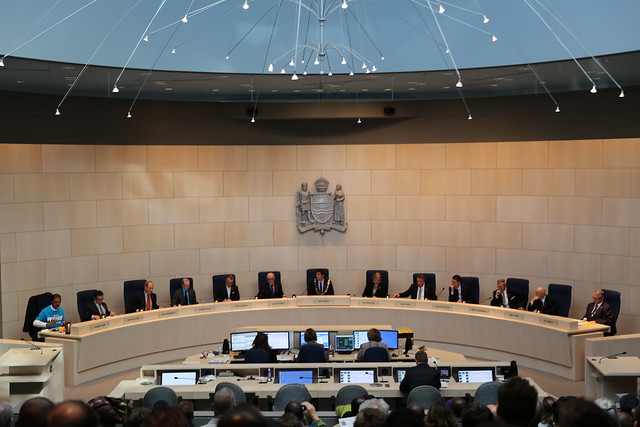
City Council Swearing In 2013-2017

Monday, April 20, 2015

The week begins on Monday with a Community Services Committee meeting scheduled from 9:30am until 5:30pm. There are eight reports on the agenda, plus one response to an inquiry from Councillor Esslinger. Here’s what caught my eye:

Comparison of Policing Costs

Comparing the cost of policing across municipalities is difficult because they all have different services, funding sources, and reporting approaches. Still, EPS has attempted to provide some comparison in this report. They surveyed Vancouver, Calgary, Saskatoon, Regina, Winnipeg, Toronto, Ottawa, and Montreal and received responses from Calgary, Regina, Winnipeg, and Toronto. Here’s what they found after trying to account for differences between the agencies:

Comparison Cost Per Capita – Tax Levy Cost Per Capita – Gross Expenditures
Edmonton vs. Regina (2015) $317 vs. $352 $405 vs. $398
Edmonton vs. Winnipeg (2014) $314 vs. $305 $387 vs. $367
Edmonton vs. Calgary (2015) $317 vs. $291 $396 vs. $365
Edmonton vs. Toronto (2015) $317 vs. $366 $413 vs. $407

Gross Expenditures refers to the annual Operating Budget before applying Revenues. Tax Levy refers to the Operating Budget after the application of Revenues.

They also compared the Cost per Authorized Employee:

eps comparison

Here’s a comparison of Staff per 100,000 Population Ratio:

eps comparison

And here’s a comparison of the percentage of budget spent on support services:

eps comparison

There is no summary or concluding remarks in the report. Just the data.

Winspear Centre Staged Funding Agreement & Parking Solution

The current Winspear Centre was built in 1997 and they’re ready for expansion. Plans call for two main components:

  1. $53 million towards a new 540 seat acoustic hall theatre, six multipurpose rooms, and commercial space
  2. $25 million towards a new 380-stall automated robotic parking system

If funded, the expansion would be complete by 2019. Here’s where they expect the funding to come from:

  • $13 million from each of the three orders of government for a total of $39 million
  • $14 million from fundraising
  • $25 million for the parking system in debt financing

So far the City has already approved $3.75 million for the project. The additional $9.25 million will still need to be approved, and could come from the Downtown CRL, the 2015-2018 Spring Capital Budget Update, or the Community Facility Partner Capital Grant Program.

The City anticipates bringing forward a capital budget profile in June.

Single-Use Recreation Fees

The City’s current recreation membership fees are organized into three tiers: facility (access to 13 smaller facilities), facility plus (access to the 13 smaller facilities plus Kinsmen and Commonwealth), and all facility. If you want to get access to the newest facilities, like Terwillegar, Clareview, or The Meadows, you either pay per use or you need to pay for the highest tier. Now the City is looking at the possibility of introducing a membership fee for use at a single facility.

A single-use pass would reduce revenue for the City but could make it more affordable for some citizens to access recreation facilities, which would be positive for health and wellness outcomes. I’m not sure if Council will take any action on this (there’s no recommendation) but my guess is that the fee structure will remain the same.

Other

Councillor Esslinger’s inquiry was made in January and is about the review of off-leash dog parks. Administration is doing that review now and expects public consultation to begin in May.

Here are some of the other reports on the agenda:

One report, on options for prohibiting smoking at all outdoor City-owned recreation facilities, parks, and attractions, has been given a revised date of June 29.

Tuesday, April 21, 2015

On Tuesday, the next Executive Committee meeting is scheduled to take place from 9:30am until 5:30pm. There are ten public reports on the agenda, plus three private reports. Here’s what caught my eye:

IT Composite Profiles

This report provides an overview of the 2015-2018 IT composite profiles and funded IT investment initiatives. Here are some of the highlights:

  • For 2015-2018, $73.2 million has been allocated to IT in five profiles, three for renewal and two for growth. This represents approximately 1.6% of the total approved capital budget.
  • Additionally, IT funding of $31.6 million was approved for the Edmonton Police Service and $5.6 million was approved for the Edmonton Public Library.
  • The IT Infrastructure Renewal profile “maintains over 15,000 devices, two petabytes of storage and 100 kilometers of network cable.”
  • The total replacement value of IT infrastructure assets is $55 million.
  • There are five key Enterprise Applications utilized across the City: POSSE, PeopleSoft, SAP, TACS, and Geospatial (SLIM and Microstation).
  • The total replacement value of Enterprise Applications is $189 million.
  • The City has a current inventory of 145 business unit applications with a replacement value of $132 million.

Progress updates will now be included in quarterly capital financial reports, the next of which will be presented to Council in June/July.

2016-2018 Financial Services and Utilities Department & Branch Business Plan

You may recall that all City branches and departments are going to be submitting updated business plans as part of the implementation plan for The Way Ahead. This one is for the Financial Services and Utilities branch which consists of five departments: Assessment and Taxation, Corporate Strategic Planning, Financial Services, Drainage Services, and Waste Management Services (business plans for the latter two will be presented at a future Utility Committee meeting).

The business plan serves three objectives, according to the report:

  1. it is a decision-making tool to aid City Council during the 2016-2018 operating budget deliberations for the City of Edmonton
  2. it is a tactical business planning tool for Administration to remain focused through future resource planning and allocation
  3. the business plans set out the work each branch will carry out over the next three years showing the relationships to strategic priorities and expectations including performance measures

Based on feedback from Council, the City will further refine and finalize the business plans. The final plans will help in the development of the 2016-2018 Operating Budget.

Pattison Outdoor Advertising Outline Agreement

Last year, following an open RFP process, the City entered into a 10 year agreement (January 1, 2015 to December 31, 2024) with Pattison Outdoor Advertising for advertising space on the transit system. The agreement provides Pattison with the exclusive right to sell ad space on buses, LRTs, and transit centres.

The City needs to buy space for its own ads, and that has averaged $580,000 per year over the last three years. Administration intends to spend about $500,000 per year going forward, and the outline agreement is intended to provide “an efficient approach” that allows the City to negotiate for the best possible advertising rates.

Other

Here are a few notes on some of the other reports:

The two private reports are a verbal update on the purchase and sale of land in the Quarters, the settlement of expropriation claims in Blatchford, and an update on the Vehicle for Hire program.

The following reports have been given revised due dates:

Wednesday, April 22, 2015

The next Transportation Committee meeting takes place on Wednesday from 9:30am until 5:30pm. There are nine reports on the agenda, plus two responses to Councillor inquiries. This one is going to be interesting!

102 Avenue Bridge Replacement Project Update

Missed opportunity here, they should have called this report “Update on GirderGate!” There’s a lot of other information here, but that’s really want Council will want an update on.

Here’s where the project is at:

“The current status of the 102 Avenue project is that the girders now in place are currently being assessed. Until this review is complete the impacts to the project completion timeline are not fully known. The 3 week delay for stabilization of the girders to the project will impact the planned opening date however the exact delay is currently not known until completion of the girder assessments.”

The City has looked at some options to try to minimize the impact of project delays on commuting traffic and businesses:

  • They considered a temporary lane reversal system along Stony Plain Road (3 lanes in direction of peak flow, 1 in the opposite direction) but as it would cost between $500,000 and $1 million, it is not being recommended.
  • They are considering dedicated tow truck operations for the area, which could cost $500 to $1000 per day.
  • Vacant lots west of 124 Street and north of Stony Plain Road could be leased by the City to offset parking meter bans. They applied for this, but a local business owner successfully filed an appeal, so this is on hold until at least August 2015.

We’ll have to wait for future updates to understand just how far back the opening date has to be pushed.

Low Income Transit Pass Pilot

This report provides an update on the potential for a low income transit pass. The Edmonton Transit Advisory Board recommended a $35.00 per month pass, which would replace the existing AISH pass. Here are the details of the City’s report:

  • Applicants would need to be residents of Edmonton and would need to meet one of the following criteria: household income below the LICO figures, recent immigrants to Canada who have lived here for less than a year, children under government care, recipients of AISH.
  • ETS estimates that a low income transit pass would result in sales of 19,000 and 20,000 per month, which includes the 4,800 AISH passes currently sold per month.
  • ETS also estimates that total ridership would increase by 1 to 1.3 million trips per year. In total, low income pass purchasers are expected to make 9.5 million trips per year.
  • Although revenue generated from new ridership is anticipated to be between $1.1 million and $1.4 million, it is offset by anticipated losses in revenue from existing riders paying less than they do now of between $3 million and $7.5 million, depending on the price of the low income pass.
  • Full implementation of a pilot project would cost $1 million annually.
  • At a 35% discount, the estimated tax levy impact would be $3.7 million. At a 50% discount, it would be $6.4 million. And at a 60% discount, it would be $8.5 million.

The report also touches on the work of EndPovertyEdmonton, and notes that it recognizes that “accessible, affordable transit plays a key role in ensuring all Edmontonians have equal access and opportunity to jobs, services and travel in our city.”

West Edmonton Mall Transit Centre Options

This report outlines options for temporary enhancement, refurbishment, or replacement of the West Edmonton Mall Transit Centre taking into consideration the Valley Line LRT expansion. Built in the early 1980s, the current transit centre building is “nearing the end of its useful life” and is “no longer able to adequately support the operational needs” of the transit centre.

Here’s an overview of the four options:

  1. Temporary Enhancement – This option would include repairs and some replacements for things like doors, but would not change the look of the building. It would cost between $300,000 and $500,000 for the next four years, after which the building would need to be refurbished or replaced.
  2. Refurbishment – This option would basically retain the bones but would give the building a modern look, complete with upgrades to major systems. This should extend the life of the building by 10-15 years but at a cost of $3 million.
  3. Full Renewal – This option would demolish the existing building and replace it with a new one. The risk is that the Valley Line LRT is only in the preliminary design stages so things could change. The cost would be $4.4 million.
  4. Modular Shelter – This option would demolish the existing building and replace it with a shelter similar to what is currently at the Jasper Place Transit Centre. The estimated life of the shelter would be 20-25 years and it could cost around $3 million.

The recommendation is to go with the Refurbishment option which the report says will provide better value than the full rebuild.

Other

The two responses to Councillor inquiries are as follows:

  • Councillor Nickel made an inquiry in October 2014 about the 97 Street on-street bike route between 34 Avenue and 63 Avenue. The report states that since 2009, “73 kilometers of on-street bike routes have been constructed in Edmonton” which brings the total on-street network to 79 km. The report provides history and context, and also costs involved with relocating the 97 Street bike route.
  • Councillor Gibbons made an inquiry in August 2013 about the potential of having bike lanes along utility corridors (power lines and pipelines). The report says that shared-use paths “are an important part of an integrated bicycle network along with on-street routes.”

Some of the other reports include:

And a bunch of reports have been given revised due dates:

Wrap-up

You can keep track of City Council on Twitter using the #yegcc hashtag, and you can listen to or watch any Council meeting live online.

Northlands Arena Strategy Committee Final Report Released

Today the Northlands Arena Strategy Committee released its final report which includes recommendations on the future of Rexall Place for the consideration of the Northlands Board of Directors. This brings our six month process to an end and I think provides the Board with some actionable, useful insight and analysis regarding what to do with Rexall Place. This is not the end of the road, but I think it is a major step toward resolving this important challenge for our city.

Rexall Place

You can download the full report in PDF here (warning: it’s large). You can also download the more reasonably sized report highlights in PDF here.

We are making two recommendations. Our primary recommendation is as follows:

“The NASC has highlighted that the current scenario surrounding a conflict oriented and competitive model specific to major sports and entertainment venues within the City of Edmonton has stalled progress; there is a need for a new approach. It is recommended that the Northlands Board of Directors consider a collaborative solution for the Northlands arena (Rexall Place) and define this possibility as two party or three party potential outcomes.”

Basically, if there’s a way to find a collaborative model that works, do so. The two party outcome would be a way for Northlands and the Oilers to work together to use Rexall Place in a way that is complementary to Rogers Place. The three party outcome would be an agreement between Northlands, the City of Edmonton, and the Oilers to find an alternative use for the building.

Fortunately, I think significant progress has been made on building the relationships necessary for a collaborative model to work. Here’s what Committee Chair Andrew Ross wrote in his summary (which you’ll find in the report):

“The NASC worked collaboratively and while we did not always agree we respectfully debated to find the right solutions; this final report has achieved consensus of the group. An unintended outcome developed throughout this process is the significant progress made to repair previously strained relationships between members of the Northlands Board of Directors and key stakeholders at the City of Edmonton and the Oilers Entertainment Group (OEG). Special thanks goes to Tim Reid, President and Chief Executive Officer of Northlands; Bob Nicholson, Vice Chairman of the OEG; Simon Farbrother, City Manager; and Mayor Don Iveson who have been willing to take a forward looking approach in the best interest of our city and the sustainability of the Northlands organization.”

If that collaborative approach does not work out, then we feel that the worst thing we could do is nothing. And so our secondary recommendation is vigorous redevelopment:

“If a redevelopment strategy is implemented the Northlands arena (Rexall Place) should be demolished and the land repurposed in a way that would complement the surrounding neighbourhood, act as a catalyst to stimulate development growth, and support the sustainability of Northlands.”

Though we did look at other models, it became clear to us that most of them are not desirable. Nobody wins in a competitive model, going dark would be highly detrimental to the community, and as mentioned, kicking the can down the road is possibly the worst decision that could be made.

The next step now is for the Northlands Board to decide which direction they want to go. I expect they’ll need some time to digest the report and its findings, and with the AGM and election coming up at the end of the month, it’ll likely be the new board that deals with the decision. Northlands has already been undergoing some strategic review and planning and I expect that work to continue into the fall.

I have really enjoyed my time on the Committee. The timelime we were working with was aggressive, but I think that brought an appropriate level of urgency to the process. I certainly learned a lot over the last six months, and I hope that I have made a meaningful contribution. I have quite a bit to say about Rexall Place and this whole challenge which I will share in the weeks ahead. For now, check out the report and let me know what you think!

Branding Edmonton: Signs & Slogans

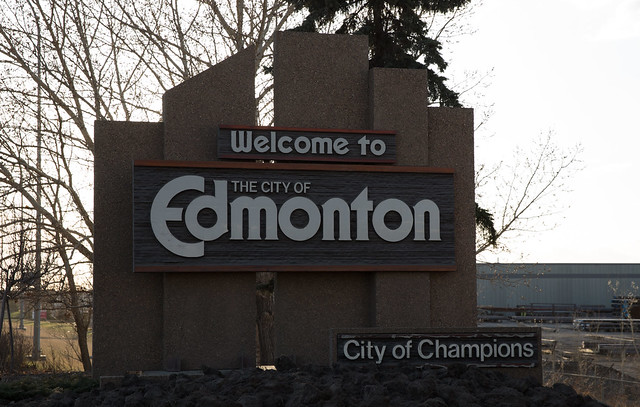
For more than 20 years, Edmontonians have been discussing whether or not our entrance signs should feature a slogan and if so, which one. Whenever City Council or other local leaders have felt the need to shore up our city’s image, the entrance signs have been the go-to starting point. And whenever someone has suggested the entrance signs are dated and need to be replaced, the conversation has inevitably morphed into one about the slogan and brand for our city.

Questions were raised about “City of Champions” as soon as the signs went up in 1989. That prompted Economic Development Edmonton to do some research and a few years later they found there were at least 27 slogans being used to describe the city, like “Gateway to the North”, “Canada’s Oil Capital”, and “Official Host City for the Turn of the Century”. But only one was highly visible, and that was “City of Champions” thanks to the entrance signs.

IMG_6621.jpg

You only see the entrance signs if you drive into Edmonton, but that hasn’t diminished their importance in the eyes of community leaders and commentators. The entrance signs and debate about them have often been considered the manifestation of our identity as a city. Gene Dub’s controversial entrance pyramid design that won a national design competition in 2008 was a good example of this. It would have done away with slogans and logos in favor of striking public art. The jury called it “a symbol of a city that is poised, confident and energetic.” But not everyone saw it that way. Former Edmonton Journal columnist Lorne Gunter compared the idea to Bedford, Nova Scotia’s giant “Clearwater” lobster statue and said Dub’s proposal would have been “an artificial symbol erected by civic leaders to try to force a recognition of their community that isn’t happening on their city’s or town’s own merits.”

It’s no surprise then that the entrance signs as they exist today are a perfect representation of this conflation of issues. The signs have been cobbled together, piece by piece, just like our city’s brand. In the absence of a strong place brand for Edmonton, we used the City of Edmonton’s corporate logo and the “City of Champions” moniker as stand-ins. When we felt that perhaps we weren’t a welcoming enough place, the words “Welcome to” were added. When we didn’t feel important enough in the province, we added “Alberta’s Capital”. Whenever our sports teams have endured slumps, we’ve suggested removing “City of Champions” from the signs (but someone has always pointed to another local success as a reason to keep them).

And now, because we’re feeling emboldened by population and economic growth, not to mention lots of capital spending, we’re again looking to the signs. They don’t feel representative of Edmonton today nor of the Edmonton we hope to become. They’re old and they look it.

Will the discussion be different this time? I think it could be. Yes, the sign and city identity issues have become so intertwined that maybe it’s not even possible to separate them now. But we should try.

Michael Oshry - Ward 5
Photo by Dave Cournoyer

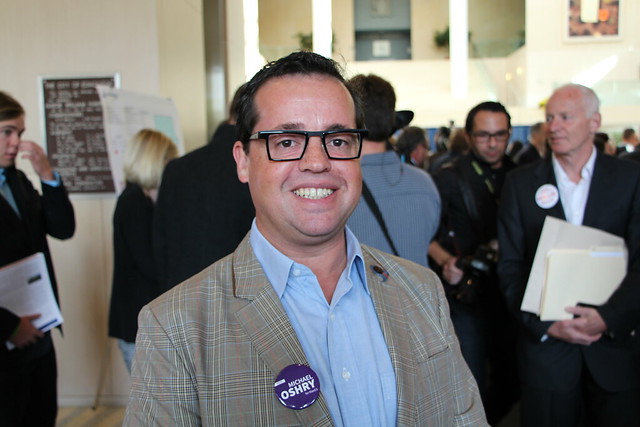
On Tuesday, Councillor Michael Oshry is expected to make a motion requesting that the City remove “City of Champions” from Edmonton’s seven remaining entrance signs. The City says the signs are structurally sound, but that’s not why Councillor Oshry is making this proposal. Removing the slogan could finally allow us to discuss the brand issue separately from the signs, and I think that’s really his endgame.

I asked Councillor Oshry why he brought the sign debate up again at Council, and he admitted it seemed like a good starting point for a broader discussion about Edmonton’s brand. “They look dated, they’re old,” he said of the entrance signs. He isn’t fond of the “City of Champions” slogan either. “When we’re trying to attract people, the slogan means nothing,” he said. “And the slogan isn’t actually used anywhere else!”

At least, it’s not used anywhere else in Edmonton. We don’t use it for any of our internal or external marketing. But other cities use it or have used it, like Boston, San Francisco, East St. Louis, Pittsburgh, Inglewood, Tuscaloosa, Syracuse, Tampa, and Brockton, to name just a few. There’s nothing unique or particularly Edmonton about the “City of Champions” slogan.

Welcome to the City of East St. Louis, IL - City of Champions
Photo by Paul Sableman

Removing “City of Champions” is low-hanging fruit that could enable us to get started with a fresh slate, Councillor Oshry said. He doesn’t know where this will lead, but if we do end up discussing new signs, he favors simple ones. “They shouldn’t even have the corporation logo on them, it should just be ‘Welcome to Edmonton’ the place.” He also doesn’t want to spend tons of money on new signs. “They don’t have to be the greatest things the City does, but they need to be better than average,” he told me.

Ronna Bremer, Director of Image, Brand, and Marketing (or just “reputation” for short) in Corporate Communications at the City of Edmonton, agrees that the signs should be replaced with something simple but attractive. “What do those dated signs say about our city?” she asked rhetorically. “They should just say ‘Welcome to Edmonton’.”

EEDC and its predecessors have frequently been included in the discussion about entrance signs and slogans (no doubt thanks to the conflation of issues). “The decision about the welcome signs belongs firmly in the hands of the City and City Council,” EEDC CEO Brad Ferguson told me. He added that for what its worth, he thinks “the signs are dated and we need new ones” but stressed “that’s different from needing a new logo and slogan.”

It has been suggested that new signs would only come after the City makes a final decision on a new brand and logo. That would be the wrong approach to take. There are three different things wrapped up in that suggestion – the signs themselves, Edmonton’s brand and identity, and the City of Edmonton’s brand. The signs do not need to include the City of Edmonton’s corporate brand; they exist to welcome visitors to Edmonton, not to the new City of Edmonton office tower or to a recreation facility. It was probably a mistake to put the corporate logo on them in the first place.

The signs should be representative of Edmonton the place. They should reflect Edmonton’s place brand. This is the work that Make Something Edmonton has been doing. They haven’t been trying to figure out what the City’s new logo should be. They’ve been working to identify the essence of Edmonton. From their brand book:

“A place cannot be reduced to a logo and a slogan. It’s more than marketing. The Edmonton brand is about being true to who we are at our best.”

They have come up with “statements of encouragement” which are kind of like slogans, but there are many of them, and you’re supposed to take inspiration from them to create your own. “Be playful about it,” the brand book says. The statements of encouragement are conversation-starters and are “simple, memorable ways to express Edmonton-ness.” But they’re not a collection of possible slogans. It would be wrong to pick one and put it on the entrance signs.

Statements of Encouragement

The brand promise is the heart of the place brand:

“If you have the courage to take an idea to reality, to build, to make something, Edmonton is your city.”

That’s what any new entrance signs need to reflect.

So how do we do that? “We could tell people a story as they enter the city,” Todd Babiak told me. He has been working on Make Something Edmonton since the beginning, and he has thought a lot about this. What if instead of a single static slogan, we changed the message on our entrance signs every now and then? What if instead of one entrance sign, we had many, each featuring a different statement of encouragement or example of local makers? We talked about the “City of Champignons” sign that some pranksters plastered over the existing “City of Champions” sign a couple years ago. “You could argue that’s the most Edmonton thing anyone has ever done!” Todd said.

He’s not sure what the answer is, but he knows how we should go about finding it. “There’s a way to build things in Edmonton,” he said. “If you want it to work, invite the community in.”

It sounds difficult, but I think it can work. Right now we don’t see Edmonton’s place brand reflected in very many places. But over the next year or two, if Make Something Edmonton and EEDC are successful at getting others on board, that will change. And then our entrance signs simply need to be consistent with the branding we use elsewhere, like at the airport or at our post secondary institutions. Let’s see what people come up with before trying to design new signs. And please, let’s remember they’re just signs!

In the meantime, we should remove “City of Champions” from Edmonton’s entrance signs to bring clarity to this discussion. The signs don’t need logos or slogans and neither does Edmonton.

You can learn more about the history of Edmonton’s entrance signs here.

Welcome to Edmonton: How our entrance signs came to be

Until the late 1980s, Edmonton’s city limits were marked with simple blue and white signs that said “Welcome to the City of Edmonton”, not unlike the signs you’ll find near entrances to dozens of other towns around Alberta. The marker “City of Champions” was added following a streak of wins by the Eskimos and Oilers, though many also attribute that slogan to the way the city came together during the tornado of 1987. Not long after, City Council decided the existing signs were tacky and commissioned a study on the wording and design of new signs. That study decided that the word “welcome” was no longer necessary, but the “City of Champions” moniker was to remain.

IMG_6621.jpg
The sign welcoming visitors entering Edmonton via the Sherwood Park Freeway

And so, Edmonton’s concrete entrance signs, made of sandblasted concrete shaped into a stylized silhouette of the city skyline, were erected from 1989 to 1991. A total of nine signs were put up, the last of which was located so close to St. Albert that aldermen there complained and threatened to redraw the southern boundary so that the sign would be on their land.

Others also disliked the signs. In April of 1989, Calgary mayor Don Hartman said Edmonton should tear the signs down. “Calgary has replaced Edmonton as the City of Champions,” he said. A cartoon in the paper next day also made fun of the signs by depicting new signs on the north edge of Calgary that read “City of Champs, 1 KM” on the southbound side and “City of Losers, 290 KM” on the northbound side.

But Edmontonians liked the signs. In late 1991, the Journal ran a reader poll about whether or not to keep the new signs. “Overall, 70 per cent of survey respondents say the signs are fine,” the paper reported. They found that residents in Sherwood Park, elsewhere in Alberta, and even outside Alberta all liked the signs.

Some locals grew to dislike aspects of the signs, however. Alderman Ron Hayter complained that the signs did not extend a welcome to visitors and were thus unfriendly. It took a while, but in the fall of 1996 the words “welcome to” were added. The total cost for adding that box to all nine signs? Just $8,837.93 ($982.00 each).

entrance sign
Photo courtesy of CBC

In late 1999, City Council began considering updated Highway 2 Corridor Design Guidelines. They also proposed spending $65,000 to “place signage of a complimentary, but smaller nature, to that of the major entrances” at thirteen other entrances to Edmonton. While discussing the report in June 2000, City Council passed the following motion:

“That the designation “Alberta’s Capital City” or other similar phrase be added to signage on Edmonton’s nine major entrance highways and included on any future entrance signage. Further that a report, including both the feasibility of this proposal and the cost involved, come back to the August 23, 2000 Executive Committee meeting.”

In the fall the report came back and said that adding the words “Alberta’s Capital” to the nine existing major entrance signs would cost an estimated $28,500. Council decided that was a bit too expensive, but a subsequent plan to spread the cost over three years was approved in December 2000. As you can see in the first photo above, the signs have fallen into disrepair and this addition isn’t even present on every sign anymore!

In December 2005, Council approved $625,000 for new entrance signs on the Stony Plain Road and Yellowhead East entrance corridors (they had already approved another $275,000 in December 2004). Manasc Isaac Architects provided an initial concept for the Stony Plain Road entrance sign:

entrance sign

The design concept for the Yellowhead East entrance came from Gibbs and Brown Landscape Consultants:

entrance sign

In March 2006, Council decided that a design competition would be held for the two new signs and that the newly formed Edmonton Design Committee would manage it. The competition drew eighteen submissions from across the country, and in May 2007 two finalists were selected: a pyramid-based design from local architect Gene Dub and a ribbon of steel design by Montreal architect Sylvie Perrault. Both received a $50,000 honoraria to take their designs to the next stage which included preliminary plans, a model, engineering assessments, and cost estimates.

entrance sign

Throughout 2007 there was a lot of debate about the new entrance signs (frequently called “entrance markers” at the time for some reason). “At some point, the old signs do need to be replaced,” said Councillor Karen Leibovici as the discussion grew more heated. Her Council colleagues seemed on board with the idea of replacing the entrance signs, but they may have been the only ones.

The most common complaint from the public was related to the cost. The City estimated the cost of the original signs to be around $400,000 each and replacing just two with new ones would cost between $600,000 and $1.4 million. But cost wasn’t the only concern. Soon after the two final designs were unveiled, citizens registered their dislike for both. Of 268 phone calls made to the City, only 2 were favorable.

Some people defended the design competition and the spending though. Then Journal columnist Todd Babiak wrote in May 2007, “the public reaction to the city’s design competition is emerging as my new least-favourite thing about Edmonton.” He argued that “to frame this project in terms of spending priorities in incoherent.” While he agreed that Edmonton was being “starved to death” by the other levels of government, he argued in favor of spending on the signs as public art:

“In 10 years, we won’t remember the potholes of 2007. But giant pyramids on each end of the city could be there, still inspiring debate.”

“If we continue to configure our priorities, as a community, around a reflexive, mean- spirited and frankly stupid hostility to cultural spending, the filled potholes will allow a lot of very smooth one-way trips out of this cold, efficient province.”

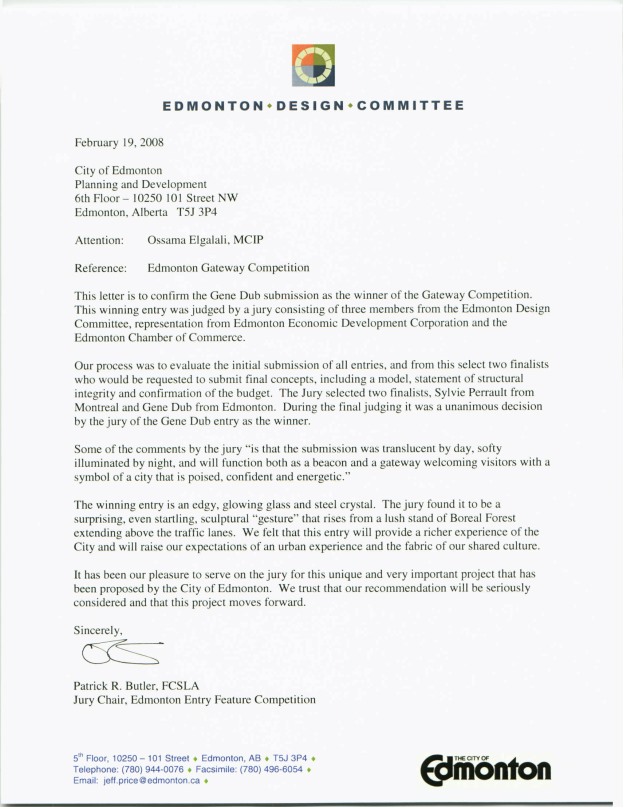
In February 2008, the jury selected Gene Dub’s proposal. A letter from the Edmonton Design Committee said the decision was unanimous and that “the winning entry is an edgy, glowing glass and steel crystal.” They called the design “surprising, even startling” and said it would “function both as a beacon and a gateway welcoming visitors with a symbol of a city that is poised, confident and energetic.”

entrance sign

But wasn’t meant to be. By the time City Council was getting ready to make a final decision, the estimated cost had ballooned from $900,000 to more than $2.5 million. Council voted 6-5 against the proposal in July 2008, bringing the debate to a close (at least temporarily). Writing about the decision in the Journal, then-columnist Scott McKeen called Council “hypocritical” and said a majority of them “caved badly under the weight of public pressure.”

There has always been some minor discussion about the signs, but in the last two years, the debate has once again become interesting. In October 2013, vandals made their mark on the signs, replacing the “City of Champions” section with their own humorous slogans like “City of Speed Traps”, “Suck it Calgary”, and “City of Champignons”.

city of champignons

Last fall, Councillor Michael Oshry officially reopened debate about the signs, saying “we need branding that demonstrates what we are about now and where we’re going and not about where we were 30 years ago.” He has since suggested an acceptable initial step would be to simply remove “City of Champions” from the signs. He is expected to make a motion to that effect at Tuesday’s City Council meeting.

According to the latest City report, just seven of the major entrance signs remain (the two welcoming visitors from St. Albert and along Highway 28 no longer exist). An option to fund new signs with corporate advertising was quickly dismissed by Mayor Iveson. “Not on my watch,” he said. A new design competition could be an option though, as could a public search for a new slogan. That’s not necessary though, according to Mayor Iveson. “We’re in the post-tagline era,” he said.

For better or for worse, debate about Edmonton’s entrance signs has always been conflated with debate about our brand and image. I’ll examine that in more detail in an upcoming post.

Coming up at City Council: April 13-17, 2015

With the Easter break behind us, Council is back in session next week.

Agendas for upcoming City Council meetings are generally released on Thursday afternoons. I like to take a look to see what Council will be discussing, and I figured I should share that here. Below you’ll find links to the meetings taking place next week, as well as links to and thoughts on some agenda items that caught my eye. You can find my previous roundups here.

City Council Swearing In 2013-2017

Monday, April 13, 2015

Council will start the week with item 7.2 from the March 16 meeting, actually. Bylaw 17116 deals with elimination location-based restrictions for Garage and Garden Suites, and enables RF1 sites to be subdivided into narrower lots, as narrow as 7.6 metres wide.

After they have dealt with that item in the morning, they’ll begin the regularly scheduled public hearing at 1:30pm. Most of the bylaws deal with minor rezoning to allow for infill development. Here are a few of the items that I wanted to highlight:

Bylaw 17151 – Text Amendment to the Zoning Bylaw

This proposed amendment is intended to streamline the process for the development of paths and trails within the river valley by removing the requirement for a development permit for paths and trails that Council has deemed essential. The whole idea here is that the City and River Valley Alliance want to move forward with their plans for a connected river valley park, and they don’t want the process to be held up in permitting. There would still be “adequate environmental review” however.

Bylaw 17142 – Development of a public park in Kernohan

Can you ever have too many public parks? Not really! This bylaw would rezone the properties at 303, 311, and 551 Clareview Road NW from CS1 and CS2 to AP to allow for the development of a new public park. These properties were originally zoned for Public Parks (AP) but were set aside to support First Place development.

Bylaw 17148 – Closure of a portion of 153 Avenue NW

This bylaw will be considered along with Bylaw 17150 and proposes to close 153 Avenue NW east of 13 Street NW in Fraser. The closed area would be consolidated with the adjacent property to make way for single detached housing. There is a 153 Avenue realignment coming in October 2016, which is when the closure would take place.

Tuesday, April 14, 2015

Next up for Council is a regular City Council Meeting scheduled to take place on Tuesday and Wednesday morning. There are 20 public reports, 8 bylaws, 2 motions pending, and 9 private reports on the agenda. It’s going to be a busy one! Here are a few highlights:

Make Something Edmonton Update

With this report, Council will receive an update on Make Something Edmonton. The key update is that the committee is now formalizing its approach to creating a community-led place brand. What does that mean?

“The activities and personalities of ‘makers’ inspired a set of statements of encouragement, or brand promises, that Make Something Edmonton believes truly represent the community identity of Edmonton.”

Basically all of the feel-good aspects of MSE are being written down and visualized in the hope that others will adopt some or all of it. Every Councillor has received a copy of the brand guidebook which “outlines how individuals and organizations can express the Edmonton brand in their own marketing and communications efforts.” For instance, with statements of encouragement:

Statements of Encouragement

I’ll have more on this in a separate post before next week’s meeting.

Edmonton Police Commission Recommendations on Unfunded Police Positions

This report is about an Edmonton Police Commission recommendation that the EPS Operating Budget be increased by $6.36 million, on an ongoing basis, to fund 40 FTEs for downtown revitalization. The source of funds is still to be determined.

You’ll recall that EPS had asked for 84 new positions during last year’s budget discussions, but Council agreed to fund only 35 of them. Now the Police Commission is back again with a focus on positions related to growth in the downtown area:

“The Edmonton Police Commission requests that City Council reconsider the proposal for these 40 positions during the setting of the mill rate.”

The report states that if the request is not reconsidered, the request will be brought back during the 2016-2018 budget process.

Impacts of the Bill 20 on the City of Edmonton

This report outlines the changes that are part of Bill 20, the Municipal Government Amendment Act, and the anticipated impacts on the City. Bill 20 received Royal Assent on March 30, at which time “the sections pertaining to City Charters and off-site levies came into force immediately.” Bill 20 is the first legislative piece of the ongoing MGA review, with additional amendments anticipated in the fall and the process continuing until the end of 2016.

The high level summary of impacts is as follows:

  • “Bill 20 provides the Lieutenant Governor in Council the authority to, upon request of a City, establish a charter for that City by regulation.” The report states that a charter regulation for Edmonton is “not anticipated before Fall 2015 at the earliest.”
  • “Bill 20 creates a mandatory requirement for Council to, by bylaw, prescribe a code of conduct for members of Council.”
  • “Bill 20 clarifies that an off-site levy may be imposed once for each purpose specified in the Municipal Government Act, and confirms that developers may be required to pay for public utilities that are not located on the land under development but are necessary to service the development.”
  • “Bill 20 creates a new requirement for Administration to ensure that, when information is provided to one councillor in response to an inquiry about the operation or administration of the City, the information must be provided to all members of council.”
  • “The current Municipal Government Act provides the City Manager with 30 days following the receipt of a petition to report on the sufficiency of the petition to Council. Bill 20 will increase this time period to 45 days.”
  • “The current Municipal Government Act prescribes specific requirements that must be followed when a bylaw or other City action must be advertised, such as placing advertisements in local newspapers. Bill 20 modernizes these advertising requirements by allowing the City to advertise on its website and allows the City to pass a bylaw prescribing alternate forms of advertising that are likely to ensure the advertised matter is brought to the attention of affected stakeholders.”

The overall reaction is that Bill 20 “supports City objectives” and that “no significant negative impacts are anticipated.”

Committee Reports

There are 14 Committee reports that were all recently discussed at one of the four committees and have been referred to Council with a recommendation for approval. A few that I wanted to highlight include:

  • Lewis Farms Recreation Centre Land Acquisition – That Administration proceed with Option 2 for District Park Land Acquisition (which means negotiating with the developers to defer costs and repay over time) and Option 1 for District Park Base Level Development (which means negotiating a development partnership for the park with a developer).
  • Aboriginal Day LIVE! Request for Support – That they be granted $100,000 to fund the concert and event, with funding to come from the 2015 Council Contingency.
  • Electronic Cigarettes – This item was referred to Council without a recommendation, which means it’ll likely be a pretty interesting discussion.
  • Fire Pit Enforcement Options – Same as the e-cig report.
  • EPL Board Member Extensions – That Ellen Calabrese-Amrhein, Chair of the Edmonton Public Library Board, be granted an additional one-year term from May 1, 2015 to April 30, 2016 to provide consistency during the transition to a new Executive Director.
  • Canada Packers Smoke Stack – That it be designated a Municipal Historic Resource and that funding of up to $265,000 for rehabilitation of the Canada Packers Smoke Stack Reserve Fund be approved.
  • Open City Policy – That policy C581, the Open City Policy, be approved.
  • NAIT Line Transit Security – That the requested six Transit Peace Officers be funded for June to December 2015 and all of 2016, with funding from the 2015 tax levy, and that the issue return to Council for consideration when the mill rate is set.

Bylaws

There are 8 bylaws on the agenda. Here are two I wanted to highlight:

  • Bylaw 17100 – This authorizes the City to undertake, construct, and finance the Downtown CRL projects and to increase borrowing authorization by $78,178,839. This is ready for second and third reading.
  • Bylaw 17102 – This authorizes the City to borrow $304,186,000 to undertake, construct, and finance Sanitary and Stormwater Drainage projects. This is ready for second and third reading. The total cost of the projects is $536,976,000, which were approved as part of the 2015-2018 Capital Budget.

Private Reports

As mentioned there are 9 private reports on the agenda this time. Council will be receiving updates on:

  • City Manager and City Auditor Performance Evaluations
  • Civic Agency Appointment Recommendations
  • Police Helicopter Information and Analysis
  • Green Trip Funding Update
  • Walterdale Bridge Replacement Project Update
  • Inter-Municipal Update

Other

There are a couple of reports that are unavailable or that will be discussed verbally:

There’s also an extensive report to support that working session.

There are two motions pending:

  • Amendment to Bylaw 12408 – Non-Profit Community Organizations Exemption Bylaw (Councillor McKeen)
  • Entrance Signs Removal (Councillor Oshry)

Wednesday, April 15, 2015

On Wednesday afternoon and evening the Audit Committee will meet. Here is what’s on the agenda:

Office of the City Auditor 2014 Annual Report

This report highlights the operating results and activities during 2014 for the Office of the City Auditor. It proudly notes that the City Manager agreed to take action on 100% of the recommendations made in the 2014 audit reports. The report lists 20 different projects that were completed last year.

In 2014, the Office of the City Auditor was named as a best practice audit function and a leader in performance auditing by the Institute of Internal Auditors Research Foundation. Only 11 municipalities in the US and Canada received the honor.

Looking ahead to 2015, the report states:

“In 2015, we will continue to focus our audits on promoting strong internal controls that result in secure, efficient, effective, and economical City operations and services. This will assist in providing assurance that taxpayer’s dollars and resources are protected and used appropriately.”

David Wiun is the current City Auditor and he is supported by a staff of 13 individuals.

Actual Numbers & Costing for the Automated Photo Enforcement Program

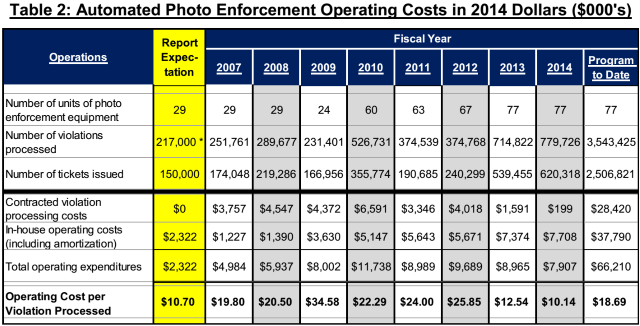
This report provides an up-to-date, all-in cost comparison of the estimated and actual costs of fully absorbing the Automated Photo Enforcement program into City operations from 2007 until 2014. Prior to 2007, the program was contracted out. As a result, 2007 is the benchmark year.

As they say, a picture is worth a thousands words, so here are the key charts:

audit ape table1

audit ape table2

audit ape chart

And the key conclusion from the report:

“Instead of purchasing a commercial “off-the-shelf” application as assumed in 2007, a custom software solution had to be developed at a significantly higher cost. That cost was more than 200 percent higher than the cost projected in 2007.”

“We found that the current cost per violation is marginally lower than the expected cost in 2007. However, the program took six years to achieve an actual cost per violation that was lower than the last year of fully-outsourced operations.”

There is also this response from Administration to the report:

“In conclusion, the maturation of the program is producing benefits in 2014 that have exceeded the cost performance targets originally which were initially proposed in 2007 for 2008 operations. This confirms that the decision to bring the program in-house was sound and the benefits are greater than initially projected.”

Other

  • City of Edmonton 2014 Consolidated Financial Statements – The report for this is not yet available, and Council approval is required. This is the first item of business.
  • KPMG 2014 Audit Findings Report – This is the second item of business and again, Council approval is required.
  • Proactive Audit Involvement in Capital Projects – This is a status report that looked at project management practices for the Rogers Place, Walterdale Bridge, Valley Line LRT Stage 1, and Alex Decoteau Park projects. “Overall we found that all four project teams are applying the 13 project management principles set out by the Project Management Institute.”
  • Strategic Enterprise Risk Management – This is a big report that pulls together the strategic risk registers for The Way We Green, Grow, and Prosper (work had already been done for Move and Live). Four common risks include: local impacts of economic boom and bust, resourcing, decision-making not in alignment with strategic objectives, and ineffective collaboration with partners.

Wrap-up

You can keep track of City Council on Twitter using the #yegcc hashtag, and you can listen to or watch any Council meeting live online. You can read my previous coverage of the 2013-2017 City Council here.
Edmonton City Council could have its first by-elections in 20 years

With the potential loss of two Councillors this year, Edmonton could have it’s first by-elections for City Council in more than two decades.

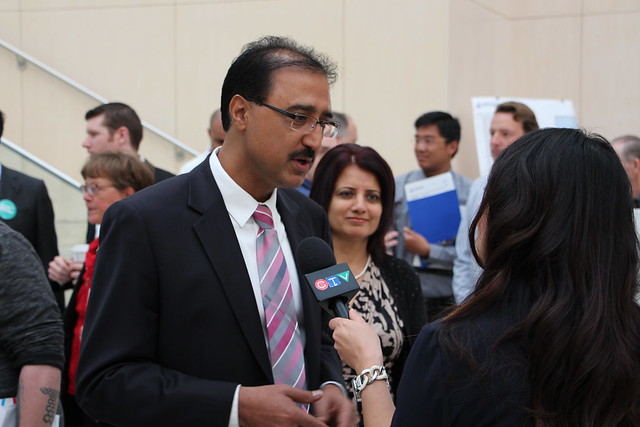
Councillor Amarjeet Sohi, who represents Ward 12, announced in January that he would seek the federal Liberal nomination in Edmonton-Mill Woods. He was acclaimed on February 12. You can see his campaign page here. Sohi has said he would take leave from Council during the election.

Amarjeet Sohi - Ward 12
Amarjeet Sohi, photo by Dave Cournoyer

Councillor Tony Caterina, who represents Ward 7, was named the Progressive Conservative candidate in Edmonton-Beverly-Clareview on March 28. He was first elected to City Council in 2007. Curiously, Caterina has said he will remain active on Council during the election, but will not draw a pay cheque.

Tony Caterina - Ward 7
Tony Caterina, photo by Dave Cournoyer

On the school board side, Sarah Hoffman is running as the Alberta NDP candidate in Edmonton-Glenora. She was elected to her second term on the Edmonton Public School Board in 2013 and stepped down as chair in January. She still holds her seat on the school board.

Sarah Hoffman - Ward G
Sarah Hoffman, photo by Dave Cournoyer

Now that we know the provincial election is taking place on May 5, a by-election for Tony Caterina and Sarah Hoffman’s seats would take place sometime before August 4 (assuming they win office). The federal election is slated to take place on October 19, so if Amarjeet Sohi were to win, a by-election for his Council seat would need to take place by January 16, 2016.

By-Election Rules

Sections 160-168 of the Municipal Government Act deal with vacancies and by-elections for councils. Here are the key points:

  • Resignations must be made in writing and given to the Chief Administrative Officer (in our case, City Manager Simon Farbrother). The resignations take effect on the date they are received.
  • The Chief Administrative Officer must report the resignation to council at the first meeting after receiving the resignation.
  • A by-election must be held to fill the vacancy unless:
    • It occurs in the 6 months before a general election, or
    • The council consists of 6 or more councillors and the vacancy occurs in the 18 months before a general election (and there’s only one) or in the 12 months before a general election and there’s enough remaining councillors to count one more than the majority
  • A by-election must take place within 90 days of a vacancy, otherwise the Minister of Municipal Affairs may order a date for one or take any other action he or she considers necessary.

The next general municipal election will take place on October 16, 2017, which is still about 30 months away, so none of the “unless” clauses apply. If any of the three mentioned above resign, a by-election would need to be held within 90 days. And since it is very unlikely that Councillor Sohi would resign before winning a seat in October, we’ll almost certainly be looking at two by-elections – one for Caterina and/or Hoffman’s seats, and another for Sohi’s seat.

The nomination and campaign periods would be set by Council following the vacancy becoming official. In practice, the City Manager would bring a report to Council to inform them of the vacancies and would make a recommendation on the nomination and election dates. The same would apply to the Public School Board, except it would be the Chief Returning Officer (Alayne Sinclair) that would bring the report.

By-Election History

Edmonton has had six by-elections in the past, the two most recent of which were for councillors making the jump to either provincial or federal politics:

  • 1907 – Morton MacAuley resigned eight months into his term and left politics.
  • 1911 – James McKinley resigned to protest the firing of two city commissioners.
  • 1912 – Herman McInnes and Charles Gowan both resigned.

julia kiniski
Julia Kiniski at a campaign meeting in 1949, courtesy of the Edmonton Archives

  • 1970 – Julia Kiniski died on October 11, 1969. She had held office since 1963, when she finally won after about a dozen previous attempts. Her son Julian won the by-election, and was the last person to be elected at-large in Edmonton as the ward system took effect in 1971.
  • 1984 – Bettie Hewes resigned after being elected as MLA for Edmonton-Gold Bar.
  • 1994 – Judy Bethel resigned after being elected as Liberal MP for Edmonton-East.

What to expect

Although Council has requested that the Minister of Municipal Affairs amend the Local Election Authorities Act to permit alternate forms of voting (which would make online voting possible) that has not yet happened and so online voting would not be an option for these by-elections.

City Clerk and Returning Officer Alayne Sinclair tells me that turnout is often even worse for by-elections than it is for general elections, so the City would try to pick a date that would maximize turnout. There would also be ample opportunity for advance voting.

With provincial and federal elections, and possibly municipal by-elections, all taking place this year, Edmontonians will be busy at the polls.

What does Alberta’s Budget 2015 mean for Edmonton?

Today was budget day in Alberta. Budget 2015 is being called “a bad news budget” but it could have been much worse. There are tax and user fee increases, cuts to spending (including the first cut to health spending in 20 years), and a new “Health Care Contribution Levy”, and still Alberta’s deficit will grow, to a record $5 billion this year. On the other hand, infrastructure spending seems to be mostly intact, programs for the most vulnerable have not been cut, Alberta retains its tax advantage, and the Province is taking some baby steps toward getting us off the energy price roller coaster. Here is Dave’s take.

Budget 2015

There’s a lot of truth to the “government town” label that people often apply to Edmonton, so any Provincial cuts are going to have an impact. According to the City’s chief economist John Rose, 22% of Edmonton’s employment is related to health care, education, or public administration.

Still, Rose said in recent weeks that Edmonton as a whole would weather the storm better than others in Alberta. From his Labour Force Report issued on March 13:

“Although the impact of lower oil prices is evident in some sectors, the diversity and depth of
Edmonton’s economy has insured that employment continues to grow in Edmonton and that the
City remains a very attractive location for those seeking new opportunities.”

So what does Budget 2015 mean for Edmontonians and for Edmonton?

Highlights

Here are some of the key takeaways from the budget that I think are relevant to Edmonton:

  • For 2015-2016, Alberta Health Services (AHS) faces a decrease of $286 million or 2.1% and will need to cut nearly 1,700 positions
  • The budget includes $926 million in capital spending for health-related “capacity expansion projects” in Calgary and Edmonton
  • There is $50 million over at least two years to renovate emergency rooms in Calgary and Edmonton (specifically the Misericordia, Grey Nuns, and Royal Alexandra hospitals)
  • The budget promises than 300 new restorative care beds in Calgary and Edmonton
  • Post-secondary institutions face $114 million in cuts
  • Campus Alberta institutions (which includes the University of Alberta) are facing a 1.4% operating grant reduction in 2015-2016 and a 2.7% reduction in 2016-2017
  • School boards will receive no money for more students and must cut 3% from non-instructional costs
  • The Province says that “most” school projects announced in 2013 and early 2014 will open in 2016-2017
  • Family and Community Support Services, which helps to fund more than 60 agencies and 80 programs in Edmonton, will be maintained at $76 million.
  • Funding for police remains the same
  • Capital spending of $1.1 billion for the next 5 years includes $124 million for NAIT expansion and $120 million for NorQuest downtown
  • GreenTRIP funding remains intact, which means the first portion of the Valley Line LRT will continue to move ahead
  • MSI funding will remain stable, even if it is more of a loan than a grant
  • The smart fare proposal from Edmonton, St. Albert, and Strathcona County is still “under consideration”
  • The budget contains no funding for the proposed Galleria project

Discussion

Certainly the health care sector is going to take a hit and that will have some impact on Edmonton. The Province maintains that we can get the same quality of service for less, while critics disagree and suggest the effect of this budget won’t be felt only by those at AHS who lose their jobs but also by Edmontonians in need of care. “The time has come for us to start looking at how we can do things in a more efficient manner,” said Health Minister Stephen Mandel. “I don’t think Albertans should have to pay 20 and 30 per cent more for things.”

In addition to the cuts in health-related spending, the budget also introduces the Health Care Contribution Levy, which will apply to individuals with taxable income greater than $50,000 per year. There’s a sliding scale from $200 to $1000 depending on your income bracket. This tax takes effect on July 1, 2015, and applies to roughly 1.1 million Albertans.

The health-related surprise though was money for hospitals, especially given recent suggestions that Edmonton facilities need more than $225 million in maintenance and repairs. The previously announced funding for emergency room upgrades will help in that regard.

It’s not clear how many cuts the education sector will face, but clearly the 3% reduction is going to have an impact. A lack of new funds to deal with growth will likely also mean larger class sizes. At the post-secondary level the cuts are much smaller than many expected.

While there is no provincial sales tax, there are increases to personal income taxes. If you make more than $100,000 per year your tax rate will increase from 10% to 11.5% (phased in over three years) and if you earn more than $250,000 your tax rate will rise to 12% when fully implemented (Edmonton’s media family income is about $100,000). We know that nearly 10,000 employees of AHS earn at least $100,000 a year, which means if they aren’t among the job cuts, they will face increased personal income tax. Though it likely won’t be those who make the most that face the cuts. According to the Herald, Mandel’s own department will spend 18% more than last year.

For most Edmontonians, increased taxes, fines, and user fees will be felt immediately. Gas taxes are increasing by 4 cents to 13 cents per litre. Cigarette taxes are increasing by $5 to $45 for a carton of 200. A bottle of wine or spirits will cost 16 cents more, and a 12-pack of beer will cost 90 cents more. Fines for speeding and other traffic offences are increasing by an average of 35%. Marriage licenses are increasing by $10 as are birth and death certificates.

There is some good news for the most vulnerable Edmontonians. There will be no reductions to child care subsidies for low-income families, nor are there any reductions to the Alberta Seniors Benefit income support. The budget will also accommodate growth for AISH and Persons with Development Disabilities. Starting July 1, 2016 there will also be a new Alberta Working Family Supplement refundable tax credit on earnings up to $41,220. Funding for FCSS, which supports many Edmonton agencies, will be maintained.

On infrastructure there’s mostly good news. Or at least a sigh of relief that important projects will continue moving forward, like the Valley Line LRT which the Province previously committed to.

Responses to Budget 2015

From Mayor Don Iveson:

“The city of Edmonton and Alberta municipalities faired reasonably well on this budget, all things considered – certainly compared to what we all heard and were concerned might be coming,” Iveson said.

“The numbers are fairly small and speaking to our chief economist just now, it may have a small effect on Edmonton’s growth, but we’re talking a decimal to Edmonton’s GDP, not a side-swipe,” Iveson said.

“We can work with the dollars provided,” said Iveson.

From Doug Goss, char of the University of Alberta’s board of governors:

“The message is clear — we all have to find new ways of doing business, we have to be a little more creative,” said Goss.

From Indira Samarasekera, President of the University of Alberta:

“This is a very good outcome,” said Samarasekera, “much better than many were expecting. The provincial government is facing financial pressures, but they’ve demonstrated they understand the importance of post-secondary to Alberta’s future.”

President Samarasekera will address the campus community at a forum on March 31.

From Michael Janz, Edmonton Public School Board chair:

“We’re going to see more students arriving at the school doorsteps with no new money provided to educate them,” he said. “I don’t think this is a good news budget for Edmonton public schools.”

From Marilyn Bergstra, vice-chair of Edmonton Catholic Schools:

“The budget cuts will make it increasingly difficult to support all of our students, particularly our most vulnerable, as well as the new students that are coming to our district,” she said.

From Helen Rice, President of the Alberta Urban Municipalities Association (AUMA):

“Sufficient funding for infrastructure is vital to address the deficit that has continued to grow across the province, and to provide for new infrastructure requirements to meet our obligations to citizens,” said Rice.

“Given the current economic climate, now is the time to secure funding to meet infrastructure needs when prices are falling and the availability of resources to work on projects is increasing,” said Rice.

The reaction from the business community appears to be more mixed.

Budget 2015

Budget 2015 Details

Here are all the budget-related news releases:

Here is the budget presentation from Robin Campbell, Minister of Finance:

You can also download the budget speech in PDF here. You can access the full list of budget documents here.

Roundup: Pre-Election Politics in Alberta

As you know I stay fairly focused on municipal issues, especially as they relate to Edmonton. But with the provincial budget set to be released on Thursday, a televised address from the Premier tonight, the review of the Municipal Government Act, and expectations of an imminent election, I’ve been thinking more about provincial politics lately. Here’s a brief summary and some thoughts on what I’ve been paying attention to.

Premier Prentice’s TV Address

Tonight, Premier Jim Prentice delivered a 16 minute address called Alberta Looks Ahead on CTV (which apparently cost between $80K and $100K). “We are a turning point in our province,” he said at the beginning. He described the need for “thoughtful decisions for the future” and said Albertans have told him they want balance.

The highlights as I understood them:

  • A 10 year plan will be introduced with the budget, with three pillars: strong fiscal foundation, building a lasting legacy, securing Alberta’s future
  • There will be no sales tax and Alberta will retain “the most competitive tax system in Canada”
  • The goal is to be back to a balanced budget by 2017
  • The government will hold the line on expenditures, which essentially means cuts in a growing province
  • Albertans will be asked “to contribute to the costs of the health system”, slowly at first but growing over time
  • By 2018-2019, 75% of energy revenue will go to program spending
  • By 2019-2020, 50% of energy revenue will go to program spending, with 25% going to emergency funds and paying down the debt and 25% going to the Heritage Savings Trust Fund

The Premier talked a lot about how he is determined to restore our commitment to the Heritage Fund, and said “paying off our debts is something we simply must do.” If I remember correctly, he mentioned only two former Premiers by name: Peter Lougheed and Ralph Klein.

Perhaps this is a more accurate, succinct recap courtesy of Marty Chan:

There were no “look in the mirror” comments tonight, but I did love the soundbite toward the end when Premier Prentice spoke about “a spirit of openness across every segment of Alberta”. He offered some examples, including “from bloggers to loggers,” which led to this gem:

Dave is probably the most well-known political blogger in the province. You can see his latest nomination update post here.

The Premier is also planning to host a series of Telephone Town Halls along with various Ministers, on March 25 and March 30. You can dial in toll-free at 1-855-269-4484. Tonight I saw many complaints about robocalls, so it’ll be interesting to see how those town halls are received.

Budget 2015 Consultations

The Province conducted an online survey for Budget 2015 and in total received 40,513 responses. The survey was open from February 5-28. Some of the key findings include:

  • 9 out of 10 respondents feel low oil prices will greatly or somewhat affect the Alberta government’s ability to budget
  • when asked what is the right balance to respond to the drop in revenue, Albertans were split almost evenly 3 ways between reducing spending, increasing revenue and running a deficit budget
  • 9 out of 10 respondents feel government needs to take action either immediately or within this year

I’m not sure how representative the results are, but it’s useful data to consider nonetheless. Budget 2015 will be released on Thursday, March 26.

Perhaps most interesting to me is that the survey results were made available through the Open Data Portal! This enables you to ask the hard questions, like: how long did the average person take to fill out the survey? The average length of time was 7 minutes, with the median at 11 minutes. Ignoring the records that were greater than 90 minutes (people leave tabs open all the time) here’s what the data looks like in a chart:

budget survey time taken

You can download all the data as a 13 MB Excel file. Give it a go and have some fun!

I hope this is a sign of things to come in terms of making information available through the open data catalogue in a timely fashion.

Municipal Government Act Amendments

Last week, the Government of Alberta tabled amendments to the Municipal Government Act. You can get a brief overview of what’s changing here. From the news release:

“The last major consolidation of the MGA took place in 1995, after nearly 10 years of review. The current MGA review began in 2012 and has involved input from more than 1,200 written submissions, and more than 1,500 people at 77 community meetings.”

A few of the proposed changes I found interesting:

  • Municipalities would be required to adopt public participation policies that outline their approaches for engaging with stakeholders. Edmonton already has a policy for this and is actively review and improving its approach to public engagement.
  • Existing petition requirements make it difficult to successfully petition a municipality, so one proposed changed would allow municipalities to change the rules for petitions.
  • Currently municipalities need to use snail mail or newspapers to notify the public about things like bylaws and public hearings, but this is 2015! The proposed change would make it possible for municipalities to announce notifications online or using other methods as they see fit.
  • Another change would require municipalities to adopt three-year operating plans and five-year capital plans. Edmonton is already moving in this direction.
  • Municipalities are currently required to have statutory plans, but there is no explicit hierarchy specified, they simply need to be consistent with one another. The proposed change is to identify the hierarchy and relationship of those plans. In Edmonton, this could impact The Way Ahead.
  • Another change would allow for the creation of civic charters, which the Province, Edmonton, and Calgary have already been pursuing.

There are more amendments still to come. Additional review and consultation will take place this spring with the goal of proclaiming the fully revised MGA and regulatory updates by the end of 2016.

MSI Funding (March 2015)

Another pre-election, pre-budget announcement was about the allocation of $400 million in MSI funding. Edmonton is slated to receive just over $80 million out of that, which is less than half of what the City was expecting for 2015.

“Until we get the provincial budget, I won’t know how much additional dollars are available and we won’t be able to make any decisions about which projects go ahead until we see the provincial budget,” said Mayor Don Iveson.

For its part, the Liberals have called the MSI announcement “an elaborate ruse” due to some creative accounting with the Basic Municipal Transportation Grant.

Wildrose Leadership Race

Also tonight, we held our third #abvote Hangout at http://abvote.ca. In addition to Dave, Ryan, and myself, we had the three Wildrose leadership candidates join us: Drew Barnes (MLA for Cypress-Medicine Hat), Derek Fildebrandt sitting in for Brian Jean (Former MP for Fort McMurray - Athabasca) and Linda Osinchuk (Former Mayor for Strathcona County). We started with a discussion about the Premier’s address, and then moved on to some other questions for the candidates.

You can watch the archived video on YouTube or here:

I asked a question about how they’d support municipalities, and of course the Wildrose 10/10 plan came up, which would allocate 10% of tax revenues and 10% of surpluses to municipalities.

They’re rushing this race, but with speculation the writ will drop on March 30, they don’t have much of a choice. You can learn more about how voting works for the leadership race here. The Wildrose party will announce its next leader on March 28 in Calgary.

Other

I have already mentioned these things in previous roundups but it’s worth linking to them again:

That’s it for now! Stay tuned for our next Hangout and follow all the latest stuff online using #ableg and #abvote. Now I guess I had better go update the Election Results dashboard

Coming up at City Council: March 23-27, 2015

It’s Committee week again and it looks like it’ll be a busy one with lots on the agenda.

Agendas for upcoming City Council meetings are generally released on Thursday afternoons. I like to take a look to see what Council will be discussing, and I figured I should share that here. Below you’ll find links to the meetings taking place next week, as well as links to and thoughts on some agenda items that caught my eye.

City Council Swearing In 2013-2017

Monday, March 23, 2015

The week begins on Monday with a Community Services Committee meeting scheduled from 9:30am until 5:30pm. There are thirteen reports on the agenda, plus one response to an inquiry from Councillor Knack and one private report. Here’s what caught my eye:

Urban Beekeeping Pilot Project & Bylaw Changes

This report provides an overview of the pilot project on urban beekeeping and also recommends some bylaw changes for Council’s consideration. Here’s how the pilot went:

  • Over 35 inquiries were made, but only 3 residential sites were setup. Timing and strict neighbour permission requirements are blamed for the low numbers.
  • All 3 sites successfully complied with the provisions of the pilot.
  • “The three pilot sites were managed by experienced beekeepers and conversations with enforcement staff were very positive.”
  • Just one complaint was received from a citizen, and it was about a noticeable increase in bees. Research about how to reduce bee hive impacts on neighbours will be “incorporated into an ongoing education and awareness program.”
  • Participants, neighbours, and community members were all surveyed – just one respondent indicated they did not support the idea of urban beekeeping.

A representative from Animal Control & Licensing met with the Edmonton Food Council, a meeting that I attended. We had a great discussion about the pilot and the proposed changes. The report says, “the Food Council supports the City to enabling implementation of urban beekeeping in a way that enhances the positives of beekeeping while minimizing the exposure of citizens to undue risk.”

Currently, the Animal Control & Licensing Bylaw prohibits citizens from keeping large animals (like Stampy I guess), poultry, bees, or poisonous snakes, reptiles, or insects, unless they have permission from the City Manager. The proposed amendments would allow those things if a citizen successfully obtains a license issue by the City Manager. This is not unlike needing to get a pet license for your dog or cat. The City could place terms and conditions on a license, such as the term, or the maximum number of animals that may be kept. They can investigate complaints and they can perform inspections. And of course, the license can be revoked at any time. The requirements are pretty straightforward:

  • You need to be 18 years of age or older
  • You need to pay any applicable fees
  • You need to provide all required information

A license to keep bees is proposed to be free. To get a license, you’ll need to comply with the City’s Bee Site guidelines, you’ll need to register with the Province Apiculturist and comply with the Alberta Bee Act, and you’ll need to complete a recognized beekeeping course. Guidelines include:

  • Hives can only be in the backyard, and must be at least 3 meters from a neighbouring fence line.
  • You can only have one active hive in your yard, consisting of a bottom board and hive cover with no more than four supers.
  • A fresh water source is required to minimize bees going to neighbouring properties.

This is really great to see – the guidelines are reasonable and approachable, the proposed process allows the City to take action when necessary, and the City is encouraging education and community around beekeeping.

I’m excited to see urban beekeeping moving ahead in Edmonton!

Electronic Cigarettes

Councillor Knack made an inquiry back in December about electronic cigarettes, seeking information about whether the current smoking bylaw is applicable or not. The report is very clear:

“The current City of Edmonton Smoking Bylaw does not apply to electronic cigarettes. This product does not contain tobacco and is not currently regulated under the Tobacco and Smoking Reduction Act or Public Places Bylaw 14614.”

There are no specific restrictions on the sale of e-cigarettes. Because they are relatively new, Health Canada has not fully evaluated them and generally advises Canadians against purchasing or using them. Because of that, e-cigarettes cannot be used in AHS facilities nor inside City facilities.

Fire Pit Enforcement Options

This one is a follow-up to the discussion that took place back in November. As directed, Administration has identified “mechanisms to protect citizens from extreme nuisance impacts of neighbourhood fire pits”. They came up with three:

  • Existing Mechanisms – Rather than issue a $250 fine, officers could require a mandatory court appearance.
  • Create a Subjective Nuisance Bylaw Provision within the Community Standards Bylaw
  • Enhanced Responsive Services – This would require additional staff, and therefore, budget.

The first two would have no cost implications.

Other

Here are some of the other reports on the agenda:

Additionally, a bunch of reports have been given revised due dates, so get your calendar out and pencil in these dates if they’re of interest:

Tuesday, March 24, 2015

On Tuesday, the next Executive Committee meeting is scheduled to take place from 9:30am until 5:30pm. There are twelve reports on the agenda, plus one response to an inquiry from Councillor Esslinger. Here’s what caught my eye:

City Council Policy on Open City Initiative

The recommendation here is that Council approve City Policy C581, the Open City Policy. “An open city is a connected city,” the report says. “Philosophically, an open city is connected and responsive to the goals and objectives of an informed and engaged public, who in turn are partners consulted in setting the goals and objectives of the city.”

The included draft policy incorporates the five most frequently occurring suggestions from respondents to an Edmonton Insight Community survey:

  • Emphasis on citizen and community involvement in decision-making
  • Embrace openness in all City employees’ and election officals’ actions
  • Clarify how privacy will be protected
  • Specify how the City will ensure all practices and processes will adhere to Open City Principles
  • Use understandable language

The draft policy says that as an open city, “Edmonton will create opportunity for diverse input and participation, inviting Edmontonians to play a larger role in shaping the community and enabling social and economic growth.” The core commitments in the policy would have the City:

  • Manage information and data assets as a strategic resource
  • Ensure information and data are open by default and private where appropriate
  • Expand opportunities to foster a collaborative environment and engage Edmontonians to ensure municipal activities reflect community values, priorities and standards
  • Embrace technology and new business models to deliver services to Edmontonians
  • Remove barriers to access and open up new possibilities for collaboration between Edmontonians and the City
  • Work with other public and private sector organizations for the advancement of Open City principles

I can’t say that I’m thrilled with the second point (I’d rather see a separate point on privacy and not diminish the “open by default” commitment), but overall, I think this is a big step in the right direction. I expect Council will be happy with it too.

Update on Infill Progress

This report provides an update on the 23 actions identified in Edmonton’s Infill Roadmap. Here are the highlights:

  • Three of the five communications actions have been completed, including work on the website and the development of the Good Neighbour Construction Guide.
  • Three of the five collaboration actions have also been completed, including the Infill Tour and the Infill Planning Academy Course.
  • One of the three knowledge actions has been completed – the creation of a document that provides a basic understanding of drainage services in Edmonton.
  • Twp of the five rules actions have been completed (these deal with zoning changes).
  • Two of the five process actions have been completed.

Northern/Circumpolar Initiatives Secretariat

Council is considering the formation of a Northern/Circumpolar Initiatives Secretariat that could help Edmonton “achieve significant progress in the Northern/Circumpolar region through supporting and building partnerships with northern communities.” EEDC was directed to develop a business plan for the initiative, which this report includes and summarizes.

The area of influence would be the Edmonton region, but also Whitehorse and Yellowknife. The hope is that Edmonton can form partnerships with northern communities around issues like health care, education, commerce, innovation, and community development.

The idea would be to formally create the Secretariat by the end of Q2 2015. The City, EEDC, the Edmonton Chamber of Commerce, and the University of Alberta would provide funding and in-kind resources as partners in the initiative. Council has already approved a one-time package of $90,000 for 2015.

Other

Here are a few notes on some of the other reports:

The following reports have been given revised due dates:

Wednesday, March 25, 2015

The next Transportation Committee meeting takes place on Wednesday from 9:30am until 5:30pm. There are five reports on the agenda, as well as one response to an inquiry made by Mayor Iveson.

Cell Phone and Wi-Fi Coverage in LRT Stations and Tunnels

I don’t think there’s much new here, but the report provides an update on the inquiry that Mayor Iveson made about getting connected when you ride the LRT. The City is targeting Q4 2015 for service in the tunnels. They are currently discussing the implementation of “a single co-location solution” that would allow any service provider to “connect to a common carrier supported infrastructure”. So instead of every company installing hardware, one set of gear will be installed that all will share. Can’t wait to see this roll out!

Valley Line Stage 1 Environmental Impact Screening Assessment Update

This is a pretty big report with four attachments. The recommendation to Council is to approve the Environmental Impact Screening Assessment, to approve the list and locations of Major Facilities, and to approve the upgrades for the construction access route through the west side of Louise McKinney Park.

311 Calls – Snow & Ice Complaints

This report summarizes the process for managing 311 calls received for snow and ice control operations. Improvements for managing these calls have been made and more are planned. For instance, revised scripts reduced the ratio of calls being referred to Roadway Maintenance from 63% to 49%.

For the 2013-2014 season there was a total of 47,779 calls, and that decreased to just 22,186 in the 2014-2015 season. The report says that 82.7% of notifications are closed within 5 business days, which is an improvement from 53.8% last time.

You can see snow & ice maintenance calls into 311 using the 311 Data Explorer.

NAIT Line Transit Security

Since 2011, ETS says it has seen a 17% increase in security-related files due to rapid ridership growth “without a proportionate increase in Transit Peace Officer staffing levels.” In order to “maintain the reputation of Edmonton Transit as a safe, secure and welcoming system” with the activation of the Metro Line to NAIT another six Transit Peace Officers will be required.

The report also notes than the Metro Line presents “unique security challenges” due to its proximity to the downtown arena and entertainment district. And though the Transit and Police Partnership Team pilot project has been positive, it also demonstrated the need for more security as a total of 140 arrests, 450 warrant executions, and 329 ticket violations were generated in a five month period.

Alternatives to adding new Transit Peace Officers include sticking with the status quo, engaging police, or hiring private security. The cost for wages, benefits, equipment, and training for six Transit Peace Officers from June to December 2015 is $354,000 and $607,000 for 2016.

Other

The other reports include:

And a bunch of reports have been given revised due dates:

Thursday, March 26, 2015

Executive Committee is meeting again on Thursday afternoon. There’s just one item on the agenda, and it’s a private, verbal report: Civic Agencies Recruitment – Applicant Interviews. This is a continuation of an ongoing item.

Wrap-up

You can keep track of City Council on Twitter using the #yegcc hashtag, and you can listen to or watch any Council meeting live online.

Coming up at City Council: March 16-20, 2015

Agendas for upcoming City Council meetings are generally released on Thursday afternoons. I like to take a look to see what Council will be discussing, and I figured I should share that here. Below you’ll find links to the meetings taking place next week, as well as links to and thoughts on some agenda items that caught my eye. You can find my previous roundups here.

City Council Swearing In 2013-2017

Monday, March 16, 2015

The week begins on Monday with a Public Hearing scheduled to last all day. There are 20 bylaws on the agenda. Here are some that caught my eye:

Bylaw 17011 – Adoption of The Decoteau ASP

You’ll recall that this bylaw was first considered at the February 9 meeting, where Council asked for some improvements. Here’s what has changed:

  • The net residential density of the proposed ASP has increased from 30.6 to 34.0 dwelling units per hectare.
  • An increase in the Business Employment designation is not being proposed as it would increase infrastructure costs, among other considerations. Administration says this can be further refined during the NSP phase.
  • Mapping and policies related to wetland and natural areas have been verified as providing “an accurate representation of the ecological network proposed for retention.”

This bylaw is ready for second reading only – third reading is being withheld pending review by the Capital Region Board.

Bylaw 17116 – Amendment to the Zoning Bylaw re: Garage & Garden Suites

This bylaw is meant to eliminate restrictions for Garage and Garden Suites and to enable the subdivision of sites zoned RF1 to narrower lots not less than 7.6 meters wide. These two amendments were brought to Executive Committee back on November 12 and address two actions from Edmonton’s Infill Roadmap (pdf):

  • Action 14: Create more and better opportunities for Garage and Garden Suites in established neighbourhoods by amending the Zoning Bylaw’s location criteria and Site regulations for these types of housing.
  • Action 15: Change the (RF1) Single Detached Residential zone to allow the subdivision of properties into narrower lots that are half of the average width of the other lots on the block (but not less than 25ft wide)

There are currently restrictions on where Garage and Garden Suites can be located, on the height of those structures, and on the minimum site area. The proposed amendment addresses all of these restrictions.

The second proposed amendment will allow a minimum site width for single detached housing of 7.6 meters, decreases the minimum site area for single detached housing to 250.8 m2, increases allowable site coverage for narrow lot developments to 42%, and allows the subdivision of a lot zoned RF1 to a maximum of two lots.

Public input came from the Evolving Infill consultation efforts as well as a pilot project that took place in the Prince Charles neighbourhood. The report says that “more than 1000 residents and stakeholders took part in both Evolving Infill and Garage and Garden Suite consultation.”

Bylaw 17114 – To allow for the development of Public Education Services, Allard

This bylaw is to rezone the property located at 660 Allard Boulevard SW from AP to US to accommodate the development of a public elementary school. This is being done “in conformance with the Heritage Valley Servicing Concept Design Brief and the Allard Neighbourhood Area Structure Plan.” No concerns or questions were raised as a result of the advance notice.

Bylaw 17132 – Closure of portions of 101 Street NW, 100A Street NW

This bylaw is about road closures yes, but it’s really about repurposing Fire Station 21 in Rossdale:

“On July 3, 2013, City Council approved a Community Services Committee Report that recommended, in part, that the existing Fire Station 21 be repurposed to house an active river rescue crew, provide backup service to the downtown core, house specialized apparatus, be approved as a major facility within the River Valley, and that the location of the facility within the River Valley be deemed essential and approved pursuant to section 3.5.1 of the North Saskatchewan River Valley Area Development Plan Bylaw. This road closure application is a step in the ongoing progression to achieving these recommendations.”

Apparently the station is built over several lots and road right-of-way created by “Plan Q” way back in 1893.

Other

A few others I wanted to note:

  • Bylaw 17111 is to allow a freestanding sign to be put up at 5315 127 Street NW to identify the new Eco Station.
  • Bylaws 17070 and 17071 will be considered together, and amend the Maple NSP to designate land that was being used for a cell tower to row housing as the tower has been dismantled and is no longer in operation.
  • Bylaw 17133 is an amendment to the zoning bylaw to reduce the required minimum Side Setback for garages in RF4 zoned areas from 0.9 meters to 0.6 meters, “specific to Garages where the vehicle doors face a Lane abutting the Site.” Currently constructing a detached garage for each unit of a semi-detached house would require a Class B discretionary development approval.

Tuesday & Wednesday, March 17/18, 2015

Next up for Council is a regular City Council Meeting scheduled to take place on Tuesday and Wednesday. There are 14 public reports, 3 bylaws, and 3 private reports on the agenda.

Council Members’ Updates on Agency & Initiative Appointments

This report provides an update on the agencies and initiatives that the Councillors are members of. Here are some highlights:

  • AUMA’s Executive Committee will be making its annual presentation to Council’s Executive Committee on March 24.
  • The Chair and CEO of the Capital Region Board will also be presenting to Executive Committee on March 24. The CRB’s Regional Services Committee may be disbanded pending a report in August 2015.
  • The Federation of Canadian Municipalities (FCM) will hold its annual conference in Edmonton from June 5-8. The mayor will host a reception in Churchill Square after the opening game of the FIFA Women’s World Cup on June 6.
  • Edmonton will be the host city for the 2019 International Council on Alcohol, Drugs & Traffic Safety (ICADTS). The 7th Traffic Safety Conference takes place here in Edmonton from April 27-30.

Edmonton’s Community Energy Transition Strategy

This report presents a draft of the strategy and will be discussed in a facilitated session on Wednesday morning. So what is a Community Energy Transition Strategy?

“Edmonton’s Community Energy Transition Strategy is a risk management strategy designed to protect Edmonton’s quality-of-life (social, economic, environment) from climate and energy-related risks.”

“The strategy responds to City Council’s 10-year goal to be “the nation’s leader in setting and achieving the highest standards of environmental preservation and sustainability both in its own practices and by encouraging and enabling the practices of its partners.” Equally, it responds to Council-approved goals in The Way We Green and to corporate outcomes and measures that call for a reduction in greenhouse gas emissions in both City operations and the Edmonton community.”

Energy transition is about reducing our greenhouse gas emissions, improving energy efficiency and conservation, ensuring our energy systems are resilient to disturbances, and positioning Edmonton to take advantage of clean energy technologies. The strategy contains:

  • A Diagnosis of the energy and climate challenges/opportunities we face globally and locally;
  • Strategic Courses of Action for addressing these challenges/opportunities in coming decades;
  • An Eight-Year Action Plan establishing the first step (2014-2017) and signaling the second step (2018-2021) of Edmonton’s energy transition journey.

The strategy calls energy transition “the golden opportunity of our age” and says that “few places are better positioned than Edmonton in terms of knowledge, experience, and financial capacity to lead and excel in this area.”

To say there’s a lot to digest here would be an understatement. There are 11 strategic actions, 7 opportunity areas, 45 focus areas, and 10 community scale programs. Targets include reducing greenhouse gas emissions by 35% by 2035 (compared to 2005 levels), reducing energy consumption by 25% per person by 2035 (compared to 2009 levels), and generating 10% of Edmonton’s energy locally by 2035.

By 2035, Edmonton’s Community Energy Transition Strategy is “expected to deliver a net present value of approximately $2.5 billion to citizens and community stakeholders.” The report argues that a City Policy is important to make this happen.

So, how much will it cost? Funding of $1.9 million a year is needed in 2016 and 2017 for startup initiatives. The programs beginning in 2018 would require another $27.5 million per year through 2021. No funding sources are identified in the report, but it does say that “additional federal, provincial, and municipal government funding will be needed to advance these initiatives.”

Communications Plan for LRT Funding Advocacy

The report isn’t available yet, but Council will be discussing how to advocate for funds for future LRT development. This item came up at the Transportation Services Committee back on February 25. As a reminder, there is roughly 32 km of the 69.7 km LRT Network Plan without funding.

Committee Reports

The Committee reports were all recently discussed at one of the four committees and have been referred to Council with a recommendation for approval. A few that I wanted to highlight include:

Bylaws

As mentioned, there are three bylaws on the agenda:

  • Bylaw 17005 is an amendment to the Procedures and Committees Bylaw 12300 to change the time for continuation of City Council meetings and Public Hearings. Currently they continue the next business day, but the amendment would allow Council to choose a time within the next three business days.
  • Bylaw 17128 is to decrease the borrowing authority by $9.6 million to $12.3 million for the Aurum Energy Park. This is required to enable the City to recover the actual cost of the local improvement rather than the estimated cost.
  • Bylaw 17101 increases borrowing for sidewalk reconstruction in the Hazeldean neighbourhood by $8,339 because the originally assessed area was short by 46 meters. This is a very small chunk of the $6.9 million project cost.

Private Reports

Council will receive three private reports: one is an intergovernmental update on the City Charter, and the other two deal with the performance evaluations for the City Manager and City Auditor. The 2014 performance evaluation results are time-specific at 1:30pm on Tuesday.

Thursday, March 19, 2015

Another Community Services Committee meeting has been scheduled for Thursday morning, to allow Council to continue interviewing applicants for the Civic Agencies Recruitment effort.

Wrap-up

You can keep track of City Council on Twitter using the #yegcc hashtag, and you can listen to or watch any Council meeting live online. You can read my previous coverage of the 2013-2017 City Council here.