Thoughts on the proposed downtown mega-bars from Urban Sparq

The two mega-bars proposed for downtown have been top of mind for many this week. One would have an occupancy of 596 and would be located in the new Fox 2 Tower on 104 Street. The second would have an occupancy of 1,400 and would be located in the old Mothers Music location on 109 Street. If approved, these two mega-bars would represent a significant variance from the current zoning which allow for establishments of 100 licensed seats. CBC has reported that Urban Sparq, owner of Knoxville’s Tavern and The Pint, is the proponent behind both.

So far the opposition to these two proposals seems unanimous. Councillor Scott McKeen has called the proposals “ridiculous”. The Downtown Edmonton Community League has sent a letter expressing its concerns, as have numerous businesses and residents from 104 Street. Many more have shared their thoughts on social media, especially on the 104 Street Facebook page. Given this, it would be extremely bold of chief planner Peter Ohm and his team to approve these variances, or at least the one on 104 Street.

I too am opposed to the proposals, but perhaps not as vehemently as others.
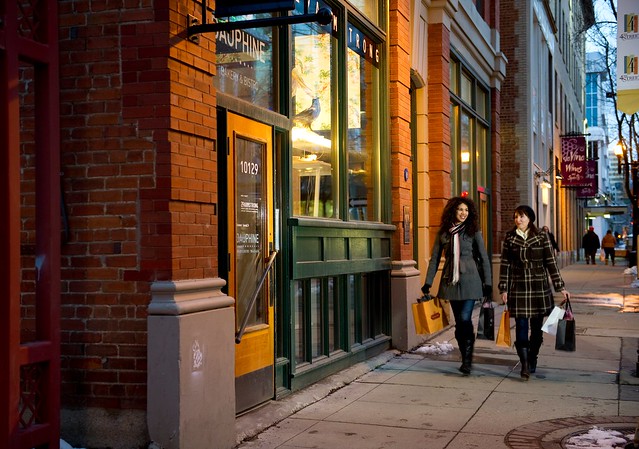
Shopping 104 Street
Shopping 104 Street, photo by EEDC

To me, noise and disorder isn’t really the issue here. Just as I don’t feel any sympathy for the people who buy a house near Anthony Henday Drive and then complain about traffic noise, I don’t feel any sympathy for those who bought a condo in the Fox Towers or any other nearby tower, just a stone’s throw away from the arena & entertainment district, with an expectation of peace and quiet. It’s simply unreasonable. This is the heart of our city and it should be a lively, vibrant place. I’m not saying that downtown should only be for singles or DINKs, but on the spectrum of neighbourhoods in the city I would not expect downtown to be at the slow and quiet end.

I’m also not convinced that a large bar is going to be so much worse than 20,000 people filing out of the arena on a regular basis and into the surrounding area, including plenty of people who have already been drinking all night inside the arena. I recognize that most events will end a lot earlier in the evening than a bar would close, and maybe the impact from arena patrons will be minimal. But I’m not sure that’s a bet I’d make.

We don’t know what kind of establishment would go into the Fox Tower. With an occupancy of 600 it is large, but far smaller than the combined occupancy of Knoxville’s Tavern and Studio 107 (formerly Oil City Roadhouse and Vinyl) at 1,600. Urban Sparq’s other properties include The Pint and Denizen Hall, both of which have much better reputations than Knoxville’s does.

As someone who has lived on 104 Street for five years, I can tell you it’s not always quiet or orderly now. Weekend evenings are frequently full of hollering from the throngs of people moving through the area, and I’ve walked around my share of puke. For the most part however, establishments on our street have been great neighbours. Most of the time you’d have no indication that Kelly’s Pub or Mercer Tavern or Cask & Barrel are on the street. They do a reasonable job of helping to make 104 Street the well-regarded area that it is and the new Purple Flag designation reflects this. I think a community working together to set reasonable expectations can go a long way toward preventing the kinds of issues that so many seem concerned about. But you need to have a dialogue to do that.

I think the way the proponents have gone about this is just ridiculous, and I think as a city we should use this as an opportunity to better define how we expect these sorts of proposals to come forward. Council squandered an opportunity to set expectations about large towers by approving the Emerald Tower last month, so I hope the City doesn’t waste this opportunity to demand more from developers looking to occupy those buildings. It’s unacceptable to avoid engaging the community and it’s even worse to try to hide your involvement altogether. It says a lot about the character of the proponents and is a major reason I am opposed to the proposals.

That said, the response from the 104 Street community thus far hasn’t been great either. The low bar set by the proponent has been matched with a “we must stop this at all costs” kind of approach, including action committees formed in many of the residences along the street specifically to fight this. Where’s the invitation for dialogue? Also, I don’t for a second believe that as many people checked the zoning before they bought into the street as one would gather from reading all the responses. NIMBYism is just as applicable downtown as it is in the suburbs, it would seem.

The most common refrain I have seen from those opposed to the proposal is that it is out of character with 104 Street and could undo the great work that has happened over the last 20 years. I have great respect for everyone who has had a role in making 104 Street what it is today, but to say that one establishment would destroy all of that strikes me as a bit alarmist. Especially considering the number of businesses that have failed on 104 Street or moved elsewhere in just the last five years alone.

The issue is not that a large bar is too dissimilar to the smaller, more intimate venues that we currently have on the street. It’s that a mega-bar like this would probably be more like Knoxville’s Tavern in that it would sit closed most of the time, meaning we’d have yet another downtown street front devoid of life. Paula wrote about this too:

“Giant big-box bars of this type tend to stay closed during the day — and sometimes during most weeknights. They often only open on Friday and Saturday nights. That means big hollow spaces sit vacant much of the week, draining life from the street. That’s not vibrancy at all.”

I get that the folks opposed are not saying they are opposed to vibrancy and business development in general. But it really comes off as, “as long as it’s vibrancy that we approve of.” Again, this could be an opportunity to identify what kinds of businesses we do want on the street and to then do something about it. How can we attract them?

Most of the discussion so far, as above, has been about the proposed bar for the Fox 2. There has been much less said about the bar proposed for the Mothers Music building, even though it is much larger and is potentially even more problematic. Consider that the building Knoxville’s Tavern currently occupies is slated to be demolished to make way for a new development and that the Subdivision and Development Appeal Board dismissed an appeal against the 388-seat Hudson’s that will open just down the block from The Pint on 109 Street. It makes sense to move the 1,000 seat Knoxville’s to the 1,400 seat Mothers Music building rather than to a smaller, more expensive location, and a proposal for a 600 seat bar on 104 Street at the same time seems like a perfect distraction. Instead of discussing whether or not we really want 2,200 licensed seats along the 109 Street strip from Jasper Avenue to 103 Avenue, the discussion is all about the supposed destruction of 104 Street. Which do you think would be worse for cleanliness, disorder, and safety?

On the Edge
On the Edge, photo by Dave Sutherland

Furthermore, there’s a bigger discussion here we should be having about the impact of Ice District. Will event-goers really need additional places to party after the arena closes? Should those places be in the district or elsewhere in the downtown? What is the impact on policing, transportation, and other considerations for each approach? These are all important questions that need exploration.

As I said, I am opposed to both proposals in their current forms. I think they would result in less truly vibrant streets and I think we should make an example of them to set expectations and to encourage higher quality proposals in the future. I am disappointed in the knee-jerk NIMBYism on display here though, and I’m concerned it is distracting us from the bigger picture. I think it is really unlikely the City will approve these variances, and I hope that once the rejections come through, we can continue the dialogue on some of the related and very important questions that these proposals have raised.
The beautiful symmetry of downtown Edmonton’s newest signs

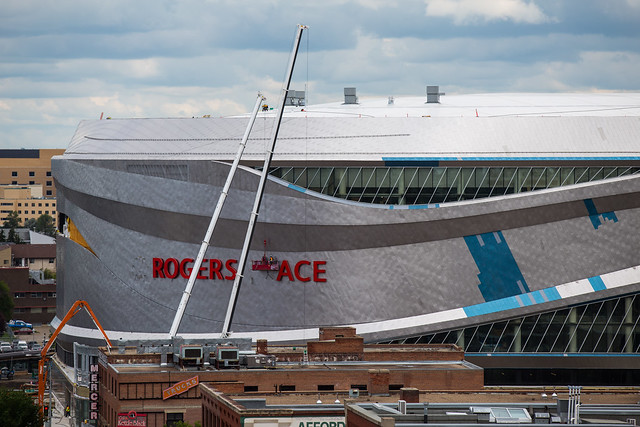
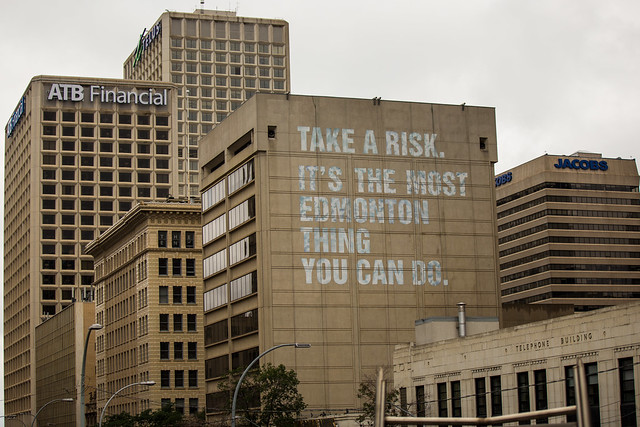
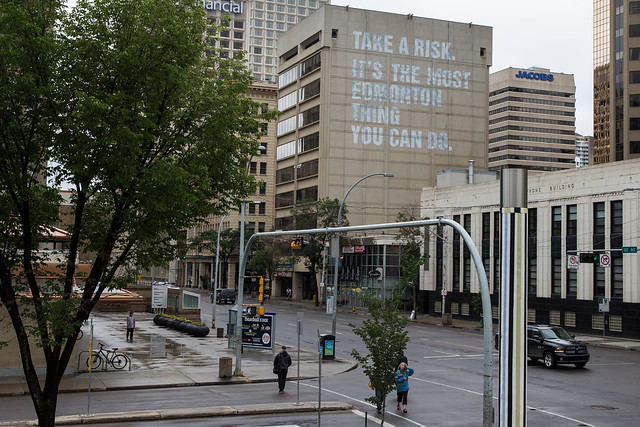
It’s probably just a coincidence that the signage on Rogers Place went up the same week as Melcor and Make Something Edmonton’s Wall of Encouragement did, but I think there’s a beautiful symmetry in that. With Rogers Place we have a shiny beacon of the megaproject-based transformation of downtown Edmonton, and with the “take a risk” words we see a physical reflection of the many smaller but no less important changes that are taking place. We need both.

Wall of Encouragement

Melcor and Make Something Edmonton collaborated with local designer Clay Lowe to install the new mural on the north facing wall of the 100 St. Place building. It reads, “Take a risk. It’s the most Edmonton thing you can do.” This is straight out of the Make Something Edmonton brand book, and while some see the mural as mere propaganada and a missed opportunity for “real art”, I like it.

“Risk taking is a fibre embedded in Edmontonians. It’s an entrepreneurial tick that each of us has, but only some of us listen to.”

The new mural was installed almost exactly five years after Todd Babiak spoke at Pecha Kucha Night 10 about “the wall” and interventions. He was referring to a different Melcor wall back then (the one behind the Edmonton Journal building) but his intent was always to impact more than the view out his window. Five years later, Make Something Edmonton carries the torch forward with partners like Melcor.

Wall of Encouragement

You can get a great view of the new mural from Churchill Square and the Tix on the Square building.

“Our aim is not only to encourage our citizens to take action on a project of their own, but also to challenge our fellow building owners to join us in treating empty walls as canvases for colour and inspiration.”

I hope this does indeed inspire some building owners to look at their exterior walls differently.

Rogers Place

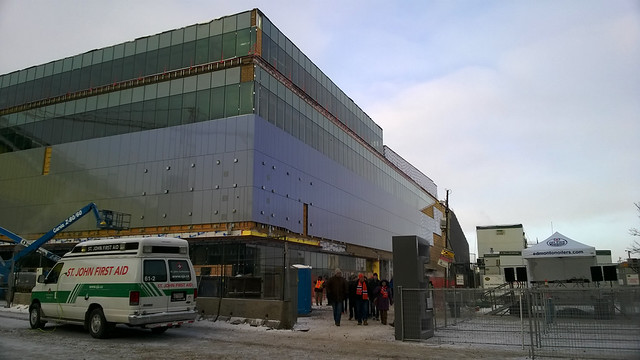
A few blocks away on 104 Avenue and 104 Street, construction on Rogers Place continues at a rapid pace. This week the “Rogers Place” signage started to go up on the west side of the building. It’s one of many milestones as the September 10 public open house approaches:

“With the letters going up, you can really start to see the building look like it does in the renderings,” said Mike Widdifield, Senior Project Manager for PCL.

I see the new arena every single day and I always feel like it is so much smaller than Rexall Place. But maybe that’s just because I’m used to it. From a distance, Rogers Place does indeed dominate the skyline.

Downtown Edmonton

The Rogers Place groundbreaking took place on March 3, 2014 and although it appears that the arena will open on time this fall, the construction won’t end there. The new Stantec Tower, JW Marriott hotel, Legends private residences, and many other projects will keep the area under construction through 2020.

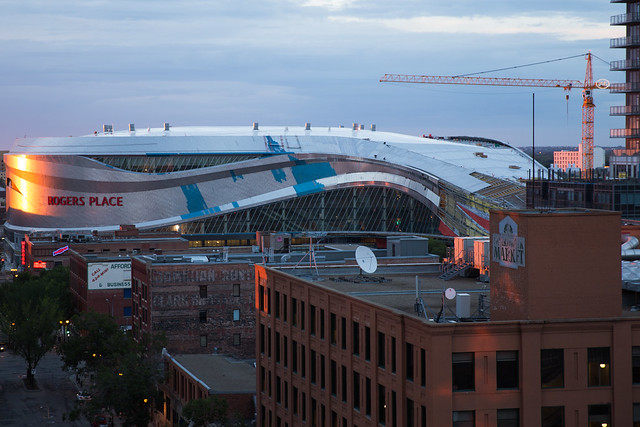
Downtown Sunset

Fewer blank walls and fewer surface parking lots (hiccups notwithstanding), that is downtown Edmonton’s future.

Coming up at City Council: May 2-6, 2016

The future of Edmonton’s LRT planning and funding will be one of the major topics for Council this week, alongside updates to the Capital Budget and a look at the funding impacts of the Federal budget. The downtown arena will also be before Council again, as there’s a bylaw to increase borrowing through the downtown CRL to make up for the Provincial funding that never materialized (but which was part of the original financial agreement).

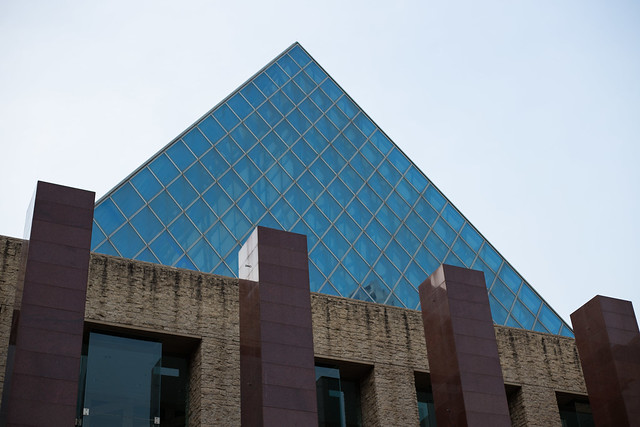
City Hall

Here’s my look at what Council will be discussing in the week ahead.

Meetings this week

You can always see the latest City Council meetings on ShareEdmonton.

Spring 2016 Supplemental Capital Budget Update

Part of the City’s budget process is to adjust the Capital Budget in the spring “in response to changing project needs, new funding opportunities and to respond to emerging issues and changing priorities.”

“The funding available for reallocation in the Supplemental Capital Budget Adjustment is $34.9 million, and is comprised of $10.3 million in Pay-As-You-Go funding, $20.6 million in Municipal Sustainability Initiative funding and $4 million of Neighbourhood Renewal Program tax levy funding (released from Profile 12-66-1073 Pavement Management Relocation), which will be directed towards the Neighbourhood Renewal funding deficit.”

Of that, $19.5 million is recommended to go toward the 2016 Neighbourhood Renewal Program shortfall (the $4 million plus $15.5 of the MSI funding). That leaves $15.4 million available for reallocation. The City is recommending using the funding as follows:

  • Manning Drive ($5.7 million)
  • St. Andrews Surplus Park ($0.8 million)
  • Bus Fleet Replacement ($4.9 million)
  • Fire – Dispatch System Radio ($1.5 million)
  • EPS – Helicopter Replacement ($2.5 million)

The report also notes that Edmonton is projected to see a $15 million decrease in MSI funding as a result of the 2016-2017 Provincial Budget and that Administration will bring forward a strategy to deal with this. You’ll also find an overview of projected savings, 2015 carry forwards, new profiles recommended for funding, and other information on changes to the budget.

One of the new profiles recommended for funding is Pedestrian Wayfinding (CM-21-6000):

“Edmonton’s streets and parks are envisioned to be vibrant places where citizens and visitors can walk, access public transit, visit local businesses, and live healthy active lives. The provision of accurate, consistent, public information to help people find their way to local destinations is a key element of improving the livability of a City. Funding this $2.6 million profile is recommended to come from two funded Transit profiles: LRT Facilities & Right of Way Renewal (CM-66-3200) & Bus Facilities Renewal (CM-66-3500) and one Information Technology profile Enterprise Applications Growth (CM-18-1508).”

I really hope that funding goes ahead!

Federal Transit Stimulus Update

This report looks at the most recent federal budget, which “announced $60 billion in new infrastructure funding, delivering on the new government’s promise to nearly double infrastructure spending over the next 10 years.” The plan will be implemented in two phases – the first will provide $11.9 billion over five years. Here’s what that means for Edmonton:

  • Edmonton will receive $50,000 in base funding plus about $140 million from the Public Transit Infrastructure Fund.
  • Alberta will receive about $196.7 million from the Clean Water and Wastewater Fund.
  • “Under the Public Transit Infrastructure Fund and Clean Water and Wastewater Fund initiatives, the federal contribution will be up to 50 percent of total eligible costs for projects, with eligible costs expanded to include design, engineering, and other planning costs not currently eligible for federal funding.”
  • “Federal Budget 2016 also announced $250 million for municipal capacity building programs to be managed by the Federation of Canadian Municipalities to provide funding directly to municipalities.”
  • “Removal of the mandatory P3 screen across the New Building Canada Fund, allowing municipalities to determine the best procurement model for their local circumstances.”

The report also identifies some potential projects that could be eligible for funding under these programs. For the Clean Water and Wastewater Fund, the only project identified is the Malcolm Tweddle/Edith Rogers Dry Pond at $20 million. For the Public Transit Infrastructure Fund, twelve projects have been identified:

  1. D.L. MacDonald Transit Yards Traction Power Substation ($5 million)
  2. Future LRT Planning, Phase 1 ($1.5 million)
  3. Future LRT Design Phase 1 ($32.7 million)
  4. Bus Replacement ($10.8 million)
  5. Growth LRVs ($116 million)
  6. Bus Camera Systems ($7 million)
  7. Growth Buses ($47 million)
  8. Bus Priority Signals ($2 million)
  9. Heritage Valley Transit Centre and Park and Ride ($29 million)
  10. Station Lands Pedway ($26 million)
  11. Electric Buses (No cost estimates)
  12. Design for the Refurbishment of Stadium and Coliseum Stations ($2 million)

The next step could be that Council chooses to submit some of these projects for federal funding.

Priorities for Future LRT Funding

Last week Transportation Committee discussed the priorities of future LRT funding. The City is recommending the following order:

  1. Valley Line, Downtown to Lewis Farms (LW-1, LW-2, LW-3)
  2. Metro Line, NAIT to Blatchford North (HNW-1)
  3. Capital Line, Century Park to Ellerslie (HSW-1)
  4. Downtown Circulator, University to Bonnie Doon (LE-1)
  5. Metro Line, Blatchford North to Castle Downs (HNW-2)

The item was referred to Council by the Committee without a recommendation.

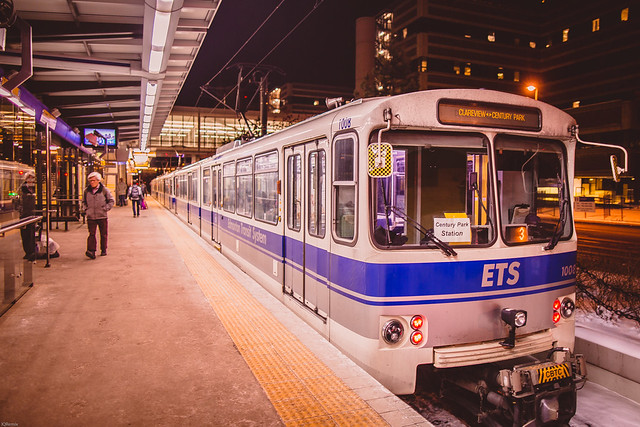
Edmonton Light Rail Transit
Edmonton Light Rail Transit, photo by IQRemix

There’s also a report on future LRT concept planning that identifies the remaining projects in order of priority:

  1. Downtown Circulator, Energy Line and Festival Line to City Limits
  2. Valley Line, Mill Woods to Ellerslie Road
  3. Capital Line, Gorman to Edmonton Energy and Technology Park
  4. Capital Line, Heritage Valley Town Centre to the Edmonton International Airport

Administration had identified $1.5 million for LRT concept planning in the 2016-2018 Operating Budget, but Council did not approve it. The service package will be updated and presented at a future supplementary operating budget adjustment.

Other interesting items

  • If Council approves, a Special City Council meeting will be scheduled for August 31 at 1:30pm to hold a non-statutory public hearing on Northlands’ Vision 2020.
  • Councillor Henderson intends to make a motion that would direct the City to investigate becoming a biophilic city, which are “cities that contain abundant nature; they are cities that care about, seek to protect, restore and grow this nature, and that strive to foster deep connections and daily contact with the natural world.” You can learn more here.
  • There’s a recommendation “that the Mayor, on behalf of City Council, write to the Minister of Environment and Parks, to advocate for the development of a regulatory compliance framework for commercial waste haulage and disposal that promotes sound environmental sustainability including incentivizing private haulers.”
  • Council had allocated $50,000 to the Downtown Proud program in 2013, but it was never spent as matching funds were not raised and circumstances changed. The City is now recommending that the money be used to help transition to a new fee-for-service delivery model and to ensure a “living wage” for program workers.
  • Bylaw 17639 would increase the borrowing authority for the downtown arena by about $32 million to replace provincial grant funding that was not secured. This bylaw is ready for first reading only.
  • Bylaw 17589 would designate Phyllis Grocery, located at 10631 96 Street NW, as a Municipal Historic Resource and would allocate funding of $91,822.50 from the Heritage Reserve Fund for the building. “The total estimated cost of the restoration portion of the project is over $183,000.”

Wrap-up

You can keep track of City Council on Twitter using the #yegcc hashtag, and you can listen to or watch any Council meeting live online. You can read my previous coverage of the 2013-2017 City Council here.

Rogers Place Sneak Peek (January 2016)

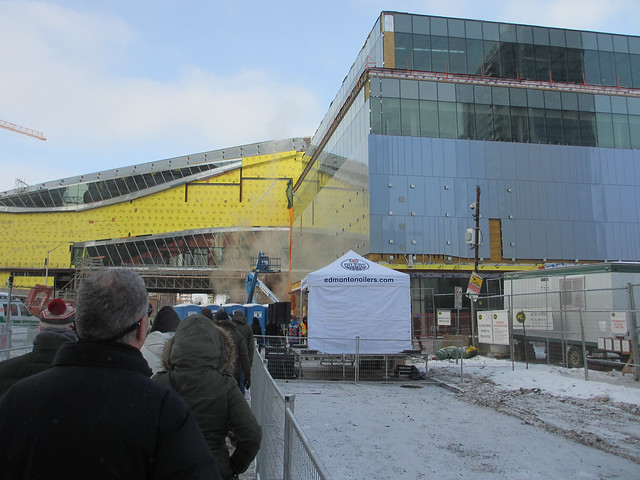
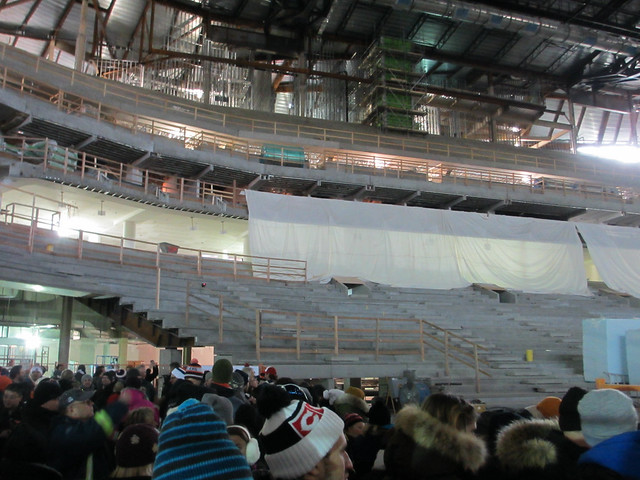
Today the City of Edmonton offered a sneak peek at Rogers Place, Edmonton’s new downtown arena slated to open in time for the 2016-2017 NHL season (there are 228 days until project completion according to the website). The $606 million project, which includes the arena, winter garden, community rink, LRT connection, and other amenities, has been under construction since March 2014. Today was the first time the public was allowed inside.

Rogers Place Sneak Peek
The Oilers flag at centre ice

I live just a few blocks away so have had an upfront view of all of the construction, but it was neat to get a look inside the building today.

Rogers Place Sneak Peek

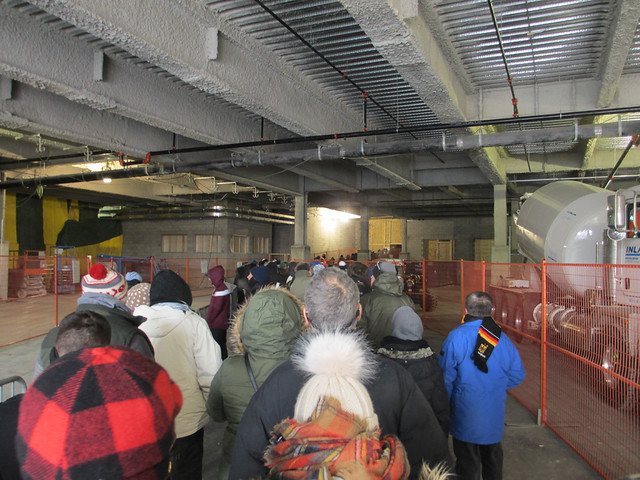
I think they were very well prepared to handle a lot of people today, but the cold temperatures probably resulted in a smaller turnout than originally anticipated. I arrived just before 11am and there were a few hundred people in line. When I left about 45 minutes later, there was no line outside.

Rogers Place Sneak Peek

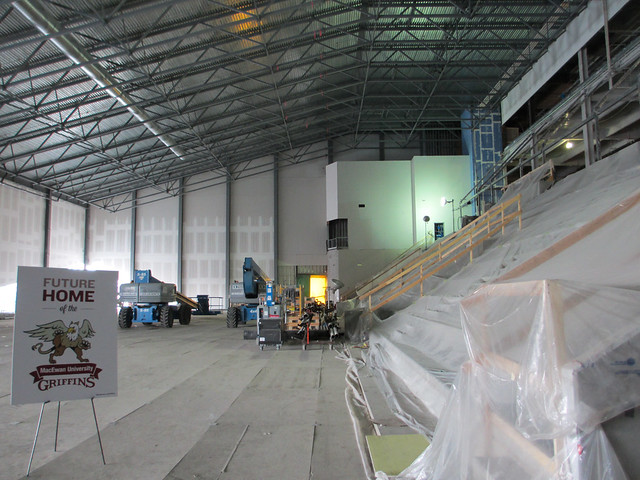
The project is being constructed on 9.5 acres of land right downtown and today we got to look at two elements of it. First, the community rink which will be home to the MacEwan University hockey teams. The rink will feature 1,000 seats for fans, and will be owned and operated by the City of Edmonton.

Rogers Place Sneak Peek

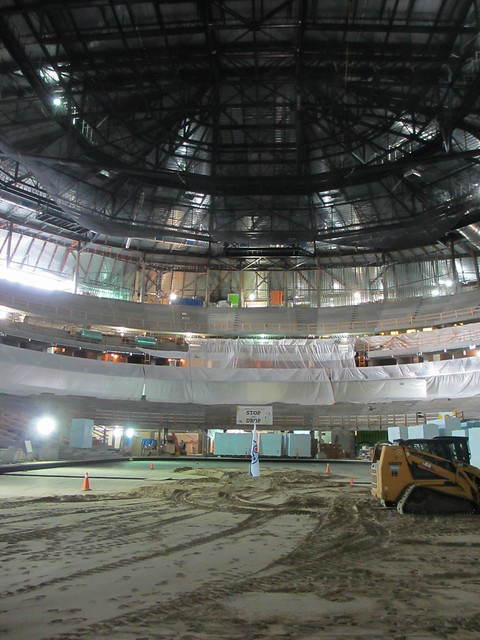
And of course, we got to step inside the main arena itself. Here’s a quick video of the view we had:

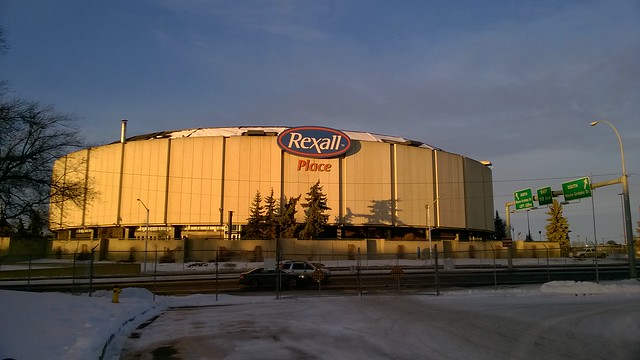
The building is 141 feet high, and I really felt that sense of scale today. The bowl feels rounder and more intimate than the current one at Rexall Place, even though the square footage inside the arena is 819,200 square feet compared to Rexall’s 497,700 square feet.

Rogers Place Sneak Peek

The capacity for hockey games is 18,641 but it can stretch to 20,734 in a centre stage concert setup or it can shrink down to about 4,500 for a small concert. Roughly 52% of the seats are in the lower bowl, compared to just 37% at Rexall Place, so more fans will be closer to the action.

Rogers Place Sneak Peek

There will be 56 suites and 24 mini suites in the new arena, plus 4,100 club seats and 1,116 loge seats. Oh, and those seats are all generally wider than the ones you’ll find at Rexall Place.

Rogers Place Sneak Peek
Bob Black explaining some of the features of the arena

Rogers Place is being constructed to the LEED Silver standard, as mandated by the City of Edmonton. There’s about 9,000 tonnes of structural steel and 24,000 cubic metres of structural concrete being used to bring it to life.

Rogers Place Sneak Peek

You can follow the construction at the Rogers Place website, and you can get all the facts on the project here. You can see more photos here.

Northlands Arena Strategy Committee Final Report Released

Today the Northlands Arena Strategy Committee released its final report which includes recommendations on the future of Rexall Place for the consideration of the Northlands Board of Directors. This brings our six month process to an end and I think provides the Board with some actionable, useful insight and analysis regarding what to do with Rexall Place. This is not the end of the road, but I think it is a major step toward resolving this important challenge for our city.

Rexall Place

You can download the full report in PDF here (warning: it’s large). You can also download the more reasonably sized report highlights in PDF here.

We are making two recommendations. Our primary recommendation is as follows:

“The NASC has highlighted that the current scenario surrounding a conflict oriented and competitive model specific to major sports and entertainment venues within the City of Edmonton has stalled progress; there is a need for a new approach. It is recommended that the Northlands Board of Directors consider a collaborative solution for the Northlands arena (Rexall Place) and define this possibility as two party or three party potential outcomes.”

Basically, if there’s a way to find a collaborative model that works, do so. The two party outcome would be a way for Northlands and the Oilers to work together to use Rexall Place in a way that is complementary to Rogers Place. The three party outcome would be an agreement between Northlands, the City of Edmonton, and the Oilers to find an alternative use for the building.

Fortunately, I think significant progress has been made on building the relationships necessary for a collaborative model to work. Here’s what Committee Chair Andrew Ross wrote in his summary (which you’ll find in the report):

“The NASC worked collaboratively and while we did not always agree we respectfully debated to find the right solutions; this final report has achieved consensus of the group. An unintended outcome developed throughout this process is the significant progress made to repair previously strained relationships between members of the Northlands Board of Directors and key stakeholders at the City of Edmonton and the Oilers Entertainment Group (OEG). Special thanks goes to Tim Reid, President and Chief Executive Officer of Northlands; Bob Nicholson, Vice Chairman of the OEG; Simon Farbrother, City Manager; and Mayor Don Iveson who have been willing to take a forward looking approach in the best interest of our city and the sustainability of the Northlands organization.”

If that collaborative approach does not work out, then we feel that the worst thing we could do is nothing. And so our secondary recommendation is vigorous redevelopment:

“If a redevelopment strategy is implemented the Northlands arena (Rexall Place) should be demolished and the land repurposed in a way that would complement the surrounding neighbourhood, act as a catalyst to stimulate development growth, and support the sustainability of Northlands.”

Though we did look at other models, it became clear to us that most of them are not desirable. Nobody wins in a competitive model, going dark would be highly detrimental to the community, and as mentioned, kicking the can down the road is possibly the worst decision that could be made.

The next step now is for the Northlands Board to decide which direction they want to go. I expect they’ll need some time to digest the report and its findings, and with the AGM and election coming up at the end of the month, it’ll likely be the new board that deals with the decision. Northlands has already been undergoing some strategic review and planning and I expect that work to continue into the fall.

I have really enjoyed my time on the Committee. The timelime we were working with was aggressive, but I think that brought an appropriate level of urgency to the process. I certainly learned a lot over the last six months, and I hope that I have made a meaningful contribution. I have quite a bit to say about Rexall Place and this whole challenge which I will share in the weeks ahead. For now, check out the report and let me know what you think!

Recap: Retrofutures – Edmonton’s Omniplex Debate

Last month I attended the first ever Retrofutures event, hosted by the Edmonton City as Museum Project. ECAMP is a project from the Edmonton Heritage Council that aims to tell the stories of the people, places, things, and moments that make Edmonton what it is. Retrofutures is a new event series they are trying to get off the ground.

The topic at this event was was the Omniplex, one of the big ideas that Edmonton was considering in the 1960s and early 1970s as the arena debate of that era raged on. The Omniplex was never built, of course, but that presents an interesting thought exercise – what if it had been built?

“The first Retrofutures project from ECAMP takes the case of Omniplex to explore these and other questions. When the idea was first hatched fifty years ago, Omniplex was one of the boldest ideas in urban planning in Western Canada.”

Dr. Russell Cobb has done some research on the Omniplex and started with a presentation on what the Omniplex was all about, as well as the context of the time in which it was being considered. If you haven’t already done so, check out his extensive piece on the Omniplex at The Wanderer.

Retrofutures: Omniplex

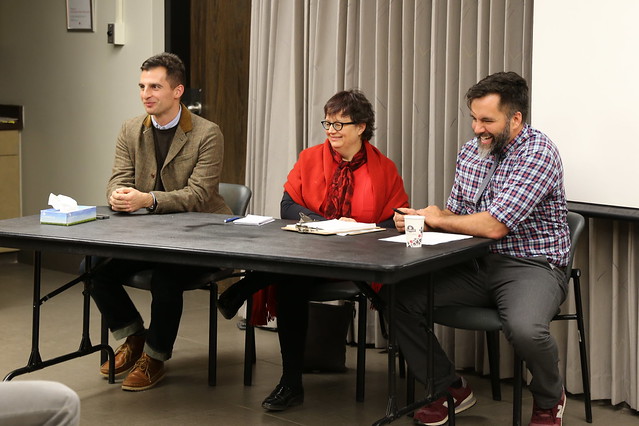
After the presentation, he led a panel discussion which featured Paula Simons and Alex Abboud. It was a great conversation, filled with interesting anecdotes and insights. Alex kind of took the position that we should have built it, while Paula took the opposite view. Much of the discussion centered around the impact the Omniplex might have had on downtown, and that raised all sorts of points about the LRT construction, West Edmonton Mall, etc. We also had a mock vote, to decide if we should have built the Omniplex or not. By a narrow margin, the room voted against the Omniplex!

If I have one criticism of the event, it’s that the Omniplex was talked about as if it was the only thing being considered at the time, when in fact it was just the most audacious in a series of arena proposals that failed before the Coliseum (Rexall Place) ultimately went ahead in the early 70s (it opened in 1974). I think you could look at three different plebiscites to support this.

The first took place in 1963. Voters were asked if Council should borrow $4 million to buy land for a megacomplex (which included an arena) to be built where the Citadel sits today. That vote failed. They were also asked if Council should borrow $10.25 million in debt to build the facility, and that vote failed too.

The second plebiscite took place in 1968. That time, voters were asked if they favored the construction of a “Trade Convention and Sports Complex” at a cost of $23 million to be operated at an annual deficit of not more than $2 million. That vote succeeded.

The third plebiscite took place in 1970 in a by-election, and that one was the Omniplex decision. Voters were asked if they wanted Council to borrow $26.4 million to construct the Omniplex – they said no. They were also asked if Council should purchase land north of the proposed site for parking. That vote also failed.

Throughout the decade, a series of arena proposals were put forward by local businessmen and politicians including Sam Hashman and Webb & Knapp. In 1966, after it was condemned by the fire chief, the Edmonton Gardens received a $670,000 renovation, extending its life a little while the arena debate continued. The Oilers moved to the Coliseum for the 1974-1975 season, and the Gardens was eventually demolished in 1982.

Retrofutures: Omniplex

ECAMP has said they plan to hold additional Retrofutures events in the future. Topics could include “what would Edmonton be like if we had not built West Edmonton Mall” or “what would have happened to Edmonton if the freeway through the river valley had gone ahead”. Should be pretty interesting! To find out about upcoming events, check the website and follow them on Twitter.

Have arenas on your mind? Northlands and the Arena Strategy Committee that I am a part of are doing an online survey on the future of Rexall Place. Fill it out and let us know what you think should happen with the arena! The survey is open until January 31, 2015.

Daryl Katz finally reveals some information about the Edmonton Arena District

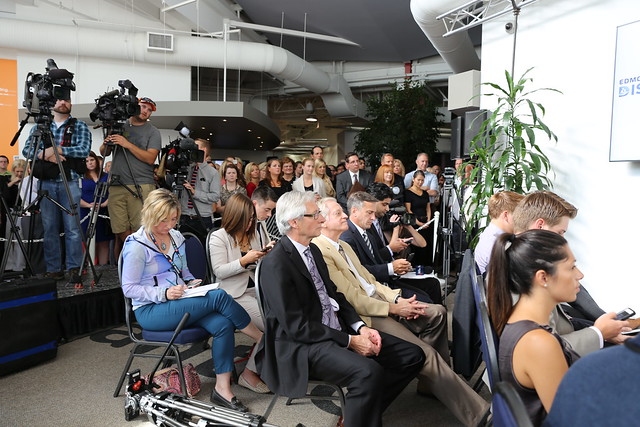
At a media briefing attended by a select few journalists on Thursday, Daryl Katz finally revealed some information about the Edmonton Arena District. The event was timed to coincide with the launch of the new district website that has lots of photos, videos, and other information about the project. It’s definitely worth checking out.

Downtown Arena Press Conference

He pitched the journalists on the scale of the project and the impact it’ll have on Edmonton, and judging by the words that were written, it sounds like he did a convincing job. But incredibly, Katz also talked about an apparent lack of knowledge about the district:

“We have a world-class sports and entertainment district under construction now in the city and nobody really knows about it.”

Surely he doesn’t think Edmontonians lack awareness about the district. There have been lots of opportunities to hear or read mention of it. For instance, the phrase “arena district” was mentioned in 251 Edmonton Journal articles since 2008. We just had a big flashy launch for the new Stantec tower. Before that there was the new City of Edmonton tower. People at least know that there’s this thing called the “arena district”.

So he must mean that no one knows about the specifics of the district. The overall design of the project, what it will include, that sort of thing. We still don’t know all that information. So the question is, why? Because Daryl Katz and his associates have never wanted to talk about it.

It’s not like the question was never asked. Despite it being critical for the CRL which will help to fund the arena, no one from the Katz Group has ever been willing to say much about the arena district. That’s why journalists couldn’t find anyone who was participating in the project. Whenever the question came up, the answer was always, “we’re not going to talk about the district today.” Only very recently did that become, “we will be providing details on [the district] soon.” If there’s a lack of knowledge about the project, that’s entirely because the Katz Group refused to share any information about it.

Daryl Katz

I understand that Daryl Katz wants to try to control the message as much as possible, and that’s his prerogative. But to lament that no one knows about it after intentionally keeping everyone in the dark? That’s rich.

Stantec looks to the future with its new tower in downtown Edmonton

The story behind downtown Edmonton’s new Stantec tower isn’t just about the arena, it’s about an Edmonton success story making a bold bet on the future of our city. Stantec is the largest architecture company in Canada, and they build communities all around the world from right here in Edmonton. They’re an important part of both our city’s history and its future.

Keith Shillington

“People know Stantec, but they don’t know Stantec,” Keith Shillington told me over coffee at Credo on 104 Street, just a few blocks from where the new tower will rise. “This is an opportunity to tell the story.”

From Dr. Stanley to Stantec

Stantec began life in 1954 as Stanley Associates, founded by Dr. Don Stanley. The company grew very successfully until the National Energy Program in 1983 hit the firm hard, forcing major layoffs. But they weathered that storm and rebounded in a big way. By the 1990s, the company’s various assets were brought under the umbrella of Stanley Technology Group, and in 1994 the company went public on the Toronto Stock Exchange. In 1998, Tony Franceshini became President and CEO and he launched the Stantec brand. He also articulated a goal for the company: to become a billion-dollar company by 2008. He retired that year having achieved his goal.

Today the company has about 14,000 staff working in more than 230 locations all around the world. The company is listed on both the TSX and NYSE and boasted revenue of more than $1.8 billion in 2013. And under current President & CEO Bob Gomes, Stantec has a new goal: to be a top 10 global design firm. His message on the website recognizes the firm’s rich history and its bright future:

“We take pride in a long history of being part of the communities we serve. We started in 1954 as a one-person firm founded in Edmonton by Dr. Don Stanley. Today we are a public company with a diverse portfolio of clients across many sectors and geographies, both in North America and internationally.”

You can learn much more about the evolution of Stantec on their website.

The search for a new home

Last year, Stantec began the search for a new home in Edmonton. The company currently has about 1,700 local employees spread across four different offices: Stantec Centre at 10160 112 Street, the Devonian office at 11160 Jasper Avenue, the Scotia Place office at 10060 Jasper Avenue, and the Bell Tower office at 10120 103 Avenue. Leases on all of those spaces come due by 2019, making it the ideal time to start thinking about consolidation.

Stantec Centre

The requirements Stantec outlined were vague. At least 300,000 square feet of space, good transit and transportation links, and good amenities. The location was not specified, with the company open to either downtown or suburban proposals, a position that led to great alarm among downtown supporters at the thought of losing one of our city’s major employers.

Keith led the team that undertook the search and ultimately selected the tower that was unveiled yesterday. He’s a Senior Vice President at Stantec, and in company parlance, Keith is a Geographic Leader of the Canadian Prairies and Regional Leader of Alberta North. He’s an Edmontonian, and a proud one.

“Imagine the statement it would have made if we had gone to the suburbs,” he said, saying that while the company stayed open to all possibilities throughout the search, their “hearts were downtown.” In all, Stantec looked at 15 proposals for a new space, 9 of which were located in the downtown area. “They really blew us away,” he said, noting the decision was not easy. “It was fun as an Edmontonian to see the possibilities.”

An iconic building?

When Stantec announced that the search for a new space was beginning, Keith spoke to the Journal about the company’s requirements. At the time, he made a surprising comment about the design of the new building:

“Again, it’s going to depend on what comes back and what developers are prepared to do to meet our needs, but to be honest, are we looking for the iconic ‘wow'”? he asked. “That’s actually not Stantec. That’s not our culture.”

He told me the comment caused quite a bit of discussion internally. “Boy did I hear about that from our design folks!” Still, he maintained that being iconic wasn’t the goal. “Iconic was not written into the RFP,” he said. “Height was not as important to us as having the right space for our staff.”

Keith talked a lot about meeting the needs of staff. For three years straight, Stantec has been named one of Alberta’s Top Employers, and it shows. The new building includes enough space not only for the roughly 1,700 current employees, but also includes room for growth. “It shows confidence in our future,” Keith said. They’re not ready to talk about the interiors yet, but there’s no doubt the design will be geared toward ensuring Stantec has a healthy, happy workforce.

Connected to the community

The new building needed to meet the needs of Stantec and its staff of course, but the company also wanted it to have an impact on the community. “It had to have meaning,” Keith told me. “It couldn’t be just another building.”

I asked him to elaborate on that in the context of Stantec’s culture. “Connected,” is the word he used. “Our connection with the community is strongest when we’re downtown.” He pointed to the existing office on 112 Street as an example. “It’s about the street,” he said, noting the company has programmed 112 Street for all sorts of events for staff. They’ve hosted extremely popular food truck gatherings, for instance. That connection to the street is one of the things that attracted Stantec to the arena district. “The plaza allows us to continue that tradition,” he said.

Stantec Tower

Another interesting aspect of the new tower is the residential component, which will fill the top 33 floors. “It wasn’t originally in the plan,” Keith told me, “but we were open to the possibilities.” It’s another way for Stantec to be connected with the community they’re located in. They’ve done something similar with their new offices in Winnipeg (which features a hotel instead of residential units).

The downtown advantage

Stantec is a major supporter of downtown already, with its existing offices and through its people. For instance, both Keith and Stantec VP Simon O’Byrne are members of the Downtown Vibrancy Task Force. But the company knew a tower provided an opportunity to do more.

Keith said there were many reasons that being downtown made sense for Stantec. “LRT was a big factor,” Keith said, and admitted it was why some of the other downtown proposals were ultimately ruled out. Being located close to multiple LRT connections was just too appealing. “Cycling routes are also very important,” he said.

Many of the firm’s clients are located downtown and many staff already live there. “Over 50% of our staff are under the age of 35,” he said, noting that increasingly they want to live in the middle of the action. He said being downtown was “a big factor” in thinking about retaining and attracting staff. The trend in cities like Toronto has been for companies to move their offices back into the core from the suburbs, specifically to better tap into the large pool of young, highly educated workers that want to live centrally.

Then of course, there’s the arena district. With the new City of Edmonton tower, a rumored hotel, the arena itself, and potentially more announcements on the way, it’s shaping up to be an exciting area for years to come. If we can pay for it, that is. Keith and the team at Stantec knew they could have a major positive impact by building their tower within the boundary of the CRL, which is a key part of the financing for the arena. “It’s another way for us to support downtown,” he said.

A lasting impact on Edmonton

There’s no question the new building will have a visible impact on Edmonton, dramatically altering the skyline for years to come. But Keith wants the building to change more than just the skyline. “I hope we can inspire others to do more,” he said. “We need to seize the opportunities in front of us.”

“We love what’s going on here in Edmonton, and we want to be part of it.”

Edmonton will officially join the skyscraper club with Stantec’s new tower

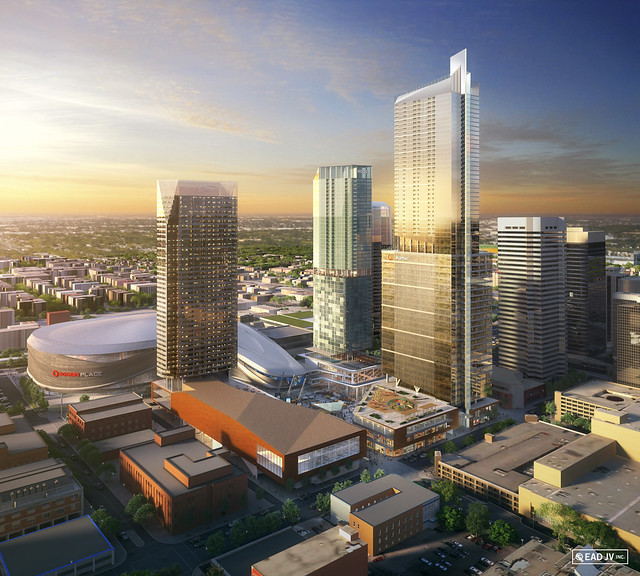
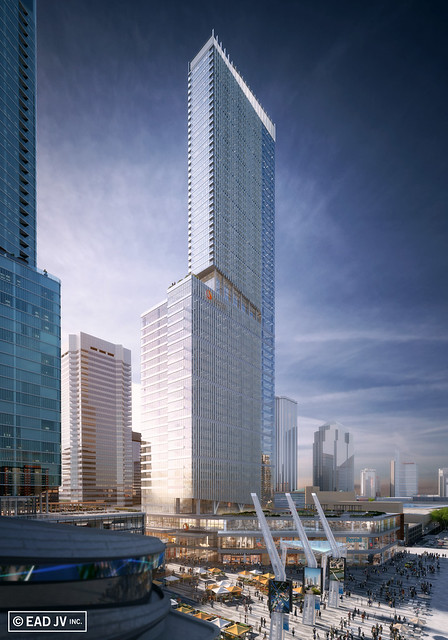
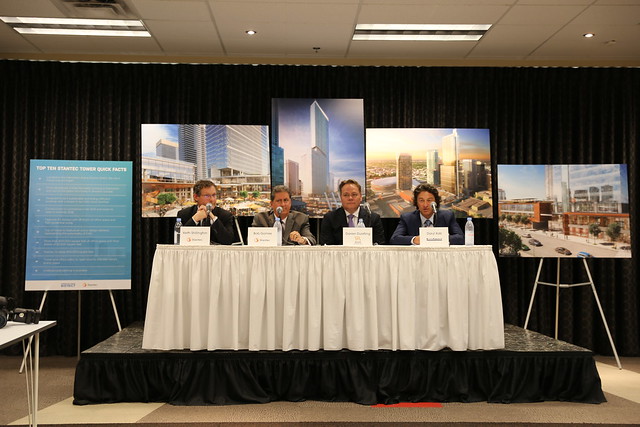
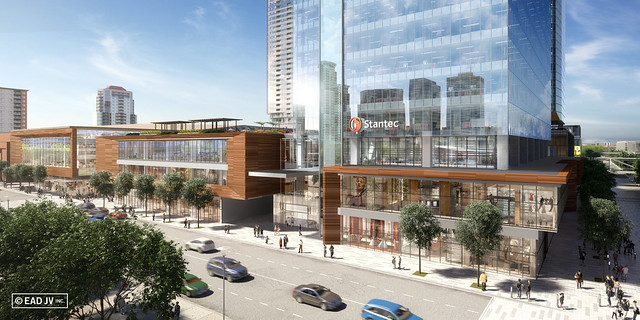
Stantec today unveiled their new headquarters, a 62-storey tower that will be built on the corner of 102 Street and 103 Avenue right in the heart of the Edmonton Arena District. Along with the Katz Group, WAM Development Group, and City of Edmonton, Stantec shared details on the new building which will be the tallest in Edmonton and one of the tallest in western Canada.

Stantec Tower

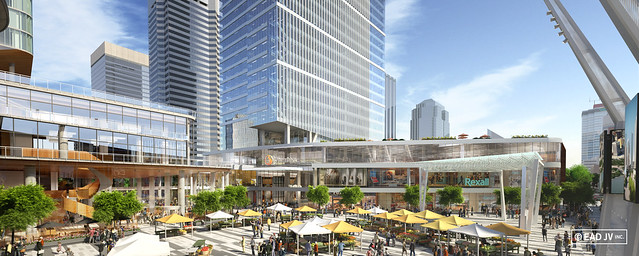
As expected, the new building will open directly into the public plaza in the Edmonton Arena District, and is being considered the “anchor” project. Construction on the $500 million project will begin this fall, with the new building slated to open in the summer of 2018.

It was back in June that City Council officially removed the Airport Protection Overlay, clearing the way for buildings higher than 150 meters to be possible. That height is significant. A building is generally considered a “high-rise” until it reaches 150m, at which point it becomes a skyscraper, at least according to most definitions. As of April 2013, there were 90 such buildings in Canada: Toronto has 56, Calgary has 16, Montreal has 9, Vancouver has 4, Mississauga has 2, and Niagara Falls and Burnaby each have 1. With the new Stantec tower, Edmonton will officially become a member of the skyscraper club!

Stantec Tower

The new tower will rise to 224 meters (or 746 feet), though officials today clarified that it could still rise higher. The design features 26 floors of offices and could accommodate another 2 floors if the market demand makes adding them feasible. The building will also include approximately 320 residential units taking up 33 residential floors. Another 2 floors are mechanical, and the first floor will feature retail.

“This new building will revolutionize the downtown landscape in Edmonton and will set expectations for future buildings in the city,” said Darren Durstling, President and CEO of WAM Development Group. “This tower is being designed, engineered and project managed entirely by Stantec, showcasing their vast capabilities and experience.”

The new building will have a dramatic effect on Edmonton’s skyline when it opens. The current tallest building in the city is EPCOR Tower, which rises to 149 meters (490 feet). Manulife Place, which was the tallest structure in Edmonton for 28 years, rises to 146 meters (480 feet). Down in Calgary, the iconic Bow tower rises to 236 meters (774 feet).

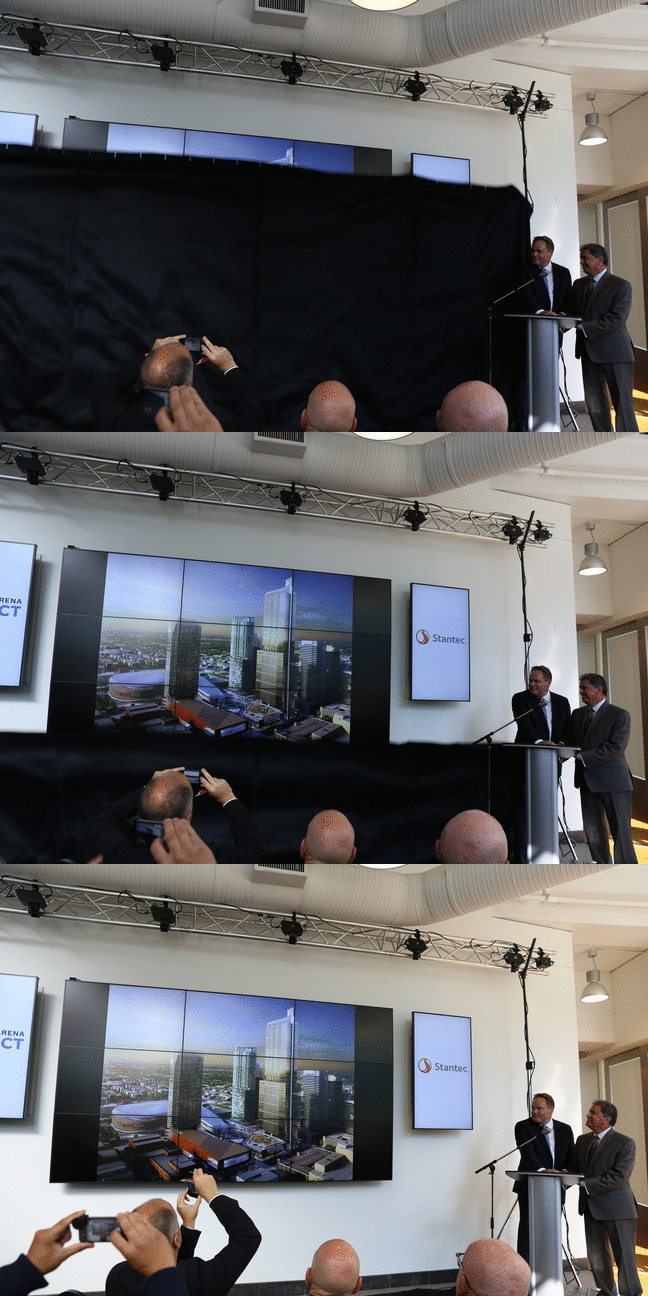
Stantec unveils new tower

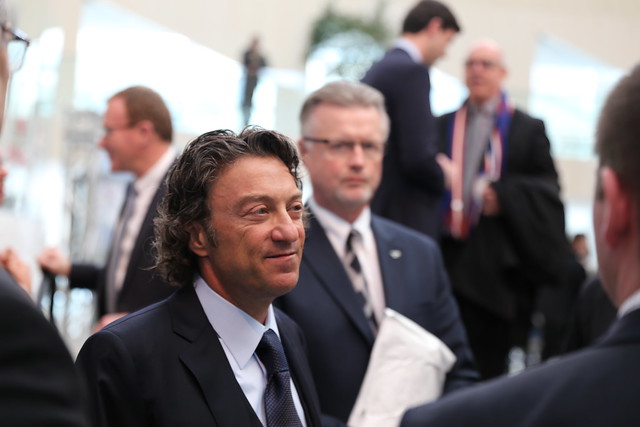
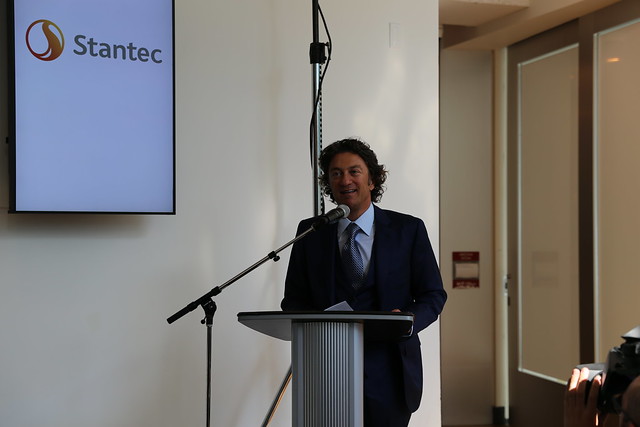
Daryl Katz said the new tower will “set the tone for new buildings in Edmonton for years to come.” He called it “an extraordinary addition” to Edmonton’s skyline. Mayor Don Iveson joked, “I’m a tall guy, but I am intimidated by this!” He highlighted the building’s impact on Edmonton, saying it will transform our city’s image across the country. “This is an indication of what the power of investment in our downtown can do,” he said.

Stantec Tower

Stantec is taking about 450,000 square feet of the new building, or approximately 19 floors. They have signed a 15 year lease which of course includes naming rights (the official name is yet to be revealed). Today’s announcement was hosted at Stantec’s head office on 112 Street, one of four local offices that will be consolidated into the new building. Dozens of Stantec staffers were on hand to witness the unveiling.

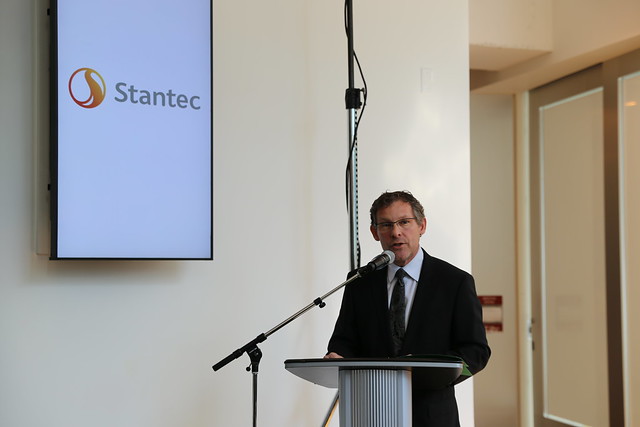
“We are proud to have both our people and our designer’s work play a role in enhancing the vibrancy of the Edmonton Arena District,” said Bob Gomes, president and CEO of Stantec.

You can see Gomes and WAM President & CEO Darren Durstling literally press a button to reveal the new building with this GIF. Stantec Senior VP Keith Shillington said “our hearts were downtown” while acknowledging the proposal received some stiff competition.

Stantec unveils new tower

I am very excited about this building. Stantec, one of Edmonton’s biggest success stories, is making a significant commitment to the future of our downtown. On top of that, this building is the first major private project in the Edmonton Arena District. During the press conference, Mayor Iveson did some back-of-the-envelope calculations to suggest that if Manulife Place currently contributes about $3 million in annual tax revenue, the new Stantec tower could contribute $4-5 million into the CRL. That’s extremely significant. Just as the Bow tower “paid for” the Rivers CRL in Calgary, the Stantec tower makes the success of the downtown CRL much more likely. And hopefully it’ll allow us to attract even more private investment. For me, the “district” just became real.

Stantec Tower

If you look closely in the renderings, you’ll see a building directly to the north that features the word “hotel” across the top. I understand that the next big announcement for the Edmonton Arena District will include details on the hotel. It’s a very exciting time for downtown Edmonton!

You can see more photos from today’s announcement here.