Recap: AccelerateAB 2018

AccelerateAB 2018 took place in Edmonton on April 24. The sold-out conference explored the theme of artificial intelligence and machine learning. As A100 Executive Director Cynthia van Sundert said in her message to attendees:

“Our province is home to some of the world’s leading thinking, research, and startups around A.I. It is fortuitous that this year’s event is being held in Edmonton, where the world famous Alberta Machine Learning Institute (Amii) – the global academic leader in A.I. – is located within the University of Alberta.”

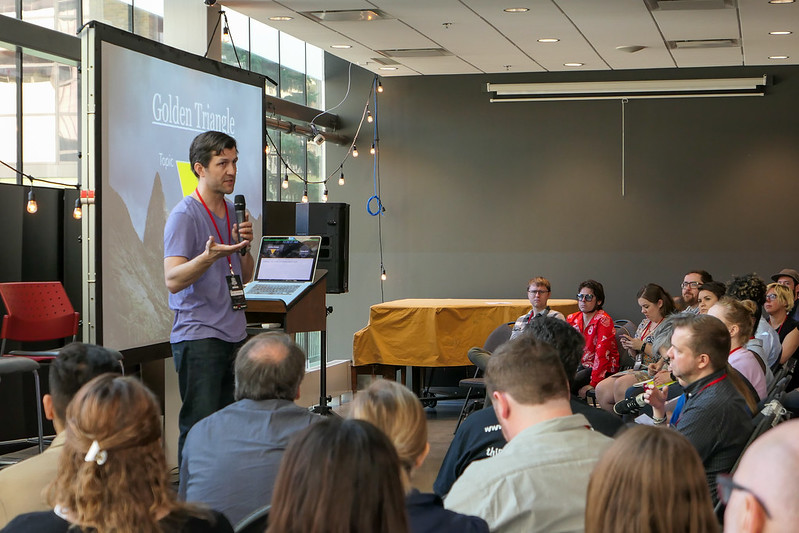
The annual conference alternates between Edmonton and Calgary, and always draws an interesting mix of leaders, investors, influencers, and entrepreneurs. The 450-ish in attendance at the Shaw Conference Centre this year were treated to an opening keynote from Scott Penberthy, Google’s Director of Applied AI, a series of AI-related panels, and a closing keynote with Dr. Richard Sutton, a Research Scientists with DeepMind at the University of Alberta.

AccelerateAB 2018
Photo by Pinstripe Productions

EEDC’s Cheryll Watson brought opening remarks, and encouraged everyone to “think of ways for Edmonton and Calgary to work together.” She spoke about having “an Alberta mindset” to be more competitive globally than just thinking about the two cities independently.

Rise of Software 2.0

Scott Penberthy opened his talk with some personal history, telling us how he was inspired by Marvin Minsky and Richard Stallman. It wasn’t long though until he was talking about scalars, vectors, tensors, matrices, and more. It was a bit technical for some in the audience I’m sure, but it served as a nice setup to the central premise of his talk: what if you could do math on thought?

“Artificial intelligence is an over-hyped but under-appreciated change,” he told the crowd. Noting that computing power has improved by a billion-fold since 1958, Penberthy highlighted some of the key advances in AI in recent years, including beating humans at image recognition in 2012 and winning at Go in 2016. He cited Ray Kurzweil’s Law of Accelerating Returns to help illustrate why further advances in AI will come more rapidly (and mentioned this video about a rock). Penberthy talked about AutoML, which is basically AI creating AI, as one such advance. He also showed some charts from the popular and accessible Wait But Why series on AI to really drive home the possibilities before us.

AccelerateAB 2018
Photo by Pinstripe Productions

“AI is going to be like having a database,” he said. “Soon every business will have this.” Penberthy devoted a good chunk of his time to explaining how AI will help businesses to be more competitive. He touched on TensorFlow, Google’s open source library for dataflow programming, and encouraged the audience to just start playing with the great tools that are now available. “Don’t build it from scratch, leverage existing AI technologies so you can focus on your differentiation,” he said. Kaggle is a good place to start, he suggested.

I appreciated Penberthy’s overview of AI, and also that he called out the success we’ve had here in Alberta in the field. “Canada saw it when no one else saw it.”

Key Takeaways: Panel Sessions

There were two AI-themed panels throughout the day: The Fundamentals of Artificial Intelligence and An Entrepreneurial Journey with Artificial Intelligence. Here are some key takeaways I noted:

  • AI is a very broad term, and machine learning is just one technique.
  • AI is at the nexus of many disciplines and fields, and provides us with techniques for intelligently making decisions using data.
  • Machine learning is useful when it is impossible to hard code a decision or when things are constantly changing, like in the real world.
  • Machine learning will find patterns in your data, but you can’t make inferences about the data that you don’t have.
  • You need to know why the data is important for the decision you’re trying to make.
  • Successful AI projects need both a well-defined problem and data in a usable format.
  • Opportunities include biomedical advances and personalized medicine, automation of boring, repetitive, and dangerous jobs, and ways for humans and machines to work better together.
  • The reason we have so much opportunity is because of the hardware – we simply didn’t have the power in the past.
  • Edmonton is the best place in the world to start a machine learning company!

AccelerateAB 2018
Photo by Pinstripe Productions

In the afternoon, the always popular Scaling Eff-Ups panel took place. Some key takeaways from that session:

  • Building a business is one of the most intense things you can do.
  • If you’re not making mistakes then you’re not reaching high enough.
  • Every industry is surrounded by patents so you need to do your homework.
  • Pay attention to the people around you and take action, but know that loyalty can be good too.

Much of the insight from the final panel could actually be boiled down to team selection. Many of the “eff-ups” the entrepreneurs discussed involved a member of the team who was selected hastily or who otherwise was not a good fit for the business.

Startup Pitches

The afternoon featured the startup pitch competition, a staple at the conference. There were pitches from 8 startups this year:

  • Fitset: “Experience fitness freedom with easy access to just about every studio & gym in Edmonton with Fitset.”
  • IronSight: “A service-hailing technology that strengthens the link between B2C through data-driven dispatching.”
  • MicroMech: “Redefining the auto service industry by sending auto mechanics directly to a customer’s door.”
  • Mikata Health: “Built a system sing machine learning that helps doctors and their administration teams to eliminate 1-2 hours of data entry each day.”
  • Paytickr: “A cloud-based service for small business that has combined time tracking and payroll distribution services into one platform.”
  • Skillpics: “A rich networking community where students can showcase their experience, portfolios, resumes and skills to potential employers.”
  • Symend: “A FinTech company that is successfully implementing recovery strategy by combining workflow and campaign automation with proven approaches in behavioural science.”
  • ShareSmart: “Mitigating costly healthcare data breaches with a system that allows healthcare professionals to take and share patient information securely.”

Each entrepreneur had a few minutes to deliver their elevator pitch, followed by a few minutes for questions from the three judges: James Keirstead, Kristina Milke, and Peter Calverley.
AccelerateAB 2018
Photo by Pinstripe Productions

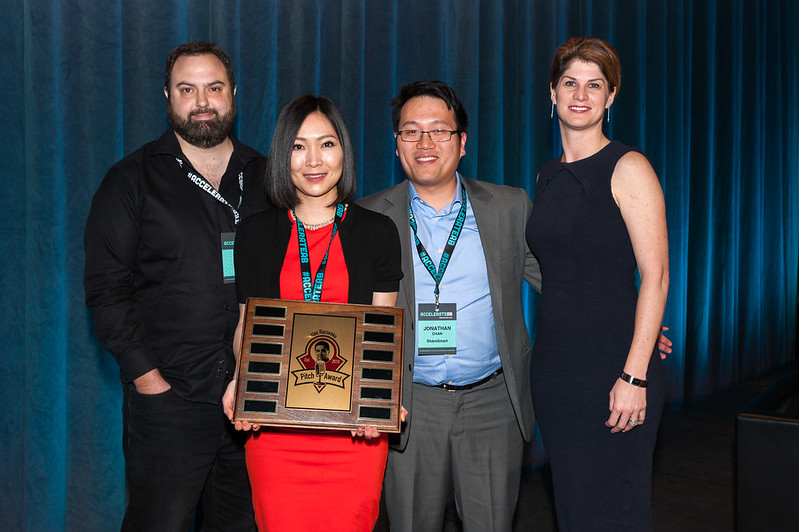
Congratulations to ShareSmart on being named the winner! They took home more than $15,000 in cash and prizes, including a $10,000 micro-voucher from Alberta Innovates.

Wrap-up

I previously wrote about Dr. Richard Sutton’s closing keynote on how Edmonton is a world leader in the science of artificial intelligence. You can also check out this Twitter thread on his talk fro Alex Kearney.

Our city’s leadership position in the field (and indeed, Alberta’s) is a key strength that we need to be proud of, and to leverage. It was great to see AccelerateAB shine a light on this. You can find out more about Edmonton’s AI pedigree at Edmonton.AI, a community-driven group with the goal of creating 100 AI and ML companies and projects.

AccelerateAB 2019 will be taking place in Calgary. Follow them on Twitter for updates!

Recap: DemoCamp Edmonton 41

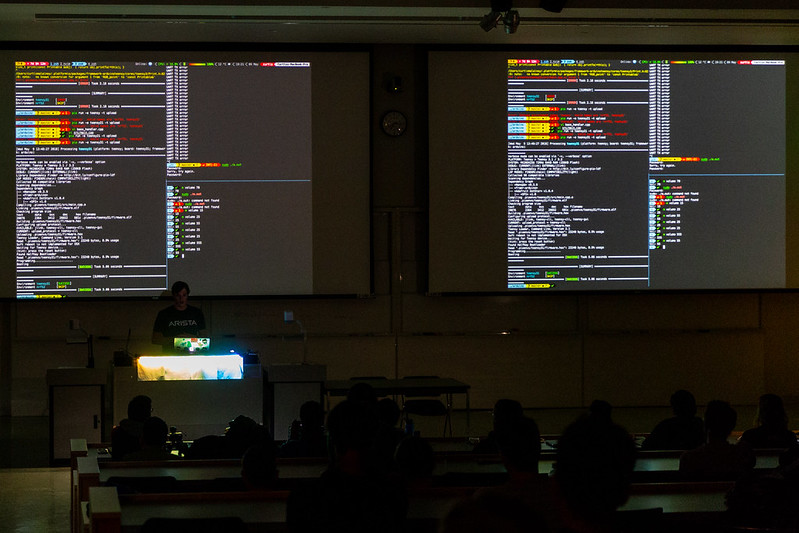
Edmonton’s 41st DemoCamp took place last night at the Centennial Centre for Interdisciplinary Sciences (CCIS) on the University of Alberta campus. You can see my recap of DemoCamp Edmonton 41 here.

Centennial Centre for Interdisciplinary Science

If you’re new to DemoCamp, here’s what it’s all about:

“DemoCamp brings together developers, creatives, entrepreneurs and investors to share what they’ve been working on and to find others in the community interested in similar topics. For presenters, it’s a great way to get feedback on what you’re building from peers and the community, all in an informal setting. Started back in 2008, DemoCamp Edmonton has steadily grown into one of the largest in the country, with over 200 people attending each event. The rules for DemoCamp are simple: 7 minutes to demo real, working products, followed by a few minutes for questions, and no slides allowed.”

It was one of the quickest DemoCamps in recent memory – I guess everyone wanted to get to drinks! We had five demos, in order of appearance:

Paulie Blart is a Raspberry Pi-based robot that was built for the SF Hacks hackathon in just 24 hours – and it won! The robot uses IBM’s Watson services to do facial recognition and when an intruder is detected, it can send you a text that includes a picture of the intruder. The robot can also be controlled by sending it a “start” or “stop” text message. Cool stuff! In his post about the win, Megnath wrote: “A special thanks to the talented and vibrant Edmonton tech community (Startup Edmonton, UofA CompE Club, etc) for organizing local hackathons and encouraging students like me to aim bigger.”

The Bylaw Infraction Dashboard uses open data from the City of Edmonton’s open data catalogue to visualize bylaw infractions. The dashboard includes a number of visualizations and they’re connected – so you can slice and dice the data by clicking on one visualization and seeing the rest update. It reminds me a lot of the way that Power BI can work. I enjoyed Michael’s story about seeing other data visualizations and getting inspired to build his own. Whether he realized it or not, his demo was a good commercial for the open data catalogue too!

Go With the Flow is a fun project that controls an LED light strip based on the audio coming from your computer. Each LED represents a single frequency, so as the sound changes, the lights get brighter or dimmer, and the color changes. Curtis demoed it with some music and also the Avengers Infinity War trailer. Always fun when we get to turn the lights down at DemoCamp.

DemoCamp Edmonton 41

IdyaFlow is software for peer-to-peer marketplaces. It’s not another place to list your couch for rent, but it can help you build the site on which you might do that. If you have a community of buyers and suppliers, then IdyaFlow can provide the technology to help you connect them. It has a focus on real-time messaging to help facilitate those community interactions. At first I was wondering if there’s actually a market for this, but when you think about it, there are hundreds of “Uber for X” type businesses, and they all have more or less the same technical requirements/features. So building a generic backend that can service them all just might work.

I think Rewardful has a lot of potential, and I am eager to see how it evolves. The service provides “a simple way for SaaS companies to setup affiliate and referral programs with Stripe.” Currently it supports a commission-based approach, but there are plans to add other possibilities like extending an existing subscription or flat referral fees. There are some companies in this space already, but if Rewardful can keep it simple and developer-friendly (like Stripe itself) I think there’s plenty of opportunity.

I always enjoy when there are a mix of hardware and software demos, and also experiments or “for fun” projects vs. actual businesses.

Here are some upcoming events to note that were mentioned in-between demos:

See you at DemoCamp Edmonton 42 in September!

JW Marriott Edmonton tops off in ICE District

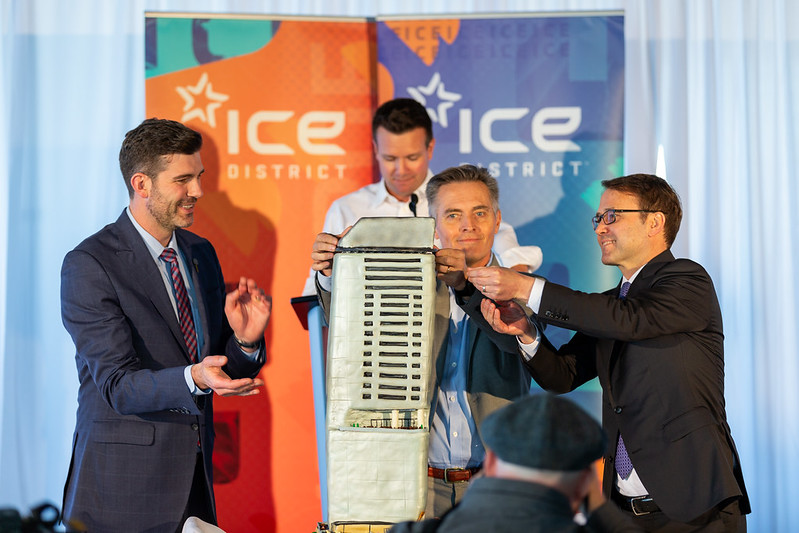
A topping off ceremony was held today for the new JW Marriott Edmonton ICE District, located on the corner of 102 Street and 104 Avenue downtown. The building is currently the tallest tower in Edmonton, though it will relinquish that title within the next month or so when the new Stantec Tower, currently under construction right next door, surpasses it. Media and VIPs were invited to the 46th floor for the ceremony, where the “topping off” was done symbolically with a cake from Whimsical Cake Studio.

Symbolic topping off

At 56 storeys high, the building will consist of 22 floors of hotel space topped by The Legends Private Residences above. The new hotel is currently slated to open in March 2019 and will be “the first modern luxury hotel built in Edmonton and one of only three JW Marriott branded hotels in Canada.” It will feature 346 rooms, roughly 22,000 square feet of meeting and conference space, a giant 10,500 square foot ballroom, a state-of-the-art fitness centre, and at least four different restaurants. The private residences above will feature 262 condo units and include access to the amenities offered by the hotel. They’re slated to open after the hotel, sometime in 2019, and are currently 90% sold.

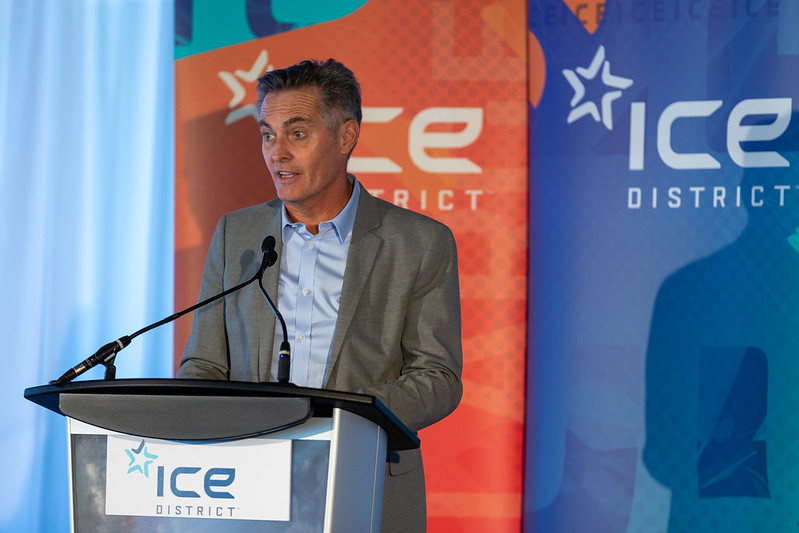
“To be topping off the first luxury hotel alongside The Legends Private Residences in ICE District demonstrates the transformation that is occurring in our downtown core,” said Glen Scott, president of Katz Group Real Estate.

Glen Scott

Getting off the construction elevator on the 46th floor, I was struck by how small Manulife Place looks. For years it was the tallest building in Edmonton, but now it is dwarfed by the new towers.

Manulife Place

I mean, since when can you see the top of Manulife Place?!

JW Marriott

There wasn’t much to see inside as the building is very much under construction still (the topping off simply “marks the completion of the structural phase of the building”) but they did have some display boards setup to show renderings of what the final product might look like. Most people were happy enough to just take in the incredible views, however.

ICON Towers in front of the Legislature & High Level Bridge

From that vantage point you see just how flat and spread out Edmonton is. At the same time, it makes the city feel a little smaller, as if it is all within reach.

Blatchford, also under construction, is clearly visible:

Blatchford

From that height you get a very unique perspective on Commonwealth Stadium and Northlands Coliseum:

Commonwealth Stadium & Northlands Coliseum

I also enjoyed the view of 104 Avenue and Oliver:

104 Avenue

You can see more photos from the event and of the views here.

Media Monday Edmonton: Update #295

Here’s my latest update on local media stuff:

PodSummit
Roger Kingkade speaking at PodSummit on Saturday, May 5

And here is some slightly less local media stuff:

Follow Edmonton media news using the hashtag #yegmedia and be sure to check out Mediagazer for the latest media news from elsewhere. You can see past Media Monday Edmonton entries here. If you have a tip or suggestion for future updates, let me know.

At Taproot Edmonton we’re working hard to ensure that local journalism has a future in our city. Join us to be part of the movement.

Thanks for reading! Want to support my blog? Buy me a coffee!

Edmonton Notes for May 6, 2018

Here are my weekly Edmonton notes:

Headlines

JW Marriott Hotel and Stantec Tower
JW Marriott Hotel and Stantec Tower, photo by Kurt Bauschardt

Upcoming Events

LRT Construction at the Harbin Gate

Thanks for reading! Want to support my blog? Buy me a coffee!

World Password Day 2018

There really is a day for everything and today it’s World Password Day! With the beautiful weather we’ve been having lately you’re probably thinking about cleaning, gardening, and all of the other renewal-driven projects that this time of year brings. Though we’d rather be outside, spending a few minutes to “spring clean” your digital security is well worth it.

This is also a good time to remind yourself to be on the lookout for fraud – I’ve received email scams recently related to the Canada Revenue Agency and tax time. Stay alert, and don’t fall for it!

According to the annual fraud survey commissioned by the Chartered Professional Accountants of Canada, “more than seven-in-ten (71 per cent) of those surveyed agreed that they are concerned about identity theft.” Almost four in ten respondents fear their personal information has already been compromised! Protecting your personal information is important, but with so much of our lives online now, it can be difficult.

security

Having strong passwords (and password hints, security questions, etc.) and good password management practices are critical for protecting yourself. Unfortunately, too many people simply don’t pay enough attention to this. It doesn’t have to be difficult or time consuming to make some simple changes that will really make a difference.

Here are my tips!

Use strong passwords and change them semi-regularly

According to Troy Hunt, a security expert who built and operates Have I Been Pwned (more on that in a minute), most passwords are terrible. “In other words, 86% of subscribers were using passwords already leaked in other data breaches and available to attackers in plain text.” The top ten includes passwords like “123456”, “qwerty”, and the ever-popular “password”.

Don’t use those passwords! Instead, generate a unique, strong password for every account you use. There are plenty of tools to help you generate passwords that are strong and that match the varied requirements that different sites have (like length, special characters, etc.). Here’s the one I use from LastPass.

It’s important to use a different password for each account. That way, if one site is compromised, your credentials can’t be used to get into other sites too. It’s also a good idea to change your passwords once or twice a year, to decrease the likelihood of a compromise. Of course, if you know a service you use has been hacked, you should change your password there right away.

Get a password manager

With a different, randomly generated password for each account, how do you remember them all? You can’t. This is where a password manager comes in! Think of it like a digital vault in which you store all of your account credentials. Then instead of remembering each one, you only need to remember the master key that you use to get into the vault.

There are a number of good password managers out there like 1Password, Dashlane, and Passpack. I use and recommend LastPass. All of them provide tools to generate strong passwords, encrypt and store them, offer browser extensions and mobile apps to make logging in easier, and typically provide ways to securely share passwords with others. One of the cool features LastPass offers is Security Challenge, which analyzes your passwords and gives you a score along with step-by-step instructions on how to improve your passwords.

While there are pros and cons to each service and their various philosophical approaches to storing your data, I don’t think you should spend too much time worrying about that. You can get a more secure solution if you’re willing to do some work and give up some convenience, but if it becomes too cumbersome to use, then what’s the point?

Use a passphrase for your password manager

With a password manager you only need to remember one password – the one to get into the password manager! So you should make it as strong as you can. One way to do that, while still ensuring it is memorable and easy to type, is to use a passphrase instead. Whereas a password is a random list of letters, numbers, and symbols combined, a passphrase is more like a sentence, though it can still have those elements.

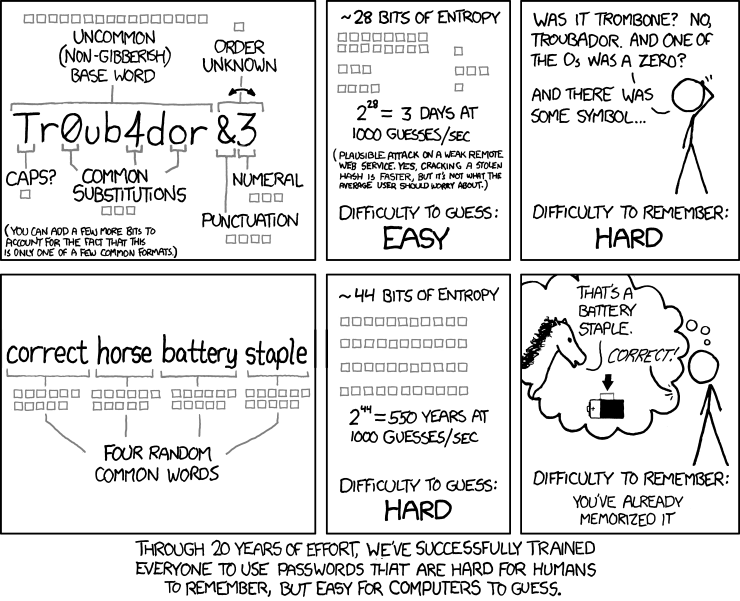
password strength

So a passphrase might look like: “trusted walrus shows off 500 petty limes”. I generated that using this Passphrase Generator, but there are plenty of other tools you can use. The key is to not use a phrase or sentence that is common or easily guessable. It should be nonsense! You can also consider running it through the Pwned Passwords tool to see if it has ever been exposed in a data breach.

Don’t use real answers for security questions

So now you have strong passwords and a password manager to help you organize them. The front door to your digital home is secure, but what about the back door or the side doors? Many sites will require you to set some security questions in case you forget your password or sometimes to confirm you are who you say you are when logging in from a new location. Don’t answer them!

Well, don’t answer them factually. Instead, generate a new random response for each question and store them in your password manager! This way, if an attacker figures out your mother’s maiden name or your favorite school teacher or your first car, the information won’t help them break into your accounts.

Turn on multi-factor authentication

Another thing you can do to improve your online security is to use multi-factor or two-factor authentication wherever possible. This means that in addition to your username and password you need another piece of information to login, usually a generated code of some kind. Most of the big sites like Facebook and Google support this, and it only takes a few minutes to enable. If you have the option of using SMS or an app, go with the app. I recommend the Microsoft Authenticator app which you can download for Android, iOS, and Windows Phone.

You can see a full list of websites that support two-factor authentication here. If nothing else, turn this on for your email accounts (Gmail, Outlook, etc.) and Facebook or any other site you often use to login to other sites. Of course, you should also enable this for your password manager!

Get educated and stay informed

Once you have done the above, stay informed. It doesn’t have to be all boring technical stuff, a lot of great information has been made available that is much more accessible. Here are some suggestions:

That’s it! Happy World Password Day – stay safe!