Keeping my desktop computer fresh with recent upgrades

Yes, I still have and use a desktop computer. This post might be a little geeky for some of you, but I wanted to document this!

I bought my current desktop computer back in June 2010. It’s a Dell Studio XPS 9000 and I paid just over $1,500 for it at the time. I ordered it with a Core i7-920 processor (it’s a quad-core) and 12 GB of DDR3 SDRAM, so it was pretty powerful right from the start. I also included an NVIDIA GeForce GTS 240 video card and 1 TB 7200 RPM SATA hard drive.

Dell Studio XPS 9000

I have upgraded it over the years, which is one of the great capabilities that a desktop offers. I’ve added additional hard drives for data, I updated my dual monitors to 23″ displays, and I’ve added lots of peripherals like webcams, and various mice and keyboards. I have also upgraded the OS of course, from Windows 7 to Windows 8.1, and I plan to upgrade it again to Windows 10 when it is available later this year.

My desktop will be five years old this summer, and I have thought about replacing it. But I have also thought, as a I do more with mobile devices, that perhaps I don’t need a new desktop. Maybe I could extend the life of this one instead?

The main limitation to further upgrades is the motherboard, which only supports the LGA 1366 socket for processors. That limits me to Core processors built back in 2011, as it has now been replaced by LGA 2011 and LGA 1150. I think the best processor I could get to replace my existing one is the Core i7-990X, released in February 2011, but availability is limited and prices are high. It just doesn’t seem worth it.

So after I eliminated the processor as a potential upgrade, I started to think about what else might give me a performance boost. The first thing I decided to do was add a USB 3 controller to make importing photos and video quicker.

inateck usb 3.0 expansion card

I did a bit of research and landed on the Inateck Superspeed 4-port PCI-E to USB 3.0 Expansion Card, which I got for $26.99 CDN on Amazon. I wasn’t familiar with Inateck, but their stuff seemed to have a ton of positive reviews. Installation was quick and straightforward, and Windows 8.1 recognized the card right away. I did experiment with a couple different driver versions, and found the best performance using the latest driver (unsurprisingly).

I have both an external USB 3 hard drive and a USB 3 hub hooked up to the card now, and everything has been working great. Even though it is hidden away under my desk, I like that the card has a dark face; it’s interesting and different. This was definitely a worthwhile and pretty inexpensive upgrade.

Speeding along with an SSD

After I had the USB 3.0 upgrade working, it didn’t take long to land on the hard drive as a possibility for the next improvement. I had been reading about solid-state drives and I knew that having an SSD could make a big difference with start and load times. I’ve always marvelled at how quick my Surface Pro starts up and I’m sure the SSD plays a big role in that.

So I decided to purchase an SSD. I went with a Samsung 250 GB 840 EVO, which I got at Memory Express for $149.99. It seemed like pretty good price for a reasonable amount of space and solid performance. It’s not the biggest or fastest SSD, but it’s definitely not the smallest or slowest either.

samsung evo 840 ssd

I already had one drive for the OS and applications and one for data, so I just replaced the OS drive with the SSD. I decided to do a fresh install of Windows 8.1 and all my apps, because I had read some negative things about trying to do a migration or backup/restore. Now clearly a fresh install of Windows 8.1 will make a difference when it comes to performance, but not this much!

Before the upgrade it took:

  • 43 seconds to get to the login screen
  • 23 seconds to get from the login screen to the desktop being visible
  • 2 minutes, 46 seconds until startup was done

After the upgrade (and after installing all updates and all the usual software I use) the times are:

  • 23 seconds to get to the login screen
  • 4 seconds to get from the login screen to the desktop being visible
  • 23 seconds until startup was done

That’s a big, very noticeable improvement (and yes the stuff running on startup is comparable if not identical). Application launch times are also noticeably quicker now that they are running from the SSD. Overall I’m really happy with the upgrade. It was definitely worth the money!

Will I have a desktop computer in the future?

This may be the last desktop I’ll ever own, actually. The performance and capability of mobile devices has come so far, there’s less and less need for standalone desktop machine. I can already use my Surface Pro for pretty much everything. Combined with external displays and input devices, it could definitely serve as my one and only computer.

On the other hand, the cloud is (for me at least) dramatically changing how I think about my devices. The days of “that’s on my desktop” or “that’s on my laptop” are long gone. So are the days of “that’s on my USB key”. Now my stuff is available on every device all the time, and the definition of “my stuff” is expanding too. With OneDrive, my files are accessible no matter where I am. When I log into Windows with my Microsoft account, my settings and apps are also available. When I sit down at my desktop computer, it looks pretty much the same as when I am working on my Surface. In other words, there’s no need or advantage to having just one computer.

So maybe it does make sense to have a computer that just sits at my desk, permanently hooked up to large displays and the ergonomic mouse and keyboard that I love. Maybe it’s more accurate to say that the my current desktop is the last “tower” that I’ll ever own. I have been looking at is Intel’s “Next Unit of Computing” or NUC form factor. The idea is basically to shrink the desktop down into something that fits in your hand. I can imagine having a powerful, tiny box on the corner of my desk to drive a few large displays. They’re relatively inexpensive too. One day maybe.

Until then, I’ll make the most of these recent upgrades to my desktop!
Edmonton wants to tap into local creativity with labs

The City of Edmonton is hoping to tap into the creative ideas and energy of Edmontonians with two new lab initiatives. Open Lab aims to “create unique technological solutions for municipal challenges” while CITYlab will “advance conversations around urban planning.” Both initiatives, if successful, will change the way the City does business. The hope is that a healthy dose of innovation will be injected into the organization to ultimately result in better, more efficient outcomes for citizens.

Open Lab

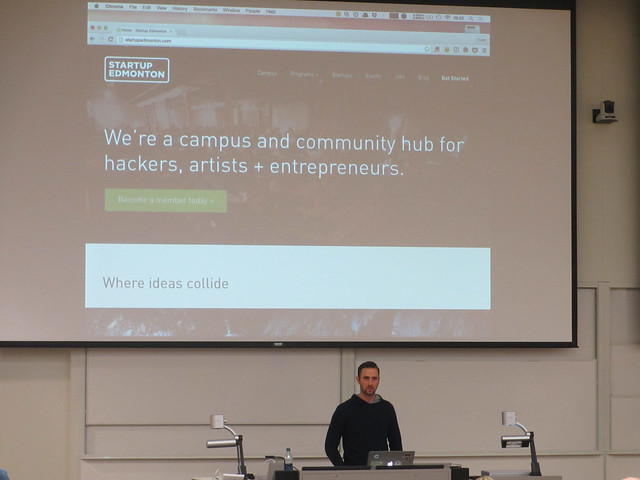
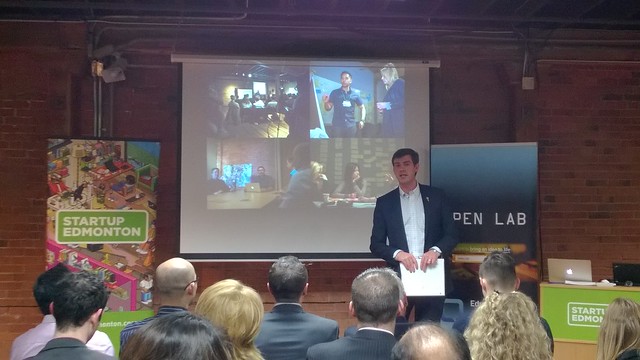
The program room at Startup Edmonton was packed yesterday for the launch of Open Lab. Mayor Don Iveson, Startup Edmonton’s Ken Bautista, a few other speakers shared an overview of what the program is and what they’re hoping to achieve with it.

Open Lab Launch

So, what is Open Lab?

“A physical and virtual space where City employees and Startup communities can work together to create innovative solutions to municipal challenges. It is a unique continuous innovation program that combines local government, open data, smart creatives, and lean startup culture to build new products that improve the citizen experience.”

Open Lab is part of the Open City Initiative, which launched back in June. It’s also a partnership with Startup Edmonton, and that’s what makes it different from previous attempts at this same idea.

Startup Edmonton believes there are three main ingredients for a thriving entrepreneurial community: people & innovation, community & collision, and leadership & growth. They believe in the importance of thinking bigger, valuing community, and building to scale.

  • “Smart creatives solve big problems.”
  • “Entrepreneurship is a team sport.”
  • “Entrepreneurial leaders grow & scale companies.”

One of the ways Startup tries to implement these principles is via the lean startup approach. The goal with Open Lab is to add some of that lean startup culture into the City. There are three main components to the initiative:

  • Collision Days – Deep dive events where startups and SMEs discuss technologies, tools, and issues impacting a particular industry or community.
  • Open Lab Accelerator – Helping teams learn how to use lean startup methodologies, customer development, and validate what products to build in the first place.
  • Leadership Program – Developing product managers and leaders inside the city who build and test ideas like startups, using prototyping, behaviour science, and design thinking.

The Open Lab Accelerator is not unlike Preflight, the successful Startup Edmonton program that has helped local success stories like Poppy Barley.

Open Lab Launch

Michael Strong, a planner with the City of Edmonton, was one of the speakers at yesterday’s launch events. He was sort of the guinea pig for Open Lab, and he described how the approach helped his team think about new ways of achieving one of their objectives, which is to get people using and thinking about LRT in a different way. They have mocked up an app that would combine the “get me from A to B” and “what’s around me” approaches to help people more effectively use the LRT.

As I indicated above, this isn’t the first time the City has tried to tap into the local startup community. I am reminded somewhat of the lackluster Leveraging Technical Expertise Locally program, for instance. I think what’s different this time is that everyone involved recognizes the biggest hurdle is culture. And certainly Startup Edmonton has demonstrated success with getting people to think differently in a way that gets results.

Another big difference from the past is that the City has continue to embrace open data and there’s a lot more to work with now than there was six years ago. There’s a greater understanding of what open data is, what the benefits are, and how the City can work together with citizens to get things done. Indeed the news release highlights the recently launched 311 Explorer as one example of “how City data can be useful to everyone.”

So I am optimistic about Open Lab. If you want to find out more in person, Startup Edmonton is hosting a series of Open Lab Meetups on the last Thursday of the month from 2pm to 5pm. Open Lab representatives will be there to hear your ideas and visions and to help guide you.

CITYlab

I have been hearing about CITYlab for months now, but no one could give me a clear description of what it was. In retrospect, that’s probably because no one knew! They had an idea but weren’t sure where to take it. Now CITYlab has found an anchor, in the Open City Initiative, and the City is ready to start experimenting with a new approach to placemaking.
citylab

From the news release:

“CITYlab will partner with groups and individuals on projects and events that test or support the City’s urban planning goals. CityLab will serve as a resource for Edmontonians with creative and new urban planning ideas.”

The aim is to be a “laboratory to support and create small, temporary projects, activities and events to advance conversations around urban planning.” They want to make urban planning fun, as difficult as that might sound!

You might expect a project like this to rely heavily on techology, but CITYlab’s first experiment is decidedly analog. Starting on March 7, CITYlab will be distributing self-addressed stamped postcards across the city. If you get one, they want you to write down your urban planning ideas or projects and send it back. All of the returned postcards will be used to make a temporary art installation, and CITYlab is committing to undertaking at least one of the ideas or projects suggested. If you’re so inclined, you can also submit a project idea online.

citylab

One of the folks behind CITYlab is Jeff Chase, a senior planner who you might know from Edmonton’s NextGen or #yegsnowfight. He is a big supporter of Make Something Edmonton and understands the value of a different way to engage citizens on urban planning. “These creative new approaches to planning will help us meet the challenges that our city faces as it grows,” he said in the news release.

CITYlab still feels a little nebulous to me, but at least it’s out in the open now. If citizens are willing to get involved, it feels like there’s an opportunity to help shape and define the initiative further.

You can follow @PlanEdmonton on Twitter for updates, or check out the #yegcitylab hashtag. You can also email citylab@edmonton.ca if you want more information or two request a postcard.

Taking steps to become an Open City

Here’s what I wrote about the Open City Initiative back in June:

“I like the direction outlined in the Open City Initiative, unfortunately I just don’t have much confidence that it’ll go beyond a report and lots of talk.”

I questioned whether the report would sit on a shelf or if its goals and objectives would be resourced and actioned. With the launch of Open Lab and CITYlab, I’m now a bit more confident that the Open City Initiative will have a real impact. These are tangible projects that I think will make a difference.

I’m excited to see how this unfolds!

Coffee Bureau and Lock Stock Coffee have revived Edmonton’s coffee district

There’s a buzz downtown and it’s not just because of all the construction taking place. It feels like Edmonton’s coffee district is back now that two new independent coffee shops have opened! Coffee Bureau and Lock Stock Coffee are now open on opposite sides of Jasper Avenue just west of 105 Street. I checked out both locations this week.

Coffee Bureau

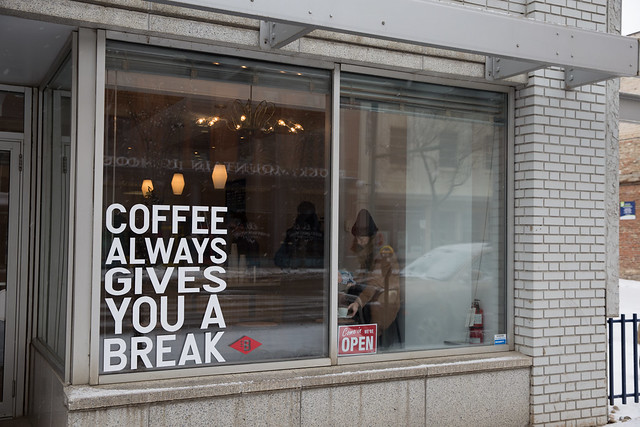
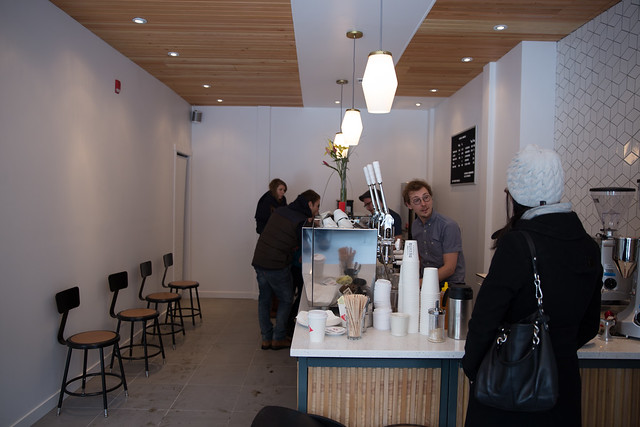
Coffee Bureau is located on the southwest corner of Jasper Avenue and 105 Street in the Dental Building. It’s a small cafe with minimal seating and big windows.

Coffee Bureau

They serve ACE Coffee (Twitter, Instagram), a new local roaster from the folks behind LEVA Cafe. You’ll find a small selection of pastries too, like carrot-pineapple muffins and butter tarts.

Coffee Bureau

Couple Peter and Criss are the duo behind Coffee Bureau. Peter was formerly a barista at LEVA Cafe.

Coffee Bureau’s hours are subject to change, but currently they’re planning to be open from 7 AM until 5:30 PM during the week, and 9 AM until 3:30 PM on Saturday. Follow Coffee Bureau on Instagram and on Twitter.

Lock Stock Coffee

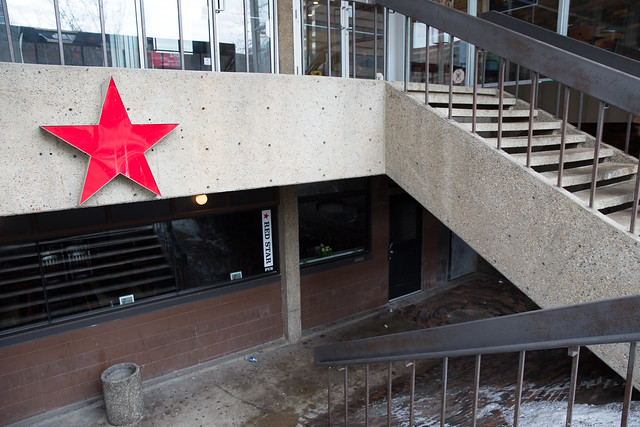
Almost directly across the street from Coffee Bureau is where you’ll find Lock Stock, nestled in-between Bower and Red Star Pub (which it is technically a part of). There’s a separate door though; it’s the dark one under the stairs to the right.

Lock Stock Coffee

Lock Stock serves Danesi coffee, which is an Italian roast that began in Rome in 1905. They also have pastries, baked in-house by Jesse who doubles as the barista (I hear the carrot cake is delicious).

Lock Stock Coffee

Red Star’s Sal Di Maio is the man behind Lock Stock. He told me they soft-launched a couple weeks ago and wanted to build up quietly. Now they’ve decided on the name and will be making themselves more known (they just started tweeting today).

Lock Stock will be open from 8 AM until 3 PM during the week, with Red Star opening at 4 PM. Follow Lock Stock Coffee on Twitter.

Edmonton’s Coffee District

It was just last fall that Burrow opened in Central LRT Station, and Transcend opened in the Mercer Warehouse on 104 Street, so it has been a great few months for Edmontonians looking for a caffeine fix downtown. I used to call the area around 104 Street the coffee district back when we had Roast and Transcend, but when they closed I figured it was no longer an appropriate title. Fast forward to today, and I think we can safely say the coffee district is back!

Here are the cafes you’ll find in the few blocks surrounding 104 Street:

  • Credo Coffee on 104 Street – the heart of the district, in my opinion
  • Transcend Mercer at 104 Street & 104 Avenue
  • Second Cup on Jasper Avenue between 103 Street and 104 Street
  • Remedy Cafe on Jasper Avenue at 103 Street
  • Coffee Bureau on Jasper Avenue at 105 Street
  • Lock Stock Coffee on Jasper Avenue between 105 and 106 Street

Also on 104 Street you’ll find Cavern and Dauphine, a cheese shop and bakery, which both serve a great cup of coffee.

Venture just a tiny bit further and you’ll find even more cafes. I suppose you could consider all of downtown the coffee district, from 101 Street to 109 Street, as Sharon does.

On the east side you’ll find Starbucks at the Empire Building, HSBC Bank Place, and City Centre on 101 Street, and of course there’s Second Cup, Good Earth, and two Tim Horton’s at City Centre too. Underground you’ll find Burrow and another Second Cup at Telus Plaza. There’s another Good Earth in Scotia Place. On 102 Street inside Commerce Place you’ll find Tim Horton’s, Starbucks, and McDonald’s (which has a separate McCafe counter).

On the west side, you’ll find Tim Horton’s and Starbucks on 107 Street, Good Earth on 108 Street, Second Cup on Jasper Avenue just west of 108 Street, and of course District on 109 Street.

And who knows what’ll come to the Edmonton Arena District in 2016! Good Earth has already listed a location opportunity for that area.

Lock Stock Coffee

A couple of other coffee-related items worth mentioning:

And with that, I’m off to drink another coffee!

Recap: DemoCamp Edmonton 27

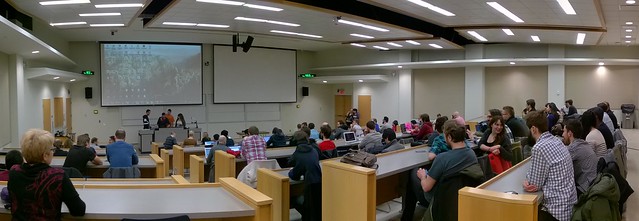
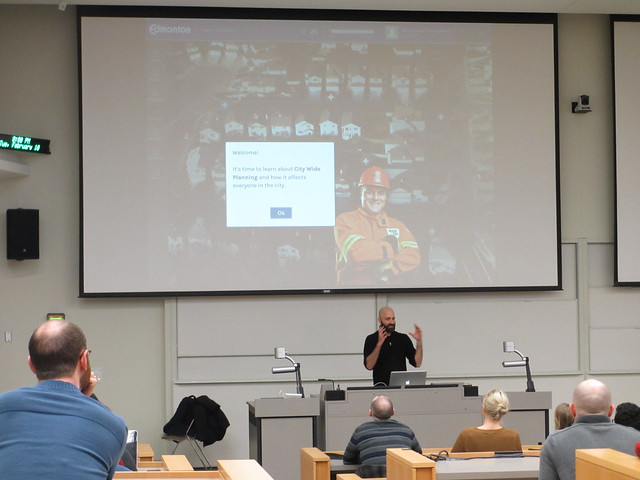
Edmonton’s 27th DemoCamp took place tonight at the Centennial Centre for Interdisciplinary Sciences (CCIS) on the University of Alberta campus. It was hackathon night at DemoCamp, as more than half the projects demoed were created at a hackathon of some sort.

DemoCamp Edmonton 27

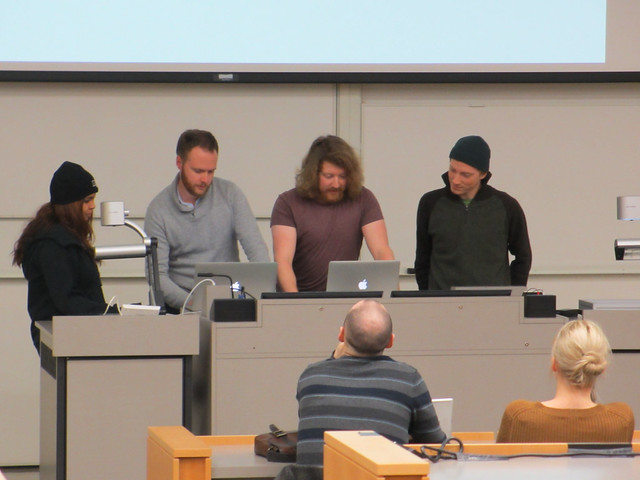
Teams from two local hackathons that took place recently were on hand to demo tonight. First was the MADJAM Global Game Jam hackathon that took place over the January 23 weekend. It had 72 participants and 15 teams that took part.

“MADJAM is an Edmonton-based, year-long event that is made up of quarterly game jams, each associated to a global or local event. At the end of each jam, the games will be judged by our panel of experts and voted on by the public. The developers of the best games will be awarded points. These points accumulate and the developers with the most points by the end of the year will win totally rad rewards!”

Their next event is coming up the week of April 26 – May 3, called GDX Super Jam.

The other hackathon was the HackED Computer Engineering Club Hackathon, which took place on January 31. About half the participants in that hackathon were software based, the other half were hardware based. The hackathon offered $2,000 in prizes and just 24 hours to build something cool.

In order of appearance, tonight’s demos included:

DemoCamp Edmonton 27

The Bees is a game that has you controlling a swarm of bees after the hive has died. “The bee colony must forge on, in hope of escaping a terrible fate,” the description reads. The team used an iPhone to compose the music, and built their game using the Unity engine. The bees swarm because the emit pheromones, and to keep the game interesting, the team made the seasons change. They focused on what could be done in just 48 hours. Wondering how the game ends? Well no matter what you do, the bees die! In a future version, they’ve talked about maybe having nanobots instead of bees.

DemoCamp Edmonton 27

After Hours was also powered by Unity, and is a side-scroller not unlike Super Mario Bros. The team wanted the game “to be tough but fair” and also wanted it to be complete. They decided to do pixel art, because it went well with the music. They added a multiplayer mode too. The goal of the game is basically to make it through the level before the time runs out. If you do, you get to go for a drink!

DemoCamp Edmonton 27

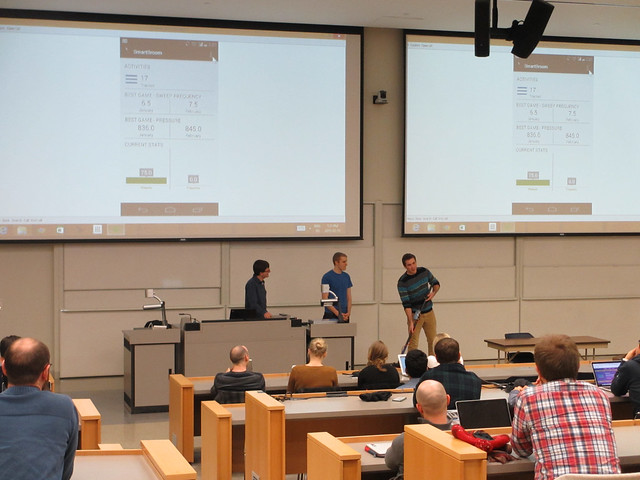
The third demo was my favorite of the night – Broom Blaster. It won second place in the HackED hackathon and is essentially a tracker for curling brooms. Inspired by the Fitbit, Jacob, Jared, Stephen, and their fourth teammate decided to add pressure and motion sensors to a broom that could be paired with a smartphone over Bluetooth low energy. The system tracks both frequency (how many times you sweep) and pressure (how hard you sweep). The team wanted hardware that could be added to an ordinary broom, to make it more cost effective. The app collects the data, and can give training and coaching information. A possible future upgrade? A speaker, so the broom can yell “hurry hard!” at you.

DemoCamp Edmonton 27

Fourth was SafetyNet by Jobber. Ben demoed his app, which is essentially an online utility to backup your data from QuickBooks Online. He built it at a recent Intuit conference that featured a hackathon and took home the $15,000 prize in the new app category. For some reason QuickBooks Online doesn’t already have a backup feature, so Ben used the REST API to create one. He had just 36 hours to build it, but was able to come up with a simple-to-use but efficient tool. Built in Rails with Bootstrap on the frontend, the app encrypts the data and offers one click to save and one click to restore.

DemoCamp Edmonton 27

Our fifth demo was WANDA. Built by Visionstate (with some help from Dark Horse Analytics), WANDA is an interactive touchscreen for washroom management. Carolyn showed us how it can be used to give patrons an easy way to submit a request for cleaning or to alert staff that a resource (like toilet paper) is low. When staff go to clean the washroom, they use WANDA to record what they did and when they did it. You’d probably think twice about touch a screen in a washroom, but WANDA features an antimicrobial overlay on the displays. The backend dashboard by Dark Horse lets you make sense of the data, such as determining optimal cleaning times.

DemoCamp Edmonton 27

Our final demo of the evening was Trajectory from Rocketfuel Games. Matthew showed us a few examples of how Trajectory can make training and certification much more enjoyable and effective. Instead of just embedding a PDF on a web page and telling new recruits to go read it, Trajectory can make the experience much more interactive. Everything a user does is tracked, including how they take to do it, but that data isn’t visualized just yet – that’s coming next.

DemoCamp Edmonton 27

A few upcoming events were mentioned. Startup Weekend EDU Edmonton is taking place at NAIT from March 6-8, and will be a great opportunity for transforming your idea for improving education into reality. The first ever Polyglot Alberta Unconference is taking place in Calgary on March 28 (and will alternate between Edmonton and Calgary). Preflight Beta is taking place at Startup Edmonton again on February 19, and is a great opportunity to learn about the Lean Canvas Model. And finally, on March 21, Startup Edmonton is hosting the Student DevCon at the Shaw Conference Centre.

DemoCamp Edmonton 27

Over 150 meetup events took place at Startup Edmonton last year! Keep an eye on the Startup Edmonton Meetup group for more upcoming events. They have also added a listing of all the meetups taking place at Startup to the website. You can also follow them on Twitter.

You can see more photos from the event here. See you at DemoCamp Edmonton 28!

We Got Married!

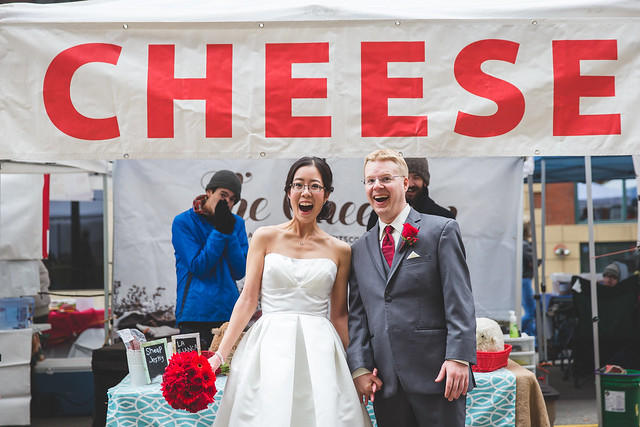
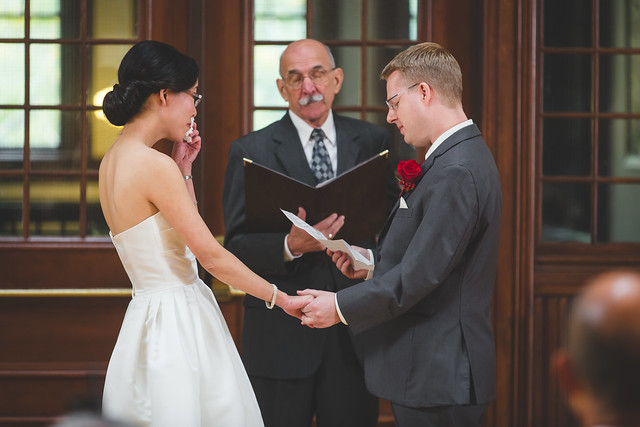
Sharon and I got married in Edmonton on September 27, 2014. We had the most wonderful day. But, as anyone who has planned a wedding can tell you, the number of people and goods involved can be complex. We wanted to sum up our day, which would also pay homage to the great vendors we worked with along the way.

Sharon: The most common question leading up to the wedding was whether or not it was stressful planning it. To be honest, the wedding was one of the most fun occasions I’ve ever organized – it was a chance for Mack and I celebrate with our loved ones, and through the process, work with vendors we respect. Any stress leading up to it was related to the fact that the wedding was the last of four “events” we were producing in the seven weeks leading up to the end of September, followed by our honeymoon departure two days after. But we made the bed, so although it was hectic, it was entirely by choice.

Mack & Sharon Wedding

Mack: I was thrilled with the way our wedding day went and it was all thanks to Sharon. I certainly tried to help, but it probably won’t surprise you to learn that she was the one that truly made it happen. Maybe it was because we’ve attended a bunch of our friends’ weddings over the last few years, but she just knew what to do, from start to finish. As usual, I’d have been completely lost without her. I appreciate that she included me in the planning process and always asked for my opinion, even if sometimes she had already made up her mind!

Mack & Sharon Wedding

What We Wore

Sharon: I have always loved the look of Audrey Hepburn’s wedding dress in the final scene of Funny Face – elegant, chic, and tea-length. Although conventional wedding dresses are typically to the floor or beyond, I knew something less fussy and easier to wear would suit me better.

Mack & Sharon Wedding

A few years ago, while visiting Amanda in Toronto, we were riding the streetcar on Queen West, when I caught a glance of a storefront window featuring cocktail-length wedding dresses. The shop I was admiring turned out to be Cabaret, a respected vintage retailer which, in recent years, had also developed an in-house collection of vintage-inspired wedding dresses. The Cabaret staff were fabulous to work with, and I loved that the garments were handmade in Toronto. In May, I ordered “The Bijou”, one of the dresses I had seen in the window all those years ago. They shipped it out to me free of charge, and it fit perfectly, requiring no alterations. I couldn’t have imagined getting married in anything else.

Mack & Sharon Wedding

Sharon: For my sisters’ bridesmaids dresses, we were hoping to continue that vintage look. Our colour palate was cranberry and charcoal. After shopping around, we couldn’t shake the appeal of Alfred Sung’s line of dresses. We found a great selection at Bridal Debut in Sherwood Park.

Mack & Sharon Wedding

I also wanted to mention the two lovely ladies who did our hair and make-up that day. It’s an understatement to say I rarely dabble in beauty products, so I entrusted Jenn Chivers and Jenise Wong to help me. Jenn was efficient, professional, and was able to create art from an image. Jenise, a friend of Felicia’s, knew my apprehension about not looking or feeling like myself, so made sure I was comfortable with the make-up. I think she did a fabulous job!

Mack & Sharon Wedding

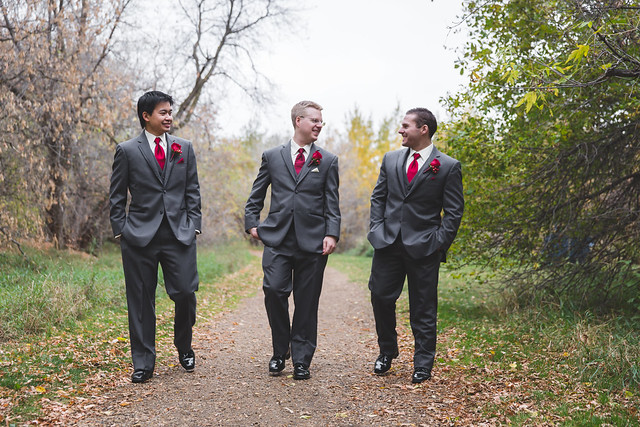
Mack: Honestly, I had never really considered what I would wear on my wedding day. There’s no “That Suit is a Beaut” or “Say Perfecto to the Tuxedo” show on TLC for guys. I guess I always figured my bride would guide me. Fortunately, she did. At Sharon’s suggestion, I decided I liked the lighter grey color with some red to pop. I wanted to look good, but I certainly didn’t want anything that would take attention away from Sharon and her dress. So with that in mind, service became the most important criteria for choosing where to get my tux.

Mack & Sharon Wedding

After checking out a couple of options, we made our way to Moore’s on Calgary Trail, where we met an awesome sales associate named Agnus. She was helpful right from the start, and made great suggestions such as getting an off-white shirt because Sharon’s dress wasn’t pure white (and could look yellow in photos if my shirt was). I ended up renting a BLACK by Vera Wang tuxedo, and was very happy with it. Again, the service at Moore’s was fantastic.

Mack & Sharon Wedding

Sharon: Although we were impressed by the sample arrangements at Wild Orchid, our deciding factor to book with them was their proximity to our condo. Being one block away, we negated delivery charges, and a member of our wedding party simply walked over the morning of to grab the bouquets. Sticking to vendors close to home definitely had its advantages!

Taking Care of Business

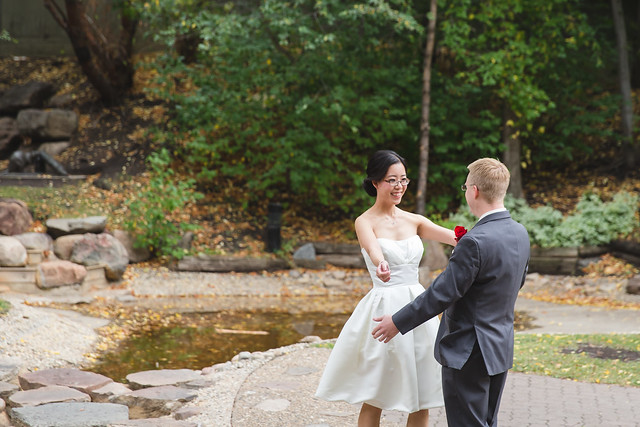
Sharon: I liked the idea of a first look – not only would it take the pressure off waiting until the start of the ceremony to see each other in our wedding attire, but it also meant we could be more economical about our time that day.

Mack & Sharon Wedding

We squeezed in an extra location for our wedding party shoot in the time leading up to the ceremony, taking advantage of having the City Market right outside our front door. It was important to us to incorporate as many of our favourite Edmonton activities into our day as possible – sure, our wedding was primarily to celebrate our love of each other, but why not celebrate our love of Edmonton, too?

Mack & Sharon Wedding

Mack & Sharon Wedding

Mack & Sharon Wedding

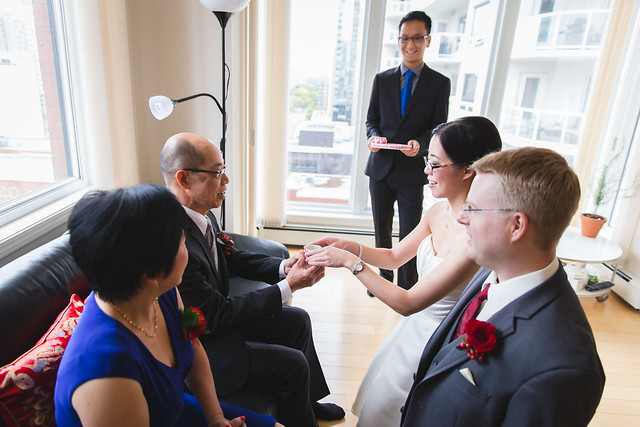
Mack: Though I was happy for Sharon to take the lead on figuring out what our day would like, I knew for sure that I wanted a tea ceremony to be part of it. The modern tea ceremony is a nod to Chinese culture and tradition and is a great way to show respect to our parents. There are variations on the procedure, but in general it consists of the bride and groom serving tea to their parents (and sometimes other elders like aunts, uncles, and grandparents). In exchange, they are presented with a small gift to wish the couple good luck.

Mack & Sharon Wedding

In our case, we served our parents tea. We also included Sharon’s sisters, and they served us tea in exchange for a red pocket (as we’re their elders). It was a fun way to include a little bit of Sharon’s familial heritage into our day.

Mack & Sharon Wedding

Saying “We Do!”

Mack: Because we have decided to live in the core, Sharon and I walk whenever possible – we walk to work, to the market, and to activities. So it was important to us that we be able to walk on our wedding day too. That meant a venue downtown, and though we initially had our sights set on the Citadel’s Tucker Amphitheatre, we ultimately settled on the historic McKay Avenue School. Located a few short blocks from home, we knew it would make the logistics on the day much easier for us, and we hoped that being centrally located would mean easier access for our guests too. The third floor assembly hall was where we held our ceremony, a beautiful space with old wooden beams and floors, and a skylight too. We are thrilled that City Council has recently decided to proceed with designating the building as a Municipal Historic Resource, so that other Edmontonians can enjoy its history and character for years to come.

Mack & Sharon Wedding

Mack & Sharon Wedding

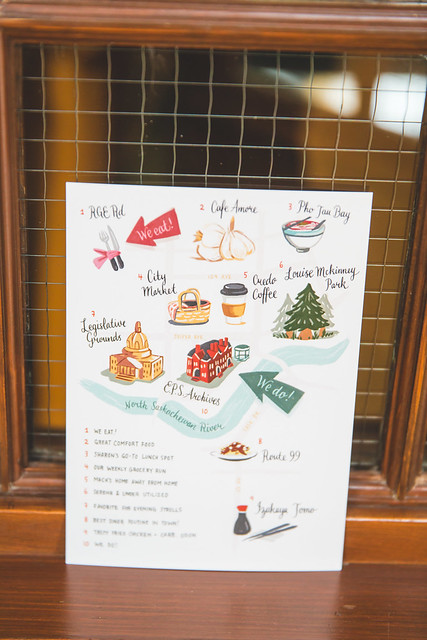
Sharon: Mack and I had elected to use an internet-based system to manage our guest list instead of issuing paper-based invites. And though we had some functionality challenges with Appy Couple, it was still the right choice for us. It also allowed us to invest more of our budget into the paper program, which we treated as the primary souvenir from the ceremony. Erica Leong, a close family friend, is a designer based out of Vancouver, and she did a fantastic job translating our vision for a whimsical representation of a few of our favourite places in Edmonton. The program text itself was adapted from an online template.

Mack & Sharon Wedding

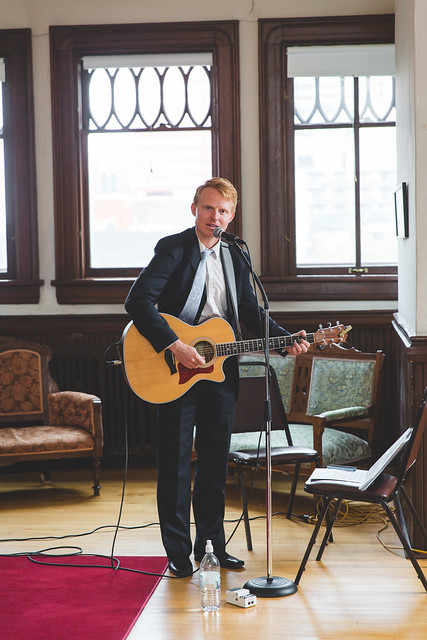
Sharon: After moving to 104 Street, I started associating City Market mornings with the sound of Martin Kerr’s voice. Windows open, his acoustic songs would float up into our condo, and over breakfast, we’d be able to enjoy his renditions of everything from Oasis to Jack Johnson. Knowing he also performed at weddings, we booked him early on in the planning process – while we didn’t get a chance to shop at the market that morning, we did have a piece of the market at our ceremony that day.

Mack & Sharon Wedding

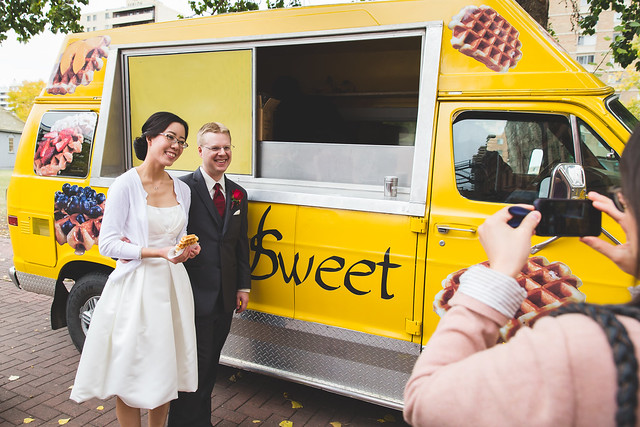
Mack: Friends of ours had Fat Franks at their wedding a few years ago and we thought it was a fun, unique way to offer guests something to eat after the ceremony. Plus, with our penchant for food trucks, we knew we wanted to incorporate them into our day in some form! We decided to ask Eva Sweet to serve the waffles we have enjoyed so regularly at the City Market downtown. They were also one of the very first participants at What the Truck?! Back in 2011.

Mack & Sharon Wedding

What We Ate

Mack: Whenever Sharon and I are feeling gluttonous and don’t want to cook, we make a trip over to Route 99. We have been eating there since our first trip together in 2007 and I guess you could say that over the years it has become “our place”. We love the easy-going atmosphere, the quick service, and the non-traditional but extremely tasty poutine.

Mack & Sharon Wedding

It was important to Sharon that we plan lunch for the wedding party into the schedule of the day as this is often overlooked and just makes everyone hungry and grumpy until the reception. That’s how we found ourselves at Route 99 for lunch in our fancy wedding clothes! It was a great way to relax slightly after the stress of the ceremony, to take a look at the social media posts that had gone up, and to go over our plans for the remainder of the day.

Mack & Sharon Wedding

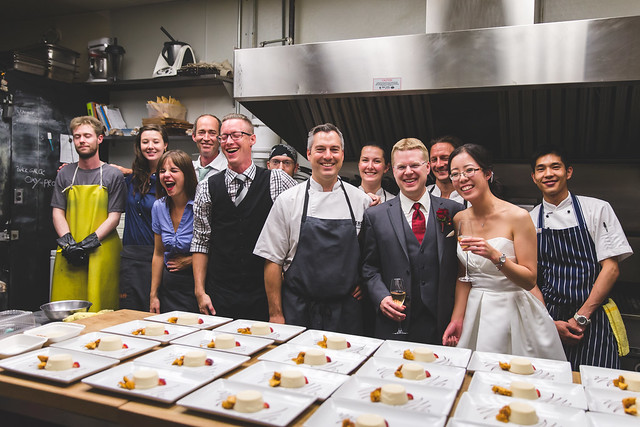
Sharon: We’ve always loved Chef Blair Lebsack’s food. Since his tenure at Madison’s Grill, to his outdoor farm dinners, and now, his celebrated establishment RGE RD, Blair has been an integral part in our journey of understanding the possibilities of locally-sourced ingredients. That said, we knew hosting our reception at RGE RD would require a very select guest list, as the restaurant only has the capacity of forty. We didn’t regret our decision – an intimate group meant we were able to spend more time with our friends and family, and the absolutely gracious staff made us feel right at home.

Mack & Sharon Wedding

Mack & Sharon Wedding

Mack & Sharon Wedding

Mack & Sharon Wedding

Mack & Sharon Wedding

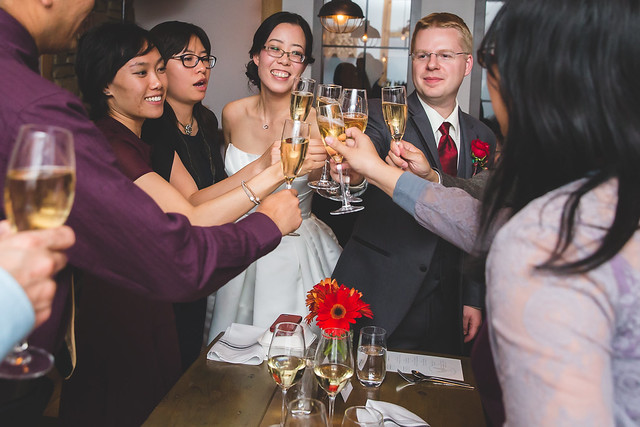
We were able to customize a menu with Blair (to the point of requesting specific dishes we’d enjoyed in the past), while Caitlin designed the drink pairings. Mack and I especially appreciated Blair’s willingness to introduce each dish – the guided tasting elevated the experience, which was a first for many of our guests. And of course, the food – I will never forget the tempura-fried, ricotta-stuffed tomato, the incredibly flavourful potage, the wood-fired roasted chicken and the panna cotta that everyone couldn’t stop talking about. It was a beautiful end to a wonderful day, and I’m so grateful to the staff that made it happen.

Mack & Sharon Wedding

Mack & Sharon Wedding

Mack: Photography is of course an important part of any wedding, and truth be told we’ve known for a while who wanted to help us capture the day. We first met Bruce and Sarah Clarke of Moments in Digital a few years ago at one of the tweetups we hosted, and we were immediately impressed with not only the quality of their work but also how great they were to work with.

Mack & Sharon Wedding

We knew that Bruce and Sarah would make us feel comfortable and that the result would be a series of beautiful images that we’d be able to enjoy for years to come. They were incredibly helpful right from the start, and played a big role in helping us to organize and plan the day. We’re very happy with how the photos turned out and hope you enjoy them too!

Mack & Sharon Wedding

Sharon: No wedding can happen without the help and support of family and friends, and ours was no exception. From our parents to our wedding party, and our friends who lent, manned or otherwise ensured things were done before or on the day, Mack and I are in your debt.

Metro Line LRT delayed again until Spring 2015, maybe, hopefully

The City held a press conference late this afternoon to provide an update on the Metro Line LRT extension to NAIT. They should have waited until February 2, because once again we learned that the opening of the new line has been delayed. The new target date is May 2015, more than a full year after the extension was originally slated to open.

2014-12-07 McEwan Station
MacEwan LRT Station in December 2014, photo by Darren Kirby

Today’s news release thanked Edmontonians for their patience and used much more careful language than previous delay announcements:

“Based on the most recent testing schedule provided by Thales Rail Signalling Solutions Inc., the City of Edmonton is cautiously optimistic the Metro Line LRT will open to public service in spring 2015.”

Cautiously optimistic is a long way from confident. The reason for the delay is the same thing we’ve heard since the project was first delayed – the contractor is having problems with the signaling system:

“Thales appreciates the patience of everyone in Edmonton as we work to complete the signaling system for the Metro Line,” says Thales Vice President Mario Peloquin. “We understand how important this essential transportation infrastructure is for the people of Edmonton, and we remain committed to delivering an outstanding product that is safe, efficient and reliable, and that will serve the city for generations to come.”

The signaling system is responsible for controlling train traffic. It tracks train movements and keeps them on schedule. Part of the challenge is that with the Metro Line, the City is changing the signaling system from a traditional fixed block system to a more modern communications-based train control system, or CBTC. It’s this new signaling system that will enable trains on the Metro and Capital lines to share the same tracks.

Even though construction completed on time and $90 million under budget, the Metro Line still isn’t open. The project has been delayed numerous times over the last year or so:

  • In September 2013, everything seemed on track for an April 2014 opening.
  • In December 2013, the opening was delayed a few months until Spring 2014.
  • In the Spring of 2014, the opening was further delayed until the end of the year. That schedule was reaffirmed over the summer.
  • In October 2014, the opening was delayed again, with February 2015 identified as the earliest possible date.
  • Now, in January 2015, the opening has been delayed until May 2015.

Needless to say, there’s very little confidence in the latest target date.

New Edmonton Arena Construction
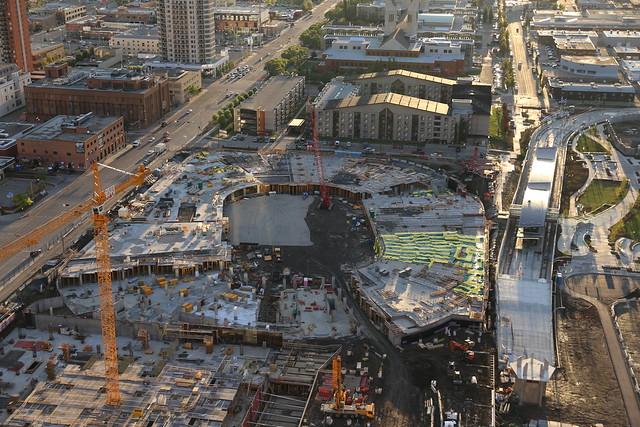
MacEwan LRT Station next to the new downtown arena, September 2014

It was in October 2014 that Mayor Iveson called the delays “unacceptable” and asked the City Auditor to review how the project had been managed. Since then, the City has held back $20 million from the $55 million contract with Thales, and the auditor has been investigating.

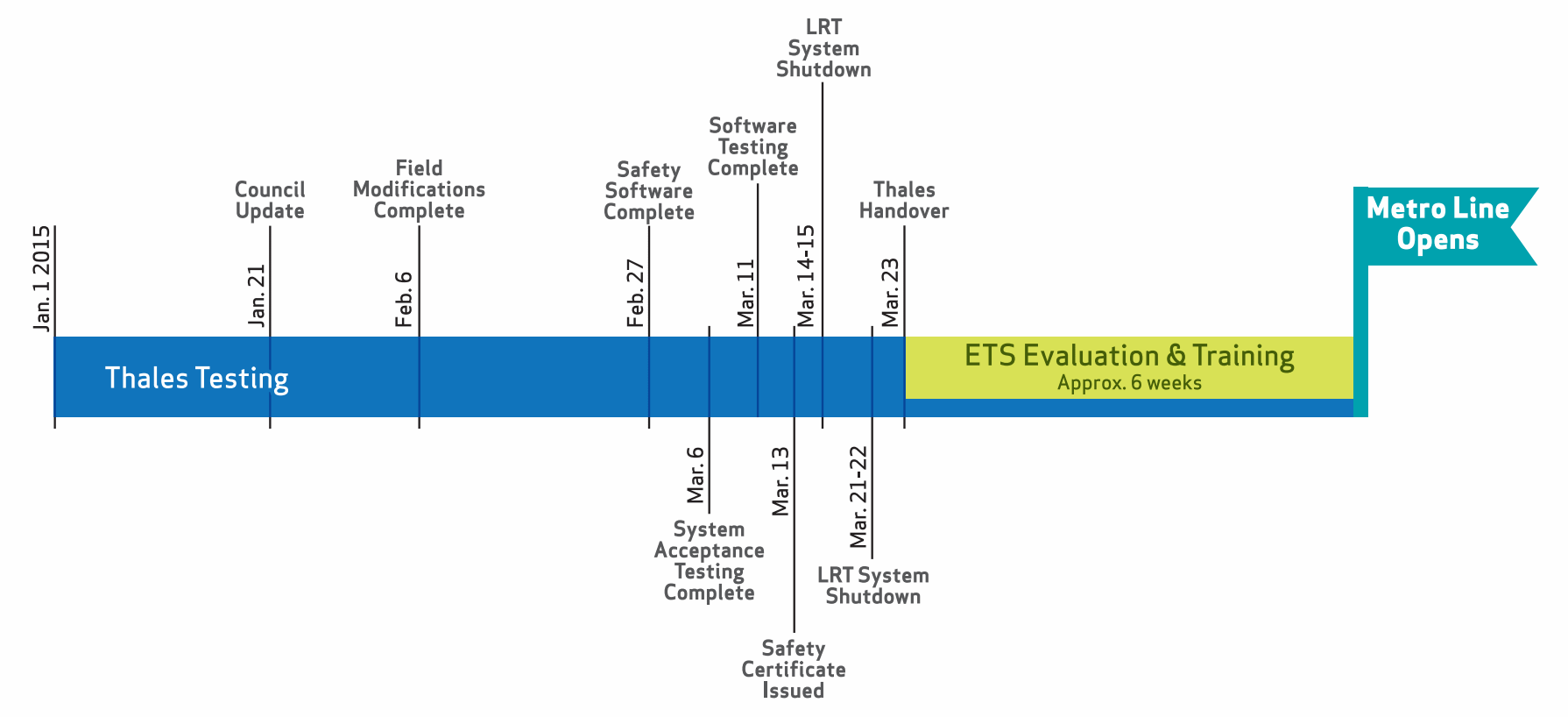
Now the City says that the latest schedule from Thales would have the handover of the signaling system take place by March 23, 2015. If by some miracle Thales is actually able to meet that date, the City would need approximately 6 weeks to evaluate the system and complete staff training.

“We are very concerned with the ongoing delay of the Metro Line and will continue doing everything we can to hold Thales to their new schedule. Our goal remains the same: to open the Metro Line for safe, reliable public service as quickly as possible.”

On the Metro Line LRT site, the City has made available a slide deck and an FAQ, both in PDF.

metro line delayed

The FAQ tries to explain what has happened and attempts to provide some confidence that the City is providing “increased” project oversight to ensure it gets done. After the number of delays this project has experienced, you have to wonder if sticking with Thales is the right approach, but that’s what the City is doing:

“At present, our best option is to continue supporting Thales to deliver the signaling system. Our expectation is that Thales will meet its commitments. The City has strict project oversight to ensure they do so. If they fail to meet a milestone or if testing does not proceed according to schedule, the City will hold Thales to account.”

Let’s hope the sunk cost fallacy isn’t at play here.

The City says they are “tracking milestones on a daily basis” and have increased resources on the project. “We’re working diligently to help Thales deliver the signaling system by March 23, 2015.” The FAQ even says the City has explored the option of using people to manage train movements in an effort to get the new line open more quickly, but they ultimately decided that approach did not meet requirements for cost, safety, reliability, or efficiency.

Curiously, the final question in the FAQ is, “are you feeling badly about the delay, City of Edmonton?” Here’s the answer:

“Everyone involved with the Metro Line project regrets the delay of this exciting transportation project. We ask for your patience and hope you’ll continue to bear with us as we work towards bringing the Metro Line into service in spring 2015.”

So we’ll have to wait until late March before we can be sure the Spring 2015 opening is actually going to happen. In the meantime, we’d better make sure the same problems aren’t going to plague the Valley Line LRT extension.

City Council opens the door for Uber to operate legally in Edmonton

After a marathon meeting that lasted until nearly 10pm, Council eventually decided to look at new regulations that could make Uber legal while enforcing the existing bylaws in the meantime. The motion put forward by Councillor Knack also seeks additional data on the taxi industry and directs Administration to look at issuing additional taxi plates. “The world has evolved and people want choice,” he said.

Here’s the motion that Council passed unanimously this evening:

  1. That Administration work with the Transportation Network Companies and other stakeholders to provide a report, before the end of the third quarter, to include a draft bylaw that would establish public safety rules and regulations for the operation of Transportation Network Companies.
  2. That, in parallel with the work in part 1, Administration work with the Taxi Industry to provide a report, before the end of the third quarter, with a draft bylaw to amend the Vehicle for Hire Bylaw 14700 to provide for improved taxi service standards, and with recommendations for issuance of additional taxi plates.
  3. That, in the meantime, Administration request that UBER temporarily suspend operations in the Edmonton market and if they refuse, Administration take all steps necessary to apply for an injunction against UBER to prevent its unlawful operation in Edmonton until such time as UBER complies with the applicable City of Edmonton bylaws.
  4. That Administration work with the taxi brokers to obtain data from dispatch systems on number of taxis dispatched at given times, wait times for taxis, and other information relevant to allow for determination of appropriate customer service standards and expectations.

With bullet #1, the motion seeks to create rules that would allow companies like Uber to operate legally in Edmonton. With bullet #2, it seeks to address the shortcomings that currently exist in Edmonton’s taxi industry.

“I think this approach makes sense because it leaves the City’s options open,” said Mayor Don Iveson before the motion was voted on. He also reiterated the need to have more data in order to make better decisions in the future. The mayor said it makes sense to ask companies like Uber to abide by the regulations that are in place while the City works to align them with the market.

Uber is currently operating illegally in Edmonton. It launched its service back in December and the City declared that any Uber car caught operating would be considered a “bandit taxi” and face a $1,000 fine. Uber has argued consistently that its technology and business model are fundamentally different and are therefore not explicitly covered by provincial or municipal regulations. Sometimes called a ridesharing app, a more general term for Uber is transportation network company.

Yellow Cab
Photo by Dave Sutherland

The discussion centered around the Vehicle for Hire Bylaw 14700, which “regulates taxi brokers, drivers, and vehicles, but does not regulate passengers.” From the report:

“The number of allowable taxi plates within the city was frozen in 1995 to facilitate a financially viable taxi industry. The taxi rates are controlled by the City of Edmonton to ensure consumer price protection.”

Edmonton caps the number of taxi permits or plates at 1,319. It has increased the number of plates allowed a few times over the years, but the City recognizes there are still too few plates to meet demand. A report from 2007 suggests that Edmonton is 177 plates short. Council mentioned repeatedly that they have heard from constituents that there aren’t enough taxis and that wait times are too long.

At one point, Councillor Scott McKeen asked Edmonton Taxi Group president Phil Strong if the industry has been lobbying for more plates to be issued, but of course they haven’t been. “I wouldn’t know where to go,” he claimed. The issue is that by making more plates available, the value of each declines.

“Almost everybody agrees the status quo doesn’t work,” the mayor said.

There was quite a bit of discussion about the idea that the City create its own app for taxi services. The problem with that in my opinion is that what makes Uber attractive is that it works in hundreds of cities. That’s great for Edmontonians travelling elsewhere, and for visitors to our city too. A local-only app would not benefit from the economies of scale that Uber provides.

There was also a lot of discussion about driver’s licenses and insurance. Most of us have Class 5 licenses, but in order to transport passengers for profit, you need to carry a Class 4 license. You can learn more in the Commercial Drivers Guide PDF. On the topic of insurance, there was some confusion about whether or not Uber’s policy, which only kicks in if a driver’s personal insurance fails to cover an accident, was sufficient. It has not yet been tested in Canada.

Most of the speakers present at the meeting today were from the taxi industry, either drivers or representatives of the brokers. Uber’s sole representative was Chris Schafer, the Public Policy Manager for Uber in Canada. It was a packed house for most of the meeting.

//platform.twitter.com/widgets.js

The reports that the motion seeks will include a draft bylaw, so don’t expect them to return to Council until sometime in the fall. In the meantime you can try to take Uber, but know that they are operating illegally.

Recap: Edmonton’s Economic Impact Luncheon 2015

“Never waste a good crisis,” EEDC President & CEO Brad Ferguson told the hundreds of Edmonton business leaders gathered today at the Shaw Conference Centre for EEDC’s annual Impact luncheon. He channeled local business pioneer Frank Spinelli and said “it’s what you do in the good times that determines how well you perform in the bad times.” He argued that Edmonton and EEDC in particular have done a lot of great things over the last two years when times were good and that means the year ahead won’t be as bad as many anticipate.

A short while later, Premier Jim Prentice took to the stage and disagreed. “It is what we are going to do in the bad times that will determine how successful we’re going to be in the good times,” he said. The Premier talked about the need to change both the income and expense side of the equation, and cautioned that all Albertans will have a role to play in making it through a difficult time.

So which is it? Well, it’s probably a little bit of both. The feeling I was left with after today’s luncheon is that Edmonton has been doing the right things and will weather the coming storm better than the province as a whole.

impact 2015

Mayor Don Iveson brought greetings to start the event and offered his two cents on the economic situation, saying “there’s no reason to panic.” He said the Edmonton economy is becoming more resilient as it becomes more diverse and that “our city’s entrepreneurial spirit has never been stronger.”

The mayor also took the opportunity to call upon the Province to keep Edmonton in mind as it tries to address a shortfall in revenue. “City building, I believe, is Province building,” he said. Later, Premier Jim Prentice referred to the comment and said, “I couldn’t agree more with that.”

Before the keynote began, EEDC showed their Build It Here video, highlighting the fact that it can be customized for businesses to use in their own materials.

Keynote

Brad Ferguson delivered the keynote address today, which you can read online. He began by talking about 2014, calling it “a great year”. There was a lot of euphoria in 2013 and throughout most of last year, so EEDC asked itself a key question:

“What should an economic development authority do when it is not in the job creation business? What should we do in the good times that will help us when the economic cycle turns?”

And with that in mind, the organization focused on ten themes throughout 2014 “that would strengthen our economy over the long term.”

  1. Direct Flights
  2. External Marketing
  3. Downtown Density
  4. Entrepreneurial Ecosystem
  5. Foreign Investment
  6. Event Attraction
  7. Regional Collaboration
  8. Unified Voice
  9. National Positioning
  10. Building the team at EEDC

Brad talked about the way EIA and EEDC are working together so effectively now, which resulted in the KLM flight. He discussed the new approach to tourism and marketing. He mentioned the big announcements that were made recently and said “more than anything else, 2014 will be remembered as the year of downtown.” He talked about the importance of event attraction, saying that big events “create a rhythm and a pulse and an energy that builds excitement and confidence.” He praised the mayor’s leadership in the region and on speaking with a unified voice. And he referenced the many newspaper and magazine articles that have been popping up across the country talking about Edmonton’s transformation.

Brad had a lot of praise for his colleagues. “I am extremely proud of the team we have built at EEDC.” He said the organization has reduced the portion of its operating budget that comes from the City, from 43% when Brad took over to 38% today. Brad said they’re on track to reduce that even further to 33% by 2017.

He then talked about oil prices and what they mean for the economy. If you want to understand the roller coaster, read this passage:

“If we look back over the last 7 years: In 2006-2007 this place was on fire, the world economy was expanding, oil prices were high, and everything was rocking. Until in March 2007 Bear Stearns collapsed and in September of that same year Lehman Brothers collapsed, the biggest financial collapse in recent history. The price of oil went from $140 to $40 (a $100 dollar drop) in six months than then settling around $58 which created a population boom scenario in Alberta and in Edmonton starting in 2010, 2011 and 2012 when the WCS (Western Crude Select) pricing traded at a significant discount, now known as the Bitumen Bubble, followed by 2013-2014 where the price rose again to $95-$100 range while the world started to rebound, and then half way through 2014 the price started to dramatically drop as the global economy started to pick up, which has us moving from a budget crunch which can be addressed into a competitiveness crunch that is more structural and tends to last for quite some time.”

He did not mince words, saying “our revenue model at the provincial level continues to fail us.” Brad said he sympathized with the Premier though, as he inherited this problem. Still, he cautioned that unless we make changes now, we’ll be experiencing the same revenue volatility in the 2020s, 2030s, and 2040s. “It’s time to be humble being from Alberta,” Brad said. “And it is time to have a serious conversation about our financial picture and to make incremental changes to our tax structure.”

Brad predicted that in Edmonton, the year ahead will be better than most people are predicting. He said we’ll outperform Calgary, and while the Province’s budget will capture the headlines, “there are many positives in front of us that cannot be forgotten.”

He urged attendees to do more than hope for a return to $100 oil prices. “We’re planning for a very competitive world and we need to operate with more intention than ever before.”

Q&A with Premier Prentice

After the keynote, Premier Jim Prentice joined Brad on stage for a fireside chat, sans fire. “This is a world class city, with world class leadership,” he said. He disagreed with Brad about the good times/bad times point-of-view, then said that “this year will be about leadership and confidence.” Premier Prentice predicted that 2015 will be a challenging year, but also a transformational one.

The Conference Board of Canada has predicted that Alberta will experience a recession in 2015, but Premier Prentice disagrees. “We are tough, we are resilient, we are entrepreneurial, we have the capacity to get through this, and we will get through this.”

At times the Premier seemed to be doing exactly what Brad cautioned against – hoping for a return to $100 oil. “The best solution for low oil prices is low oil prices, they will come back,” he said at one point. At other times, he was very clear that action was necessary. “People have had enough of the roller coaster,” he said. He has struck a new budget committee and confirmed that “everything is on the table.”

The Premier was also very honest about the challenges faced by the Province. “We have not done a good job with our public finances,” he said. “We have been living beyond our means.” He said that needs to change, and that “we are living on resource revenue that properly belongs to our children and our grandchildren.” He said the amount we spend in Alberta on health care “is not sustainable” and added that “we’re going to have to contain expenditures as we move forward.”

Premier Prentice did not shy away from the topic of taxation, either. Asked if the market is ready for a conversation about it, the Premier replied, “I certainly hope so.” He suggested that most Albertans probably don’t support the idea of a provincial sales tax, but did say that now is the time to discuss it. “We welcome the views of all Albertans on taxation,” he said. “Now is the time to speak up about this.”

Perhaps thinking ahead to the budget, Premier Prentice talked about what to expect. “First and foremost we need a fiscal plan than Albertans can look at and have certainty,” he said. And knowing that the roller coaster cannot continue, “it has to be a ten year plan.” He said that oil “may always be the family business” but said that diversification is important.

Given the opportunity to offer some closing thoughts, Premier Prentice said “you don’t win a bigger lottery than to be an Albertan.” He ended on an optimistic, hopeful note. “This is a remarkable province and we have a remarkable future.”

Extra Notes

EEDC Board Chair Barry Travers brought greetings on behalf of the board of directors, and introduced all of his colleagues. The event was hosted by Grant Ainsley and featured a giant Twitter wall powered by Freeman Audio Visual and SAM that received rave reviews from attendees. Everyone received a copy of “Navigating Your Economic Future in Edmonton: A Guide for Business Leaders”. The entire event was livestreamed by the Edmonton Journal, which you can watch here.

For additional context on this story, check out the following posts:

An update on the initiative to end poverty in Edmonton

The task force for the elimination of poverty in Edmonton got underway last March. Mayor Iveson spoke about the initiative in his State of the City address, and a week later City Council formally established the task force. A lot has happened since then, and the year ahead looks to be an important one. Here’s an overview of the work that took place in 2014 and a look at what’s to come.

Mayor’s Symposium on Poverty

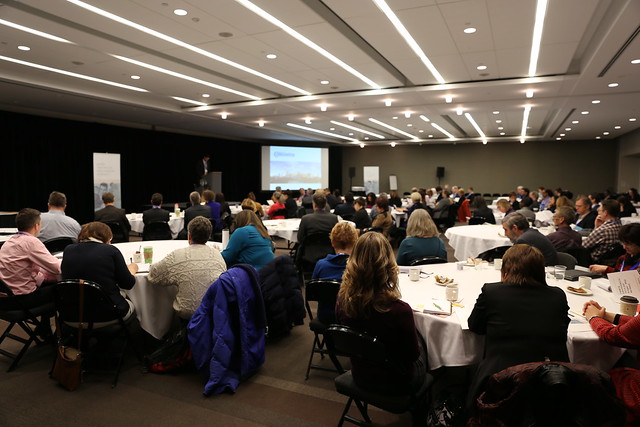
Following the establishment of the task force, the Mayor’s Symposium on Poverty was held on March 20, 2014. Roughly 130 Edmontonians came together at the Shaw Conference Centre to discuss the new task force and to “tap into the wisdom of the community to set the foundation” for its work. Mayor Iveson opened the event, and said “this may be the most extraordinary Make Something Edmonton of all time.”

Guest speaker Dr. John Rook spoke about ‘The City that will End Poverty’, sharing insights and stories from his experience leading the plan to end homelessness in Calgary. He praised the mayor for making poverty elimination a priority, and said “I know with your bold leadership that Edmonton will be a city where poverty is not an enigma.” You can read his full remarks in the symposium report.

Mayor's Symposium on Poverty

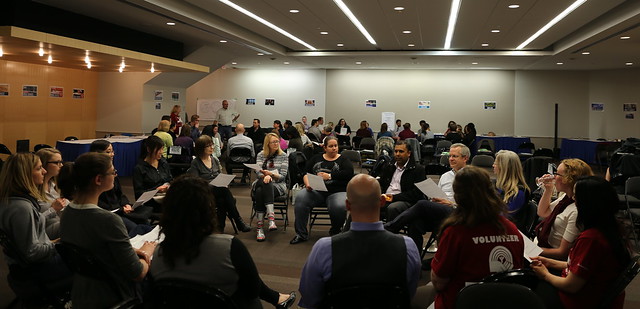
Afterward, the crowd broke into smaller discussion groups to talk about some of the key themes, like health or transit. The report includes a summary of their discussions, as well as some broader conclusions:

“The overarching goal of ending poverty, however, is an ambitious one. The importance of advocacy and lobbying with all orders of government surfaced throughout the discussion groups, because in many cases a wholesale policy shift will be necessary in creating the kind of change that participants talked about.”

I attended and had some great discussions throughout the day. I left feeling optimistic but also very aware of the incredible amount of work ahead.

Task Force & Round Table Meetings

The Mayor’s Task Force to Eliminate Poverty in Edmonton met eight times in 2014 – you can find the meeting agendas and minutes here. They also established two round tables, one focused on Information & Research and one focused on Aboriginal Edmontonians, which met five and six times, respectively. Finally, a Communications and Engagement Committee was established (which I am a member of) and met a few times.

Task Force Working Groups

Over the summer, the task force established working groups as an approach for involving more Edmontonians in the creation of recommendations for eliminating poverty.

“Working Groups will explore, discuss, develop and ultimately bring forward recommendations and associated implementation strategies connected to its focal area that are needed to address and ultimately eliminate poverty in Edmonton. Each Working Group will identify and propose a variety of recommendations for action.”

An orientation event was held on August 26 where community stakeholders were brought up-to-date on the work of the task force and a discussion was held about the focal areas that would form the basis of the working groups. Six were established:

  • Early Childhood Development
  • Education
  • Community Well Being
  • Housing and Transportation
  • Income Security
  • Health and Wellness

In the fall, a 7th working group was formed, focused on Justice and Democratic Participation.

Each working group consists of roughly one to two dozen participants, and they have all met a few times throughout the final part of the year. Their work will continue throughout the early part of 2015, with the goal of finalizing recommendations for the task force by the end of March.

United Way Poverty Simulations

Ever since they brought the program to Edmonton in 2012, the United Way has hosted poverty simulations to help educate Edmontonians about what it’s like to live in poverty. In May, I co-hosted one of the simulations with Omar Mouallem. A few dozen young professionals joined us at the Shaw Conference Centre for the event.

United Way Poverty Simulation

The program has certainly evolved since I first participated in November 2012, but it’s just as eye-opening as ever. Again I was struck by the importance of transportation and the challenges that people living in poverty face as a result. I was also reminded of how hard it can be to live near the poverty line, where you’re just once unfortunate situation from not making ends meet.

I ran into a couple of young women after the event was over, and they admitted that they were skeptical before attending. How could a simulation do justice to those who live in poverty? Fortunately they found the experience educational and positive, and were glad they attended.

For upcoming poverty simulation dates and to learn more, check out the United Way website.

Live Below the Line

The Global Poverty Project held a five-day challenge in late April called Live Below the Line to live on just $1.75 per day for food and drink. Mayor Iveson, members of his staff, Councillor Knack, and Councillor Walters all took part. Together they raised more than $2200 for Raising the Village. The mayor spoke about the challenge on BT Edmonton:

Mayor Iveson wrote about his experience and said “this first-hand understanding of malnourishment has been extremely revealing.” He was glad at the awareness the challenge raised and said his “resolve both as Mayor of Edmonton and as a global citizen is only further strengthened to take action to eliminate poverty.”

EndPoverty Edmonton

In the fall, the task force adopted a new identity and established a presence on social media. EndPoverty Edmonton is the name that was chosen. You can follow @EndPovertyYEG on Twitter, on Facebook, and you can access the website at edmonton.ca/endpoverty.

endpoverty edmonton

The Twitter and Facebook accounts frequently share poverty-related news and links, so they’re slowly becoming great resources for anyone interested in the initiative.

Working Definition of Poverty

In September, the task force adopted its working definition of poverty:

“Edmontonians experience poverty when they lack or are denied economic, social and cultural resources to have a quality of life that sustains and facilitates full and meaningful participation in the community.”

You can read the full document which includes context, assumptions, a discussion on measurement, and an explanation, on the task force website.

What’s next?

The goal of the task force is to bring a draft poverty elimination plan before City Council in June. There’s a lot to do before that can happen.

The Edmonton Social Planning Council was contracted in the fall to develop a profile of poverty in Edmonton. The document will outline facts on poverty and will examine the pattern of poverty in our city. The profile is “also intended to provide benchmarks to monitor progress” of the poverty elimination plan. A draft was circulated toward the end of the year and it should be posted soon.

The working groups will present their recommendations to the task force in March, after which the task force will have to work to develop goals, outcomes, actions, and an implementation strategy. Throughout the spring, the poverty elimination plan will be drafted and a presentation for Council will be prepared. I understand a series of public engagement opportunities will take place along the way to help with that work.

The Communications and Engagement Committee has begun work on a new website for EndPoverty Edmonton. The goal is to be able to provide regular updates on the work of the task force, to engage Edmontonians who want to get involved, and to create a resource that will live on past the creation of the plan.

end poverty roadmap

The task force will also need to consider what happens after the plan is approved by Council. How will the plan be implemented? How will we engage more Edmontonians to join the cause and to take action? These and other important questions will be tackled in the months ahead.

For now, I would encourage you to follow EndPoverty Edmonton on Twitter and Facebook, so that you can find out about opportunities for engagement, the website launch, and more.