Don’t get too excited about supertall building proposals in Edmonton

There’s nothing quite like a skyline-defining tower to get people excited. Earlier this week a proposal for an 80-storey tower in The Quarters known as the The Quarters Hotel and Residences caught the eye of many. Developers Alldritt Land Corporation LLP still need to get approval for the tower from City Council, something they’ll seek within the next year. But is this proposal really something we should get excited about?

After decades without any new towers being built downtown, I completely understand the appeal of these proposals. Especially with recent examples to point to like Enbridge Centre and the new City of Edmonton Tower, both of which are very attractive buildings. Not to mention the Stantec Tower, which will finally get Edmonton into the skyscraper club. Closing the City Centre Airport and removing the height restrictions over downtown made these buildings possible.
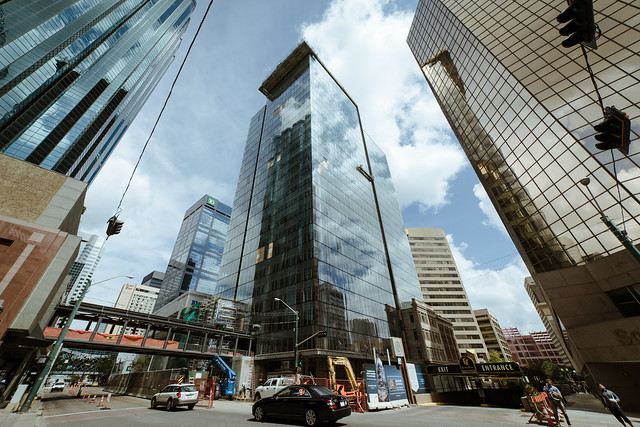
Kelly Ramsey Hero Shot
Kelly Ramsey Hero Shot, photo by David Sutherland

But those are office towers, not residential towers, and they’re located in the heart of our commercial core. When we look at residential towers elsewhere in our downtown and the surrounding neighbourhoods, density is what should be important to us, not necessarily height. We want to increase the population of our core neighbourhoods, but we don’t need record-setting heights in order to achieve that. And in fact, such heights might actually be detrimental.

I wrote about this back in June when the issue of changing downtown land economics came up before Council:

“A really tall tower on one site might be appealing for the impact it’ll have on the skyline, for the apparent “prestige” that comes along with height, and for the increased profits and/or reduced financial risks for the developer. But it could also mean that instead of development occurring on multiple sites, only the tall tower goes ahead. Look at it this way: would you rather have three 20-storey towers or one 60-storey tower?”

There is one other potential benefit of the supertall towers aside from being attractive and it’s that in theory Council can negotiate with the developers to ensure there are public good contributions made in exchange for the height. The problem is that the last time that opportunity came up with the 45-storey Emerald Tower in Oliver, we didn’t end up with a very good deal. This is partly because there are no formal rules for those negotiations.

At it’s July 6 meeting, Executive Committee passed the following motion in attempt to change that:

“That Administration conduct further research and stakeholder engagement towards a formalized review procedure and incentive system to be applied to Direct Control Provision rezoning applications that add Floor Area Ratio in the city core and Transit Oriented Developments, and return to Committee in the First Quarter of 2017.”

Ideally this framework will be approved before the proposed Quarters tower goes to Council.

Downtown Skyline

There are other reasons to question proposals for supertall buildings, of course. Plenty of proposals have come forward and then quietly disappeared, such as the 71-storey “Edmontonian” tower that was proposed back in 2013. More recently, there are concerns about the vacancy rate downtown with the approved towers coming online and the impact that’ll have on the residential market. And on top of that residential towers like Brad Lamb’s Jasper House Condos which haven’t started construction yet are now lowering prices. For all of these reasons there’s no guarantee that the proposed Quarters tower will go ahead.

Yes, it would be great to see The Quarters develop into a vibrant part of our downtown core, and maybe this building could help us achieve that. A supertall building there could do for The Quarters CRL what the Bow Building did for The Rivers District CRL in Calgary. It’s certainly better than a giant hole in the ground! But I’m not convinced a single, supertall building is what we should be pursuing for the area.

A similar discussion is playing out in cities like New York, albeit at a very different scale. Here’s the criticism that Diller Scofidio + Renfro co-founder Elizabeth Diller had for the multiple out-of-character skyscrapers being proposed in New York City:

“I believe in planning logics where you have neighbourhoods, and you don’t just do one building at a time. We need more planning vision in the city than there is now, where there’s no thinking of the effect of tall buildings. I believe in planning, and even zones that are planned up high. There are zones and then logics, and they have edges. There needs to be a consciousness of the urban adjacencies and the products of what the building comes with.”

Edmonton absolutely needs to build up rather than out, but we need to consider the impact that approving one supertall tower will have on the surrounding area. Multiple tall buildings is probably more desirable than one supertall tower.
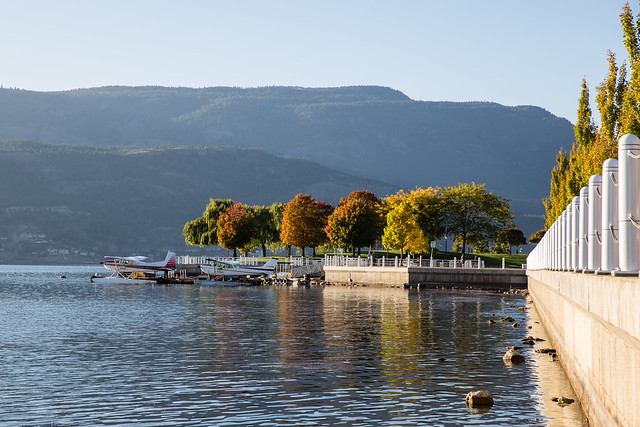

Highlights from the Okanagan

Sharon and I usually take a vacation toward the end of September and this year was no different. We decided to stay in Canada this time however, and spent nine days in the Okanagan. Aside from a quick trip to Kamloops and Kelowna a few years ago, neither of us had been to the Okanagan since we were kids. I keep joking that it’s nice to want to go to the wineries instead of being dragged along!

We flew into Kelowna and spent a couple of days there before moving on to Penticton and then Osoyoos. It was an interesting time of year to visit as we found ourselves right between high season and the winter season when many things close until the spring. We were also able to enjoy the beautiful fall colors and relatively warm weather (it snowed here a day after we returned home). Along the way we met a surprising number of Albertans including a few fellow Edmontonians!

Our guide for the trip was Jennifer Cockrall-King’s book Food Artisans of the Okanagan. Combined with a bit of TripAdvisor, which I finally started adding reviews to, we had no shortage of things to see and do. You can see my full collection of photos on Flickr, but here are some highlights from our trip!

We of course spent some time in downtown Kelowna, walking along the marina and through Stuart Park. It’s a beautiful part of the city an well worth a visit. You can even see Ogopogo!

Stuart Park Kelowna

We saw dozens and dozens of fruit stands throughout the Okanagan but decided to visit one in Kelowna very early on in our trip. Paynter’s Fruit Market is located in West Kelowna (which we learned separated from Kelowna in 2007 and was designated a city in 2015). There wasn’t much left, but picked some delicious pears and apples! The Red Delicious looked purple on the tree and were very tasty indeed.

Paynter's Fruit Market

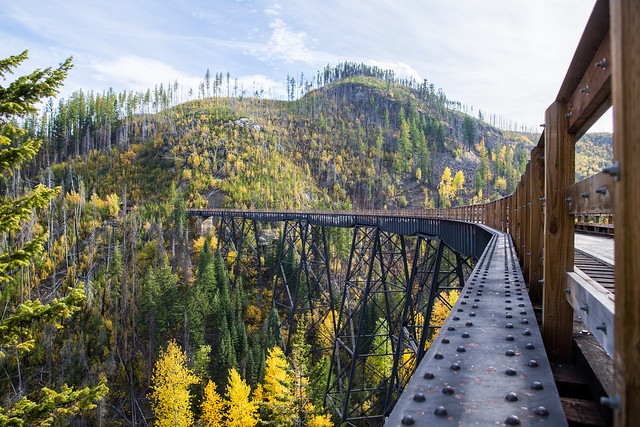
The number one Kelowna attraction in TripAdvisor is Myra Canyon Park, known for its historic trestle bridges. There are sixteen wooden bridges and two steel bridges that were once part of the Kettle Valley Railway that have been saved (and reconstructed after a devastating fire in 2003) and incorporated into an amazing pedestrian and cycling trail. It was not particularly easy to find or get to, but was totally worth it once we did.

Myra Canyon Trestles

We decided to spring for the bike rentals and completed the entire 24 km circuit in about three and a half hours. The well-maintained trail was easy to navigate and the views along the way were spectacular. If you’re in the Kelowna area, don’t miss this!

Myra Canyon Trestles

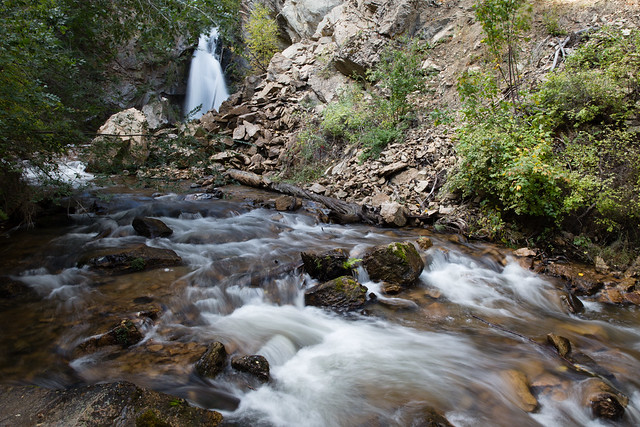
On our way out of the city we stopped at Hardy Falls, near Peachland. It’s a relatively short trail and the falls are not very big but we really enjoyed our visit. We were lucky to witness the annual Kokanee salmon run which meant the creek was full of bright orange fish!

Hardy Falls

I don’t know why, but I wasn’t expecting much from Penticton and was pleasantly surprised at how much we enjoyed the city. This is the view from Munson Mountain which is on the east side of the city.

Munson Mountain

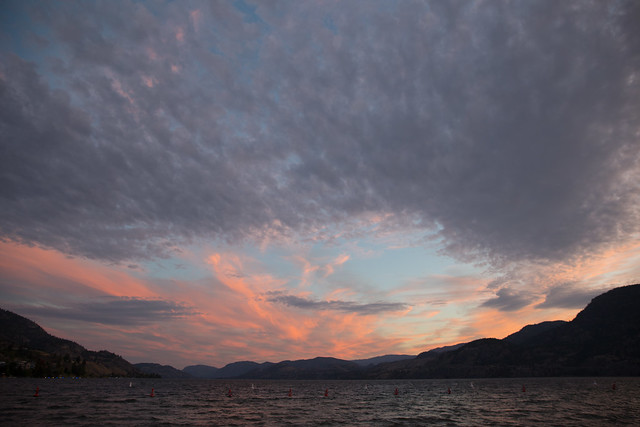
Penticton is bounded by Okanagan Lake to the north and Skaha Lake to the south. It was a bit too cold to go into the water while we were there, but we did manage to catch some amazing sunsets over the lake.

Sunset over Skaha Lake

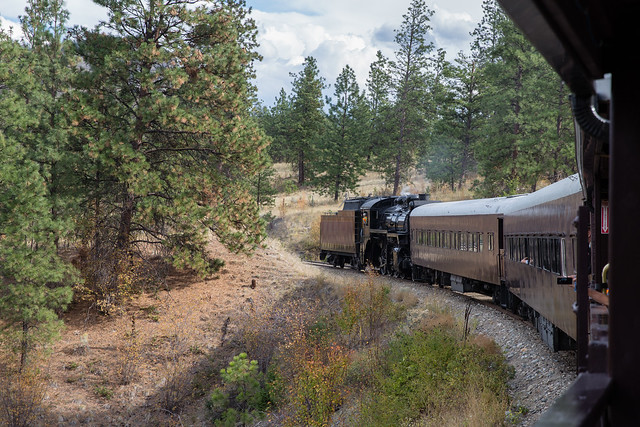
A short drive from Penticton in Summerland is the Kettle Valley Steam Railway. Knowing how much I love trains, Sharon made sure we didn’t miss it!

Kettle Valley Steam Railway

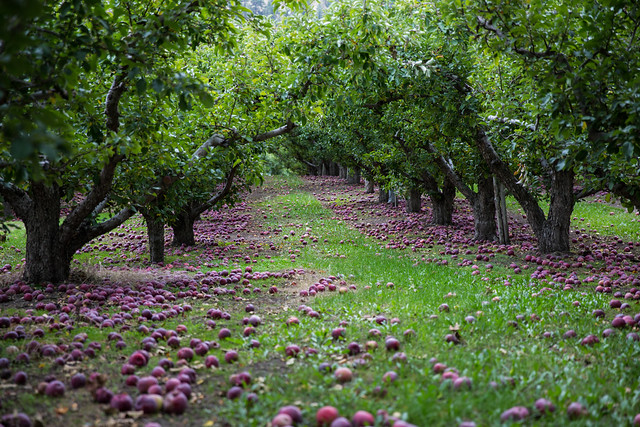
On our way back to Penticton we came across this orchard with apples covering the ground and I just had to stop to take a photo. This wasn’t the only fruit we saw on the ground during our trip, and it was suggested to us that the Okanagan Valley is simply over-producing.

Excess Fruit

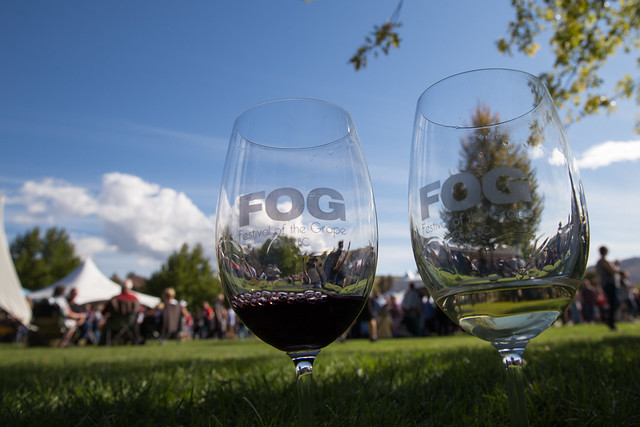
We realized that the Festival of the Grape was on in Oliver so purchased tickets and made a stop there on our way to Osoyoos. This was the 20th year of the festival which attracts more than 3,000 people each year. We enjoyed the wine tasting, Grape Stomp, and some food trucks too.

Festival of the Grape

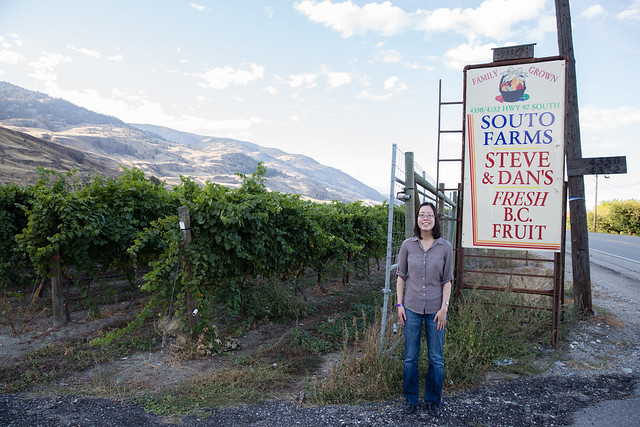
Just south of Oliver is where we found Steve and Dan’s Fresh BC Fruit farm. We buy from them every week at the City Market Downtown so we had to stop for a photo!

Steve & Dan's

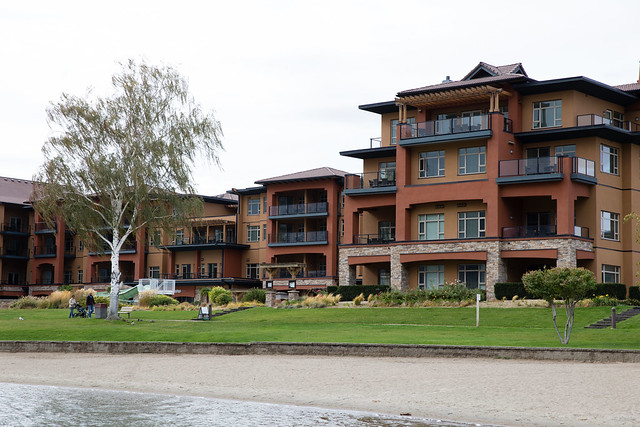
We spent a few days in Osoyoos staying at the Watermark Beach Resort, which had been recommended to us by a few people. I can see how it would be packed in the hot summer months but at this time of year it felt like we basically had the place to ourselves! It was a good homebase for our stay in the desert.

Watermark Osoyoos

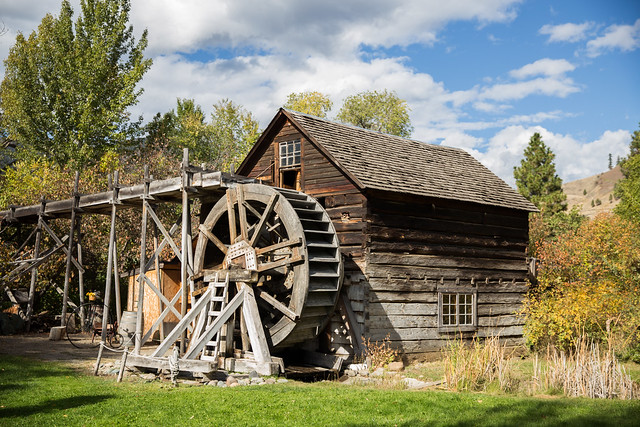
Osoyoos is pretty close to the Similkameen Valley so we took a trip there one day. The highlight for me was visiting The Grist Mill, a historic water-powered mill that has been painstakingly restored to its original 1881 operating layout and actually grinds flour for sale once again. We spent about an hour with Cuyler Page, the man behind the project. His passion was clear and we learned a lot, including that the site is basically the reason (along with the work of Page and Sharon Rempel) we have Red Fife wheat again today.

The Grist Mill

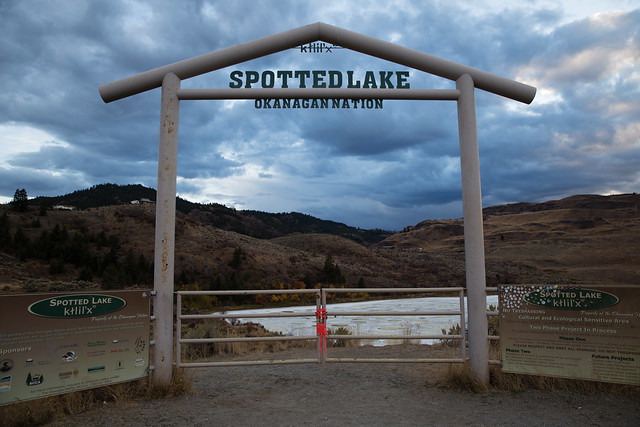
We stopped in Keremeos on the way home at Benja Thai, a restaurant that you simply wouldn’t expect to find in such a small place. It was great, and it was very busy too! Just before getting back into Osoyoos we stopped for a photo at Spotted Lake, which is a “saline endorheic alkali lake”. It’s also a sacred site thought by First Nations peoples to provide therapeutic waters.

Spotted Lake

Before leaving Osoyoos we went on a tour of Nk’Mip Cellars, the first Aboriginal-owned winery in North America. Owned by the Osoyoos Indian Band, the winery is a small part of the 32,000 acres that make up the Osoyoos Indian Reserve.

NK'MIP Winery

I was really happy that we made it to the final day of the season for Hammer’s House of Hog, a food truck in Oliver. We ate a delicious pulled pork sandwich and enjoyed the beautiful scenery in the nearby park.

Fall Colours

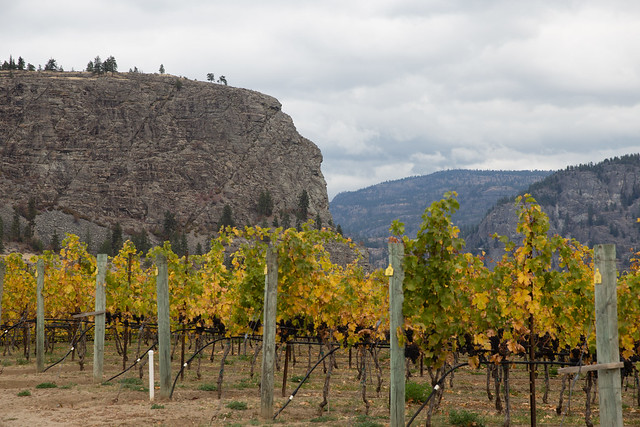
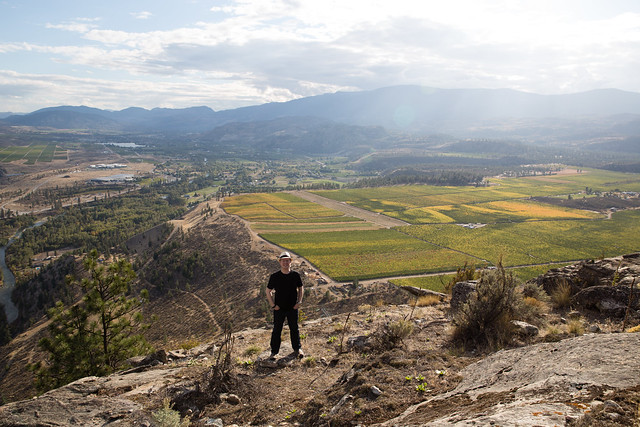
It was the fuel we needed to tackle the four hour hike up to McIntyre Bluff. It’s a well-known landmark with an elevation at the highest point of 673 m (2,208 feet). It’s also known to be home to bears and rattlesnakes, neither of which we ran into.

Covert Farms

We’re fairly inexperienced hikers so it was quite the trek for us! I’m glad we did it though. It was really windy at the top but the views were great.

Hiking to McIntyre Bluff

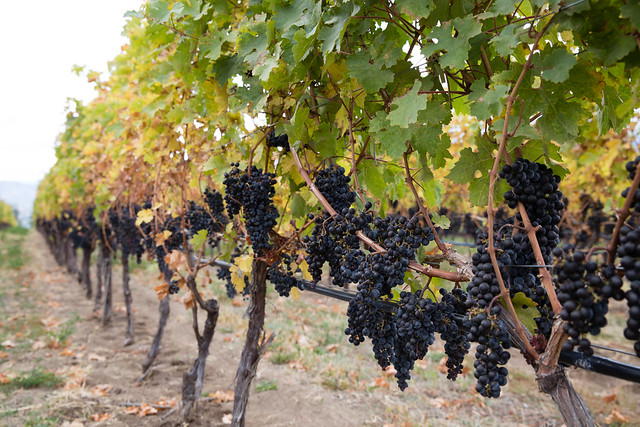
On our last morning we toured Covert Farms, an organic farm and winery. It was really interesting to hear how they stay grow more than 40 different crops organically, not to mention grapes.

Covert Farms

Like all vacations, it came and went too quickly, but we had a great time and learned a lot along the way!

Covert Farms

You can see my full collection of photos on Flickr. Stay tuned for more detailed posts from Sharon if you’re thinking of a trip to the Okanagan yourself!

Who’s responsible for the Edmonton Metro Region?

Last week the Metro Mayors Alliance signed a Memorandum of Understanding “outlining a commitment to plan, decide, and act as one Edmonton Metro Region on regionally significant issues.” The MOU was the first recommendation of the Advisory Panel on Metro Edmonton’s Future, which delivered its report in early June. The next step is to negotiate a legally binding Master Agreement.

Mayors at MOU signing
Photo courtesy of the Metro Mayors Alliance

Today the Capital Region Board approved its updated Edmonton Metropolitan Region Growth Plan with a 22-2 vote. The plan “sets a path for more compact and efficient growth within the region’s 24 municipalities” over the next 30 years. The next step for the CRB Growth Plan is to send it to the Government of Alberta for review.

CRB Growth Plan

If you’re thinking there might be some overlap here, you’re right.

The Metro Mayors Alliance is made up of the mayors of nine municipalities: Mayor Roxanne Carr (Strathcona County), Mayor Stuart Houston (City of Spruce Grove), Mayor Don Iveson (City of Edmonton), Mayor Gale Katchur (City of Fort Saskatchewan), Mayor Rodney Shaigec (Mayor of Parkland County), Mayor Greg Krischke (City of Leduc), Mayor John Whaley (Leduc County), Mayor Tom Flynn (Sturgeon County), and Mayor Nolan Crouse (City of St. Albert). The latter two are not pictured above and were not at the ceremony, but they did sign the MOU. All nine municipalities are of course members of the Capital Region Board, and together they represent 95% of the region’s population, 96% of its assessment base, and about 80% of its land base.

The Metro Mayors Alliance MOU declares the municipalities’ intent to work in three key areas: economic development, public transit, and land use and infrastructure. The idea is that by acting together on opportunities related to these three areas the region will be better able to compete globally. The CRB’s Growth Plan also aims to “advance the Region’s global economic competitiveness” in a way that balances the region’s diversity and rural and urban contexts. It too discusses economic development, transportation, and land use and infrastructure.

There are some key differences to note between the Metro Mayors Alliance (MMA) and the Capital Region Board (CRB). First, as mentioned above, the MMA is much smaller than the CRB which has in the past been criticized for moving too slowly due to infighting (the new Growth Plan took 30 months to develop). Fort Saskatchewan Mayor Gale Katchur spoke about this to the Fort Saskatchewan Record:

“Quite often, it takes us a long time to make decisions (at the CRB) and a lot of the projects can take years before we see any advancement on them. The Metro Mayors came together to say we would be the willing who want to move things forward and to see how we can advance the items out of the recommended report. We can show that working together corroboratively with the biggest population and the biggest land mass, we can be more effective and more efficient than the CRB.”

In theory getting just nine municipalities to approve something is easier than getting a majority of the twenty-four at the CRB.

Another key difference is that while the CRB was mandated by the Province in 2008, the MMA is merely a partnership between the nine municipalities (formed in 2015). It’s a “coalition of the willing” as opposed to a group of cities forced to play in the same sandbox. That means that until a legally binding agreement is in place, there’s really nothing forcing the members of the MMA to do the things they say they’re going to do, unlike with the CRB. At the same time, the members of the MMA are the ones with all the resources (and the bulk of the challenges) needed to make things happen.

St. Albert Mayor Nolan Crouse is the chair of the CRB and this week suggested the two groups have too much overlap. “The report that was issued by the panel is basically the same mandate that the capital region board is already working on,” he told the St. Albert Gazette. He signed the MOU, but only because there was no cost and nothing binding, and said he’d be skeptical of next steps. “I’m being critical because we’ve got a good amount of work going forward with the capital region board.”

Note that two CRB members voted against the new growth plan. Leduc County voted against it because they felt it didn’t value the agricultural land south of Edmonton highly enough (the new plan includes an Agriculture policy area). Parkland County voted against it because they felt the CRB was expanding its mandate by considering agriculture and economic development. The rest supported the new plan however, which CRB CEO Malcom Bruce has said will save the region $5 billion in land and infrastructure costs and will save 250 quarter sections (160 sq km) of land.

It does seem redundant to have two groups focused on the same goals. And it’s confusing when there are potentially two different visions for the future of the region, especially if they overlap significantly. Some are already trying to use this confusion to their advantage. On top of this there’s the Municipal Government Act review and the City Charter discussions, both of which could have an impact on how things get done in the region. Especially if the City of Edmonton is granted new powers that the other municipalities lack. And of course there are annexation proposals that add to the tension. Does our regional governance need to evolve to clean all this up? It’s a suggestion that has come up many times over the last few decades.

At least there seems to be some consensus that we’re calling it the Edmonton Metro Region.

Edmonton’s population rises to 899,447

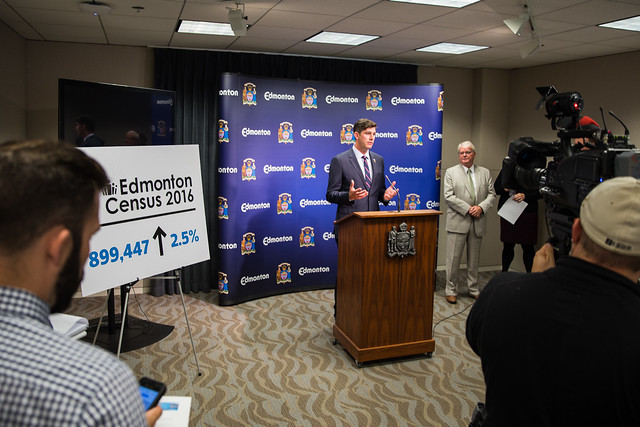
The results of Edmonton’s first ever paperless municipal census were released at City Hall today, revealing that Edmonton’s population has grown by 2.5% since 2014 from 877,926 to 899,447. That is much more modest growth than we saw in the period between 2012 and 2014 when our city’s population grew by 7.4%. From today’s news release:

“The impact of the recent economic slowdown and higher unemployment in Alberta and Edmonton is evident in the stable population growth figures recorded over the past two years,” said John Rose, Chief Economist for the City of Edmonton.

The slowdown mirrors to some extent what is happening provincially and federally. Estimates put Alberta’s growth rate at 3.9% from 2014 to 2016, down from 6.5% between 2012 to 2014, and Canada’s growth rate at 2.0% from 2014 to 2016, down from 2.3% between 2012 and 2014.

IMG_1154.jpg

The update to the Capital Region Board’s Growth Plan projects that Edmonton’s population will grow to at least 1.3 million people by 2044, which we’ll achieve if we can grow at an average of 1.8% per year.

“Although we saw more moderate growth these past two years, Edmonton’s population has increased by 117,000 since 2009. When you add to that the growth of neighbouring municipalities, it highlights the need for us to combine our efforts to ensure effective use of land and smart infrastructure planning.” said Mayor Iveson. “We need to work together and leverage our resources as well as those of the provincial and federal governments to ensure an ongoing strong and growing region, one that continues to attract and retain people and investments.”

Regional cooperation is especially important because it looks like Edmonton is getting even more suburban. Ward 6, which includes Downtown, Oliver, and other central neighbourhoods, saw its population decrease 5.0% from 2014 with a loss of 3,769 people. In fact, the centrally-located wards (6, 7, 8, 10, 11) all saw their populations decrease by anywhere from 2.2% to 5.0% while the outer wards (1, 2, 3, 4, 5, 9, 12) all saw their populations increase by anywhere from 1.1% to 12.1%. This is a big shift from the 2014 Municipal Census in which every ward grew.

2016 census by neighbourhood

It’s disappointing to me to see “population loss in a number of core and mature neighbourhoods” while the developing neighbourhoods like Walker, Laurel, Summerside, Chappelle, Windermere, and McConachie all show strong population gains. A decrease of 1,012 people in Oliver and 380 people in Downtown is cause for concern. Inglewood, Central McDougall, and Strathcona were some of the other central neighbourhoods that saw their populations decrease. We are continuing to grow out when we really need to be growing up.

You can see a comparison of census results from 2016, 2014, 2012, and 2009 in PDF here. There are 201 datasets related to Edmonton’s municipal census in the Open Data Catalogue with more to come. You can also access the latest results in PDF here. And here’s my post about the 2014 Municipal Census.

Northlands’ Vision 2020 is not going to happen

The City of Edmonton released its analysis of Northlands’ Vision 2020 proposal today. Introducing the report, City Manager Linda Cochrane said, “we acknowledge that Vision 2020 is an option for what could be done with the 160 acres.” It’s clear from reading the report however that the City doesn’t support the plan.

“Northlands has proposed an ambitious plan and there are elements that are worthy of future exploration,” Mayor Iveson said. But there’s a but. “Council’s job must be to make decisions that are in the best interest of the city, not just one organization.” Suggesting that there’s more work to be done, he said “it’s critical that we aren’t rushed and that we make the right decision for our city.”

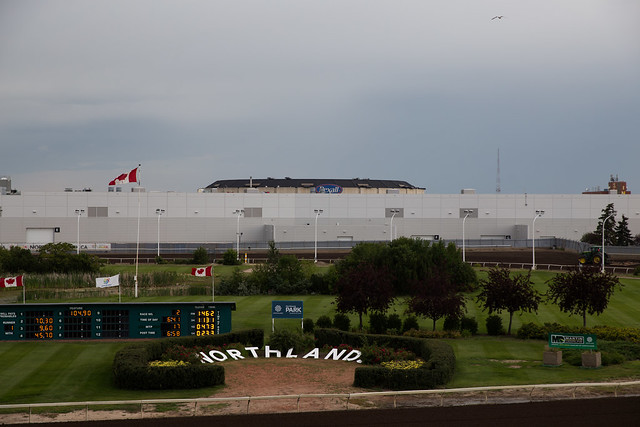
Northlands Park

Vision 2020 proposes a transformation of both Northlands as an organization and the 160 acres of land that it leases from the City and operates, which includes Rexall Place, the Edmonton EXPO Centre, Northlands Park Racetrack and Casino, and all of the parking. The plan would see Rexall Place repurposed as a recreation facility, a retrofit for Hall D in the EXPO Centre, a new agriculture strategy, the end of horse racing and a redevelopment of Northlands Park into an urban festival site, and a redevelopment plan consisting of commercial, retail, and residential uses. The key to making the plan work is debt forgiveness on the $48 million outstanding debt that Northlands owes on the Edmonton EXPO Centre, to say nothing of the capital expenditures required to build everything outlined in the plan.

Debt Forgiveness

On the debt forgiveness, Mayor Iveson was clear that is not likely to happen. “I don’t believe Edmontonians would support forgiving a debt this large.” Perhaps more importantly, there’s no upside to the City by forgiving the debt.

Northlands owes $47.4 million as of June 30, 2016 and the City has a corresponding debt obligation with the Alberta Capital Finance Authority for the same amount. Every year Northlands pays the City $4.05 million which the City in turn pays to ACFA, so there’s zero impact to the City. If the loan were forgiven, the City would have to find a way to pay the $4.05 million each year for the loan from ACFA, which expires in 2034 and does not have an option for early termination. “Funding this loan from the tax levy would require a 0.3% tax levy increase in 2017 at a total cost of $72.8 million for the remaining duration of the loan.”

Northlands is projecting negative cash flows of $7.7 million per year which means it may be at risk of defaulting on its loan payments as early as next year. If that were to happen, the City would have the ability to terminate the lease and take back possession of the EXPO Centre which provides the City with “a tangible capital asset that will limit the impact of a default on the City’s financial position.” In theory the City could use income generated from the EXPO Centre to fund the ACFA loan.

“The business case for the expansion of the Expo Centre was overly ambitious in retrospect,” Mayor Iveson said today. But we are where we are, there’s no going back now.

Debt forgiveness or not, the City is on the hook for the money. But by allowing Northlands to default on its loan, the City gains complete control of the Northlands site and EXPO Centre as well.

Repurposing Rexall Place

“There is no immediate demand for six new ice sheets in Edmonton,” the report states, “however opportunity does exist to leverage the Rexall repurpose concept in the context of closing or repurposing four single-sheet ice facilities in north and northeast Edmonton.” The Mayor sounded somewhat optimistic about the idea, and mentioned that he had even spoken with Hockey Canada recently to explore the idea of a hockey academy in the facility. Northlands estimates the cost of repurposing the facility at $85 million. While the City says it “is technically feasible” they disagree on the cost, suggesting “an estimate of $102 million within -10% to +20% would be more appropriate.”

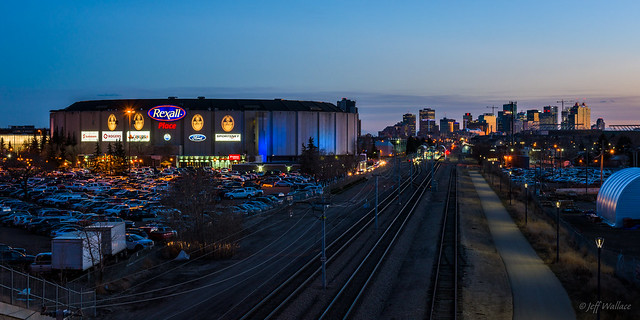
Farewell Rexall Place
Farewell Rexall Place, photo by Jeff Wallace

The wrinkle with this part of the plan is that the City is restricted by the Master Agreement with the Edmonton Arena Corporation (EAC) on the kind of investments it can make to Rexall Place. “The City cannot not make additional capital expenditures that exceed those required to maintain Rexall Place in a safe condition and in compliance with applicable laws.” Furthermore, as soon as Rogers Place opens the City has to stop providing any financial support to Rexall Place, directly or indirectly, except as required to comply with the law and maintain public safety.

The biggest issue however is that “the City must not financially support or advocate in favour of any plan to rebuild or renovate Rexall Place, unless it is to convert the facility to something other than a sports or entertainment facility.” If the plan to repurpose Rexall Place is going to go ahead, the EAC would need to formally waive that restriction.

Hall D

The Hall D retrofit would increase seating capacity to 5,000 but “appears difficult to justify based on the anticipated market demand” for events it might serve. Vision 2020 assumes the facility could attract 50 concerts and events annually, but the consultants research indicates that “a maximum of 20 to 24 concerts annually appear to be the upper boundary for this type of building.” Last year, Hall D hosted 6 concerts.

Electrical and mechanical upgrades as well as a roof replacement would all be required for Hall D in the next 2-4 years. “Without a long term tenant (e.g. minor sports franchise), enhancements to Hall D cannot be justified in the immediate term.” Again the report suggests a higher cost estimate than Northlands did, at “$38.7 million within -10% to +30%.”

Urban Festival site

Recognizing that the site “may provide a unique opportunity to the region” the report raises major concerns about the feasibility of the idea. Industry data suggests there may be market demand in the long-term, but “it is unclear if there is sufficient market demand to achieve the necessary revenue to make the site profitable.” Interviews conducted with local festival organizers suggest “there is not significant interest in relocating to the Northlands site at this time.”

K-Days

In general, the report highlights a lack of detail supporting the idea and says that further investigation would be required. “The updated cost estimate provided by Northlands of $83.6 million cannot be verified as accurate with any certainty,” the report says.

Residential Opportunities

Vision 2020 proposes 3,195 residential units in a mix of concrete high-rise buildings, wood frame low/mid-rise buildings, and townhomes. It anticipates absorption of 540 units per year, a figure the report says is unrealistic. The consultants estimated that Northlands “could reasonably capture at most 15-20% of apartment demand in the city’s mature neighbourhoods” which would mean demand for, “at most, 100-150 multi-family apartment units per year on average from 2015 to 2035.” There does appear to be “market demand for 400 beds to serve Concordia University” but the report notes that in addition to a lack of funding, “the economics of a concrete high-rise for student housing that assumes market rates for land is difficult to achieve.”

The Future of Northlands

When Vision 2020 was released earlier this year, Northlands suggested it would cost $165 million. The City puts the estimated cost at more than $230 million. Northlands deserves some credit for thinking big and putting something on the table, but Vision 2020 just isn’t realistic and will not happen. The future of Northlands will be something different.

Asked if the decision to build the new arena is the root of all of Northlands’ problems, the mayor said that was an oversimplification of a complex situation. “This has hastened a conversation that I think would have happened anyway,” he said.

mayor don iveson

Mayor Iveson indicated he will propose a merger of the EXPO Centre and Shaw Conference Centre next week when Council discusses the report. “This report provides a wake up call that the time for integration is now,” he said. “I believe that if we look at bringing the two conference centres together under a shared events authority, we will get better tourism and economic development results for our city.” He wouldn’t speculate on whether Northlands, EEDC, or a new organization should become that shared events authority.

This is an idea that is long overdue. It regularly comes up in discussions about the various facilities and organizations, and came up again earlier this month when Chris LaBossiere suggested a merger could be a way forward for Northlands. To his credit, Northlands CEO Tim Reid is open to the idea. “One of the things that has never made sense to me in our city is why we have two very large conference, convention and trade facilities that are run under different entities,” he told Metro.

Council will discuss the report at a Special City Council Meeting on August 31. You can dig into the full analysis here.

Summer fun at K-Days 2016

No summer in Edmonton is complete without a trip to K-Days to eat greasy food, take in the sights and sounds of the midway, enjoy some entertainment, and to stay up late for the fireworks. It’s something Sharon and I do every year, and this year we were fortunate to have our gate admission, food, and tickets to the TD Comfort Zone covered by Northlands. We visited on Saturday, and couldn’t have asked for better weather.

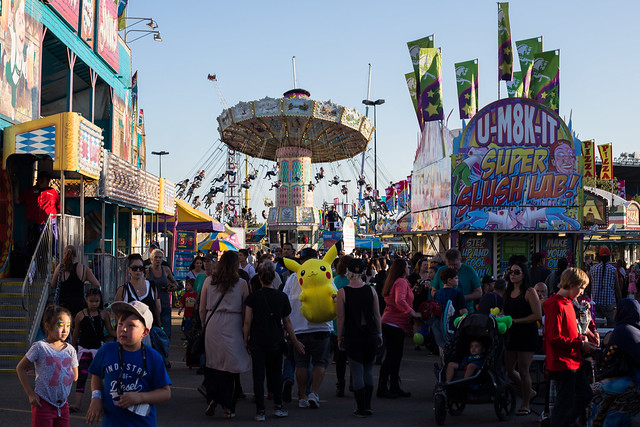
K-Days
Swing of the Century on the midway

This being the year of the Pokémon Go craze, the game was everywhere. From the Pikachu and other plush characters being won at the midway games to the five PokéStops on site, good luck ignoring Pokémon if you attend K-Days this year.

Food

It turns out the first new food item we ate this year was the best! The Meatball Sub on a Stick from Pizza Casa actually won 1st Place in the New Food Contest and we can see why. It took a few minutes to make, but it had great flavor, wasn’t messy to eat, and actually didn’t feel all that unhealthy! I really liked that the meatballs were wrapped in dough, rather that in a bun that was awkardly skewered which is what I had imagined.

K-Days
Meatball Sub on a Stick

The Teriyaki Chicken Perogies from International Perogies were on our list of new food items to try, but once we got there we were swayed by the Poutine Perogies. The $12 price seemed a bit steep, but the portion size was actually pretty generous. Have a bottle of water on hand when you eat this dish, because it was a bit salty, but it was very tasty.

K-Days
Poutine Perogies

There are two things I always eat at K-Days: a corn dog and mini donuts. This year I tried the Bacon BBQ Corn Dog, which was pretty good and not much different than a plain corn dog with BBQ dipping sauce actually. I also tried the new Big Pickle Dog from Chicky’s Chicken. I really wanted to like it, but it was awful. The pickle was way too big and much too difficult to bite into. And in trying to bite into it, hot pickle juice flew everywhere. Worse, the hot dog itself was soggy and slid right out of the centre of the pickle. Just avoid it.

K-Days
Big Pickle Dog

Also on the avoid list was the Mac N’ Cheese Stuffed Burger from Gourmet Hand Made Stuffed Burgers. Aside from the highly questionable food safety practices of the vendor (even for K-Days) the dish just lacked flavor. Like the pickle dog, two things I love combined should have been amazing, but instead it was pretty disappointing.

Games & Attractions

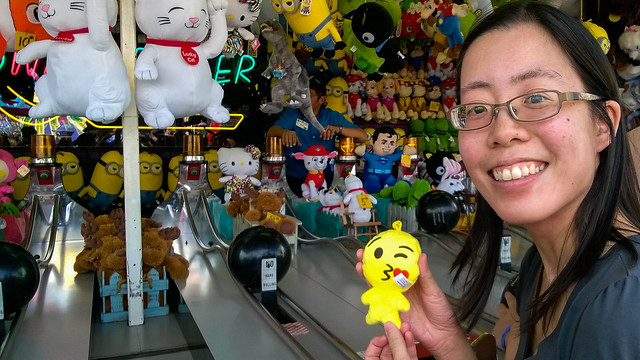
I wouldn’t say that we’re big midway gamers, but Sharon does love Bowler Roller (the 25 cent version). Though we spent a few dollars there, she actually won on her very first roll! Aside from Pokémon characters, emoji seemed to be the other hot prize this year. She won two of them.

K-Days
Sharon won an emoji

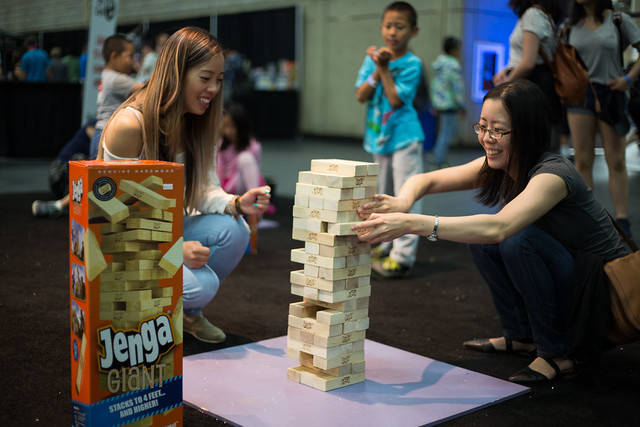
There was also fun to be had inside! We spent some time inside at TechLife where lots of people were playing video and board games. I’m tempted to go back on the weekend for the Canadian Drone Racing Championships! One of the more interactive features was the Jenga Giant games, which Felicia and Sharon played. They attracted a small crowd at one point because of the height they got to before it call came crashing down.

K-Days
Jenga!

Back outside we visited the K-Days Pow Wow, produced in partnership with the Alexis Nakota Sioux Nation. The pavilion features a different theme each day of the festival and “will host members from First Nation communities within Treaty Six and across Canada.” Every day between 3:30pm and 8:00pm you can experience a variety of traditional songs and dances.

K-Days
Pow Wow Grand Entry

If I’m being honest it felt a little like it was tacked on, but to be fair we didn’t spend a lot of time at the Pow Wow. I do think it’s important to recognize that K-Days takes place on Treaty Six land and I hope this aspect of the festival can be built upon in future years.

Entertainment

In past years we have enjoyed the Super Dogs show inside the Expo Centre. This year, we watched the Peking Acrobats then went outside to take in The Canine Stars.

K-Days
The Canine Stars

I mean, who doesn’t love dogs doing amazing stunts? They caught frisbees, jumped over incredibly high hurdles, and dove into a giant pool, splashing everyone around it. It’s the kind of event the crowd really gets into!

K-Days
The Canine Stars

Entertainment, and specifically music, has been a focus for K-Days this year with great line-ups at both the North Stage and the South Stage. Shawn Hook, Rachel Platten, and Victoria Duffield are some of the artists you can hear at the North Stage, while major names like X Ambassadors, Moist, Tom Cochrane, Simple Plan, and Finger Eleven can be heard at the South Stage. On Saturday when we attended, I was thrilled that Matthew Good was performing!

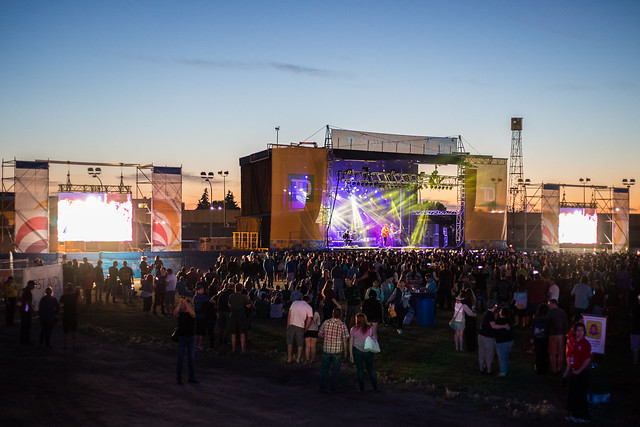
For the first time, the South Stage was moved from the concrete jungle alongside the rides to the track infield at Northlands Park. With a capacity of more than 12,000, the fully-licensed, grassy infield gave the stage much more of a music festival vibe. Just to the left of the stage was the TD Comfort Zone, a VIP area “designed for those superfans who truly want a night to remember.” It’s a large, covered, raised structure with appetizers, a cash bar, and a great view of both the stage and the crowds. Compared to the 5,000 or so people out in the infield, the VIP area was pretty empty, and we think most in attendance were invited by Northlands. Still, it did make for a comfortable way to take in the show if beach balls and mosh pits aren’t your thing.

K-Days
Matthew Good performs at the South Stage

The other great thing about the new South Stage is that it offers an amazing view of the fireworks! We’ve always made our way over toward the casino for fireworks in the past, but this year we were able to get closer and could see the lights of the midway in the background. I definitely recommend checking it out, even if you aren’t particularly interested in the musical act that night.

Attendance

So far K-Days has had pretty good weather and with strong pre-sales thanks to the music line-up (I’ve heard twice as many pre-sales as last year), I think this could be an incredibly strong year for the festival. K-Days attendance peaked at 810,503 back in 2005. The festival was re-branded Capital EX the following year, and attendance plummeted to 688,369.

k-days attendance

What’s most interesting is that the average attendance for the seven Capital EX years was 731,992. That’s only slightly below the average of 753,933 for the preceding seven years. But the branding damage was done, and the switch back to K-Days in 2013 was widely celebrated.

K-Days

So that was our experience this year! There’s a lot more to K-Days than we were able to take in, like rides, but we had lots of fun. Thanks to Northlands for the opportunity. You’ve got until Sunday to visit K-Days for yourself! You can see more photos from our 2016 experience here. You can read about our 2014 experience here. Be sure to check out Linda & Mike’s experience this year too!

Thoughts on the proposed downtown mega-bars from Urban Sparq

The two mega-bars proposed for downtown have been top of mind for many this week. One would have an occupancy of 596 and would be located in the new Fox 2 Tower on 104 Street. The second would have an occupancy of 1,400 and would be located in the old Mothers Music location on 109 Street. If approved, these two mega-bars would represent a significant variance from the current zoning which allow for establishments of 100 licensed seats. CBC has reported that Urban Sparq, owner of Knoxville’s Tavern and The Pint, is the proponent behind both.

So far the opposition to these two proposals seems unanimous. Councillor Scott McKeen has called the proposals “ridiculous”. The Downtown Edmonton Community League has sent a letter expressing its concerns, as have numerous businesses and residents from 104 Street. Many more have shared their thoughts on social media, especially on the 104 Street Facebook page. Given this, it would be extremely bold of chief planner Peter Ohm and his team to approve these variances, or at least the one on 104 Street.

I too am opposed to the proposals, but perhaps not as vehemently as others.

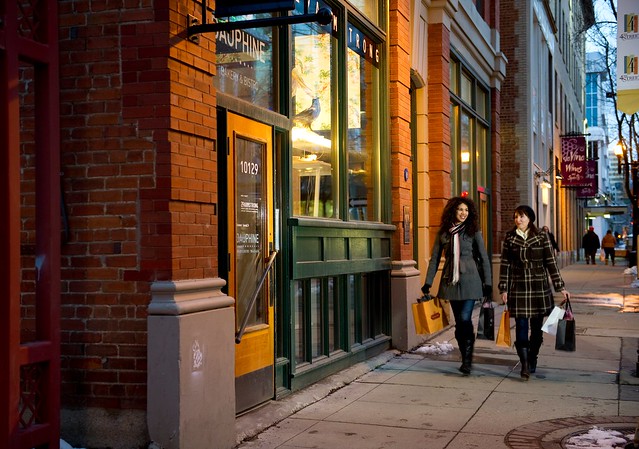
Shopping 104 Street
Shopping 104 Street, photo by EEDC

To me, noise and disorder isn’t really the issue here. Just as I don’t feel any sympathy for the people who buy a house near Anthony Henday Drive and then complain about traffic noise, I don’t feel any sympathy for those who bought a condo in the Fox Towers or any other nearby tower, just a stone’s throw away from the arena & entertainment district, with an expectation of peace and quiet. It’s simply unreasonable. This is the heart of our city and it should be a lively, vibrant place. I’m not saying that downtown should only be for singles or DINKs, but on the spectrum of neighbourhoods in the city I would not expect downtown to be at the slow and quiet end.

I’m also not convinced that a large bar is going to be so much worse than 20,000 people filing out of the arena on a regular basis and into the surrounding area, including plenty of people who have already been drinking all night inside the arena. I recognize that most events will end a lot earlier in the evening than a bar would close, and maybe the impact from arena patrons will be minimal. But I’m not sure that’s a bet I’d make.

We don’t know what kind of establishment would go into the Fox Tower. With an occupancy of 600 it is large, but far smaller than the combined occupancy of Knoxville’s Tavern and Studio 107 (formerly Oil City Roadhouse and Vinyl) at 1,600. Urban Sparq’s other properties include The Pint and Denizen Hall, both of which have much better reputations than Knoxville’s does.
As someone who has lived on 104 Street for five years, I can tell you it’s not always quiet or orderly now. Weekend evenings are frequently full of hollering from the throngs of people moving through the area, and I’ve walked around my share of puke. For the most part however, establishments on our street have been great neighbours. Most of the time you’d have no indication that Kelly’s Pub or Mercer Tavern or Cask & Barrel are on the street. They do a reasonable job of helping to make 104 Street the well-regarded area that it is and the new Purple Flag designation reflects this. I think a community working together to set reasonable expectations can go a long way toward preventing the kinds of issues that so many seem concerned about. But you need to have a dialogue to do that.

I think the way the proponents have gone about this is just ridiculous, and I think as a city we should use this as an opportunity to better define how we expect these sorts of proposals to come forward. Council squandered an opportunity to set expectations about large towers by approving the Emerald Tower last month, so I hope the City doesn’t waste this opportunity to demand more from developers looking to occupy those buildings. It’s unacceptable to avoid engaging the community and it’s even worse to try to hide your involvement altogether. It says a lot about the character of the proponents and is a major reason I am opposed to the proposals.

That said, the response from the 104 Street community thus far hasn’t been great either. The low bar set by the proponent has been matched with a “we must stop this at all costs” kind of approach, including action committees formed in many of the residences along the street specifically to fight this. Where’s the invitation for dialogue? Also, I don’t for a second believe that as many people checked the zoning before they bought into the street as one would gather from reading all the responses. NIMBYism is just as applicable downtown as it is in the suburbs, it would seem.
The most common refrain I have seen from those opposed to the proposal is that it is out of character with 104 Street and could undo the great work that has happened over the last 20 years. I have great respect for everyone who has had a role in making 104 Street what it is today, but to say that one establishment would destroy all of that strikes me as a bit alarmist. Especially considering the number of businesses that have failed on 104 Street or moved elsewhere in just the last five years alone.

The issue is not that a large bar is too dissimilar to the smaller, more intimate venues that we currently have on the street. It’s that a mega-bar like this would probably be more like Knoxville’s Tavern in that it would sit closed most of the time, meaning we’d have yet another downtown street front devoid of life. Paula wrote about this too:

“Giant big-box bars of this type tend to stay closed during the day — and sometimes during most weeknights. They often only open on Friday and Saturday nights. That means big hollow spaces sit vacant much of the week, draining life from the street. That’s not vibrancy at all.”

I get that the folks opposed are not saying they are opposed to vibrancy and business development in general. But it really comes off as, “as long as it’s vibrancy that we approve of.” Again, this could be an opportunity to identify what kinds of businesses we do want on the street and to then do something about it. How can we attract them?

Most of the discussion so far, as above, has been about the proposed bar for the Fox 2. There has been much less said about the bar proposed for the Mothers Music building, even though it is much larger and is potentially even more problematic. Consider that the building Knoxville’s Tavern currently occupies is slated to be demolished to make way for a new development and that the Subdivision and Development Appeal Board dismissed an appeal against the 388-seat Hudson’s that will open just down the block from The Pint on 109 Street. It makes sense to move the 1,000 seat Knoxville’s to the 1,400 seat Mothers Music building rather than to a smaller, more expensive location, and a proposal for a 600 seat bar on 104 Street at the same time seems like a perfect distraction. Instead of discussing whether or not we really want 2,200 licensed seats along the 109 Street strip from Jasper Avenue to 103 Avenue, the discussion is all about the supposed destruction of 104 Street. Which do you think would be worse for cleanliness, disorder, and safety?

On the Edge
On the Edge, photo by Dave Sutherland

Furthermore, there’s a bigger discussion here we should be having about the impact of Ice District. Will event-goers really need additional places to party after the arena closes? Should those places be in the district or elsewhere in the downtown? What is the impact on policing, transportation, and other considerations for each approach? These are all important questions that need exploration.

As I said, I am opposed to both proposals in their current forms. I think they would result in less truly vibrant streets and I think we should make an example of them to set expectations and to encourage higher quality proposals in the future. I am disappointed in the knee-jerk NIMBYism on display here though, and I’m concerned it is distracting us from the bigger picture. I think it is really unlikely the City will approve these variances, and I hope that once the rejections come through, we can continue the dialogue on some of the related and very important questions that these proposals have raised.

The beautiful symmetry of downtown Edmonton’s newest signs

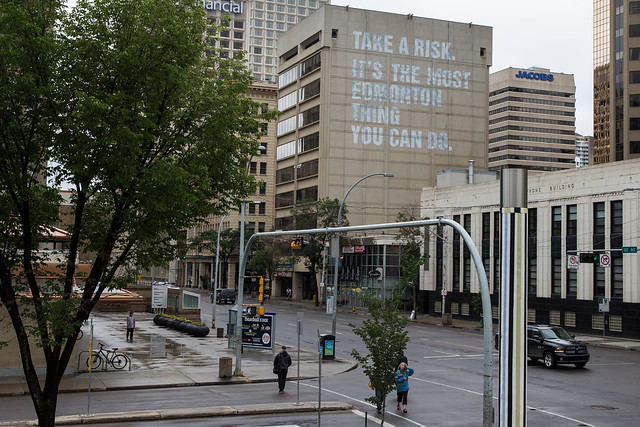
It’s probably just a coincidence that the signage on Rogers Place went up the same week as Melcor and Make Something Edmonton’s Wall of Encouragement did, but I think there’s a beautiful symmetry in that. With Rogers Place we have a shiny beacon of the megaproject-based transformation of downtown Edmonton, and with the “take a risk” words we see a physical reflection of the many smaller but no less important changes that are taking place. We need both.

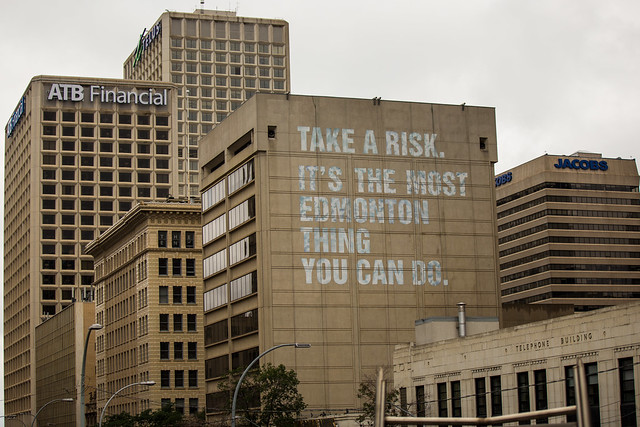
Wall of Encouragement

Melcor and Make Something Edmonton collaborated with local designer Clay Lowe to install the new mural on the north facing wall of the 100 St. Place building. It reads, “Take a risk. It’s the most Edmonton thing you can do.” This is straight out of the Make Something Edmonton brand book, and while some see the mural as mere propaganada and a missed opportunity for “real art”, I like it.

“Risk taking is a fibre embedded in Edmontonians. It’s an entrepreneurial tick that each of us has, but only some of us listen to.”

The new mural was installed almost exactly five years after Todd Babiak spoke at Pecha Kucha Night 10 about “the wall” and interventions. He was referring to a different Melcor wall back then (the one behind the Edmonton Journal building) but his intent was always to impact more than the view out his window. Five years later, Make Something Edmonton carries the torch forward with partners like Melcor.

Wall of Encouragement

You can get a great view of the new mural from Churchill Square and the Tix on the Square building.

“Our aim is not only to encourage our citizens to take action on a project of their own, but also to challenge our fellow building owners to join us in treating empty walls as canvases for colour and inspiration.”

I hope this does indeed inspire some building owners to look at their exterior walls differently.

Rogers Place

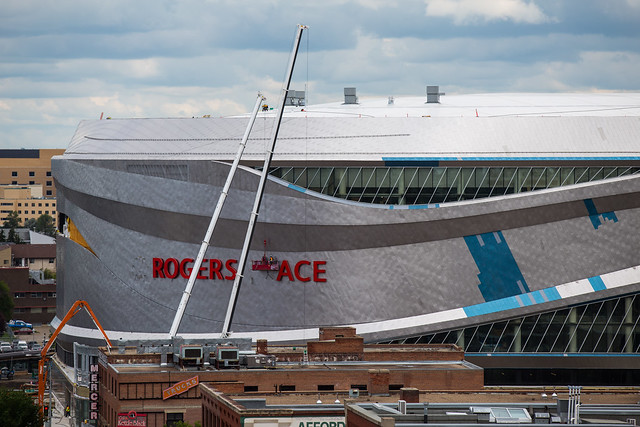
A few blocks away on 104 Avenue and 104 Street, construction on Rogers Place continues at a rapid pace. This week the “Rogers Place” signage started to go up on the west side of the building. It’s one of many milestones as the September 10 public open house approaches:

“With the letters going up, you can really start to see the building look like it does in the renderings,” said Mike Widdifield, Senior Project Manager for PCL.

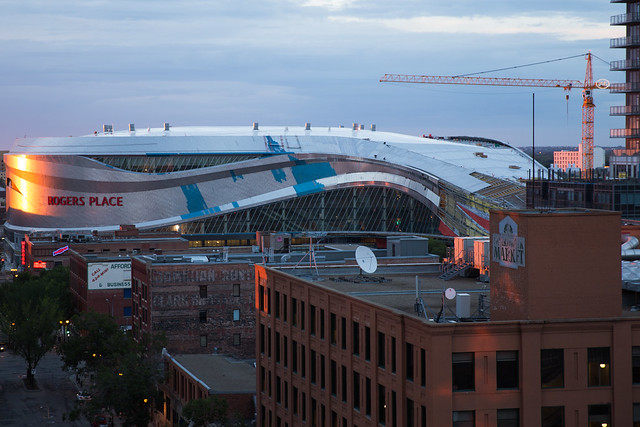
I see the new arena every single day and I always feel like it is so much smaller than Rexall Place. But maybe that’s just because I’m used to it. From a distance, Rogers Place does indeed dominate the skyline.

Downtown Edmonton

The Rogers Place groundbreaking took place on March 3, 2014 and although it appears that the arena will open on time this fall, the construction won’t end there. The new Stantec Tower, JW Marriott hotel, Legends private residences, and many other projects will keep the area under construction through 2020.

Downtown Sunset

Fewer blank walls and fewer surface parking lots (hiccups notwithstanding), that is downtown Edmonton’s future.

From intervention to rejuvenation: Michael Phair Park

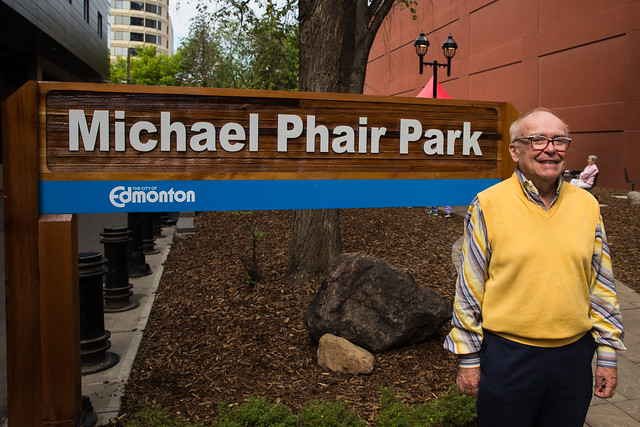
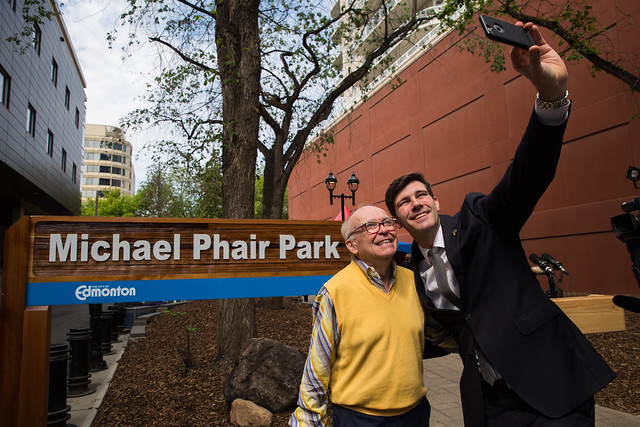
The little pocket park on 104 Street was given an official name recently. Located behind the former Sobeys just north of Jasper Avenue adjacent to the Icon towers, the park is now known as Michael Phair Park! I can’t think of anyone more deserving of this honor than Michael Phair.

Michael Phair Park Unveiling

It was Michael who convened a group of Edmontonians known as Edmonton on the Edge to “examine, challenge and suggest what it takes to rejuvenate public spaces.” They decided to focus on the alley between Beaver Hills House Park and 103 Street, which came to be known as the Alley of Light. “Inspired by similar alley interventions from other cities around the world, we hope to revitalize the space by making it more engaging, accessible, safe and sustainable.” The group organized pop-up events like IllumiNITE, open houses and workshops to imagine what the space could be, and even painted the roadway in 2011. They showed the forgotten space the love it needed.

Michael Phair Park Unveiling

The decision to name the park was championed by Ward 6 Councillor Scott McKeen last year. The following motion was carried unanimously at the March 10, 2015 meeting of the Edmonton Naming Committee:

“That the Naming Committee approves the naming of a park, located on 104 Street and north of Jasper Avenue legally described as Lot 130A, Block 4, Plan 7823267 within the Downtown Neighbourhood, as ‘Michael Phair Park’.”

The space was previously known as Devonian Park1, though most just called it the 104 Street pocket or strip park. The new sign was not installed until last month and until May 26 it was covered up with blue tarp. Finally on that beautiful Thursday, with more than 100 friends and fans of Michael Phair present, the name was unveiled.

Michael Phair Park Unveiling

The park has changed quite a bit since Michael and the EOTE folks took an interest in it. After years of drawing attention to the alley, work began on finding a way to pay for improvements to both the alley and park. Michael’s knowledge of how to navigate the bureaucracy of the City was especially helpful in that effort, and as a result the park was included in the Downtown CRL. I had my doubts about the approach, but Michael was persistent and never gave up and it paid off. Improvements were made to the alley in 2013 and the park renovations were made in late 2014, transforming the dark, neglected space into a usable park.

Michael Phair Park Unveiling

As a resident of 104 Street I very much appreciate having the park nearby. It has made that park of my ‘hood much more attractive and welcoming and I actually enjoy walking through there now. It will continue to improve when new permanent artwork is installed too, including a new mural by Destiny Swiderski.

Michael Phair Park is also a daily reminder for me that with a little collaboration, persistence, and flair you really can make a difference in your city.


  1. And I think it is actually Lot 192A as I am fairly certain that 130A is Beaver Hills House Park. I understand the space was registered as an easement in 1977. I’ve seen reference to the land having been gifted to the City at some point, but I haven’t been able to find any confirmation of that. The Award of Merit page for Cecil Place also references ‘Devonian Park’. 

Learning about photography for #3SkillsYEG

I’ve had a digital camera (many, actually) for as long as I can remember. You know those really old Casio digital cameras that produced super grainy, low resolution photos? Yep, had one. Today my primary camera is a Canon 6D, which is a full-frame DSLR. It produces incredible photos, technically speaking. But as any “intro to photography” book or course will tell you, it’s not the gear that produces great photos, it’s the photographer. The hardware has changed an incredible amount since the advent of digital photography, but the principles of taking better photos have changed much less. Like most people, I never really learned those principles. I picked some stuff up by watching other photographers of course, like my Dad whose work I really admire. But mostly my strategy has been “spray and pray”. Take lots of photos and hope for the best. I decided to change that for the “Creativity & Expression” theme during #3SkillsYEG.

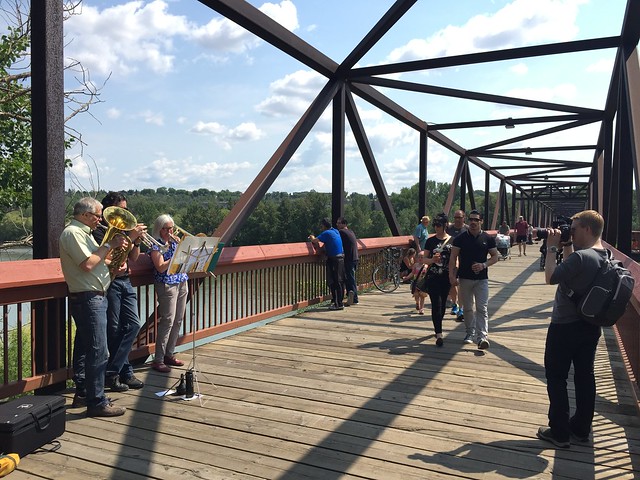
Cloverdale Footbridge
Me taking a photo on the Cloverdale Bridge last summer

Obviously there are dozens and dozens of resources for learning more about photography through EPL. I decided to narrow it down to digital resources, and it wasn’t long before I stumbled across the amazing content available through Lynda.com. It’s truly amazing that Edmontonians have free access to this incredible resource with a free library card. I still can’t get over it, to be honest!

Photography is one of the top-level categories at Lynda.com so there’s definitely a lot of content to choose from. There are 643 courses and 28,488 video tutorials related to photography, to be exact.

“Whether you want to be a photographer or just love taking pictures, learn what you need with our in-depth courses in photography: how to shoot photos that tell a story, choose the right gear, create a photo book, and more. Get tips on photo editing, studio photography, and lighting, too.”

Here are the courses I completed:

I also skimmed through parts of a course on Lightroom, which I am using to edit and organize photos. Even with just those five courses, I learned a ton. I now have a good idea of how much I don’t know! I especially enjoyed the videos with Ben Long and was very happy to see that he has a weekly show on Lynda.com called The Practicing Photographer. I found his style very approachable and well-paced. At one point he shares that he used to get asked a lot what type of photos he likes to take – landscape, portraits, etc. He reflected on it and decided that he likes to photograph light. That really stuck with me.

Here are some of my favorite photos that I took while working through the videos:

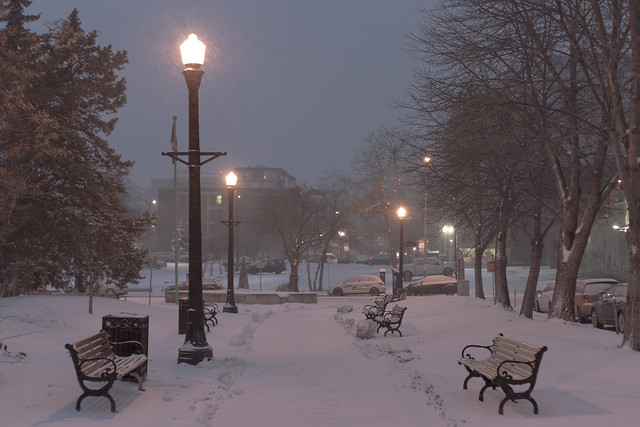
Spring Snow
One of the first photos I took with my new 50mm prime lense

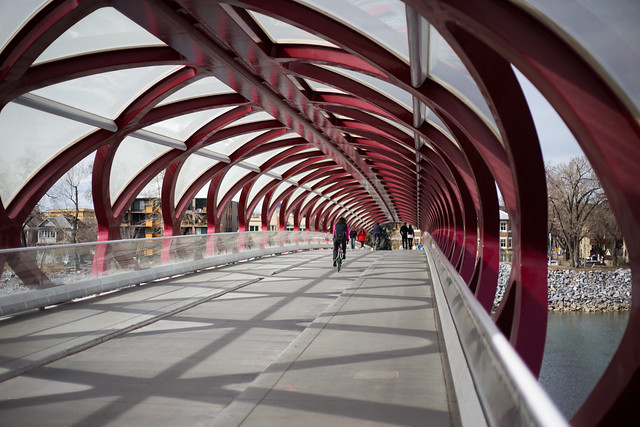
Peace Bridge
Always love the Peace Bridge in Calgary

Sunset Reflected Downtown
Experimented with stitching photos together here, using ICE

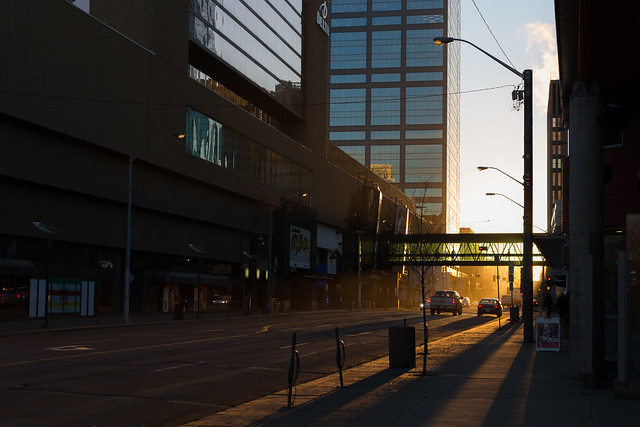
Morning Sunlight
I had Ben Long’s comment about shooting light in my head for this one

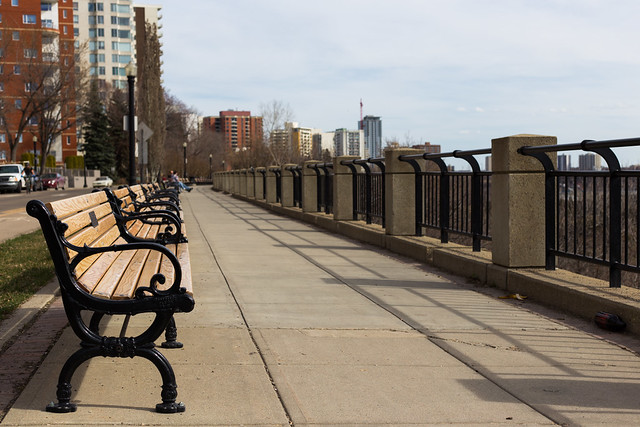
Victoria Promenade
An example of crouching down to get a better shot

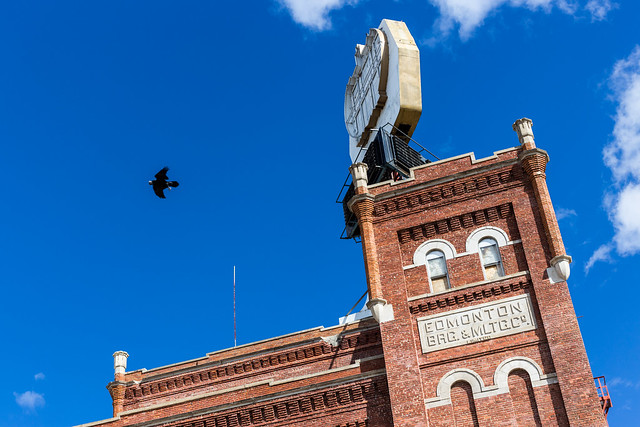
Flying over the old Molson Brewery
Good timing, but also I like the color contrast

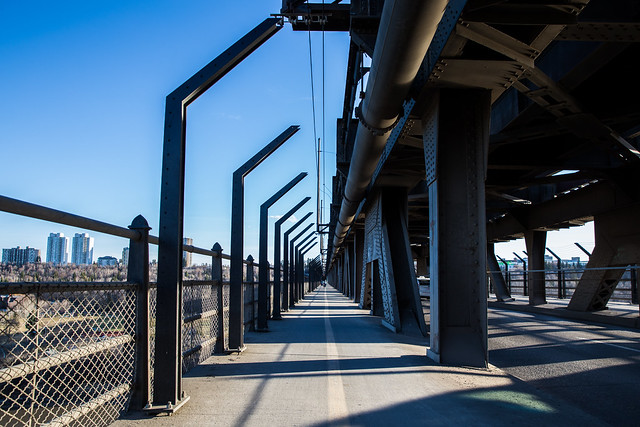
High Level Bridge
Another example of changing my perspective to get a different shot

I have started on my next course already, Foundations of Photograpy: Composition. After that, I’ll move on to the other videos in the Foundations of Photography series, including Black and White, Night and Low Light, and Flash.

If you’ve been reading my blog for any length of time you’ll know that I am a sucker for gadgets. So it was a little dangerous to dive further into a topic like photography where you can spend thousands of dollars on gear! I did pretty well though, and ended up only making a few purchases. The biggest was the Canon 50mm f/1.8 STM, my first prime lens and a great deal at just $170 or so. I also picked up a lens cleaning kit, and a few accessories from Peak Design to go with my messenger bag.

I have really enjoyed learning more about photography and working to improve my skills and I look forward to continuing it with the resources available through EPL! The #3SkillsYEG campaign is over for 2016 (I’m way behind on posting this) but that shouldn’t stop you from learning about something that interests you! If you need an excuse, remember that we’re a City of Learners!