Looking back at the Transforming Edmonton blog’s first year

A little over a year ago, the City of Edmonton launched its official blog, called Transforming Edmonton. Though it launched as a pilot project, the blog was meant to be another vehicle for the City to “share stories about how the City is working on transforming itself.” It remains focused on the City’s Vision and Strategic Plan, with sections on Economic Diversity, Environment, Financial Sustainability, Livability, Transportation, and Urban Form. How successful has the City of Edmonton’s foray into the world of blogging been? Let’s look back at the blog’s first year.

Let me start by saying that any blog that has made it past three months and is still updated somewhat regularly can probably be described as a success! Blogging takes commitment, so I applaud the City for sticking with it. Jas Darrah, Communications Business Partner at the City of Edmonton, was nice enough to answer my questions about the blog’s first year.

Over the last year, a total of 87 entries were posted to the blog. That’s not far off from the original goal of two new posts per category per month (which would have resulted in 144 posts). Though there are approximately 40 registered authors in the system, Jas clarified that in reality up to 100 people have collaborated on the resulting posts, as Public Information Officers and subject matter experts have worked together to craft the content. Initially, a lot of effort went into recruiting City employees to contribute to the blog, but that has become less necessary according to Jas. “The desire to participate from business units across the organization grows weekly, while in the first months we were beating the bushes to get participation.”

The blog has averaged 2400 page views per month over the year, which is respectable but quite a bit less than I expected. Of course, page views are just one piece of the puzzle. There’s also RSS feed readers (that’s how I read the blog), people who read the entries on Facebook, or who see the entries on YouTube, etc. And keeping in mind the City’s goals for the blog, engagement is a better metric than traffic statistics anyway. Slowly but surely, they’re having some success in that area. The blog has received 157 comments over the year, primarily on the two most successful posts: Bob Boutilier’s Q&A post on The Way We Move, and Phil Sande’s Q&A post on the City Centre Redevelopment Project. Jas says we’ll see more of those kinds of posts in the future.

Jas told me the blog is still being classified as a pilot, because the City is still gathering information to help evaluate it. I don’t think the public perceives it as a pilot however, and it sounds like City employees are happy for the blog to continue as well. Jas said the City’s “communications teams now see this as another vehicle to offer the City business units to reach out to the community, while offering ways to experiment with multimedia.” Many posts recently have included video and photos, such as the series on the Heads Up! campaign. While it may be just another tool in the communications arsenal, Jas confirmed the blog is “one of the most cost-effective tools in our toolkit.”

I’m a big fan of the Transforming Edmonton blog, and I’ve mentioned it numerous times in social media presentations over the last year. The design is clean, and I particularly like the simple Comment & Trackback Policy, accessible on every page. Jas said he’d regard the project as a success, even though there is still a lot of work to be done.

Raffaella Loro (the blog’s primary instigator) told me before the launch last November that she saw the blog as “encouraging a cultural shift” in the way the City operates. A year later, I think that is happening. Jas noted that “our City leadership saw that any negative comments that this project may facilitate would be outweighed by the positive reputation for facilitating those comments.” City employees like the blog as a way to share information, and according to Jas, many thought the blog was only internal when it launched! He told me the City will be launching its first internal blog in January.

I’d say the Transforming Edmonton blog has had a successful first year. There’s lots of room to grow and improve, but there’s now a strong foundation in place. I look forward to seeing it evolve.

A follow-up thought: I think the blog can become an important archive of the City’s perspectives over time. In the spirit of digital archiving, here’s what the blog looked like as of December 6.
Edmonton’s FIRE Industry: $135 billion and counting

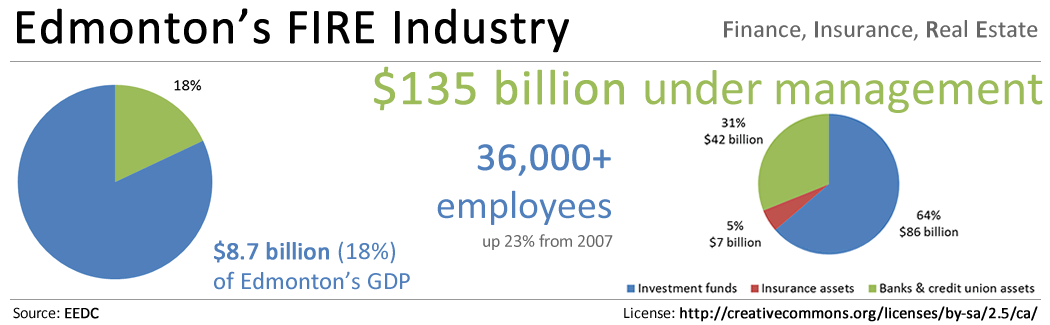
Did you know that more than $135 billion is managed right here in Edmonton? I didn’t either until I heard someone an EEDC event I was at mention it in passing. I’m sure we’ve all heard another Edmontonian gripe about our city’s lack of head offices, about how blue-collar we are, but how many people have mentioned that billion dollar stat? Not many is my guess. I decided to learn more.

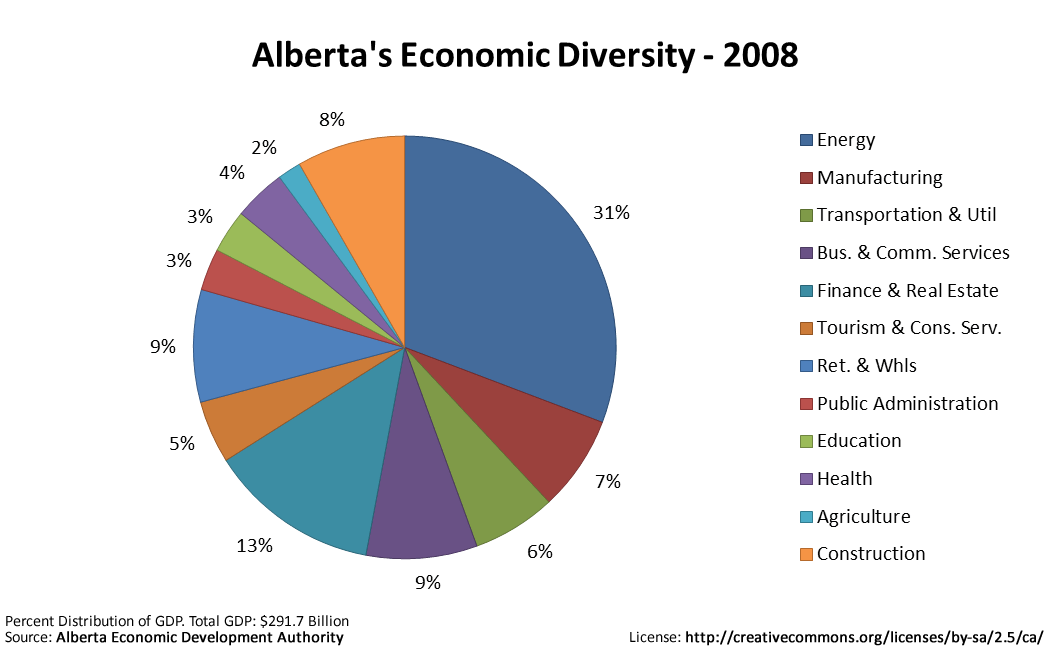
The acronym FIRE stands for Finance, Insurance, and Real Estate. It’s a big industry, with more than 36,000 employees in Edmonton (roughly 5.5% of our labour force). In 2009, the FIRE industry accounted for $8.7 billion or 18% of Edmonton’s GDP. Employment in the industry has grown 23% from 2007, and GDP created from the FIRE industry has grown 40% over the last ten years (compared to 30% overall).

Those numbers come from Greg Bainbridge and Tammy Fallowfield at Edmonton Economic Development Corporation (EEDC). They were nice enough to help me gain a better understanding of the industry.

I wanted to get a sense of just how big the industry is, compared to other places. As you might expect, it’s difficult to compare Edmonton with a population of around 1 million people to Toronto, which is four or five times our size. Comparing Alberta as a whole makes more sense. That means looking at Calgary and Edmonton together, an idea that both EEDC and the Alberta Economic Development Authority (AEDA) are promoting. Greg told me that “Calgary and Edmonton are complementary financial service centres”, something that is common in other places as well (Dallas/Houston, Geneva/Zurich, Amsterdam/Rotterdam, etc). He pointed me to AEDA’s recent report entitled Building Alberta’s Financial Services Industry (PDF). Sure enough, one of the “strengths we can build upon” listed in the report is the complementary nature of Calgary and Edmonton’s financial services sectors.

The local financial services industry in Calgary has established a reputation as among the world’s best for energy financing. Edmonton’s financial services industry, meanwhile, has established strengths in banking and risk management.

The report makes the point that as a whole, Alberta’s FIRE industry is, well, on fire. From 2004 through 2009, total capital investment in Alberta totaled almost $433 billion. Here’s what the per capita investment looked like across the country in 2009 (the national average was $9,174):

Employment growth in the financial services industry in Alberta has outpaced the national average over the last ten years as well.

We’re not without challenges, of course. The AEDA report cites economic diversification as a key challenge:

Another key challenge is a shortage of skilled labour: “compared to those of other provinces with financial centres, Alberta’s labour force includes the lowest proportion of individuals with post-secondary education.”

That’s a challenge that the industry is tackling here in Edmonton. Greg described the industry as “an industry of human capital, the foundation of which is smart people”. The University of Alberta has a number of programs of course, such as the MBA program, and NAIT offers a risk management program for insurance, but beyond that there isn’t much in the way of FIRE-specific education. Many of the industry’s senior positions have been filled by drawing expertise from elsewhere, and attracting talent has been a major focus of the industry.

That’s one of the reasons that EEDC recently formed the Financial Services Working Group here in Edmonton. Greg told me that the industry has grown quite organically and independently thus far, due at least in part to the government being located here (thinking of AIMCo and ATB, for instance), but that has meant very little coordination or working together (a mission to Toronto in June 2009 focused on recruitment was one of the first tangible examples of working together). The working group, which met for the first time in October, is brainstorming ways to further the industry, and working more closely with educational partners such as NAIT to develop relevant curriculum is a key outcome of that effort.

Continuing education of the industry’s labour force is another goal. Conferences, luncheons, and other events are all being considered. Though the University of Alberta has the only Chartered Financial Analyst (CFA) partnership in Western Canada, there isn’t a strong understanding of the designation in the industry (think of it as the CA equivalent for investment professionals). There are also opportunities to share research being done at the University of Alberta more directly with the industry.

So who are some of the key players in the FIRE industry in Edmonton?

  • Canadian Western Bank – Formed as the result of a series of mergers & acquisitions, but started in 1984 as the Bank of Alberta. CWB has nearly $12 billion in assets, more than 1200 employees, and has achieved 89 90 consecutive profitable quarters.
  • ATB Financial – Founded in 1938 under William Aberhart. ATB has more than $25 billion in assets and more than 5000 employees.
  • Servus Credit Union – Formed as the result of a series of mergers, the largest of which was Capital City Savings, formed in 1987. Servus has nearly $10 billion in assets and more than 2000 employees.
  • AIMCo (Alberta Investment Management Corporation) – Created by legislation in March 2007. AIMCo manages approximately $71 billion and ranks as one of the five largest institutional investment managers in Canada.
  • Peace Hills Trust – Established in 1980. Peace Hills has nearly $500 million in assets and over 120 employees.
  • Peace Hills Insurance – Established in 1982. Peace Hills has more than $270 million in assets and more than 175 employees.
  • ATRF (Alberta Teachers’ Retirement Fund) – Has been administering a pension plan for Alberta teachers since 1939. ATRF has assets of roughly $5 billion.

These organizations and others in the FIRE industry will play an important role in the future economic growth of our city and province. As the AEDA report states:

The financial services industry is a critical enabler of economic growth, competitiveness, scalability, and productivity. It provides businesses and other industries across the economy with the necessary capital, financial support and advice to pursue opportunities and compete internationally. A robust financial services industry facilitates connections and access to international markets, and helps develop local entrepreneurship, equity, and wealth.

They might be large, but these organizations are also part of the community. ATB Financial, for instance, is a very active community member with thousands of volunteers hours and millions of dollars invested.

The future for the industry looks bright, and initiatives such as the working group should help to take the industry to the next level. Greater engagement with educational partners is important, but the industry will need to make even broader connections to truly succeed. Organizations such as the Edmonton Financial Literacy Society (of which Greg is the chair) can help in that regard. It’s also encouraging to see people like Larry Pollock, CEO of Canadian Western Bank, connect with young professionals like he did at the Emerging Business Leaders’ September meeting.

Edmonton’s FIRE industry is successful and growing, with over $135 billion under management. Remember that the next time someone tells you Edmonton is blue-collar!

Proposed Downtown Arena: Response to Council’s Questions

Back in July, City Council asked questions of Administration, the Katz Group, and Northlands regarding the proposed downtown arena district. A lot of questions. Today, the responses to those questions are being made available in preparation for the December 10 meeting (read them here). Here are a few questions and answers that I have extracted.

Mayor Mandel asked Administration: How many parking stalls are in downtown Edmonton that are within 8-10 blocks of the new proposed arena site?

Data from a parking study prepared as a background report for the Capital City Downtown Plan (Capital City Downtown Plan) in 2008 and recent calculations indicate approximately 46,100 total parking stalls exist within a 10 block radius from the proposed arena site.  Of these, approximately 2,700 are on-street metered parking, 17,300 are off-street surface parking, and 26,100 are located within a parkade (i.e. structured parking).

Councillor Caterina asked Administration: Why was the 5th best location chosen rather than #1 – Jasper Avenue, #2 – Northlands, etc.?

The confidential HOK Study does not prioritize the proposed locations.  Rather, it identifies the essential components required to attract major sporting and entertainment events and identifies location issues and the criteria necessary for a successful facility development.  The proposed location for the district is a viable choice when factoring in the various criteria identified in the HOK Study, particularly related to the challenges/opportunities of land assembly.

Councillor Leibovici asked Administration: Can a condition of a CRL be a guaranteed revenue stream?  In other words if projected development does not occur as anticipated can the City require that the Katz Group provide a guarantee to cover debt servicing costs?

A risk assessment is part of the requirement for the CRL.  The CRL plan must identify expected and alternative funding sources in the event the development does not occur.  Alternative revenues to make up any shortfall in expected revenues from a CRL would be discussed as part of a negotiation with the Katz group.

Councillor Leibovici asked Administration: What are the projections for the Edmonton Convention Market? Part of the answer:

From Mike Fitzpatrick, VP & General Manager of the Shaw Convention Centre: The Shaw Conference Centre is routinely turning away convention business due to a lack of downtown convention space; when that happens these events are almost always forced to select another city.  In the nine months from January to September 2010 we have already turned away 13 future convention bookings.

Councillor Sohi asked Administration: Have discussions taken place with the Province regarding the CRL model?

Administration has had preliminary discussions with the province on the use of a CRL for arena development.

Councillor Anderson asked the Katz Group: Is the $100 m Katz dollars cash or land?

There are a number of ways to deliver $100m  in value, but we recognize that this will have to be done in a fashion that is acceptable to the City.

Councillor Iveson asked the Katz Group: Please explain exactly how a Location Agreement works from the Franchise perspective, including the contemplated duration of the agreement.

A location agreement would be a term of the lease pursuant to which the Oilers would play in the new building.  It would bind the Oilers to playing only in that building for the full term of the lease.  We are prepared to sign a long term lease in a new downtown arena that would bind the team to Edmonton for the  term of that lease.  We expect a term of 25 years or more.

Councillor Sloan asked the Katz Group: Forbes has shown consistently over the past 3 years that the Oiler net operating income is better than the Calgary Flames anywhere from $3 million to $10 million per year?

That is not accurate based on our information.

Councillor Sohi asked the Katz Group: Are two arenas viable in Edmonton?

No.

Councillor Thiele asked the Katz Group: If no new downtown arena district is built in Edmonton and the Oilers will not play in a renovated Rexall Place, where will they play?

Our singular focus is upon negotiating a mutually satisfactory agreement with the City of Edmonton that will facilitate the construction of a new downtown arena.  We are confident that this can be achieved.

The complete list of questions and answers is available here. At the December 10 meeting, Northlands will be giving a presentation, the questions and answers will be discussed, and Administration will be talking about the public consultation that took place.

The issue will come before Council again on January 17. You can see more information here.

Reimagine: Achieving a Sustainable Building Stock in Edmonton

A few weeks ago I attended Manasc Isaac’s Reimagine Tower Renewal Summit 4 (see my preview). John Woelfling from Dattner Architects in New York was the guest speaker, and he shared a wealth of information on the renewal of the Peter W. Rodino Federal Office Building in Newark, New Jersey.

Reimagine Tower Renewal Summit

John covered all aspects of the renewal project, from cooling & heating plant upgrades to egress improvements and façade upgrades. They were able to achieve a significant increase in the energy efficiency of the building, and it looks much nicer now too! A lot of the information was over my head, but you can download John’s presentation here if you’re interested (PDF, 10 MB).

Peter W. Rodino Federal Office BuildingPeter W. Rodino Federal Office Building

One slide in particular from John’s presentation stuck with me. To help set the context, he showed this graph:

As you can see, the vast majority of new office construction in Manhattan occurred back in the 1970s and 1980s. Why is that significant? Building codes and regulations were far less likely to consider energy efficiency at the time. An office tower built today is far more likely to be energy efficient than one built in 1970. It wasn’t until the Brundtland Report was published in 1987 that the term “sustainable development” was defined.

I have been thinking about that graph ever since, wondering if the situation here in Edmonton was similar, and trying to wrap my head around the problem of having an old and inefficient building stock. I spent some time on the website for The Way We Green, and came across this discussion paper from Klaas Rodenburg of Stantec. Titled Achieving a Sustainable Building Stock, the paper discusses the very thing I have been thinking about. Here’s a key excerpt:

Buildings are directly responsible for more than a third of all energy used and more than 50% of natural resources consumed in Canada. As a significant part of the problem, buildings also present part of the solution.

Although buildings look permanent, they are actually replaced or renewed on a perpetual basis. Municipalities can take advantage of this continual renewal cycle to significantly grow their stock of sustainable buildings by expecting higher standards for new buildings and encouraging existing building owners to engage in green renovations. Building codes are slow to change and focus on life safety, health and accessibility and not environmental performance.

The paper goes on to discuss voluntary rating systems such as LEED, and identifies strategies our city could employ to achieve a more sustainable building stock.

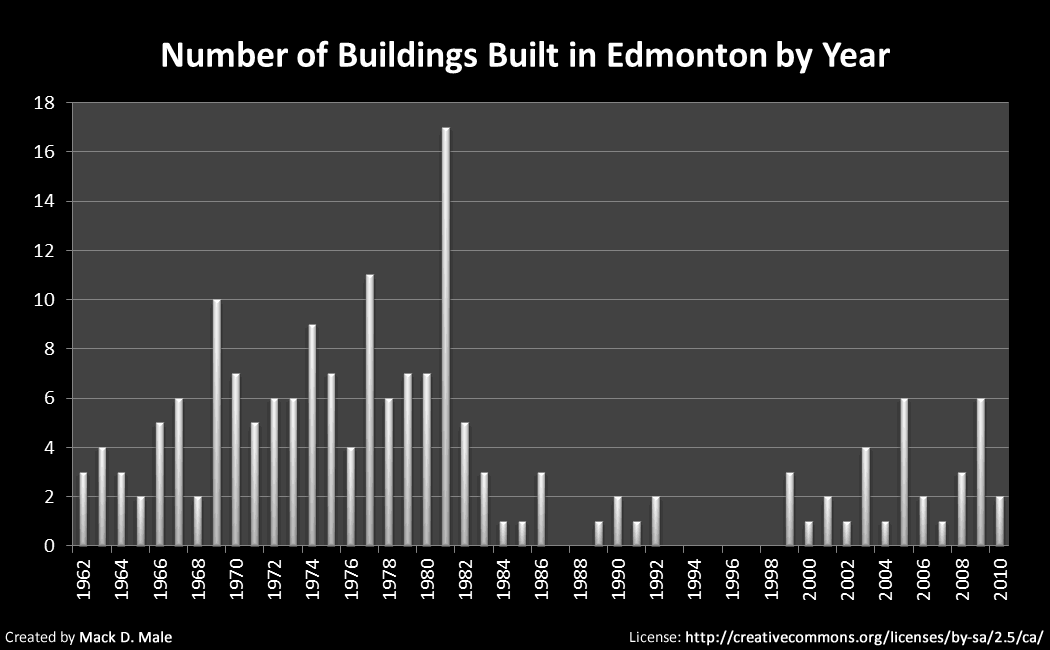
So what does our building stock look like? I turned to SkyscraperPage.com to help find the answer. They’ve got a pretty good database of Edmonton buildings – it currently contains 283 completed buildings. Of those, 183 have a “year built” associated with them. Here’s what you get with a little Excel magic:

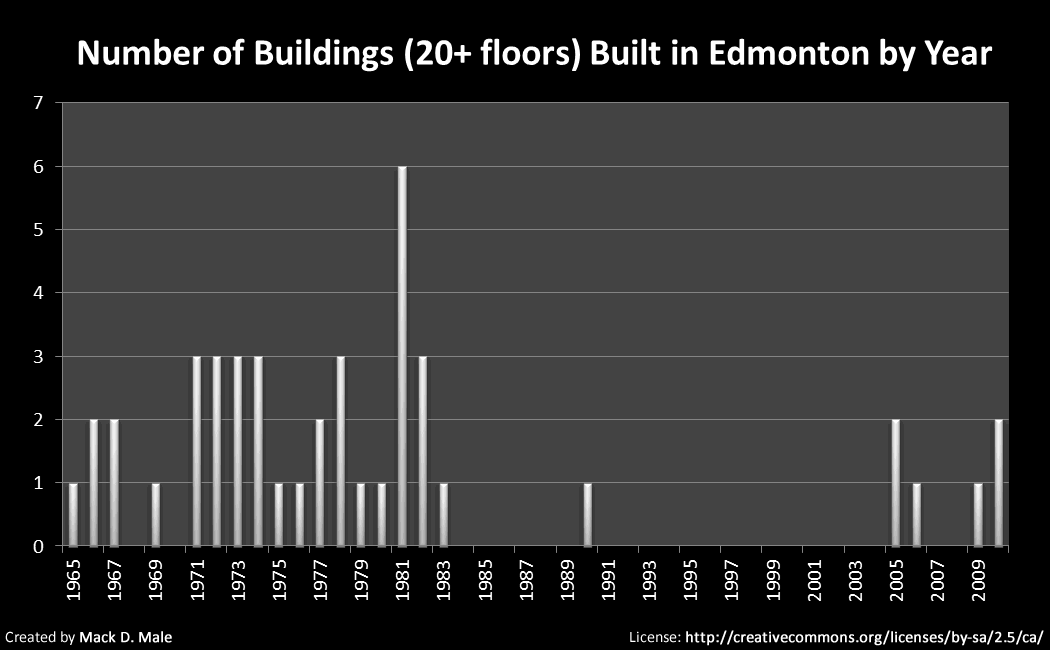
Very similar to the Manhattan chart (though the SkyscraperPage data includes both residential and office buildings). Most of Edmonton’s buildings were built prior to the mid 1980s. Here’s what it looks like when you focus just on buildings that have 20 or more floors:

Yikes! All of the buildings on the right side of that graph are residential too: One River Park, The Century, The Jasper Properties, ICON I, ICON II, and Quest.

Obviously we need to ensure that any new buildings we are constructing are energy efficient. As Rodenburg says in his discussion paper, they must “exceed existing codes and standards by a significant measure.” I think that is happening to a certain extent – being LEED certified is something we hear quite a bit about now.

The graphs above suggest that perhaps we should pay more attention to our existing building stock as well. There’s a number of strategies we could use to make our older buildings more efficient, including the increasingly popular idea of reskinning.

Edmonton Transit’s new lost & found system: Foundtastic by Hybrid Forge

A little over a year ago, the City of Edmonton held an open house for a new initiative known as Leveraging Technical Expertise Locally (LTEL). The initiative was created as a way to allow the City to gain access to innovative local technology companies who may not otherwise have the scale or resources to participate in a traditional RFP process. The pilot project was a replacement for Edmonton Transit System’s electronic lost and found system. A total of fourteen local companies proposed solutions and the field was narrowed to six finalists in January: Hybrid Forge, Aldata, Aurora Bar Code, Damaag, Stage 2, and XEA Services.

Hybrid Forge was selected in February, and they started work on their lost and found solution in early spring. Called Foundtastic, the application goes live today and tomorrow at the City of Edmonton.

Foundtastic

I caught up with Geoff Kliza and Chad Smith from Hybrid Forge, as well as Loren Andruko and Bruce Beecher from the City of Edmonton, to talk about the process and the new solution.

Geoff and Chad told me they “underestimated the seriousness with which ETS treats lost and found.” This is good news for you, the transit user! Here’s how the process worked before Foundtastic:

  1. You lose something on the bus in the morning.
  2. Later that day, at the end of his/her shift, the driver collects all the items found on the bus and hands them off to the dispatcher at the garage (there are six garages, plus DATS, and the ETS security officers who also find items).
  3. The dispatcher does the paperwork for the lost items and prepares them for transport to Churchill Square.
  4. The items are transported to Churchill Square, and the items are entered into an Access database.
  5. By the middle of the next day, your item has been catalogued at Churchill Square and is ready for staff to respond to your requests.

Certain items are special, of course. For passports, driver’s licenses, cell phones, or other easily identifiable items, ETS will proactively try to contact individuals. But for the most part, that’s the process. There are signoffs along the way, so that ETS can track items from bus to customer.

There are a number of issues with that process. Two of the most obvious issues are the disconnect between the paper trail and the database at Churchill Square and the time delay between an item being found and that item being searchable. If you called on the same day you lost your item, staff would tell you to call back the next day because they’d have no way of knowing if something was found until it was in the Access database.

Foundtastic solves both of these problems, and more. The process is largely the same, except that dispatchers no longer need to catalogue items on paper. Instead they enter them into the system directly. A paper manifest is still kept at each garage, but it is printed now, reducing the likelihood of mistakes or illegible handwriting. And by enabling each location to add the items into the database directly, the delay for customers is also removed. Now staff can tell you the same day if its likely that your item was found or not. Auditing is greatly improved now too. The system records whenever a change is made, whereas in the past something could be scribbled and crossed out on paper, making it difficult to track.

I asked whether the idea of using scanners or photographs as part of the process was considered. Maybe using barcodes at the garage and Churchill Square to further automate the process of ensuring that everything that was found made it to the station. Both sides looked at the idea, but ultimately decided that the costs outweighed the benefits.

Chad told me that like most software projects, the scope evolved and changed over time. Instead of “here’s the problem, give us a solution” it evolved into more of an agile development process. When it became clear that the paperwork could be reduced by allowing dispatchers to enter items directly, a slight business process change was required. That’s where Loren came in – he played a key role in the process, acting as the key connector between the City and Hybrid Forge. Chad remarked that Hybrid Forge “would not have been successful if Loren had not gotten involved” in the project. Loren was equally as positive about working with Hybrid Forge, saying he would love to work with them again.

One of the most interesting things I learned is that Foundtastic is software-as-a-service, which means Hybrid Forge is responsible for hosting the application. At the open house, it was specifically stated that the solution would have to run in-house, so I’m quite pleased to see that the City relaxed that requirement (they indicated they would as the deadline for submissions approached). Foundtastic is an important system, but it’s not mission critical, so it was a great opportunity for the City to experiment with SaaS.

Foundtastic

An interesting challenge that Hybrid Forge ran into was the interface. As you can see, they’ve created an attractive user interface, but it was actually scaled back somewhat from their original designs. The application needs to be efficient for staff to use, so maintaining the Access-like data entry interface was important. While tabbing from column to column and making extensive use of the keyboard is the way Access works, that’s not typical on the web. Hybrid Forge used jQuery to maintain that experience for users. For those of you interested in the technical side of things, Foundtastic is built using ASP.NET MVC 2.

With Foundtastic, the City of Edmonton received a cost-effective piece of software, with a user interface that isn’t typical of City applications, and the opportunity to explore SaaS. For Hybrid Forge, the opportunity to showcase what they can do and the ability to count the City of Edmonton as a customer were both positive outcomes. And for you, the transit user, improved customer service is the big win.

The idea that the LTEL project would be a way for local companies to springboard into a larger market seems somewhat less successful, however. While the City has arranged contracts and such to ensure that Foundtastic could be used in other departments, there are no immediate plans for that to happen. And Hybrid Forge would of course need to spend the time and money to identify opportunities and market their solution if they wanted to sell it to customers beyond the City, something they’re not likely to do as a company focused on custom solutions rather than product development. It seems that aspect of the project is something that TEC Edmonton could have helped with, but they were not involved beyond the initial selection process.

I asked all four gentlemen if they’d do the LTEL process again, and if they’d recommend it to other software companies or other departments at the City. All said yes. That to me suggests that the pilot was a success! Of course, there are lots of improvements that will be made, and Bruce said the City is now operationalizing the process, and that an LTEL2 seems likely. I hope it happens.

In the next six to eight weeks, another key aspect of Foundtastic will go live. Instead of having to call ETS to check if your lost item was found, you’ll be able to fill out a form on the website. You’ll be asked for some identifying criteria, and the system will tell you whether or not it’s likely that your item was found (it’s important to avoid specifics, to reduce the potential for abuse) and what the next steps are to retrieve it. It’s another improvement to the customer service experience made possible by Foundtastic.

Kudos to Geoff, Chad, and the team at Hybrid Forge for showing the City of Edmonton what local software development companies are capable of. And kudos to the City for experimenting with something new. It’ll be interesting to see how LTEL evolves!

Edmonton Election 2010: Visualizing Results by Polling Station

Ever wonder where the candidates in last month’s municipal election received the most support? Which parts of the city supported which mayoral candidates? After seeing the maps that were created for Calgary’s top three mayoral candidates, I wondered about the same kind of thing here. Local software developer Josh Kjenner was also interested, and he has been busy visualizing the results by polling station ever since.

Josh wrote an application called Metroview for the City of Edmonton’s Apps4Edmonton competition, a project which he spent about 60 hours on. The tool is implemented in Processing, a programming language and environment that Josh called “a really really intense Java library.” He returned to the project after the City of Edmonton released the final election results by polling station, and spent another 20 hours or so improving it. Josh told me the biggest challenge he faced was conditioning the KML files from the open data catalogue (a common challenge that open data developers face…getting the data and the tools/technology working together).

The result is an interactive application that lets you visualize candidate support and other data on a map of Edmonton.

Here are a few of the data visualizations you can see in Josh’s metroview yegvote 2010 app (requires Java).

Eligible voters versus voter turnout:

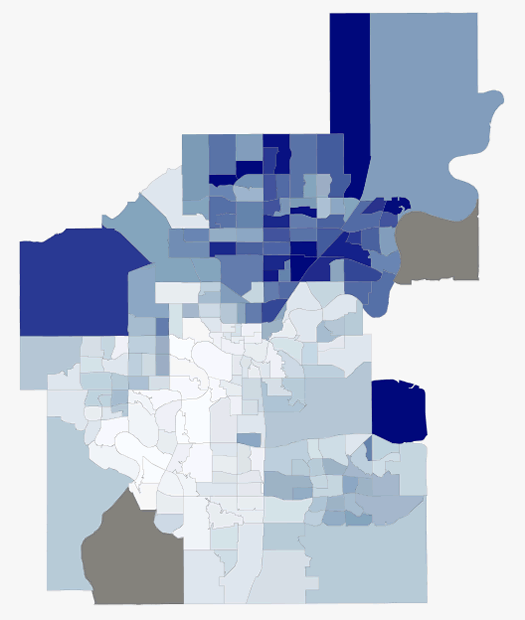
Support for Stephen Mandel:

Support for David Dorward:

Support for Daryl Bonar:

You can see that Mandel received most of his support from the south part of the city, while Dorward received the most support from the north part. You can use the metroview tool to see similar results for every ward, public school ward, and catholic school ward too.

Thanks Josh for creating this tool! This is another great example of what can be created when the data is open and available.

UPDATE: It should be noted that you can’t really compare Mandel’s graph to Dorward’s. A dark area in Mandel’s is not equivalent to a dark area in Dorward’s, for example, because of the difference in the number of overall votes that each candidate received. The colors on each graph are in relation to the other areas on that graph for that candidate only. If you look at Josh’s app, you get the raw values as you hover over each area, and you can choose absolute instead of relative for the drawing mode.

Edmonton’s Hot to Huddle 2010 Grey Cup Festival Parade!

Downtown Edmonton has been full of energy this week for the Grey Cup Festival, but today’s parade took it to another level! Here are some of the highlights.

I’d say green was definitely the dominant color in the crowds – they even brought chairs!

2010 Grey Cup Parade

The Snowbirds criss-crossed the sky a few times!

2010 Grey Cup Parade

2010 Grey Cup Parade

Bryan Hall was the Grand Marshall for the parade.

2010 Grey Cup Parade

Each of the teams had a Nissan Cube.

2010 Grey Cup Parade

They also had cheer teams. The Eskimos cheer team even did some stunts!

2010 Grey Cup Parade

A favorite from the Capital Ex parade returned – the West Jet plane!

2010 Grey Cup Parade

I thought the Coast Hotels float was creative.

2010 Grey Cup Parade

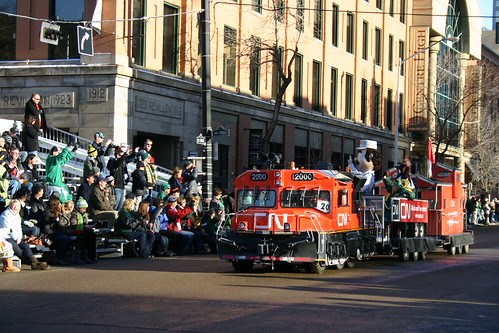
The CN float was really well done too.

2010 Grey Cup Parade

These poor kids had the worst job, following the horses.

2010 Grey Cup Parade

The Riders’ cheer team received a warm welcome!

2010 Grey Cup Parade

As did the rest of the Roughrider supporters.

2010 Grey Cup Parade

They even had pyrotechnics. How can you go wrong with that?!

2010 Grey Cup Parade

It really was a sea of green for a while.

2010 Grey Cup Parade

This one was my favorite of the parade:

2010 Grey Cup Parade

This guy remarked “buying fans one Candy Cane at a time!” as he passed by.

2010 Grey Cup Parade

I love that this guy is a Calgary fan.

2010 Grey Cup Parade

There was loud applause as our Armed Forces passed by.

2010 Grey Cup Parade

Attendance wasn’t as large as the Capital EX parade, but given the temperature, I’d say it was still a very strong turnout!

You can see the rest of my parade photos here (over 140 in all).

LRT Expansion was never just icing on the Edmonton EXPO 2017 cake

Allow me to begin with a passage from the executive summary of The Way We Move, the City of Edmonton’s current Transportation Master Plan:

We are building a 21st century city, shaping an Edmonton that will meet the needs of our diverse and growing urban and regional population. Growing environmental concerns, acknowledgment of the ongoing investment needed to maintain our transportation infrastructure and the rapid growth of our city demand a shift in transportation priority setting. It is a shift from single passenger vehicle use to more public transit; from building outward to a compact urban form. From an auto oriented view of transportation to a more holistic view of an interconnected, multi-modal transportation system where citizens can walk, bike, bus and train efficiently and conveniently to their desired location.

The City of Edmonton is working to achieve this vision through the LRT Network Plan, as well as other initiatives. This vision does not ignore automobiles, but it certainly places greater emphasis on public transit.

At the top of the list of benefits that EXPO 2017 could have brought to Edmonton was funding for infrastructure. Was it the best way to try to get higher levels of government to commit to funding something that Edmonton so desperately needs? Perhaps not. But make no mistake about it: funding for LRT expansion was never just icing on the EXPO 2017 cake. Expanding our LRT network is vital for Edmonton’s future. Here’s what Councillor Don Iveson wrote nearly a year ago:

Projects like this require the alignment of at least two and, properly, three orders of government. It will require the relentless pressure of citizens on Councillors, but more particularly on MLAs and MPs.

He was right then and still is today. Our quest to be Canada’s host city for EXPO 2017 might have failed, but we cannot allow our plans for LRT expansion to fail as well.

At a news conference yesterday, Transportation GM Bob Boutilier questioned why Edmonton had not received the same level of federal support as Toronto has when it comes to funding for public transit, saying “I just think we’re owed. It’s time.” But he also suggested that LRT expansion plans would be delayed by a year or two now that EXPO is no longer in the picture, something that would potentially save money.

This is unacceptable.

It’s unacceptable that the expansion is being delayed, and it’s unacceptable that it’s Boutilier and not Council questioning the federal government’s support.

Why would LRT expansion have been fast-tracked with EXPO 2017 but not without it? Back in April, Boutilier said that meeting the deadline of 2017 was “do-able” with some creativity, noting that “we cannot use the conventional approach to building transit that we’ve used in the city up to this point.” A few weeks later, he suggested a board of directors to oversee the construction as a way to speed up the project. At the time, the cost of the expansion was pegged at “more than $3 billion”. It has since been narrowed down to $3.4 billion. So either it was going to cost significantly more than Boutilier was letting on, or the cost savings of delaying by a year or two are negligible.

I think Boutilier has one of the toughest jobs at the City of Edmonton, overseeing one of the most vital and controversial parts of the business, so I don’t envy the tough decisions he has to make. Boutilier should definitely be willing to make noise about the lack of resources he has, but in the same week that we lost EXPO, I would have liked to have heard some Councillors speak up for LRT as well. Instead, that job has been left to Boutilier and to EXPO bid committee chair Tony Franceschini. I’ve seen only Councillor Ben Henderson comment, saying “I personally don’t want to see us slow down.” Councillor Kerry Diotte also remarked on funding, “With the feds these days, who knows?”

I want my City Council to stand up for The Way We Move. If there’s a window of opportunity with regards to the federal government as a result of the EXPO decision, take advantage of it. Ask Administration to keep going, not to slow down. Make some noise. Show some of the emotion that Mayor Mandel showed on Monday.

The loss of EXPO shouldn’t be an excuse for us to slow down with LRT expansion. It should be a catalyst for increased pressure to get the job done.

Reclaiming Edmonton’s Lost Spaces: Alley of Light

A couple of weeks ago I linked to the Edmonton on the Edge website, after I had come across their page on “reclaiming lost spaces”. The organization, which consists of members from the University of Alberta, Edmonton Design Committee, ISL Engineering, Edmonton Federation of Community Leagues, and M.A.D.E. in Edmonton, among others, recently explored the idea of reclaiming two of Edmonton’s lost spaces: the alley behind Sobeys on 104 Street, and the alley behind the Melton Building on 103 Street. They settled on the alley behind Sobeys, and worked with around 40 individuals from the area to start imagining how the space could be transformed.

The project, led by former City Councillor Michael Phair and EIDOS Landscape Architect Peter Spearey, has been dubbed the “Alley of Light” and there’s an open house coming up on Sunday, December 5 for anyone interested to provide input. I live less than a block away from the alley, so I’m excited about the opportunity to help transform it into something more. Here’s what the alley looked like tonight:

Alley of Light

You can see that it is dark, and not exactly inviting. Even during the day, the alley does not “create a sense of ownership and pride amongst community members”, one of the goals of the Reclaiming Lost Spaces project. Aside from the Christmas lights in the tree nearest to the street, there’s not much there. Though I wasn’t sure what to make of them at first, the red illuminated cones outside Lit are a welcome addition to the street. They add some color and, well, some light!

Aside from Lit, one of the first things that came to mind for me when I heard the name “Alley of Light” was the Illuminate Yaletown event that I went to in Vancouver last year. It featured some impressive light-as-art installations, like this one:

Illuminate Yaletown

I’d love to see some improvements to the alley that would work both during the day and at night. Think of a water installation during the day that becomes illuminated at night, something like that. It’s a little difficult to see in this photo, but even during daytime events such as Al Fresco the space is underutilized at the moment. It would be great for the space to be welcoming both day and night.

Here’s one idea for the alley:

Alley of Light

The main idea there is the beams of light extending from the Sobeys building, as well as getting rid of the fence and smoothing out the park. There are all kinds of opportunities, and if you’d like to see some more or even provide your own, I encourage you to come to the open house:

WHO: You and your friends!
WHAT: Alley of Light Open House
WHEN: Sunday, December 5 from 2pm to 4pm
WHERE: Enterprise Square, Main Atrium
WHY: To help reclaim one of Edmonton’s lost spaces!

Next steps and additional information will be provided at the open house. Anyone and everyone is invited, so spread the word!

Edmonton’s Hot to Huddle 2010 Grey Cup Festival Kick-off!

Tonight the 2010 Grey Cup Festival officially started here in Edmonton with a big kick-off party outside City Hall. Hundreds of people braved the cold to see the Grey Cup in person, to experience the flashmob and fireworks, and to get a first look at Huddle Town.

Purolator delivered the “special guest” that everyone was hoping to see.

2010 Grey Cup Festival Kickoff

There were fans of all teams on hand to celebrate!

2010 Grey Cup Festival Kickoff

With the Zipline in the background, everyone listened for the official kick-off of the festivities.

2010 Grey Cup Festival Kickoff

After the dignitaries had spoken, there was a big flashmob on the CN field (I suppose no one saw it coming, but the large group of people lined up on the field, with security preventing others from joining in, made it clear that something was up…not to mention the volunteer for the flashmob page on the website).

2010 Grey Cup Festival Kickoff

Fireworks quickly followed the entertaining dance number!

2010 Grey Cup Festival Kickoff

The trophy was so close you could almost touch it.

2010 Grey Cup Festival Kickoff

The end of the kick-off program meant the official opening of Huddle Town, the giant heated tent in Churchill Square.

2010 Grey Cup Festival Kickoff

Meanwhile, a Peewee football game was played on the CN field.

2010 Grey Cup Festival Kickoff

Here’s an overhead shot of City Hall and Huddle Town.

2010 Grey Cup Festival Kickoff

The festival is now officially underway!

You can see upcoming events at the official site (when it works) or at ShareEdmonton (and subscribe to the iCal here). You can see the rest of my photos from the evening here.

Ready, set, huddle!