Recap: Edmonton Twestival 2009

Wow, what a fantastic evening! Thanks to everyone who came out tonight, and to everyone who supported Twestival. I think it’s really cool that the Edmonton community was able to participate and help make a difference for those in the world who don’t have access to safe, clean drinking water.

Our hope was to have around 50 people attend this evening, and we came very close – the final tally was 45. Everyone donated $20, which means we raised at least $900 from ticket sales. I know at least another $100 was donated online via tipjoy, so that brings us to $1000 raised for charity: water. Well done everyone!


Photos by momentsindigital (site)

Thanks once again to everyone who donated the door prizes: @sassycakes, @transcendcoffee, @bruceclarke, @NAIT, @thechadj, @Out_Inc, @cmscritic, and @tonyratcliffe. Thanks also to @sharonyeo for doing a ton of work to make tonight happen!

I’ve posted a few photos and a video here, @bruceclarke posted some much better ones here, and @tonyratcliffe posted his photos here. If you know of any others, please let me know! If you’re feeling adventurous, you can read some of tonight’s chatter at Twitter Search.

I can’t wait to hear how Twestival went in other cities – there should be lots of exciting news over the next few days. Keep an eye on @twestival for updates.

Our next Twitter event here in Edmonton will be EdmontonTweetup4. See you there!

UPDATE: We raised at least $1000 but because of the online donations and other ways to help out, our total raised may end up being higher than that. I’ll update again when I know the official numbers.

Talking Tech with Edmonton Transit (ETS)

I was fortunate enough today to chat with Bruce Beecher and Dennis Nowicki from Edmonton Transit (ETS). Bruce is the IT Strategic Advisor for the Transportation department, and Dennis is the Director of Community Relations for ETS. Though we talked about a variety of things, the focus was technology.

I think there was some educating happening on both sides. I learned more about their situation and perspectives, and I hope they soaked up some technical stuff from me. I think it went really well!

What I’d like to share in this post is an overview of what we discussed. There’s nothing confidential here, but some of this information may still be new to you. They’re aware they need to improve on the communication side of things!

ETS has been evaluating potential technologies to deploy to the fleet for quite a while now (I wrote about some at last year’s Community Conference). These technologies include:

  • Automatic Vehicle Locator (AVL) – This is essentially a GPS module that would be installed on each bus.
  • Automated Traveler Information Systems (ATIS) – This is essentially giving riders access to that GPS information. That is, where is my bus right now?
  • Mobile Data Terminals (MDT)
  • Automated Stop Announcement (ASA) – No more peering out into the darkness to see if you’re at the right stop. Also important for accessibility.
  • Automatic Passenger Counter (APC)
  • Automated Fare Booth (Smart Cards)
  • Automatic Vehicle Monitor (AVM) – This would gather information about the engine, fuel consumption, etc. It’s like a black box for the bus.

Those are listed roughly in order of priority, though nothing is set in stone. In fact, the AVM might get bumped to the front of the list simply because it offers the best ROI for ETS. The ability to know what’s wrong with a bus on the fly would have a huge impact on the bottom line. Same goes for being able to determine if a bus is getting poor fuel consumption for some reason. Makes sense to me.

There are a few problems with all of this technology, mostly related to cost:

  • Edmonton has bumpy roads and extremely cold temperatures in the winter. On-board equipment needs to be hardened and reliable. We often can’t use the same stuff that San Francisco uses, for example.
  • Rough estimates place the cost per bus at $15,000. There are currently 903 buses in service.
  • By 2012, the number of buses will be closer to 1300, so it won’t get any cheaper to deploy.

Another issue is maintainability. Ideally, each bus would have one computer with a LAN of some kind that everything else just connects to, so that it’s all integrated. Otherwise you end up with many potentially disparate systems.

What I took away from all of this is essentially that ETS is keen to deploy GPS technologies and to make that information available to riders. The challenge is finding a way to make it happen.

Next we shifted gears and talked about the ETS website, Google Transit and my API idea (though I’m definitely not the only one with the idea…dub5 is another interested group). There are improvements to the ETS Trip Planner in the works, so watch for something during the summer. They’re also looking to improve the main ETS website, now that everyone has had time to digest the edmonton.ca redesign.

Unfortunately I can’t talk as much about Google Transit as I’d like to just yet, but I can tell you that a major announcement is coming in the next week or so. I plan to cover it here, and you’ll no doubt see it in the mainstream media. Bottom line: ETS is fully behind Google Transit, and that’s a good thing for Edmontonians.

As for the API idea? They like it and would like to learn more about it. At this point however, getting access to a dump of the same data that Google gets is probably more likely. It would work like this: you sign some sort of agreement with ETS outlining the terms of use (basically something like “I agree not to misrepresent this information…”, and they send you the GTFS data. From there, you could do whatever you like with it. You could build and release your own API, for instance.

Is that going to happen – are they going to make the data available? No guarantees, but they will definitely consider it. Obviously an API would be better for accessing real-time data, but even a recent snapshot would be a step in the right direction. I think this is very encouraging!

If they do go down the data sharing route, I think we should organize an API building weekend!

The final thing I want to mention is that we talked briefly about RSS. My goal is to get every City of Edmonton department publishing as many RSS feeds as possible! It’s horribly underutilized at the moment. I think Bruce and Dennis definitely understand the benefit of RSS, and I hope to see some ETS feeds published soon!

Thanks to both Bruce and Dennis for a great conversation – I learned a lot, and I look forward to keeping the dialogue going.

Two days until Edmonton Twestival 2009

In less than 48 hours, Edmonton Twestival 2009 will be underway! I’m really looking forward to the event and I hope you are too.

One of the things we wanted to do with Twestival was showcase local organizations on Twitter. Fortunately, quite a few have stepped up to contribute door prizes! Thanks to:

Want a shot at winning one of these fantastic prizes? You must register online! If you’re not comfortable entering your credit card online, register for the free ticket and bring your donation to the event.

I also wanted to thank the Calgary Twestival crew for getting an Alberta Twestival logo created:

Very cool! Here are a couple of other things created for Twestival recently:

  • Donation Water Cloud – Donate and get your name on the cloud! The most generous donors will appear on the official Twestival t-shirt.
  • Official T-Shirt – You can order the shirt until Monday, February 16th. I love the design!
  • Twestival.fm – What’s a festival without music? Donate and tweet your favorite tunes.

I’ll be posting updates on both @mastermaq and @edmontontweetup as we get closer to show time. You can also check out the #twestival hashtag on Twitter Search.

Hope to see you on Thursday evening!

UPDATE: We made the front page of the Edmonton Journal today! You can read the article online here.

Where am I?

Though I consider myself a netizen, I don’t live online (yet). I remain tethered to the real world, in real physical space. The lines are beginning to blur somewhat however, thanks to the increasing popularity of location-based online services.

A good example of this is Brightkite, a service I’ve written about a couple of times. In a nutshell, Brightkite gives you a way to say “here I am in the real world!” For example, when I get to work in the morning I “check in”. You can see this action in two ways: on my profile (or at any service that sucks in my profile, such as FriendFeed) and on the place itself. Each place inside Brightkite has a unique ID which means every real world location has a corresponding digital representation. That’s powerful!

The problem with Brightkite is that I need to manually check in. This is where Google Latitude comes in. The service was launched on Wednesday:

Latitude is a new feature for Google Maps on your mobile device. Once you’ve opted in to Latitude, you can see the approximate location of your friends and loved ones who have decided to share their location with you.

Ready to share your location? If you have a mobile smartphone, visit google.com/latitude on your phone’s web browser to download the latest version of Google Maps for mobile with Latitude.

It’s annoyingly basic, but it works. I’ve got it running on my BlackBerry so my location is updated in real-time everywhere I go. That means that Google Latitude knows I am in the office before I actually get on the computer to check in on Brightkite.

Obviously it would be better to have Latitude and Brightkite work together. The Brightkite team have said on Twitter that they’ll look into it as soon as Latitude has an API. I hope that happens relatively soon!

Why does all of this matter? Because location is vitally important. Today it might seem geeky to broadcast your location on the web, but in the not-to-distant future, I’m betting it’ll be completely ordinary. Your social graph and location-aware services will be the first beneficiaries of this information, but others will follow. It’s exciting to consider!

In the meantime, feel free to add me on these services. I’m mastermaq@gmail.com on Google Latitude, and mastermaq on Brightkite.

Notes for 2/8/2009

Here are my weekly notes:

Mack with chocolate fondueOld Strathcona Farmer's MarketRoyal Bison Art & Craft FairPad Thai with ShrimpMack & SharonHappy Birthday Andrea!

Edmonton Notes for 2/7/2009

Here are some Edmonton-related things I found interesting this week:

What do you do in your spare time?

A post at the Canadian Developer Connection blog last week caught my eye. Joey deVilla posted about something he had read at the Harvard Business blog related to interview questions. In both posts you learn about Captain Chesley Sullenberger, the pilot who safely made an emergency landing in the Hudson river last month. What does “Sully” do in his spare time? Anything and everything related to aviation, apparently. As a result, both posts argue that the most important interview question to ask, is:

“What do you do in your spare time?”

I couldn’t agree more. People who are excellent at their jobs are probably passionate about what they do, and spend more time and energy on things related to their area of expertise/interest than the average person. My experience with software development definitely backs this up. The best developers are usually the ones who go home and work on a hobby project after they’re done with the “day job”. There are exceptions, of course, but as a general rule I think you need to practice your craft outside of work to be good at it.

I’m currently reading Malcolm Gladwell’s Outliers, and right near the beginning of the book he argues the same point. Practice makes perfect. He estimates you need to spend 10,000 hours practicing something to truly master it. Gladwell uses The Beatles, Bill Joy, and Bill Gates as examples, and argues that in addition to their hard work it was a series of fortunate events that made it possible for them to spend about 10,000 hours practicing, and that’s what truly made them successful.

Every time I look at a resume, I look for the “extra” stuff. In the case of a developer, I look for programming competitions, contributions to open source projects, anything outside of school and work. It’s amazing how few mention anything like that.

I want to see passion, and by extension, practice!

Pecha Kucha Night: Edmonton #3

Tonight was Edmonton’s third Pecha Kucha night. Around 300 people attended the event at The Matrix Hotel downtown, and like PKN #2, it was completely sold out. There wasn’t even a waiting-list or at-the-door ticket sales this time! There’s clearly a lot of demand for this event, and I don’t think that’s going to change in the future. Make sure you pay attention if you want to have a chance at getting tickets for PKN #4!

For those of you new to the concept – Pecha Kucha was conceived in 2003 as a place for young designers to meet, network, and show their work in public. Presenters are given 20 slides with 20 seconds per slide, so each presentation is 6 minutes and 40 seconds long. There are no formal Q&A periods, but everyone is encouraged to chat at the breaks. How to pronounce “Pecha Kucha” is a common question here in Edmonton. Is it “pet-cha-koo-cha” or is it “petch-ach-kah”? Edmonton Next Gen decided it was the former and started with an exercise to get everyone to say it aloud:

Mayor Mandel also said a few words (his attendance meant there were dozens of cameras and a couple video crews present), and then it was on with the presentations.

Tonight’s event didn’t have a theme, but I think perhaps it should have. In comparison with the previous two Pecha Kucha Nights, I found the presentations this evening rather weak. There was far too much self-promotion going on. There’s nothing wrong with talking about your work/projects, but I think focusing on the ideas/concepts is much more interesting. It would have been nice to see more diversity too – tonight was fairly academic. As Sharon remarked to me, the presentations at PKN #2 were more accessible – you didn’t have to be an architect or industrial designer to “get” it. Also: two of the presenters were from Calgary, apparently. Could they really not get two other Edmonton presenters?

Pecha Kucha Night 3Pecha Kucha Night 3Pecha Kucha Night 3Pecha Kucha Night 3Pecha Kucha Night 3

The first two, Ben King and Tobias Olivia, felt almost like pitches for their respective organizations. Al-Arqam Amer was third, and gave an interesting talk about how architects should do away with floorplans and 2D representations and should instead make use of photorealistic 3D models. Cezary Gajewski then talked about communicating industrial design. The final presentation before the break was by Ron Wickman, who talked about designing with accessibility in mind.

Pecha Kucha Night 3Sharon, Peter, Cam

After the break Amber Rooke from The Works Art & Design Festival gave the oddest presentation I’ve seen to-date. She spoke about the festival, but I don’t think anyone was listening to her. Instead, they were focused on the mostly naked man posing on stage. Everyone in the audience was given a pad of paper and a pencil, and were asked to draw his various poses. Amber concluded by saying “6000 drawings were made in six minutes, imagine what we can do in 13 days.” I think the shock-value worked against her though.

Pecha Kucha Night 3Pecha Kucha Night 3Pecha Kucha Night 3Pecha Kucha Night 3Pecha Kucha Night 3

Romy Young was up next to share his thoughts on photography – again, way too much “I” in his presentation. Milena Radzikowska followed with a presentation about a GIS-related project she’s leading with Mount Royal and Alberta Parks. Robert Lederer showed a bunch of random designs during his six minutes. The second last presenter was Thomas Gaudin, an industrial design student from the U of A. I thought this presentation was one of the best. He talked about Modernism and Postmodernism, and suggested combining them to result in something called Interface Architecture. He also said that South Edmonton Common is a worst case example of design, much to the delight of many in the crowd. The final presenter was Ryan Stark from the City of Edmonton, who talked about EXPO.

Once again there was a DJ, food, and a cash bar. I thought the seating took a step backward this time – we were spoiled by stadium-style seating at the TransAlta Arts Barns at PKN #2. Everyone seemed to be having a good time though, and the quality of the presentations notwithstanding, I think the event went really well. It’s great to see such a large group of passionate Edmontonians come together. I look forward to PKN #4!

You can see more of my photos here, and you can subscribe to the Edmonton Next Gen mailing list here.

Happy 5th Birthday Facebook!

Today is Facebook’s 5th birthday. Hard to believe it has been around that long, actually. Over 150 million people have joined since launch, and Facebook is now a household name. I remain a regular user of the site, though I’m not nearly as active there as I once was. I guess you could say the buzz eventually subsided for me.

I am continually amazed at how many people have Facebook accounts. Almost my entire family does – even my Grandma, who just joined last week! And it’s more than just having an account. My parents are very active on the site, far more active than I am. This is important.

Why? Because of Facebook Connect. I’ve been playing with it recently, and I’m impressed with how easy it is to integrate into a website. Essentially Facebook Connect is a single-sign-on service. Instead of creating a new account at a website, you can just login with your Facebook credentials. Additionally, the site can publish stories to your feed if you allow it. It’s pretty slick.

Facebook Connect needs lots of active users to be successful. It also needs participating websites. Though there aren’t very many yet, I expect adoption to pick up. It’s easier to decide on Facebook Connect than on something like OpenID because you don’t have to explain what it is, and chances are your users already have a Facebook account anyway.

It’ll be interesting to see how Facebook changes over the next five years. I’d bet that Facebook Connect will play a big part in any changes.

For more on Facebook’s 5th birthday and some up-to-date statistics, check out Hitwise and VentureBeat.

State of the Edmonton Twittersphere – January 2009

I love Twitter, Edmonton, and pretty graphs. In this post, I combine all three! Welcome to the first State of the Edmonton Twittersphere, my look at the intersection of Twitter and Edmonton.
As some of you know, I’ve been working on a new side project for a couple months now called ShareEdmonton. I’ll post more details on that later, but for now all you need to know is that tracking Twitter usage in Edmonton is a big part of the project. As a result, I’ve gathered lots and lots of data over the last month, and I thought I’d dig into a little.

All of the data I am sharing in this post was collected from Twitter Search. It’s a fairly broad set of updates – anything posted by Edmontonians, or about Edmonton. The data set is incomplete (I’m sure I didn’t capture all tweets, and I improved the algorithm for the second half of the month), and is subject to certain restrictions. For instance, unless someone puts “Edmonton” or something similar (lat/long, Sherwood Park, etc) in the Location field of their profile, I have no way of reliably knowing whether or not they are a local user. That said, I feel that the data set I do have is very representative of Twitter usage in the Edmonton area. Going forward, I’ll try to keep the methodology consistent.

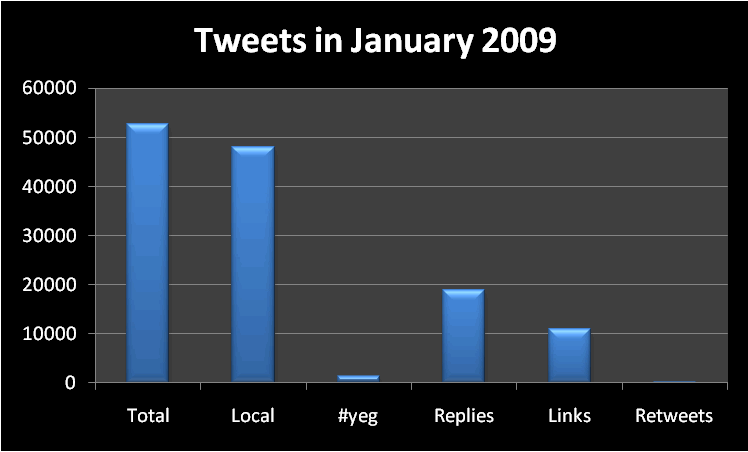
Enough preamble – on to the statistics! For January 2009:

# of users: 1948
# of tweets: 52697

# of local users: 851 (43.69%)
# of tweets by local users: 48091 (91.26%)

# of tweets containing #yeg: 1315 (2.50%)
# of tweets that were replies: 18837 (35.75%)
# of tweets containing links: 11033 (20.94%)
# of tweets that were retweets: 265 (0.50%)

And some other interesting statistics for the month:

  • Ten most active users (most tweets first): fcedmonton, angelzilla, britl, zoocasaedmonton, mastermaq, justNICKI, Pat_Lorna, iNews880, foomanizer, bgrier
  • If you ignore the three “bots”, then alainsaffel, GuitarKat, and fusedlogic also make the list.
  • Those thirteen users account for just over 21% of all tweets in the data set.
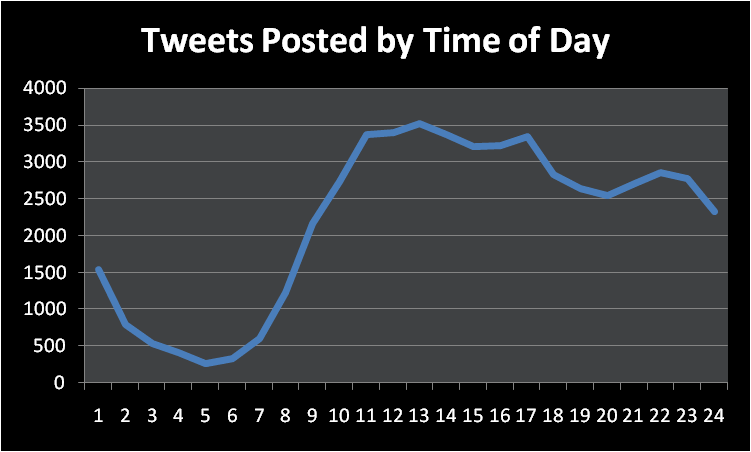
  • Nearly 45% of all tweets were posted between 10 AM and 4 PM.
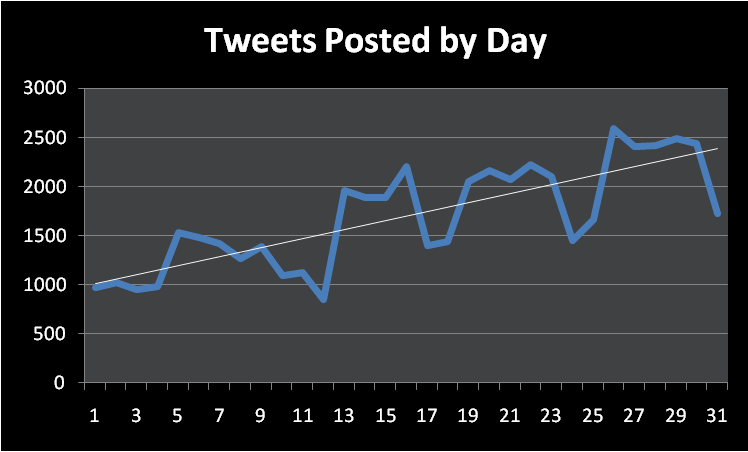
  • The number of tweets posted per day generally increased throughout the month (though this is at least partially due to improvements to my code over the month). Monday, January 26th had the most tweets posted (2592).
  • Local users posted 18042 replies. Of those, 7406 (41.05%) were to other local users.
  • Most aren’t frequent posters: 293 local users posted 31 times or more this month.

And finally, the top ten users in Edmonton (as of January 31st):

In the future, I hope to look at trending topics for the month to get a better idea of just what Edmontonians were talking about. Numbers are one thing, content is quite another.

I’m surprised to see that 851 local users updated this month (all but 110 updated more than once). I would have guessed there were about that many local users in total, not active! So that’s good. It’ll be interesting to see how that number grows over the next few months.

I hope you enjoyed this quick, completely unscientific look at the Edmonton Twittersphere! If you have any suggestions on other things I could include in future posts (or potentially as an update to this one) please let me know.

See you at Edmonton Twestival on February 12th!