Recap: 2014 Mayor’s Celebration of the Arts

The 27th annual Mayor’s Celebration of the Arts took place last night at the Winspear Centre. It was the first for Don Iveson as mayor, and he seemed to enjoy the opportunity, telling the audience, “I’d be lying if I said this wasn’t one of the reasons I wanted to be mayor.” He made a point of shaking every winner and performer’s hand on stage, and happily snapped photos with and high-fived other nominees and guests in the lobby before and after the show. He even took out his phone while on stage and said, “it’s not an awards show without a selfie!”

//platform.twitter.com/widgets.js This year’s event supported the Music Enrichment Program, which provides stringed music and orchestral lessons to children across the city. The non-profit organization first began in 1959, and today is administered by the Edmonton String Players Association. Here’s a sample of the work of some of their students:

Here’s an excerpt from Mayor Iveson’s message in the program:

“This yearly event brings together artists, businesses, media and many others to celebrate our city’s finest artistic talent. Supporting our arts scene is integral to making Edmonton a diverse, vibrant place to live, and I congratulate tonight’s nominees for contributing to our city’s dynamism and quality of life.”

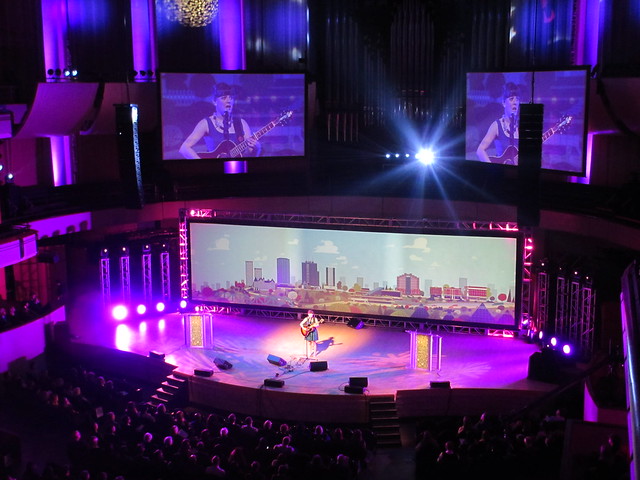
The evening was hosted by Bridget Ryan and Mark Meer, a wonderful pair that kept things moving with humor and energy throughout. Behind them was an incredible stage built by Production World which featured original artwork by Jason Blower. The best part is that it was animated!

2014 Mayor's Celebration of the Arts

The full list of nominees is available at the PACE website. Here are the winners:

Mayor’s Award for Innovative Support by a Business of the Arts
Capital Power Corporation, nominated by Art Gallery of Alberta

Mayor’s Award for Sustained Support of the Arts
Steven LePoole, nominated by Alberta Baroque Music Society

John Poole Award for Promotion of the Arts
CJSR FM 88.5, nominated by Ramparts Entertainment

ATB Financial Ambassador of the Arts Award
Prairie Dog Film + Television, nominated by Jesse Szymanski

ATCO Gas Award for Outstanding Lifetime Achievement
Douglas D. Barry, nominated by Dr. Adiranna Davies CM

CN Award for Youth Artist
Rebecca Lappa, nominated by Martha Livingstone

DIALOG Award for Excellence in Artistic Direction
Ron E. Scott, nominated by Jesse Szymanski

Northlands Award for an Emerging Artist
Doug Organ, nominated by Chris Szott

The 2014 Robert Kroetch City of Edmonton Book Prize
Selected Poems, by Tim Bowling

Syncrude Award for Excellence in Arts Management
Dave Cunningham, nominated by Film and Visual Arts Society

TELUS Courage to Innovate Award
Darcia Parada, nominated by Jodine Chase

Congratulations to all the nominees and winners!
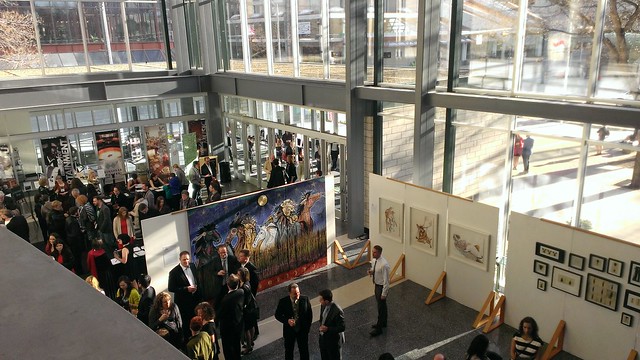
2014 Mayor's Celebration of the Arts

The lobby also featured the work of three visual artists:

The evening’s performances included:

The program run quicker than in previous years, taking just over an hour and forty-five minutes. It flew by with the amazing performances the audience was treated to! Jeff Stuart got things started with a great three-song set, which featured wonderful strings. We got a taste of the show Mercy of a Storm by Brian Dooley and Gianna Vacirca. Ariane Mahryke Lemire’s performance a little while later was Sharon’s favorite of the evening. I thought our Poet Laureate, Mary Pinkoski, stole the show with her incredible slam poetry. We took a break for some humor next, with a bit from The Irrelevant Show that joked about the Edmonton Oilers and their continued rebuild into the year 2029. Closing out the formal program was Mitchmatic, who provided the music for Kelsey Wolver’s impressive hoop dancing and Sugar Swing’s high-energy number.
2014 Mayor's Celebration of the Arts

After the formal program guests were encouraged to enjoy drinks and food in the lobby. Elm Cafe made some delicious tasting boards that very quickly disappeared! With the quicker program, it seemed like more people were willing to stick around.

2014 Mayor's Celebration of the Arts

Kudos to the Professional Arts Coalition of Edmonton for another successful event, but I want to especially recognize Catch the Keys Productions. This was the first year that Megan and Beth Dart worked with the Mayor’s Celebration of the Arts, and I thought they absolutely hit it out of the park! They produced the evening and are directly responsible for all of the wonderful things I wrote about above. Great work, and I can’t wait to see how you’re going to top this!

You can read last year’s recap here. See you at the 2015 Mayor’s Celebration of the Arts!

I was thrilled to once again play a small role on the Steering Committee for the event. It’ll be interesting to see how the Mayor’s Celebration of the Arts evolves now that Mayor Iveson will be around at the start of planning for 2015!


Media Monday Edmonton: Update #110

Here’s my latest update on local media stuff:

Alberta launches new online organ and tissue donor registry
Minister of Health Fred Horne announces Alberta’s new online organ and tissue donor registry

You can follow Edmonton media news on Twitter using the hashtag #yegmedia. For a great overview of the global media landscape, check out Mediagazer.

So, what have I missed? What’s new and interesting in the world of Edmonton media? Let me know!

You can see past Media Monday Edmonton entries here.

Edmonton Notes for 4/27/2014

Here are my weekly Edmonton notes:

Headlines

"Airship" AGA
“Airship AGA” by Jeff Wallace

Upcoming Events

Visited @bioware in Edmonton and hung out with my true love, Thane.
From Felicia Day: “Visited BioWare in Edmonton and hung out with my true love, Thane.”

Was your first mobile phone a Nokia too?

The first cell phone I ever owned was a Nokia 5190. I was moving down to Edmonton, away from my family, and my Dad wanted to make sure I had a cell phone. I remember going to the Fido store at Londonderry Mall and being quite excited to own something so futuristic!

nokia 5110

My phone was green, and it served me well for a few years. I used it mostly for phone calls, but also for Snake! Eventually I upgraded to a Motorola Timeport (the popular silver flip phone, I think it was a P8767). From there I went to a BlackBerry, then an LG, and now an HTC. Many people have gone to Apple or Samsung of course, but I bet the vast majority of us started with Nokia phones. They’ve shipped billions of devices over the years!

As a Windows Phone fan, I think it’s safe to say my next phone will be a Nokia, though it’ll be from a different company than the one I started with:

“Microsoft Corp. has announced the completion of its acquisition of Nokia Devices and Services business. The completion of the acquisition marks an important step in bringing these two organisations together as one team, a process that is expected to take 18 to 24 months to complete.

Stephen Elop, former Nokia President and CEO, will serve as executive vice president of Microsoft’s Devices Group, reporting to Microsoft CEO Satya Nadella. Elop will lead an expanded team made up of Xbox, Xbox Live, Microsoft Studios, Microsoft Hardware, Surface and Nokia Devices and Services.”

This is really exciting. Nokia pretty much owns the Windows Phone market already, and all of the exciting hardware and feature advancements seem to come from Nokia. I’m happy with my HTC 8X (especially with the new Windows Phone 8.1), but there’s no question that Nokia devices are the way to go for Windows Phone.

Nokia Day One

Officially the division is now called Microsoft Mobile, but they do have an agreement to continue using the Nokia brand for a period of time. No word yet on what the branding of future phones will be, but it’s safe to say that Lumia will be the primary brand name.

Microsoft now controls the entire stack, from device to operating system to cloud, just like Apple, and just like Samsung is rumored to be exploring. Should make for interesting times in the mobile market over the next few years!

I’m not sure when I’ll switch phones, but I have found myself looking longingly at the new Lumia Icon. We’ll see how long I can hold out…

Media Monday Edmonton: Update #109

Here’s my latest update on local media stuff:

You can follow Edmonton media news on Twitter using the hashtag #yegmedia. For a great overview of the global media landscape, check out Mediagazer.

So, what have I missed? What’s new and interesting in the world of Edmonton media? Let me know!

You can see past Media Monday Edmonton entries here.

Why does the University of Alberta want to be part of the Galleria project?

“The University has long desired to establish a significant campus in downtown Edmonton.”

That’s the first thing the Edmonton Downtown Academic and Cultural Centre (Galleria) business case from April 2013 identifies under opportunities and benefits for the University of Alberta. It sounds plausible, given the ongoing interest in revitalizing downtown and the University’s desire to play a role in the larger Edmonton community. But is it really true?

Here’s what columnist Paula Simons wrote in November 2001:

“Officially, a downtown campus isn’t an option. I’ve spoken to U of A President Rod Fraser, to University Provost Doug Owram, and to Jim Mitchell, the university’s vice-president of facilities. They all tell me it would be too expensive to build downtown, much more than developing land they already own in Garneau or southwest Edmonton. They say it would be too hard to find suitable space for labs and large lecture theatres. They say students and staff would feel isolated from campus life and facilities. They say it’s not their mandate to save downtown, but to serve the best interests of the U of A.”

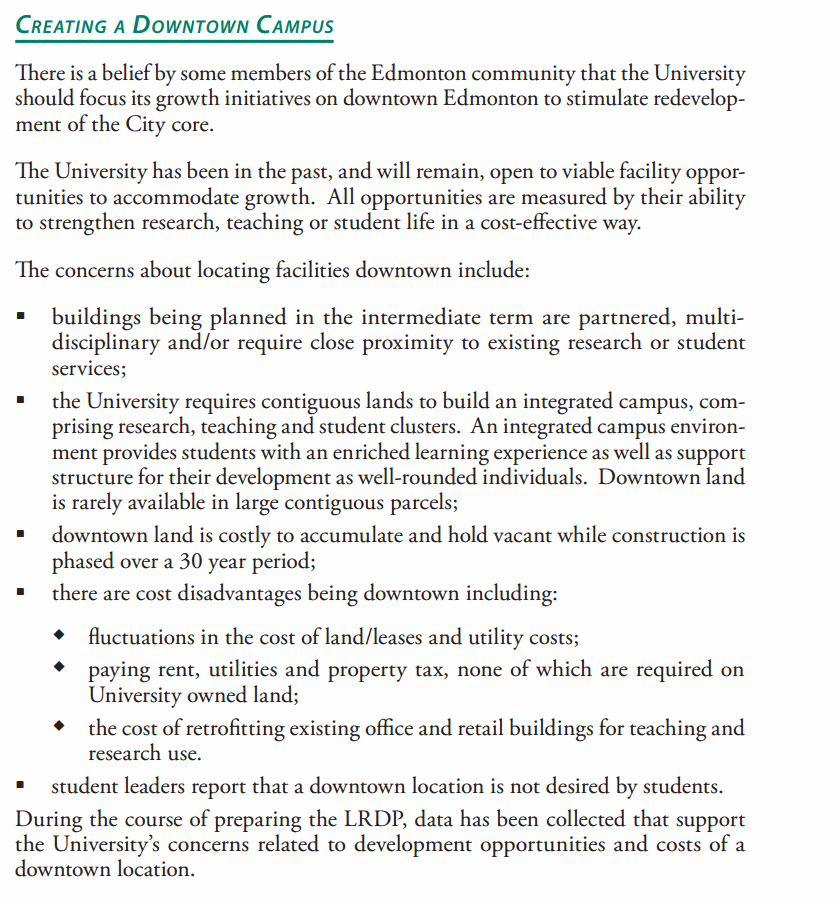
That was around the time that the University of Alberta’s Long Range Development Plan (LRDP) was being developed (approved in 2002). It provides “a planning framework to accommodate and to guide physical development on University lands during the next thirty years.” Though it focuses on land and facilities that the University already owns, it does deal explicitly with the idea of a downtown campus:

ualberta lrdp

Though the plan has been amended a few times over the years, notably to incorporate Augustana Campus and most recently to incorporate updated plans for South Campus, that section has never been changed. “South Campus will accommodate much of the growth of the University of Alberta for the next thirty years” is what the most recent amendment says.

Even in 2005, when the University announced plans to buy the Hudson’s Bay building, it was not seen as a first step toward a larger campus in downtown or a change to previous plans. New President Indira Samarasekera said “the University of Alberta is a contributor to business, arts, and other sectors,” adding “we have an obligation to the community that we take seriously, and a downtown presence will build on that.” A few years later at the official opening of Enterprise Square, she said “that the University has finally crossed the river and found a place in the heart of the city is very significant” but also admitted that “it initially scared the heck out of me; we took a leap of faith.”

It was with some surprise then that Provost and Vice President Academic Dr. Carl Amrhein posted the following on the University of Alberta’s blog yesterday:

“The Galleria project is more than much-needed space for the University of Alberta—it is consistent with the university’s vision of an urban, linear campus connected by LRT where students, faculty and members of the public move freely around the city to access world-class teaching and research experiences offered at Edmonton’s post-secondary institutions. Imagine the vibrancy that 5,000 art, design and music students, faculty and staff will bring to the downtown core. Imagine the potential when students and professional artists interact through linkages with the Winspear, Citadel and Art Gallery of Alberta. The creative energy will be palpable!”

That seems to contradict not only statements by earlier University officials, but also the LRDP. Had the need for “an integrated campus environment” changed? Had the disadvantages about paying rent changed? Did student leaders now find a downtown location desirable? I reached out to Dr. Amhrein for clarification.

“There’s a technical point,” he told me, “which is that the Long Range Development Plan is concerned with real estate that the university owns and controls.” Given that the U of A would be leasing space inside the new Galleria project, it wouldn’t necessarily contradict the plan. He recognized the larger point however, and said “the argument for integrated locations is ease of mobility and the ability to move people around in a certain amount of time.” That’s where the LRT comes in.

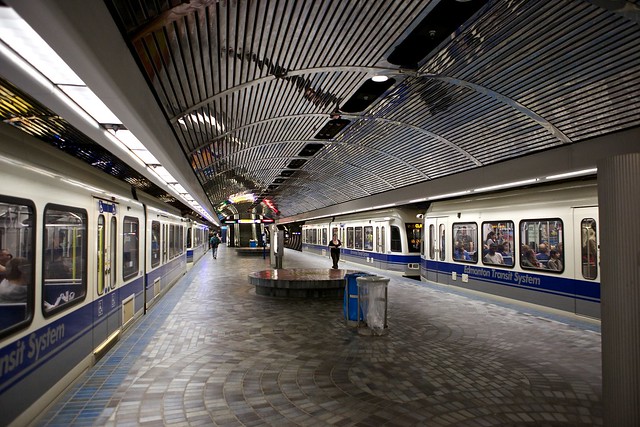
Bay/Enterprise Square
Bay/Enterprise Square LRT Station, photo by Christopher Cotrell

“The feature that made Enterprise Square imaginable was the LRT,” Dr. Amrhein told me. “It meant that it was no more difficult to get from HUB to Enterprise Square than it was to get from HUB to South Campus.” He said the U of A’s first question then about the Galleria project was, “is there an LRT stop?” As both Churchill LRT Station and MacEwan LRT Station are close, the goal of an “urban, linear campus connected by LRT” is achieved at the Galleria, according to Dr. Amrhein.

In his blog post, Dr. Amrhein reiterated the University of Alberta’s key requirement for the Galleria:

“Yes, the university has identified climate-controlled access to the Galleria from the LRT as critical for our students, faculty and staff, and the patrons of the performances at the Galleria theatres and concert halls. A pedway is one solution, but there are others.”

He sounded annoyed that the pedway had become such a touch point in discussions about the Galleria. “The pedway is not a deal-breaker for the University,” he told me. Only “climate-controlled access” is a requirement. When I asked him to suggest alternatives to a pedway that could meet that requirement, initially he dodged the question. But asked a second time, he suggested the position of the buildings could provide the required access, citing the Telus towers and their connection to the LRT as an example. “Clever positioning with a plus fifteen would achieve the same result,” he said, noting that the project architects would have to rethink their plans to make that happen.

Dr. Amrhein told me the University requires climate-controlled access for three reasons. The first is the need to move faculty, staff, and students around campus in short periods of time. “When it’s dark and cold, there’s a disincentive to move around the facilities,” he said. The second is safety, which Dr. Amrhein said has been “completely lost in the conversation.” He stressed the importance of safety, saying that pedways are “well-lit and heated, and very visible” and that they often include security features. “There’s a personal safety issue here.” The third is accessibility of the performance venues for the community.

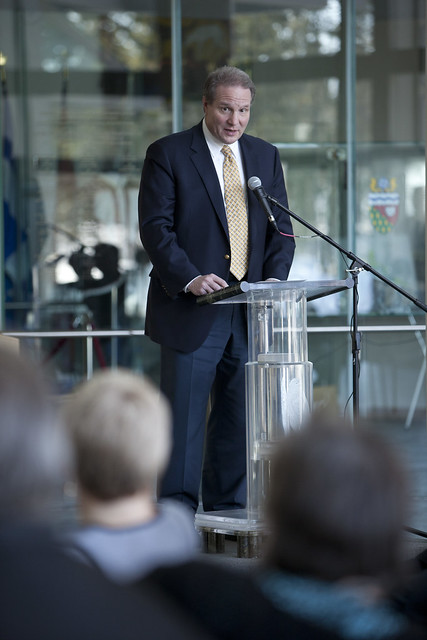
AuroraCollege_jm258
Dr. Carl Amrhein, photo by James MacKenzie

Back to the central question – why does the University of Alberta want to be part of the Galleria project? To answer that, Dr. Amrhein brought up Mayor Mandel and his vision to have all of Edmonton’s post-secondary institutions integrated and connected by LRT. “Imagine a medical student at NAIT,” Dr. Amrhein said. “That student can move from the classrooms at NAIT to the labs at the Walter MacKenzie Health Sciences Centre because of the LRT.” Integration across institutions like that would “put Edmonton in a very small group” of cities, Dr. Amrhein said.

It’s clear that Dr. Amrhein views the University’s participation in the Galleria project as something that will help Edmonton as a whole. “I hope it goes ahead.”

Digital Canada 150: The plan for Canada’s digital future

Have you heard about Digital Canada 150? I bookmarked the plan on April 4 because it caught my eye when Industry Minister James Moore announced it.

“Digital Canada 150 encompasses 39 new initiatives that build on our government’s successful measures for a more connected Canada. It is based on 250 submissions that were received from more than 2,000 Canadians who registered to participate in online consultations held over three months in 2010.”

In his speech, Minister Moore said “we want to position Canada among the world’s leaders in adopting digital technologies.” You can watch the speech here – which makes sense if we’re going all-in on digital! He made it clear that this isn’t just a Government of Canada plan, but that it requires “polytechnics, clusters, universities, start-ups, angel investors, apps developers, chambers of commerce, business leaders, community leaders” to all work together to realize the vision.

“Working together, we can prepare Canada for a new digital world and shape the course of our country for years to come.”

The plan is called Digital Canada 150 because it is meant to coincide with our country’s 150th birthday in 2017. I understand that much of the plan was already in place, though there are some new initiatives too.

The plan contains five key pillars:

  1. Connecting Canadians: An effective digital policy is one that connects Canadians through high-speed Internet access and the latest wireless technologies
  2. Protecting Canadians: Canadians will be protected from online threats and misuse of digital technology.
  3. Economic Opportunities: Canadians will have the skills and opportunities necessary to succeed in an interconnected global economy.
  4. Digital Government: The Government of Canada will demonstrate leadership in the use of digital technologies and open data.
  5. Canadian Content: Providing easy online access to Canadian content will allow us to celebrate our history, arts, and culture and share it with the world

Digital Canada 150

While much of the plan reads like marketing-speak for the Government, there are some things that I was happy to see, particularly under the “What’s New” section of each pillar. Here are a few thoughts on each.

À la carte TV

Will we really get to pick & choose channels?

“We will work with the Canadian Radio-television and Telecommunications Commission (CRTC) to develop a plan to unbundle television channels and ensure cable and satellite providers offer Canadian consumers the option to pick and choose the combination of television channels they want.”

It would be fantastic to only choose the ten or so channels that we actually watch, rather than having to buy the giant package, but I just don’t see this happening anytime soon. Especially since it’s something they’ve been working on for a while now. I’m skeptical but hopeful that this initiative actually comes to fruition.

Have your say on where cell towers are built

Living downtown I don’t really notice cell antennas (as they are typically on top of buildings) but I know people in more residential areas do.

“We introduced changes to the policy on how new cellphone towers are installed to ensure that local residents and governments are at the forefront of the tower placement process.”

Edmonton City Council adopted a new policy on cell towers last January, but ultimately their placement is up to Industry Canada. That’s why the announcement on February 5, 2014 was a step in the right direction, ensuring that residents are informed and consulted.

Stop the Spam

Some estimates peg the amount of spam at up to 92% of all email messages sent each year. It’s a problem, though not as bad as it was a few years ago.

“We passed Canada’s world-leading anti-spam law, which comes into force July 1, 2014, to protect Canadians from malicious online attacks.”

While it’s great to see tougher legislation on the spam problem, I’m not sure how much of an impact the law will actually have. Filters and other technological solutions have come a long way in recent years, and at least for me personally, receiving spam nowadays is relatively rare.

More funding for startups

Canada’s Economic Action Plan 2013 announced $60 million over five years for the Canada Accelerator and Incubator Program (CAIP).

“Support for the Canada Accelerator and Incubator Program will increase to $100 million to help digital entrepreneurs take the next step in developing their businesses.”

Increasing the fund will help to make even more accelerator and incubator programs, like those run at Startup Edmonton, possible. These kinds of organizations have a big impact on the viability of early-stage firms and entrepreneurs. The deadline to apply to the existing CAIP fund was October 30, 2013 so presumably a new round of applications will now be accepted.

Open Data

The Government of Canada has quickly caught up to other jurisdictions, making a significant amount of data available online in its open data catalogue.

“We will continue to support and stimulate the app economy and create a homegrown open data developer ecosystem in Canada.”

Last year, Minister Tony Clement came to Edmonton to talk about the government’s revamped open data portal. They have definitely worked to continue improving the catalogue, in both the breadth of data available and in the features offered. There’s still a lot of data that could be added though, so it’s great to see a continued push to take this forward!

More history available online

Established in 1978 as the Canadian Institute for Historical Microreproductions, Canadiana.org has been working to make Canada’s heritage content available digitally for quite some time now.

“We will continue to support the digitization and online publication of millions of images through the partnership of Library and Archives Canada and Canadiana.org.”

While I’d like to see an initiative to capture Canada’s digital history as we create it (think a Canadian version of archive.org) I’m happy to see that we haven’t given up on making all of the existing content available online.

The final section of the plan is called “Moving Forward” and it thankfully acknowledges that things change quickly in the world of technology:

“It is imperative that we keep our plan current because, in the digital world, change is the only constant. We are committed to continuously updating Digital Canada 150, adapting to better serve Canadians.”

It’s not clear what I as an individual can do to help move Digital Canada 150 forward, aside from “acquiring the skills and embracing the opportunities of the digital economy.” Still, it’s encouraging to have a national plan for becoming a digital nation.

Now if only we could adopt a national strategy for public transit…

City Council takes a step in the wrong direction by supporting the Galleria Project

Well it just wouldn’t be a high-profile project without Council doing most of its deliberations in-camera (private) now would it? That’s exactly what Council did again tonight in considering the Galleria Project (items 6.5, 6.6, and 6.7). It’s a worrying trend.

Essentially what Council decided to do was move forward with building the pedway, at an amount of up to $30 million, and that it would purchase the necessary land and relocate the EPSB Maintenance Building at a cost of about $33 million, pending written confirmation from tenants of the project. This doesn’t mean the Galleria Project is a done deal, but it is a significant step in that direction. And I think it’s a step in the wrong direction, at least at this time.

Here’s the motion as passed this evening:

  1. That the Capital Profile number 14-17-5037 in Attachment 2 of the April 15, 2014, of the Sustainable Development report CR_1065, be amended to a total cost of $30 million.
  2. That subject to an agreement to share the total cost of construction for the Pedway, approved by Council, with land owners north of 103A Avenue benefitting from the construction of the Pedway Connection to the Royal Alberta Museum:
    1. the amended Capital Profile number 14-17-5037 to fund the Pedway, be approved, and
    2. a contract with Ledcor Construction in the amount of $4.4 million for the design for the construction of the Pedway, as outlined in the April 15, 2014, Sustainable Development report CR_1065, be approved, and the contract be in form and content acceptable to the City Manager.
  3. That the Galleria Project – Downtown Academic and Cultural Centre be acknowledged as an innovative development opportunity in downtown Edmonton and subject to the City receiving written confirmation of financing and financial commitment for the Galleria Project from the Province of Alberta for the University of Alberta, a major office building tenant, other office building tenants, and retail tenants, that the purchase of land and relocation of the Edmonton Public School Board Maintenance Building and Capital Profile number 14-17-5031, as set out in Attachment 1 of the April 15, 2014, Sustainable Development report CR_1066, be approved.

Wasn’t this project supposed to be mostly paid for by donations? Yet here we are, with the City taking on much of the upfront risk.

Galleria Project

Council decided on all of this after receiving a report full of potential risks. Here are some excerpts from one of the reports that Council considered today on the Galleria Project (emphasis is mine):

  • “The Foundation initially requested financial support for the Galleria roof, but has withdrawn that request given the preliminary state of the project and the absence of a clear design or plan.”
  • “The University of Alberta has confirmed its intention to relocate the School of Music and Department of Art and Design to the site, bringing potentially 5,000 additional staff and students to downtown. This relocation is conditional upon direct, climate controlled connection to the LRT (i.e. an underground pedway connection to Churchill Station).”
  • “On February 18, 2014, as a result of revised cost estimates for the pedway construction and land purchase, the Foundation requested additional funding that reflected the increased cost estimates. In addition, because of the design and construction schedule for the Royal Alberta Museum, the City was asked to fund the pedway design and associated utility relocations immediately. This work cannot be deferred to a later date.”
  • “In order to purchase the School Board property, the City will be responsible for all costs to relocate the School Board Maintenance Building Operations to an alternate site.”
  • “In order to protect for the opportunity to connect both the Royal Alberta Museum, the Galleria, and other new development north of 103 A Avenue directly to Churchill LRT Station, the decision to proceed with the design of the pedway, the commencement of required utility relocations, and commitment to construct the shell under the Museum forecourt must be made now.
  • “The request to the City to contribute towards the construction of a roof over the Galleria has been removed. The Foundation may return with a request for assistance at a later date once more information is available. It is considered premature to consider any additional funding for this component until the project further evolves.”
  • “The business case as developed by the Foundation identifies that the source of funding for the Trust, and in turn for the theatres, is from the revenues generated by the office space and retail leasing on the property. In the event that the revenues are not realized, then while there is no legal obligation for the City to assume the operation of the theatres, there is a risk that the City could be asked to provide financial assistance in order for the theatres to continue to operate.”
  • “It is difficult to define and quantify risks at this time as this project is still at the concept design stage. The Foundation has provided what information it has, but there is not sufficient information available to fully address many of the issues identified for clarification.”
  • “Critical assumptions have been made relative to office and retail lease rates, rate of office space absorption, retail market demand, financing costs, construction costs, fundraising commitments and availability of government grants. Should any of the assumptions made in the business case not be realized, there is a risk that the funding to build, operate and maintain the theatres will not be sufficient to achieve the goal of providing affordable space to the arts community.”
  • “While the Foundation is confident in their ability to secure an anchor tenant for the office tower as well as several additional tenants, no proposed tenants are under contract.”
  • “With several new office towers having recently been announced or underway in the downtown, vacancy rates are expected to rise, and given the existing vacancy within the EPCOR Tower, the ability to secure tenants in a short time frame is considered to be a significant risk.”
  • “Costs for the theatres are difficult to estimate as they are subject to considerable range depending upon the design; however the costs are at the low end of the range of recent theatre construction in Calgary and Toronto.”
  • “The Foundation or Cultural Trust will offset the anticipated net operating loss of the theatres with diverse and dedicated revenue streams from office and retail rental rates from the larger Galleria project. There is no contingent plan contemplated to continue the operations of the theatres if the projected revenues are not realized.”

Nevermind that the original business case called the four new theatres “financially self-sustaining”. Guess not. Or that it declared the project was “feasible” and “sustainable” or that it would “generate significant revenue.” Unless of course the assumptions are wrong. Or worst of all, that the City wouldn’t have to put in much money, because it was a unique “P4” model. Right.

Somehow, after discussing the project behind closed doors, Council was able to look past all of that risk and concern (not to mention the ultimatum about needing to decide today) to support the project. Furthermore, many of them made a point of expressing their support verbally, as if the proponents might see the motion not as a victory but as a loss.

Councillor Henderson called it “a remarkable opportunity for the city.” Councillor Esslinger called it “an exciting project.” Councillor Sohi said it was “a very innovative development opportunity.” Only Councillor Knack spoke partially against the motion, suggesting that it should be compared against other projects up for consideration as part of the next Capital Budget. Mayor Iveson too pointed out that more assurances are needed, but said “it’s entirely appropriate to further explore” the project. He said it’s a “very exciting concept.”

Councillor McKeen made the motion, and used his remarks in part to justify the use of an in-camera session. He essentially asked us to trust Council, to take their word for it that the proponents did their homework. I fully appreciate the sensitivity around confidential information that doesn’t belong to the City, but I fail to see why that means the entire discussion needs to be had in private.

Furthermore, Councillor McKeen said “I think we’re asking a lot of the proponent” and added “we have spent a lot of time on this.” Really? Given the glaring holes in the proposal and self-admission that it is still extremely preliminary, I don’t think Council is asking much of the folks behind the Gallera Project at all. And I certainly don’t think Council has spent “a lot” of time on this project, unless it all happened behind the scenes.

In general I think the land investment by the City is a good thing – I’d rather have the City own it than some speculator or foreign investor who will just leave an ugly and unsafe surface parking lot on it. I think it also makes sense for the City to be a key player in land assembly for big projects. But aside from that, I’m really at a loss for why this should proceed with City funding.

The word most commonly used by Council tonight to describe the project was “innovative”. They all seemed to find the proposed Cultural Trust especially appealing, despite the risk that it may never come to fruition if the anticipated revenues from the office space and retail leasing don’t pan out. Unfortunately no questions were asked about the success of such initiatives in other cities throughout North America. No questions were asked about the likelihood that such a scheme would work here in Edmonton.

Only one question came up about whether the project as proposed would actually meet the needs of the arts community. No one asked why other arts organizations aren’t lining up to support the project, however.

At no point in the brief public discussion tonight did any question come up about the potential impact this project could have on the arena, located directly across 101 Street. This despite the fact that both projects need significant retail leasing to happen in order to succeed, which means they’ll be competing against one another.

Galleria Project

And most importantly, no consideration appeared to be given as to whether or not this is the way we want to build our city. Is moving billion dollar projects around like lego pieces really the way to do it? Shouldn’t there be some concern about how they’ll all work together? Or maybe some sort of bigger vision or plan? At the very least, shouldn’t we understand whether or not we can afford the worst case scenario?

I’m all for building downtown and the positive vision that Council has for Edmonton. I fully appreciate the incredible work that Dianne and Irving Kipnes have done and will continue to do in Edmonton. But I’m finding it incredibly difficult to support the Galleria Project as it has currently been proposed.

Media Monday Edmonton: Update #108

Here’s my latest update on local media stuff:

March 29 - Celebrity Showcase - Kelly Rosborough - 37-3
Local media celebrity guys at WCFW

You can follow Edmonton media news on Twitter using the hashtag #yegmedia. For a great overview of the global media landscape, check out Mediagazer.

So, what have I missed? What’s new and interesting in the world of Edmonton media? Let me know!

You can see past Media Monday Edmonton entries here.

Edmonton Notes for 4/13/2014

Here are my weekly Edmonton notes:

Headlines

Strathcona Community Hospital opens its doors May 21, 2014
Strathcona Community Hospital, slated to open on May 21

Upcoming Events

Edmonton Motor Show 2014
Edmonton Motor Show by iqremix