Edmonton’s Pedway: The Beginning

This is the first part in a series of posts looking at the past, present, and future of Edmonton’s pedway network.

For nearly 40 years Edmonton’s pedway system has been a fixture downtown. The maze of pedestrian walkways built above streets, through parkades, and under buildings has hosted parades, buskers, and even a pop-up restaurant over the years. It has kept office workers from having to step into the rain or snow, and it has served as an emergency shelter for our city’s most vulnerable during cold spells. Thousands of Edmontonians use the system each and every day, and while not universally loved, most Edmontonians can’t imagine our downtown without it.

Elevated walkways and other pedestrian-oriented urban planning concepts were becoming increasingly common in the 1960s in North America. Cities such as Chicago had started a pedway network as early as 1951. In Canada, Toronto led the way with PATH in 1959, followed just three years later by Underground City in Montreal. Eventually the idea moved west, and both Edmonton and Calgary started exploring the concept of a pedestrian circulation network in the late 1960s.

City Council paved the way for the pedway in Edmonton by approving the following recommendation on April 8, 1968:

“Council accepts the principle of a Downtown Pedestrian Circulation System as a guide to the future planning of pedestrian circulation in this area.”

Increasing concern about pedestrian safety played a key role in the recommendation, though it would be six years before the plan to separate pedestrians from vehicles became real. A working paper on the Downtown Pedestrian Circulation System published in 1980 offered this explanation: “Unlike streets, pedways cannot be laid out, constructed, and await development to occur around them.” The pedway has never had a master plan because no one owns it. Passages cannot be built until there are developments to connect, which makes the pedway a cooperative effort between a variety of developers, including the City.

Edmonton Centre opened in early 1974, and with it came Edmonton’s first pedway connections. It was the city’s first full-block development, and it featured both above-grade and below-grade pedways. The first above-grade pedway connected Edmonton Centre with the 14-level parkade across 102A Avenue. Connections were later added to Eaton’s (now City Centre West) and the Four Seasons Hotel (now Sutton Place).

Brand new Edmonton Centre 1974
Pictured top-left is Edmonton’s first above-ground pedway, photo of microfilm by Darrell

Over the summer of 1974, Council approved the City of Edmonton Transportation Plan Part 1. The document proposed “an enclosed walkway system” for the downtown and was an important step in the development of the pedway network.

That same year construction began on the LRT. Council had first endorsed the concept of a rapid rail transit system in 1968, and through a series of reports and debates the decision to go underground was made. That presented the challenge of ensuring smooth access from the street to the trains. To tackle it, the City approved a series of development agreements with nearby properties, and started building “climate-controlled linkages” which quickly became known as pedways.

In July of 1977, Council adopted the Pedway Concept Plan with the following motion:

“That the policy guidelines contained in the Pedway Concept Plan be adopted for future planning, design, security, maintenance, financing, operation, and implementation of a pedway network for Downtown Edmonton.”

According to the plan, the City had made “substantial investments to encourage construction of the pedway system” throughout the 1970s. However it also signaled that as acceptance of pedways increased and the network was built out, the City would no longer contribute financially. The pedway would have to evolve without the direct backing of the City.

The LRT began regular service on April 22, 1978, with Central and Churchill Stations all but guaranteeing the pedway would play a key role in moving people throughout Edmonton’s downtown for years to come.

Media Monday Edmonton: Update #82

Here is my latest update on local media stuff:

Just Another Morning
Just Another Morning. Photo by Ian McKenzie.

You can follow Edmonton media news on Twitter using the hashtag #yegmedia. For a great overview of the global media landscape, check out Mediagazer.

So, what have I missed? What’s new and interesting in the world of Edmonton media? Let me know!

You can see past Media Monday Edmonton entries here.

Edmonton Notes for 7/7/2013

Here are my weekly Edmonton notes:

Downtown from the west

Here are some upcoming events:

2013 Edmonton International Street Performers Festival
A photo of the International Street Performers Festival from earlier tonight!

I can’t say that I particularly like the message “feel the pulse”, but I do generally like this video showcasing Edmonton’s downtown:

What do you think?

Edmonton Notes for 6/30/2013

Hope you have a wonderful Canada Day tomorrow! Here are my weekly Edmonton notes:

Midnight ride
Midnight Ride by Chris C.

Here are some upcoming events:

Sketchy
Sketchy parkade that totally has me wishing for new Matrix sequel to be shot here in Edmonton! Photo by Dave Sutherland.

Machete Something Edmonton

Well, that escalated quickly1.


GIF created by Jay Runham

This morning at the ONEdmonton Leaders Forum at the Shaw Conference Centre, Mayor Mandel took to the stage to share his thoughts on the impact of post-secondary cuts on Edmonton’s economy. But he also used the opportunity to once again call into question the decision to dismantle Capital Health and form AHS, and to express his distaste with a recent National Post column. Here’s what Chris Selley wrote in the Full Pundit column on Monday:

The Calgary Herald’s editorialists could not be more proud of how those affected by terrible flooding over the weekend in Calgary and other communities conducted themselves. “It all adds up to one giant, collective effort, a well-oiled machine that slipped seamlessly into action with no hitches,” they write. “There was no major crime, there was no rioting. That sort of thing has happened elsewhere because disasters can bring out the worst in people. But that’s not southern Alberta’s way and never has been.” Edmonton, for example, would be a smoking hole in the ground at this point, infested with twitchy-eyed, machete-wielding savages.

As you can imagine, it was that last line that set Mandel off. Here’s a video from the Edmonton Sun with comments the Mayor made later in the day. You’ve got to admire his passion for Edmonton and his boldness in making those remarks! Many have pointed out that the column was satirical, and that the comment was directed at the Calgary Herald, not Edmonton. Mayor Mandel said he found nothing satirical about it, and instead found it “demeaning” and “disgusting”. One of the problems seems to be the difference between the online version and the print version. Brittney was first to share the news this morning, with a photo of the print edition:

The Sun mentioned to Mayor Mandel that the story was getting quite a bit of traction on Twitter. “It should gain a lot of traction,” he responded. “It shows a total disdain for our City, and I think citizens should respond to it.”

And respond they did.

Marty Chan got the party started in true Edmonton-form by making a clever hashtag:

#machetesomethingyeg has been trending all afternoon as dozens of tweets have been posted using it. Some are serious, but most are funny and trying to make light of the situation.

Of course, the humor is what has attracted most people to the hashtag, both online and offline:

It’s easy to dismiss this as merely some Friday-before-the-long-weekend-fun, or to look at the uproar over the National Post’s column as proof that Edmontonians are insecure and overly sensitive. But I think there are some important undercurrents here.

First, it should be noted there’s a sensitivity around media coverage of Edmonton and knives. Two years ago, our city was in the national news because of our alarming homicide rate. Knives factored into that narrative, though much of the coverage was outlandish and sensational. Still, that did long-term harm to our city’s reputation and brand.

Even if the comments in the National Post were meant as a joke, portraying Edmontonians as machete-wielding savages only perpetuates the myth that Edmonton is unsafe. It’s not funny, because it’s not true.

Second, I think this whole episode speaks to the connection Mayor Mandel has with Edmonton. He brings something up, and Edmontonians respond. We’ve seen it in recent weeks after his comments on the post-secondary cuts, and we’re seeing it again right now. It’s clear that Mandel loves this city, and the fact that he’s not shy about it is inspirational. Edmontonians are willing to back him up when he calls the National Post out.

Third and most important, I think this is further proof of the new energy that many Edmontonians have been talking about lately. We’ve always been proud of our city, but we haven’t always been willing to say that. Maybe because we lacked the right words, or maybe because we were simply afraid. But no more.

Things are different now. Gone are the days of us letting someone else tell our story. And gone too are the days of us staying quiet when something needs to be said. Welcome to the new Edmonton.

If you haven’t already done so, check out the hilarious #MacheteSomethingYEG hashtag on Twitter.

UPDATE: The National Post stands by the column: Surely, Edmontonians can take a joke

UPDATE2: You can now get your very own Machete Something Edmonton t-shirt! $1 of each sold will go to Alberta flood relief efforts.

Construction hoarding in Edmonton’s downtown is a disaster

There’s a lot of construction taking place downtown, and that can mean closures, detours, and delays. For the most part, I’m willing to live with some short-term pain because I know it’ll bring long-term gain. But if you think construction downtown is bad now, brace yourself. It’s going to get much worse with the Valley LRT line, the arena, the new RAM, new condo and office towers, and much more. The City needs to do more to ensure it all goes as smoothly as possible.

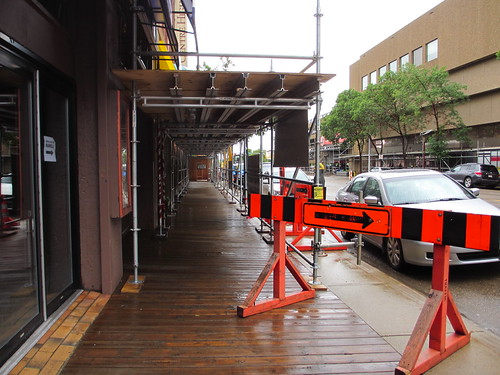
One big issue that we should be able to do something about is hoarding (the temporary fencing you see around construction sites). At the moment, construction hoarding downtown is a disaster.

Here’s what 101 Street looks like thanks to the demolition of the Kelly Ramsey building:

Kelly Ramsey Construction

Here’s what it looks like on Rice Howard Way:

Kelly Ramsey Construction

They’ve taken the sidewalk and one lane on either side. It has been like this for weeks now.

Over on 104 Street, here’s what the Fox Tower construction looks like:

Fox Tower Construction

As you can see they’ve taken not only the sidewalk but one lane of traffic too. Yet on the alley side, they don’t appear to have needed any extra space:

Fox Tower Construction

I would have praised the Ultima Tower construction, as they have kept the sidewalk open complete with a bus stop, but their temporary closure (from May 24 to June 29) is just as bad as the others:

Ultima Tower Construction

You can’t actually see that the sidewalk is closed until you get near the site, so you know what happens right? People walk on the street, right in traffic:

Ultima Tower Construction

Hardly safe! Hopefully they’ll be back to normal next week, with the sidewalk and bus stop open.

All of these examples share some common problems. First and foremost, pedestrian access has been disrupted, and in some cases, vehicular access too. Secondly, signage is either non-existent or very poor. All have been in place for weeks or even months, with no indication about whether or not they are temporary or permanent until the projects are done. And of course, all are quite unattractive.

The Downtown Edmonton Community League (DECL) has already raised concerns with the City regarding the Fox Tower construction. They were initially concerned about the loss of trees, but when it became clear that the sidewalk would be closed with no clear timetable for it to reopen, they brought those concerns to the table as well. Thus far the response has been lukewarm at best. I understand that Graham Construction has not indicated a willingness to change anything. Worse, the City’s response was that the development would bring hundreds of new residents to the street, as if that made up for the impact on the hundreds of residents who already live here. We must do better!

Aren’t there rules?

As great as the Capital City Downtown Plan is, it lacks any real guidelines for construction hoarding. Here’s what it says:

Ensure that construction hoarding in the Downtown features a minimum functional clearance of 2.15 metres continuous linear electrical illumination and public art if in place for over 1 year, to provide a safe, clean and professional appearance.

We missed an opportunity to really strengthen the requirements through that document. There’s also the Procedures for On-Street Construction Safety document, but it mentions hoarding just once, and only as a way to “ensure that there is no danger to pedestrians from above.” Finally, there’s a section of the City’s website devoted to Design & Construction Standards, but those documents do not mention hoarding either.

If you search long enough, you’ll eventually come across Bylaw 15894, the Safety Codes Permit Bylaw. Part 1, Section 13 requires that any hoarding placed on a highway (street, lane, road, alley, etc., including sidewalks and any other land between the property lines adjacent) requires a permit. Section 14 outlines the hoarding regulations. Section 15 basically states that there must be a walkway for pedestrians approved by the City Manager. Part 7 outlines hoarding permit fees.

So in theory, the construction projects mentioned above needed to obtain a hoarding permit from the City, and must pay ongoing fees for as long as the hoarding is in place. I say in theory because, if you read the regulations, it’s clear they are not being met. So who knows if the City actually polices this kind of thing. Maybe they just approve each application without too much consideration. And though the Alberta Building Code isn’t mentioned, presumably the construction site hoarding requirements from subsection 8.2.1 also apply. But the bottom line is the City can approve whatever they like.

What happens elsewhere?

Compare all of that to Calgary, which has produced the Practical Guide for Construction Sites. It has an entire section on construction hoarding, which includes this passage:

As pedestrian flow is vital to downtown and neighbourhood vibrancy and operations, The City of Calgary Roads hoarding policies, fees and fines are intended to improve pedestrian mobility, provide effective hoarding solutions and visually enhance construction sites in Calgary. Where required, hoarding provisions must be maintained at all times for the safe passage of pedestrians in and around construction sites. In an effort to add to Calgary’s visual appeal, The City is encouraging an Enhanced Screening Initiative for hoarding applications and offers incentives for this option.

The document goes on to outline requirements for fencing and sidewalk maintenance, citing appropriate sections of the Alberta Building Code. It very clearly states that developers must “keep sidewalks adjacent to construction sites clear of obstructions” and also that they must “maintain publicly accessible and safe sidewalks.” Straightforward and to the point. On top of that, they’re offering a discount on the fees! If developers take part in the Community Boardworx Project, intended to add visual interest and public art to construction sites, they’ll receive a 25% reduction in hoarding fees!

My experience in places like Toronto and Vancouver has always been pretty positive. Oh there’s lots of scaffolding, but at least pedestrian access was maintained. It’s not all rosy though. Here’s an article from January talking about construction site nightmares in Toronto:

The current building boom has created a checkerboard of downtown curb lane and sidewalk closures. Some three dozen construction sites, mostly condo towers, are ringed with hoarding that extends over the sidewalk and curb lane, many on major streets including Yonge and Adelaide.

Politicians there have made some great suggestions as a result. Requiring developers to file construction staging plans upfront, charging higher fees the longer the closure goes on, and putting construction trailers on top of hoarding (as they do in New York) are all possibilities. There’s a lot we could learn from other cities.

Let’s be good neighbours

Downtown, like every other neighbourhood, is shared. By residents, employees, students, and yes, construction sites. When construction sites pop up in the neighbourhood, I’d like to see greater thought given to how that site will be a “good neighbour”. We’ve all got to get along. Construction hoarding, as the interface and barrier between the site and users of the sidewalk and street, is very important. At the moment, most downtown construction sites are not being very neighbourly. I’d like to see that change, and I think it must change if we’re going to make it through the next few years of construction mayhem.

Media Monday Edmonton: Update #81

Here is my latest update on local media stuff:

Alberta Weekly Newspapers Association Conference
Photo of Ministers participating in the Alberta Weekly Newspapers Association conference a few weeks ago. Photo by MLA Robin Campbell.

You can follow Edmonton media news on Twitter using the hashtag #yegmedia. For a great overview of the global media landscape, check out Mediagazer.

So, what have I missed? What’s new and interesting in the world of Edmonton media? Let me know!

You can see past Media Monday Edmonton entries here.

Edmonton Notes for 6/23/2013

Happy Birthday Sharon!

Here are my weekly Edmonton notes:

Don Iveson
Councillor Iveson in the media scrum after announcing his mayoral campaign, photo by Dave

Here are some upcoming events:

Edmonton a.m.
This photo was taken on the morning of June 13 by Sarah – great shot, I totally missed the fog!

#yeg turns five

#yegToday marks the fifth anniversary of the #yeg hashtag on Twitter (here’s #yeg tweet number one). Can you believe it has been five years since Twitter started to take hold here in Edmonton? I can’t. I’m also continually surprised at the impact our humble hashtag has had on this city. Here’s something I wrote back in 2009 about the start of the #yeg hashtag.

It started out simply but has exploded in use since, and not just online. Now it is common to see the tag offline, even in the names of companies like YEG Live. I’m always surprised when newcomers to Twitter discover and start using the hashtag, but I’m even more surprised when I see it out in the offline world! What is it about those three letters?

YEG didn’t start with Twitter, of course. Most Edmontonians would associate YEG with Edmonton because of our international airport, constructed around 1960. According to Tom Hinderks and Richard Skermer, YEG would likely have been assigned to us roughly a year before the airport received its operating certificate, so that would have been 1959. That means those three letters have been associated with Edmonton for more than 50 years! But it wasn’t until Twitter came along that Edmontonians really started to embrace YEG as a sort of identity for the city. It was probably a wise decision for the Edmonton International Airport to focus on EIA as its brand rather than YEG, because there’s a risk it would have gotten lost amongst the chatter.

Use of the hashtag on Twitter has grown fairly steadily over the years. Today it might not even be the hashtag that you follow most, it might instead be one of the 430+ related tags that have become popular such as #yegfood or #yegtraffic. There were nearly 1 million tweets posted by Edmontonians last year that included the #yeg hashtag or one of the related tags, and that’s up from less than 140,000 in 2009.

How do you pronounce it? I did an informal survey on Twitter in December 2011, and that was one of the questions I asked. About 61% say yegg (rhymes with egg), the rest spell it out as in why-e-gee. Around the same time I asked Chris Martyniuk, co-founder of YEG Live, how he pronounces it. “Originally we were adamant about spelling it out,” he told me. “But we gave in about a year ago, because everyone said ‘yegg live’.” However you choose to say it aloud, online those three letters have become synonymous with Edmonton.

People from other cities often comment on how connected and tight-knit the online community in Edmonton seems to be, and I think the #yeg hashtag is really at the heart of that. We’ve used it to make new friends, to share the news, to raise money for important charitable causes, and for thousands of other interesting and important reasons. The world of social media is very different today than it was in 2008, with a variety of new services like Pinterest and Instagram, but the #yeg hashtag remains as a way to bind it all together.

I had no idea that Twitter would become as popular as it has in Edmonton, nor that the #yeg hashtag would take hold and play such a significant role in creating a sense of community here. Thank you to everyone who has used #yeg to make this a richer, more interesting city to call home.

Here’s to the next five years of #yeg!

AccelerateAB 2013: The Next Billion Users with Mozilla CEO Gary Kovacs

In less than a month, Alberta’s tech entrepreneurs and investors will descend upon Calgary for AccelerateAB. Now in its third year, AccelerateAB is an initiative of the A100 focused on “connecting, educating and showcasing the incredible tech companies that proudly call Alberta home.” It’s not just locals you can expect to see there, but also mentors and investors from around the country and across the continent.

This event is a true melting pot that brings together Alberta’s seasoned veterans, young punks, quality mentors, whip-smart investors and keen students, all with the goal of building Alberta’s tech ecosystem. With speakers, mentors and investors jetting in from Silicon Valley and all across Canada, this isn’t just a great tech event for Alberta, it’s a great tech event. Period.

Here’s a promo video for the event:

This year’s opening keynote features Mozilla CEO Gary Kovacs who will be speaking about The Next Billion Users:

The next billion users: the global opportunity of wireless. As mobile technology spreads throughout the developing world, everything we know about mobile communication, commerce and information is about to change.

I had the opportunity to talk with Gary back in April about his keynote.

Born in Toronto, Gary completed his BComm and MBA at the University of Calgary’s Haskayne School of Business throughout the 90s. Though now located in California, he does make it back to Calgary a couple of times a year. Given that AccelerateAB is taking place during the Stampede, Gary said he was looking forward to returning with his family. Beyond that, he relishes the opportunity to connect with Alberta-based entrepreneurs. “I want to bring my mistakes and lessons back to people who are working hard in Alberta,” he said. “It’s an opportunity to speak one-to-many, not just one-to-one.”

Gary has talked about the next billion users before. He spoke at the Mobile World Congress in Barcelona back in February, and I encourage you to check out his blog post about the topic. “It took 22 years for the first billion users to come online, and everything changed,” Gary started. “The next two billion will come online over the next five years.” It’s that dramatic pace that has Gary most excited. “If we thought we were moving fast before, we can’t even understand this change.”

The interesting thing about the next billion users is that they aren’t tied down. “They won’t be constrained by any existing process,” Gary said. “They can start something new.” Sending money using a phone might be a shift in habit for someone from Canada used to visiting a bank, but for the next billion that will be just the way you do things. I mentioned that students in Africa often receive test scores via text message, whereas I had to wait for a piece of paper when I was in high school. Being free of the context of paper is part of what makes the coming shift so exciting to Gary. “To anyone who has never had a test score delivered via a sheet of paper, they don’t even have that in mind.”

Something that Gary has focused a lot of energy on during his time at Mozilla is privacy. “It’s a concern mostly because there’s no transparency,” he told me, which in the context of the recent NSA and PRISM news is quite accurate. The challenge around privacy in bringing the next billion users online is to enable them to have control. “Tools are being developed, and there will be ways for them to have a much better privacy experience from the start,” Gary said.

gary kovacs
Gary Kovacs at Mobile World Congress

Another topic we discussed was the open web. “It must be open and available for all to participate,” he said. “The next two billion people can’t be forced to go online in a way that advantages one commercial organization over another.” Gary mentioned the history we’ve been through with AOL, and noted that in the world of mobile today we’re forced to essentially choose one of two centrally planned economies. “One or two organizations cannot possibly keep up with the millions of requests of human innovation,” he said.

Lastly, I wanted to ask Gary what advice he’d give to startups. “Big organizations innovate at the centre of the bell curve,” he said. “Startups are magically placed to innovate at the edges.” For Gary, the next two billion people coming online is an incredible opportunity for startups. “Look beyond the boundaries of where you live,” he advised. Startups are able to have an impact in areas that simply cannot be contemplated by larger organizations. “Also think in terms of systems,” he added. “We should no longer think of mobile as a device or an app, that wave of innovation has occurred; the next wave is when anything is connected.”

Very exciting times ahead indeed! This is just a small snapshot of the things you’ll hear discussed at AccelerateAB in Calgary next month. The conference takes place on July 11, and tickets are just $30. You’ve got until July 2 to register, so get on it! You can check out the schedule here.

The other thing happening in conjunction with AccelerateAB is Alberta Tech Week. All week long there will be interesting tech events taking place, and you can submit your own if you’d like to get involved. It’s going to be a great week to connect with tech entrepreneurs from across the province!