Social Media and the Edmonton Storm

As you probably know, a violent storm passed through Edmonton on Saturday evening, causing lots and lots of damage around the city. Emergency services, Epcor, and the local media all had a very busy weekend, and the cleanup will likely continue for days. Users of Twitter, YouTube, and other social networks also had a busy weekend, posting thousands of first-hand reports as well as dozens of photos and videos online. In this post I recap some of the highlights.

Twitter played a big role in the storm of course, which means that I received a number of phone calls from the local media today. I was interviewed for the evening news on both Global and CBC, and will be on CBC Radio tomorrow morning at 6:15am. Why do they call me? Because I have the data to back up my observations, and now you will too!

From July 18th at noon until July 20th at noon, local users posted 14456 tweets. Of those:

1640 were tagged #yeg, #yegstorm, or #yegweather
462 contained TwitPics
682 were retweets
2024 contained links

To put these numbers into context, I compared them with the average of the three previous weekends:
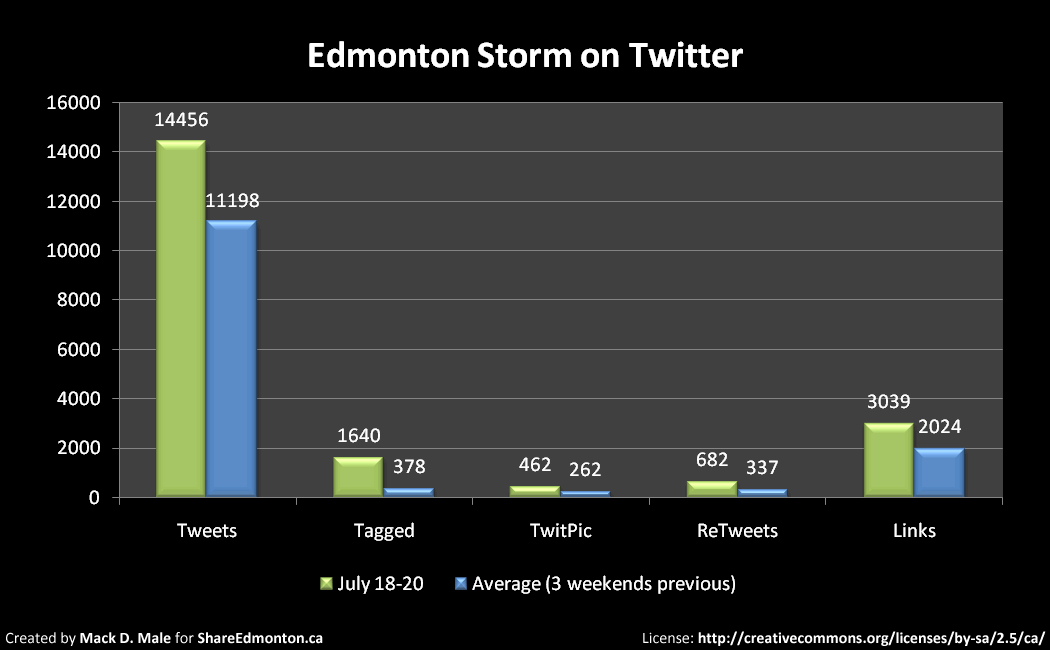
As you can see, each category was higher than normal. Of particular interest to me, was the number of tagged tweets. During the 48 hours of the storm and aftermath, local users posted 4.3 times as many tagged tweets as they do on a normal weekend. There was a definite spike at the height of the storm:

That got us into the trending topics on Twitter, and spam bots and non-local users helped push up as high as #6:


Photo courtesy of Brittney Le Blanc, iNews880

There was a lot of information being posted on Saturday night, so I decided to aggregate the best of what I saw using CoverItLive. The tool has changed a lot since I last used it, but I got up and running pretty quickly. You can see the stream here. Some stats on the live stream:

283 different people followed along
92 total comments were submitted
259 tweets were aggregated
70 other items were posted (I was listening to the radio and adding extra comments)

One of the people following the live stream was Evan Adnams, who at the time was in North Carolina! He took the information in the live stream and started plotting it on a collaborative Google map that has since been viewed nearly 13,000 times.

I know for a fact that the local media used Evan’s map to find out where they should send their cameras. Users continue to update it too, which is great!

As I mentioned, lots of videos were posted online. This video by Trevor Prentice is probably the most watched of them all, racking up over 30,000 views:

There were also dozens of photos posted (check out galleries at CTV Edmonton and iNews880). This one by Brittney Le Blanc was not only the most retweeted photo during the storm, but it also immediately put to rest rumors that the CN Tower had collapsed:

I think that’s an important point. People often say it’s great that you can post stuff on Twitter in real-time, but who’s going to do the fact checking? The answer, of course, is everyone. Citizens like Jerry Aulenbach, who posted a number of TwitPics, joined forces with members of the mainstream media like Brittney to do the fact checking. Josh Classen and Mike Sobel posted frequent weather updates on Twitter based on the data they had, and citizens augmented that with live reports from all around the city. The Edmonton Journal, which couldn’t publish on Sunday due to power outages, kept its website up-to-date with a combination of articles written by its reporters and links to the social media resources I’ve mentioned above.

It was a truly collaborative effort, and it won’t be the last time we see social and mainstream media teaming up to get the job done.

Social Media and the City Centre Airport Debate

Where there’s smoke, there’s fire.

On Thursday morning Jeff Samsonow and I chatted about the City Centre Airport for a few minutes on CBC Radio. During the interview I was asked if I thought social media played a role in the debate. I answered, “absolutely”.

Also on Thursday, Graham Hicks mentioned the “rise of youth” in his column, observing that “the younger demographic flexed its muscle” and that “the "social media" was solidly anti-airport”. He specifically mentioned myself, Jordan Schroder, Dave Cournoyer, and Michael Janz.

Scott McKeen got things rolling on Friday with his column in the Edmonton Journal, stating that “a new reality emerged along with a new establishment.” He too mentioned age:

Blogger Mack Male used Twitter to go live from council chambers during the final debate. In one Twitter post, he wrote: "There is a silver-haired guy in the audience shaking his head during Don Iveson’s remarks."

Global Edmonton’s Linda Nguyen interviewed me Friday for a piece that aired during the evening news (click on “silent majority” because their video system sucks). Councillors Iveson and Krushell were also interviewed for the story, and cited the use of social media by young people as a trend to keep an eye on.

On Saturday, Todd Babiak’s column in the Edmonton Journal took the story to another level. He interviewed both myself and Jordan Schroder, and said:

It must have been devastating for the city’s most powerful men and women to watch a group of virtually connected–but politically unconnected–young people creating and controlling public debate with speed, elegance and respect.

Is it just coincidence that so many stories on the same topic appeared over the last few days? Were they all just trying to avoid another negative comment from Cal Nihols and his side? Maybe, but I think there’s more to it than that.

Social Media Lessons

Social media definitely played a large role in the City Centre Airport debate, on both sides. As I mentioned in my post introducing NotMyAirport.ca, AEG made use of social media for its campaign too, though the local media seems to have glossed over this fact. David MacLean was active on Twitter, and actually was the first to use the #ecca hashtag that has become so popular. You may know that I didn’t create the Not My Airport group on Facebook, Jordan Schroder did. I just looked for the largest pro-closure group and linked to it – Jordan then renamed it and made me an admin. David told me a similar thing happened with their side’s Facebook group. David and I both took part in the web debate hosted by FusedLogic, and we both encouraged others to email their councillors.

All of which begs the question, if both sides had such similar stories, why were the pro-closure side’s social media efforts so much more effective? The fact that, at least in my opinion, we had a stronger case notwithstanding, I believe the following reasons are key:

  1. Blogging

    Blogs are still the stars of social media. The pro-closure side made use of blogs quite extensively. Myself, Dave, Michael, Adam, Adam, and Jeff all blogged about the issue numerous times, and I’m sure there were others too. A blog has many benefits, but three in particular played a role here: a place to expand on thoughts and to lay out facts, a good ranking in search engines, a place for others to leave comments and have a conversation. The pro-Muni side didn’t have any blogs, and they missed out accordingly.

  2. Consistency

    Perhaps the most important thing you can do when you have a blog is to post regularly. I did that, as did others. We were also consistent with other tools. We kept the Twitter stream updated, and we regularly sent messages to our Facebook group and posted on the wall. The debate seemed more alive because we were consistent with our communications.

  3. Using the right tool for the job

    Blogs are great for sharing a relatively large amount of information. Twitter is great for short, real-time bits of info. Here’s an example: I listened to the live stream for the public hearings, and Twittered about it in real-time. The pro-Muni side was nowhere to be found. Similarly, I live tweeted the final decision, because that’s what Twitter is good at. The pro-Muni side again was silent. Even the web debate is a good example – I suggested it because I knew it would give us time to explore the issues and a chance for others to converse online.

  4. No distractions

    You might call it grassroots or simply having no money, but the pro-closure social media efforts were not affected by other “distractions”. The billboards, lawn signs, etc. all have an impact – in this case, they made the pro-Muni side seem like it had some money, and that took away from the authenticity of their social media efforts.

Over the weekend, Adam and Dave wrote about Babiak’s story. Both suggested that there’s more to the story than just young people using social media. I agree with them. If age played any role, it’s that young people are more comfortable with social media tools and thus used them more effectively. That’s a bit of a generalization, however. There were young and old people on both sides of the debate.

Final Thoughts

There’s no doubt in my mind that the City Centre Airport debate and the role social media played in that debate will have a lasting impact on politics in Edmonton. Having said that, it’s important to realize that change doesn’t often happen overnight. Just as it will take years for the airport itself to give way to something new, political decisions will continue to be made the way they always have been, at least for the foreseeable future.

The difference now, I hope, is that social media has been legitimized in the eyes of our local political system and should see greater use in the future.

I think that’s something to be proud of.

The future of local news gathering in action

On Saturday morning Sharon and I walked to the City Market Downtown, as we often do on the weekends. Along the way, near 107th Street and 102nd Avenue, we came upon a parade of firefighters. I immediately took out my camera to snap some photos, and also used my BlackBerry to post one to Twitter via TwitPic. We followed them up the street until they turned toward Jasper Avenue, taking a few more pictures. They were a somber group, so we assumed it was a memorial march of some kind, but we didn’t know the details.

Firefighters remember Station Captain Al HarrisFirefighters remember Station Captain Al Harris

For the next couple hours, I sent BlackBerry messages back and forth with Brittney at iNews880. She had seen my TwitPic, and wanted to write a story about the march. I always tell her she can use my photos, but she asks anyway which is nice. Brittney and her team figured out what the march was for, wrote the story, and posted it with my TwitPic. When I got home, I uploaded the rest of my photos and they added them to the story.

That’s the future of news gathering in action.

Now I realize that iNews880 and some other media organizations regularly use photos from contributors but I think what’s significant here is that the story started with the photo. Would they have written about it had I not posted a TwitPic? Maybe, maybe not. In this case they saw the photo, tracked down what it was about, and were able to produce a story.

Here’s a quote you might have heard:

In journalism, there has always been a tension between getting it first and getting it right. – Ellen Goodman

In this case, I got it first and iNews880 got it right. Note that doesn’t mean that I got it wrong and iNews880 was way behind. We simply worked together to make the story happen. This is the kind of news gathering that can scale. So many of us walk around with mobile Internet devices, always ready to post a message or a photo.

What comes next? Aggregation, of course.

Why the proposed City Centre Airport compromise won’t work

Tonight was I on Alberta Primetime with David MacLean from AEG to discuss the compromise that was proposed recently by the Alberta Aviation Museum in the debate about what to do with the City Centre Airport. The compromise would see one of the two runways closed, to make room for some redevelopment. We didn’t have a lot of time to get into the issue, but we agreed on one thing: a compromise isn’t going to work. City Council needs to make a decision.

There are two runways at the City Centre Airport. There’s 16/34, which has the ILS (instrument landing system), prevents NAIT from expanding, and has the largest impact on the Outer Surface restricting building heights over downtown. The second runway is 12/30, which is slightly longer than 16/34 but lacks the important ILS. The runways are placed in an intersecting “V” configuration.

It’s true that if Council decides to shut the City Centre Airport down, it won’t happen overnight. It’s also true that it’ll take time for any development to be completed. Those two facts aren’t enough to make the proposed compromise work, however:

  • It’s not clear which runway would be shutdown. Clearly 16/34 would make more sense from a development perspective, and a financial one too as it requires about $7 million of investment (part of the $35 million in total required for ECCA over the next ten years).
  • That would largely be dependent on moving the ILS to 12/30, something which may not be possible. Actually, it may not even be desirable given how old the system is – it almost certainly needs to be replaced.
  • Shutting down 12/30 instead doesn’t make a lot of sense either, because height restrictions would still be impacted and NAIT expansion would still be blocked.

I’m told that Edmonton Airports has promised to provide Councillors with a feasibility study on the compromise in time for next week’s Council meeting. It doesn’t really matter though.

The truth is that such a compromise is just an easy way out for Council. If they don’t decide once and for all to shut it down or keep it open, we’ll just keep having this same debate every few years. Or even worse, we’ll end up with some development right next to a crippled airport. Nobody will benefit from either of those scenarios.

City Council must take a bold step to do what’s right for the future of Edmonton. Encourage your City Councillors to vote in favor of closing the City Centre Airport.

Newspapers, cities, and the local web

Edmonton SkylineThe concept of “local” has never been more important – that’s something I firmly believe. Though I found the book somewhat wordy, Who’s Your City by Richard Florida presents this idea very effectively:

Globalization is not flattening the world; on the contrary, the world is spiky. Place is becoming more relevant to the global economy and our individual lives.

It’s definitely worth a read. So much of our lives is defined by place – by the people and things around us. I think this is especially true when you live in a city.

Cities are interesting because they encompass a range of place sizes. A specific block, neighborhood, area, quadrant, etc. right up to the entire city and greater metropolitan area. Some people identify most with a neighborhood or area, others with the entire city. Often their affiliation depends on the current situation (perhaps a neighborhood when it comes to family issues and the city when it comes to business). Consequently, the information individuals are interested in varies.

Newspapers try to cater to this range of interest. Here in Edmonton, the Examiner publishes stories for different regions of the city. On the opposite end of the spectrum, the Edmonton Journal attempts to cover the entire city. Then there are all of the other publications in between. And some news simply isn’t covered by any publication.

There are many problems with this. A newspaper can’t get too specific, because advertisers won’t want to buy ad space if only a few dozen people are going to see their ad. As newspapers move toward a larger audience to attract better ad revenue, they inevitably end up with more general content. And of course, newspapers are not real-time.

Put simply, newspapers are not very good at representing places. For this reason, I find it incredibly bizarre that a number of recent articles focus on place as the reason why newspapers will not go away. For example, here’s an excerpt from a National Post story on Monday:

Newspapers retain their market relevance partly because flipping through a newspaper is one of the quickest and easiest ways to answer the question, "What’s new and might be of interest to people who live where I live?"

The printed version of the newspaper is connected with a physical geography at a specific point in time that few, if any, online resources can be.

How can any of that be true? We know that to truly find out “what’s new and might be of interest to people who live where I live”, we’d have to flip through a number of newspapers. And even then we’d be missing stuff. The second point is absolutely wrong also – there are many online resources that are intimately connected with a place and time. For instance, EveryBlock. Such online services are probably more connected with a specific place and time because they go down to the street level and often deal with real-time information.

Here’s another excerpt, from a Todd Babiak column in yesterday’s Edmonton Journal:

For its residents, a city must be more than a house, a car and a job. It’s a narrative, a living history, myths and conflicts, and for as long as Canada has been a country the newspaper is where the city has been inscribed.

If it is true that the city newspaper is dying, the city is dying with it.

Just because something has always been a certain way, doesn’t mean it’ll remain that way forever. Innovation is largely about challenging the status quo. Thus, the fact that newspapers are failing to innovate shouldn’t be a surprise. To suggest that cities are dying as a result is simply ridiculous, however.

I’m not falling for the myth that cities depend on newspapers. It’s true that a newspaper plays an important role in documenting the evolution of a city, but it’s not the only institution that does so. A newspaper is also not the only way to get information to citizens. Increasingly, citizens can get information directly.

I think we’re at the beginning of the “local” era on the web. As more and more people carry mobile devices that are location-aware, this trend will accelerate. Increasingly, online services will help answer the question, “what’s new and might be of interest to people who live where I live?” Eventually they’ll also provide context and background in a way that simply isn’t possible in the offline world.

Newspapers can play an important role in this local era. However, just as cities do not need newspapers to survive and flourish, neither will the local web.

You’re asking the wrong question

Last week’s issue of SEE Magazine was a “theme” issue, focusing on the future of the media industry (“print in peril”). In addition to this interesting article, there was a panel comprised of four local newspeople with lots of experience: Linda Hughes (U of A, formerly Edmonton Journal), Ron Wilson (CBC), Jeremy Lye (iNews880), and Roy Wood (MacEwan, formerly Edmonton Journal). They discussed a range of things, including the fact that the industry didn’t develop these problems overnight. The general consensus is that journalism is important, but what it looks like in the future is up in the air.

Of course, you can’t have an article on the future of media without asking who’s going to write about City Council, and the panel didn’t disappoint! Linda Hughes asks:

But with breaking news and local-level news, who is going to go sit in a courtroom all day for a three-paragraph story that is important to know about but isn’t sexy and is just part of the pubic discourse? Who is going to do that? Bloggers often provide a lot of insight, but most bloggers are not going to go to sit in city council committee meetings for five hours to keep track of what city council is doing.

Ask a sports writer about the future of news and he’ll probably use this defense, even though he never sets foot inside City Hall! It’s the easy way out, and it’s an incredibly common response lately from journalists in the hot seat. To make things worse, SEE asked the question again later in the piece:

If newspapers and mass media outlets do dwindle, then, who will be the watchdogs in society to ensure politicians don’t run wild? Who will pay for the investigative reporters who can zero in on one thing for months and all of a sudden have the biggest story of the year?

Sigh. There will still be passionate individuals who follow specific topics and do investigative reporting. Probably more now than ever thanks to easy publishing systems (blogs, wikis, Twitter, etc). And they’ll produce much more interesting content than someone who does it just because they get paid to.

Let’s ignore that argument for a minute, however. Asking how to pay a journalist to sit through meetings to get three paragraphs is still the wrong question!

The real question is, why have we ever had to pay someone to sit through five hours of City Council committee meetings? Let’s get rid of that absurd need altogether and this discussion becomes irrelevant.

This is why I’m so excited about ChangeCamp and the possibilities it represents. If we can change the way our government communicates with us, the need for a newspaper filter could go away altogether.

Let’s focus less on how we’re going to pay a journalist to sit with Council all day and more on how we can get Council to communicate with us in a meaningful way. If we can do that, the journalist will have much better things to cover!

Twitter lovers: watch out for baseball bats!

I was in the mainstream media here in Edmonton twice today for Twitter-related stories. Basically, the local media’s love affair with Twitter continues! First up, Metro Edmonton (@metroedmonton). They asked me about politicians on Twitter, and specifically about Councillor Don Iveson, who I encouraged to join the service. Here’s my quote:

“It shows that governments are in the know, connected and paying attention to what people are passionate about,” said Edmonton tech guru Mack Male (@mastermaq). “Right now, young people seem to be big on Twitter.”

I was responding to the possibility that Councillor Iveson and others may use Twitter as a way to connect with a younger demographic. I think that’s totally possible, and I expect we’ll hear more about that at ChangeCamp. I think it’s great that Don has joined, and that it’s actually him tweeting.

Secondly today, I was a guest on CBC’s Wildrose Country phone-in program (@WRoseCBC). They were interested in my recent live tweeting of an Edmonton Symphony Orchestra event. One of the people who called in was ‘Bob’. He thought my tweeting was entirely disrespectful and said:

“mastermaq should be hit in the head with a baseball bat!”

I’m not sure why he felt the need to be so violent, but his reaction isn’t entirely surprising. Many people are afraid of social media because they don’t understand it, and they react accordingly. On air, I advised Bob and others like him not to focus on the individual, potentially meaningless tweets in isolation, but to recognize that once aggregated together, there’s incredible value in the noise that Twitter facilitates. It’s going to happen (helping you make sense of the clutter), whether Bob likes it or not. In the meantime, tweet away!

I also feel that the “disrespectful” feeling about tweeting is largely a generational thing that will change over time. I could be wrong about that, but I don’t think so. If everyone is used to others texting in a variety of situations, it’s no longer odd or abnormal. Perceptions will then fall in line.

I’m guessing that CBC will post the segment online, but I’m not sure – check the website for details. I’ll update this post with a link if they do.

Thanks to everyone who listened and sent me encouraging comments this afternoon during the CBC segment. I have to admit that having Bob on the show made the discussion a bit more interesting, and if that’s what it takes to get Twitter more accepted and into the mainstream, I say bring it on.

Just watch out for crazy people with baseball bats!

Edmonton Media Organizations on Twitter – Update 1

Back on March 3rd, I posted a list of local media organizations on Twitter. At that time, there were roughly a dozen organizations with official accounts. It was easier to count the number of organizations using Twitter, than those not using it.

That’s no longer the case.

Here are the local media organizations using Twitter as of April 10th, 2009, by category.

Print

Television

Radio

Of course, these are just the official accounts. For each of these, there are employees and personalities with their own accounts. That list of names is growing ever longer!

So which organizations are missing?

  • 101.7 World FM
  • 105.9 Shine FM
  • 790 CFCW, though there is @stella790cfcw
  • Access TV, though they do have @ABPrimetime
  • AM930 The Light
  • EZ Rock 104.9
  • Magic 99
  • OMNI Edmonton
  • SEE Magazine
  • Shaw TV Edmonton
  • The Team 1260, though there is @CoreyGraham

Some of these organizations may never get on Twitter, I suppose.

I think it’s fair to say that we’ve reached critical mass with regards to the local media on Twitter. It’ll be interesting now to see how they use it, especially as more and more Edmontonians join the service.

Talking Twitter with CTV Edmonton

It’s no secret that the local media have jumped aboard the Twitter train in recent weeks. They seem completely smitten with it! Almost all the media outlets in Edmonton are now on Twitter in some capacity. The two big television stations, Global and CTV, have been really great about accepting feedback and assistance as they figure out how Twitter can best work for them. A couple weeks ago Karl Kovacs spoke to the Global Edmonton newsroom, and yesterday, I was fortunate enough to speak at CTV (there were also some folks from Access and 91.7 The Bounce in attendance).

I guess “speak” isn’t really the right term. I started with a bullet list of some key concepts (such as terminology and that Twitter Search rocks) but didn’t have any prepared slides or remarks. Instead, I had a browser open and encouraged everyone to fire away with questions. And fire away they did!

Questions ranged from “why do people follow other people” to “how can we best use Twitter during our newscast”. We also took some time to talk about the #teachctv discussion I had started on Twitter in the morning. I think it was a good eye-opener for most in the room to see how quick and easy it was for me to gather a bunch of feedback from the Twitter community. Thanks to everyone who posted a tweet in response.

I don’t know what CTV is going to do with the things we talked about, but the feedback I got was that everyone found the “primer” useful. I think I was able to start some interesting discussions, and I look forward to seeing what they come up with in the weeks ahead.

What I hope they took away from our chat was the following:

  • Links are important! I’d rather see a link than “coming up at 6” and I think most others on Twitter would also.
  • You’ve got to be willing to experiment. Some things will work, others won’t.
  • Twitter will not replace the TV or website, it is simply another tool. If used correctly, it can compliment CTV’s other channels.
  • Twitter is about people and relationships. You’ve got to show that there are humans behind the Twitter accounts! Be personable.

Those points are valid for any business on Twitter of course, not just for CTV.

Thanks to Carrie Doll and her team for the opportunity to discuss my favorite topic! I think it’s great that CTV Edmonton is so keen to utilize Twitter. Exciting times ahead!

To follow CTV on Twitter: @ctvedmonton, @carriedoll, @darylmcintyre, @joshclassen, @JoelGotlib, @robbywilliams, @ErinIsfeld, @davidjamesgreen, @crnkylttlmnky

Edmonton Media Organizations on Twitter

Given the recent interest in Twitter from the local media, I thought it would be a good idea to take a look at which of the organizations are on Twitter and how they use it. Back in November I wrote about local news organizations and their use of social media. At that time, only the Edmonton Journal and iNews880 were on Twitter.

Things have definitely changed!

Here are the local news organizations (and their representatives) I know about on Twitter (numbers retrieved on 3/3/2009 at 12:30 AM):

Which media organizations are missing? Lots:

  • Edmonton Sun
  • CityTV Edmonton – though there are @axfergie, @meagankelly, and @KMPhotographer
  • Edmonton Examiner
  • Vue Weekly – I setup a placeholder account: @vueweekly
  • SEE Magazine
  • Avenue Edmonton
  • 24 Hours
  • 630 CHED – there is a placeholder account, @630CHED, but their efforts are focused on the iNews880 account
  • CKUA – though there is @kevinckua
  • Most other radio stations: Team 1260, 91.7 The Bounce, 96.3 Capital FM (added above), EZ Rock 104.9, CISN Country 103.9, 100.3 The Bear, Magic 99, etc.
  • Edmontonians Magazine
  • Venture Publishing magazines (maybe) – though there is @VentureMags, @RachelatVenture and @RuthatVenture

From this we can identify a few trends:

  • Most accounts were only recently created, and there are still lots of organizations not yet on Twitter.
  • Most of the active accounts are updated automatically using twitterfeed.
  • Most organizations have an “official” account that is treated like a bot, and employees have the more personal, interactive accounts.
  • Most accounts don’t follow back. The one notable exception is @iNews880.

I’m not sure how long I’ll wait before revisiting this list, but I’m pretty sure the number of local media organizations using Twitter will continue to increase. There’s definitely some concern in the community that by simply broadcasting, the local media aren’t using Twitter as effectively as they could be. I still think there’s value in having them on Twitter though.

UPDATE (3/5/2009): Very quickly others are joining! Here’s 91.7 The Bounce: @917thebounce, @onair1980, @carlykincaid