Social Media Marketing Bootcamp comes to Edmonton

Vancouver-based Capulet Communications has been running a number of popular social media marketing ‘bootcamps’ in Victoria and Vancouver, and now they’re taking their show on the road. In addition to stops in Kamloops, Kelowna, and Calgary, Capulet will be in Edmonton on September 9th. Here’s what you can expect:

Adding social media into the marketing mix is increasingly important for marketers who want to establish an online presence for their businesses. Building on the sold-out course we taught for UBC Continuing Education this winter, we discuss the dos and don’ts of social media marketing; look at successful marketing campaigns; introduce the social media tools every marketer should know about; and cover online communications etiquette.

And a little on the instructors, who I know and definitely recommend:

We’re Julie Szabo and Darren Barefoot, the founders of Capulet Communications. With a background in technology and public relations, we’ve been running social media marketing campaigns since before it was called "social media". We’ve worked with the nation’s smallest startup and its biggest brands like Mountain Equipment Co-op and Best Buy.

Here are the details for the Edmonton event:

WHO: You!
WHAT: Social Media Marketing Bootcamp
WHERE: Metterra Hotel, 10454 82 Avenue (map)
WHEN: Wednesday, September 9th, 9:30am to 4:30pm
WHY: To learn all about social media marketing.
COST: $299 (or save $50 if you blog about it), register here

Darren also says they are looking for local marketing and communication groups to spread the word in exchange for a discount for members. If you’re one of those people, get in touch with him.

I’ve noticed a definite increase recently in the number of local individuals and organizations looking for help with social marketing. I think the City Centre Airport issue and the recent big storms have had a huge impact on increasing awareness of social media. People are naturally wondering how they can take advantage of it. I think Capulet’s bootcamp is a great way to get started, so don’t miss it.

Social Media and the Edmonton Storm

As you probably know, a violent storm passed through Edmonton on Saturday evening, causing lots and lots of damage around the city. Emergency services, Epcor, and the local media all had a very busy weekend, and the cleanup will likely continue for days. Users of Twitter, YouTube, and other social networks also had a busy weekend, posting thousands of first-hand reports as well as dozens of photos and videos online. In this post I recap some of the highlights.

Twitter played a big role in the storm of course, which means that I received a number of phone calls from the local media today. I was interviewed for the evening news on both Global and CBC, and will be on CBC Radio tomorrow morning at 6:15am. Why do they call me? Because I have the data to back up my observations, and now you will too!

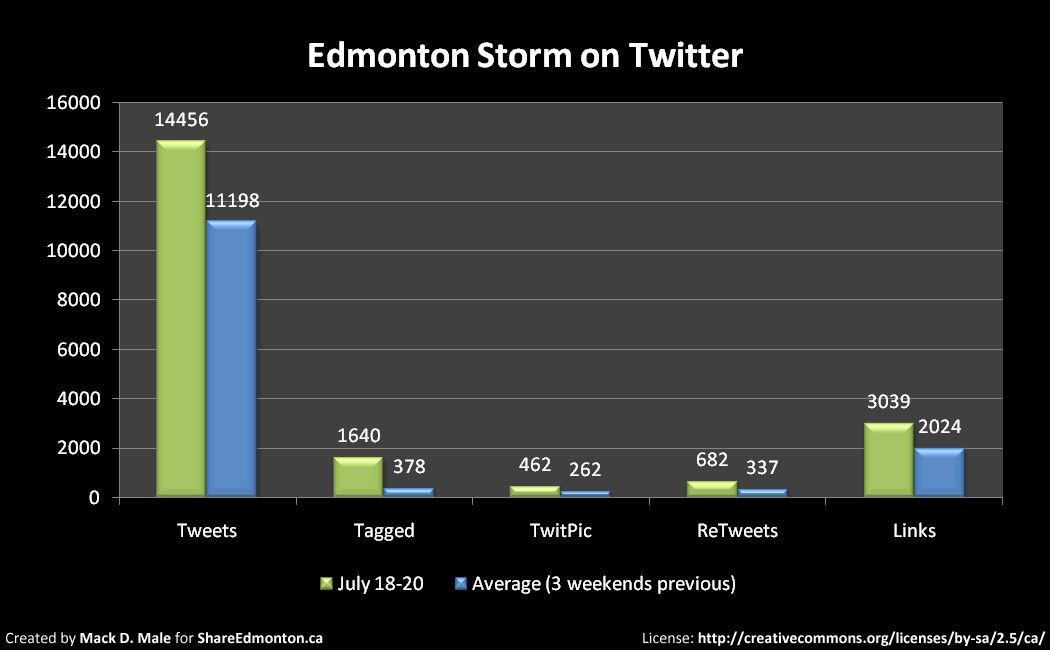
From July 18th at noon until July 20th at noon, local users posted 14456 tweets. Of those:

1640 were tagged #yeg, #yegstorm, or #yegweather
462 contained TwitPics
682 were retweets
2024 contained links

To put these numbers into context, I compared them with the average of the three previous weekends:

As you can see, each category was higher than normal. Of particular interest to me, was the number of tagged tweets. During the 48 hours of the storm and aftermath, local users posted 4.3 times as many tagged tweets as they do on a normal weekend. There was a definite spike at the height of the storm:

That got us into the trending topics on Twitter, and spam bots and non-local users helped push up as high as #6:


Photo courtesy of Brittney Le Blanc, iNews880

There was a lot of information being posted on Saturday night, so I decided to aggregate the best of what I saw using CoverItLive. The tool has changed a lot since I last used it, but I got up and running pretty quickly. You can see the stream here. Some stats on the live stream:

283 different people followed along
92 total comments were submitted
259 tweets were aggregated
70 other items were posted (I was listening to the radio and adding extra comments)

One of the people following the live stream was Evan Adnams, who at the time was in North Carolina! He took the information in the live stream and started plotting it on a collaborative Google map that has since been viewed nearly 13,000 times.

I know for a fact that the local media used Evan’s map to find out where they should send their cameras. Users continue to update it too, which is great!

As I mentioned, lots of videos were posted online. This video by Trevor Prentice is probably the most watched of them all, racking up over 30,000 views:

There were also dozens of photos posted (check out galleries at CTV Edmonton and iNews880). This one by Brittney Le Blanc was not only the most retweeted photo during the storm, but it also immediately put to rest rumors that the CN Tower had collapsed:

I think that’s an important point. People often say it’s great that you can post stuff on Twitter in real-time, but who’s going to do the fact checking? The answer, of course, is everyone. Citizens like Jerry Aulenbach, who posted a number of TwitPics, joined forces with members of the mainstream media like Brittney to do the fact checking. Josh Classen and Mike Sobel posted frequent weather updates on Twitter based on the data they had, and citizens augmented that with live reports from all around the city. The Edmonton Journal, which couldn’t publish on Sunday due to power outages, kept its website up-to-date with a combination of articles written by its reporters and links to the social media resources I’ve mentioned above.

It was a truly collaborative effort, and it won’t be the last time we see social and mainstream media teaming up to get the job done.

Social Media and the City Centre Airport Debate

Where there’s smoke, there’s fire.

On Thursday morning Jeff Samsonow and I chatted about the City Centre Airport for a few minutes on CBC Radio. During the interview I was asked if I thought social media played a role in the debate. I answered, “absolutely”.

Also on Thursday, Graham Hicks mentioned the “rise of youth” in his column, observing that “the younger demographic flexed its muscle” and that “the "social media" was solidly anti-airport”. He specifically mentioned myself, Jordan Schroder, Dave Cournoyer, and Michael Janz.

Scott McKeen got things rolling on Friday with his column in the Edmonton Journal, stating that “a new reality emerged along with a new establishment.” He too mentioned age:

Blogger Mack Male used Twitter to go live from council chambers during the final debate. In one Twitter post, he wrote: "There is a silver-haired guy in the audience shaking his head during Don Iveson’s remarks."

Global Edmonton’s Linda Nguyen interviewed me Friday for a piece that aired during the evening news (click on “silent majority” because their video system sucks). Councillors Iveson and Krushell were also interviewed for the story, and cited the use of social media by young people as a trend to keep an eye on.

On Saturday, Todd Babiak’s column in the Edmonton Journal took the story to another level. He interviewed both myself and Jordan Schroder, and said:

It must have been devastating for the city’s most powerful men and women to watch a group of virtually connected–but politically unconnected–young people creating and controlling public debate with speed, elegance and respect.

Is it just coincidence that so many stories on the same topic appeared over the last few days? Were they all just trying to avoid another negative comment from Cal Nihols and his side? Maybe, but I think there’s more to it than that.

Social Media Lessons

Social media definitely played a large role in the City Centre Airport debate, on both sides. As I mentioned in my post introducing NotMyAirport.ca, AEG made use of social media for its campaign too, though the local media seems to have glossed over this fact. David MacLean was active on Twitter, and actually was the first to use the #ecca hashtag that has become so popular. You may know that I didn’t create the Not My Airport group on Facebook, Jordan Schroder did. I just looked for the largest pro-closure group and linked to it – Jordan then renamed it and made me an admin. David told me a similar thing happened with their side’s Facebook group. David and I both took part in the web debate hosted by FusedLogic, and we both encouraged others to email their councillors.

All of which begs the question, if both sides had such similar stories, why were the pro-closure side’s social media efforts so much more effective? The fact that, at least in my opinion, we had a stronger case notwithstanding, I believe the following reasons are key:

  1. Blogging

    Blogs are still the stars of social media. The pro-closure side made use of blogs quite extensively. Myself, Dave, Michael, Adam, Adam, and Jeff all blogged about the issue numerous times, and I’m sure there were others too. A blog has many benefits, but three in particular played a role here: a place to expand on thoughts and to lay out facts, a good ranking in search engines, a place for others to leave comments and have a conversation. The pro-Muni side didn’t have any blogs, and they missed out accordingly.

  2. Consistency

    Perhaps the most important thing you can do when you have a blog is to post regularly. I did that, as did others. We were also consistent with other tools. We kept the Twitter stream updated, and we regularly sent messages to our Facebook group and posted on the wall. The debate seemed more alive because we were consistent with our communications.

  3. Using the right tool for the job

    Blogs are great for sharing a relatively large amount of information. Twitter is great for short, real-time bits of info. Here’s an example: I listened to the live stream for the public hearings, and Twittered about it in real-time. The pro-Muni side was nowhere to be found. Similarly, I live tweeted the final decision, because that’s what Twitter is good at. The pro-Muni side again was silent. Even the web debate is a good example – I suggested it because I knew it would give us time to explore the issues and a chance for others to converse online.

  4. No distractions

    You might call it grassroots or simply having no money, but the pro-closure social media efforts were not affected by other “distractions”. The billboards, lawn signs, etc. all have an impact – in this case, they made the pro-Muni side seem like it had some money, and that took away from the authenticity of their social media efforts.

Over the weekend, Adam and Dave wrote about Babiak’s story. Both suggested that there’s more to the story than just young people using social media. I agree with them. If age played any role, it’s that young people are more comfortable with social media tools and thus used them more effectively. That’s a bit of a generalization, however. There were young and old people on both sides of the debate.

Final Thoughts

There’s no doubt in my mind that the City Centre Airport debate and the role social media played in that debate will have a lasting impact on politics in Edmonton. Having said that, it’s important to realize that change doesn’t often happen overnight. Just as it will take years for the airport itself to give way to something new, political decisions will continue to be made the way they always have been, at least for the foreseeable future.

The difference now, I hope, is that social media has been legitimized in the eyes of our local political system and should see greater use in the future.

I think that’s something to be proud of.

Now a Certified ScrumMaster

A few weeks ago I attended a ScrumMaster training/certification course here in Edmonton, administered by Berteig Consulting. We’ve been using Scrum at Questionmark for a couple years now, and are continually trying to improve. I did a podcast interview with Michael McClenaghan back in March talking about some of the challenges we’ve faced along the way.

We recently decided that we should ensure knowledge about Scrum was consistent across the company, hence the training. Last week I received word that I am now an officially certified ScrumMaster!

Some of the key points about Agile & Scrum that were repeated throughout the training:

  • Agile is: learning
  • Agile is NOT: a defined method for delivery, nor a buffet of best practices
  • Scrum is a process that encourages learning!

In a way it’s kind of bizarre that you can be certified in Scrum, because I think you only get a handle on it after some experience – a three day training course probably isn’t enough, though it is a good way to get started.

In that regard, Scrum is kind of like social media – you can’t really be an expert in it because you’re continually learning, and the amount of experience you have is what really matters. Here’s another similarity:

Individuals and interactions are valued over processes and tools.

Social media is all about people and their relationships too!

Who knew Scrum and social media would have so much in common 🙂

Social Media in Action: Belua Designs

This post is the first in a new, semi-regular series of entries called Social Media in Action. My goal with the series is to share my favorite examples of organizations using social media effectively. To start, I wanted to highlight local monster creators Belua Designs.

Sarah Bourque makes handmade monsters from new socks and recycled wool sweaters, scrap buttons and felt. Each monster is unique, and sells for between $20 and $50. Sarah makes up to about 50 monsters per week and in addition to selling via Etsy, usually has a table at the many local Farmers’ Markets and craft fairs.

For the last few months, she’s also been writing a blog. Writing about sewing probably isn’t the most fascinating topic in the world, and Sarah seems to understand that. Instead, she tells a story with almost every post, and generally keeps the blog focused on the monsters. It’s engaging, and it keeps me subscribed. Many readers look forward to Fremly’s Friday Favorites – a weekly series of posts highlighting Sarah’s mascot monster and other local designers (here’s my favorite entry).

Sharon and I are both big fans of the blog (she gets so excited to find out what Fremly is up to – she loves her own monster too), so I asked Sarah a few questions about it.

How long have you been blogging, and why did you decide to start a blog?

I started my blog just after Christmas last year. I always wanted a website but kept putting it off because I felt it would be expensive and time consuming. After doing a bit of research into the blog world I realized it was the perfect way for me to go. It was very easy to set-up, it had all the elements I was looking for and it was free (which is always a bonus!).

How do you decide when and what to post?

I try to post 3 times a week. I’ve been pretty good about it although I must admit when things get really busy I don’t post as often. I keep my blog monster related so I usually feature a monster a week and talk about upcoming shows.

What kind of feedback have you received? Do you think the blog is effective?

I think the blog is very effective and the feedback has been great. I really noticed it after I injured my finger after a sewing accident (yes, that can happen!). I was at a craft show and a few different people came up and asked me how my finger was doing. It caught me off guard until I realized that my blog was actually being read. It’s always nice when people can feel a more personable connection with the creator of something they just purchased.

Do you use Twitter, Facebook, or any other social media services to promote your business – why or why not?

I take advantage of as many social media services as possible. My blog has a link to my Twitter, business Facebook fan page, Fremly’s personal Facebook page, Flickr and my shop on Etsy. I think it’s really important to have everything connected from one main source otherwise it could get a bit confusing. I have found them all to be really effective and a great way to stay in touch with customers.

I think Sarah has done a number of things really well with the blog. She posts regularly, and consistently. She has a good mix of updates on the business and stories about the monsters. Most importantly, she’s gotten creative with the personalities of the monsters. You can tell when you read the blog that she’s having fun!

Check out Belua Designs if you haven’t already – it’ll put a smile on your face!

Edmonton Federation of Community Leagues (EFCL) and Social Media

Can an antiquated organization use social media to become relevant to younger generations? The Edmonton Federation of Community Leagues (EFCL) may soon give us an answer. They’ve started to create a presence on Twitter and Facebook, and promise that more is on the way.

First of all, what is a community league? From Wikipedia:

A community league is an organization of community residents who represent their community at large in communication with a municipal government. Community leagues are organized to provide such services as providing recreational opportunities to the community, addressing municipal issues which address the community directly, and keeping community residents up-to-date on happenings within the community.

Edmonton was the first city in Canada to adopt the idea of a community-based organization, according to the EFCL history page. The Crestwood Community League was formed way back in 1917! Today, there are 150 community leagues under the EFCL umbrella.

So far, EFCL have created a Twitter profile and a Facebook page. They are “slowly slipping [their] toe into the waters of social media.” I contacted Michael Janz, EFCL’s Marketing Director, to ask for his thoughts. He quickly corrected my initial assessment of the organization:

“I would challenge the notion that EFCL is ‘antiquated’ – I think ‘established’ is a better word. EFCL has been here for 80 years. People know what it is and what EFCL can accomplish.”

He did concede that the younger generations are much less familiar with the EFCL however, which is what I meant by “antiquated”. The organization’s main membership drive kicks off in September, and the goal this year is to have a more coordinated promotional effort, making use of both traditional and social media. Michael told me that the EFCL is getting on Twitter and Facebook now to be prepared. They are “moving to where the puck is going”, Michael said.

I asked Michael about the challenges EFCL faces with adopting social media, and learned there were other, bigger challenges: “As of March 2008, only 50% of our leagues had websites. We’re now up to 70%.” Clearly having a web presence is an important first step before making the jump to Twitter! EFCL’s mandate is to serve the community leagues, and helping them get websites and email addresses setup is the focus for now. Social media tools will follow.

The first community league to follow that trajectory is Crestwood. They have a regularly updated website, full of information for members. Recently, they joined Twitter and have been posting an interesting mix of tweets – some community-specific, some related to Edmonton as a whole.

I think it’s great that EFCL is mindful of Twitter, Facebook, and other social media tools and services. They’re fortunate to have someone like Michael on board. I look forward to following their progression in the world of social media, first in September for the big kick off, and beyond.

Live Tweeting at the Edmonton Symphony Orchestra (ESO) Sunday Masters

Last year, the Edmonton Symphony Orchestra invited a number of local bloggers to live-blog Symphony Under the Sky. I remember reading Adam’s posts from the event, and thought it was a cool initiative; a rather unique way to try to get a different crowd interested in the ESO. When I was invited to do the same this year for Carmina Burana, I readily agreed (I received two free tickets and a CD previewing the 2009/2010 season).

Of course, I decided to live-tweet the event rather than live-blog it – you can see my tweets here. I tried to do a mix of details from the program and observations. Two other bloggers sat next to me, though they weren’t live-blogging: Jim Tustian (a former photographer for the ESO) and The Choir Girl. We were up in the Gallery, which was sold out despite not normally being open for Sunday performances.

The Winspear Centre

Snagged this photo before the show started, ignoring the sign about recording devices!

The first piece was Alexander Borodin’s Prince Igor: Polovtsian Dances. It was immediately recognizable. At just 13 minutes for the performance, I was left wanting more! I’m a sucker for the contrast of Disney-esque sections and the familiar booming sections.

The second piece was Benjamin Britten’s Serenade for Tenor, Horn and Strings, consisting of all eight movements: Prologue, Pastoral, Nocturne, Elegy, Dirge, Hymn, Sonnet, Epilogue. I was thankful the performance was just 23 minutes long, because I couldn’t get into it. Before the performance started, conductor William Eddins said that you need a strong tenor, strong horn player, and strong string section to perform Britten’s piece. He joked that getting all three was as likely as the Edmonton Oilers winning the Stanley Cup this year!

The main event was after the intermission – Carl Orff’s Carmina Burana. Again, this one was instantly recognizable, though with about 65 minutes of music there were definitely long sections I had never heard before. I enjoyed it all, but my favorite part was definitely Fortuna Imperatrix Mundi, O Fortuna which both opened and closed the performance.

As I mentioned, William Eddins was the conductor. He’s currently in his fourth season as Music Director for the ESO. Performers today included Allene Hackleman, French horn, Bonaventura Bottone, tenor, Illana Davidson, soprano, and Hugh Russell, baritone. The Cantilon Chamber Chorus and the Ukrainian Male Chorus of Edmonton provided the rest of the vocals.

The Edmonton Symphony Orchestra and Social Media

Before the show and during the intermission, I had the chance to ask Philip Paschke, ESO’s New Media Specialist (he must be one of the only people in the city with a title like that), about their travels into the world of social media. He told me their website needs work, and in the future will hopefully incorporate the ESO Blog, and potentially Twitter, Facebook, and other services. Like so many organizations, they are hearing a lot about Twitter and the other social media tools and are struggling to understand how to best make use of them.

I think the blogger initiative is a good one. There’s another concert being blogged on April 16th, and Philip hopes to get at least one more before the season ends. One of the biggest challenges thus far has been fielding complaints about “the inconsiderate texters” from other concert-goers. It’s definitely a challenge to make the click-clacking of keys seem welcome inside The Winspear Centre (fortunately my BlackBerry was relatively silent).

I’m not sure if my live-tweets were of interest to anyone, but I had fun doing it. If nothing else, tweets and blog posts during a concert just help to remind others that the ESO is still putting on great concerts.

Thanks to Philip for inviting me to participate – I really enjoyed the show, and I look forward to the ESO’s future adventures with social media.

Questionmark enters the blogosphere

I spend most of my time at Questionmark writing code, managing projects, and performing all the other tasks that make sense for a software developer. That doesn’t stop me from thinking about how the company could take advantage of social media though! Ever since I started with the company, I’ve been looking forward to the launch of an official blog. On Tuesday, it finally happened! Introducing Getting Results – The Questionmark Blog:

Stay connected with us and with the wider testing and assessment community right here. Ask questions, post comments and take the opportunity to spark discussions.

Together, let’s explore how best to create, deliver and report on assessments that help individuals and organizations work more effectively. And let’s have some fun in the process!

I can’t take credit for getting the blog setup – our marketing team did a great job at that. I’d like to think that I helped get the idea going, however. And I’ve done my best in the last few weeks to act as an “in-house expert” of sorts, offering advice and suggestions on what to consider.

I look forward to watching the blog evolve. One of my local colleagues, Greg Pope, has already posted an entry on psychometrics! In it, he mentions the Questionmark Users Conference, coming up on April 5th in Memphis. I’m sure there will be a number of great posts that come out of that event.

I should also mention that our CEO, Eric Shepherd, has become quite a champion for blogging! He recently started his own blog, which I encourage you to check out as well.

And yes, I’m already pushing the next big thing…watch for that in the next few weeks!

Social Media: What Edmonton Transit (ETS) could learn from TransLink

I think the South Coast BC Transportation Authority, or TransLink, is one of the most web-savvy transit organizations in Canada. Through blog posts, videos, meetups, and more, TransLink is doing a great job of fostering a community of people interested in transit. I think Edmonton Transit (ETS) could learn a lot from them!

The Buzzer blog

The Buzzer is a free publication found on all TransLink vehicles (our equivalent is In Transit) and The Buzzer blog is its companion. The blog is described as a “frank, fun, and ongoing conversation about TransLink and its work.” Every time I read it, I find myself wishing that ETS had something similar! Here’s what I love about the blog:

  • It is updated regularly – almost a post per day!
  • They have comments enabled – and they participate in them!
  • They post about a variety of topics, not just announcements and service updates
  • There are clearly defined Participation Guidelines

Most importantly, the blog is written with a human voice. It’s interesting and easy to read.

What ETS could learn: The easiest, most effective way to get involved is to start a friendly, regularly updated blog. It forms the foundation of TransLink’s social media efforts, and could perform the same role for ETS. This should be priority #1!

TransLinkInfo on YouTube

Video is time-consuming both to produce and to consume, so while it shouldn’t be the primary form of communication there are times when video is handy. TransLink gets this. They primarily post short updates and announcements on their YouTube channel. Videos range from about 30 seconds to 5 minutes. I think it could be a good vehicle for “behind-the-scenes” kinds of stories as well.

What ETS could learn: Pick the right tool for the job. There’s more to the web than just text, so venture into other forms of media too!

TransLink on Twitter

There are a few TransLink accounts on Twitter: @thebuzzer, @KenHardie, @2010Transit, and @TransLink. I think the 2010 account will get more interesting as the Olympics near, and The Buzzer account could probably be used for more than just broadcasting, but they are on Twitter and are evaluating how to use it better (they recently polled the community to see if they wanted Twitter service alerts). It’s pretty cool that Ken Hardie, Director of Communications at TransLink, is an active user.

What ETS could learn: Twitter is growing incredibly quickly and is becoming an increasingly important platform for news and connections. TransLink is guessing (I think correctly) that Twitter will be a key communications tool for the 2010 Olympics, and they’re getting prepared now. ETS would be wise to make use of Twitter on a regular basis, and especially during Edmonton’s major events.

I Love Transit Week & The Buzzer Meetup

TransLink celebrated I Love Transit Week on its blog from February 23rd to 27th. I like their introduction to the event:

Why? Because while there are things we don’t like about transit, I know there are many things that we do like about the system. And there just hasn’t been an official opportunity to celebrate what we like – until now!

That could definitely apply to something similar here in Edmonton. We always hear people complain, but there are lots of things to like as well. TransLink did a good job of keeping the blog updated with I Love Transit Week content.

The other cool thing they did that week, was the meetup. They hosted the gathering at a local cafe, and brought transit-related swag to give away. Face-to-face conversations are always best, so the meetup was a great (and obvious) idea.

What ETS could learn: The annual Community Conference is a formal, one-way conversation – ETS speaking to a select few. Meetups are more informal, and are two-way. They allow the community to put human faces to the organization. Plus they can be a ton of fun!

Final Thoughts

I don’t mean to suggest that TransLink is perfect, because they’re not. And to be fair, ETS acknowledges that it has a lot of work to do in the area of community engagement. Like many other organizations they are new to social media, and are going to have to learn quickly.

Conversations about the state of transit in Edmonton are happening, but ETS isn’t yet participating. The sooner they get involved, the better off they’ll be. Fortunately for ETS, they don’t have to start from scratch. Others like TransLink are already leading the way!

Northern Voice 2009: Teh Funny

No, that’s not a typo! Rob Cottingham (@RobCottingham) was the second keynote speaker today, and he led us on “a lightning tour through both the intentionally and accidentally hilarious sides of social media.” I couldn’t really blog this keynote – it’s one of those things you needed to experience. I laughed a lot, as did everyone else in the room.

Rob CottinghamNorthern Voice 2009

Which are funny?

  • Podcasting – Really funny.
  • End-User License Agreements – Yes, funny!
  • Beta – Not funny. Maybe kinda funny.
  • Memes – No, not funny.
  • Blogging – Funny!
  • Business – Rob thinks it’s hilarious, the audience isn’t so sure.
  • LOLcats – Audience is 50/50, Rob says it’s a matter of taste.

Some of the non-funny things Rob said:

  • At the heart of social media is creative self-expression and the need to connect.
  • The first Northern Voice was a techier crowd than it is today.
  • Teh funny is a big part of the way we connect on the social web. Shared laughter is something primal.
  • If you’re already doing teh funny, please, keep it up!

Two other interesting things about Rob’s keynote – first he attempted to become the first comic in history to heckle himself. He setup some scheduled tweets using HootSuite, very funny. Second, Nancy White drew an “illustrative interpretation” of Rob’s talk on the board behind him. It actually turned out quite well!

Fantastic keynote. I hope someone has some video to share!