Recap: DemoCampEdmonton9

I feel like a broken record, but I really think tonight was our largest crowd ever for DemoCamp! It’s just amazing to see so many people who care about the technology industry and local entrepreneurs come out to show their support, learn something, and connect with one another. Kudos to everyone who continues to help make DemoCamp the fantastic event it has become by showing up and spreading the word! Special shout out tonight to NAIT’s Digital and Interactive Media Design (DIMD) group – I understand there were a couple dozen students in attendance!

As usual, we had six demos:

  • Victor Rubba from CrazedCoders got things started by demoing a side project – an iPhone game called Pik’s Revenge. It’ll appear in the App Store soon for $1.99, and is the first in a series of roughly four chapters. It includes 4 movies, 8 comics, and 2-5 hours of gameplay. I loved Victor’s demo because there was no talking for the first half, just gameplay being demoed.
  • Next up was Reg Cheramy and Scott Montgomerie who demoed their new Facebook app called Book That Bet. Built simply to “scratch an itch”, the app lets you track wagers with your friends, making use of the social graph on Facebook. It’s written in Ruby on Rails and is intentionally simple to start. Reg and Scott had a good demo, but actually received more love for their other app, OneClap.
  • Third tonight was Logan Foster who demoed a Kongregate game called Team Battle. It’s a Flash-based, real-time fighting game with some interesting graphics creation (3D models to 2D sprites). The intent is not to create a World of Warcraft competitor, but rather a game to play in your spare time.
  • Next up was Andrew Czarnietzki from 3D Interactive Inc. or 3DI. He demoed a really interesting simulation built for Caterpillar. Powered by the Unreal engine, Andrew described the simulator as a “serious game” – basically they bring game technology to the business world. The level of detail in the simulator was just incredible. Andrew did a good job of balancing the demo part with the talking part.
  • Fifth tonight was Colin Bramm who demoed SelfChecker, an online quiz authoring tool. The idea is to make it easy for teachers to create questions that can be shared with students via a simple link. Students take the test and see feedback immediately.
  • Last but not least was Ken Bautista who demoed his 2009 Venture Prize award winning solution called CIE: See Your Own Proof. An online community for kids, CIE hosts missions and other activities, and includes a whole social networking element as well. Interestingly, CIE combines the online and offline world with “field missions” in which kids visit real museums to learn and explore. The beta starts next week!

Most of the demos tonight were for projects that have been in the works for quite some time. I think it’s safe to say that the game demos did not go as well as expected. It turns out that demoing a game is harder than it sounds, particularly because you only get ten minutes! I think it was Graham who said something like “if you can’t play the game, then it had better be entertaining to watch with explosions or something!” I think I agree – the game demos just weren’t as exciting as everyone hoped. The fact that we had multiple game demos probably didn’t help.
DemoCampEdmonton9DemoCampEdmonton9
Photos taken as folks were still coming in. It filled up even more!

I think Ken’s demo was definitely a favorite, as people seemed really excited about CIE. The demo of the night has to go to Andrew though, for offering us a peek at some really awesome technology and for keeping the demo entertaining, informative, and on time.

There were a few announcements made this evening:

Thanks to everyone who came out tonight. Thanks also to Eric and the Free-Wifi project for getting everyone connected.

See you at DemoCampEdmonton10!

Recap: Community Evening with Jim Diers

Last night Sharon and I attended the West Community Evening with Jim Diers, the second of three events taking place in Edmonton this week (the last one is tonight in the south service area). Jim is a community organizer best known as the former director of the City of Seattle’s Department of Neighbourhoods, a position he held for 14 years. Some of Seattle’s most successful and well-known community initiatives, such as Little City Halls and the Neighbourhood Matching Fund, started and prospered under his watch.

Now Jim spends his time teaching at the University of Washington, and travelling all around the world speaking about what he calls “neighbour power”. In fact, he wrote a book on it! That’s what brought him to Edmonton this week, at the request of the City of Edmonton’s Great Neighbourhoods initiative. Last night was the second time I’ve had the pleasure of seeing Jim speak – he was in Edmonton back in 2006 for the Walkable Edmonton initiative.

Jim is probably best described as a motivational speaker. That’s what he did last night, sharing stories about the amazing things happening in communities all around the world. Here are some of the key takeaways for me:

  • You can have a neighbourhood without community! A neighbourhood is a place with which we identify, whereas a community is the extent to which we identify with and support one another.
  • There are four key ingredients for community: common identity, manageable scale, gathering places, and a vehicle for collection action.
  • Jim says that community is the key to so much of what we care about, and highlighted four main types of community power:
    • Power to care for the Earth
    • Power to prevent crime
    • Power to care for one another
    • Power to demand justice
  • So what does it take to build community?
    • Have fun!
    • Start where people are (their block, their language & culture, their networks, their passion, their call)
    • But don’t leave them there – strive for results!
    • Focus on assets rather than needs
  • Discover the buried treasure in your community!

His presentation was incredibly high energy, and he had the audience frequently do a cheer – one half yelled “neighbour!” and the other yelled “power!” Jim himself would let out a Howard Dean-esque “Yeah!” after each cheer.

My favorite stories were actually two that I heard back in 2006 – one about the Fremont Troll, and the other about the terraced community garden known as Billy Goat’s Bluff. All of the stories were really interesting, and I’m sure they motivated the more than 200 people in attendance to want to do similar things in their communities.

As I mentioned, Jim was here for the Great Neighbourhoods initiative. Everyone received a Neighbourhood Engagement Application last night. A total of 15 will be selected to attend an action planning workshop with Jim in February 2010. After the workshop, the City of Edmonton may provide matching funds of up to $2500 for projects. All projects need to be put into action by September, when Jim will return to check in.

I really enjoyed Jim’s talk, and I’m excited to see the projects that will happen in Edmonton as a result (but don’t forget there are already many amazing things happening).

For more on Great Neighbourhoods, check out the official website and also this article on Connect2Edmonton.

For more on last night’s event, check out posts from Tamara Stecyk and George Watts.

Recap: Leveraging Technical Expertise Locally Open House

Last night was the open house for the City’s new Leveraging Technical Expertise Locally (LTEL) initiative (you can read my previous coverage here). The event was meant to provide more details to the community, and to introduce the people behind the scenes. David Faber from the Deputy City Managers Office, Kamren Farr from TEC Edmonton, Keith Chorley from CoE IT, Bruce Beecher from CoE IT/Transit, and Cam Linke were all on hand to introduce the idea and answer questions. Roughly 25 people attended.

Leveraging Technical Expertise Locally

David began by giving the pitch, essentially providing the same information he shared with me last week. He stressed that this is a pilot program, and that it’s okay to fail. The City of Edmonton is hoping to learn from the experience, and will be reporting back to Executive Committee with the results. David highlighted the intent of LTEL:

  • To communicate the services that the City of Edmonton provides.
  • To build bridges with the local community, to enable small tech companies to use the City of Edmonton as a sandbox.

Next up was Bruce, who provided some information on the challenge – creating a replacement for Edmonton Transit’s Lost & Found system. The current database was built with Access 97, and the IT branch is keen to replace it with something more modern. A few details on the system:

  • Roughly 1700 items are tracked per month
  • Items are stored for 30 days, and if not retrieved are then donated, auctioned, or otherwise disposed of. Passports, for example, are returned to the government, and cell phones are returned to the carrier.
  • Items are stored tagged in bins in a storage room that is roughly 20 feet x 20 feet.
  • Most wallets, cell phones, backpacks, and purses are collected within 2 days.

The basic business processes are:

  1. Enter articles – start tracking lost items
  2. Search articles – when someone calls with a description
  3. Claim articles – individual signs the tag upon retrieving the item
  4. Purge articles – items removed from database after retrieval or 30 days

Some of the opportunities identified include:

  • Improved security and access control
  • Multiple item search (currently you can only search one item at a time)
  • Track people inquiring about items
  • Enhance reporting
  • Potentially something generic enough that other CoE departments could use it

Kamren was up next, to provide the preliminary market assessment. He talked about the “lost and found” industry, and highlighted solutions at TransLink and the New York transit authority as best-of-breed. There are four existing types of lost and found systems:

  1. Public – transit, etc.
  2. Private – hotels, etc.
  3. Return service – you pay for tags or some incentive to return
  4. Online classifieds – lost and found posters, basically

He went on to talk about market segments, and highlighted some of the market drivers, opportunities, and challenges.

The challenge was eventually described as:

Use technology to reduce costs for the customer (City of Edmonton) and increase recovery rates for users (people who have lost things).

All of this information will be made available on the LTEL page. The only other pertinent detail is that the upper limit for the budget is $75,000. Technical requirements and other details will also be posted on the website.

Leveraging Technical Expertise Locally

My Thoughts

I talked with a number of people after the session to get their perspective. Most folks seemed excited about the idea. Andrew from dub5, in particular, said he was impressed that the City of Edmonton took the time to get this pilot started, and suggested that it was a big step in the right direction. Bruce Winter echoed that sentiment, but like me, was hoping for something a little more visual.

Here are my thoughts on the open house:

  • The City needs to do a much better job of spreading the word. I realize they wanted to manage expectations, but I don’t think enough people knew about last night’s event.
  • I would have loved to have seen the format of the event mimic DemoCamp. Instead of slides full of bullet points, why not demo what they currently have?
  • I get that a lost and found database isn’t particularly exciting, but that doesn’t mean that the presentation can’t be. Instead of telling us there’s a 20×20 room packed with items, why not show a photo?
  • This is going to sound harsh, but Kamren’s presentation wasn’t much more than a Google search. Very basic business concepts (competition, market segments, opportunities, challenges) and nothing more than the names of some other lost and found systems. I’m still wondering what exactly TEC Edmonton and EEDC bring to the table, besides a couple more names?

My biggest concern however, is related to the very first question I asked. I wanted to know if there were any technical requirements, and specifically, if the application had to be on-premise (meaning the City of Edmonton hosts and manages it). Keith answered yes, tech requirements would be provided, and that yes, the solution needs to run in the City of Edmonton’s existing infrastructure. One of the stated goals of LTEL is to expose the City of Edmonton to some of the innovative ideas of the local tech community, so this seems like a big step in the wrong direction. Maybe there’s a good reason for this particular solution, but if so it was not made clear. I think putting up big restrictions like that right from the start limits the potential solutions the City could learn about. (Also, I was under the impression the City wanted to get out of the tech business, by not doing custom development and reducing the burden of hosting and managing systems.)

This criticism is meant to be constructive. Overall I think LTEL is a good thing, and I want to see it succeed. I look forward to the rest of the process!

Stay tuned to the website for updates and an application form. Companies interested in developing a solution have until December 15 to express interest.

Canadian Finals Rodeo (CFR) Attendance Numbers

The 2009 Canadian Finals Rodeo wrapped up on Sunday, and although attendance was down from previous years, it was still pretty good. I’m always disappointed, however, when the press release or media article comes out and compares attendance only with the previous year, or sometimes with the record year. I’m often more interested in trends, and in comparing with other events. Slowly but surely, I’ll gather all of the data to make that easier! So far I have:

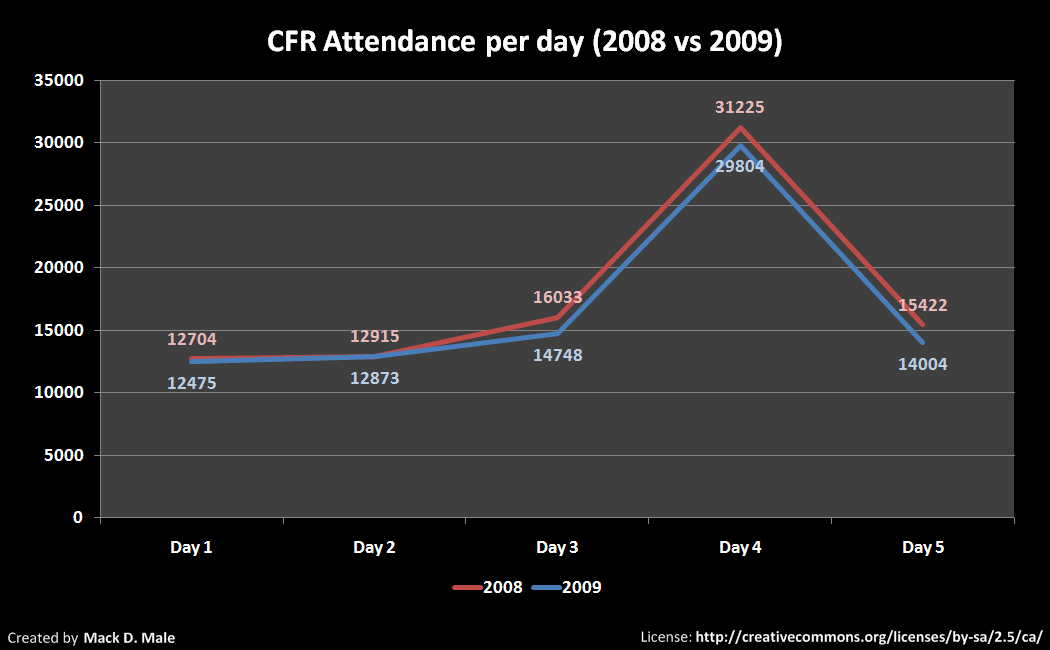
And now, I have some data for CFR. Here are the attendance numbers for this year compared with last year:

Day 4 is the Saturday, and is always higher because there are both matinee and evening events. Here are the attendance numbers from 2005 to 2009:

As you can see attendance peaked in 2006, the record year for CFR.

Download the 2008/2009 attendance data in CSV

Download the 2005-2009 attendance data in CSV

Christmas Bureau of Edmonton 2009 Campaign Launch

Today the Christmas Bureau of Edmonton launched its 69th campaign, challenging everyone to help provide for 65,000 less fortunate Edmontonians this year. The goal is to raise $1.6 million in the six weeks prior to December 25th. Councillor Henderson was on hand this afternoon to proclaim December 2009 as Christmas Bureau Month in the City of Edmonton. He echoed the thoughts of many in the room when he said that the Christmas Bureau is embedded into what makes Edmonton great. It’s amazing that they’ve been helping less fortunate families since 1940! Honorary Campaign Chairpersons Kevin Lowe and the Oilers Ladies also gave some remarks. I had no idea that Kevin Lowe has been involved with the Christmas Bureau for 27 years!

To help launch the campaign, the media were invited to participate in a gingerbread house making competition! I was fortunate enough to participate, representing new media along with The Unknown Studio. Here’s the “Twitter” house I came up with:

Christmas Bureau Gingerbread Competition

I had lots of fun, and was amazed at some of the houses the others created. Check out most of them in my photoset here. Thanks to the Christmas Bureau for asking me to take part.

To learn more about the Christmas Bureau, check out their website. You can donate, volunteer, or sponsor a family. You can also follow them on Twitter!

Notes for 11/15/2009

Here are my weekly notes:

Edmonton Notes for 11/14/2009

Here are my weekly Edmonton notes:

Leveraging Technical Expertise Locally – Open House on November 17

As you may have heard by now, the City of Edmonton is hosting an open house on Tuesday, November 17 (on ShareEdmonton) at City Hall to present a pilot project to interested members of the local tech community. The initiative is known as Leveraging Technical Expertise Locally (LTEL), and the open house follows on the report that was presented to Executive Committee back in August. I’ll get to some of the event details in a second, but first I want to offer some background.
I heard about the open house late on Monday afternoon, and immediately posted a tweet. You might think that the City’s IT department would be behind it, but many of them only learned about it because of my tweet! And that’s where things get interesting.

I had the opportunity this week to sit down with David Faber, one of the folks making this initiative happen. David is the Executive Director of Enterprise Strategic Management in the Deputy City Managers Office. His involvement means that this initiative is happening at a level slightly above IT, as David is (along with his team) charged with strategy, direction, accountability, and stewardship for the entire City of Edmonton, not just IT. David’s job is to bring the City’s Vision and Strategic Plan to life, and LTEL is just one of the ways in which he’s doing that.

As you might expect, David oozes passion for Edmonton. He’s been with the City of Edmonton for 12 years now, and even spent some time working in IT, so he has some experience in the field. For David, the LTEL initiative is about innovation and economic development, as well as the opportunity to simply connect with startups and other small tech firms in Edmonton. He outlined a few key goals of the initiative:

  • To bring the community together with the City, and to open the door at CoE for smaller companies.
  • To build shared learning by using the City as a sandbox and by not being afraid to fail.
  • To be supportive of the City Vision, which is to say that the LTEL pilot must be repeatable and sustainable.

I agree with Chris LaBossiere – this sounds like we’re on the right track.

I did explain to David that I was highly critical of the original report, and that I along with others in the tech community are concerned about EEDC and TEC Edmonton’s involvement. Unfortunately, David didn’t say much to alleviate my concerns when I asked how specifically those organizations would be involved, suggesting only that they would provide resources. I’m willing to wait and see how things turn out, because it certainly sounds like TEC Edmonton is less central to the pilot than was suggested in the original report.

We’ll learn more about the project at Tuesday’s event, but here’s what we know already:

  • The problem is to come up with a replacement for Edmonton Transit’s current electronic Lost and Found system.
  • Prospective participants must be incorporated companies by February 3, 2010, must have annual revenue of $2 million or less, and must be located within the City of Edmonton’s boundaries.
  • Prospective participants have until December 15, 2009 to express interest.
  • Potential solutions will be presented on January 28, 2010.
  • A selection announcement will occur on February 3, 2010 with the pilot project starting March 1, 2010.

The Lost and Found system was selected for two important reasons: it’s tangible, and already has funding attached. Representatives from IT, DCMO, ETS, and TEC Edmonton will be on hand to provide more information.

I’ll be there on Tuesday to learn more about it, and I hope you’ll consider attending as well.

State of the Calgary Twittersphere – October 2009

Welcome to the eighth State of the Calgary Twittersphere, my look at the intersection of Twitter and Calgary. You can see last month’s stats here.

The source of the data this month is the same as last, primarily Twitter Search but also from Twitter directly. If a user has his or her location set to Calgary, Airdrie, Okotoks, Cochrane, Strathmore, or matching lat/long coordinates, they are considered a Calgarian. If a tweet is “about Calgary” it contains either the word Calgary, the #yyc hashtag, or both.

For October 2009:

# of local users: 7283 (an increase of 139 from September)

To clarify, that means there were 7283 users who posted at least one tweet in October 2009 with their location set to something that makes them an Calgarian as described above. This number should be treated as a minimum – there are probably many more Calgary users without their location set or that were not captured for some other reason.

Here are the rest of the stats for October 2009:

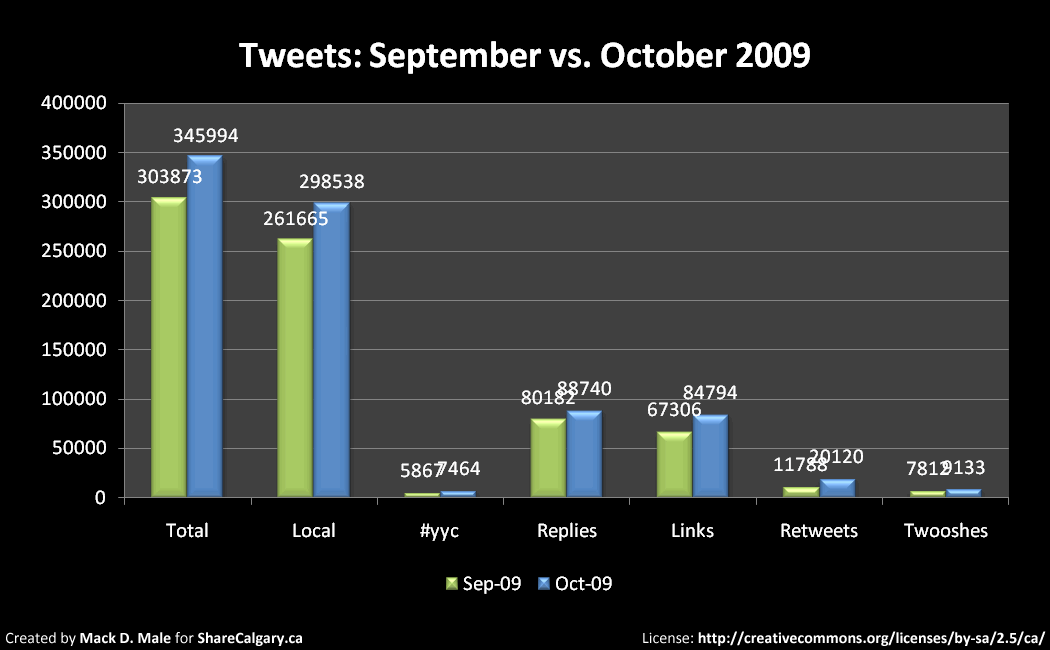
# of tweets by local users: 298538
# of tweets by local users containing #yyc or #calgary: 7464 (2.5%)
# of tweets by local users that were replies: 88740 (29.7%)
# of tweets by local users containing links: 84794 (28.4%)
# of tweets by local users that were retweets: 20120 (6.7%)
# of tweets by local users that were twooshes: 9133 (3.1%)

I’ve heard that some folks in Calgary use #yyc while others use #calgary, so I decided to do the stats for both this month. Of the 7464 total tagged tweets, just 934 of them used #calgary. Of those, just 381 did not also include #yyc.

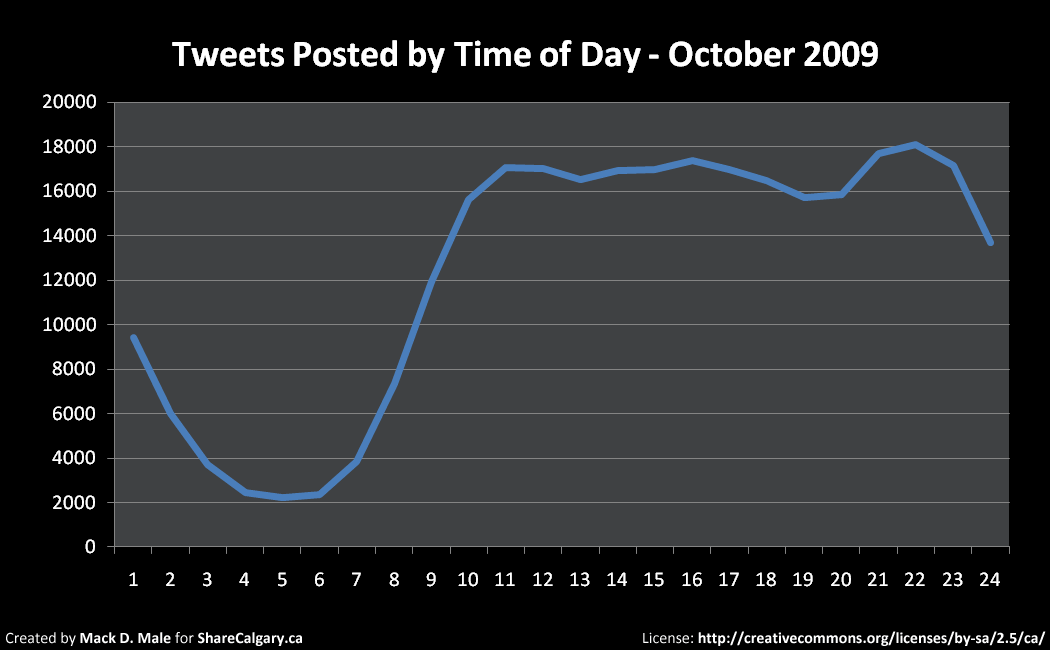
Here are the numbers above in graphic form:

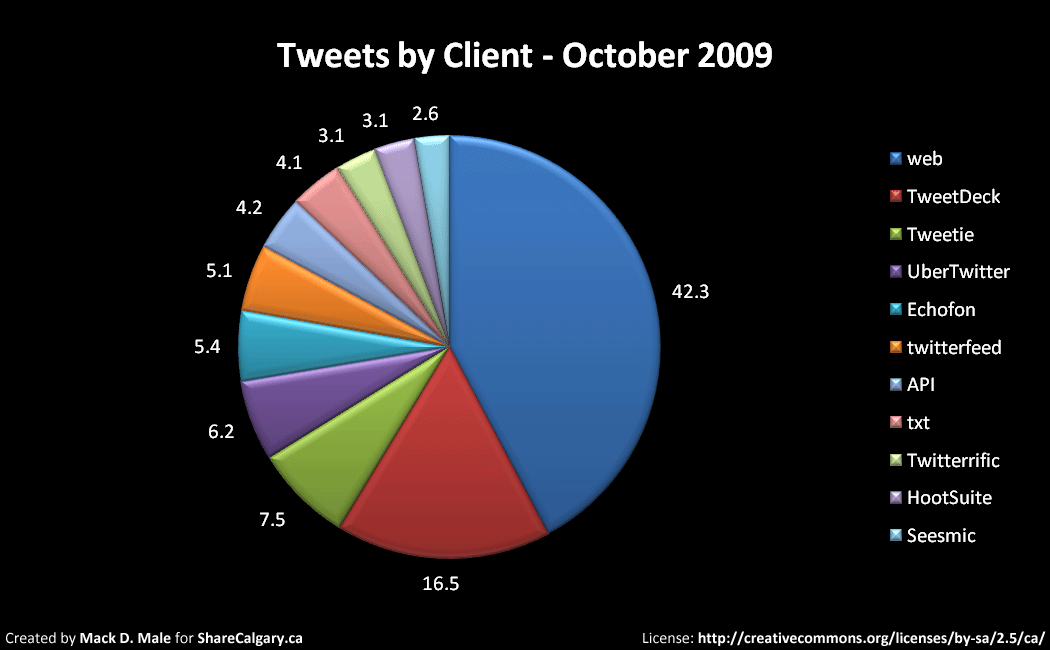
Here are the top clients used by local users for posting updates:

Some other interesting stats for the month:

Final Thoughts

User growth was less than Edmonton this month, which doesn’t happen very often! The number of tweets posted by local users is still on the rise, however. There were 5 days in October with more than 11,000 local tweets posted.

Since March, I have identified just over 16,200 local users. The number above, 7283, is how many of them were active in October.

Jasper Avenue New Vision – November 2009 Update

Back in May I attended the first open house for the Jasper Avenue New Vision project, an initiative that seeks to re-establish Jasper Avenue as the main street of Edmonton. Tonight another open house was held at Enterprise Square downtown, to provide an update on the project and a lot more detail on the plans and designs. Like last time, there were large posters, a 3D foam model, and a presentation. This time however, the presentation was much more in-depth.

Jasper Avenue New VisionJasper Avenue New Vision

Mark Reid of Urban Strategies hosted once again, and began by stressing that the New Vision project is about more than just the streetscape. It takes into consideration the adjacent streets, and is really about targeting re-investment to strengthen downtown’s economic advantage. Much of the presentation focused on the six “big moves”:

  1. Re-vision Jasper Avenue: A catalyst for downtown investment
  2. Civic and Cultural Riverfront Centre
  3. Veterans Park Intensification Area
  4. Capitol District Intensification
  5. Warehouse Community
  6. Railtown Centre

The first big move is to make Jasper Avenue the signature street in Edmonton, reflecting the vibrancy and diversity of the city. Some of the key principles the team has used include: Place Making, The Streetscape, Prioritize Transit/Pedestrian Use, Built Form, Winter City, Activate Ground Floors, Residential Focus, Sustainability, Leadership & Commitment.

The key recommendation for Jasper Avenue is related to space. Currently the street is 30m wide, 21.8m of which is devoted to paved lanes, and 8.2m of which is devoted to sidewalks (4.1m on either side). Essentially 75% of Jasper Avenue is for cars and buses – 4 thru lanes, 2 parking/transit lanes, and 1 turn lane. The plan is to reduce that to 60% – 2 thru lanes, 2 thru/transit/parking lanes, and 1 turn lane, resulting in 17.6m for paved lanes and 6.2m of sidewalk on either side. There would be no parking during rush hour, and only two lay-bys would remain (the space for buses to park on the side). Additionally, the curb lane would be wider to help facilitate transit and cyclists. Traffic volume statistics show that the roadways that run parallel to Jasper Avenue are very underutilized, so there appears to be capacity for this reconfiguration to work.

Jasper Avenue New Vision
Jasper Avenue and 106th Street, facing northwest

Another set of recommendations are related to the streetscape. I noted a few main ideas:

  • Larger trees, by increasing the amount of soil available for each tree by 5 times. In addition to playing a visual role, the trees are an important part of storm water removal.
  • A “grander” looking sidewalk, with steel-faced curbs to reduce the damage caused by winter snow removal, among other things.
  • Heated sidewalks, powered by a glycol system that would pipe waste heat from buildings through the sidewalks. The idea is that Jasper Avenue sidewalks would never need to be shoveled, sanded, or salted ever again!
  • Four scramble intersections, tentatively located at 99th Street, 100th Street, 105th Street, and 108th Street.
  • Newspaper boxes, seating, and other “clutter” would largely move to side streets, keeping Jasper Avenue clean looking. With the removal of lay-bys, you would have a mostly clear, straight sight-line down the Avenue.

There are also recommendations for the appearance of buildings along Jasper Avenue. The team has identified four main categories:

  1. 13% of the facades are heritage buildings or contribute positively.
  2. 18% require some sort of major retrofit.
  3. 32% of the facades are candidates for redevelopment.
  4. 37% require some sort of minor retrofit.

These are all part of the Urban Design Framework, a document that itself will form part of the Capital City Downtown Plan.

Jasper Avenue New Vision
Jasper Avenue & 105th Street, facing northeast

Less time was spent on the other “big moves”, I think because the presenters were running out of time! In the study area today, there are just 2.6 hectares of municipally-owned park space, which is about 3% of the total space. A key target is to increase that to 8%, which is what the Veterans Park Intensification and the Civic and Cultural Riverfront Centre moves are aimed at. Some of the key ideas include:

  • The creation of “MacDonald Central Park” in front of Hotel MacDonald (Mark cited Bryant Park in New York as an example). The park would link up to the “Riverfront Heritage Trail” behind the hotel, which in turn would connect with Veterans Park.
  • The introduction of “mews” throughout downtown – pedestrian-only streets, essentially.
  • Expanding and improving Beaver Hills House Park, as part of the proposed Warehouse Community.

Overall the ideas presented are quite exciting, and when Mark asked for a show of hands indicating support, nearly everyone raised their arm.

In total, the plans call for an increase of:

  • 8,300,793 GSF of residential space
  • 1,173,454 GSF of office space
  • 656,487 GSF of retail space

Which if implemented today, would result in a $19 million increase in tax revenues.

The big question, of course, is how much this will cost and when it’ll happen. Mark said costing information will come in the next phase (winter 2010), which also includes preliminary streetscape and engineering designs, and a finalized urban design framework. Some of the work will happen anyway, though. The trolley wires are scheduled to be removed, and Central LRT station is in need of renovations due to water leaks, work that is tentatively scheduled for 2012. Beyond that, no details were provided.

A lot of information was presented this evening, and I’m not sure I’ve done it justice here. It’s one thing to read about the recommendations, and quite another to see the detailed diagrams and other artwork. I really wish they’d update the website with more information and visuals!