Maybe next time Elections Alberta can spend $1 million on something useful

Well there’s $1 million down the drain. Voter turnout for the 2015 provincial election here in Alberta ended up being 53.7%, down from 54.4% in 2012. The flashy ad campaign that Elections Alberta ran probably had very little impact on those numbers, if it had any impact at all. I’d wager than anger against the PCs and enchantment with the NDP’s orange crush did more to impact voter turnout than #ChooseYourAlberta did.

choose your alberta

They could have spent that money on things that would have actually, measurably impacted turnout. Like more voting stations. Or better educational resources on how to vote. Or online voting. Or, as I will argue for in this post, on a better website and on open data. Let’s start with the website.

Is a functional, reliable, up-to-date website too much to ask for in 2015?

The Elections Alberta website is an unmitigated disaster. It’s garish, uses tables for layout, and is horribly unfriendly to use on a mobile device. Worse, there’s not just one website, but many. Here are some of the subdomains I’ve come across:

There are probably others that I haven’t even found yet, too. Each of those sites has a different navigation menu even though they share a similar design, which makes them very disorienting. Worse, they change seemingly on a whim. Links are removed or change, redirects are put in place, and there is no revision history.

I suppose you could argue that we don’t have elections very often so it’s not worth putting a lot of money into the website. But I’m not talking about a fancy, complicated, expensive redesign. I’m talking about a simple, responsible, and trustworthy website that is actually useful.

I think being trustworthy is especially important. Elections Alberta is the authority on elections in Alberta – I would expect to be able to go their website to find accurate, reliable information. But it’s hard to trust a site that is constantly in flux, with information appearing for a few days and then disappearing again, or links that look like they were added almost as an afterthought.

For instance, I downloaded a list of candidates in the 2015 election in Excel format a few weeks before election day, as I was building my results dashboard. It was somewhere on the WTV site. Today that page is gone, and the WTV site redirects to results. Thanks to the Wayback Machine, I can see that a completely different site used to be there, with the link to the Excel document I had downloaded. Why remove that?

It seems they have removed nearly all of the previous information and functionality now that the election is over. Searching for your candidates has been replaced with finding your MLA. Which kind of makes sense, except that you’re on the Elections Alberta site, not the Legislative Assembly website. I expect to find election-related information at Elections Alberta, thank you very much!

A small fraction of the $1 million ad campaign budget would have gone a long way toward addressing these issues with the Elections Alberta website.

It’s time to get on board the open data bandwagon

I really like building things for elections. Whether it’s a results dashboard, a where-to-vote tool, a sign management system for a campaign, or something else entirely, I enjoy it all. These projects generally need data. Sometimes you crowdsource the data (where did volunteers drop all of the signs) but often you want official data from the election authority. In the case of the provincial election, I wanted to build a site that was useful before and after the election, with a where-to-vote feature, information on all of the candidates, and a results dashboard. I needed some data from Elections Alberta to make it happen. Here’s a rough overview of what I wanted:

  • A list of all parties (ideally with contact info)
  • A list of all candidates (ideally with contact info, their electoral district, etc.)
  • A list of all electoral districts (ideally with returning officers and other info)
  • A list of all polling stations (ideally with addresses and contact info)
  • The geographical boundary data for each electoral district
  • The geographical boundary data for each polling station
  • Results data for the 2015 election
  • Historical results data

Each of those datasets would allow me to build additional features, especially when combined with my own data. All of them are fairly straightforward in my opinion, and should be things that the authority on elections would have. Once I knew which datasets I needed, I set about finding them.

My first stop was the Alberta Open Data Portal: “The portal makes data the provincial government collects on behalf of citizens publicly available in machine readable formats with an open licence.” Like the City of Edmonton’s data catalogue, the Alberta Open Data Portal should be a one-stop shop for open data. But unfortunately, it contains no election-related data. I of course submitted a dataset request, but knew it wouldn’t be actioned in time. I still haven’t heard anything back about it.

I knew at this point that I’d have to hunt each dataset down individually, likely on the Elections Alberta site. And given what I wrote above about the website, I knew that was likely to be problematic.

As mentioned I found the list of candidates in Excel format. I also managed to find the electoral district boundary information and the polling station boundaries here. I ended up scraping nearly everything else, including the list of electoral districts. Just four days before the election, after repeated requests that went unanswered, they added an Excel document of all the polling stations (which you can see here via the Wayback Machine).

I’m pretty happy with the way the results dashboard turned out, but again it was all scraped. Instead if making a results feed available, or any kind of structured data, Elections Alberta only provides a static HTML page (which of course does not validate correctly making scraping even more difficult). Now that the election is over, I see they have added the resultsnew site, which appears to provide an option to download the results in Excel. Too little, too late.

One quick note on historical data. You can get PDFs here, but that’s pretty useless for anything other than manual lookups. I couldn’t find anything else. The only reason my results dashboard is able to show results data from 2012 is that I had saved copies of the static HTML results files that year.

This situation is untenable. Scraping data, hunting around a constantly changing website, and pleading for more complete datasets is not my idea of an open and accessible government. Open data is not a new concept, and the Province already has an open data catalogue. All Elections Alberta needs to do is make their data available inside of it.

There’s plenty of time to fix this before the next election!

I know that election time is crunch time, and that the folks at Elections Alberta were probably incredibly stressed out and constantly faced an uphill battle. And I know there are smart, dedicated Albertans who work there. Keila Johnston, Director of IT and Geomatics for Elections Alberta, was particularly helpful. But now the election is over, and I’d really like to see some positive change.

It would be an incredible shame if we got to the next election here in Alberta and found ourselves in the same position: with a website that’s out-of-date and unreliable, and a lack of open data to power new tools and experiences for voters. Elections Alberta has the talent and ability to fix both of those issues, if they prioritize it. And the best part? It shouldn’t cost $1 million to do so.

City Council endorses phased approach to Edmonton Galleria project, but many questions remain

The long-discussed Galleria project received a fresh injection of life today after Council threw its support behind a phased approach that would see the $1 billion project constructed through 2020. The item was up at Executive Committee again after last year’s request by Council to find a way to lower the risk to the City.

Galleria

The Galleria project consists of the same components today as it did then: four performing arts theatres (1600 seat theatre, 650 seat theatre/concert hall, 200 seat theatre, 200 seat recital hall); the relocation of the University of Alberta’s School of Music, Department of Art & Design, and one other department; construction of an office tower; development of a covered public galleria; and commercial and retail opportunities. The difference is that now it’s not an all or nothing proposition.

Today’s decision by Council to endorse a phased approach means the project backers can seek funding from the other orders of government. It also means in theory that certain triggers must be met before the City needs to spend any money, the first of which is agreeing to a memorandum of understanding in September and giving final approval to the City’s financial contribution.

So how much would the City be on the hook for?

“The total project costs outlined in this report that would be the responsibility of the City total $58.3 million. When factoring in interest charges on the amounts that are eligible to be borrowed for, the total expected cash expenditure for the City is estimated at $75.2 million.”

It sounds like any City money would come with strings attached too: “The release of city funds would be dependent on EDAC achieving certain milestones including the securing of a tenant in commercial/residential development with income sufficient to cover the capital and operating commitments of the Foundation.” That’s a much better approach than they took with the arena. For now they’ve approved $7.5 million for the pedway between Churchill LRT Station and the Royal Alberta Museum.

As I mentioned last year, I’m fine with the land acquisitions the City would be making. That’s probably a wise investment whether the Galleria project goes ahead or not. But there are still too many questions outstanding for me to support this project.

Provincial or Federal funding

The Galleria project is only going to move forward if funding from the other orders of government can be secured, and that’s far from guaranteed.

We saw absolutely zero interest from the PCs in supporting the project, even with Irv & Dianne Kipnes as donors, so I don’t see why the NDP would be any more likely to support it. The Provincial government has stuck to its hard line against funding the downtown arena, and I’d be surprised to see them all of a sudden come to the table on the Galleria.

On the federal side, Mayor Iveson has said that Council has received “mixed signals” and that he’d be surprised if the project could secure any federal funding at all. It has not been easy to get money out of Ottawa. Council had to agree to a P3 in order to get federal funding for the LRT, for instance.

Furthermore, the reality is that the City and specifically Council is going to have to go to bat for the project if the Province or the Feds are going to pony up anything at all. And that begs the question, is this really the project you want to burn important political capital on? Is this more important than the City Charter, LRT, poverty elimination, or any of the other significant priorities Edmonton has?

Lack of support from the Arts Community

Crickets. That’s what we’ve heard from most arts organizations about the Galleria project, at least publicly. Privately many have argued against the project, but the Kipnes are powerful enemies to attract.

A purpose-built opera house would undoubtedly be a good thing for the Edmonton Opera. It’s probably the most expensive art form in the world. For example, the Jubilee is effectively dark for about 90 nights a year to stage just 3 or 4 opera performances because of the construction and rehearsal time that each one takes. That’s a lot of lost revenue when you consider that events like “The Book of Mormon” can arrive and be setup in a day and will nearly always sell out.

Without hearing from other organizations, how can we be sure the proposed four theatres would meet the need that exists in the arts community? How much of the new Galleria space would be open and available to other arts organizations? How often would it be unavailable thanks to either opera or University of Alberta use? What costs or other requirements would go along with use?

Perhaps those details are yet to be finalized and that’s why it is difficult for arts organizations to decide whether or not to support the project. But it’s not a good sign that the arts community at large has been so quiet on the project.

Breaking up the University of Alberta

With MacEwan and NorQuest consolidating their campuses downtown, I can understand that perhaps the University of Alberta feels a little left out, but breaking up its own campus doesn’t seem like a wise move. For years it was pretty clear in all U of A long range plans that a downtown campus was not in the best interests of the university or its students. The South Campus vision was the preferred approach, allowing for a more connected campus.

There has been some vague lip service paid to the fact that being connected via the LRT to all other post secondary institutions would be a beneficial thing, but as soon as the Metro Line opens we’ll already have that. No need for a new campus.

Innovation doesn’t seem to be happening by segregation. The most interesting and powerful ideas that are changing the world are coming from interdisciplinary efforts. Why separate the arts from the science and engineering part of the university?

Furthermore, what impact would a downtown arts campus for the U of A have on MacEwan’s new Centre for Arts and Culture? Does it make sense to have two arts campuses so close to one another?

More empty space left behind

Look up and you see cranes. Look around on ground level and you’ll see a bunch of empty space.

We’re coming up on four years since the EPCOR Tower opened, the first new office tower built downtown since 1990. Originally known as “Station Lands Tower A”, the building still to this day has empty, unused space (such as the entire 16th floor where the recent downtown event was held). The other buildings that were slated to be part of the Station Lands development have never materialized.

The old EPCOR tower, rebranded First & Jasper, still has plenty of empty space, such as most of the ground level commercial. Even Edmonton’s premier downtown street, 104 Street, is home to its share of vacancies. The old Carbon space near 102 Avenue remains empty as does the old Sobey’s on the corner of Jasper Avenue, one of the most visible – and in theory attractive – locations in all of Edmonton.

All of this space is empty today, before development has really gotten underway. What will happen when the City of Edmonton offices consolidate into the new tower? Scotia Place, HSBC, Century Place, and other buildings are going to have a lot of vacancies. What about when Stantec consolidates into its new tower? All of its existing offices will need new tenants. What happens to City Centre when the new hotel and theatre open in the arena district? It’s already struggling to keep retailers.

In fact, a Cushman and Wakefield report suggests that by the end of 2017, Edmonton’s office vacancy rate could reach 17%, the highest in the country.

I’m all for getting rid of additional parking lots, but where’s the demand for yet another office tower? Especially one that needs to generate revenue to help fund the project.

Competition with the Edmonton Arena District

So far the Katz Group has been publicly supportive of the Galleria but I have no doubt that would change if their significant real estate investments came under threat. There’s simply too much money at stake.

The arena deal is done and for better or worse the Downtown CRL depends on it. So as taxpayers, we need that project to be successful. Does it really make sense to build a competitive project right next door? Another office tower to fill, with additional retail spaces that need to attract patrons? Proponents of the Galleria would argue that the project will drive significant additional traffic to the area but I find their estimates unrealistic and I’ve not see any new data that would change my mind.

Plus we’d have yet another big, open public space to program or have sit empty. Is there really a need for Churchill Square, the EAD square, and a public galleria?

A holistic decision needs to be made

I completely understand that when someone comes forward with $50 million as the philanthropists behind the Galleria project have, there’s a desire on the part of Council to leverage that money. Acquiring funding for projects is hard and having private money brought to the table is a huge help and doesn’t happen every day. But just because you come to the table with money doesn’t mean that your project should go ahead.

Galleria

Council needs to decide not only if the Galleria itself is a good project, but whether it is going to bring a positive, net benefit to downtown and to Edmonton as a whole. Does Edmonton need the Galleria right now? Will it have a positive impact, without negatively impacting the other major projects we have underway?

With so many big questions still unanswered, I remain unconvinced that Edmonton should support the Galleria project.

Recap: 2014 Yeggies

On Saturday night at La Cité francophone the 2014 Edmonton New Media Awards, better known as the Yeggies, were handed out. This was our third annual event and with over 300 nominations across 16 categories, there was a lot of really excellent work to highlight! About 200 Edmontonians filled the room to help celebrate some of our city’s best online content creators.

If you’re reading this blog I’d say it’s a safe bet that you know what the Yeggies are about, but just in case:

“The Edmonton New Media Awards, or the Yeggies, is an annual awards show created to recognize and celebrate outstanding social media content creators in the capital region. It’s an awards show to highlight some of the amazing talent we have here in Edmonton — from people who code websites themselves, to those who write, speak, draw, all on their own time. Yeggies recipients inspire, evoke, inform, educate and entertain us, and they do it because they have a passion for it.”

As you may have heard, Edmonton has a vibrant and strong social media community. The Yeggies are an opportunity to highlight the work being done and to say thanks for providing interesting content for us to enjoy. Not to mention it’s a fun evening of networking, catching up with friends, and putting faces to the Twitter names!

Untitled

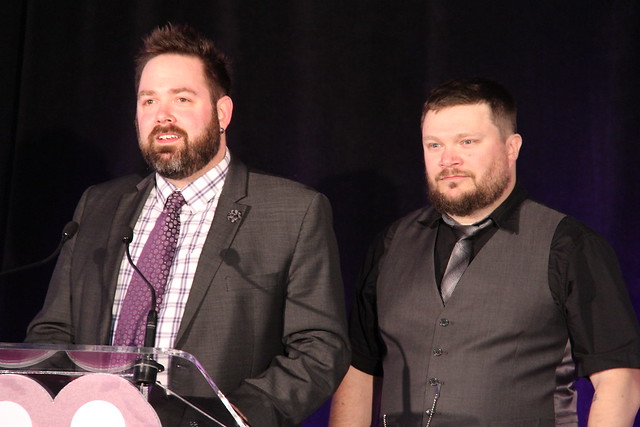
Adam and Trent were our emcees for the evening and I thought they did a great job. You might say they crossed the line once or twice, but I thought they were hilarious and kept the show running at a great pace! We went with a Back to the Future theme this year, given that 2015 is a very special year in the trilogy. Sadly no one dressed up in Doc Brown’s white radiation suit or Marty McFly’s orange vest, but as has become custom at the Yeggies, most people embraced the “cocktail comfy” dress code. It was a good looking crowd!

We had a very funny standup performance by local comedian Liam Creswick to start the second half of the show. DJ Polyesterday provided the perfect ambiance to the evening. There was food from Cafe Bicyclette, and the bar featured a special “#iheartyeg” cocktail.

Untitled

From the full list of nominees, 90 were shortlisted. Our panel of judges then had the difficult task of choosing the winners, based on the quality of their work, their impact on Edmonton, and their ability to build community, among other factors.

Here are the winners for 2014, in order of awarding:

It was great to see so many of the winners in attendance this year. Congratulations to all of the nominees and winners!

I thought Phil Wilson, aka Baconhound, had two great speeches. He acknowledged the loss of BT Edmonton, noting that many people in the room had probably been given a leg up thanks to that show and the great people behind it. And in accepting his award for Best Twitter Persona, Phil recognized the huge impact that Marty Chan has had on Twitter over the last few months, especially during the hashtag election.

Untitled

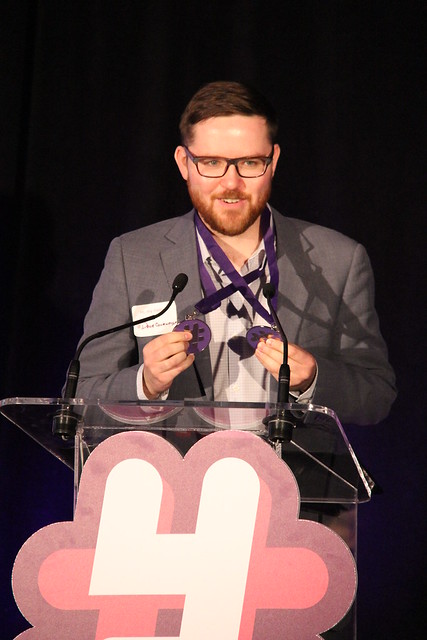
We’ve often joked about having a special lifetime achievement award, but this year it actually made sense to hand one out. Dave Cournoyer has been blogging for more than ten years now at Daveberta.ca, an incredible milestone, and without question he has had a huge impact on Edmonton and Alberta. He’s the go-to source for political news and analysis and for good reason. Dave talked about how he almost gave up on blogging until the Ed Stelmach domain name debacle launched him into the spotlight. I’m glad he kept it up!

Untitled

I want to thank the volunteers who helped us out during the show, including Carol, Julie, Lindsey, and Sharon. We couldn’t have done it without you! Thank you also to our sponsors for helping to make the evening a success: TELUS, EEDC, Kiwi Productions, Northlands, EIA, Copy City, All About Flowers, Oodle Noodle, Focus Communications, and ACME Meat Market.

Untitled

You can see the full set of photos from the evening here. Thank you Nanc Price for the incredible photos!

Follow us on Twitter and Instagram to find out when nominations for the 2015 Yeggies open and for details about the 2016 event!

A colorful window into downtown Edmonton’s transformation

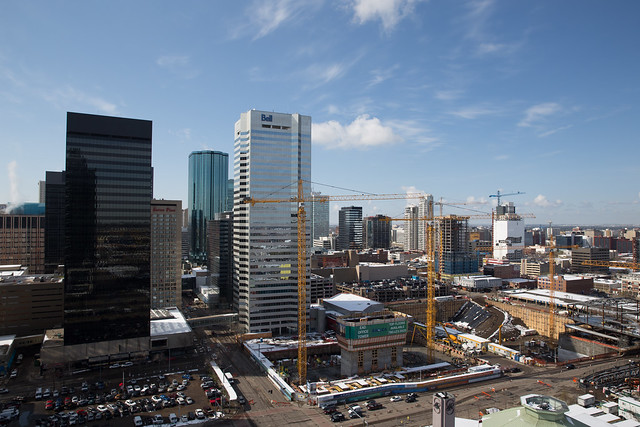
Edmonton’s downtown is undergoing an incredible transformation right now. You can tell by looking up at the more than two dozen cranes located in and around downtown. You can tell by the dust and other construction debris that gets blown around by the wind. You can tell by the closed sidewalks and the detours that drivers face. And of course, you can tell by the energy and excitement that seems to be in the air whenever someone talks about what is happening downtown. This is no mere revitalization. To use the City of Edmonton’s words, it’s an “incredible renaissance coming to life” in the heart of our city.

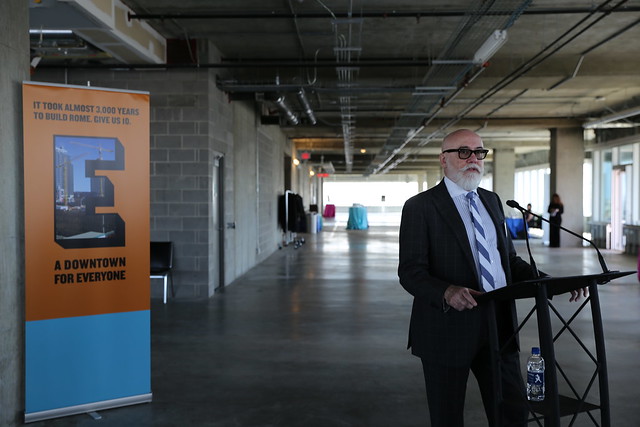
This growth and momentum was the focus of a showcase that took place today on the empty and unfinished 16th floor of the EPCOR Tower. I’m not sure the organizers appreciated the irony of talking about new buildings and more development while we were standing in the middle of the last new office tower built downtown, one which remains only partially full. I know they wanted the view, but still.

A Downtown for Everyone

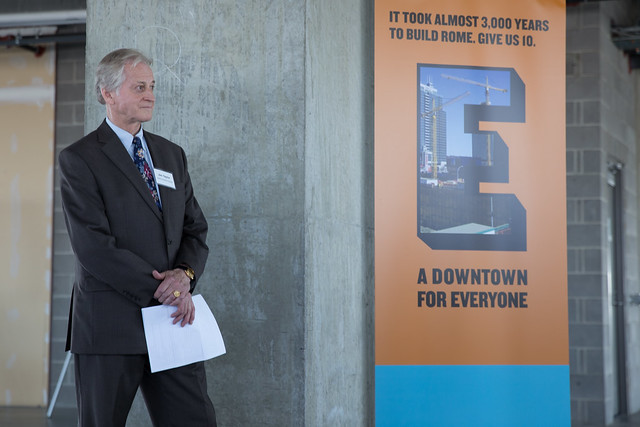
The statistics that Jim Taylor, Executive Director of the Downtown Business Association, and Scott McKeen, City Councillor for Ward 6, shared with us are impressive:

  • In just two years, the amount of underdeveloped land decreased by 17%.
  • Over 1 million square feet of land in the core comprises active construction sites. That’s the equivalent of about 62 NHL-sized hockey arenas.
  • There is 6.6 million square feet of floor area under construction, which is bigger than West Edmonton Mall.
  • Over 1,100 resident units are under construction and another 3,300 have been announced by developers.

“The new downtown vibrancy and momentum is unmistakable,” said Jim Taylor. “There’s about $5 billion in new condos, office towers, hotels, and infrastructure under construction or planned for our downtown.”

A Downtown for Everyone

Projects under active construction include Rogers Place, the new Royal Alberta Museum, MacEwan Centre for Arts & Culture, NorQuest College Singhmar Centre, Kelly Ramsey, Fox Towers, The Ultima, 107 Street Annex, Hyatt Place in The Quarters, and of course all the buildings in the Edmonton Arena District, like the new Stantec tower. These projects are for residential, commercial, post-secondary, and other uses. It’s great to see such a varied mix.

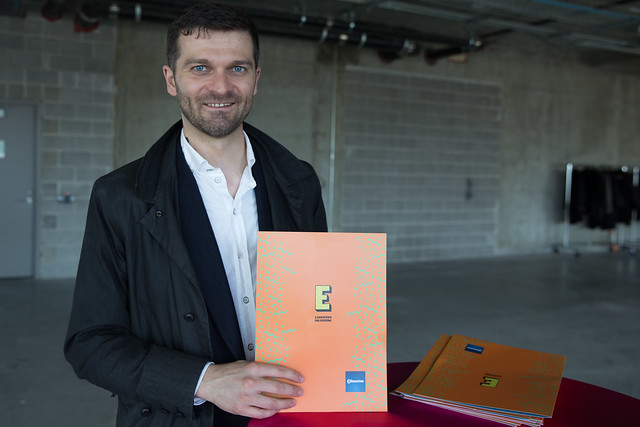
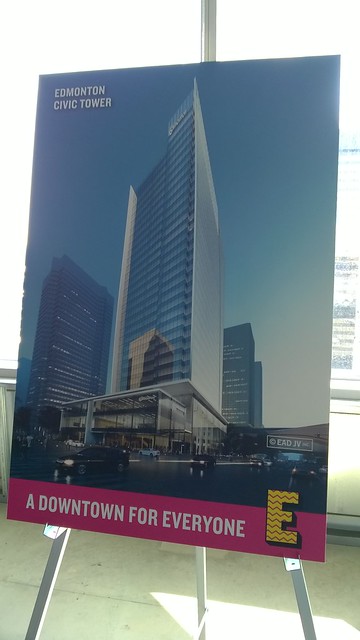
The highlight of today’s event was the new visual icon that is meant to tie the various projects together. It’s a window in the shape of an “E” and it comes with lots and lots of color.

A Downtown for Everyone

I’ll admit my first reaction to the design when I saw it a few weeks ago was negative. I still don’t get the “E”. It doesn’t say anything about downtown nor does it say anything about construction. I guess you can take it to mean that all of these projects are building a bigger and better Edmonton, but that feels like a bit of a stretch. The City seems indicate that the “E” is for everyone:

“Together, as a community, we are building a downtown for everyone, one that is economically strong, vibrant, global and inclusive. The visual style is bold, optimistic and confident. Everything our downtown, and Edmonton, truly embodies.”

That seems at odds with the approach Make Something Edmonton has taken. Instead of pretending that Edmonton is for everyone, MSE posits that it’s not, but that if you’re a maker, this is your city. Can downtown really be for everyone? I will say the design is growing on me though.

A Downtown for Everyone

Berlin did the work and I had the opportunity to talk to Michael Brechtel about it. He’s a partner and is in charge of creative for the firm. He was quick to point out what the design is not. “It’s not intended to be a new brand for downtown,” he said. “It’s meant to reflect this specific time and this specific place.” He talked about the excitement that people are feeling about downtown and said his team is no different. “We’re excited and we feel a sense of ownership over downtown”, he said, pointing out that most of his colleagues live somewhere in the core and many walk to work.

There are three aspects of the design that I really like. I love the fact that it’s a window. You’ll see that reflected in print and online, and hopefully also around the construction sites, with literal windows into what’s going on behind the hoarding. If I had to pick my favorite construction hoarding from around Edmonton, it would be the new Royal Alberta Museum, partially because of the window (but also the fact that its colorful, well-lit, etc). A window into what’s coming is a pretty straightforward visual metaphor and it works.

Another thing I like about the design is that it’s colorful and bright, something that construction generally is not. “This should feel celebratory,” Michael told me. I’ve written about the short-term pain that comes with construction, but Michael is right – there’s a lot to celebrate. He noted that color helps to provide that feeling but is also accessible and inviting.

The third thing I like is that there’s at least an attempt to tie the various projects together. Obviously it wouldn’t make sense for the Oilers to get rid of their own branding, or for the Kelly Ramsey tower to ditch its excellent signage. But adding the “E” could help to better convey the message that there’s something bigger underway here. “We wanted a fun, common visual connector to raise interest and show our support for downtown,” said Councillor McKeen.

A Downtown for Everyone

Of course, that only works if it is widely adopted. There were a couple of dozen representatives from the downtown projects in attendance today, so that’s a good sign. I spoke with Tim Shipton from the Edmonton Oilers and he assured me they are on board and are looking forward to integrating the “E” into their site along 104 Avenue. I hope others are planning to do the same.

It will be interesting to see what the City itself does with the “E” as well. So far they have run with the idea on the new downtown section of the website. They’ve added taglines like “put yourself in the picture”, “excitement worth waiting for”, and “who says cranes are an endangered species”. They communicate about what’s happening downtown more than anyone else, so including the “E” will be critical if it’s going to see any traction.

I would argue they need to do more than just marketing, however. The challenge is not selling Edmontonians on the projects, which I think more or less speak for themselves. The real issue is in keeping downtown functional and open while the construction is happening. The new Current Traffic Disruptions map is a good step in the right direction, but there’s so much more that could be done. Without question all the business and community partners have a role to play, but the City is in the best position to provide leadership here.

A Downtown for Everyone

Today’s gathering reminded me a little of last year’s Edmonton in a New Light event. The focus was a little broader that time, but the message was the same. “Something big is happening,” and we need to tie it all together to help share the story. With luck, the colorful “E” window will help to do just that.

Alberta goes orange with NDP majority and an Edmonton sweep

Tonight with more than 1.4 million votes cast, Alberta elected an NDP government making Rachel Notley our 17th premier. And to the surprise of many, the polls turned out to be pretty accurate this time. After 44 years in power, the longest unbroken run in government at the provincial or federal level in Canadian history, the PC’s reign has come to an end. They won’t even be the official opposition – although they earned more votes than the Wildrose, they won 11 fewer seats.

2N0A4028
Photo by Don Voaklander

The data in this post comes from my results dashboard. All results are unofficial until May 15 when Elections Alberta is expected to announce the final results. And it could very well change, as we have a tie currently in Calgary-Glenmore between the NDP’s Anam Kazim and the PC’s Linda Johnson.

Here’s what the seat breakdown looks like:

abvote2015 seats

The NDP won with 54, Wildrose came second with 21, and the PCs finished third with 10. And here’s what the popular vote looked like:

abvote2015 votes

We’ll have to wait to see what the final numbers are like, but voter turnout is not going to be much different than it was in 2012 at 54%. My guess is it will in the range of 53-57% when the final results are published.

The NDP won support from across the province, picking up 14 seats in Calgary, 19 in Edmonton, and 20 from other parts of Alberta. Here in Edmonton, they won every seat by no fewer than 4400 votes:

edmonton orange

That means some high profile PC members are out, including former mayor Stephen Mandel, current Minister of Human Services Heather Klimchuk, current Speaker Gene Zwozdesky, former deputy preimier Thomas Lukaszuk. Other promising individuals like businessman Chris LaBossiere never made it in. It also means that Liberal Laurie Blakeman is out, our province’s longest serving opposition MLA.

Also interesting is that the number of female MLAs has gone from less than 20 to 27. A step in the right direction.

It’s no surprise that Jim Prentice announced he would step down as leader of the PC party, but it was a shock to hear that he would resign the seat he won in Calgary-Foothills and would leave public life altogether. I can appreciate that being the public eye takes a toll, but his announcement felt incredibly selfish after all his talk of joining politics again because Alberta needed him.

This was a positive election for the Alberta Party. Not only did they roughly double their vote count from 2012, they elected their first MLA in leader Greg Clark who won in Calgary-Elbow.

Albertans have spoken and the winds of change have swept through the province. Rachel Notley and the NDP ran a solid campaign and they now have a clear mandate to govern. Congratulations to all and much respect for everyone who put their name forward as a candidate in this election.

Election Day: Where to Vote and Watch Results

Today is Election Day here in Alberta! It doesn’t take long to vote, so make sure you head down to your polling station today if you haven’t already voted in one of the advance polls. Here’s an overview of how to vote.

Where to Vote

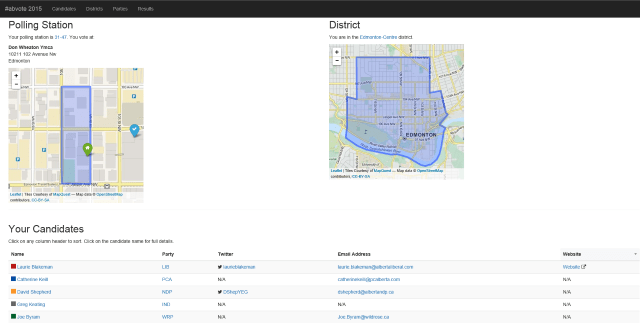
If you need to know where to vote, you can use the tool I built here. It lets you search by address or if you’re on a mobile device in particular, just click “Locate Me” and it’ll figure out where you are. For the most accurate results, simply enter your postal code. Here’s what you’ll see:

where to vote

Once the search completes, it’ll show you the district you’re in, the candidates you can vote for, and your specific polling station (with pins for your location and for the polling station).

I had built this a week or two ago, but yesterday realized that Elections Alberta has improved their own search tool. Nice to see them making some enhancements. The main difference is that my tool has more information about candidates (such as social media links) and also has integrated results information.

Election Results Dashboard

The polls are open today from 9am until 8pm, after which we’ll see results trickle in from around the province. You can watch the results using the dashboard here. It should work well on your desktop, laptop, tablet, or phone!

where to vote

The dashboard shows some overview information, including the number of polls reporting and the estimated voter turnout, and a chart of votes by party. It has six other key features:

  • Party Overview – districts leading/won, total votes, vote % by party
  • Leader Races – votes for each party leader and whether or not they’re winning
  • Closest Races – districts that have the fewest number of votes separating first and second
  • Regional Races – districts leading/won by party by region
  • Most Supported – candidates who have received the most votes
  • Districts – leader, margin, polls, votes, and turnout by district

Most importantly, it’ll update automatically as soon as results come in from Elections Alberta. You don’t need to refresh the page or do anything else – just leave it open and watch the data appear!

I hope you find it useful. I’ve done quite a bit of testing with it, but do let me know if you run into any issues.

Happy Election Day!

Edmonton is ground zero in the PC campaign of fear

What an interesting week in the Alberta Election, especially here in Edmonton. It started with Mayor Don Iveson’s confident State of the City address, in which he declared that “Edmonton is too important to Alberta’s future to be ignored.” He said he’s confident that Edmontonians “will not stand for any provincial government ever forgetting about Edmonton again.” The mayor contrasted a strong, vibrant Edmonton with an uncertain, shaky Alberta, and said that Edmonton could play a significant role in a provincial turnaround. Edmonton is not just the capital.

With every passing day the NDP have looked stronger and stronger. The polls, whether you trust them or not, have consistently had the NDP either in the lead or close to it, with today’s predicting a minimum victory of 25 seats. Everywhere you look there are signs of the “orange crush” sweeping across the province, but especially here in Edmonton where NDP support is strongest. The prospect of an NDP win has become so realistic in fact, that the PCs have had to take the unusual position of fighting back. And it’s here in Edmonton that they have focused their efforts.

Last week Edmonton-Rutherford PC candidate Chris Labossiere wrote a widely-criticized blog post that said the NDP “have not demonstrated any real passion or partnership with Edmonton as a dynamic and changing global city.” He wrote, “I do not trust that they share or appreciate Edmonton’s story, our energy or our ambition.”

Edmonton-Spruce Grove MP Rona Ambrose said today that an NDP government here in Alberta would be a “risky experiment.” She said that although she understands the anger being directed at the PCs, Albertans “need to think twice about electing an NDP government.”

edmonton business leaders
Photo by Dave Cournoyer

And in a press conference late this morning, five Edmonton businessmen called the NDP’s policies “amateur” and urged Albertans to make sure they’re “thinking straight” when they go to vote on Tuesday (you can read their opinion letter here). The Journal reports that together, the five have given nearly $95,000 to the PCs since 2010. There have been incredible things said every day during this election, but a couple of comments today were just on another level. Here’s what Tim Melton, executive chairman of Melcor Developments said:

“I don’t understand the unhappiness and disenchantment that appears to be out there. We don’t need amateurs running this province through these difficult times … we’ve got to stay with the government that has got us to where we are today.”

Is it really so hard to understand why Albertans are unhappy with a government that has faced scandal after scandal? With a government that has failed, again and again, to get us off the resource revenue roller coaster?

As if that wasn’t enough, NPO Zero CEO Ashif Mawji had this to say at the same news conference:

“If there’s no bottom line, then there’s no money that goes to charities. We won’t make donations to charities,” Mawji said, using the Stollery Children’s Hospital and the University of Alberta as examples of where the losses will be felt.

There’s no question that leaders like Doug Goss have done great things for Edmonton, and I’m sure they will continue to, but to threaten the charities that support Albertans when the government won’t? Disgusting.

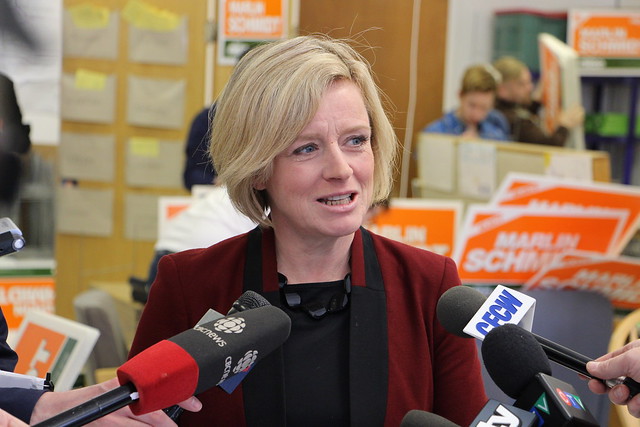
Rachel Notley
Photo by Dave Cournoyer

Here’s what NDP leader Rachel Notley said in response today:

“Frankly, if I were them, I’d be more focused on talking with Albertans about what it is they can do to make the lives of regular families better. They’ve chosen to fearmonger about the NDP instead. I guess we’ll see … which approach is more appealing and more convincing to Alberta voters.”

Indeed we will, in just a few days.

“Changing our government is not something Albertans should be afraid of,” is what Dave wrote today. “It is something we should probably do on a regular basis.”

Recap: TEC VenturePrize 2015

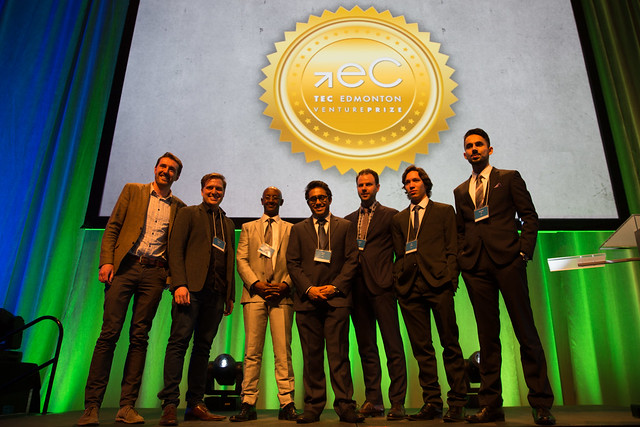
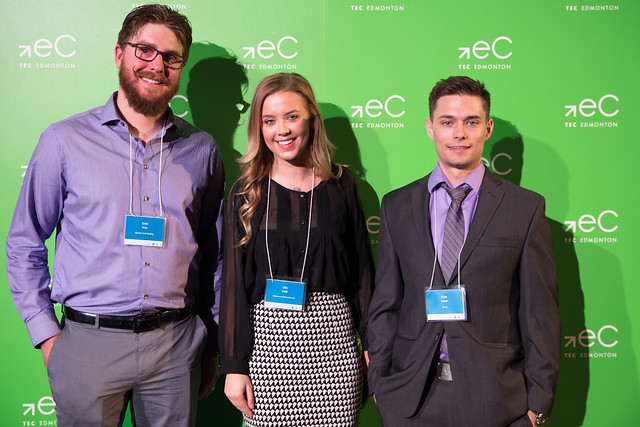
TEC Edmonton held its 13th annual VenturePrize Awards this evening at the Shaw Conference Centre. A total of $150,000 in prizes was handed out to three deserving companies. TEC Edmonton says the competition is a win for all of the participating companies, as they receive mentorship, publicity, possibly new investors, but it’s also a win for Alberta:

“Nine new technology-based companies, creating new wealth. Companies on the leading-edge of their sector, companies hiring highly educated individuals, companies using the knowledge of our post-secondary institutions and their graduates, companies paying corporate taxes, companies fulfilling Alberta’s desire to be less dependent on the energy sector alone.”

There are three different competitions that make up VenturePrize now. The Fast Growth category is for general high-growth businesses, the TELUS ICT category is for technology-focused enteprises, and the Student category is for businesses started by post-secondary students from throughout the province. In each category, there are three finalists but only one winner.

VenturePrize 2015

Here were the finalists for 2015:

Fast Growth

  • Alieo Games is an educational technology company that recently launched COW, a writing app for students and teachers from kindergarten to Gr. 12. COW provides a safe and fun space for students to practice writing (building writing fluency and vocabulary) and to share their work with classmates. For teachers, COW uses text analysis to provide useful feedback that they can use to customize their lesson plans to meet the specific needs of their students.
  • Pogo CarShare is Edmonton’s first car sharing service. Founded and managed locally, Pogo provides members 24/7 access to a pool of vehicles located within a central zone in our city on a simple pay-as-you-go basis. Cars can be located, reserved and opened using the Pogo app.
  • Sensassure is a wearable technology sensor solution for the incontinent – alerting nursing staff in extended care homes to the need to change incontinence underwear. Sensassure helps restore dignity to those who suffer from incontinence by automating existing manual care processes, leading to timely changes that prevent secondary conditions from developing.

VenturePrize 2015

TELUS ICT

  • OMx is accelerating the development of advanced molecular diagnostics with technologies to analyze and combine data about the chemicals, proteins and DNA in the body. Their first product helps improve and optimize diet and lifestyle with a urine test that measures indicators for diet and wellness.
  • MasV is a software company within the oil and gas sector, MASV has a new way to benefit both rental companies and renters of oil and gas equipment. By connecting renters to the rental companies that have the relevant items, they reduce downtime stress while increasing profit for both parties.
  • Advancing Edge Technologies addresses technology deficiencies with diagnosis reporting in anatomical pathology (providing patients with the final diagnosis from tissue biopsies and body fluids). Their state-of-the-art touchscreen-based examination software delivers a more streamlined, accurate, and consistent pathology diagnostic report while also saving money and time.

VenturePrize 2015

Student

  • Alberta Craft Malting – Olds College: Alberta Craft Malting uses Alberta barley to develop specialty made-in-Alberta malts – a crucial ingredient in the making of beer. The use of local grains means brewers can now access specialty malts made from local barley considered among the world’s best, rather than depending on out-of-province suppliers.
  • Scout – University of Alberta: Scout is a marketing platform for small and medium businesses that incorporates a smartphone based loyalty program. The Scout app replaces traditional punch cards and allows merchants to create a loyalty program tailored specifically to them, allowing them to truly interact with their customers.
  • NoLemon Automotive Inc. – University of Alberta: By offering an online classified platform providing third-party vehicle inspections, NoLemon helps buyers and sellers more effectively navigate the vehicle transaction process. NoLemon provides the comfort and confidence individuals seek in making their vehicle purchasing decisions.

VenturePrize 2015

Some of these companies were familiar to me and it’s great to see them continuing to grow and evolve. Alieo Games was of course the winner of last year’s student category and they presented at Launch Party 5 back in October along with fellow Fast Growth competitor Pogo CarShare and MASV and OMx from the TELUS ICT category (and OMx was at DemoCamp earlier this month) And in the Student category, I have seen Scout at a previous VMS event and around town at various retail locations such as Earth’s General Store and Remedy Cafe. It’s an encouraging sign that companies are moving through the pipeline, from hackathon to business plan and beyond.

VenturePrize 2015

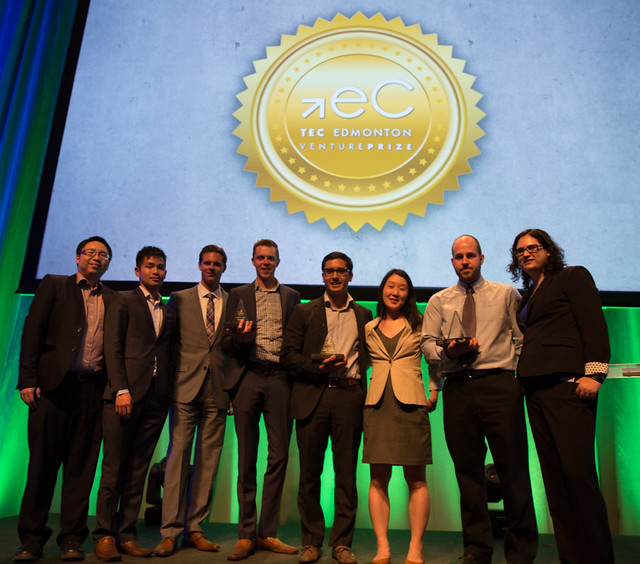
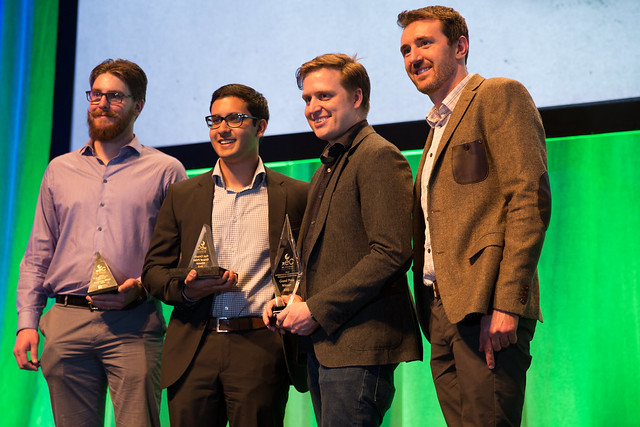
Here are your 2015 winners:

Screeners Award of Merit
Physio4D

Edmonton Journal People’s Choice Award
Alieo Games

Student VenturePrize Competition
Alberta Craft Malting

TELUS ICT Competition
OMx

Fast Growth Competition
Sensassure

Congratulations!

Our host for the evening was Ryan Jespersen and while he always brings an energetic approach to his emcee duties, I think he deserves a special shoutout tonight for dealing with a challenging room.

VenturePrize 2015

This year TEC Edmonton wanted to change the format to see if they could encourage more networking. That meant using more of Hall D and getting rid of the round tables in favor of cocktail tables and theatre-style seating. The program started on the west stage and then moved to the east stage. In terms of networking, it was a big success! But I suspect the format will be changed for next year as no one was paying attention to the speakers and presentations for the first half of the show.

There were a couple of other awards handed out this evening too. The inaugural Ross & Verna Tate Science Entrepreneurship Award was awarded to Alieo Games. The other award was the Peace Country Regional Science Fair Award, which went to Michael Fyfe from Glenmary School in Peace River. Science fairs sound like they’re becoming more interesting – the PCRSF now includes an entrepreneurial event called Bear Cave (inspired by Dragons Den). Michael was the 2015 Bear Cave Grand Prize winner.

Congratulations to all of the participants in this year’s competition and especially to this year’s winners. Thanks to TEC Edmonton for providing me with a seat tonight to capture the action. You can see a few more photos here.

Recap: Mayor Iveson’s 2015 State of the City Address

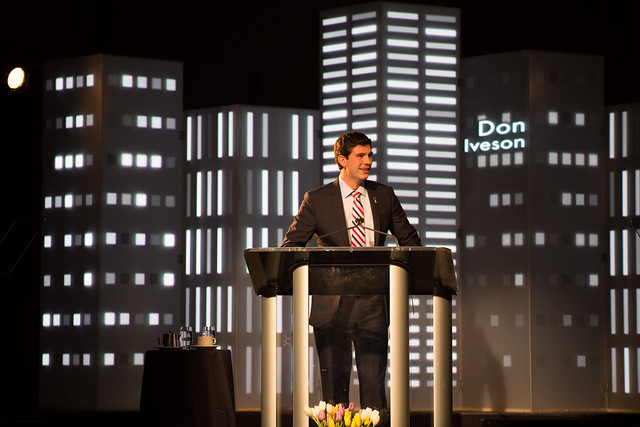
Nobody fills a room like our mayor, Don Iveson. He delivered his second State of the City Address on Monday in front of an absolutely packed house at the Shaw Conference Centre. Roughly 2,200 people attended the annual event hosted by the Edmonton Chamber of Commerce. We’re in the middle of a provincial election of course, so there were plenty of candidates in attendance yesterday and more than a few people wondering what, if anything, Mayor Iveson might say. On the topic of the provincial government, he did not tread lightly.

State of the City Address 2015

“Edmonton is too important to Alberta’s future to be ignored,” he said near the end of his remarks. “That’s why I’m confident that no matter what Albertans decide on May 5, together, you along with our City Council, will not stand for any provincial government ever forgetting about Edmonton again.”

Mayor Iveson spoke for nearly 30 minutes before getting to that point. He spelled out why Edmonton matters, he talked about the opportunities that are before us, and he consistently pointed out that we could do more if only the Province would come to the table as a partner. “I want to be clear about what partnership means to me,” he said. “It means that both parties recognize their mutual interest in achieving something great together.”

Saying that there have been “some important steps” in the city charter talks thus far, Mayor Iveson made it clear that he expects the new government to continue that work. “To abandon or shortchange the charter would be to miss the chance for Edmonton to be a true partner in building this province,” he said. On homelessness, social services, early childhood education, climate change, and infrastructure, Mayor Iveson said that “Edmonton has shown we do deliver results” and challenged the Province to “give us the responsibility and resources necessary to get to the finish line.”

If there was a theme to the mayor’s remarks, it was resiliency. He opened with a compelling story about the great flood of 1915 that left an estimated 2,000 people homeless and which devastated businesses and entire industries. “Other places in similar circumstances might have let all their hope and promise be swept away,” he said. “But not Edmonton.” His message was clear. Just as our 1915 counterparts made smart decisions for the long-term, so must we.

Though the price of oil is down and there are layoffs in Alberta, Edmonton’s economic picture is much rosier he told us. “Edmonton is weathering this downturn,” he said. Citing the “unprecedented” number of cranes in the downtown, Mayor Iveson talked about the continuing confidence here in Edmonton. Last year Edmonton became the fifth largest region in Canada, “a quiet but important milestone.”

If you’re here in Edmonton, you know these things. But others around the country and around the world do not. “It’s never been more important for us to tell a clear and consistent story about Edmonton,” he said. Yes, he mentioned Make Something Edmonton, but I think Mayor Iveson really intended for his remarks on storytelling to be one of those smart decisions for the long-term. He suggested we start talking about “Edmonton Metro” which at 1.3 million people, “will be a force to be reckoned with.” This is an evolution of the “Edmonton Region” term he started using as soon as he was sworn in as mayor. Unlike “region”, the term “metro” is distinctly urban, is cohesive, and highlights the confidence of Edmonton at its core.

State of the City Address 2015

We need more than a great story for Edmonton to continue to prosper, however. “Mass transit has the potential to transform a city in a way that few other infrastructure investments can,” Mayor Iveson said. He highlighted the federal government’s new transit building fund and said it could be great for Edmonton, “but only if our Province steps up and matches this ongoing commitment.”

He also talked about the task force to end poverty and the importance of sharing Edmonton’s prosperity with all Edmontonians. While work is well underway here, the mayor called out the Province for not taking action since unveiling the Social Policy Framework back in 2013. He talked about the Year of Reconciliation and said “we can show the way for a new vision of Canadian city that lives and breathes the treaty spirit.” He spoke about climate change and said our cities “are not prepared to deal with it.” And he said that “Edmonton can play a role in changing a conversation that has, for too long, hurt the way the world sees us.”

Mayor Iveson also had some interesting things to say about cities. “We’re the agents of change in Canada and, today, we matter more than ever,” he said. “Cities are increasingly the places where the work is getting done.” He talked about how cities “are the crossroads where resources and creativity intersect” and said nowhere is that more true than right here in Edmonton.

His core messages of resiliency and working with the Province were his focus though. “If we want to build a strong and resilient Alberta,” he said, “we need a strong and resilient Edmonton.”

State of the City Address 2015

I thought Mayor Iveson carried greater confidence through his remarks this year compared to last. The highlight of his speech last year, when he looked right at Premier Redford and called for provincial funding for the LRT, was not possible this year with the uncertain political future of Alberta so he needed to be strong throughout. He looked and sounded at ease and his delivery was much better.

It’s true that most of the things he said on Monday were similar to things he said last year. The importance of LRT, the opportunity that comes with being an Aboriginal city, the need to end poverty rather than manage it, the baby steps toward a city charter, and even the need to talk about Edmonton as the heart of the region were all things he touched on in 2014’s State of the City address. But it wasn’t the same message. I think there are two key differences. First, while last year was a bit heavy on ideas and what’s coming, this year he talked about accomplishments, like the task force to end poverty which is well underway or the Open City initiative which is already have a positive impact. Second, he focused on Edmonton’s strengths this year rather than its needs. Edmonton is resilient. Edmonton is compassionate. Edmonton gets things done.

Things are uncertain at best in Alberta right now, but Edmonton is well-positioned for now and for tomorrow. I think it was wise to take advantage of the timing, to contrast Edmonton with Alberta, and to make it clear that Edmonton can play a bigger role in helping turn things around for the whole province.

You can see a few more photos from the event here.

Recap: The Walrus Talks Aboriginal City in Edmonton

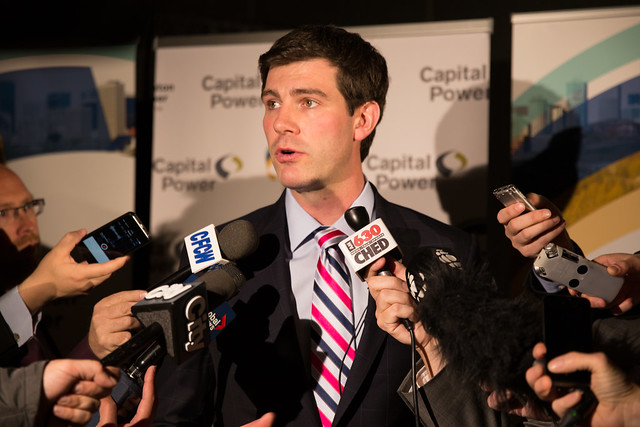
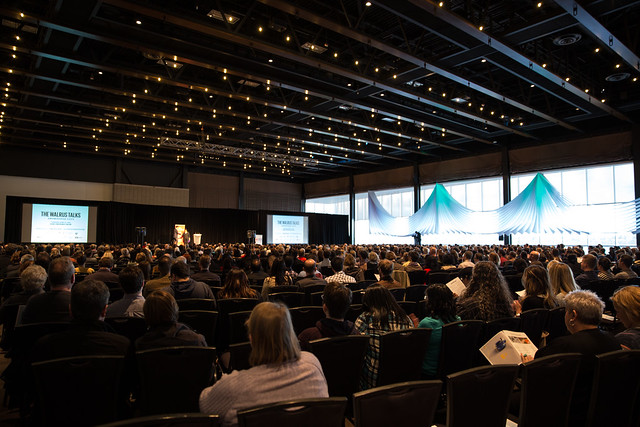
Tonight I joined close to 1,200 others at the Shaw Conference Centre for The Walrus Talks Aboriginal City, “eighty minutes of lively, thought-provoking ideas on Aboriginal life in Canadian cities – from culture, to business, to politics, and more.” I didn’t realize the event was going to be so large but I’m glad it was; some very important ideas and issues were discussed this evening. The event opened with a blessing by Elder Ida Bull, after which Confederacy of Treaty Six First Nations Grand Chief Bernice Martial and Mayor Don Iveson brought greetings.

The Walrus Talks Aboriginal City

After a brief introduction to the format from Shelley Ambrose, publisher of The Walrus, we got right into things. There were nine different speakers this evening (you can read their bios here) and each of them had seven minutes on stage. Here are some the highlights and takeaways from each presentation:

Ginger Gosnell-Myers

Ginger is the Aboriginal planner for Vancouver. She spoke about the misconceptions people have about urban Aboriginals. “Being urban just happens to be a choice about where we live.” She challenged the misconception that Aboriginal people are migratory. “The reality is the majority of Aboriginal people who move to cities end up staying for the long-term,” she said. “The city is our home.” Ginger also tackled the notion that cultural values disappear when Aboriginal people live in the city. “Every day I feel urban and cultural at the same time.”

Douglas Cardinal

Douglas is a renowned Canadian architect and is an officer of the Order of Canada. He spoke about his vision for the future of the city. “I see a thriving, organic, densely-populated metropolis that is a dynamic, living organism.” He took the analogy further and said that everyone has a responsibility to contribute to the health of the organism as we are the nutrients for the city. “We must first change our mindset from a culture of exploitation to a culture that reflects the indigenous values of sharing.”

“We can shape our environment but in turn it shapes us.”

Lewis Cardinal

Lewis is well-known to Edmontonians of course, and I had heard some of what he had to say previously. But that did not diminish my enjoyment of his message and delivery. Lewis spoke about storytelling primarily. “A city cannot truly know itself or reach its full potential until it knows and cherishes its stories,” he told us. “All stories, the good, the bad, sometimes the unbelievable.” He also cautioned that “we are not telling the stories and paying the proper homage to the spirit of this place.” He noted that even the name “Edmonton” carries a story in that “monto” means the divine essence, the power of creation, or as he clarified for Star Wars fans, the force.

Lewis earned a few chuckles when he told us that the Aboriginal population of greater Edmonton is around 100,000. “Yes, you are surrounded by Indians,” he said. “But it’s all good!” He finished with a plea for more storytelling. “I beg all of you, leave no story untold.”

Patti LaBoucane-Benson

Patti is the director of research, training, and communication at the Native Counselling Services of Alberta. She spoke about the over-representation of Aboriginal people in the Canadian justice system. “This is indeed a crisis,” she declared. Patti noted that Aboriginal people make up 43% of admissions to custody in Alberta. The root cause? She says it can be traced to the inter-generational transmission of historic trauma, a topic discussed in the graphic novel The Outside Circle.

Ryan McMahon

Ryan is an Aboriginal comedian and though he took a mostly serious approach with this presentation, he couldn’t help but make people laugh a few times. “I come from a long line of moose hunters,” he told us. “I don’t know much about cities.” In contrast with the “we’re here” message that was repeated a few times throughout the evening, Ryan called upon non-Aboriginals to speak up. “So often we are burdened with the responsibility to talk, to explain, to teach,” he said. “I can’t wait for the time when I get to sit and listen, to learn, to understand what you see.”

He said he knows what he can’t do in the city. “I can’t hang my dead moose from an oak tree, apparently it brings down property values,” he said to laughter. But he also highlighted what he can do. “I can contribute to the conversation. I can listen and I can share. And I can be patient.” He said that Aboriginal people are sometimes “patient to a fault”. He finished by highlighting the importance of the city to him. “It was in a city where I met some of the most influential people in my life.”

Roberta Jamieson

Roberta Jamieson was the first Aboriginal woman to earn a law degree in Canada and she is an officer of the Order of Canada. She shared seven key messages (I have simplified them of course):

  1. Let’s create a two row wampum city
  2. Let’s make the city a home for human beings
  3. Indigenous values offer cities a very important vision
  4. Open spaces in cities so that indigenous peoples can thrive as indigenous peoples
  5. Educate our children to be human beings before anything else
  6. Build relationships, bring together all sectors, to make a better city
  7. All of these messages come in a bundle

She talked a lot about making space for indigenous people in cities. “Make space for us in the city and the city will be richer for it.” She also highlight the fact that many cities take their names from indigenous languages. “This is not a coincidence,” she said.

“The human city, the real city, is built of relationships, not of concrete and steel.”

Clayton Kootenay

Clayton is the MOU team lead of Treaty 6, 7, and 8. He shared a number of statistics about Aboriginal people in Alberta, such as the fact that there are 48 First Nations and 148 reserves in Alberta. Most of his presentation was focused on the importance of treaties and the need for improving education. “Treaties are about relationships and responsibility,” he said. He said Alberta has two systems of education – the provincial one and the band-operated one (there are 58 band-operated schools in Alberta). He spoke about the MOU and their efforts to improve education for Aboriginal youth. “All parties have a collective stake in improving First Nations success,” he said. “Let’s not lose another generation.”

Bob Rae

Bob is the former premier of Ontario and is an officer of the Order of Canada. He spoke about the misunderstanding that is at the heart of Canada. He said it is important to understand the context in which the treaties were signed – the Crown’s perspective was “to draw a line in the sand,” he said. It wasn’t a marriage, it was a divorce – it was about saying what isn’t allowed and about what is lost. “The only way to get to a better place is by understanding from whence we have all come,” he said. For Bob, that better place is a country “that is not based on some people thinking they are better than others.”

He also talked about the fast growing urban Aboriginal population in Canada. “As a country we now face a choice: do we celebrate this and make it work and make it happen or do we continue to see it as a problem, a difficulty, an inconvenience, a nuisance?”

Jessica Bolduc

Jessica is the national youth representative for the Congress of Aboriginal Peoples. She spoke about “edgewalkers”, her term for Aboriginal youth who “have no patience for the status quo” and who have “a hunger to contribute to a better future.” She said that “indigenous issues are Canadian issues.” Jessica pulled no punches, saying “to hell with fitting our round peg in your square hole.”

She also addressed the potential of Aboriginal youth. “Aboriginal people are some of the most innovative leaders coming out of this generation,” she said. “They are the future of our cities.” She urged everyone to go find the edgewalkers in their city. “They are everywhere.”

Closing Remarks

CBC Edmonton’s Mark Connolly closed the evening with some final remarks. He was very open about how much he has learned in the last ten years or so, starting with Treaty 6. “I’m so pleased that now wherever I go, we speak of Treaty 6,” he said. Mark challenged everyone to think about how they could contribute to a broader understanding of the topics discussed during the evening. “It’s Edmonton that came forward here and I think we can make a difference.”

The Walrus Talks Aboriginal City

I really enjoyed the presentations. The Walrus promises that their Talks series “delivers fresh ideas and new ways of looking at big issues” and on that I think the event delivered. We’ve been hearing for years that Edmonton is going to have the largest urban Aboriginal population in Canada soon, but why wait until we achieve that milestone to have a productive conversation about what it means for our city?

Every speaker tonight gave me something to think about. I learned quite a few things and came away with a better understanding of some of the challenges and opportunities. The question now, as always, is what the 1,200 people that heard those presentations will do with that information! Taking Mark’s advice, I will continue to learn and to share.

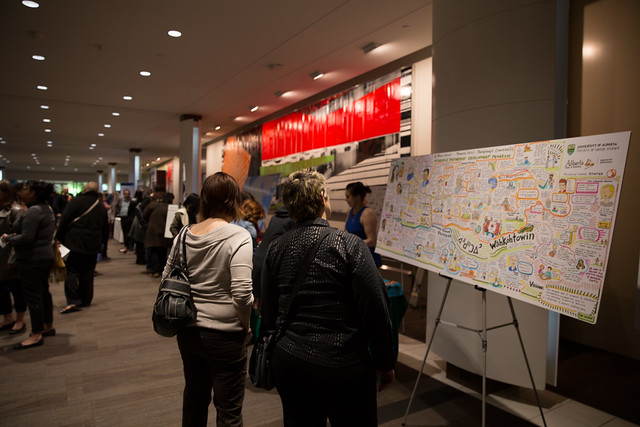
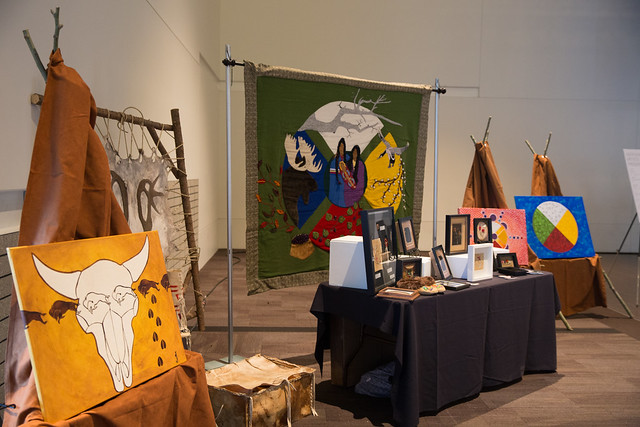
Before and after the presentations, guests were treated to an Aboriginal Art Exhibit in the Hall D lobby and around the edges of the hall itself. Produced by Dawn Marie Marchand and Dawn Saunders Dahl, the exhibit featured the work of ore than 30 Aboriginal artists from Western Canada. It was funded by the Walrus, EEDC, and the Edmonton Arts Council. You can learn about the presenting artists here.

The Walrus Talks Aboriginal City

I considered staying home tonight to watch the Leaders’ Debate but decided I’d miss more by skipping the Walrus event. I’m confident now that I made the right call. Kudos to Lisa Baroldi and her entire team at Enterprise Edmonton for putting on a fantastic event! You can see a few more photos here.