State of the Edmonton Twittersphere 2012 – Overview

Welcome to the State of the Edmonton Twittersphere for 2012, my look at the intersection of Twitter and Edmonton in 2012. You can see my previous annual recaps here: 2011, 2010, 2009.

I’ve done my best to ensure all of the data in this report is accurate, but I make no guarantees – use it at your own risk. The data comes from the Twitter API, and was collected over the course of 2012. If a user has his or her location set to Edmonton, St. Albert, Sherwood Park, Leduc, Nisku, Stony Plain, Fort Saskatchewan, Beaumont, Spruce Grove, or matching lat/long coordinates, they are considered an Edmontonian, and thus a “local user”.

Please treat the numbers in this report as a minimum. There are instances where I wasn’t able to capture all of the data, and there are certainly users here in Edmonton who do not match the above definition of a “local user”. More important than the raw numbers themselves are the trends, and that’s why in many cases I have presented rounded rather than exact figures. You can click on any graph to see a larger version.

Here are the highlights for 2012:

  • More than 105,000 local users posted at least one tweet.
  • About 17 million tweets were posted by local users, which works out to 32.3 tweets per minute (up from 11.2 million tweets and 21.4 tweets per minute last year).
  • Here’s a breakdown of those tweets:
    • Nearly 900,000 tweets were tagged #yeg or a related hashtag (5.3%, down from 6.4% last year)
    • More than 850,000 tweets were retweets (5.1%, down from 6.2% last year)
    • About 6.5 million tweets were replies (38.8%, down from 39.4% last year)
    • Just under 2.4 million tweets were replies to other local users (14.2%, down from 15.2% last year)
    • About 4 million tweets contained links (23.3%, down from 22.9% last year)
    • Nearly 5 million tweets contained hashtags (28.9%)
    • More than 400,000 tweets were twooshes (a twoosh is exactly 140 characters) (2.5%, down from 2.9% last year)
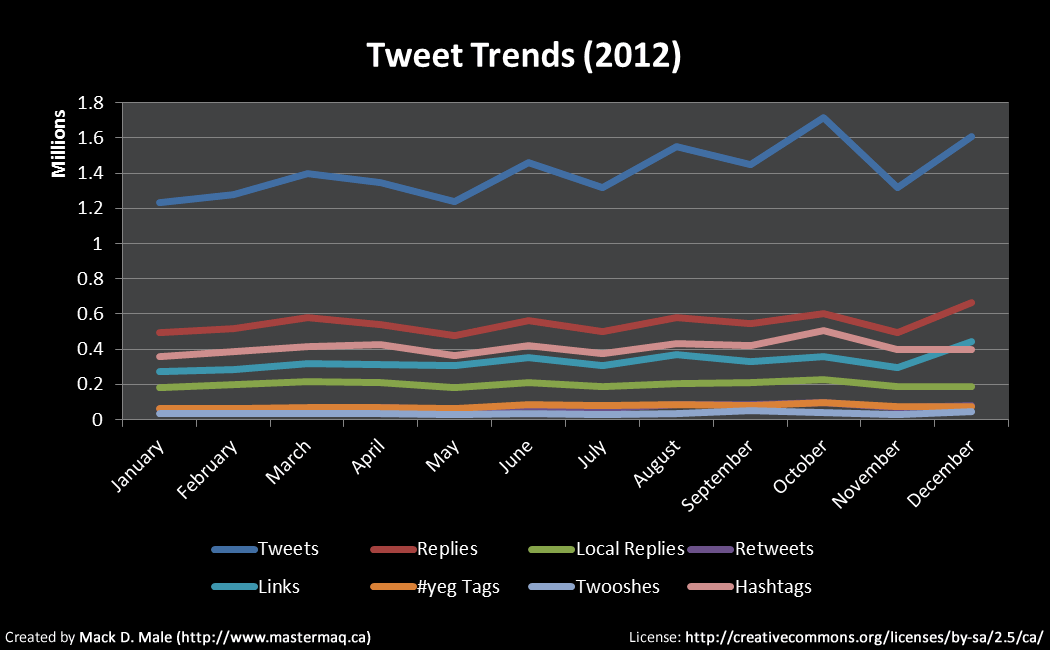
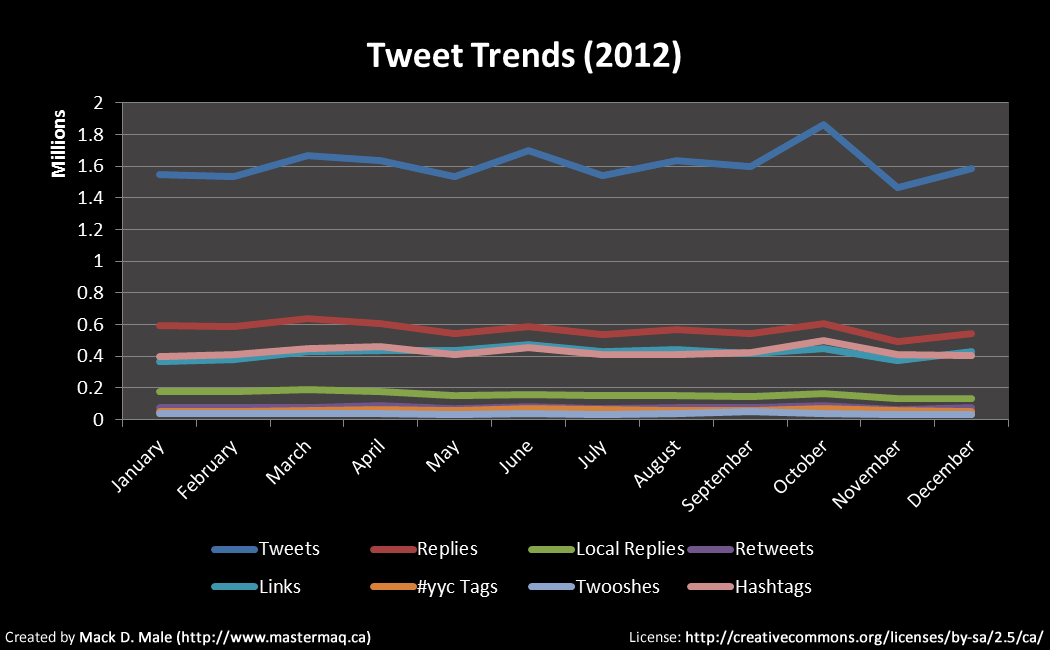
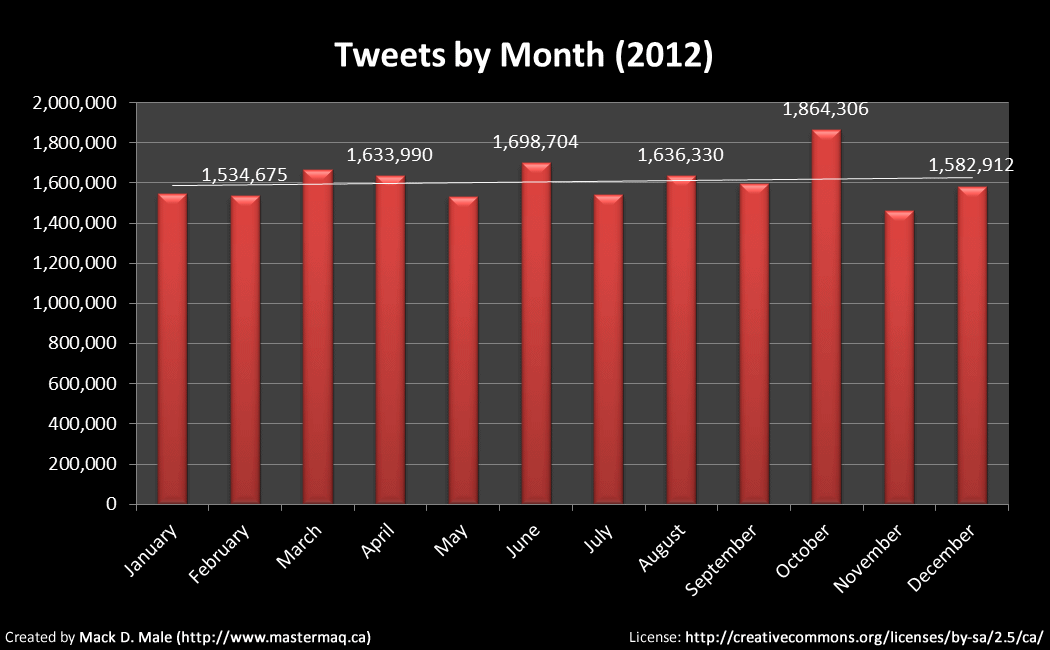
When the year started, Edmontonians were posting about 1.2 million tweets per month. While the growth over the course of the year was less dramatic than in years past, the trend was clearly up. Please note that November shows a dip but that was due to issues with my system, and does not reflect a sudden drop in activity. October was the busiest month we’ve had in terms of tweet volume, with a little over 1.7 million tweets posted.
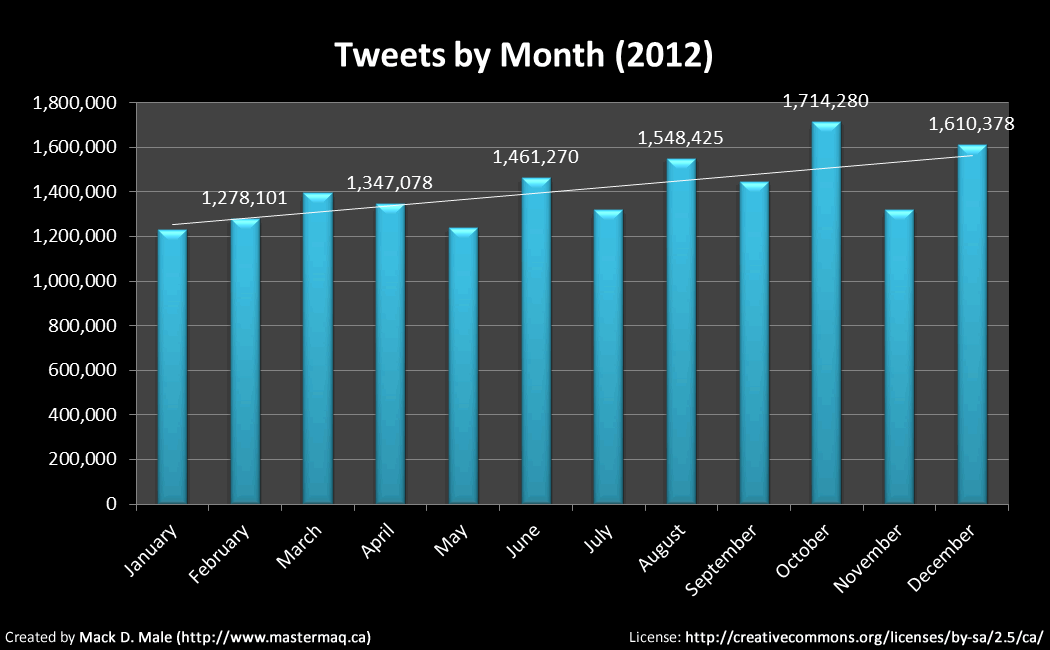
The day with the most tweets posted was November 7. A quick scan of the headlines shows that was the day of our major snowfall that caused all kinds of issues for Edmontonians, and clearly they took to Twitter to talk about it. A little over 50 tweets per minute were posted that day, and the number of local replies to one another was twice the average.

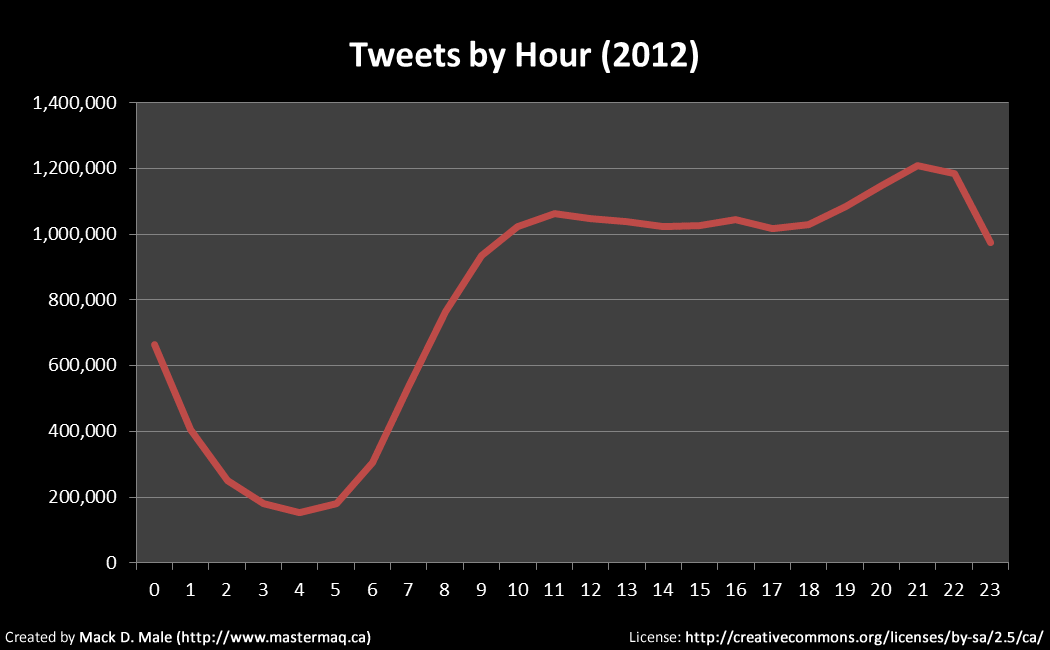
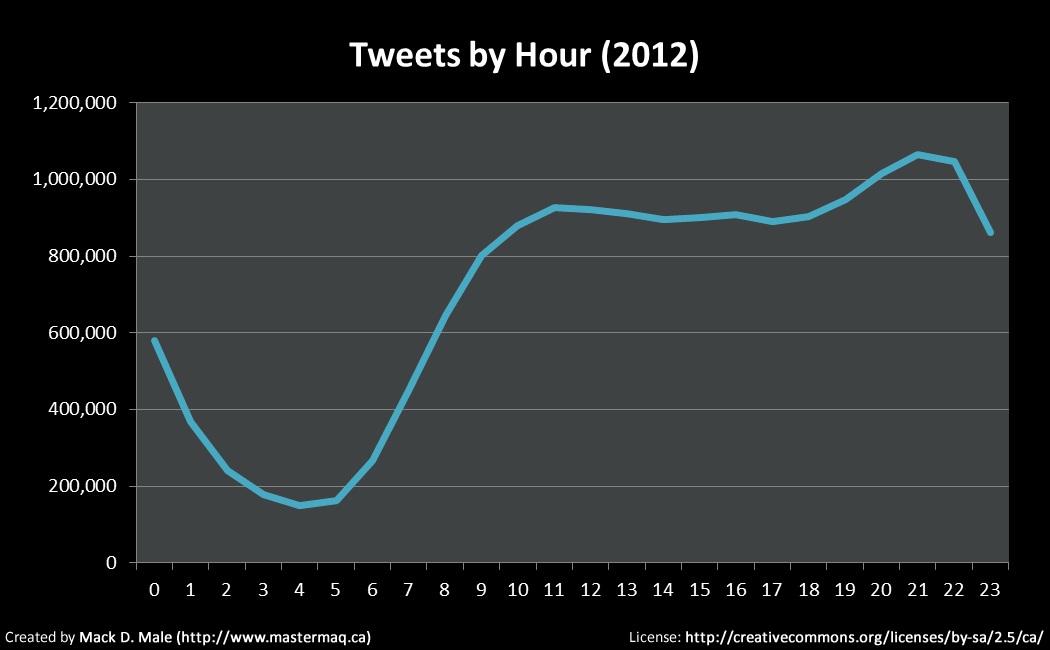
Roughly 47.5% of all local tweets were posted between the hours of 9 AM and 6 PM, which is down a little from 49.1% last year. The fewest tweets are posted around 4 AM, and the peak comes at around 9 PM.
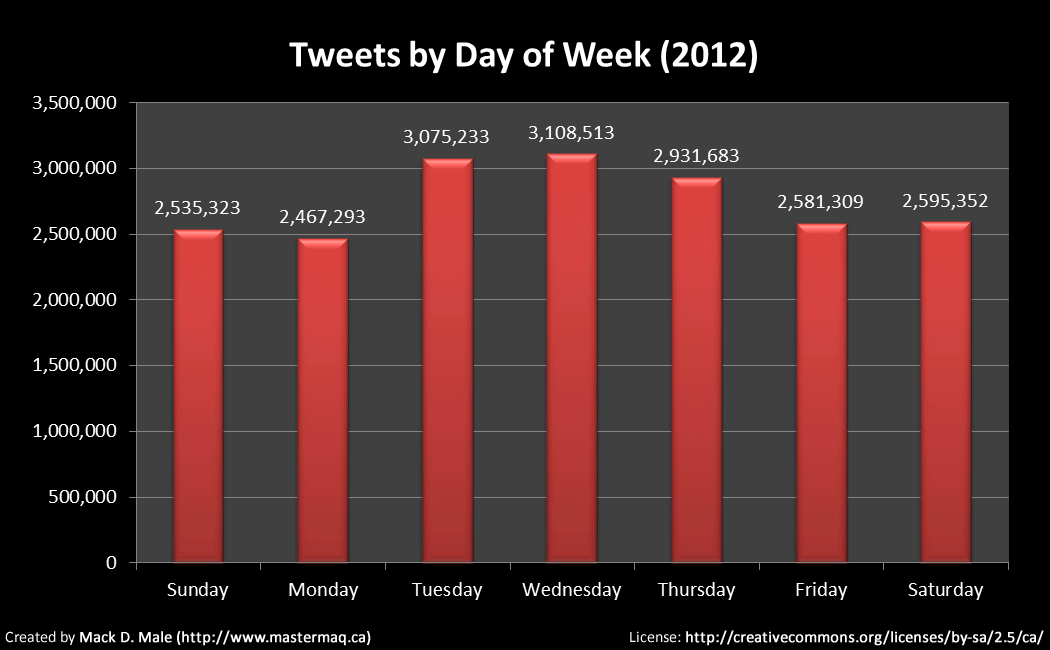
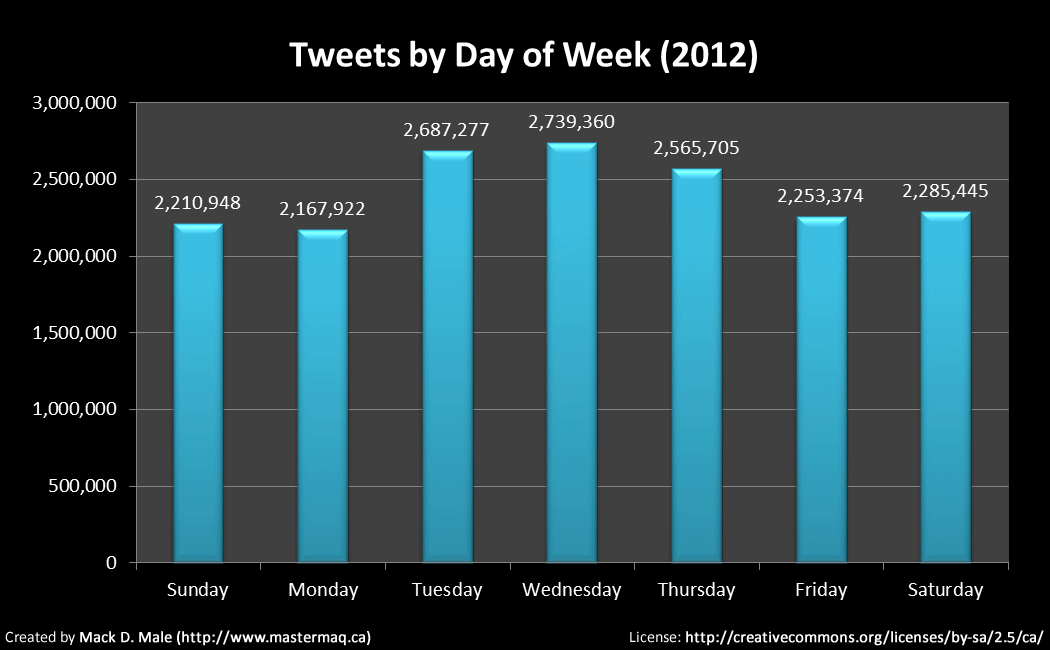
Looking at days of the week, it turns out that Wednesday had the most tweets posted followed closely by Tuesday, with Monday being having the fewest. This is more or less the same as last year, when Wednesday was also the highest and Sunday was the lowest.
Looking at the stats by year is great, but it is the longer-term view that is most interesting. Here’s a look at the number of tweets posted per month since I started tracking back at the beginning of 2009:
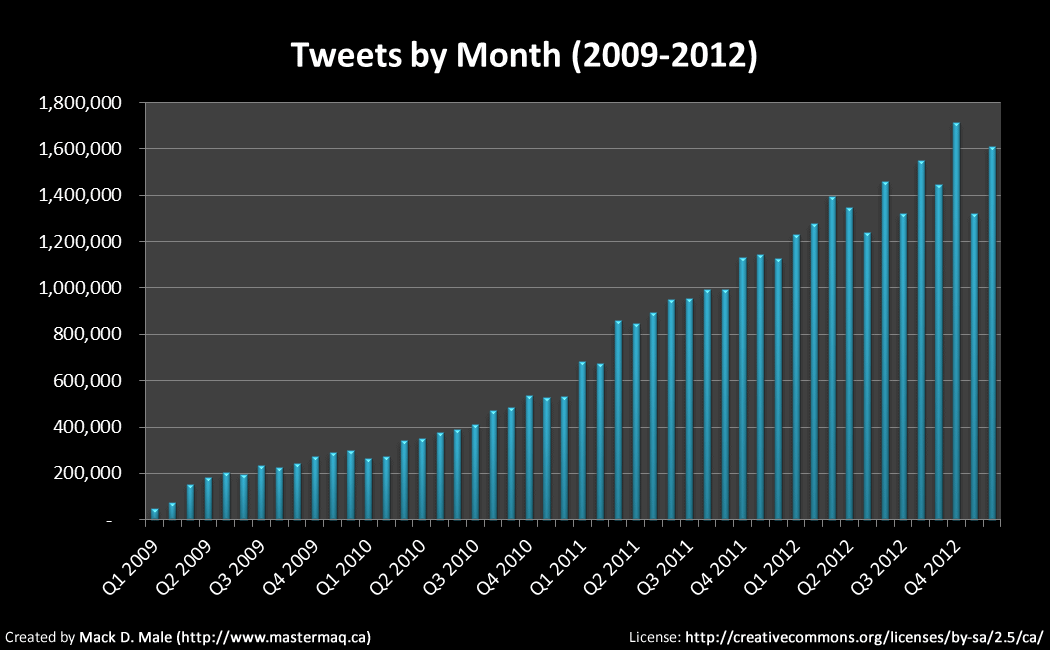
When I built my tracking system at the end of 2008 there were very few users and very few tweets being posted each month. I have maintained and improved it over the last few years, and thankfully Twitter’s API has become incredibly stable. But the original design/approach has reached some limits. So with that in mind, I built a new system over the holidays that I will soon be launching at ShareEdmonton so that you can see this information in near real-time. It may not be as complete initially, but I will improve it over the course of the year. Stay tuned!

Coming Up

In order to make it easier to produce and consume this report, I have decided to break it into sections. This entry provided an overview, and upcoming entries will focus on different aspects of Twitter usage in Edmonton:

  1. Overview
  2. Users & Clients
  3. Hashtags & Links

If you have any questions about this information, please leave a comment below!

Recap: DemoCamp Edmonton 20

Tonight was Edmonton’s 20th DemoCamp, a pretty great milestone for an event that began back in early 2008. The event still manages to attract both new and familiar faces, which makes it a great opportunity to connect with others in the community. We had a really strong turnout tonight and a very solid lineup of interesting demos.

Tonight’s event was held at the Telus Centre on the University of Alberta campus, and featured six demos (in order of appearance):

  • Dan Haight showed us the EMS analytics application that Darkhorse Analytics has built. It runs on an iPad and provides emergency services professionals with insights into the data they already collect (every time you call 911, that information is recorded, along with response times, lat longs, hospital information, etc). The app is very attractive and the UX seems really intuitive. It could easily be adapted to markets other than EMS as well.
  • Next up was Gezim Hoxha who showed us Team Do List, a super simple task list sharing application. With a focus on simplicity the app doesn’t let you do much more than create a list and add tasks to it, but that’s the idea. You don’t even need to create an account to create a task list, you can just start adding tasks. When you’re done, you can share them via email or SMS.
  • Neil Lamoureux was up third and he showed us CodeBaby’s suite of tools for creating intelligent virtual assistants. I have to say, it looked a little too good to be true! In just a matter of minutes, Neil had created an animated, lip-synced virtual assistant for TD Insurance, it was really impressive. The application features a friendly drag & drop interface, and includes the ability to preview an assistant on a live site without making any code changes. Very slick!
  • Our fourth demo was from Ashley & Dana Janssen and Matt Riemer who showed us Tradetacular, a platform for trading Magic: The Gathering cards online. I thought they did a good job of showing us why Tradetacular is better than the alternatives that already exist. I also really enjoyed the fact that they had multiple accounts and browsers setup and open to facilitate demoing a trade. While they are focused on Magic: The Gathering right now there is no reason that Tradetacular couldn’t be used for other collectibles in the future. They’re on to something!
  • Jeff Marvin was up next to show us BioWare’s N7 HQ, an online companion site for the popular Mass Effect 3 game. The site lets players track challenges and awards, view characters, inventory, and leaderboards, and explore profiles of other players. I was hoping for a little less talk and a bit more demo, but it was interesting to gain some insight into a big company like BioWare.
  • Our final demo of the night was from Sam Jenkins and Estyn Edwards who showed us WellNext, an interactive service that helps organizations implement employee wellness and engagement programs. Tonight they focused on a specific integration they built that uses data from a blood test to provide insight into how healthy an individual is, and then provides the organization with an aggregated view of the health of their employees. It was really neat to see it in action!

I think most people in the audience were impressed by how smoothly all of the demos went tonight, so great job to all of the demoers! I’m a sucker for analytics, so I really enjoyed Darkhorse’s demo. But we’ve seen them at DemoCamp before, so I’m going to go with Tradetacular as my favorite of the night, followed closely by WellNext. I loved the attention to detail in both, as well as the confidence in how to address their respective markets. Also, as Cam mentioned, the Tradetacular demo was really well done:

Some of the announcements from the event include:

DemoCamp Edmonton 20

This being a milestone event, I thought some of you might like to go back in time and revisit our past events, so here are my recaps and links for all 113 demos:

See you at DemoCamp Edmonton 21!

State of the Calgary Twittersphere 2012 – Overview

Welcome to the State of the Calgary Twittersphere for 2012, my look at the intersection of Twitter and Calgary in 2012. While I have kept up with the stats for Edmonton, I haven’t posted anything about Calgary since my last monthly post way back in September of 2010. That post looked at the statistics for July 2010, when just 10,500 local users posted a tweet. Twitter has grown significantly since then, and so has the community in Calgary.

I’ve done my best to ensure all of the data in this report is accurate, but I make no guarantees – use it at your own risk. The data comes from the Twitter API, and was collected over the course of 2012. If a user has his or her location set to Calgary, Airdrie, Okotoks, Cochrane, Strathmore, or matching lat/long coordinates, they are considered a Calgarian, and thus a “local” user.

Please treat the numbers in this report as a minimum. There are instances where I wasn’t able to capture all of the data, and there are certainly users here in Calgary who do not match the above definition of a “local user”. More important than the raw numbers themselves are the trends, and that’s why in many cases I have presented rounded rather than exact figures. You can click on any graph to see a larger version.

Here are the highlights for 2012:

  • More than 105,000 local users posted at least one tweet.
  • More than 19 million tweets were posted by local users, which works out to 36.6 tweets per minute.
  • Here’s a breakdown of those tweets:
    • Nearly 700,000 tweets were tagged #yyc (3.6%)
    • Just over 900,000 tweets were retweets (4.7%)
    • Almost 7 million tweets were replies (35.5%)
    • Almost 2 million tweets were replies to other local users (9.9%)
    • More than 5 million tweets contained links (26.2%)
    • More than 5.1 million tweets contained hashtags (26.6%)
    • More than 400,000 tweets were twooshes (a twoosh is exactly 140 characters) (2.3%)

When the year started, Calgarians were posting about 1.5 million tweets per month. That number remained relatively constant throughout the year, though there was a big jump in October to more than 1.8 million (and November appears lower than it should in this report due to issues with the data collection).

Roughly 47.8% of all local tweets in 2012 were posted between the hours of 9 AM and 6 PM. The fewest tweets were posted at about 4 AM, and there’s a visible spike in volume at around 9 PM.

Looking at days of the week, it turns out that Tuesday and Wednesday saw the most tweets posted, with Monday having the fewest (though there isn’t much of a difference compared to the rest of the week).

Though I have been recording stats for Calgary since 2009, I haven’t looked at the data in quite some time, so this was an interesting exercise. Comparing the data to last year’s report for Edmonton (and this year’s, which will be posted soon) gives you a sense of how much Twitter usage in Calgary has grown.

Coming Up

I have decided to break this report into sections to make it easier to produce and consume. This entry provided an overview, and upcoming entries will focus on different aspects of Twitter usage in Calgary:

  1. Overview
  2. Users & Clients
  3. Hashtags & Links

Thanks for reading!

How I travelled in 2012

Lattes weren’t the only thing I decided to track in 2012! I also decided to track how I much I travelled over the course of the year. One reason I wanted to do so was simply for my own knowledge! I think if you really want to change something, you need to first measure it. I figured if I could compare how often I drive with how often I choose other methods, I might be more inclined to change my behavior. Another reason was to hopefully inspire others to look at their own habits.

111 Street Pedway
Cars, buses, LRT, and good old fashioned walking! Photo by Darren.

I used a few tools to track this information. First, my Fitbit, which tracks how many steps I take each day. Second, I took advantage of the data I have been tracking for years about my driving habits. And finally, I recorded everything else in DAYTUM. To get distances, I would use Google Maps or this handy calculator. I use TripIt for all my out-of-town trips, so that’s where I got the flight distances.

Here’s what the overall distance data looks like:

TYPE DISTANCE (KM)
Airplane 34642.0
Bicycle 16.4
Bus 392.4
Ferry 5.7
LRT 207.5
Shuttle 55.4
Streetcar 17.1
Subway 1.0
Tube 110.9
Vehicle 6951.1
Walking 2043.1

No surprise there – I travelled further by airplane than any other mode of transportation. I flew to Toronto, Portland, Kamloops, London, Dublin, and Miami in 2012.

What’s more interesting is comparing how I got around Edmonton and the other cities I visited:

I suppose including the steps distance in that is a bit misleading, because walking around the house or office is included in that total, but there’s no easy way to break it out. Regardless, I think that chart more or less illustrates how I get around Edmonton. If a destination is in walking distance (about 20 minutes or so), I’ll generally walk. If it is far away, I’ll probably drive. For everything in between, I try to take transit.

If I could do it again, I would have tracked the # of trips in addition to distance (I have started doing that for 2013). I didn’t track how many times I used the car to get around Edmonton, for instance. I did track bus & LRT trips though, because I had to enter all that data into DAYTUM. In total in 2012, I made 141 trips using public transit:

Tracking the amount I walk has absolutely been motivating. There were lots of times that I tried to walk a bit more, just to get over 10,000 or whatever milestone I was close to. According to my Fitbit, I did 2,835,849 steps in 2012, covering a total distance of 2043.1 KM. That works out to an average of 7749 steps and 5.6 KM per day. Here’s what it looks like on a chart:

I did more than 30,000 steps on June 9 (which was the day of Al Fresco) and more than 25,000 once more on August 26 (which was the tour of the Northeast farms and Blink). I did more than 20,000 steps five times and more than 10,000 steps seventy-four times. My laziest day was Boxing Day when I did just 1860 steps (clearly, we stayed home).

Portland September 2012

Recording all of this data has definitely caused me to think about my habits more, and my lack of cycling stands out. If I had a bicycle, I could probably replace a number of the car trips that are either too far for walking or too inconvenient to wait for the bus. I really loved cycling when we were in Portland, so I think I will definitely try to do more of it here in Edmonton this year!

I probably drank too much coffee in 2012

I drink a lot of coffee. I start my day with a mug or two of freshly ground and brewed coffee, usually black. A couple times a week and especially in the winter, I’ll also have a Starbucks Via in the evening, though I have been trying to drink more tea instead. On top of all that, I drink a lot of lattes. I generally don’t make new year’s resolutions, but I do like to try new things each year. For 2012, I decided I would dive further into the world of self-tracking. Using the free and wonderful DAYTUM, I tracked each latte I drank throughout the year. Here’s what that data looks like.

Credo Coffee
Credo Coffee on 4th Street Promenade

In total, I drank 120 lattes in 2012. I did my best to record diligently and while I’m sure I missed a few, that’s probably fairly accurate. That’s an average of 2.3 lattes per week. If I had purchased each one myself at an average of $5 (thankfully I didn’t, others often buy me coffee) that would be $600 over the year.

Here are my top ten lattes by number consumed:

  1. Credo Vanilla Latte (46)
  2. Starbucks Caramel Macchiato (12)
  3. Starbucks Cinnamon Dolce Latte (10)
  4. Starbucks Eggnog Latte (7)
  5. Credo Iced Vanilla Latte (5)
  6. Starbucks Pumpkin Spice Latte (5)
  7. Roast Vanilla Latte (4)
  8. Transcend Vanilla Latte (4)
  9. Latte (3)
  10. Second Cup Caramel Corretto (3)

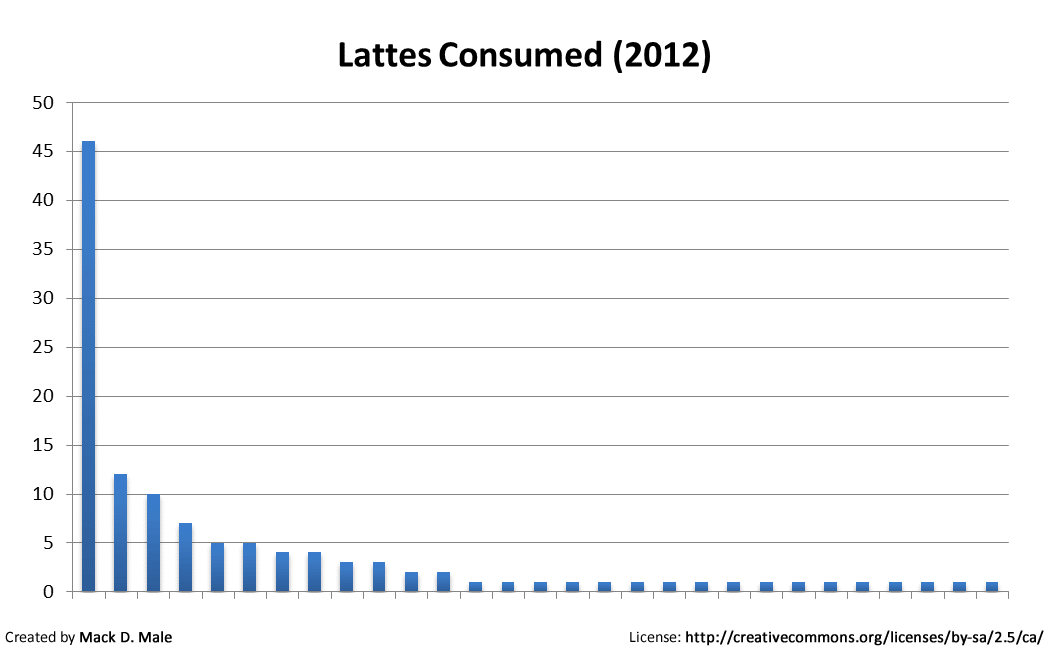
Plot everything on a graph, and you get a long tail:

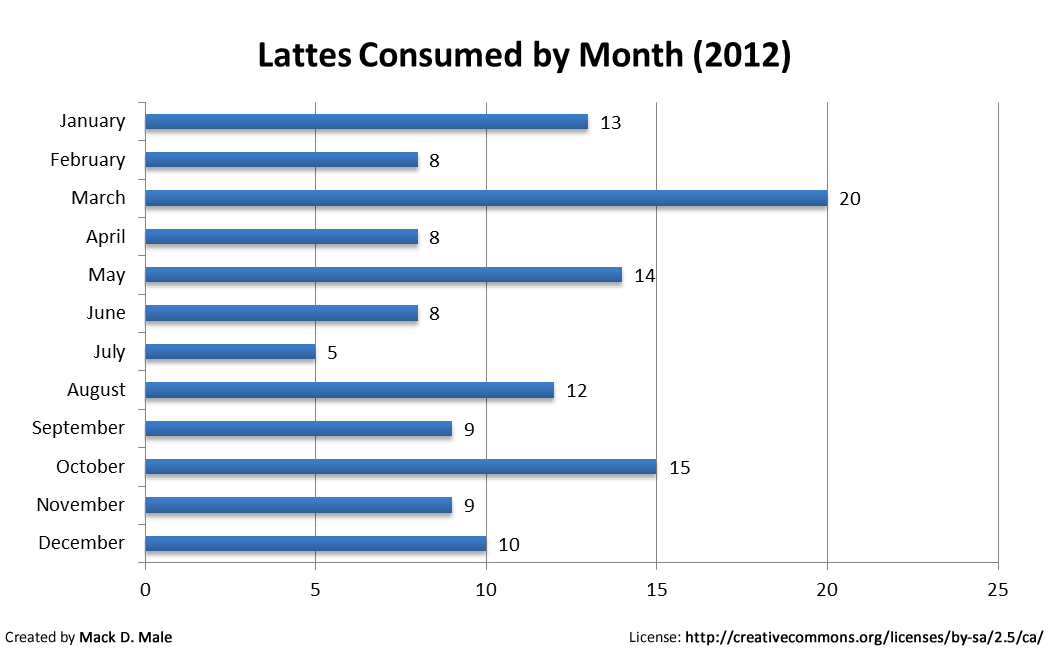
The other thing I can do with the data is look at my consumption over the year:

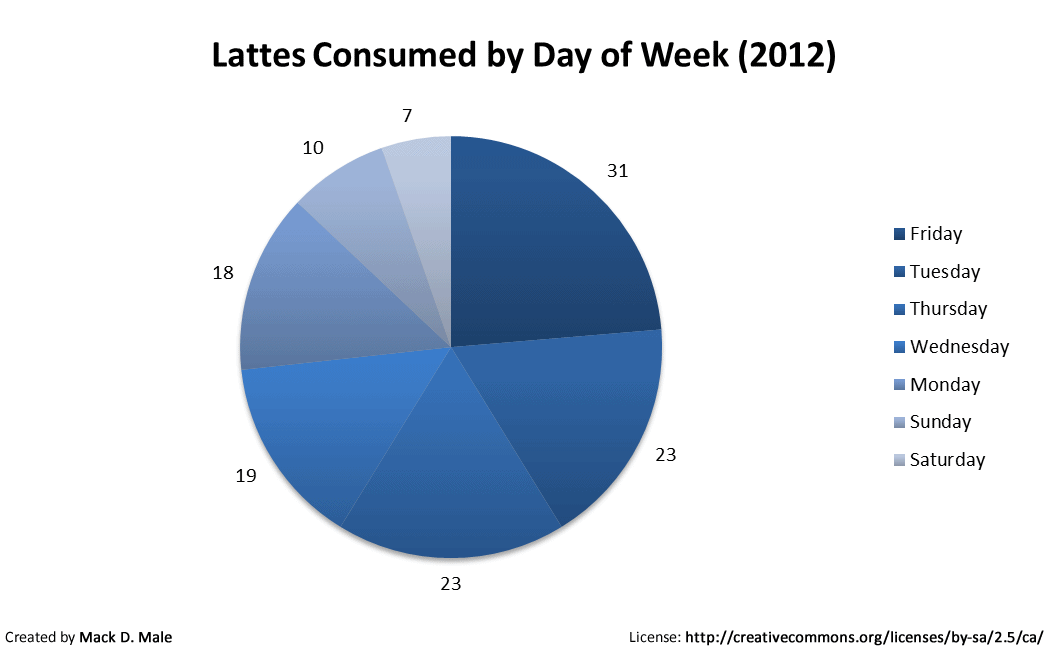
And I can see which days of the week I was most likely to indulge on:

I plan to keep tracking this data throughout 2013, so it’ll be interesting to compare at this time next year.

Transcend Coffee
My first latte of 2013!

Though it seems like a lot of lattes, I’m not sure I necessarily want to cut back. Many of those lattes represent an opportunity to sit down and chat with someone, and that’s something I am not ready to give up!

Top 10 Posts for 2012

Happy New Year! Here are the ten most viewed posts of 2012 on my blog:

  1. Your Guide to Summer Festivals & Events in Edmonton!
  2. The Past, Present, and Future of Food Truck Bylaws & Guidelines in Edmonton
  3. Edmonton’s City Market Downtown needs community representation
  4. Food, agriculture and the battle over Edmonton’s future growth
  5. Avenue Edmonton’s Top 40 Under 40 for 2012
  6. Startup Edmonton announces a new home for creative innovation in the Mercer Warehouse
  7. Urban/Suburban Marketing in Edmonton: The suburbs are winning
  8. Media Monday Edmonton: Update #29
  9. It’s time to stop investing in Edmonton Stories
  10. 2012 Alberta Election: Social Media Highlights

Check out the lists for previous years too: 2011, 2010, and 2009.

Thanks for reading, commenting, and sharing over the last year!

Edmonton in 2012

It’s that time of year when pretty much all the news being published is in list form! I figured I’d try once again to pull some Edmonton lists and year-in-review articles together into a single place. I’ll keep adding to it as I find more, so let me know what I have missed!

The Edmonton Journal also did a 2012 Year-in-Review video:

Here are some other links related to Edmonton in 2012:

Fireworks 5
Fireworks downtown for New Year’s Eve 2011 by Blair Haggerty

Happy New Year!

I’m loving my HTC 8X with Windows Phone 8

I dropped my phone back in September. I was getting my coat and shoes on and accidentally dropped it on the stone tile in our doorway. The screen was cracked pretty badly, but surprisingly everything still worked (well, everything except the proximity sensor). I had a spare screen protector, so I put that on to make sure I wouldn’t cut myself. I dropped into the TELUS store to check out my options, but being on contract I found I would basically have to buy out the old phone and then either pay for a new one or sign a new contract. I kept thinking to myself, why couldn’t this have happened in November?! I had been growing impatient for the arrival of Windows Phone 8 and had been planning to upgrade anyway.

I decided to stick it out with the cracked screen, but trust me, it wasn’t easy. Not just because of the screen either, but because despite Windows Phone 8 being released on October 29, devices were not available until weeks later (at least here in Canada). Being a TELUS customer was even worse – they have only just made the Samsung ATIV S available. I knew I wanted one of the two premier phones – Nokia’s Lumia 920 or HTC’s 8X. As luck would have it, just after they became available, one of my colleagues got the Lumia 920 and another got the 8X. That gave me the opportunity to see and hold each one in person. With its slimmer, lighter build, I decided the 8X was the phone for me (this piece from The Verge helped too).

HTC Windows Phone 8X

I spent a few hours trying to track one down at a Bell or Rogers store, but they either didn’t have any in stock or wouldn’t sell it to me. Thankfully I remembered hearing about OmegaCell, and that’s where I ultimately ordered mine from, unlocked. I picked up a $10 Micro-SIM from TELUS and a couple of hours later, I was up and running (for some reason the online site wouldn’t accept the new phone and SIM, so I had to call TELUS to get it activated, but that was quick and painless). There’s been a huge advertising push lately and I have seen more and more displays for Windows Phone, so I hope it becomes easier to get one of the devices.

I’ve had my “California Blue” 8X for a little over three weeks now, and I love it.

I think it’s a beautiful device. It’s just 10.12mm thick and weighs 130 grams (lighter than my LG Optimus 7 which weighed 157 grams but not as light as my BlackBerry Curve which was 115 grams). It features unibody construction, Gorilla Glass 2, a pixel density of 342ppi, and a soft polycarbonate back (full specs here).

HTC Windows Phone 8X

With its tapered edges, it truly is a comfortable phone to hold. I will say that this is the first phone I’ve owned that makes people go “wow, let me see”.

HTC Windows Phone 8X
BlackBerry Curve, LG Optimus 7, HTC 8X

The camera on my LG Optimus 7 was usable, but it wasn’t very good. The camera on the 8X is spectacular. Here’s a photo I took earlier this afternoon:

Downtown Edmonton

I think The Verge did a great job of highlighting the hardware in their review, so check that out for more detail.

Everything I loved about Windows Phone 7 still applies and in many cases has been improved:

  • Information at-a-glance with live tiles! It really is great to see upcoming appointments and the temperature without having to open separate apps.
  • Easy setup with all of my accounts including Microsoft/Windows Live, Facebook, Twitter, LinkedIn, Hotmail, Google, and Office 365. This lets me sync email, calendars, contacts, and social alerts. It intelligently links contacts, which is awesome.
  • The “Me” tile is still just fantastic. Quick access to post an update or see mentions on Twitter and Facebook.
  • The combination of SMS, Messenger, and Facebook inside the messaging hub means I can use whatever service is appropriate, and I don’t have to open up separate apps to switch.
  • I can take photos and have them upload to SkyDrive automatically, or I can post them to Facebook and other services with a couple of taps. No need to open an app. The new camera saves settings and supports Lenses too.
  • Xbox integration for games and achievements, SkyDrive integration for photos and other files.
  • The keyboard on Windows Phone is just awesome. I’ve used the iPhone’s keyboard, and I don’t know what it is exactly, but the experience of typing on a Windows Phone is just so much better. No crazy autocorrect here! There’s some great detail behind the keyboard here.

WP8 Home Screen There’s a ton of under-the-hood improvements in Windows Phone 8, but there’s some fantastic, more visible new stuff too:

  • It seems like a small feature, but having three sizes of live tiles is great (as you can see in my home screen). For example, I like to keep the calendar tile large so that I can see the full details of upcoming events, but the messaging tile small so I just see the number of new messaging.
  • Internet Explorer 10 is included, thankfully. I’ve had far fewer issues browsing websites than I did before.
  • OneNote has been promoted to its own tile. I use this all the time and I love that my notes are automatically synced to SkyDrive across all my devices.
  • The 8X supports NFC so it has the Tap+Send feature which makes it easy to share photos and files with other devices.
  • I like the improved lock screen. I have mine set to use Bing’s images, so I get a beautiful new photo every day.
  • The new Skype app is beautiful and works really well. My old phone lacked a front-facing camera, but that’s no longer a problem!
  • Xbox Music is the improved successor to Zune. I can make a playlist on my desktop and have it sync automatically to my Xbox and phone.
  • Xbox SmartGlass enables me to control my Xbox 360 with my phone. This isn’t exclusive to WP8, but it is a fantastic feature.
  • I haven’t really used the Wallet feature yet, but it does seem promising.

Yes there’s fewer apps on Windows Phone, but the gap is closing. I would love to see an Instagram app, and maybe a Pair app. I know the lack of a Dropbox app is a big deal for many people. But there are some truly great apps on Windows Phone such as 4th & Mayor, a much better Foursquare app than the official one, and Baconit, a Reddit app. New apps appear all the time (more than 75,000 in 2012), and the improved Store make them easier to find than ever.

I wouldn’t hesitate to recommend Windows Phone 8 and the HTC 8X. As I have said before, you should probably pick your device based on your ecosystem, but if you are in the market for a new phone and aren’t sure what to get, take a look at Windows Phone. I think you’ll be pleasantly surprised!

The Edmonton Oilers look to gain an edge with analytics & hackathons

The Edmonton Oilers are mining for gold, and they want you to help them do it.

Last Thursday they launched the Oilers Hackathon 2.0, an analytics competition that hopes to harness the collective intelligence and passion of Oilers fans to surface valuable information that could ultimately help to improve the team.

The Oilers challenge for Oil Country in the newly launched Hackathon 2.0 is to conjure up the proper methodology to solve one of four questions the team’s analytics group has created. Naturally you’ll need the statistical information to back-up your formula and that’s why the Oilers are opening their information vault to anyone with an analytical mind and a love of hockey.

The hackathon is a great opportunity for math-geeks-slash-hockey-fans to engage with the team in a different way. But as Kevin Lowe told me when we discussed the competition, it’s also a recognition that having data is just part of the puzzle. “It’s all find and dandy to have the data, but it’s what you do with it that matters.” The Oilers no doubt have some ideas about what to do with it, but they know others do as well.

oilers hackathon

This idea of tapping into the “wisdom of the crowd” is hardly new, and one of my favorite stories on the topic comes from Don Tapscott’s book Wikinomics. In the first chapter, he tells the story of Goldcorp Inc. and the decision by its CEO Rob McEwan to tap into the expertise outside his organization. McEwan told his head geologist the idea: “I’d like to take all of our geology, all the data we have that goes back to 1948, and put it into a file and share it with the world. Then we’ll ask the world to tell us where we’re going to find the next six million ounces of gold.”

It was a gamble, but with the company struggling McEwan was determined to try something different. The “Goldcorp Challenge” was launched in March 2000 with $575,000 in prize money available. The contest was a big success, as Tapscott explained. “Not only did the contest yield copious quantities of gold, it catapulted his underperforming $100 million company into a $9 billion juggernaut while transforming a backward mining site in Northern Ontario into one of the most innovative and profitable properties in the industry,” he wrote.

The use of statistical analysis in sports is not new either, and thanks to Moneyball many people have at least heard about analytics being applied to baseball. Though he is most often associated with politics these days, New York Times writer Nate Silver actually got his start with baseball. “I have been a fan of baseball – and baseball statistics – for as long as I can remember,” he wrote in his book The Signal and the Noise. He started creating statistics for the game when he was just twelve, and while working at KPMG he created PECOTA, a forecasting system for baseball player performance. There are good reasons that baseball has been at the forefront of analytics, as Silver explains:

“Baseball offers perhaps the world’s richest data set: pretty much everything that has happened on a major-league playing field in the past 140 years has been dutifully and accurately recorded, and hundreds of players play in the big leads every year.”

While baseball is a team sport, it is unlike hockey or basketball or most other team sports in that it proceeds in a linear fashion. You could argue that a batter or pitcher in baseball is more responsible for his or her own performance than a forward is in hockey. It’s therefore a little easier to test empirically a hypothesis in baseball than it is in hockey.

Still, that hasn’t deterred NHL teams from delving into the world of analytics (though there have certainly been ups and downs over the years). David Staples, a guest of the Oilers Analytics Working Group (AWG), wrote about its creation back in March:

Some pro hockey bosses have little time for “Moneypuck,” the notion that NHL teams can use advanced statistics to gain an advantage. Others are more open to this cutting edge work. But there’s no doubt that interest in the field is exploding.

The Oilers formed the AWG a little over a year ago as a result of an advisory group on analytics coordinated by the University of Alberta’s Faculty of Extension. Members of the AWG include Kevin Lowe, Nick Wilson, and a number of other members of the Oilers operations team, Cult of Hockey blogger Bruce McCurdy, University of Alberta professors Corey Wentzell and Bruce Matichuk, AICML’s Randy Goebel, and Daniel Haight of Darkhorse Analytics. The group meets monthly, though someone is looking at the data almost every day. The Oilers have purchased reports and other sources of data in the past, but with the AWG, they’re considering data and analytics more aggressively. They see hackathons as a key way to extract value from all of the data.

The Hackathon 2.0 offers anyone who is interested the chance to delve into more than 1 GB of CSV data going all the way back to 1918. That’s 1 GB of pure text, roughly equivalent to 1000 thick books, and much more than was available during the first hackathon. For a data geek like myself, it’s pretty exciting. Hardcore hockey fans also seem to like the idea. “This is entirely fascinating. I cannot believe it’s really happening,” wrote Justin Bourne on theScore’s blog. Some have even started analyzing the data. Not everyone is as optimistic, however. Well-known Oilers blogger Tyler Dellow wrote, “while I applaud the effort, I’m not really sure that I think they’re going to get a whole lot that’s useful out of it.”

My sense after talking to Kevin Lowe and Nick Wilson about the hackathon is that they are realistic about the potential for data analytics. “It’s about knowing where to spend your time and resources,” Kevin said. “The findings are not earth shattering, but it’s a little bit of knowledge that you can hand over to the coach that at the right moment he can use, or so that he has more confidence in his decisions.” Nick agreed. “It’s a two or three percent contribution, like everything else.”

That said, there is some optimism that a fan will come up with something the Oilers just haven’t thought of, with some nugget of gold. “What’s unique about math applied to sports is the undiscovered, the lingering moneyball,” Nick said. “There’s incredible fans, incredible intelligence in this city,” Kevin agreed.

A total of 400 entrants had registered for the hackathon as of this morning. If you want to participate, you’d better move quickly – the deadline to register is tomorrow. After filling out the form, you’ll receive an email with a link to download the data. From there you’ll have until February 15 to submit your methodology for answering four challenges set forth by the Oilers AWG. You can see the full contest details here.

If you don’t get the opportunity to participate this time, don’t worry, the Oilers are keen to do additional hackathons in the future. “It’s not a one-off, and we definitely want to do more,” Nick told me. That’s probably a good strategy, given that new data is available all the time. As technology improves, you can imagine all sorts of new statistics being tracked. For example, cameras could help to track the number of strides a player takes per shift, or the number of times he pivots on the ice.

I’m planning to participate in the hackathon, though for me it’ll be more for fun than anything. I have already enlisted the help of my Dad who is a much bigger hockey fan than I am, based on some advice from Nate Silver: “Statistical inferences are much stronger when backed up by theory or at least some deeper thinking about their root causes.” In other words, it helps to know a thing or two about hockey!

Proudly waving the Make Something Edmonton banner

Why Edmonton? I’m often asked this question. As if I somehow need to justify why I spend so much of my time experiencing the city, thinking about it, writing about it. Or maybe people ask it because they can’t fathom why I would choose to live here, of all places. Why choose Edmonton over some other place?

Some people ask that question because they’ve already made up their minds about Edmonton, and they don’t like it. They ask the question because they want to compare their negative vision with someone who appears to have a much more positive one. Some people ask because they want to explain why they have chosen Edmonton, but they’re not sure how. Others ask the question from a neutral point of view. Some days they like Edmonton, other days they don’t. Maybe I can move them a little closer to the positive side with my response, but they won’t stay there for long. They like sitting on the fence.

I don’t like being asked this question, mostly because I don’t have a good answer for it. And yet it is a good question to ask. I want to respond with a well-rehearsed elevator pitch, but instead I usually spit out something about opportunity and how Edmonton is such a great place to live. Blech. I just can’t articulate what I feel, what I know to be true. I think a lot of Edmontonians struggle with that.

Why do I live here? I was born here. My siblings live here. Most of my extended family lives here. And now, my life is here. My friends, my work, my partner. But that’s the easy answer. I could find work elsewhere. I could keep in touch with friends and family from afar. So, why do I still live here?

It’s true that Edmonton is a great place to live, and I can rattle off all the statistics that help to illustrate why this is so. Per capita income is about $11,000 higher and unemployment is about 2% lower than the national average. There are more than 160 kilometers of trails in our river valley parks, the longest urban parkland system in North America. Three quarters of Edmontonians live within a 20-minute walk of a natural area. The Edmonton Public School system is regularly cited as the model for other jurisdictions in North America. About 60% of waste is diverted from landfill, and we’re on track to increase that number to 90% by 2015. Our water is some of the best in the world. Over the last three-year capital investment cycle, a record $3.3 billion was invested in capital infrastructure projects. We have more than 2200 hours of sunlight each year.

I could go on, but so what? Nearly every city has a similar list of positive features. How does any of that differentiate Edmonton? There are lots of cities that could be said to offer great quality of life. You don’t even have to go very far to find one.

There must be something more to Edmonton.

Maybe that something, in a word, is opportunity. Edmonton is a city in which it is possible to get things done. We’re big enough to be considered a large city and to have the affordances (and challenges) that go along with that, yet we’re small enough that the degree of separation between the average Edmontonian and the city’s power brokers is quite small. But it’s more than that. You don’t need permission here to take action, and people are always willing to lend a hand if you ask for it, even the so-called power brokers, in my experience.

Edmonton has always been a city of opportunity. In the early 19th century, Edmonton was an important fort in the North American fur trade. As the 20th century approached, thousands flocked to Edmonton on their way to the Last Great Gold Rush. Many stayed. Just after the second world war, oil was discovered near Leduc, and we quickly became known as the Oil Capital of Canada. A sense of opportunity seems to be ingrained in our civic culture.

But don’t other cities also have opportunity? Of course they do. The thing is that in Edmonton, you can have an impact. You can act on that opportunity and do something and make a difference.

Todd Babiak has been writing about this topic a lot lately. He too likes to ask the question, Why Edmonton? I’ve come to really like his answer. Here’s how he explains it:

People are growing things in every city in the world, but we’re doing it differently in Edmonton. Our economy and our culture, that spirit of openness and curiosity, of urban barn-building, is peculiar. People say it in different ways: this is the best place to build, to create, to get ‘er done. To make something. It always has been.

This is our past and our present. Edmontonians know this. They arrive at this truth, when you talk to them long enough. But we don’t say it to each other and we don’t say it to people in Toronto, in New York, in Beijing.

I think that’s the truth I was having trouble articulating. Todd calls this Make Something Edmonton, and in recent weeks many Edmontonians have embraced the idea by using the #MakeSomethingYeg hashtag on Twitter.

Make Something Edmonton is a call-to-action. It’s about building up rather than tearing down. It’s simple and powerful. It is broad enough to encompass the great diversity found in our city, yet it doesn’t fall into the trap of being vanilla. It encourages story rather than sound bites. But perhaps the most important thing about Make Something Edmonton is that it is participatory. Anyone and everyone can make something here, and that’s why it is meaningful.

Why Edmonton? Because if you have the courage to make something, Edmonton is your city.

Thanks to Todd, I now have some vocabulary to address why I love this city. Just like any of you, I can take the Make Something Edmonton banner and wave it proudly.

But saying that naturally leads to a question – what does the banner look like? What exactly is Make Something Edmonton? Does it fit into the various branding exercises we’ve undertaken over the years? Could it be the next one? Todd discussed the notion of a Make Something Edmonton campaign back in October:

If this is going to work, it has to be a call and an invitation to all Edmontonians — not just the creative class types. In Edmonton, you can make something beautiful. You can make something new, make something big, make something global, make something delicious, make something green, make something north, make something odd, make something unforgettable, make something true. We have anecdotes to prove all of these and more.

I like that Make Something Edmonton is inclusive and that all Edmontonians can participate. It doesn’t matter what you’re making, as long as you’re making something. Sure that makes it a little bit messy, and it certainly makes it more difficult to fit into a “traditional campaign”, but I think that’s one of the greatest things about Make Something Edmonton. It’s more than just a slogan or a logo, because Edmonton and Edmontonians should not be reduced to such things.

Clearly there’s tremendous upside to having three simple words like Make Something Edmonton to help articulate the complexity behind why Edmonton is different. The downside is that it’s all too easy to jump from those words straight to the notion of a brand or campaign. To ask what the banner looks like. I say, who cares? Just make something, and wave that banner proudly!