Media Monday Edmonton: Update #174

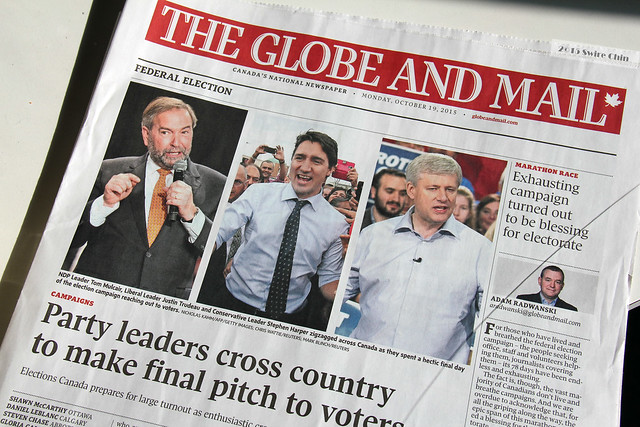
As I write this, Justin Trudeau and the Liberals have just won a majority in the federal election, relegating Stephen Harper and the Conservatives to the role of official opposition. Harper is expected to resign as leader of the party.

With today being the election, let’s start with a few updates on that topic:

Canada will decide who will lead the country after today
Canada will decide who will lead the country after today, photo by Can Pac Swire

Here’s my latest update on local media stuff:

And here are some slightly less local media-related items:

You can follow Edmonton media news on Twitter using the hashtag #yegmedia. For a great overview of the global media landscape, check out Mediagazer.

So, what have I missed? What’s new and interesting in the world of Edmonton media? Let me know!

You can see past Media Monday Edmonton entries here.

Edmonton Notes for 10/18/2015

Be sure to get out and vote! Here are my weekly Edmonton notes:

Headlines

Fall
Fall, photo by Dave Sutherland

Upcoming Events

Edmonton Fall Season
Edmonton Fall Season, photo by IQRemix

Coming up at City Council: October 19-23, 2015

Monday is the federal election, so that will be the focus for most Edmontonians and I’m sure Council will be paying close attention also. Mayor Iveson joined other big city Canadian mayors in calling for cities to be a key factor in determining who to vote for. FCM has setup a website to provide information on all of the promises the parties have made related to cities.

Untitled

Here’s my look at what Council will be discussing in the week ahead.

Meetings this week

You can always see the latest City Council meetings on ShareEdmonton.

Zoning Bylaw Amendments on Urban Agriculture

Bylaw 17403 is a text amendment to the Zoning Bylaw 12800 that will add several urban agriculture uses and associated regulations. There are three new uses:

  • Urban Gardens “is for personal, community, or institutional food production and will be allowed in most zones.”
  • Urban Outdoor Farms “is for commercial food production on private property, primarily intended for vacant and underutilized lots in Edmonton.”
  • Urban Indoor Farms “is for commercial and industrial operations that take advantage of new technologies and processes to increase yield and operate year round.”

Additionally, “Farms” will be renamed to “Rural Farms” and “Greenhouses, Plant Nurseries and Market Gardens” is renamed to “Greenhouses, Plant Nurseries and Garden Centres” and will be updated to better align with the products those businesses sell.

The goal of these amendments is to more closely align the Zoning Bylaw with the policies identified in Fresh, Edmonton’s Food and Urban Agriculture Strategy. Importantly, the three new uses “are proposed to assert that primary food production is legal and encouraged in Edmonton.”

Anthony Henday Drive & 135 Street Interchange and Manning/Meridian Interchange

The City is recommending an interchange at Anthony Henday Drive and 135 Street, which could cost in the order of $125 million, “as one of the three top candidates for the Provincial-Territorial Infrastructure Component of the New Building Canada Fund.” They say the return of investment would come from further development of Heritage Valley.

Also up for Council’s consideration is a project bundle for the Edmonton Energy and Technology Park. The planned 4800 ha area envisioned as “a world-class eco-industrial park” is off to a slow start.

“Development in the Edmonton Energy and Technology Park to date has been limited. It is unlikely that development will occur as desired without infrastructure investment. A significant impediment to development taking place in the Edmonton Energy and Technology Park currently is the lack of existing infrastructure and its associated cost.”

The infrastructure investment in both transportation and stormwater drainage could cost in the order of $230 million. However, Administration advises that “it would be appropriate for Council to first provide direction with respect to the degree to which, and where, public funds should contribute to infrastructure servicing that is otherwise provided by developers.”

Meeting Schedule & Council Appointments

It’s that time of year again – Council needs to approve its meeting schedule for the year ahead. There’s nothing too surprising in the proposed schedule. Council would resume after the Christmas break on January 11 and would meet through March 24, right before the Easter break. The summer break would begin on July 15, with Council resuming on August 15.

“The draft January 1, 2016, to December 31, 2016, Council and Committee Meeting Schedule has 19 Council and Standing Committee meeting rotations, 19 Statutory Public Hearings, 18 Non-regular City Council meetings, along with three half-day Council meetings and eight Committee meetings for civic agency recruitment and selection matters.”

The report helpfully includes some statistics from 2013 – 2015 to compare the proposed schedule with previous years. Council must also set the Deputy Mayor and Acting Mayor schedules for the coming year. Each Councillor gets a turn.

As of December 31, a number of Council appointments to civic agencies will expire. The following appointments are being proposed:

  • Alberta Capital Region Wastewater Exchange Agreement Coordinating Committee – Councillor Anderson and Councillor Walters
  • Canadian Urban Transit Association Transit Board Members Committee – Councillor Sohi
  • Capital Region Board – Councillor Gibbons
  • Capital Region Waste Minimization Advisory Committee – Councillor Anderson
  • Edmonton Police Commission – Councillor McKeen
  • Edmonton Public Library Board – Councillor Henderson
  • Edmonton Salutes – Councillor Loken
  • Inter-City Forum on Social Policy – Councillor Esslinger
  • REACH Edmonton Council for Safe Communities – Councillor Loken (as advisor/liaison)

If Councillor Sohi is successful in Monday’s election, then a future report will be brought forward to replace his existing appointments. There is also a list of appointments not yet up for renewal if you’d like to see which Councillors are representing us where.

Northern Circumpolar Secretariat Memorandum of Understanding

The Northern Circumpolar Secretariat is a collaborative effort between the City, EEDC, Chamber of Commerce, U of A, and the Edmonton Regional Airports Authority. It was established earlier this year and the report on the table presents the Memorandum of Understanding for approval. It is “a policy tool to ensure the long-term stability of the Secretariat as it executes its mandate in support of the Northern Relations Council Initiative.” The MOU is 10 pages long and also attached is a 22-page business plan which outlines the budget, governance model, goals, vision, and timeline and deliverables for the Secretariat. The City is providing $90,000 this year, $35,750 in 2016, and $62,000 in 2017.

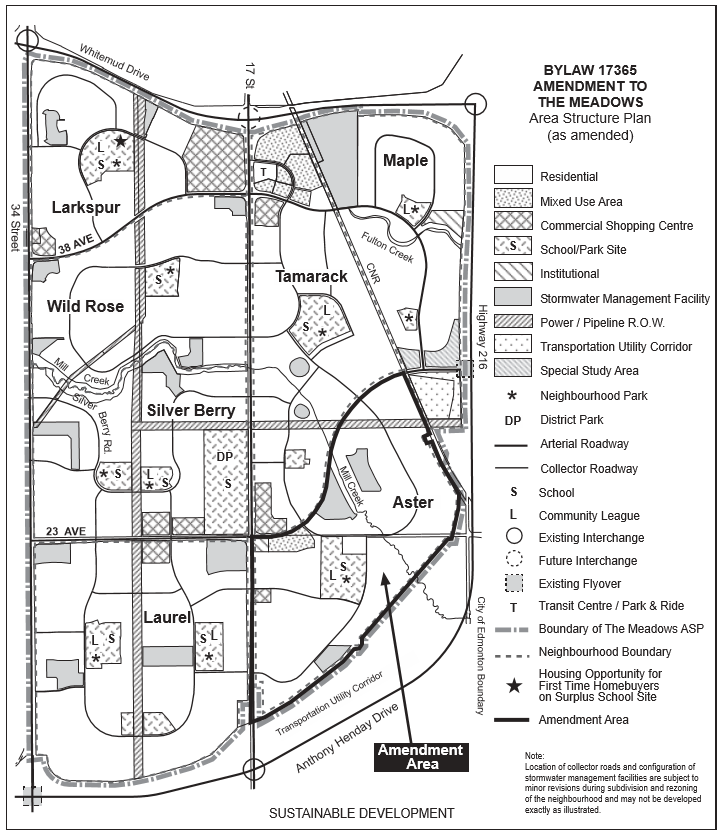
Adoption of the Aster NSP

Aster is the 7th and final neighbourhood in The Meadows ASP. Larkspur, Wild Rose, and Silverberry are considered 100& complete in terms of low density residential units while Laurel, Tamarack, and Maple are considered 45% complete.

meadows asp

Aster will accommodate approximately 3,499 dwelling units and 8,755 people, which is a density of 33.3 upnrha, barely meeting the CRB target for the region. It will account for approximately 15% of The Meadows ASP’s gross area and population.

The neighbourhood will include:

  • one school/park site, with two K-9 schools located in the centre of the area, and three pocket parks throughout the neighbourhood
  • approximately 22 hectares of preserved existing natural areas
  • approximately 13 hectares of stormwater management facilities
  • a system of shared use paths and a bicycle network

The initial neighbourhood infrastructure costs are being largely funded by developers – $104.7 million compared to the City’s $14.8 million – but as usual “there will also be associated operating and life cycle costs that would require City funding allocations in Operating, Utilities and Capital Budgets.” City funding could be required as early as 2017 if the planned construction begins in 2016.

Bylaw 17366 will be considered along with Bylaw 17365 to amend the Meadows ASP and Bylaw 17367 to amend the boundary of the North Saskatchewan River Valley ARP.

Committee Recommendations

Recommendations that have come forward from Committee include:

There are also two Executive Committee reports that have been referred without a recommendation:

Bylaws

There are a number of bylaws on the agenda. Here are a few highlights:

  • Bylaw 17352 will allow for digital signs to be erected in South Edmonton Common, between Gateway Boulevard and Parsons Road and 23 Avenue and Anthony Henday.
  • Bylaw 17373 and Bylaw 17374 together will “ensure the continued operation and preservation of the Oblats Maison Provinciale building, a Designated Municipal and Provincial Historic Resource.”
  • Bylaw 17297 would amend the Public Places Bylaw to include the prohibition of e-cigarettes in the same manner as tobacco products.
  • Bylaw 17432 authorizes borrowing of up to $250 million for the Valley Line LRT project.
  • Bylaw 17390 will increase the borrowing authority to finance construction costs for the Valley Line LRT from $152 million to $1.1 billion.

Other interesting items

  • Council will once again be discussing the Youth Council recommendation of vegetarian eating, in the name of sustainability.
  • There is a small change being proposed to the 2016-2018 Budget Process, to allow for an early release of the Utility Budget. Council must now submit written questions regarding the budget by October 28.
  • The City Manager Recruitment Committee, made up of Mayor Iveson and Councillors Esslinger, Loken, and Walters, met for the first time on September 30. Pretty much all of their activities will be carried out in private.
  • Tuesday’s agenda includes six private reports, including an update on the Valley Line LRT Funding Plan, an update on City Infrastructure Priorities for the Provincial Budget, and a status update from the Acting City Manager.
  • Wednesday’s agenda includes just two private reports: verbal shortlistings for both the Edmonton Regional Airports Authority and the Edmonton Police Commission.

Wrap-up

You can keep track of City Council on Twitter using the #yegcc hashtag, and you can listen to or watch any Council meeting live online. You can read my previous coverage of the 2013-2017 City Council here.

Edmonton Notes for 10/4/2015

I’m on vacation at the moment in Europe, so I likely won’t be blogging much until I get home in a couple of weeks. But I am today! Here are my weekly Edmonton notes:

Headlines

Having a Cigarette at the End of the World
Having a cigarette at the End of the World, photo by Dave Sutherland

Upcoming Events

Nuit Blanche Edmonton 2015
Nuit Blanche Edmonton, photo by IQRemix

Media Monday Edmonton: Update #173

Here’s my latest update on local media stuff:

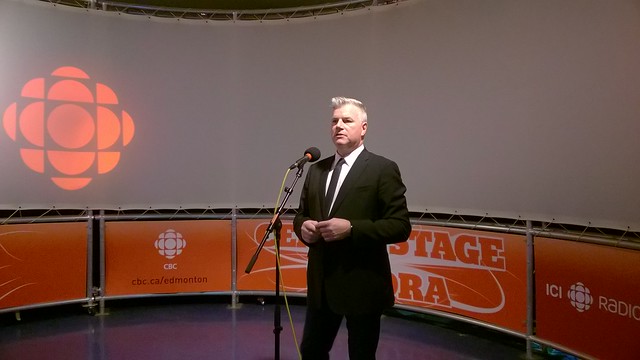
  • CBC Edmonton hosted an event last week to share information on its latest programming changes. Starting today, you can watch Edmonton AM on TV from 6-7am every weekday. The radio studio has been outfitted with video cameras and has been “spruced up” a bit for TV.

CBC Edmonton Radio

  • The reason for this new radio-on-TV approach is that they’re cutting an hour from the news in the evening (but they are mandated to have a certain number of hours of original local content…so this seems like a clever skirting of the intent of that requirement, but I digress). Starting October 5, CBC News Edmonton will run for just 30 minutes starting at 6pm (it currently runs 5-6:30pm), and will “focus more on context” while also pushing social media so viewers can “see themselves and be a part of the newscast.” The late night newscast will run from 11-11:30pm and will be anchored by Sandra Batson. The TV set is getting an update too.

Gary Cunliffe

And here are some less-local notes I wanted to share:

You can follow Edmonton media news on Twitter using the hashtag #yegmedia. For a great overview of the global media landscape, check out Mediagazer.

So, what have I missed? What’s new and interesting in the world of Edmonton media? Let me know!

You can see past Media Monday Edmonton entries here.

Edmonton Notes for 9/27/2015

This week’s update comes to you from London, UK where I’ll be for the next ten days or so before heading to Paris and Amsterdam with Sharon. Yay vacation! Also, today is our one year anniversary!

Here are my weekly Edmonton notes:

Headlines

Crane Migration
Crane Migration, photo by RemotelyBoris

Upcoming Events

Nuit Blanche, Edmonton
Nuit Blanche at City Hall, photo by Geoffrey Rockwell

Recap: Ignite Edmonton 2015

A couple weeks ago I had the opportunity to attend Ignite Edmonton, courtesy of EEDC. This was the first year for Ignite, though it’s fair to say the event was the latest iteration of an idea that EEDC has been pursuing for a few years now. How do you host an event to promote creativity and entrepreneurial thinking in a more interesting and engaging way than the typical conference?
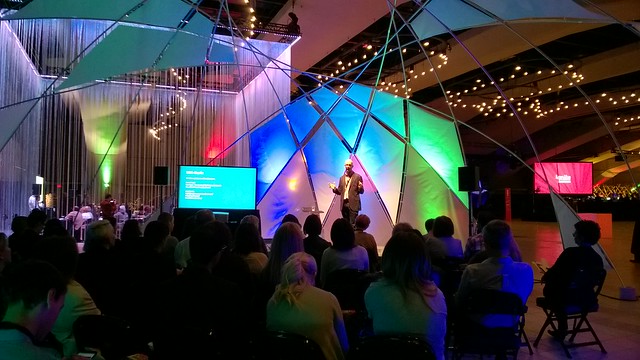
Ignite Edmonton Festival

E-Town Festival

Ignite’s roots go back to September 2013, when the first E-Town Festival took place here in Edmonton (which I previewed here). E-Town was “an intensive two-day festival of ideas for entrepreneurial-minded people who get excited by innovation, change and disrupting common thought.” It was also a mishmash of workshops, plenaries with big-name speakers like Chris Hadfield and Guy Kawasaki, a Food Truck Fest, a concert featuring the Barenaked Ladies, and more. The event took place throughout the Shaw Conference Centre, with the big sessions being hosted in Hall D.

I completely appreciated the opportunity to hear from Chris Hadfield, and I love food trucks more than most, but there was an awful lot going on over those two days. You have to admire the bold vision of the folks at EEDC who organized it though. They wanted to make a statement, and they did.
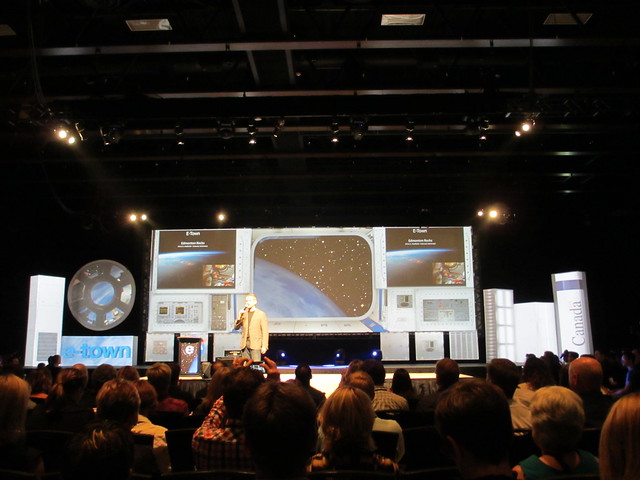
E-Town

E-Town returned in 2014 for another two-day event that featured speakers like Hayley Wickenheiser, Bob Nicholson, and Raine Maida. It kept the Food Truck Fest, and also had a concert featuring Maida and his wife Chantal Kreviazuk. The event was promoted like this:

“E-Town Festival feeds the mind and heart of people who get excited by innovation, creativity and disrupting common thought. You’ll be immersed in new ideas from thought-provoking speakers, contribute to interactive breakout sessions, connect to other bright minds and be entertained by great artists. You’ll leave inspired, re-energized, smarter and ready to take bold action.”

Again there was a desire to build a “high-involvement, high-energy event” that “wasn’t your typical conference.” But I know more than a handful of people who looked at either the agenda or the price or both and felt it was safe to pass on the event. I think both iterations of E-Town were reasonably successful, but people attending a concert is not the same thing as attendees taking something useful back to their work. I wonder if the right people were in the room.

There were plans for another E-Town, as the website stated:

“Looking to the future, we envision a multi-day, multi-venue festival experience that attracts attendees from western Canada and north-western United States.”

That didn’t come to pass, of course (at least not yet). After having attended Ignite, I think that’s probably a good thing, because I like the new direction they’ve taken.

Break the mold

To me the idea that EEDC has been pursuing first with E-Town and now with Ignite is this: creative, entrepreneurial thinking can help startups, big companies, and everyone in-between, but it doesn’t have to come from the usual suspects or in typical business-conference-fashion.

I think that’s why there was such an interest in previous years to incorporate musicians, artists, food trucks, and other not-usually-seen-at-business-conference-type folks into the event. They all have useful, interesting, and entertaining things to say, things that those of us in business (whether at startups or big companies) can benefit from hearing.

Ignite stayed true to that idea, I think, but with a course correction. Instead of just getting all those folks together in the room and hoping that the cross-pollination would happen, Ignite took a much more intimate and curated approach.

Ignite Edmonton

Ignite was organized by a big team of EEDC staff and volunteers, led by Ken Bautista, Director of Entrepreneurship and Innovation at EEDC. There’s a certain expectation of polish that comes with an event organized by Ken (he’s set the bar high with TEDx, Startup Edmonton, and other events). He delivered once again with Ignite. The website, name badges, program, swag bags, venue, and everything else were attractive, high quality, and cohesive.

This year’s event took place on the Assembly Level in Halls A and B, with coffee, lunch, and social space outside in the common area. That meant everyone was in more or less the same space, which was better for networking and running into people.

Inside the two halls is where the main action took place. I have to completely agree with Neetu’s assessment of the venue:

//platform.twitter.com/widgets.js
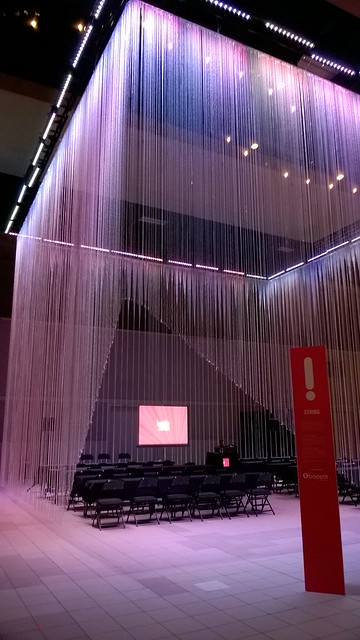
The six pavilions – Cocoon, Interlock, Orb, Riverview, String, Transposed Formation – were all designed by local designers through a special design competition setup just for Ignite. Each of the workshop sessions took place in one of the pavilions, which I think it’s fair to say achieved the desired effect of creating “a completely immersive, incredibly inspiring experience.” Everyone was snapping photos and commenting on them! Because of the way the room was setup there was probably more noise bleed than the organizers had hoped for, but I think most people were willing to forgive the excess noise because of the uniqueness/novelty of the pavilion designs.

Instead of bringing in food trucks as was done for E-Town, attendees of Ignite were treated to food created by the Shaw Conference Centre culinary team, led by Executive Chef Simon Smotkowicz. And why not? He’s one of our city’s most accomplished chefs! I thought the lunch options were great, and went back for more than a couple of the tasty sandwiches.

For scheduling, Ignite used Sched. Attendees could login ahead of time and choose their sessions, which produced a completely customized agenda for the two days. Each day started with a couple of main stage talks, which were about 30 minutes in length. The workshop sessions were perhaps a touch long at 90 minutes, but thankfully there was a lot of social time built into the agenda, even on top of lunch and drinks.

On the final afternoon attendees had the opportunity to attend a “studio session” which offered an introduction to “the inner-workings of some of Downtown Edmonton’s most creative offices and workspaces.” Startup Edmonton, Ice District HQ, DDB, and TELUS all hosted field-trips.

Session Highlights

You can see all of the speakers and sessions here.

Just like Nathan, I found the Square presentation by Steve McPhee to be thought-provoking. Be sure to check out his post for more highlights! In terms of main stage sessions, I also really enjoyed both Nir Eyal‘s talk on building habit-forming products (looking forward to reading his book Hooked) and Ted Graham‘s talk on what he learned about innovation by driving for Uber. Their presentation styles were completely different, but both were able to use their limited time to get across some interesting ideas.

My favorite session was a workshop called “Building a Team Culture with Respectful Leadership”. It was led by FC Edmonton Head Coach Colin Miller.

“Colin Miller specializes in the art of respectful leadership. As a coach and former professional athlete, Colin has faced every challenge in the world of teams from both sides of the white line.”

“His leadership style is the crux of a unique approach to team-building which stresses respect and professionalism as the building blocks in pursuit of excellence. Any company can use the respectful leadership model to elevate their team – no matter their size or budget.”

In addition to being an engaging and sometimes funny speaker, I really enjoyed Colin’s approach. He focused on what he knows best and is passionate about, which is football. The insights he shared could of course be applied to business, but he didn’t have to spell it out. That was an exercise left to the reader, and I think made for a bigger impact.

Ignite Edmonton Festival

For Colin, respectful leadership is “in-depth knowledge of your field” and “treating people correctly.” He shared a few key lessons that he has gleaned through his years of working with football players, including:

  • Give time for uninterrupted work
  • Surround your team with pros
  • Expect your team’s respect

I don’t think anything he said was revolutionary, but the way he framed his key points and supported them with examples from his experience in coaching was really valuable. Most importantly, I felt I could immediately take what he said and try to apply it to my own teams. I think that’s what I liked best about Ignite – most of the information seemed actionable.

A solid platform

I understand that through Ignite’s Community Fellows Program, sponsored by nine different organizations focused on entrepreneurs and business, some people in the audience had their attendance paid for (like me). That probably helped the event seem fuller than it would otherwise have been, because I doubt the $449+ tickets sold out (though the content, food, and swag bags make it seem like a pretty good value). My hunch is that EEDC didn’t make any money on Ignite. But I hope that’s not the only measure of success they consider.
Ignite Edmonton Festival

Whereas E-Town seemed targeted to everyone with concerts and food trucks, I think Ignite’s target audience (“teams of entrepreneurs, creatives, builders and change makers”) was narrower and the event was more successful as a result. Instead of talking about the spectacle, attendees were talking about the content. It’s anecdotal, but my conversations with people at the event and most of the comments I saw on Twitter suggest to me that Ignite was not just a fun event that attendees will forget. It was something they got value out of and will take back to work.

I don’t know if Ignite will become an annual thing, but I think if it returns in 2016 using a similar approach to this year, EEDC will have a successful event on its hands.

What’s next?

Ignite 2016, hopefully! But before that, there are a number of other entrepreneurship-focused events coming up:

Thanks to EEDC for the opportunity to attend Ignite. See you at Edmonton Startup Week!

Media Monday Edmonton: Postmedia’s new Edmonton Journal

Last Tuesday the Edmonton Journal launched its redesigned newspaper, website, and mobile apps. It has a new logo, new fonts, new colors, and a new ad campaign called “at your fingertips”. In announcing the changes, editor Margo Goodhand wrote:

“These changes reflect detailed research on how, when and why you read us. As our audience has grown and changed the past 112 years, we have, too. We’re excited about unveiling big, new ideas.”

The redesign is the latest in a series of changes that Postmedia has made since the Ottawa Citizen launched its new look in May 2014. The Montreal Gazette and Calgary Herald redesigns launched back in October and November 2014, and at the time it was expected the Journal redesign would launch in March of this year (I’m not sure why it was delayed). We’re the fourth of seven planned redesigns.

New Edmonton Journal
Edmonton Journal editor Margo Goodhand

Thus far Postmedia has been highlighting its four platform strategy, with different print, web, smartphone, and tablet editions. But it appears that strategy has faltered here in Edmonton, as we are not receiving the same tablet changes that other markets have. For instance, when the new Herald launched Postmedia talked about “a new weekday news and current affairs magazine app for the tablet available through Apple Newsstand, ready for readers to download weekdays at 6 p.m.” Here in Edmonton, we’re getting “a rebranded iPad app, available through Apple iTunes, providing a comprehensive tablet news experience with multimedia and rich photos.” Instead of the updated tablet app, we’re getting additional non-local content with “NP in the Edmonton Journal”, a pilot project that is “a comprehensive package, 8-12 pages in length of national and international news, commentary and analysis powered by the National Post.”

This highlights that there’s nothing local about the changes. The redesign removes any doubt that the Journal is part of a national chain, with Postmedia featured prominently and very little room for the Journal to be unique. The Herald, Journal, Gazette, and other papers in the family have always shared elements of their look and feel, and even content, but the new design seems to take that commonality to the next level.

The New Logo

The new Edmonton Journal logo was designed by Tyler Brûlé & Winkreative (all the new redesigned logos were). It features a two-tone orange abstract shape that had many Edmontonians scratching their heads when it was unveiled. Paula collected all the responses and jokes about just what the logo is here.

ej logo

The official explanation is:

“The Edmonton Journal’s redesigned masthead combines its classic nameplate with an abstract representation of Edmonton’s River Valley. Rendered in shades of orange, inspired by the fall colours, harvest time and the beautiful sunsets over the Edmonton city skyline, the new masthead reinforces our connection to the city and unifies our print, web, smartphone and tablet platforms.”

As mentioned the words “Edmonton Journal” are the same as before, they’re just now inside the orange box. Still, I found this response to the Montreal Gazette’s new logo could just as easily apply here:

“I don’t recognize the Gazette anymore. The new logo doesn’t say, “trust me.” Now it just whispers “I’m from Toronto,” or, more specifically, “My design was outsourced to Hamilton,” because it’s a little to shy to admit it. I would be, too.”

I understand the decision on the logo and colors was made in Toronto well before Albertans elected an NDP government. I also understand that we won’t be the only “orange” city in Canada as only a handful of colors were chosen for the planned newspaper redesigns.

Having a square logo makes a lot of sense in this age of profile icons, but I honestly do not see the river valley nor sunsets when I see the new Journal logo. I just keep thinking about file folders. I guess it’ll take some time to get used to it and to stop hunting for the blue EJ icon.

The new logo is being used in all four editions and has also made its way to ID badges and signage.

The New Website

This is the edition I use most. The new Journal website runs on WordPress VIP just as before but it now features a modern, responsive design. This means that depending on the size of your screen, the site adjusts its layout accordingly. It looks good, if a little stark (there’s a lot of white). Headlines use the “Titling Gothic FB Cond-Standard” typeface, with the article body using “Benton Sans-Regular”.

One of the biggest changes appears to be the prominence of the Postmedia brand. You’ll see it in the top right in the banner that is pinned to every page, and in the footer in big, bold letters with links to other Postmedia Network properties. Combined with the National Post ad banner that usually appears above the fold, the new Edmonton Journal is more tied to the network than ever before.

The other big difference with the new site is the performance. It’s anecdotal, but it feels faster to me than the old site did. A quick test using Pingdom shows that the site takes 271 requests to load 3.3 MB for a performance grade of 68/100. According to the tool, the new Journal site loads faster than 43% of all websites tested.

Unfortunately I didn’t run the test using the old site before it switched over, but we can compare to some similar sites. The Province, which uses the same layout/design as the old Journal site, takes 958 requests to load 13.1 MB and achieves a performance grade of 69/100 which makes it slower than 78% of all websites tested. Similarly, the Regina Leader-Post (which looks even more alike the old Journal site) takes 482 requests to load 8.1 MB and achieves a performance grade of 58/100 which makes it slower than 94% of all websites tested.

It seems like URLs are in transition, with a new slug style (/business/local-business/paula-simons-blog-how-orange-was-my-valley) and old slug style (/news/world/pizza+wins+over+hearts+jaded+cynics+social+media+starts+trending/11378573/story.html) co-existing. The new ones are much more readable, though they still aren’t hackable (/business/local-business/ gives you a 404).

And my favorite change? The artificial 2-page article is gone – everything appears on a single page now, no JavaScript clicks required.

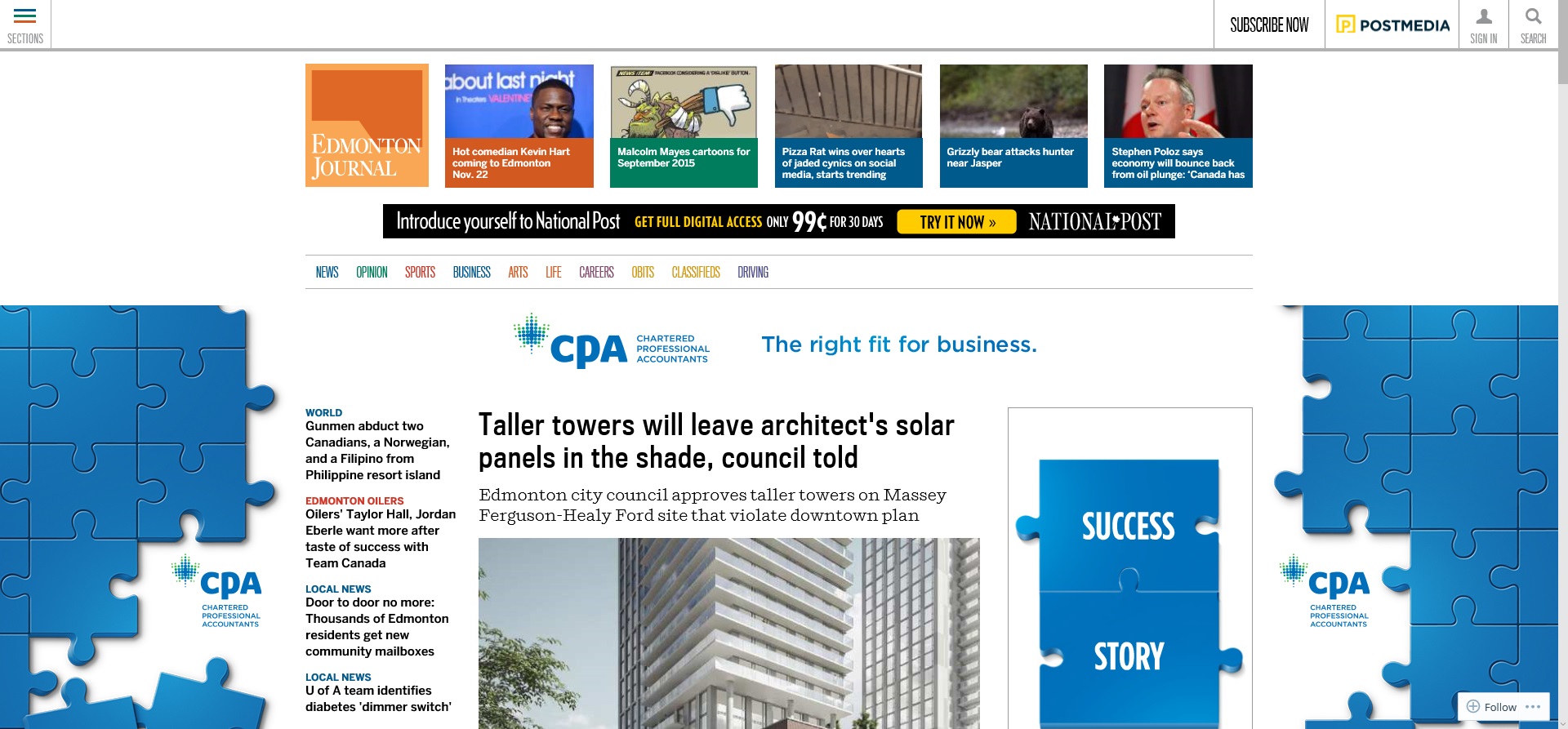
Though there are some very visible changes, a lot has stayed the same also. Stories still use Facebook for comments. You’ll still find a large ad unit at the top and a few ad squares down the right column. And annoyingly, you’ll still get full page ads like this:

ej website

Another thing about that screenshot is that it probably takes you longer than it should to figure out what site you’re looking at! There is no traditional-looking masthead and the square logo isn’t very differentiated from the other squares at the top of the page.

Overall though, I like the changes. The site feels faster, the new story toolbox (with share, comment, print, and font adjust buttons) is much more useful, and even though it’s a hamburger menu I actually am growing to like the section navigator.

The New Print Edition

I don’t regularly read the print edition, but Sharon does. She noted the reorganized (and in some instances renamed) sections and also commented (as others have) that the font seems smaller (though it is actually “a wee bit bigger” but I guess the different typeface could account for the difference). The new print edition was designed “by Postmedia design consultant Gayle Grin, with input from Mario Garcia, the world’s preeminent newspaper designer,” the same folks that worked on the other newspaper redesigns (as you might expect).

New Edmonton Journal

In glancing at the new print edition, it strikes me as more colorful but less local. I’m sure it has just as much local content as before, but the National Post and Financial Post seem to be featured quite prominently (in addition to NP in the Edmonton Journal there’s FP Edmonton which is the new Business section).

The New Apps

The new tablet app is actually the old tablet app as mentioned above, but with a fresh coat of paint. You’ll find the new orange logo and some minor look & feel changes, but that’s it. Everything else is the same as it was before.

New Edmonton Journal

The new smartphone app has changed, however. In addition to the new logo and colors, the app now features a section called “EJ Now” which is intended to “focus on live, local storytelling with content formatted for the small screen and aimed at readers on the move.” It is updated from 6am until midnight. The app is available for iOS and Android, so Windows Phone users like myself have to rely on the responsive website (which is a huge improvement over what we had before).

The New Ad Campaign

I’ll just highlight what was written in the news release for this one:

“The new advertising campaign, “At your fingertips”, is centred on the Edmonton Journal offering a variety of content that matters to Edmontonians and is available on all four platforms. The campaign focuses on both local and generic characters representing content categories such as news, sports, politics, business, arts and life and reinforces the accessibility readers have to the Edmonton Journal’s content. The integrated campaign, developed in collaboration with Sid Lee, starts today.”

at your fingertips

The McDavid finger is cute, but I don’t expect this campaign will last long.

Overall Impressions

I think there are some positive and negative changes with the Journal’s redesign. The faster, responsive website is long overdue and will have a big impact. The print changes don’t seem too controversial, though it remains to be seen how pilots like the National Post insert will fare. I think we could see some great things with the EJ Now smartphone feature, but it’s a shame nothing has been done for the tablet edition.

But with all of these changes the Journal feels less local and unique. And who knows what’ll happen now that the Sun and Examiner are working in the same building. It was very strange to see Sun/Examiner publisher John Caputo walking around with an orange Edmonton Journal pin at the launch event. It’s a brave new world, I guess!

The bottom line with this redesign? It seems that a better experience comes at the expense of local individuality. The Edmonton Journal is Postmedia’s Edmonton Journal, now more than ever before.

Edmonton Notes for 9/20/2015

Here are my weekly Edmonton notes:

Headlines

Edmonton Sunrise
Downtown Sunrise

Upcoming Events

Edmonton Mid Autumn Festival
Edmonton Mid Autumn Festival, photo by IQRemix

How Uber supports Edmonton’s transportation strategy

Uber launched in Edmonton on December 18 last year, and it has been operating here illegally ever since. Now the City has put forward a draft bylaw that aims to provide a framework within which Uber can operate legally, but in a lot of ways it has just become a fight between taxis and Uber. I think this fight has shifted focus away from the bigger picture.

taxis
Taxis on the way to City Hall to protest, photo by Lincoln Ho

Edmonton’s transportation system should always be evolving to meet the needs of Edmontonians. There’s a place for taxis, but there’s also a place for new approaches to transportation like Uber.

The Way We Move, our city’s Transportation Master Plan, states:

“How easily we move through our city, the distances we must travel, the transportation choices we have and how readily we can move between different transportation modes profoundly affects our relationship with the city, the environment and each other.”

In general the strategy focuses on “mode shift” which “is about adding more walking, cycling, car-sharing and transit in Edmonton’s transportation mix.” There’s a consistent goal of offering Edmontonians more options for getting from point A to point B without needing to use their vehicles. The strategy identifies seven goals to help achieve this. Let’s look at how Uber might fit in with those.

Transportation & Land Use Integration

This goal encompasses building so-called complete communities, where people can live, work, and play, reducing the need for driving. It also highlights transit-oriented development and making it possible for people to live closer to great transit service that can get them to where they need to go.

I think carsharing services like Pogo are probably a better fit with this goal, but Uber can play a role too. In fact, they wrote about this earlier in the year:

“What we discovered is that 36% of trips started or ended within 400m of an LRT stop. Of the trips that start or end close to an LRT stop, almost 90% pick up or drop off in an area that isn’t conveniently served by public transit.”

We have a great vision for the LRT Network, but it’s a long way from being completed. Taking a train and Uber together could be a great option until more of the LRT is built out.

Access & Mobility

This goal deals with addressing the transportation needs of a diverse urban population.

“An accessible transportation system addresses the transportation needs of a diverse urban population regardless of mobility challenges or vehicle ownership.”

Believe it or not, Uber does have a story to tell here. The company often talks about the accessibility of its mobile app, which includes features for those with audio or visual impairments. In some cities, they also have UberACCESS, which “offers access to wheelchair-accessible vehicles through partnerships with fleet owners.”

Uber has also started to bring other options to Edmonton, launching uberXL earlier this year which offers spacious, high capacity vehicles.

Regulation will probably be required for this goal more than most, but Uber can play a role in ensuring Edmontonians have accessible transportation options.

Transportation Mode Shift

Though The Way We Move talks primarily about shifting transportation modes from driving to transit and active modes of transportation (cycling, walking), that can be a big shift for people to make. We know that the majority of Edmontonians agree we need to drive less, but they’re somewhat less willing to make the shift themselves.

“In recent research, 84% agreed or strongly agreed with the statement ‘Edmontonians need to reduce driving’. however when this general desire is applied specifically to individuals, the population is essentially split 50/50 into two groups, those who are totally committed to driving and those who are potential experimenters.”

Uber, Pogo, and other services could offer a stepping stone from to the other. Why stay shackled by your car? Take an Uber to get somewhere, but then consider walking or taking transit for your next short trip. It’s incredible how stressful driving is after you haven’t had to do it for a while.

Sustainability

The City has long supported carpooling because it not only can help you to save money, “it’s also an efficient and sustainable way to help reduce road congestion and CO2 emissions.”

Taking Uber still means there’s a car on the road of course, but being a passenger rather than a driver is a step in the right direction (and could mean you’re more likely to use a combination of transportation modes). Uber is not really a rideshare or carpool service, though it does offer a Split Fare feature which can make it even more cost effective and which makes it possible for even more cars to be taken off the road. And that’s important:

“In 2005, the total distance travelled daily by car drivers on the Edmonton region road network was 13 million — this is projected to increase to nearly 50 million kilometers by 2044. by providing less energy intensive transportation options, we have an opportunity to reduce Edmonton’s greenhouse gas emissions.”

I think UberX is a way for us to use our vehicles more efficiently. When discussing the Sustainability goal, the TMP states:

“Promoting the reuse and redevelopment of underutilized facilities that already exist will rejuvenate our neighbourhoods and help to optimize use of infrastructure, including investments in the transportation system.”

Considering that our cars sit parked more than 90% of the time, I’d say they count as “underutilized facilities that already exist”. Why not reuse some of them to drive each other around?

Health & Safety

Obviously Uber isn’t going to do anything for emergency vehicles, nor does it do much to encourage more physical activity. This goal seems to highlight safe walking more than anything.

But on the topic of safety, there has been a lot of discussion about what’s required to ensure Edmontonians are safe taking Uber. The company does highlight background checks, vehicle inspections, and having appropriate insurance. And last week it announced a partnership with Intact Insurance here in Canada.

As I wrote when Uber launched in Edmonton, the company has attracted a lot of controversy. Clearly they have room to improve. But I wonder how many safety incidents happen in taxis all around the world that we never hear about, simply because they’re all so isolated? A safety incident in one city is going to make the news in other markets that Uber operates. I think that greater awareness and visibility into safety issues will result in safer rides for everyone, not less.

Well-maintained Infrastructure

Reducing the number of cars on the road will have a positive impact on the City’s financial sustainability:

“Encouraging fewer single occupant vehicle trips reduces the pressure on the roadway system and reduces the need for increased roadway investment.”

Edmonton’s road network is already more than 4,500 km long. We have about 170 bridges. We spent hundreds of millions of dollars supporting all that infrastructure. Any reduction in stress on those assets is a good thing!

Economic Vitality

Whether we like it or not, Uber, Lyft, and similar services are growing in popularity throughout cities all over the world. It’s easy to think that the advantage of Uber is just the app, and while that is part of it, I think the connection to a bigger network is also an important advantage. If I can use Uber in other cities I visit, why not here?

That mode shift report also discusses this idea:

“We are following the lead of today’s successful cities and creating urban environments that provide a high quality-of-place experience and quality of life for residents in order to attract the best and the brightest to their city. This includes providing the type of sustainable transportation choices that align with international preferences.”

We need to provide a range of options:

“Diversifying the transportation options and more effectively using our current infrastructure are critical to attract businesses for the sake of the economic development of the city as well as to allow an effective exchange of goods and services.”

I think Uber’s claims of job creation are questionable, especially with all the negative press they have received for not looking after their contractors. That said, there are plenty of stories of drivers who have made a positive financial change in their life thanks to Uber.

Wrap Up

The discussion about Uber in Edmonton lately has focused primarily on the fight between taxis and Uber, understandably. Lots of Edmontonians have horror stories to share about taxis, and there’s no question that competition from Uber will have a positive impact on the industry.

But let’s not lose sight of the bigger picture. Uber and other transportation network companies can positively contribute to Edmonton’s transportation mix. We should do what we can to allow them to operate here legally.