Mayor Don Iveson calls on Edmonton investors to get in the game

In his State of the City address (available here in PDF) yesterday at the Shaw Conference Centre, Mayor Don Iveson said there are four crucial “pipelines” that must be established in order to actively shape Edmonton’s economic future. The “export” pipeline, the “investment” pipeline, the “talent” pipeline, and the “innovation” pipeline are what we need for growth in Edmonton.

2018 State of the City Address

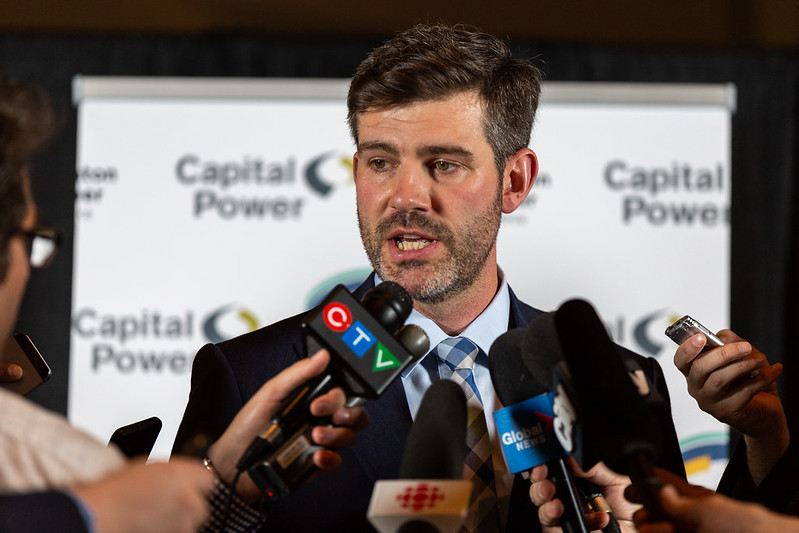
Most of what Mayor Iveson told the packed room was simply a rehash of ideas he and other local leaders have been sharing for years, updated to use the startup language of the day. What was different this time was the very specific audience he was speaking to. It wasn’t a speech for all Edmontonians, or for community leaders, or even for the business community. Yesterday’s speech was targeted squarely at local investors.

“As it stands right now, we don’t have enough local investment committed to our local innovation ecosystem,” Mayor Iveson said. He noted that too much local money is being sent out of the city to be invested elsewhere. “I’d like to change that dynamic.”

We need Edmonton’s investor class to get engaged

Mayor Iveson started by describing Edmonton’s investor class:

“It doesn’t always look like one might expect. It’s not always dressed in bankers’ suits. It’s not always flashy like in other cities. It’s more reserved and quiet. But it’s deeply committed to this community.”

“A lot of you are in the room today,” he said. “You’ve built your companies in dynamic and creative ways, you employ thousands of Edmontonians and you are proud to call this city home.” Mayor Iveson outlined three key reasons why the investor class should invest locally:

  1. “This is very doable,” he told them. “A lot of early-stage companies in Edmonton don’t require cash in the millions.” Instead, typical seed funding requirements are in the tends of thousands.

  2. “More local, private investment will give our innovation ecosystem more rigour.” Compared to institutional investors, private investors put “a premium on commercial viability and outcomes.”

  3. “Investing in the growth of local companies means actively shaping Edmonton’s economic future.” He appealed to their love of Edmonton. “You care about what happens to this community over the long run.”

“There must be a willingness from our community to place some bets on local innovations, on local entrepreneurs, on local talent,” Mayor Iveson said.

There are billions of dollars under management right here in Edmonton, but startup funding remains elusive. As one example, AngelList currently shows 16 investors from Edmonton with only 11 of those having actually made investments. Mayor Iveson mentioned just one seed fund by name, Panache Ventures. The situation is much better than it was back in 2006, but to say there’s room for improvement would be a huge understatement.

“I recognize I’m asking a lot of you, especially in this fragile economic climate,” he said. “But this is Edmonton’s moment, and your city needs your engagement and support more than ever.”

We need a bigger startup funnel

Noting that Startup Edmonton currently assists about 65 companies per year in their startup phase, Mayor Iveson said “we need to drastically increase the number of companies coming into the ecosystem funnel.” By this time next year, the mayor wants “to at least double the number of start-up companies that are assisted on an annual basis.” To do this, he will be asking City Council and both public and private sector parterns “to make sizeable investments” to help expand the size of the startup funnel.

This is a familiar refrain locally, especially in the tech sector. Increasing the number of startups in Edmonton is of course the whole reason for Startup Edmonton, an initiative that Mayor Iveson has long been a supporter of. Many other initiatives in recent years have focused on increasing the number of local entrepreneurs. Even in last year’s State of the City address, Mayor Iveson talked about the need “to focus on how we take local start-ups to the next level — to zero-in on adopting a scale-up mindset and build a scale-up community that helps our small enterprises grow confidently.”

This time, Mayor Iveson reiterated the importance of local investment. Edmonton needs more than just more companies, he said. “It also needs larger amounts of early-stage capital to help our entrepreneurs go from start-up to scale-up and beyond.”
Mayor Don Iveson

We need to hustle

One of the key messages Mayor Iveson focused on was the need to hustle. “Edmonton has experienced incredible external pressures before, and we have always managed to adapt and get by,” but that’s not good enough anymore, he said. Recent trips to San Francisco and Asia showed the mayor just how hard we need to work just to keep up, let alone get ahead. “From the moment you hit the ground in these places, the hustle is on.”

We have heard this before. When Brad Ferguson took over as President & CEO of EEDC in 2012, he was already sounding the alarm about complacency, calling it “our number enemy.”

This time though, the mayor got a bit more specific. “Today, we have one of the best AI research institutions in the world but we risk being outspent and out-hustled by other provinces and other cities,” he said. While there’s a role for government, “there’s also a significant role for local investors and philanthropists.”

We’re a world leader in the science of artificial intelligence, and we need to aggressively build on that.

We need a bigger talent pipeline

More talent is going to be critical for Edmonton’s growth. “We know we have work to do in terms of developing skilled talent — both locally grown, and talent that we attract from elsewhere,” Mayor Iveson said.

Again, this is not new. At the EEDC Impact Luncheon in January 2016, Brad Ferguson told the crowd that “the most important thing we can do is continue to invest in talent.” In September 2014, the Edmonton in a New Light event touched on the same ideas – be less humble, go tell the world, attract people and investment – but used different language. “The opportunity before us is to let the rest of the world in on the secret of why we’re all here,” Mayor Iveson said at the time.

The mayor did announce yesterday a new partnership with EEDC and LinkedIn “to do a deep dive on Edmonton’s talent landscape” to better understand “the kinds of skills we’re missing to grow our innovation ecosystem.” Based on that, the City will craft “an Edmonton story that is compelling, honest and attractive” and that highlights “the incredible quality of life we have here.” Plenty has been written about our city’s branding efforts and missteps, so while I applaud a more data-driven approach, I find it hard to believe this time will be different.

2018 State of the City Address

We need to sell to the world

Mayor Iveson said that for sustained growth in Edmonton, we need more businesses with a focus on exports. “Companies that aren’t satisfied to stay local, but want to scale up and take their product or service to customers around the world,” he said, and cited Stantec, PCL, Yardstick, Showbie, and BioWare as examples of local companies that “opened global markets through relentless quality and ambition.”

This focus on global should be very familiar by now. Shortly after he won the 2013 election Mayor Iveson started using some new language, “innovative” and “globally competitive” in particular. And even then Mayor Iveson was talking about solving local problems and exporting the solutions to the world:

“As problem solvers, we can do our business cleaner, greener, cheaper, faster and safer – and sell those solutions to the world. This is how we will ensure that Edmonton will compete globally, and endure long into the future, no matter the price of oil.”

He mentioned the new direct flight to San Francisco as one of the ways to enable more exports. “Although we’re in a digital world, the face-to-face meeting is still a vital commodity when it comes to engaging advisors, connecting with partners and making deals,” he said. The flight will be “a tremendous enabler for more Edmonton-made businesses, with global ambitions, to reach beyond Canada.”

We need to use the City as a lab

After talking about the challenges the City faces, Mayor Iveson said “I want to take the burgeoning community of technology minds in our backyard and unleash them on those City problems.” Earlier this month he introduced a motion to have City Administration outline a draft policy or program to make this a reality. And he said he would pursue a “Startup in Residence” program to connect startups with local government.

As early as 2009 the City was trying and failing to accomplish this goal, first with the Leveraging Technical Expertise Locally program. In his 2015 State of the City address, Mayor Iveson talked about Open Lab, “a new partnership with Startup Edmonton that aims to solve municipal challenges in a more entrepreneurial way.” It sounded promising, but it has gone nowhere, and the City even took down its web page about the program.

“Let’s actively shape Edmonton’s economic future by leveraging our local tech talent to help make our established companies become as competitive and innovative as they can be,” the mayor said. He talked about his idea for an “Innovation Hub” downtown, a place to bring together “entrepreneurs, service providers, mentors, investors, talent and business experts in an environment specifically designed to encourage the creation and growth of companies.” In contrast to the manufactured office parks seen elsewhere, the mayor promised it would reflect “Edmonton’s lifestyle where innovation, entrepreneurship, the arts, creativity and vibrant urban life intersect.”

Mayor Don Iveson

Growing Edmonton’s economy is the focus

Mayor Iveson made growing the economy a key election promise last year, so it makes sense that economic development was his focus for this year’s State of the City. Earlier this month he released a report on the Mayor’s Economic Development Summit, and his remarks yesterday built on that. Again, none of the ideas are particularly new, but perhaps by better involving local investors they’ll have a much greater chance of success.

“Edmonton is ready for this,” the mayor said. “Ready to get off the bench and play at a global level.”


Edmonton Notes for May 20, 2018

Here are my weekly Edmonton notes:

Headlines

NAIT, Kingsway LRT Stations

Upcoming Events

Ice district Edmonton June 2018
Ice District Edmonton, photo by jasonwoodhead23

Thanks for reading! Want to support my blog? Buy me a coffee!

Recap: PodSummit 2018

I was really glad to have had the opportunity to attend PodSummit 2018 on Saturday, May 5 at CKUA in downtown Edmonton. About 100 “podcasters and the podcast-curious” attended the event to learn about starting a podcast, making it sound amazing, growing an audience, and creating content that listeners will love. Organized by Ernest Barbaric, the sold out event featured six sessions punctuated by ice-breakers and other fun activities. Every single talk was interesting and informative, so well done to the organizers and speakers on knocking it out of the park!

PodSummit

Before I share some of my notes from the day, you might be wondering why I (as primarily a blogger) would attend an event about podcasting!

My podcasting story

I started a podcast in 2013 with Graham Hicks called Mack & Cheese. We published 59 episodes before calling it quits and moving on to other projects. But my history with podcasting goes back much further, to 2004 when I launched a podcast called Blogosphere Radio before we even called them podcasts (we just called it a show). That helped me to see an opportunity, and in 2006 I launched Podcast Spot, a hosting service for podcasters. We ended up shutting it down a couple of years later.

Reflecting in October 2008 on what I might have done differently, I wrote:

“There’s a ton of things I might have done differently, but two things in particular: I would have avoided using the word “podcast” in the name of our service; and, I would have focused on sharing audio and video for a specific niche.”

At the time, podcasts were very associated with the iPod, and they were fairly difficult to work with. You still had to plug your device into a computer to sync the audio files! It was far from certain that podcasting would take off. Today it seems almost silly to question the success of podcasting, given the popularity of podcasts like Serial and The Daily, the latter of which apparently averages about 1 million listeners a day (and I am one of them).

Here’s what we learned at PodSummit

PodSummit reflected the current state of podcasting with a much more diverse audience than the geeks and old white guys that were common a decade ago. There was a good mix of podcasting vets and newbies.

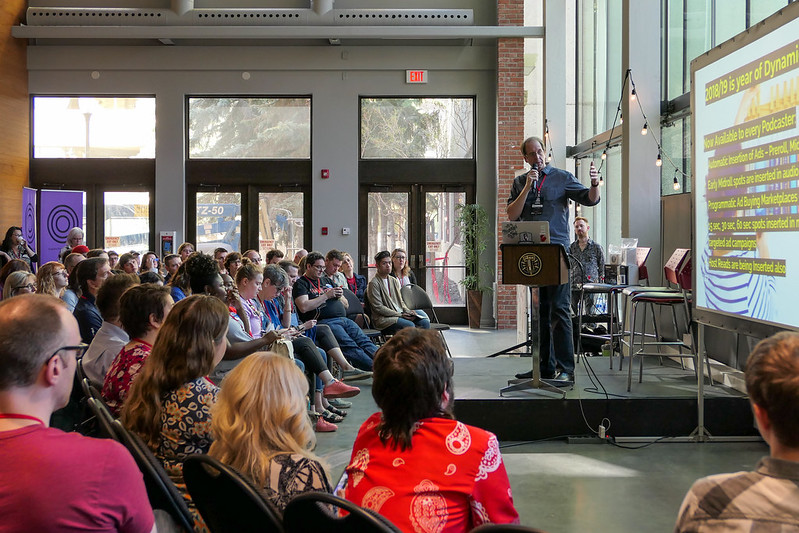
The day started with Rob Greenlee‘s State of the Podcasting Union. He noted there has been “steady growth” but thanks to media coverage there’s “a perception that things are exploding.” Rob cited The Infinite Dial Canada, a new study of consumer behavior and media consumption, and noted that 61% of Canadians 18+ are familiar with the term podcast. There are something like 525,000 podcasts in existence, about half of which are active, with maybe 2,000 new ones added each month. The number of listeners for all of those podcasts could get much bigger in the months ahead as both Google and Spotify are ramping up their activities in the space. Rob finished by suggesting that dynamic ad insertion will be a big thing for podcasting in the year ahead.

PodSummit

Next up was Roger Kingkade who shared tips on how to design a successful podcast. “People will listen,” he said, noting that both David Letterman and Howard Stern amassed large audiences even though their topics don’t at first seem that interesting. “You are what will connect with the audience.” Here are his tips for podcasting success:

  • Your topic should be about someone else’s problem or interest. Start from a place of servitude, and know you’re filling a gap in your listener’s life.
  • You can find an existing community and learn about their wants and needs, then answer their questions on your podcast.
  • Make a perspective statement, and run every episode through it, to ensure that you stay on track.
  • Think about your approach: will be you be the Jedi teacher, the explorer, or the guide?
  • Ask your audience for ratings and reviews – they’re much more likely to do it if you ask!
  • You need to be consistent. Roger recommends recording a bunch of episodes before you launch, and publish the first three right away, to help develop a rapport with your audience.

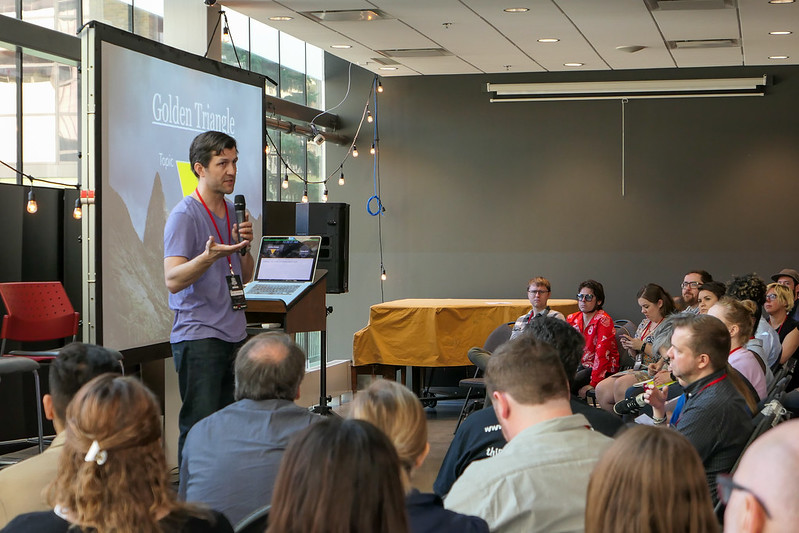
Topic, Audience, and Perspective form the golden triangle for your podcast, he said. Roger suggested planning your podcast (one tool you could use is Karen’s Podcast Canvas) to ensure you focus on answering the right questions.

PodSummit

The final session of the morning was from Andrea Beça, who shared her tips on growth & promotion strategies. She echoed the importance of fulfilling a need or solving a problem with your podcast. “Podcasts are not an ‘if you build it they will come’ kind of thing,” she told us. It takes work, and you will put “way too many” hours into creating your podcast! Building your community is key to building your podcast, and Andrea shared a number of useful suggestions like choosing the right social media channels for your audience, thinking about visuals to help promote your work, and keeping tabs on previous guests to support them (and have them support you back). Speaking of guests, Andrea said to choose them wisely, and noted that the first 40 listeners will do more for you than your next 400, so honor them! She also said it is ok to reference past episodes, something that too many people are surprisingly reluctant to do. “Don’t let your content die,” she said.

PodSummit

I skipped lunch, but I understand that Ernest himself gave a great talk on how to start a podcast.

After lunch we heard from Mike Russell, who gave a masterclass on editing and production. His tool of choice is Adobe Audition, so that’s what he used to illustrate his tips:

  • Don’t edit out every pause or breath, otherwise it’ll sound unnatural.
  • Start with good audio – you can’t fix a terrible recording!
  • Don’t worry about mistakes: just be you.
  • You can make a voice sound better using the parametric equalizer tool.
  • You can also compress a voice a little, which will even out the loud and quiet parts of your voice.
  • You can add a noise gate to help get rid of background noises.
  • Use ripple deletes to trip an edit without leaving a gap.
  • If you’re interviewing someone via Skype, adaptive noise reduction can be very useful.

Mike was a great presenter, and I loved the approach he used, handing off to his pre-recorded self to demo things.

PodSummit

Next up was Andreas Schwabe who spoke about the art of podcasting. He’s a former teacher at NAIT and was the Director of Digital Media for the Oilers. He had some fantastic tips and suggestions:

  • Sound like you mean it!
  • Planning ahead is key. Reinforce the three phases: what you’re going to tell them, tell them, then recap it.
  • Writing for the ear is a different thing than normal writing. You can find this out by recording yourself and then transcribing the audio.
  • Keep it short using declarative sentences.
  • Avoid cliches like Monday soup. (Because the Friday leftovers go into the Monday soup!)
  • Play with turns of phrase. “You can lead a chicken to ice but you can’t make it skate.”
  • Sound provides a lot of information, including location, speed, material, mass, and density.
  • You can convey a lot with your voice through pacing, tension, etc.
  • Talk to an audience of one, not many.
  • Refer to events rather than dates or times, and rough figures rather than exact numbers (unless you need to be specific for a reason).
  • Identify your crutches like “so” or “ok” or “um” and work to reduce them.
  • Listen to lots of podcasts to find out what you hate about them so you can avoid that in your own podcast!
  • Remember that no one sets out to make a bad podcast.

Such a fantastic talk.

PodSummit

The final session of the day was a monetization campfire chat featuring Andrea Beça, Erika Ensign, and Karen Unland. It was a great chat on the three legs of the podcast monetization stool: sponsorship/ads, listener support, and feeding your business. They noted the chances are good that while you might earn enough to cover your costs, earning enough to cover your time is a whole other thing. The fact is, many podcasts are labors of love.

Wrap-up

As mentioned there were some great activities throughout the day, like Podcast Bingo. It was a fun way to move around the room meeting other people and learning a thing or two about them or their podcast. I also liked the Pitch It Forward activity that Karen from the Alberta Podcast Network hosted, which got people to pitch other people’s podcasts!

It’s really encouraging to see such a strong podcast community here in Edmonton. If you’re pod-curious, I encourage you to check out the Edmonton Podcasting Meetup. And if you’re looking for some great local podcasts to listen to, be sure to read the Alberta Podcast Network’s regular roundups.

PodSummit

Congratulations to Ernest, his wife, their adorable daughter, and all of the other volunteers on hosting such a useful and successful event!

You can see the rest of my photos here.

Edmonton Notes for May 13, 2018

Happy Mother’s Day! This one is special.

Here are my weekly Edmonton notes:

Headlines

  • Thales Canada fired back at the City of Edmonton this week saying “a big challenge is education, fundamentally.” Thales vice-president Dave Beckley said “it’s at all levels of the organization.” They have submitted a new schedule for review, which the City is evaluating.
  • City of Edmonton Chief Economist John Rose says Edmonton’s economy should continue growing as long as the Province avoids deep spending cuts. “We have already seen the leader of the UCP (Jason Kenney) talking about significant reductions in provincial expenditures, so that could be very negative in terms of the outlook, but right now, modest growth.”
  • The City received 12 formal submissions and 50 ideas on developing the Northlands Coliseum lands. The next step is to review the submissions and explore “a list of viable, innovative ideas that best realize the project’s potential and guiding principles.”
  • Clare Drake, “the legendary University of Alberta coach known as the winningest college hockey coach ever,” died today at the age of 89.
  • The City of Edmonton’s proposal in the $50 million Smart Cities Challenge has been officially accepted by Infrastructure Canada. “Edmonton’s proposal makes the case for an innovative Healthy City Ecosystem of residents, post secondary institutions, research organizations and governments united to provide meaningful and efficient health services to people.” You can read the submission here.
  • Joy Lakhan is the City of Edmonton’s new GoatWorks coordinator. “I’m both humbled and excited to work in this position,” she said. You can look forward to “Meet and Bleat” events this summer!
  • Edmonton’s Borden Park Pavilion won a Governor General’s Medal in Architecture and is another example of how architecture in our city is improving. “I think the whole culture of architecture in Edmonton is really … frankly, it’s become interesting to the rest of the country,” Pat Hanson said.
  • Jay Esterer, who bought the Edmonton Queen riverboat two years ago, has received regulatory approval to operate for the next two summers. “I think it showcases the river valley. It gets more people down on the river and it’s really beautiful here.”
  • Could colorful crosswalks enhance safety in our city? The idea came up recently from Child Friendly Edmonton and Councillor Aaron Paquette thinks it could really make a difference.
  • Organizers for the 2018 Grey Cup Festival, taking place right here in Edmonton in November, are looking for 1,000 volunteers to help out with activities like the zipline, which is coming back, bigger and better than last time!
  • Edmonton Fire Rescue Services planned to visit 350 homes in Eastwood and Alberta Avenue over the weekend to install combination carbon monoxide/smoke detectors. “Since the Smoke Alarm Program began in 2007, EFRS has provided close to 7,000 smoke alarms.”
  • ICYMI: Here’s my recap of the topping off ceremony for the new JW Marriott Edmonton ICE District.
  • Mark Messier was among the 45 Canadians invested into the Order of Canada this week.
  • From Explore Edmonton, here are your Summer Must-Dos in Edmonton. They made a video too.
  • For more recent headlines, check out ShareEdmonton.

Commonwealth Stadium & Northlands Coliseum

Upcoming Events

Edmonton Playground
Edmonton Playground, photo by Kurt Bauschardt

Thanks for reading! Want to support my blog? Buy me a coffee!

Recap: AccelerateAB 2018

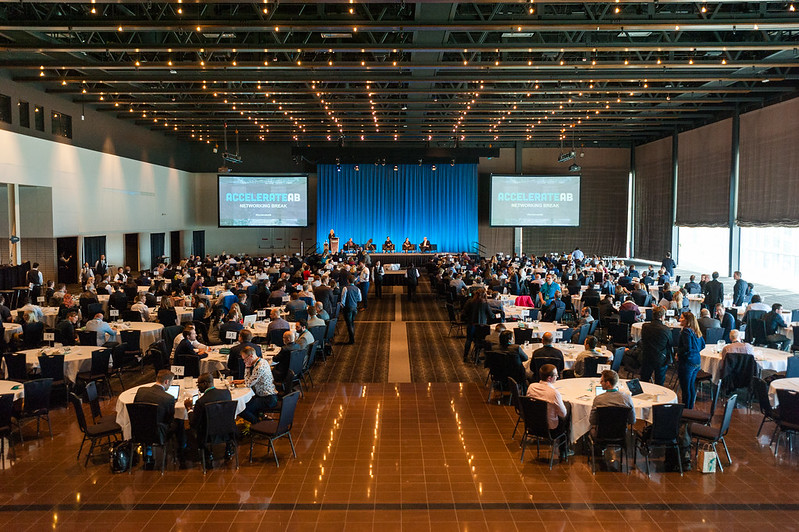
AccelerateAB 2018 took place in Edmonton on April 24. The sold-out conference explored the theme of artificial intelligence and machine learning. As A100 Executive Director Cynthia van Sundert said in her message to attendees:

“Our province is home to some of the world’s leading thinking, research, and startups around A.I. It is fortuitous that this year’s event is being held in Edmonton, where the world famous Alberta Machine Learning Institute (Amii) – the global academic leader in A.I. – is located within the University of Alberta.”

The annual conference alternates between Edmonton and Calgary, and always draws an interesting mix of leaders, investors, influencers, and entrepreneurs. The 450-ish in attendance at the Shaw Conference Centre this year were treated to an opening keynote from Scott Penberthy, Google’s Director of Applied AI, a series of AI-related panels, and a closing keynote with Dr. Richard Sutton, a Research Scientists with DeepMind at the University of Alberta.

AccelerateAB 2018
Photo by Pinstripe Productions

EEDC’s Cheryll Watson brought opening remarks, and encouraged everyone to “think of ways for Edmonton and Calgary to work together.” She spoke about having “an Alberta mindset” to be more competitive globally than just thinking about the two cities independently.

Rise of Software 2.0

Scott Penberthy opened his talk with some personal history, telling us how he was inspired by Marvin Minsky and Richard Stallman. It wasn’t long though until he was talking about scalars, vectors, tensors, matrices, and more. It was a bit technical for some in the audience I’m sure, but it served as a nice setup to the central premise of his talk: what if you could do math on thought?

“Artificial intelligence is an over-hyped but under-appreciated change,” he told the crowd. Noting that computing power has improved by a billion-fold since 1958, Penberthy highlighted some of the key advances in AI in recent years, including beating humans at image recognition in 2012 and winning at Go in 2016. He cited Ray Kurzweil’s Law of Accelerating Returns to help illustrate why further advances in AI will come more rapidly (and mentioned this video about a rock). Penberthy talked about AutoML, which is basically AI creating AI, as one such advance. He also showed some charts from the popular and accessible Wait But Why series on AI to really drive home the possibilities before us.

AccelerateAB 2018
Photo by Pinstripe Productions

“AI is going to be like having a database,” he said. “Soon every business will have this.” Penberthy devoted a good chunk of his time to explaining how AI will help businesses to be more competitive. He touched on TensorFlow, Google’s open source library for dataflow programming, and encouraged the audience to just start playing with the great tools that are now available. “Don’t build it from scratch, leverage existing AI technologies so you can focus on your differentiation,” he said. Kaggle is a good place to start, he suggested.

I appreciated Penberthy’s overview of AI, and also that he called out the success we’ve had here in Alberta in the field. “Canada saw it when no one else saw it.”

Key Takeaways: Panel Sessions

There were two AI-themed panels throughout the day: The Fundamentals of Artificial Intelligence and An Entrepreneurial Journey with Artificial Intelligence. Here are some key takeaways I noted:

  • AI is a very broad term, and machine learning is just one technique.
  • AI is at the nexus of many disciplines and fields, and provides us with techniques for intelligently making decisions using data.
  • Machine learning is useful when it is impossible to hard code a decision or when things are constantly changing, like in the real world.
  • Machine learning will find patterns in your data, but you can’t make inferences about the data that you don’t have.
  • You need to know why the data is important for the decision you’re trying to make.
  • Successful AI projects need both a well-defined problem and data in a usable format.
  • Opportunities include biomedical advances and personalized medicine, automation of boring, repetitive, and dangerous jobs, and ways for humans and machines to work better together.
  • The reason we have so much opportunity is because of the hardware – we simply didn’t have the power in the past.
  • Edmonton is the best place in the world to start a machine learning company!

AccelerateAB 2018
Photo by Pinstripe Productions

In the afternoon, the always popular Scaling Eff-Ups panel took place. Some key takeaways from that session:

  • Building a business is one of the most intense things you can do.
  • If you’re not making mistakes then you’re not reaching high enough.
  • Every industry is surrounded by patents so you need to do your homework.
  • Pay attention to the people around you and take action, but know that loyalty can be good too.

Much of the insight from the final panel could actually be boiled down to team selection. Many of the “eff-ups” the entrepreneurs discussed involved a member of the team who was selected hastily or who otherwise was not a good fit for the business.

Startup Pitches

The afternoon featured the startup pitch competition, a staple at the conference. There were pitches from 8 startups this year:

  • Fitset: “Experience fitness freedom with easy access to just about every studio & gym in Edmonton with Fitset.”
  • IronSight: “A service-hailing technology that strengthens the link between B2C through data-driven dispatching.”
  • MicroMech: “Redefining the auto service industry by sending auto mechanics directly to a customer’s door.”
  • Mikata Health: “Built a system sing machine learning that helps doctors and their administration teams to eliminate 1-2 hours of data entry each day.”
  • Paytickr: “A cloud-based service for small business that has combined time tracking and payroll distribution services into one platform.”
  • Skillpics: “A rich networking community where students can showcase their experience, portfolios, resumes and skills to potential employers.”
  • Symend: “A FinTech company that is successfully implementing recovery strategy by combining workflow and campaign automation with proven approaches in behavioural science.”
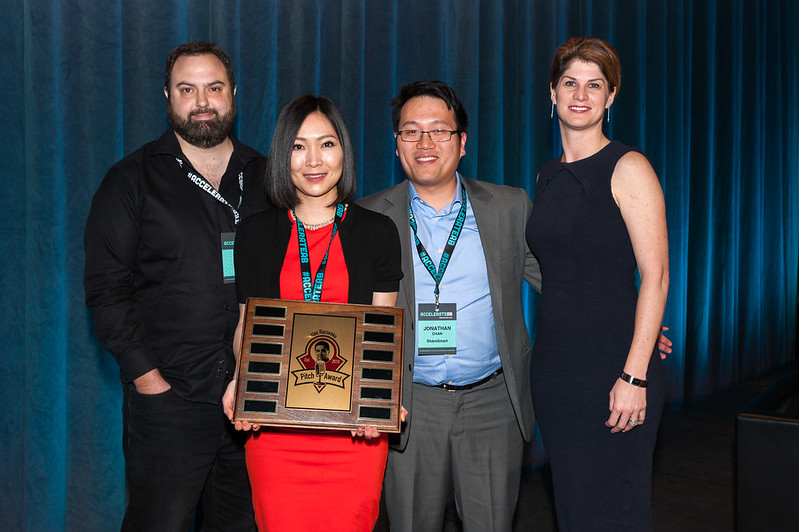
  • ShareSmart: “Mitigating costly healthcare data breaches with a system that allows healthcare professionals to take and share patient information securely.”

Each entrepreneur had a few minutes to deliver their elevator pitch, followed by a few minutes for questions from the three judges: James Keirstead, Kristina Milke, and Peter Calverley.

AccelerateAB 2018
Photo by Pinstripe Productions

Congratulations to ShareSmart on being named the winner! They took home more than $15,000 in cash and prizes, including a $10,000 micro-voucher from Alberta Innovates.

Wrap-up

I previously wrote about Dr. Richard Sutton’s closing keynote on how Edmonton is a world leader in the science of artificial intelligence. You can also check out this Twitter thread on his talk fro Alex Kearney.

Our city’s leadership position in the field (and indeed, Alberta’s) is a key strength that we need to be proud of, and to leverage. It was great to see AccelerateAB shine a light on this. You can find out more about Edmonton’s AI pedigree at Edmonton.AI, a community-driven group with the goal of creating 100 AI and ML companies and projects.

AccelerateAB 2019 will be taking place in Calgary. Follow them on Twitter for updates!

Recap: DemoCamp Edmonton 41

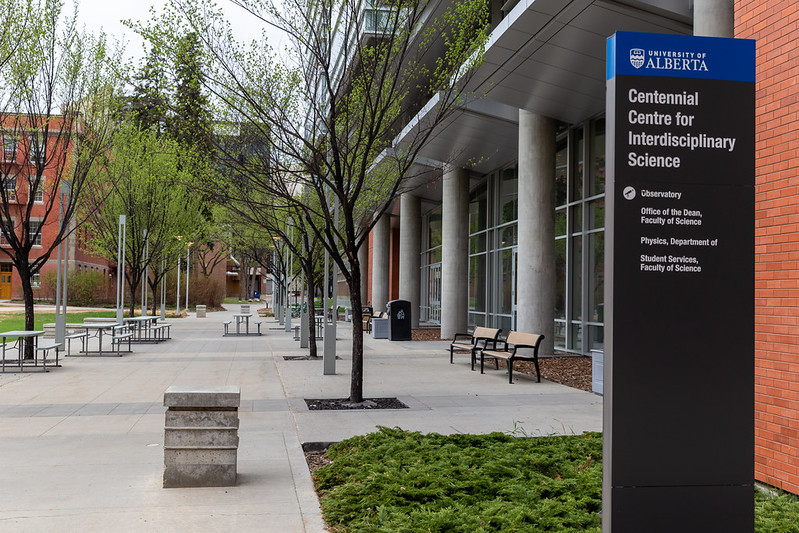
Edmonton’s 41st DemoCamp took place last night at the Centennial Centre for Interdisciplinary Sciences (CCIS) on the University of Alberta campus. You can see my recap of DemoCamp Edmonton 41 here.

Centennial Centre for Interdisciplinary Science

If you’re new to DemoCamp, here’s what it’s all about:

“DemoCamp brings together developers, creatives, entrepreneurs and investors to share what they’ve been working on and to find others in the community interested in similar topics. For presenters, it’s a great way to get feedback on what you’re building from peers and the community, all in an informal setting. Started back in 2008, DemoCamp Edmonton has steadily grown into one of the largest in the country, with over 200 people attending each event. The rules for DemoCamp are simple: 7 minutes to demo real, working products, followed by a few minutes for questions, and no slides allowed.”

It was one of the quickest DemoCamps in recent memory – I guess everyone wanted to get to drinks! We had five demos, in order of appearance:

Paulie Blart is a Raspberry Pi-based robot that was built for the SF Hacks hackathon in just 24 hours – and it won! The robot uses IBM’s Watson services to do facial recognition and when an intruder is detected, it can send you a text that includes a picture of the intruder. The robot can also be controlled by sending it a “start” or “stop” text message. Cool stuff! In his post about the win, Megnath wrote: “A special thanks to the talented and vibrant Edmonton tech community (Startup Edmonton, UofA CompE Club, etc) for organizing local hackathons and encouraging students like me to aim bigger.”

The Bylaw Infraction Dashboard uses open data from the City of Edmonton’s open data catalogue to visualize bylaw infractions. The dashboard includes a number of visualizations and they’re connected – so you can slice and dice the data by clicking on one visualization and seeing the rest update. It reminds me a lot of the way that Power BI can work. I enjoyed Michael’s story about seeing other data visualizations and getting inspired to build his own. Whether he realized it or not, his demo was a good commercial for the open data catalogue too!

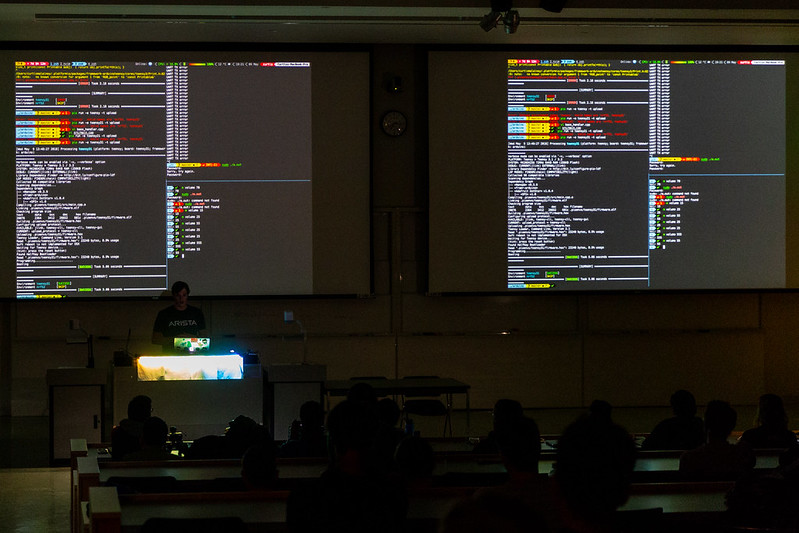
Go With the Flow is a fun project that controls an LED light strip based on the audio coming from your computer. Each LED represents a single frequency, so as the sound changes, the lights get brighter or dimmer, and the color changes. Curtis demoed it with some music and also the Avengers Infinity War trailer. Always fun when we get to turn the lights down at DemoCamp.

DemoCamp Edmonton 41

IdyaFlow is software for peer-to-peer marketplaces. It’s not another place to list your couch for rent, but it can help you build the site on which you might do that. If you have a community of buyers and suppliers, then IdyaFlow can provide the technology to help you connect them. It has a focus on real-time messaging to help facilitate those community interactions. At first I was wondering if there’s actually a market for this, but when you think about it, there are hundreds of “Uber for X” type businesses, and they all have more or less the same technical requirements/features. So building a generic backend that can service them all just might work.

I think Rewardful has a lot of potential, and I am eager to see how it evolves. The service provides “a simple way for SaaS companies to setup affiliate and referral programs with Stripe.” Currently it supports a commission-based approach, but there are plans to add other possibilities like extending an existing subscription or flat referral fees. There are some companies in this space already, but if Rewardful can keep it simple and developer-friendly (like Stripe itself) I think there’s plenty of opportunity.

I always enjoy when there are a mix of hardware and software demos, and also experiments or “for fun” projects vs. actual businesses.

Here are some upcoming events to note that were mentioned in-between demos:

See you at DemoCamp Edmonton 42 in September!

Edmonton Notes for May 6, 2018

Here are my weekly Edmonton notes:

Headlines

JW Marriott Hotel and Stantec Tower
JW Marriott Hotel and Stantec Tower, photo by Kurt Bauschardt

Upcoming Events

LRT Construction at the Harbin Gate

Thanks for reading! Want to support my blog? Buy me a coffee!

Edmonton Notes for April 29, 2018

Here are my weekly Edmonton notes:

Headlines

Downtown Edmonton
Downtown Edmonton

Upcoming Events

Urban Barn
Urban Barn, photo by Kurt Bauschardt

Thanks for reading! Want to support my blog? Buy me a coffee!

Edmonton is a world leader in the science of artificial intelligence

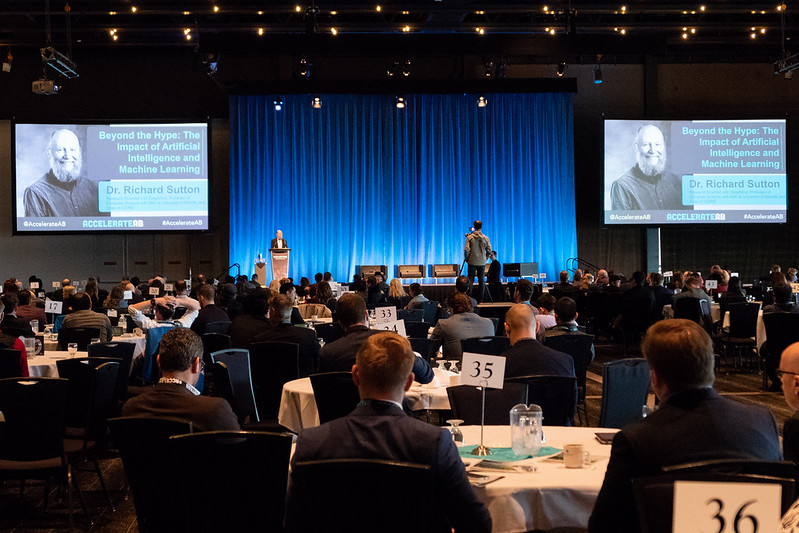
Though he works in perhaps the most hyped field of science there is, Dr. Richard Sutton comes across as remarkably grounded. I heard him described at the 2018 AccelerateAB conference on Tuesday as “the Wayne Gretzky of artificial intelligence” and he’s often called a global pioneer in the field of AI. Sutton has spent 40 years researching AI and literally wrote the textbook on Reinforcement Learning. But he spent the first part of his closing keynote discussing the tension between ambition and humility. “It’s good to be ambitious,” he told the audience tentatively. “I’m keen on the idea of Alberta being a pioneer in AI.” But he tempered that by discussing the risk of ambition turning to arrogance and affecting the work of a scientist.

AccelerateAB

“I think you should say whatever strong thing is true,” he said. Then: “Edmonton is a world leader in the science of AI.”

Sutton made sure to highlight the word “science” and noted that we fall behind when it comes to the application of AI. And of course, he backed up his claim with sources, citing DeepMind’s decision to open an international AI research office here at the University of Alberta, and pointing to the csrankings.org site which ranks the U of A at #2 in the world for artificial intelligence and machine learning.

So how did Edmonton come to be such a leader?

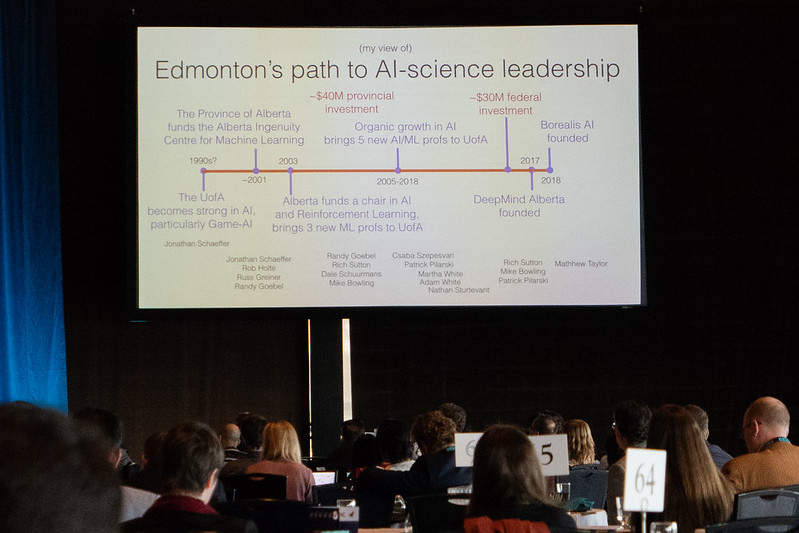
It started with Jonathan Schaeffer’s work in the 1990s on Chinook, the first computer program to win the world champion title in checkers. The U of A’s growing expertise in game AI helped to attract a number of AI/ML professors and funding from the provincial and federal governments throughout the early 2000s. Edmonton’s rise to AI prominence was cemented with DeepMind’s recent decision to locate here.

Sutton showed the following timeline to help illustrate Edmonton’s path to AI-science leadership:

AccelerateAB

Sutton then outlined some of the key advances that have happened in the field of artificial intelligence over the last seven years:

  • IBM’s Watson beats the best human plays of Jeopardy! (2011)
  • Deep neural networks greatly improve the state of the art in speech recognition, computer vision, and natural language processing (2012-)
  • Self-driving cars becomes a plausible reality (2013-)
  • DeepMind’s DQN learns to play Atari games at the human level, from pixels, with no game-specific knowledge (~2014)
  • University of Alberta program solves Limit Poker (2015) and then defeats professional players at No-limit Poker (2017)
  • DeepMind’s AlphaGo defeats legendary Go player Lee Sedol (2016) and world champion Ke Jie (2017), vastly improving over all previous programs
  • DeepMind’s AlphaZero decisively defeats the world’s best programs in Go, chess, and shogi (Chinese chess), with no prior knowledge other than the rules of each game

Though the research taking place here in Edmonton and elsewhere has helped to make all of that possible, “the deep learning algorithms are essentially unchanged since the 1980s,” Sutton told the audience. The difference, is cheaper computation and larger datasets (which are enabled by cheaper computation). He showed a chart illustrating Ray Kurzweil’s Law of Accelerating Returns to make the point that it is the relentless decrease in the price of computing that has really made AI practical.

“AI is the core of a second industrial revolution,” Sutton told the crowd. If the first industrial revolution was about physical power, this one is all about computational power. As it gets cheaper, we use more of it. “AI is not like other sciences,” he explained. That’s because of Moore’s Law, the doubling of transistors in integrated circuits every two years or so. “It feels slow,” he remarked, and I found myself thinking that only in a room of tech entrepreneurs would you see so many nodding heads. “But it is inevitable.”

Given this context, Sutton had some things to say about the future of the field:

  • “Methods that scale with computation are the future of AI,” he said. That means learning and search, and he specifically called out prediction learning as being scalable.
  • “Current models are learned, but they don’t learn.” He cited speech recognition as an example of this.
  • “General purpose methods are better than those that rely on human insight.”
  • “Planning with a learned model of a limited domain” is a key challenge he sounded excited about.
  • “The next big frontier is learning how the world works, truly understanding the world.”
  • He spoke positively about “intelligence augmentation”, perhaps as a way to allay fears about strong AI.

Recognizing the room was largely full of entrepreneurs, Sutton finished his talk by declaring that “every company needs an AI strategy.”

I really enjoyed the talk and was happy to hear Sutton’s take on Edmonton and AI. It’s a story that more people should know about. You can find out more about Edmonton’s AI pedigree at Edmonton.AI, a community-driven group with the goal of creating 100 AI and ML companies and projects.

If you’re looking for more on AI to read, I recommend Wait But Why’s series: here is part 1 and part 2.

Edmonton Notes for April 22, 2018

Here are my weekly Edmonton notes:

Headlines

105th
105th, photo by Kurt Bauschardt

Upcoming Events

Funicular Elevator

Thanks for reading! Want to support my blog? Buy me a coffee!