Your Guide to Summer Festivals & Events in Edmonton: 2016 Edition!

It looks like summer is here to stay, and that means it’s time for my listing of summer festivals & events, powered by ShareEdmonton. Below you’ll find dozens of events with a website, dates, and links to social media for each. You’ll also find a link to the event at ShareEdmonton and a link to an iCal for the event. I hope you find this listing as useful as I do.

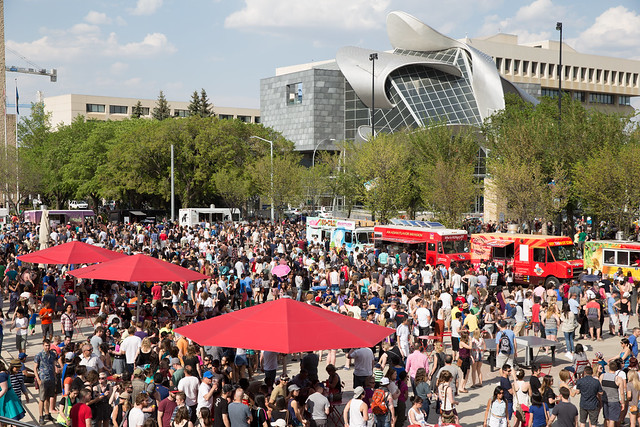
What the Truck?! at Churchill Square

Festivals

Here’s my list of 50+ festivals and events you can look forward to this summer in and around Edmonton!

Event Dates Links
NUOVA Opera & Music Theatre Festival May 21 – July 3 SE  
TALES Storytelling Festival May 26-29 SE
What the Truck?! May 28/29 & more! SE
Edmonton International Cat Festival May 28 SE
Oliver Community Festival May 28 SE
International Children’s Festival May 31 – June 4 SE
Bikeology Festival (Bike Month) June 1-30 SE
NextGen Month June 1-30 SE
Nextfest June 2-12 SE
Park After Dark June 3 – September 2 SE
Edmonton Craft Beer Festival June 3-4 SE
Edmonton Pride Festival June 3-12 SE
100In1Day Edmonton June 4 SE
Edmonton Pride Parade June 4 @ 11am SE
Bonnie Fest June 4 SE
eek! Comic & Pop Culture Fest June 4-5 SE
Heart of the City Festival June 4-5 SE
Sprouts New Play Festival for Kids June 4-5 SE
Edmonton Filipino Fiesta June 11-12 SE
Improvaganza June 15-25 SE
Latitude 53 Patio Series June 16 – August 25 SE
Mercer Summer Super Party June 17 SE
Beaumont Blues & Roots Festival June 17-19 SE
Porkapalooza BBQ Festival June 17-19 SE
Highlandia Festival June 18 SE
Summer Solstice Festival June 20-28 SE
Freewill Shakespeare Festival June 21 – July 17 SE
Slide the City June 23 SE
The Works Art & Design Festival June 23 – July 5 SE
Found Festival June 23-26 SE
Edmonton International Jazz Festival June 24 – July 3 SE
Feats Festival of Dance June 27 – July 10 SE
Canada Day July 1 SE
Sand on Whyte July 1-10 SE
Historic Festival & Doors Open Edmonton July 3-10 SE
Lawn Summer Nights July 7-28 SE
Whyte Avenue Art Walk July 8-10 SE
Edmonton International Street Performers Festival July 8-17 SE
Seven Music Festival July 9 SE
Taste of Edmonton July 21-30 SE
Canadian Food Championships July 22-24 SE
Interstellar Rodeo July 22-24 SE
K-Days July 22-31 SE
K-Days Parade July 22 @ 10am SE
Servus Heritage Festival July 30 – August 1 SE
Rock’n August August 2-6 SE
Edmonton Folk Music Festival August 4-7 SE
Animethon August 5-7 SE
Cariwest August 5-7 SE
Cariwest Parade August 6 @ 12pm SE
Edmonton Airshow August 6-7 SE
Edmonton International Fringe Theatre Festival August 11-21 SE
Edmonton Rock Music Festival August 12-13 SE
Edmonton Latin Festival August 13-14 SE
Edmonton Dragon Boat Festival August 19-21 SE
Edmonton Blues Festival August 19-21 SE
Symphony Under the Sky August 26-28 SE
Viva Italia Viva Edmonton August 28 SE
Tour of Alberta September 1-5 SE
SONiC BOOM September 3-4 SE
Kaleido Family Arts Festival September 9-11 SE
Strathearn Art Walk September 10 SE
Edmonton Comic & Entertainment Expo September 23-25 SE
Edmonton Oktoberfest Sept 30 – Oct 1 SE

You can check out a calendar view of festivals here or you can download the iCal feed for your own apps.

Markets

This year I have also decided to include a listing of the many markets you can find around Edmonton! Some are open year-round, but many are just open for the summer, usually from late May/early June to late September/early October.

Event Dates Links
Beverly Towne Farmers’ Market Tuesdays, 4-8pm SE
Miller Crossing Farmers’ Market Tuesdays, 4-8pm
Sundays, 10am-3pm
SE
Callingwood Farmers’ Market Wednesdays, 2-6pm
Sundays, 10am-3pm
SE
Castle Downs Farmers’ Market Wednesdays, 4-8pm SE
Sherwood Park Farmers’ Market Wednesdays, 4-8pm SE
Southwest Edmonton Farmers’ Market Wednesdays, 4-7:30pm SE
124 Street Grand Market Thursdays, 4-8pm SE
Millwoods Farmers’ Market Thursdays, 5-8pm SE
Salisbury Farmers’ Market Thursdays, 4-7:30pm SE
Westmount Farmers’ Market Thursdays, 10am-4pm SE
Night Market Edmonton Fridays, 7-11pm SE
YEG Market District Fridays, 4-8pm SE
City Market Downtown Saturdays, 9am-3pm SE
Old Strathcona Farmers’ Market Saturdays, 8am-3pm SE
South Common Farmers’ Market Sat & Sun, 10am-4pm SE
St. Albert Farmers’ Market Saturdays, 10am-3pm SE
Century Park Market Sundays, 10am-3pm SE
French Quarter Grand Market Sundays, 11am-3pm SE

Alberta Strong

Summer came early this year, but the lack of moisture from a relatively mild winter has meant very dry conditions and we have seen some devastating wildfires around the province already. That is very likely to continue throughout the summer (you can get updates here), so you can be sure that many of the summer festivals will be accepting donations to try to help out. We’ll be accepting donations for the food bank at all What the Truck?! events this year, for instance. Check the festival websites before you attend to see how you can contribute.

Of course, a monetary donation is always a great way to help out! You can donate to the Red Cross here to help those affected by wildfires. Or consider donating directly to Edmonton’s Food Bank or to Edmonton Emergency Relief Services. Also be sure to check out the Province’s tips for donating to charities.
Happy Summer in Edmonton

There are of course many more events listed in the ShareEdmonton calendar, so check it out! Have I missed something that should be included? Let me know in the comments and I’ll add it.

Happy summer!

The last 25 years of wildfires in Alberta

Like all of you I have been watching the images and stories coming in from Fort McMurray and elsewhere in the province with horror and fascination. Horror because of the incredible devastation caused by the wildfires and fascination because of the incredible response of Edmontonians and Albertans to help all those affected.

The wildfire that is wreaking havoc in Fort McMurray grew very rapidly and is approaching 200,000 hectares in size. It has been nicknamed The Beast by officials. Wildfires are not a rare thing in Alberta of course, we have our fair share every year. I found myself wondering how this year compared to previous years and how this fire compared in size. I was pleasantly surprised to find all of the data readily accessible in the federal and provincial open data catalogues.

Here’s a look at the number of fires and the number of hectares burned in Alberta from 1990 through most of 2015:

alberta wildfire stats

A large number of fires doesn’t always mean more area burned – some fires are just more destructive than others, weather conditions play a role, etc. The worst year in the last 25 years in terms of area burned was 2011 when more than 806,000 hectares burned. One fire that year, the Richardson Fire, was nearly 600,000 hectares in size, the second largest in Alberta history (after the 1950 Chinchaga fire).

The average size of a wildfire in Alberta from 1990 to 2014 was about 120 hectares. There have been a few years with fires over 100,000 hectares in size, but the largest is about 70,000 hectares on average. Here’s the largest fire size by year (for 1990-2014):

YEAR SIZE (HECTARES)
1990 11,810
1991 1,559
1992 475
1993 7,820
1994 13,138
1995 132,679
1996 452
1997 2,800
1998 163,138
1999 10,349
2000 2,147
2001 104,534
2002 238,867
2003 29,936
2004 107,829
2005 43,000
2006 18,204
2007 63,000
2008 11,600
2009 11,506
2010 33,075
2011 577,647
2012 134,603
2013 8,819
2014 4,173

Another thing I was curious about was the cause of these wildfires. The data shows that for the 25,000+ wildfires that burned during the 1996-2014 period, lightning causes about 43% of them and residential or recreational activities cause about 38%.

alberta wildfire causes

This year isn’t the first time Fort McMurray has been significantly affected by wildfires, though there’s no question the damage this year is unmatched. A large fire in 2002 caused a number of evacuations of communities near Fort McMurray and threatened Highway 63 before it was eventually contained. The highway was shut down in 1995 when a large fire caused more than 500 people to flee their homes.

Alberta Wildfire Data

If you’d like to dig into the data yourself, here are the relevant datasets:

Updates

For the latest updates on the current wildfire situation, here are the official links:

Also note that a province-wide fire ban is in place. If you’d like to donate to the cause, you can do so at the Red Cross online.

Recap: DemoCamp Edmonton 31

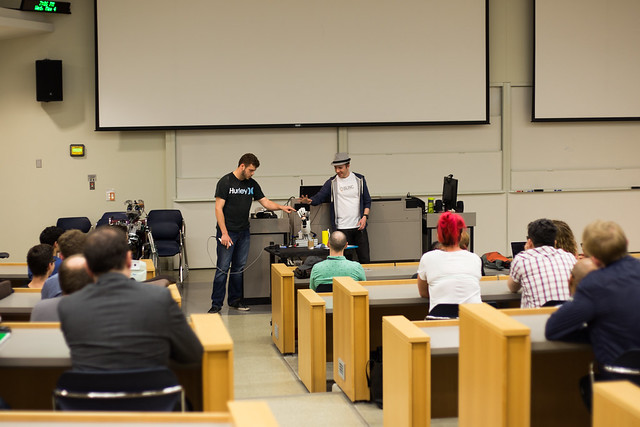
Tonight was robot & games night at Edmonton’s 31st DemoCamp which took place at the Centennial Centre for Interdisciplinary Sciences (CCIS) on the University of Alberta campus. After missing the last two, it was great to be back to see some inspiring new projects and entrepreneurs. You can read my recap of DemoCamp Edmonton 29 here.

If you’re new to DemoCamp, here’s what it’s all about:

“DemoCamp brings together developers, creatives, entrepreneurs and investors to share what they’ve been working on and to find others in the community interested in similar topics. For presenters, it’s a great way to get feedback on what you’re building from peers and the community, all in an informal setting. Started back in 2008, DemoCamp Edmonton has steadily grown into one of the largest in the country, with over 200 people attending each event. The rules for DemoCamp are simple: 7 minutes to demo real, working products, followed by a few minutes for questions, and no slides allowed.”

In order of appearance, tonight’s demos included:

DemoCamp Edmonton 31
Bento Arm

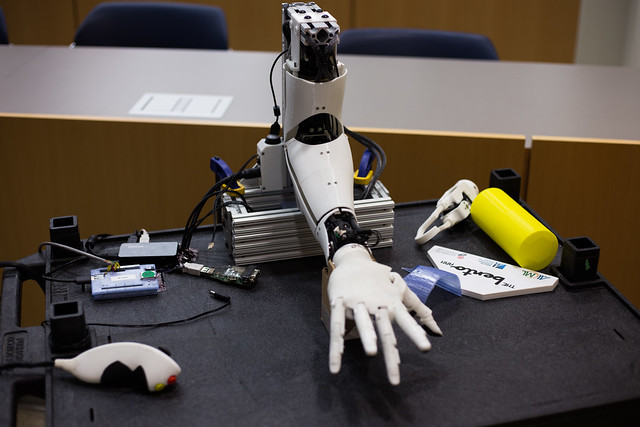
Rory & Jaden showed us the latest version of Bento Arm, a 3D printed robotic arm. It features pressure sensors in the finger tips, servo motors that track velocity and other metrics, potentiometers, and even includes a camera embedded in the palm. The idea with having all of those sensors is to use machine learning to improve its capabilities over time (for instance the camera might recognize objects to help the arm pick them up). The demo showed how the hand could be controlled using a joystick, moving the arm around, and opening and closing the fingers. Bento Arm runs on the Robot Operating System and the team plans to open source everything, hardware and software. To the end the demo, they played rock-paper-scissors against the Bento Arm, which won. Welcome to the future!

DemoCamp Edmonton 31
vrNinja demo

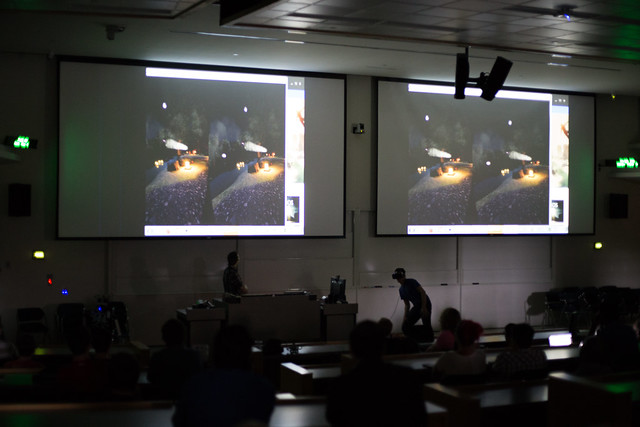
Nathaniel & Alexendar were up next and they showed us vrNinja, a ninja simulation game built for the Oculus Rift VR headset. In the game you are a ninja and you must learn and use new weapons as things get faster and faster. The game features positional audio and requires you to move quite a bit in order to play (so be careful what’s next to you). The team are hoping to release it in the Oculus store in the next month or so, and they have plans to look into the HTC Vive VR headset as well. If you’d like a closer look, you can check out the game this weekend at GDX Edmonton.

DemoCamp Edmonton 31
Anthrobotics

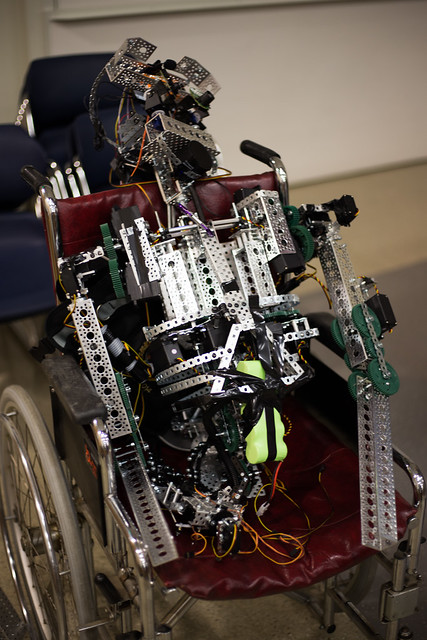
Next, Ian & Evan showed us what they have been working on with Anthrobotics. The idea is to build robots that do all the boring, redundant tasks that we all need to do each day. They showed three prototypes. The first was an anthropomorphic named Robio who sat in a wheelchair. Unfortunately the demo gods got the better of him and the speech demo didn’t work. They said they liked the humanoid form (even though it is difficult to build) because they think it has the greatest potential for being useful in our world. The next two prototypes were a hand that featured and opposable thumb and a leg that could move both entirely and just the foot. They are using Arduino boards right now but have plans to add Raspberry Pis in the future. Their robots are very much in the prototype stage, but if this is what they’re doing in high school, I can’t wait to see what they build in the future!

DemoCamp Edmonton 31
Hugo, the Twitter-powered robot

Jeff and couple of his colleagues from Paper Leaf were up next to show us Hugo, the Twitter-powered robot that you probably tweeted inappropriate things to last year when it launched. The way it works is you tweet something with the hashtag #hugorobot and Hugo will speak it aloud. You can read more about Hugo here. Hugo was a big success, and even helped Paper Leaf to win an ACE Award. At the experiment’s peak, Hugo was receiving 3100 tweets per hour and more than 7000 people watched the livestream. Hugo was posted to Reddit, 4chan, and 9gag, all of which meant that the team had to work hard to keep the blacklist updated. It’s a fun project and Jeff says you could apply the same concepts of social media and crowdsourcing elsewhere.

Our final demo of the evening was from Matt & Logan who showed us RunGunJumpGun. It’s a 2D side-scrolling “helicopter-style” game that they first prototyped at least year’s GDX Edmonton. Now a year later, they have improved and refined the game, and plan to release it this summer. The game features 40 levels that increase along a difficulty curve so that as you progress you should master the skills needed to win. Though honestly the last level looked impossible to pass! There’s a certain amount of frustration that comes along with the style of play, but it also has a high degree of replay-ability. They plan to launch an iPhone version at some point too.

DemoCamp Edmonton 31

Some upcoming events to note:

  • Monthly Hack Day is coming up this Saturday at Startup Edmonton
  • GDX Edmonton takes place Saturday and Sunday at the Robbins Health Learning Centre downtown
  • Preflight Beta takes place Tuesday at Startup Edmonton and “helps founders and product builders experiment and validate a scalable product idea”
  • The full Preflight program started today!
  • The next ROS Robotics Meetup takes place on May 19 at Startup Edmonton

Over 150 meetup events took place at Startup Edmonton last year! Keep an eye on the Startup Edmonton Meetup group for more upcoming events. They have also added a listing of all the meetups taking place at Startup to the website. You can also follow them on Twitter.

See you at DemoCamp Edmonton 32!

City for Life: Gil Penalosa in Edmonton

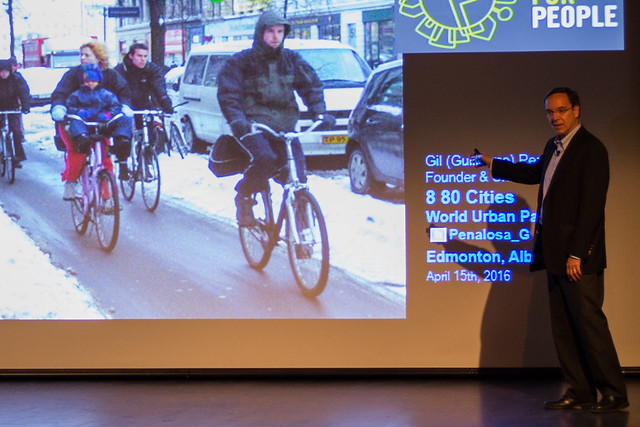
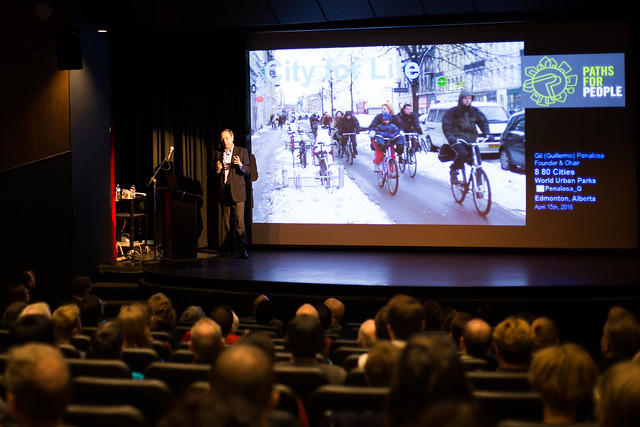
Gil Penalosa was in Edmonton tonight to share his thoughts on building successful cities, healthy communities, and happier people. Gil is the founder of Toronto-based 8 80 Cities, chair of the board of World Urban Parks, consultant with Danish firm Gehl Architects, and former Commissioner of Parks & Recreation in Bogota where he led a transformation of that city’s park system and implemented the “new Ciclovia” program that sees nearly 1.5 million people walk, run, skate, and cycle along Bogota’s roads every Sunday. He spent about 90 minutes with a theatre full of people all passionate about making Edmonton a better place for pedestrians and cyclists and ultimately, for everyone.

Gil Penalosa

He started out addressing winter. We’ve had an unusually mild one this year, but normally it’s all Edmontonians talk about. “It’s a mental problem more than anything,” he told us. “There’s no such thing as bad weather if you have the proper clothing!” Gil suggested we probably have 20 horrible days a year, 60 that are pretty cold and not great, but that leaves more than 200 good days. “When you focus on those 20 horrible days, you end up with a bad city 365 days of the year,” he said. I don’t think he’s talking about ignoring our Winter City Strategy – he showed some great examples of winter-friendly architecture – but he is saying that we shouldn’t let winter prevent us from cycling. He noted that we have an average of 123 cm of snow each year. “Over five months, that’s nothing.”

Gil talked about the 8 80 rule of thumb. Think of an 8 year old child you know, then think of an 80 year old person you know, and then ask yourself if it is safe for them to cycle to the park or to cross the intersection. Would they feel safe? If the answer is no, then there’s work to do. And by making our city great for 8 year olds and 80 year olds, it’ll become great for everyone. “We need to stop building cities as if everyone is 30 years old and athletic!”

Gil Penalosa

He talked about Ciclovia and all of the positive examples of change around the world that it has inspired. He talked about the importance of having quality sidewalks and bikeways, because they result in safety and dignity for pedestrians and cyclists. He talked about how many pedestrians are killed by motorists around the world (1 every 2 minutes) and they are incidents, not accidents, because they are preventable. He talked about the need for equity, not equality. He talked about the public health and noted that 1 out of 4 Edmontonians are obese and 1 out of 3 are overweight. And he spent quite a bit of time highlighting “the grey bloom” as he calls it. “Older adults are our biggest wasted resource,” he said. “We need to rethink how to engage them and how to take advantage of what they have to offer!”

We need more walking and cycling in our cities. So why do people spend so much time complaining about potholes? Why don’t they use the energy spent on organizing to fix the potholes on promoting walking and cycling instead? Gil’s theory is that it’s because 20-35% of our cities are the streets. And if you take away all of the private property, streets are 70-90% of the public space. “That belongs to all of us and we need to make use of it,” he said. “Do we want streets for cars or streets for people?”

Gil Penalosa

Gil did provide some solutions to all of these challenges. To tackle health, promote walking and cycling. It’s the only way that cities are able to encourage the 30 minutes of physical activity needed per day to keep us all healthy. To reduce the number of pedestrians killed by vehicles, install pedestrian islands in intersections because they result in 56% fewer fatal incidents. And to encourage more cycling, don’t waste time and money with sharrows, he told us. “Don’t just paint a line, that doesn’t work.” We need high quality, separated paths.

Gil said all of this with an infectious energy and humor. You can get a sense of that by checking out this TEDxCarlton talk he did back in 2011.

In fact, his talk tonight was pretty similar to that, although much longer. It was similar to the many other keynotes and presentations he has done. He’s been spreading this message for more than five years! What should we take from that? Clearly there are a lot of cities in the world to visit to share this message with. Gil told us he has worked in over 200 cities in the last nine years. But maybe also that Edmonton is late to the party. And perhaps, as Gil himself told us repeatedly, that change is hard everywhere.

I left Gil’s talk feeling excited, energized, and optimistic about what we can achieve in Edmonton. But it didn’t take long for the cynical, negative, pessimistic thoughts to return. Close a street to cars, he says. Except I know how much work that is (and continues to be). Don’t waste your time on sharrows, he says. But of course that’s what we have focused on. Take action in 90 days and definitely within five years, he says. Our Bicycle Transportation Plan, imperfect as it was, began in 1992 and was updated in 2009 and yet what have we got to show for it?

On the other hand, every city that Gil highlighted as examples of what can be done probably faced challenges that aren’t too dissimilar from the ones I cited above. “I know what you’re thinking,” Gil said at one point. “Edmonton is different. You’re unique.” He nodded knowingly at the crowd. “Always remember that you are absolutely unique, just like everyone else!” he said, quoting Margaret Mead.

Gil’s core message is that change is hard and you need five things to make it happen:

  • A sense of urgency
  • Political will
  • Doers (people that actually do things)
  • Leadership from throughout the community
  • Citizen engagement

Change is hard was a common message throughout his talk. “When you try to get something done,” Gil said, “CAVE people show up.” That’s “Citizens Against Virtually Everything”. The audience loved that. Later he said to beware of the “citizen cadavers”. What are those? “They’re the people who haven’t done anything for the community so you thought they were dead but then you try to change something and they come back to life!”

In addition to the five things mentioned above, we need a shared vision and a lot of action, Gil told us. Turn challenges into opportunities, and don’t be spectators! “We have to be smarter about using our public assets.”

Paths for People

The event tonight was hosted by Councillor Michael Walters, who wrote earlier this week on his blog:

“Each time I engage Edmontonians in conversations about active transportation, one thing becomes clear – that we need to shift the conversation away from car vs. bike to one about healthy people and healthy communities.”

So, who is Paths for People? They’re activists, as Michael Phair explained tonight. From their about page:

“Paths for People is an enthusiastic and strategic group of community-builders working to improve conditions for bicycling and walking (and any other human-powered transportation) within the City of Edmonton.”

Today the group launched its minimum grid:

“Our vision for Edmonton’s Minimum Grid – a grid of walk/bike routes that would connect 140,000 Edmontonians into and around downtown and the university safely and pleasantly.”

It’s a start.

I’m thrilled to have been invited to participate in tomorrow’s City for Life summit, where “leaders in the Edmonton community will gather with City Councillors and Senior Administration to create a vision document for a healthier, happier, more mobile Edmonton.” I’m positive that we’ll have a constructive, future-looking discussion and I am hopeful that together we’ll find a way to transform that into meaningful, long-lasting change. We need action, not just more talk, because when all is said and done, a lot more is said than done.

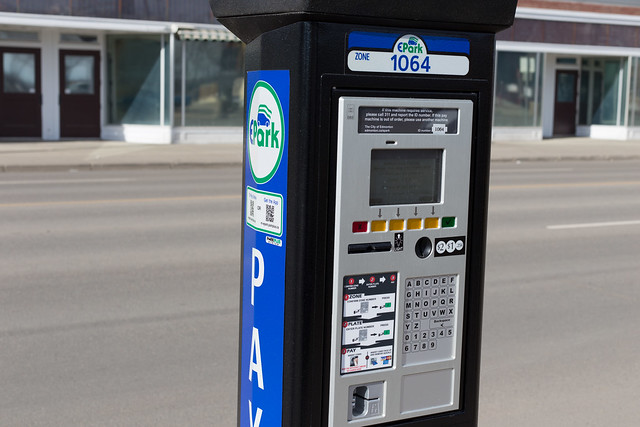
EPark has replaced coin parking meters in Edmonton

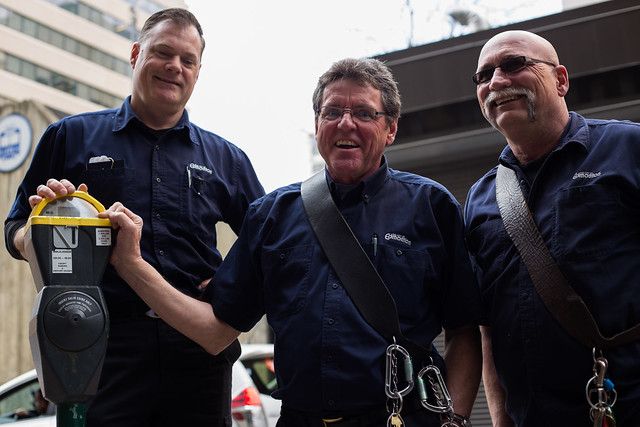
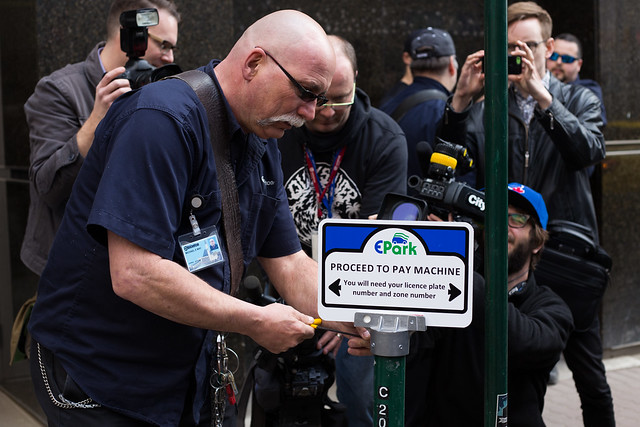
Edmonton’s last coin parking meter was converted into a new EPark spot on Rice Howard Way today. Councillor Scott McKeen, the City’s GM Operations Dorian Wandzura, and Downtown Business Association Executive Director Jim Taylor were all on hand for a brief ceremony that saw the old meter replaced with a new EPark post cap. Councillor McKeen said he was not sad to see the old parking meters go, nor were the City parking staff who had gathered for the spectacle as they recalled the challenges of carrying money around. The move to the digital EPark system is a sign of the times, and it’s not the first time that parking meters have helped to illustrate Edmonton’s progress.

Councillor Scott McKeen with the last parking meter
Councillor McKeen cradles the last coin parking meter

Our city’s first parking meters, 854 manual winding meters, were installed downtown on July 26, 1948. It cost a nickel to park for an hour, or a penny for 12 minutes. Fines were $1. A few days later, the first parking meter theft in Canada took place in Edmonton as a meter from 101A Avenue near 100 Street was stolen. “The meter contained no more than a few dollars,” the Journal recalled in a piece recognizing the 50th anniversary of parking meters in the city. “In the first week meters operated, the city collected $598.98 in coins, plus ‘a king’s ransom in slugs, plugs and buttons,’ according to newspaper reports.” The City took in about $50,000 in revenue from the parking meters that year.

Toronto became the first Canadian city to install meters accepting dimes in 1952, but Edmonton was doing its share of experimentation at that time too. A Globe and Mail article on the news reported:

“The latest thing in parking meters is being tried in Edmonton. Installed in municipally operated parking lots are meters which during the day take money for parking but at night take 25 cents to keep a car’s motor warm. A coin in the machine sends current through wires which are attached to the motor.”

That story was published on February 6, 1952 so that’s no April Fool’s joke! By 1954, Edmonton’s parking meter tally had grown to about 2,000.

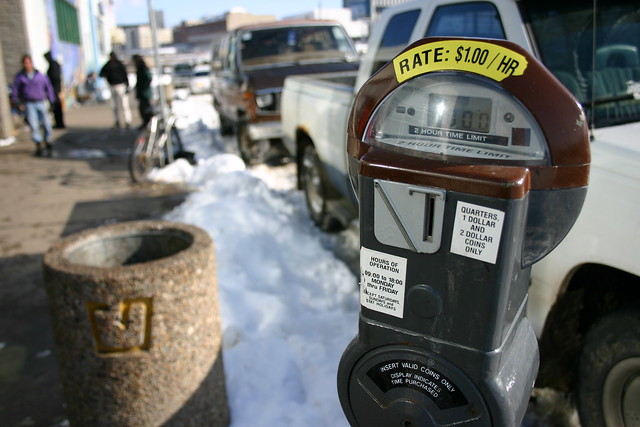
Parking Meter

At some point Edmonton’s parking meters were upgraded to the now more familiar self-winding or electric style. And in 1991, they were upgraded to stop accepting dimes and to start accepting loonies. The Journal reported at the time:

“Before the increase, quarters and dimes covered the 60- to 80-cent-per-hour parking fees but the goods and services tax and the city’s desire to add an extra $300,000 to its $1.8-million yearly parking coffers has changed that.”

There was no shortage of complaints about high parking costs and parking meter enforcement over the years. For instance in 1987, about 30 motocyclists protested against parking meter enforcement by using up almost every spot along a block of Whyte Avenue. Not everyone was so peaceful though. Ray Morin was in charge of the city crew that looked after parking meters, and reflecting on the 50th anniversary in 1998 he told the Journal that about three or so meters were stolen each month. “They take the cement, the works,” he said. Vandalism and abuse of parking officers were also problems for as along as we’ve had parking meters.

City Staff pose with Edmonton's last parking meter
They won’t miss the coin parking meter’s problems

Not everything stayed the same though. When parking meters were first installed downtown, the response from the public was pretty negative. People were upset about having to pay for something they previously got for free. But 50 years later, parking meters were being hailed as convenient, less expensive than parkades, and a way to bring some vibrancy back downtown. “There’s a lot of parking out there, but people want convenience,” Ray Morin told the Journal in 1998. “So we brought in the meters.” Now we’re looking to strike a balance, promoting active transportation options while ensuring downtown is accessible for visitors.

The City did experiment with getting rid of parking meters back in 1995. The small stretch of 103 Avenue between 100 Street and 101 Street had 13 angled parking spots and instead of meters the City installed two ticket dispensing machines at a cost of $10,000 each. The machines were expected to be cheaper to operate than parking meters, but they didn’t last and eventually parking meters were installed.

The new EPark cap is screwed onto the parking meter post
Michael May installs the EPark cap

Ten years later, Impark brought pay-by-cellphone to parking lots in Edmonton. They had a transaction fee of 35 cents, but for many it was worth the convenience. Calgary was developing their parking system at that time and made the switch in 2007. Edmonton borrowed some machines from Calgary for a trial in June 2013, and after Council approval the following year, installed the first 16 EPark machines in October 2015.

EPark

Edmonton used to operate about 3,300 parking meters (159 of which were in the garage under City Hall) and collected nearly $15 million per year. The new EPark system was budgeted at $12 million to implement and is expected to increase revenues to about $22 million a year by 2018. More than 375 EPark machines now located in Edmonton, mostly around downtown, Old Strathcona, and 124 Street. The new system means there’s actually more space for parking (thanks to the removal of the lines) and will be more efficient for the City to operate and enforce. Prices can also be adjusted in response to demand.

Edmonton's last coin parking meter
Edmonton’s last coin parking meter

The final parking meter will be taken to the City Archives for safe keeping. If you want to keep a bit of parking history for yourself, you can buy one of the old meters:

“Citizens wanting to buy an existing parking meter, in ‘as is’ condition, at a cost of $100 per meter, are asked to contact 311 by May 31 to express their interest. The City is also hoping to sell the remainder of the meters to another municipality. The next step in the evolution of parking is the move towards automated enforcement with use of vehicle-mounted cameras later in 2016.”

You can learn more about EPark at the City’s website.

The Edmonton Oilers bid farewell to Rexall Place

Tonight the Edmonton Oilers played their final game in the building they have called home since 1974. Though its future remains uncertain, Rexall Place has been an important part of Edmonton for more than 40 years.

Farewell Rexall Place

The subject of its own, drawn out arena debate, Rexall Place was eventually built in the early 1970s. It opened on November 10, 1974 and the Oilers played their first game in the building that night. They won that game over the Cleveland Crusaders by a score of 4-1. For more on the history of Rexall Place, check out this great deep dive from David Staples.

Farewell Rexall Place

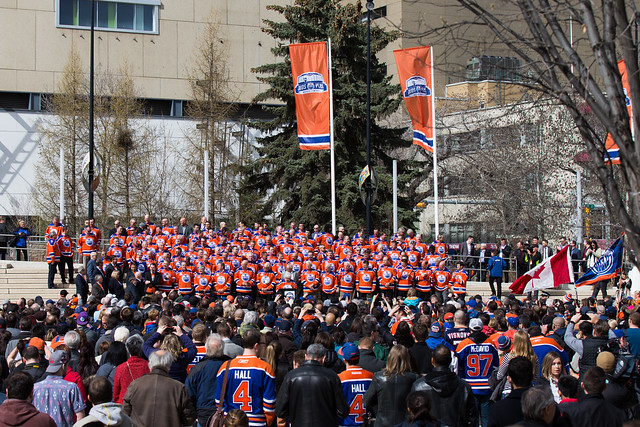
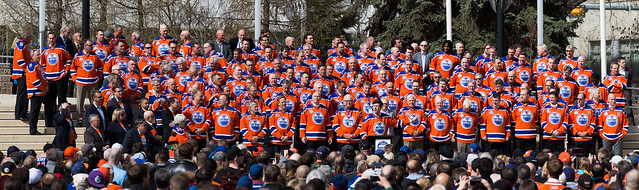
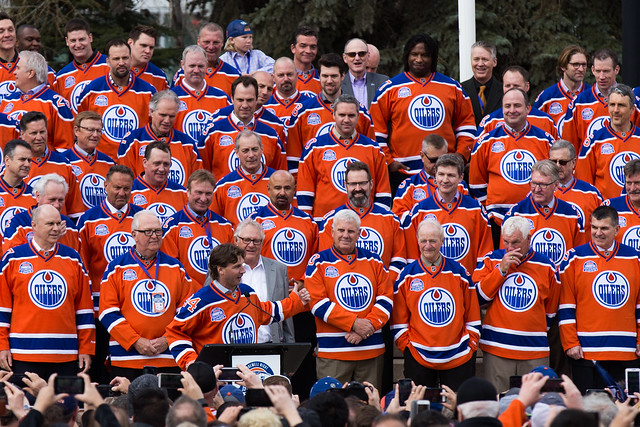
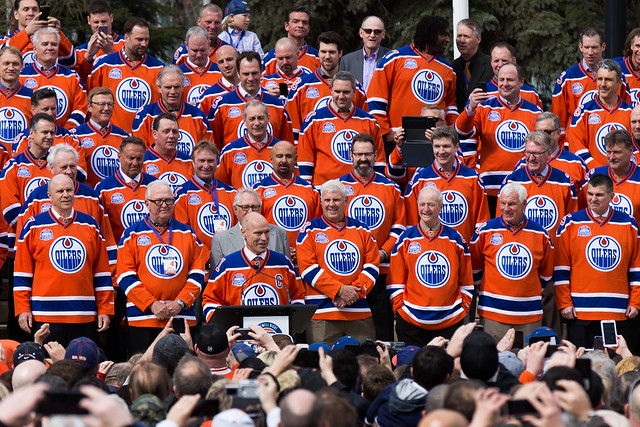
In addition to tonight’s celebrations at the building itself, the Oilers and the City held a rally in Churchill Square today. All former Oilers were invited to attend, and more than 100 did. The event was hosted by City Manager Linda Cochrane and was a nice opportunity for fans to join with the Oilers to say thanks to Rexall Place.

Farewell Rexall Place

Mayor Don Iveson, Jason Strudwick, Ryan Smyth, and Mark Messier all shared a few memories and tributes to Rexall Place.

Mark Messier

I thought it was very fitting that the crowd did the wave today at the rally given that Rexall Place is the venue in which the wave was perfected.

The Oilers have been preparing for this all season long, of course. Here’s what they had to say about leaving the building earlier today:

“Hours before opening faceoff, media members and arena workers flooded the halls, snapping photos of the old barn. The current players laughed at the fond memories of their home building, while lamenting missed opportunities in recent seasons. The alumni shared stories with the media and with each other, some serious and others hilarious tellings of locker room happenings. The mood at Rexall Place’s final pre-game morning was more joyful and reminiscent than sad, but it is sure to be an emotional evening of goodbyes for all those with ties to a historic venue.”

You can see the pre-game, in-game, and post-game videos and other media here.

Farewell Rexall Place

Northlands itself also had some positive things to say about the building today:

“On behalf of our board, staff and volunteers we want to thank the Edmonton Oilers for an amazing partnership,” said Tim Reid, Northlands President and CEO.

They also pointed out that while the Oilers won’t be playing at Rexall Place anymore, there are still other events on the schedule including the 2017 Ford World Men’s Curling Championships next April which is the final qualifying event for the 2018 Winter Olympics in South Korea. But for pro hockey at least, tonight was the end.

Oilers Superfan

For the current team, next season and the brand new Rogers Place can’t come soon enough. It hasn’t been a great season, but at least they ended on a high note tonight with a 6-2 victory over the Vancouver Canucks.

You can see more photos from the lunch time rally here.

Exploring Calgary’s East Village

Sharon and I spent most of the long weekend down in Calgary, enjoying the beautiful weather and trying a bunch of new restaurants. A trip to our southern neighbour to eat has nearly become an annual tradition for us. This time we visited Cluck n Cleaver, Charbar, Shiki Menya, Pigeonhole, and returned to our favorite, Blue Star Diner. It was a great weekend!

Our visit to Charbar also gave us an excuse to explore the East Village once again, an area we last spent some time in back in 2014.

East Village

The East Village ARP notes that redevelopment of the area has “been a long-standing objective of the City of Calgary” and that the General Municipal Plan of 1979 encouraged residential development. From the ARP, here is the vision statement for the East Village:

“East Village will become a vibrant, humanly scaled and sustainable high density downtown neighborhood that respects and enhances its historical, physical and social context and reinforces a high quality of life for its diverse residents.”

The East Village area is 49 acres between Fort Calgary and the downtown and is where Calgary was founded. As development intensified elsewhere, the area was neglected for many years. But not anymore:

“Fast forward to today. East Village is in the midst of an exciting transformation. Since 2007, CMLC’s commitment of $357 million into infrastructure and development programs has so far attracted $2.4 billion of planned development expected to deliver $725 million of Community Revitalization Levy (CRL) for the City of Calgary, our sole shareholder. As developers and retailers have come to see the value of the East Village transformation, our available inventory of land has been snapped up. Today, just three parcels remain.”

You can see the current East Village ARP in PDF here. The City of Calgary is currently in the process of updating the East Village ARP, first approved in 2001 and last updated in 2010. That process has been underway for a couple of years now and is expected to wrap up later this year, with the draft available for public review this spring.

East Village

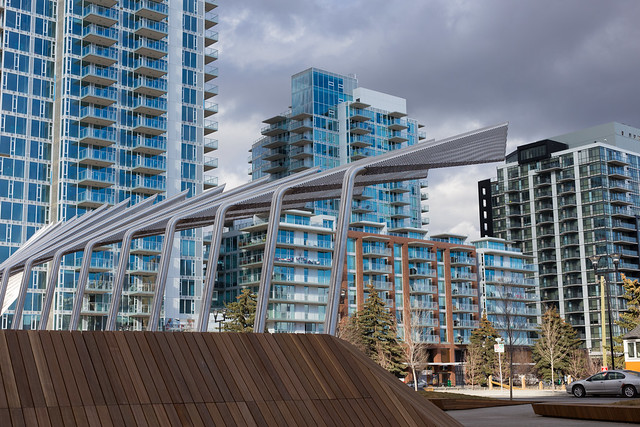
We made the ten minute walk to the East Village from our downtown hotel. We entered via 7 Avenue SE which meant that Celebration Square, or CSquare, was one of the first things we saw. It is meant to “provide a mid-day sunshine break to folks in nearby offices or residents returning home from downtown” and features a curved wooden bench, a small stage, and a striking design. “The Veil’s architectural baffles animate the movement of passing trains,” the website says.

National Music Centre

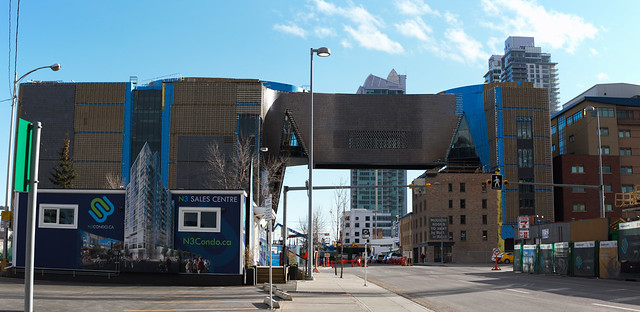
This is the year of music in Calgary as they are hosting the Juno Awards this weekend. Later this year, the brand new National Music Centre will open in the East Village. Just a short walk up from CSquare, you can’t miss the NMC’s unique look. Construction on the project began in 2013:

“Designed by Allied Works Architects of Portland, Oregon, NMC is imagined as a living instrument, a destination and a new kind of cultural institution. The 160,000 square foot, $168 million project is being built around the historic King Edward Hotel – Calgary’s legendary home of the blues – and straddles 4th Avenue SE via an overhead passageway that leads to another vast building.”

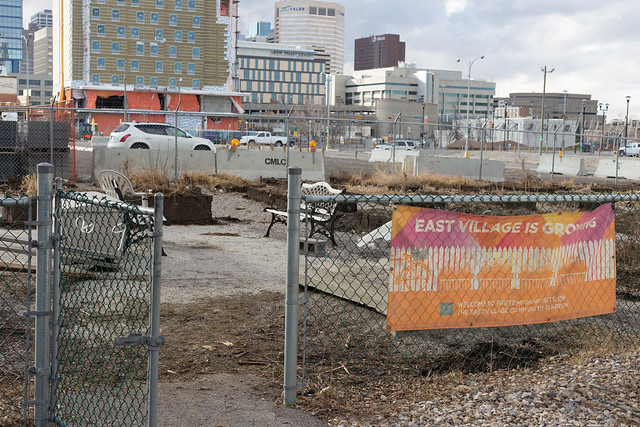
A little further away we came across one of the community gardens that has been established in the East Village. Living in the East Village right now would be exciting with all of the changes taking place, but it will be a few more years before the urban village vision is realized.

East Village is Growing

For instance, a grocery store is yet to appear, but one is coming. “The dream team of RioCan Investment Trust and Embassy BOSA are partnering to develop two new residential towers at 6 Avenue and 3 Street SE which will be anchored by a full-sized Loblaws store, as well as other retail tenants.”

Simmons Building

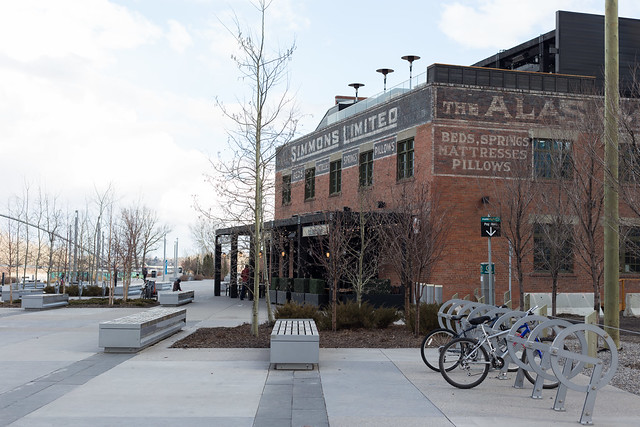
We were perhaps most looking forward to checking out the redeveloped Simmons Building, which just opened last summer and now features Charbar, Phil & Sebastian Coffee Roasters, and Sidewalk Citizen Bakery. Restoration efforts began in 2008 on the historic building:

“Formerly a factory warehouse for a national bedding manufacturer, the Simmons Building snoozed beside the Bow River for decades before CMLC took up the restoration challenge. The occupancy of the Simmons Building by three local food and beverage champions puts in place an important piece of CMLC’s retail strategy for East Village, which calls for approximately 100,000 sq ft of Village Format retail – a ‘boutique’ style of retail that tends to be more intimate and service-oriented than Urban Format retail, which in East Village will add up to about 300,000 sq ft and include such categories as grocery, home improvement and general merchandise.”

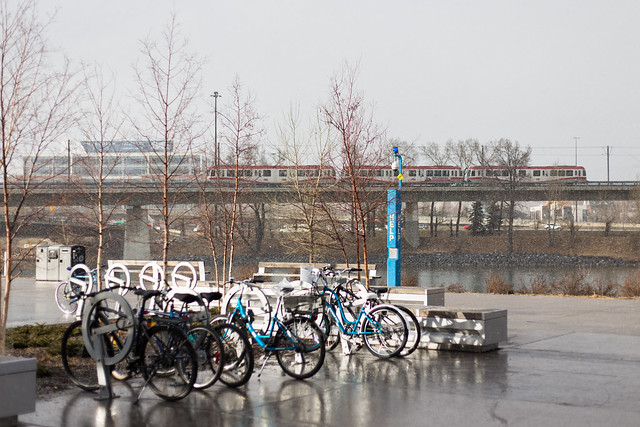
On a Friday night, the building was busy, and it just so happened that Edmonton’s own Poppy Barley was hosting a pop-up in the building that weekend! The bike racks were well-used and there were lots of people out enjoying the plaza.

Sunny Snow

Inside the building, we had a great meal at Charbar! Our favorite dish was probably the picante dry-cured chorizo, served with pickled vegetables, but the entire meal was delicious.

Charbar

The inside of the building reminded me a lot of the Mercer Warehouse, with the exposed brick, beautiful wooden beams, and hardwood floors. With a Phil & Sebastian’s I could definitely see myself hanging out in the building frequently.

Simmons Building

The Simmons Building is located right along the RiverWalk Plaza, part of a beautiful pathway that runs along the river and connects to Calgary’s larger pathway system. Before dinner, we walked along it and made our way to St. Patrick’s Bridge which has been nicknamed the “skipping stone” bridge. It was under construction the last time we had seen it.

East Village

The bridge connects to St. Patrick’s Island which is described as “a beautifully revitalized 31-acre backyard.” Among its many features is Bloom, a public art installation on the west side near the bridge.

Sharon

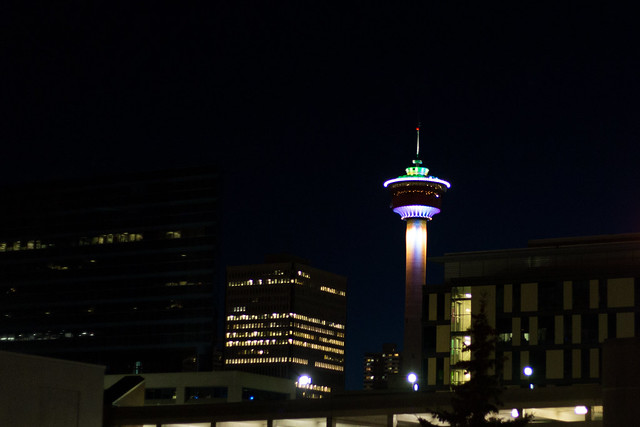
Our short walk back into downtown after dinner offered a great view of the colorfully lit Calgary Tower. It was a great evening in the East Village! We’ll definitely be back to see more of the area’s evolution.

Calgary Tower

You can see more photos from our trip to Calgary here.

Linda Cochrane is Edmonton’s new City Manager

Mayor Don Iveson announced this morning that City Council has hired Linda Cochrane as Edmonton’s new City Manager. A long-time City employee, Linda has been the Acting City Manager since September when Council decided to fire Simon Farbrother.

Linda Cochrane

Here’s what the mayor had to say on why Linda was selected:

“As you know, Linda had been Acting City Manager since the fall of 2015. In that time she has earned the complete trust of City Council through her continuing work to transform the structure of the corporation and lead a more open and effective local government.

It is important to note that this was an international search with applications from candidates far and wide. The interest of so many talented applicants is a wonderful compliment to our community, our vision, and the work of our administration – things we should all be immensely proud of. More to the point, it is a reflection of the quality of Linda’s tremendous service and inspiring leadership that she was considered best amongst this class of impressive candidates.”

Council has signed Linda to a three year term, with options to renew. Linda was very clear back in January that she wanted to be considered for the role. Today she was elated to have been selected, telling the Journal: “I’m just over the moon. It’s a realization of a lifetime dream. I couldn’t be happier.”

//platform.twitter.com/widgets.js

Linda started her career in aquatics programs, first in Edmonton as a swim instructor and then with Spruce Grove. She returned to the City in 1982 and started climbing the management ladder. She was director of the Kinsmen Sports Centre and in 1990 was asked to take on the role of director at the Valley Zoo. It wasn’t long until she was in charge of the City’s parks and recreation centres. Linda was most recently the general manager of Community Services (now Citizen Services after the reorg she announced in January), a position she took on in 2006.

Linda has worked on a number of high profile projects throughout her career. She defended the Valley Zoo’s care of Lucy the Elephant and refused to bow to pressure from Bob Barker and others who wanted Lucy moved. Linda was one of only four women on the eighteen-person bid committee for the 2001 World Championships in Athletics. She led the charge to build the Terwillegar Rec Centre and led a review of all the City’s facilities. Most recently of course she earned the nickname “cabbie whisperer” for her quick action to restore order during contentious Council discussions on Uber.

//platform.twitter.com/widgets.js

Linda is Edmonton’s first female City Manager. That’s particularly interesting given that she is the only woman on the Corporate Leadership Team (CLT). “Between 2012 and 2015, the percentage of general and branch managers who were woman held steady at 22 per cent. It’s now 16 per cent,” reported the Journal. Of course there’s just one woman – Bev Esslinger – on City Council as well.

I wrote back in November that I didn’t think Linda was likely to get the job. That comment was based not on her abilities, but on what Council had publicly stated they were looking for. Mayor Iveson’s statement back in September said “the scale and complexity of the challenges ahead demand a fresh perspective” and that Council’s goal was to “hire someone who can meet the aspirations of this city head-on and help build the kind of city we can all be proud of.” It seemed as though Council wanted someone from the outside.

I do think Linda is a great choice for City Manager. She is well-known and widely respected at the City has earned a reputation as someone who gets things done. Linda will tell it like it is, and that’s certainly important to Council. She has been supportive of the ongoing culture shift at the City and has talked often of leading through service. Linda is ideally suited to guiding the City through turbulent times.

In just a few short months as Acting City Manager, Linda has really put her stamp on the organization, earning Council’s trust, the public’s admiration, and leading a key reorganization. I can’t wait to see what she accomplishes in her new role.

Learning about pulses for #3SkillsYEG

Over the last month, I have been learning about pulses and how to cook with them as part of the #3SkillsYEG challenge. Cooking with pulses seemed like a great topic for me given the suggested theme for February was “Personal Growth & Wellbeing” and that 2016 is the International Year of Pulses.

Pulses

Learning about pulses

It just so happened that the Canadian Association of Foodservice Professionals (CAFP) and the Alberta Pulse Growers (APG) hosted a dinner early in the month called Everything is PULSEible. I was fortunate enough to attend with Sharon, who had been invited to blog about the dinner. It was a great way to both taste and learn more about pulses, though I suppose I didn’t realize just how familiar with them I already was. Here’s an excerpt from Sharon’s post:

“After reading Mark Bittman’s Food Matters more than five years ago (his mission was to encourage more conscious consumption of non-meat proteins), I was inspired to start including more beans and lentils in our diet. In 2011, Julie Van Rosendaal and Sue Duncan’s cookbook, Spilling the Beans, was released, becoming one of our go-to guides for meal inspirations. Now, pulses have just become a part of our regular rotation, both as a meat alternative but also to enhance soups, salads and mains, stretching the meal all while adding nutrients. At this point, our pantry and freezer would feel bare without having some variety of pulses on hand.”

She’s not kidding! Our meals often have beans and I guess I just didn’t think of them as pulses. So what exactly is a pulse? From Pulses.org:

“Pulses are the edible seeds of plants in the legume family. Pulses grow in pods and come in a variety of shapes, sizes and colors. The United Nations Food and Agriculture Organization (FAO) recognizes 11 types of pulses: dry beans, dry broad beans, dry peas, chickpeas, cow peas, pigeon peas, lentils, Bambara beans, vetches, lupins and pulses nes (not elsewhere specified – minor pulses that don’t fall into one of the other categories).”

Canada is one of the leading producers of pulses in the world. In 2011, Canada produced over a third of the world’s lentils and had the largest amount of dry pea production in tonnes. Saskatchewan is the largest pulse producing area in Canada with about 80% of the market, followed by Alberta at 20%, according to Statistics Canada. There are more than 2,300 farms growing pulses here in Alberta, which accounts for about 10% of the province’s crop acres. There’s good reason that the prairies are so good at producing pulses:

“The Canadian prairie soil and climate conditions, research for developing new varieties that resist lodging and disease or have a shorter growing season, agronomic and economic benefits when planted in rotation with other field crops and the growth of processing facilities all contributed.”

Unfortunately it’s not as easy as you might think to locate pulses grown here in Alberta because the packages most often end up with a “product of Canada” label. But as Sharon noted, “Alberta grows a variety of pulses: primarily peas (green, yellow, marrowfat), but also beans (great northern, black, cranberry, pink, small red), lentils (red, green) and chickpeas.”

Cooking with pulses

Pulses are very versatile ingredients and offer some excellent nutritional benefits. Pulses are gluten-free and vegetarian, low in fat and high in protein, and they’re a great source of folate and high in fibre. They’re also relatively cheap, especially when compared with meat. But despite all of those benefits, we don’t eat very many pulses. “A small amount is used by Canadian consumers and has increased over time, but is still relatively low compared to countries where pulses are a dietary staple,” wrote Statistics Canada. Many organizations are working to change that, including the Global Pulse Confederation and of course Alberta Pulse Growers here at home. One of the ways they’re doing that is by developing recipes that show just how easy it is to prepare dishes with pulses.

CAFP Alberta Pulse Dinner

The most surprising dish to me at the Everything is PULSEible dinner was the dessert – Lentil Fudge Pie. “This fudge pie is so delicious, you’ll never guess there’s lentils in it!” They were right. It was very tasty and had I not been told, I’d have never guessed that it contained a red lentil purée. I’m not much of a baker, but I’d be willing to give this a shot.

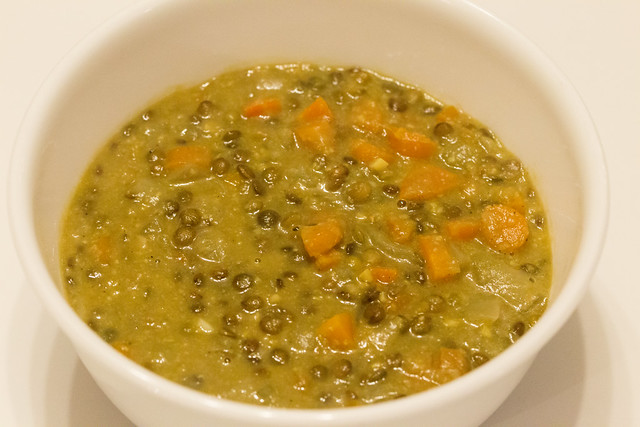
For a variety of reasons, I ended up doing a lot of the cooking in February. I did my best to use plenty of pulses and I’m happy to report it wasn’t hard! I made dishes in which the recipe called for pulses, like Mushroom Lentil Bourguignon (from Spilling the Beans). I also made some dishes that I simply added pulses to, like Carrot, Spinach and Rice Stew which I added chickpeas to. One of the more interesting dishes I made again tonight so I could take some photos – Curried Lentil Soup.

Curried Lentil Soup

The soup calls for both French green lentils (or dupuy lentils) and chickpeas (garbanzo beans). The lentils are easy to work with – simply rinse them and then add to the pot. I used stock instead of water, and they cooked nicely in about 30 minutes.

Chickpea Butter

The chickpeas take a bit more work as you need to purée them into a butter. I added a can of chickpeas to the food processor along with the garlic, lemon juice, and olive oil and before long I had a nice buttery spread. The last step is to add the chickpea butter to the simmer soup and combine, which gives it a beautiful, rich consistency.

Curried Lentil Soup

The soup is one of Sharon’s favorites, and I have to admit I’m quite fond of it myself. Easy to make, extremely tasty, and pretty healthy too!

Working as Sharon’s sous chef in the past, I don’t think I appreciated just how easy it is to add pulses to a dish. I have a better appreciation for them now, and am happy that our pantry is always stocked with beans and lentils!

Next steps with pulses

To help celebrate the International Year of Pulses, Pulse Canada has teamed up with the American Pulse Association to promote the Pulse Pledge:

“Commit to eating pulses once a week for 10 weeks and join a global food movement! Eating dry peas, lentils, beans and chickpeas helps reduce your carbon footprint – and it’s great for your health. Every 1/2 cup of cooked pulses delivers 9 grams of protein. Get rewarded for eating these miraculous superfoods.”

Pulses once a week? Piece of lentil cake!

I encourage you to give pulses a chance. And as a Learning Champion, I definitely encourage you to check out #3SkillsYEG! The theme for March is Creativity and Expression, and I have decided I will learn how to use my macro camera lens. That’s what I used to take the lentil and soup photos above! You can pick any skill you like, of course, the theme is just to get you going. Be sure to share your learning journey and enter the #3SkillsYEG contest.

I wish you tasty pulses and happy learning!