Edmonton Notes for 8/18/2013

Here are my weekly Edmonton notes:

//platform.twitter.com/widgets.js

//platform.twitter.com/widgets.js

Here are some upcoming events:

The 97 Street Night Market went really well yesterday! The freak afternoon hailstorm was a bit concerning, but as you can see in the photo below, it turned out to be a lovely evening. Congrats to all involved but especially to Sharon, who put in a ton of work to make it happen!

97 Street Night Market at sunset

Edmonton Election 2013: Update #1

The format seems to work well for my weekly Edmonton and Media notes, so I’m starting a weekly series for the election. Thursday evenings will be the day, mainly because that’s when you can expect to have a #yegvote Hangout at EdmontonPolitics.com.

Tonight was our third Hangout and our first with a special guest! We spent some time talking with Aliza Dadani, founder of ActivatED, a self-described group of “concerned, young forward-thinking Edmontonians.” Here’s some coverage they got recently from Metro. You can watch the video at YouTube:

Here are this week’s notes:


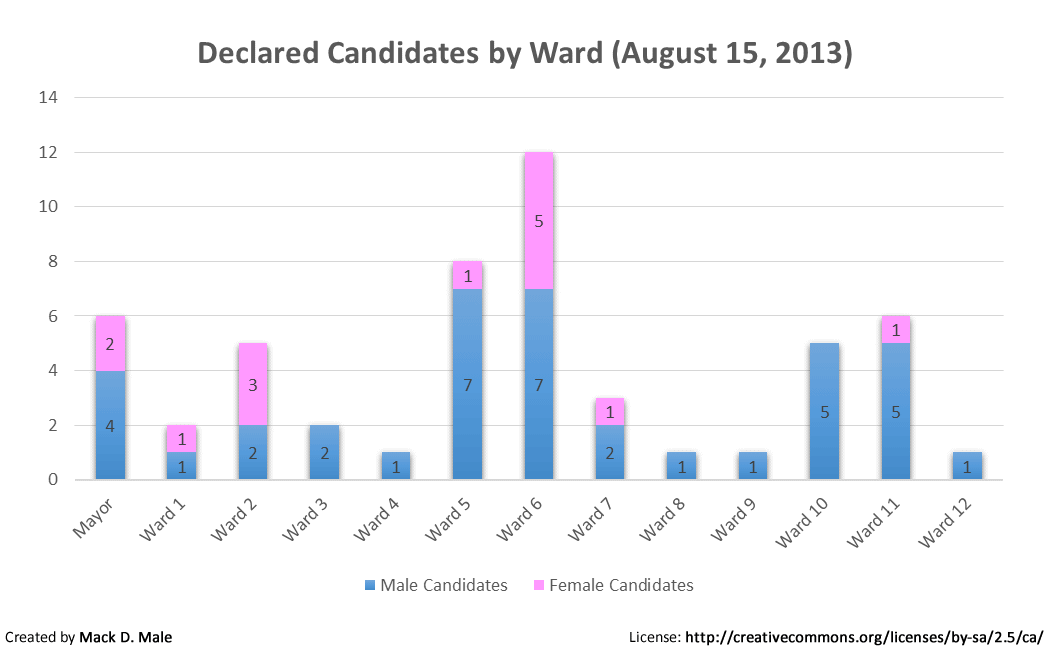
I decided to put Dave’s declared candidate data into a spreadsheet. There are currently 6 mayoral candidates, 47 ward candidates, 16 public school board candidates, and 11 Catholic school board candidates. That compares to 7, 62, 24, and 20 on nomination day in 2010. Here’s the mayoral and ward races broken down by gender:

Some forum and other event dates to note:

You can follow Edmonton Election news on Twitter using the hashtag #yegvote and you can see my coverage here.

What have I missed? Let me know!

Disclosure: I’m actively volunteering for Don Iveson’s mayoral campaign.

Media Monday Edmonton: Update #85

Here is my latest update on local media stuff:

//platform.twitter.com/widgets.js

  • It’s an odd decision. Assuming the Journal and Postmedia understand the importance of digital to their future, then the only logical reason to let Kerry go would be if they felt someone else was a better fit. If that’s the case, then I’d expect them to bring someone on board who lacks a traditional media background (Kerry was a journalist & editor for more than a decade at the Journal before taking on digital). Another possibility is that Postmedia is planning to centralize digital, which I’m not sure is wise. Of course, there could be some sort of internal politicking going on too, but that seems unlikely given that the Journal is currently without a publisher or editor-in-chief.
  • Rick Harp’s last day as host of Edmonton AM on CBC was today. He’s returning to Winnipeg to reunite with his family. Best of luck Rick, can’t wait to see what you’re up to next!

//platform.twitter.com/widgets.js

You can follow Edmonton media news on Twitter using the hashtag #yegmedia. For a great overview of the global media landscape, check out Mediagazer.

So, what have I missed? What’s new and interesting in the world of Edmonton media? Let me know!

You can see past Media Monday Edmonton entries here.

Edmonton Notes for 8/11/2013

Here are my weekly Edmonton notes:

NSR twin bridges (berm construction before June flood) - May 2013
Twin bridges under construction (May 2013)

Twin Bridges from above
Rendering of what they’ll look like

Here are some upcoming events:

DSC_7142
Love the “awesome” photo bomb! Check out more cosplay from Animethon here.

Mover is making cloud storage solutions in Edmonton

moverCan you build a successful, scalable technology company in Edmonton? Local startup Mover thinks so, and yesterday they received validation of that goal in the form of $1 million in seed financing from an impressive list of American and Canadian investors.

“Absolutely” was Mover CEO Eric Warnke‘s response when I asked if he thought he could find the necessary talent and other resources to grow the company here in Edmonton. The tech landscape is a lot different today than it was five or six years ago when Eric was at Nexopia, the hot local startup at the time. “Realistically we’d have to double salaries if we relocated to the valley,” he told me. Not that Mover isn’t paying a fair wage, it’s just that the cost of living there is much higher and the competition for talent is much fiercer. “A lot of people ask us if we’re going to move, but there are good incentives to stay here.” The footer of Mover’s website carries the message “proudly made in Edmonton.”

Mover is barely a year old, but it certainly doesn’t lack history. Walk around the office on the second floor of the revitalized Mercer Warehouse building and little reminders of the past consistently pop-up. A Free Wi-Fi magnet on a metal divider, a Firenest coffee tumbler on top of the fridge, a Mesh Canada brochure hanging on one of the beautiful wooden beams. Even the Launch Party sign front-and-centre as you walk across the creaky floors offers insight into how the growing local tech scene made it possible for Mover to go from idea to reality.

Mover Office

In 2004, Eric was employee number four at Nexopia and wore a number of hats there over the years, everything from customer service to ad management. A few years later, while working full-time at the social networking site and also going to school, Eric found time to start and run an Internet café on Whyte Avenue. It was the Internet café that sparked an interest in wireless networks and led to the creation of the Free Wi-Fi Project. Through that initiative Eric met Mark Fossen, a former partner at ThinkTel Communications. The two decided to join forces and launched Mesh Canada in 2009. They sold it to a Calgary company last year.

In January 2012, Eric & Mark decided to participate in Startup Edmonton’s Startup Hackathon. They built a utility called Backup Box that helped users move files from one place to another (such as an FTP server to Dropbox), and eventually showed it off at DemoCamp in March. A few months later, they were part of GrowLab‘s spring 2012 cohort in Vancouver. Renamed as Mover, they refined the product and when they got back to Edmonton, realized they needed to grow. That’s when Ben Zittlau joined as a partner and the VP of Technology. He had previously worked on Firenest, a web-based tool for non-profits, and for a short time worked at Yardstick Software too.

In the space of a year the team has grown from four to ten. They’ve mostly hired people they know, and that was a deliberate decision. “Slowly but surely we’re putting Nexopia back together,” Eric half-joked. He stressed how important it is to hire strong people. “They had a lot of great people working at Nexopia.” Mover plans to stay in the Mercer Warehouse as long as possible, and already have their eye on some additional space on the second floor. “It’s walkable for almost everyone on the team,” Eric said. “There are great amenities here, and being downtown and close to Startup Edmonton is really great.”

Mover Office

I asked Eric to describe the culture at Mover. “Pretty awesome” was his response. The fridge is stocked with groceries in addition to beer, so that everyone on the team can have a healthy lunch at the office if they choose to (today the team had a craving for Oodle Noodle). The company is flexible on working hours and vacation, and employees get ownership options. Eric cited Box, Dropbox, and Singly as companies he admires with Jobber and Granify as local examples. “One day we’ll be the example others mention,” he added.

Mover has a strong technical team. Greg Bell, Graham Batty, and Sean Healy are all former Nexopia employees. Derek Dowling was a programmer for The Gateway. Jacob Straszynski worked at Mediashaker. Eric thinks they’ll add a few more technology folks, but where the new funding will really help Mover is with marketing and business development. Aside from Eric and Mark, there’s just marketing intern Aidan McColl at the moment.

Mover Office

Mover has quickly become a leader in the growing world of cloud storage migration and backup. With support for about a dozen popular services like Dropbox, Google Drive, and SkyDrive, Mover is carving out a unique middleware position for itself in a rapidly growing market. Steve Jobs famously said Dropbox was just a feature, not a product, but today the company has more than 100 million users who collectively save more than 1 billion files each and every day. And they’re just one of many options available to consumers and enterprises. Back in 2010 a series of Microsoft commercials featured the refrain “to the cloud!” Today more than ever, that’s exactly what’s happening, and Mover is hoping to play a key role in the space.

The plan was always to raise money. But like many technology startups, Mover was probably too ambitious last year in trying to build an impressive technical solution to a problem that not enough people have yet. The lesson was to focus on the areas in which they already had traction, Eric told me. “We’ve got this really interesting thing here, and we need some money to figure that out so that we can get to the next stage.” That approach, combined with a realization that it’s okay to say “I don’t know” to certain questions, led to the new investment.

Mover currently thinks about two primary categories of customers. There are individuals who are mostly self-service but have a wide range of needs. Then there’s enterprises, with lots of users and fairly well-defined problems. Both offer lots of opportunities and are expected grow significantly in the years ahead. Balancing the feature set between them is one of the challenges Mover will face. “We’ve got a fantastic backend,” Eric said, “but we need to make some improvements to the user experience.”

The team is well aware there is lots of work to be done. Every Friday afternoon they meet in the “conference room” for a retrospective led by Ben. Each person has the opportunity to share something positive from the past week as well as something that needs to be improved. The admin dashboard they’ve built is displayed on a large television and allows the team to monitor performance, identify potential bugs, and highlight areas of improvement.

Mover Office

Eric and Mark took part today and used the opportunity to talk about the new investment, thanking everyone for their hard work. “It was a team effort,” Eric said. “Each of you have played an important role in getting us to this point.” Mark added some thoughts about what the investment means for the company, and there were smiles all around. But that was the extent of the celebration. Minutes later they were back to discussing some workloads that had been flagged on the display. The message was clear: the investment helps a great deal, but it’s not the endgame. Mover has lofty goals and there’s a lot of work to be done to achieve them.

Media Monday Edmonton: Update #84

Here is my latest update on local media stuff:

  • Let’s start this update with a recap of the big changes that Corus has been making recently. We now know who will be taking over the spot vacated by the Rutherford Show on 630 CHED – Dan Tencer and Andrew Grose will begin hosting Tencer and Grose on August 19. J’lyn Nye will be taking over the afternoon show from 2-6pm on 630 CHED with Mark Scholz that same day (her final day with Fresh FM was July 26). The surprise casualty in all the changes? Lesley Primeau has been let go.

//platform.twitter.com/widgets.js

//platform.twitter.com/widgets.js

You can follow Edmonton media news on Twitter using the hashtag #yegmedia. For a great overview of the global media landscape, check out Mediagazer.

So, what have I missed? What’s new and interesting in the world of Edmonton media? Let me know!

You can see past Media Monday Edmonton entries here.

Edmonton Notes for 8/4/2013

I was in London, UK all week for work and though I didn’t plan on taking a mini-break from blogging it turned out that way. Anyway, I’m back now!

Here are my weekly Edmonton notes:

The Edmonton River Valley above the Royal Glenora Club #yeg
Great panorama by Dean Smith.

Here are some upcoming events:

art gallery in edmonton
Love this shot of the Art Gallery of Alberta by Leighton Ramos.

The Make Something Edmonton Rope

What’s a rope? "A rope is a linear collection of plies, yarns or strands which are twisted or braided together in order to combine them into a larger and stronger form," according to Wikipedia. I like to think of Make Something Edmonton (MSE) as a rope. As such, it’s made up of a number of different strands that had to come together. There are three strands that I want to highlight.

strand

The first started with a wall.

In the spring of 2011 while still working at the Edmonton Journal, Todd Babiak wrote a series of stories on what he called "interventions". It began with the blank, unattractive wall that he saw every day when looking out the window. Todd wanted to do something about it, so he wrote about it. And he encouraged readers to email him with their suggestions.

A few months later at the downtown-focused Pecha Kucha 10, Todd spoke about the interventions project. He stole the show that night with a hilarious, entertaining, and thought-provoking presentation. Todd called Edmonton "a magpie town" and shared with us a lesson he learned through the interventions process: "I should have asked people to do something, then email me."

Six months later, Todd had a new startup called Story Engine, and he found himself pitching the City of Edmonton. "I had worked on the City Vision for 2040, and I had noticed — in community halls all over the city — that citizens were obsessed with the Edmonton story," he later wrote. Todd wanted to help tell that story. He was persuaded to start a blog, appropriately called magpietown, and he used it to explore the ideas that would form the groundwork for Make Something Edmonton.

The second strand is a long one. If you follow it back far enough, you might find yourself at Edmonton’s beginning.

Like most cities, we aspire to be recognized and loved on the world stage. We want our city’s image to be positive and well-received. Branding is a part of forming that image, and over the years there have been numerous attempts at identifying or creating our brand. We’ve always had this inferiority complex, and many Edmontonians have tried to do something about it. Most recently, the City of Edmonton embarked on a project called Edmonton Stories. By most accounts it was a disappointment, masked only by the repositioning of the project as a tool for recruiting rather than as a tool for emboldening Edmonton’s image.

Last year, the issue once again came up at City Council. One of the outcomes of The Way We Propser was a desire by those involved to better define and communicate our city identity. So in July 2012, Council decided to strike a task force. It got off to a rocky start due to significant differences in approach, but by the fall everything was in place.

That’s when Brad Ferguson, the new CEO of EEDC, spoke up about the issue. "On a scale of one to 10, we’re a one and a half. I’m not going to sugar-coat it," he told Council. All of a sudden, the new task force on image and branding became even more important.

The third and final strand I want to highlight is probably pretty boring to most people, but it’s highly intriguing to a City-watcher like myself.

Since 2006, the "big C" City (the City of Edmonton) has been undergoing a significant transformation. A new City Manager, a new approach to visioning and planning, and a progressive Council working cohesively to move things forward all contributed to a very different mood around City Hall.

One of the side effects of that transformation, in my opinion, has been an expansion in the kinds of things the City is willing to take on. Whereas in the past certain things may have been ignored because they were not seen as central to the City’s mandate (such as establishing a Food Council), today there’s almost an expectation that the City tackle such endeavours. On the whole this has probably been a good thing for citizens.

I think the City has gone back-and-forth on who should own the image and branding piece. Should it be Communications? Should it be a new City-led office? Should it be a partner, most logically EEDC? If the expansion trend continues, I would not be surprised to see some within the City push for MSE to remain a City-led initiative.

These and other strands all came together to form Make Something Edmonton. How exactly the strands came together, I don’t know for sure. But I like to imagine that the committee was sitting around trying to figure out how to get from being 1.5 out of 10 to something better, and Todd said, "I have an idea!" He pitched Make Something Edmonton and everyone declared, "our work here is done!" That’s probably unfair to everyone who put some significant volunteer time into the project, and I don’t mean to belittle that effort. But I also think it’s probably not far from the truth.

The initiative, or movement, or experiment – take your pick – officially launched in March of this year with a splashy party attended by the same people who always show up at these sorts of things. It was a good start, and the launch party was energizing and created a certain amount of momentum. There have been a number of really successful projects added to the website, and the Twitter hashtag remains as popular as ever. It’s a great way to showcase the many exciting things happening in Edmonton.

There is, however, a certain amount of spin surrounding Make Something Edmonton. It was evident at the launch party, and has become somewhat more evident in recent weeks.

Is MSE a grassroots movement, by the people for the people? The funding and committee structure behind it would suggest otherwise. There’s a big MSE committee, and a number of smaller sub-committees, all made up of the same 300 or so people who get involved in most things. Furthermore, that committee is expected to submit a report back to Council. It is, after all, just an expanded form of the task force that Council struck.

Is MSE a new approach to city branding, because traditional branding doesn’t work? The process would seem to suggest otherwise. The City hired a firm to design the MSE logo and identity, and another firm to build the website. There was Brand Camp a few weeks ago, but the only element of it that didn’t resemble a traditional branding exercise was that it was called Brand Camp. It was a bunch of people in room talking with no clear idea about what the outcome should be. Pretty typical consultation piece for a branding exercise if you ask me.

Does MSE tap into a fundamental truth about Edmonton? I feel it does, but many others dispute this point. "Can’t I make things in Winnipeg?" they ask. "Maker is too exclusive," others will say. If MSE isn’t resonating with the smaller group of the same 3000 people that are already hyper-engaged, how can we ever hope to get to 30,000? Or to 300,000?

Since March there have been a number of smaller MSE-related events (like Brand Camp), but the big success has undoubtedly been the creation of the website and its listing of hundreds of projects. I think "maker" is absolutely the right word, because otherwise we’ll end up with the lowest common denominator and that’ll get us exactly nowhere. It needs to be aspirational. Seeing all of the projects on the website and thinking about all of the people behind them gets me incredibly excited about our city.

But as great as that website and all of those projects are, thinking about them inevitably leads to the question that I’ve been hearing people ask more and more: what’s next?

The City of Edmonton has funded MSE so far (by way of the task force on image and reputation) which means they not only feel a sense of ownership, but need to be careful about how they spend the money. It also means that MSE is going up against everything else the City does for resources. And practically it means there will need to be a report that goes back to Council.

Another thing is that while our current Mayor and City Council support the initiative, they’re gone in October. There’s no guarantee that the next Council will be as supportive. So you can almost certainly expect the report to come out before then.

Beyond that, I’m not sure anyone knows what’s next. Maybe there’s not even a correct answer. Let’s phrase the question differently: what are we going to do with this rope?

Are we going to have a tug-of-war to see who hangs on the tightest? Are we going to give up and let it collapse into a pile on the ground? Or are we going to keep using it to climb ahead?

I hope we can use it to keep climbing ahead, but to do so we’ll need to know what outcome we’re moving toward.

Here are some suggestions on how we can establish that:

  • Let’s figure out where Make Something Edmonton will live. Right now I think it should be EEDC, because if it remains City-led there’s too great a risk that politics and/or bureaucracy will cause it to fail (or at least to hold it back). (And if we’re going to give it to EEDC, let’s ask them to drop something that doesn’t align as closely with their vision and strategic plan as a consequence.)
  • Let’s recognize that there’s a difference between the organization that funds & supports Make Something Edmonton, and the people who lead it. EEDC can provide meeting space, coffee, and administrative support, but it doesn’t need to be EEDC staff setting the direction.
  • Let’s identify the gaps between the successful projects and the ones that haven’t gotten off the ground. That’ll help us seed opportunities and remove barriers for makers, hopefully resulting in even more great projects for our city.
  • Let’s clearly define our desired outcomes. We want the language, tools, and confidence to be able to talk about Edmonton. From there, we want the City of Edmonton, EEDC, the University of Alberta, Northlands, and everyone else to make use of that toolkit.

Thoughts?

Media Monday Edmonton: Linking in the local paywall era

In December 2012, the paywall came to Edmonton when the Edmonton Sun launched SUN+. In May, the Edmonton Journal followed suit with the Postmedia paywall. It was only a matter of time before local media decided to try the approach made popular by the New York Times. Maybe they’ll help a little, but paywalls are unlikely to save media organizations, especially local ones. Time will tell what kind of an impact they have here in Edmonton.

For my own news consumption, I haven’t really been affected by either paywall. I’m a print subscriber of the Journal, so I get full digital access as well, provided I login. I don’t read the Sun particularly often to be honest, so I find I don’t run up against the limit there.

Where I have been impacted is in what I link to. If you did an analysis of all of the websites I have linked to over the years, particularly in my weekly Edmonton Notes, I don’t think it would be a surprise to find the Edmonton Journal on top. The reason I link there is simple: they cover more local news than anyone else, often sooner than anyone else, and almost always better than anyone else.

Lately though, I have been trying to avoid linking to the Journal. The reason is also simple. I hate the experience someone might have if they click through and have reached their paywall limit:

journal paywall

If you encounter that screen and try to close the dialog, you’re taken to the Journal’s homepage. You don’t get to read the article I sent you there to read. Now that’s fine, you need to pay if you’ve reached your limit. And if you don’t want to pay, then you shouldn’t be able to see the article.

But that’s not the experience I want someone to have coming from my website. Links are the currency and soul of the web, and I don’t make them lightly. If I’m linking to something, it’s because I think it is worth you taking the time to click on it.

I have never been particularly happy about linking to the Journal, actually. The biggest problem used to be that if you clicked on a link that was old enough, there’s a good chance the article would no longer be online. It’s a baffling strategy that I’ve never understood. In some cases I have used the canada.com trick to try to keep the links valid for longer, but there’s no guarantee they’ll continue working indefinitely. There almost never is on the web.

The Journal’s paywall has changed the equation. Now it doesn’t matter how old the link is – you could have a poor experience just by virtue of clicking on the Journal’s website too many times. That sucks, in my opinion.

The solution to this seems simple, right? Just link to another source that doesn’t penalize readers for reading! The problem is this: more often than not, there’s no one else worth linking to.

That sounds harsh, but it’s true.

Here’s a couple of recent examples. Let’s say I wanted to link to Mayor Mandel’s comments on turning the Yellowhead into a freeway. The Journal is my only option (here’s the canada.com link). They’re the only ones who wrote about it.

What about today’s news that the first signs are up on the site of the new downtown arena?

CTV has a video, but no story (and that video page is horrific…there’s no date or time anywhere on the page!). iNews880 has a 354 word story with a video and a couple photos. CBC has a 138 word story with a single photo. Metro has a 272 word story with a single photo. The Edmonton Sun has a 454 word story with a photo, though the story is not really about the signs (they took a different angle which is not a bad thing). But remember they too have a paywall. Global has the "best of the rest" in this case with a 578 word article and a video, though the article is mostly quotes.

The Journal’s article clocks in at 565 words and has two photos. But word counts are just one indicator to look at. In this case, as in most others, the Journal’s article is best because of the information it contains1. It has quotes like all the others, and it tells you what the signs are for, like all the others. But it also gives you the context of the project – where it is, how much it cost, how a previous Council vote led to this, what the DBA’s research has found, when construction will start, when the Oilers are expected to start playing in the new facility, the impact on Northlands, and more. There’s no question you’ll be better informed after reading the Journal’s article.

That’s the one I want to link to, if only I could be sure you’d get to read the wonderful article I just described.

It probably sounds like I’m lamenting the state of local media. I actually think this is potentially a big opportunity. Why couldn’t someone other than the Journal produce high quality content consistently? There’s no secret sauce at the Journal for doing so. Surely another organization could do what they do. It just takes resources (time, effort, money, widgets, algorithms, whatever).

Which brings us back to the paywall. Producing high quality content consistently isn’t free. If nothing else, it takes time. Postmedia (and by extension, the Journal) seems to think that the paywall can help to cover the cost of producing that content. I don’t think that’ll turn out to be the case in the long run, but I hope I’m wrong. It would be a shame if the only thing the paywall accomplishes is to make the best local content harder to get.

1 – To be clear, I don’t think the Journal’s article is perfect. It doesn’t take advantage of the fact that it’s on the web – there are no links, no interactive media, etc. But it does contain the best information in the text itself.

Edmonton Notes for 7/21/2013

Here are my weekly Edmonton notes:

K-Days Parade

Photo from the K-Days Parade by PremierofAlberta

Here are some upcoming events:

Boyle Renaissance

Boyle Renaissance, the site of our Truck Stop on Thursday evening!