Mayor Iveson on Budget 2016-2018

As he did last year, Mayor Don Iveson hosted a lunchtime “editorial board” for some local bloggers at City Hall last week. We covered a range of issues during the lunch hour, including his proposal to cut the 1.5% neighbourhood renewal levy, the need for affordable housing, the latest on the City Charter and his alignment with Calgary mayor Naheed Nenshi, and the ballooning Edmonton Police budget.
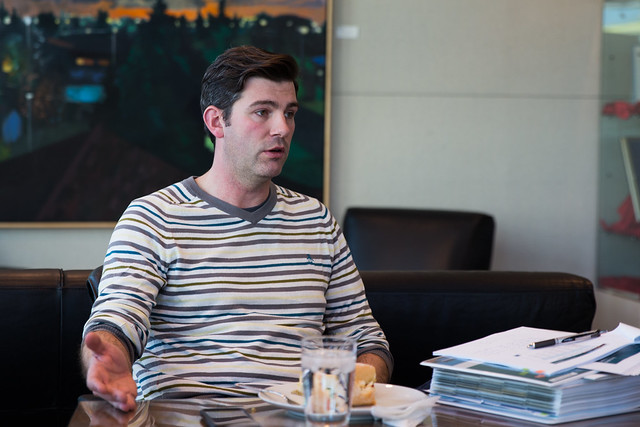
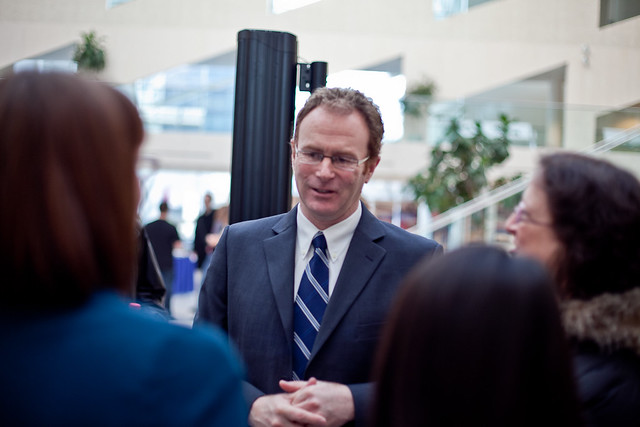
Mayor Don Iveson
Mayor Don Iveson discusses the budget with local bloggers

Communicating about the budget

It was suggested that public sentiment is that the City announces a high percentage tax increase and then Council works to bring it down throughout the budget process, looking like heroes in the process. Mayor Iveson rejected this notion. “It’s not a game, it’s us showing all the cards,” he said. The City is “the most transparent order of government” according to Mayor Iveson.

“If decisions were made in private, there’d be no cynicism,” he continued. “But there’s no cure for cynicism like participation!” He called the entire budget process a “good example of local democracy” in action.

Neighbourhood Renewal

The economic situation has changed and property owners’ ability to pay is different, is how Mayor Iveson explained his proposal to suspend the 1.5% neighbourhood renewal for three years. “For a while we were the only order of government raising taxes,” he said. “Now the other two orders of government are raising taxes.”

He wanted to be clear that cutting the levy does not mean slowing down, however. “The discussion is just how to pay for it,” he said. So if we’re cutting the levy, where will the money come from? First, Mayor Iveson suggested that the tough economy means that costs for the work could actually come down. Second, he’s counting on transfers from the Province and the Feds. “I’m quite confident we will get predictable, sustainable transfers from the Feds starting next year, potentially closing in on nine figures in transfers to Edmonton,” he said. On top of that, the mayor said it’s “a reasonable assumption” that there will be a successor to MSI. That program is getting a $20 million bump next year, but its future beyond 2018 is uncertain.

Mayor Iveson indicated the levy could be reviewed annually and brought back if necessary, though some of his Council colleagues have questioned whether it would really be that easy.

Housing

We talked a little about affordable and social housing. “It sounds like there may be funding for affordable housing in the new Federal budget,” Mayor Iveson said. He told us the City is working to influence how that money will flow. “There’s lots of opportunities to redevelop old sites where the land is the most valuable asset,” he said.

Building housing isn’t enough though. Mayor Iveson talked about the need for an ongoing funding source and said that could come from social enterprise. He mentioned the proposed Londonderry project and said that social housing with wraparound services could be very viable. “Cities are the places where creativity can occur,” he said.

Edmonton Police Service

I’ve written in the past that I think the Edmonton Police Service budget has grown too large and needs to be reigned in. It seems that Council finally agrees, as on Friday they agreed to cap budget increases for the police to the rate of inflation plus population growth. Mayor Iveson blogged about his proposal today.

Mayor Iveson didn’t give any indication he would introduce such a motion when we spoke on Wednesday, though he did say “it’s true that EPS has gotten almost everything they’ve asked for in the last eight or nine budgets.” He also suggested that the Edmonton Police Commission needs to play a role in scrutinizing the budget.

Mostly though he defended police spending and suggested the Province needs to do more to help. The mayor said Edmonton’s police budget is perhaps larger than other cities because of demographics, the boom/bust cycle, and the number of prison spaces in the region. As with health care, demand for policing is growing faster than population, said Mayor Iveson.

“The cost drivers are real,” he said, noting the impact of homelessness and poverty. “But we need to fund a response in the meantime.”

City Charter

Mayor Iveson acknowledged that the timeline for the Charter that was agreed with former Premier Jim Prentice will not be met, but said that everyone is still committed to getting it done with this Council term (the next municipal election is October 2017). He noted that kind of timetable also aligns nicely with the proclamation of the new Municipal Government Act.

Mayor Iveson outlined three phases for the City Charter discussions:

  1. Phase 1 has been about legislative changes. The goal is to have fewer restrictions on Edmonton and Calgary, and maybe over time that can trickle down to other municipalities like Red Deer. It’s really about the Province having trust in Edmonton and Caglary.
  2. Phase 2 is “an earnest discussion about roles and responsibilities.” The prime example is policing. Mayor Iveson noted that smaller communities in Alberta have their policing expenses paid for, but the big cities do not. On top of that, Edmonton picks up the tab for the region. He said “there’s a busines case here,” for example by better aligning the justice system and police to “work together more efficiently.”
  3. Phase 3 would be about financial changes. The term used most often is “long-term sustainable funding” for the big cities.

He also told us that both he and Calgary mayor Naheed Nenshi have aligned around four key priorities:

  1. Policing & Community Safety
  2. Housing
  3. Transit
  4. Poverty

They feel that “implementation is best done municipally” but that there’s a lot of opportunity to work together. Both Edmonton and Calgary have community plans around ending poverty, and they want to see the Province align its efforts with those plans. He noted the Province has not abandoned its Social Policy Framework and that Edmonton’s strategy is consistent with it. When it comes to funding for the plan however, “that remains to be seen.”

Budget deliberations continue

Council will continue discussing the budget right through December 10 if needed. You can dig into the budget here or you can check out the interactive budget simulator.

Downtown’s missing E, Welcoming Syrian refugees, Progressing big city issues

I’m trying something new, where I share some thoughts on a few topical items in one post. Less than I’d write in a full post on each, but more than I’d include in Edmonton Notes. I’ll organize them here. Have feedback? Let me know!

What happened to the colorful downtown E?

Back in May I wrote about the new “downtown for everyone” visual identity which features the E-shaped window. I didn’t really like the “E” itself, because “it doesn’t say anything about downtown nor does it say anything about construction.” I liked the color and the idea of tying the various downtown construction projects together. But as I noted at the time, “that only works if it is widely adopted.”

Now more than six months later, I think it’s pretty clear that adoption is not happening. Despite planning to incorporate the “E” window, the Oilers have not installed it or any of the design elements around Rogers Place. The Royal Alberta Museum used to have great construction hoarding of its own, but it never adopted the window and now the chainlink fence lacks the “E”‘s visual cues. Even the City’s own office tower lacks the “E” window and colors. If they aren’t even going to use it, why would anyone else? Yes there was the big metallic E around town this summer, but the only other place it has shown up is on the website.

New Civic Tower
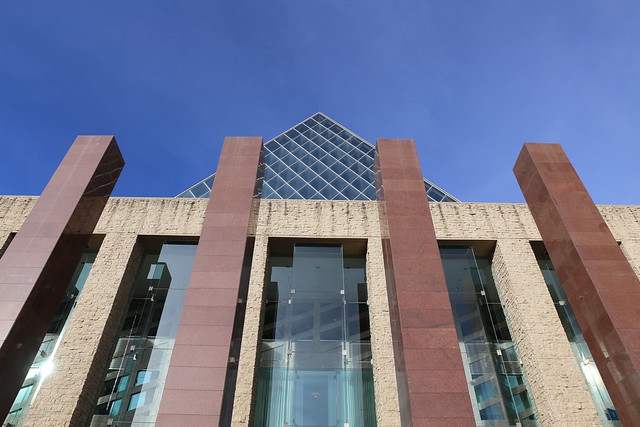
New civic tower construction

The only construction site that has really adoped the “E” is NorQuest’s new expansion. If there were awards for construction hoarding, I think NorQuest would win hands down. It’s bright, colorful, informative, and safe.

Welcoming Syrian refugees to Edmonton

Estimates suggest that roughly 2,500 to 3,000 Syrian refugees will be coming to Alberta, part of the federal government’s pledge to accept 25,000 Syrian refugees by the end of the year. Most of the refugees that come to Alberta will settle in Calgary and Edmonton, of course. According to Stephen Carattini, CEO of Catholic Social Services (the agency with the federal contract to settle refugees here in Edmonton), roughly 400-500 refugees would normally be settled in a year. Settling three times that many in just over a month and a half will not be easy.

There have been some horrible things written and said about refugees since the deadly attacks in Paris, but Premier Notley said we must stick to the plan to welcome Syrian refugees into Canada.

“We need to do that carefully and cautiously but we need to definitely move forward. We cannot have our decisions being driven by fear.”

The Canadian Council for Refugees issued an excellent statement in response to the attacks in Paris and Beirut. Here’s an excerpt:

“The CCR joins in the global outrage at the recent mass murders in Paris and Beirut. The loss of life and shattering of our sense of security connects us to the daily death and destruction in Syria and in other countries at war. We hope that Canadians will remember that Syrian refugees are victims of this violence and will redouble their commitment to welcome them in Canada.”

It’s too bad this unnecessary fear has impacted the United States, where the House today voted to tighten screen procedures on refugees from Syria.

Progressing big city issues

Yesterday afternoon Mayors Iveson & Nenshi met with Premier Notley at the Legislature to discuss the big city charter, policing costs, poverty reduction, and more.

“We want to have an increasingly collaborative relationship and we know that the cities do incredibly important work for the citizens of their cities and, frankly, the province in many ways,” Notley said.

Who knows how productive their meeting really was, but Premier Notley invited both mayors to present their wishlists to the Alberta NDP cabinet in January, so that’s interesting. Mayor Iveson sounded upbeat about the meeting, tweeting “appreciated the chance to explore value-enhancing partnerships around transit, housing, policing & poverty.” Mayor Nenshi tweeted simply, “thanks for the time and continuing our partnership.” For her part, Premier Notley tweeted “a very productive meeting with @DanielleLarivee, @doniveson & @nenshi as we strengthen our partnerships.”

Premier Rachel Notley meets with Edmonton Mayor Don Iveson and Calgary Mayor Naheed Nenshi
Photo by Premier of Alberta

Iveson and Nenshi spent the lunch hour yesterday on Alberta at Noon, taking calls from listeners. Best thing to come out of that? Probably this GIF. At least we know Nenshi liked it!

They both spoke about refugees, of course. Mayor Nenshi said:

“We have a moment now…a moment to define ourselves as a people, as who we are, and what we do, and to show the world what we are capable of. And I know that we’re going to do a great job.”

Mayor Iveson said:

“This can be another example that we look back on as Canada doing what it does best, which is being a light to the world in terms of multiculturalism, in terms of inclusion, and in terms of humanitarianism.”

Isn’t it great to have our province’s big city mayors displaying such leadership?

Ward 12 by-election confirmed, Jobber secures $8 million, EndPoverty Edmonton extended

I’m trying something new, where I share some thoughts on a few topical items in one post. Less than I’d write in a full post on each, but more than I’d include in Edmonton Notes. I’ll organize them here. Have feedback? Let me know!

Ward 12 by-election confirmed

We now have a date for the Ward 12 by-election to replace Amarjeet Sohi! Thanks to a 30 day extension from the Province, the by-election will take place on Monday, February 22, 2016. That means Nomination Day will take place on January 25. The results of the election will be made official on February 26 by noon.

As Dave noted earlier today, there are seven candidates who have announced they’ll run in the by-election so far. The successful candidate will be sworn in at a special City Council meeting on February 26 from 1-2pm. Then they’ll face an aggressive orientation and training period from February 29 to March 4.

Amarjeet Sohi - Ward 12
Amarjeet Sohi on Nomination Day in 2013, photo by Dave Cournoyer

The City’s estimated budget for the by-election is about $300,000. That includes $130,000 in wages and salary, $90,000 on communication and legal advertising, and $55,000 on technology. As for what it’ll cost to run, there could be quite a range. Back in the 2013 municipal election, winning Councillors spent between $31,000 and $106,000 with an average of about $73,000. Amarjeet Sohi raised more than $130,000 and spent $85,105.03 to win his seat. My hunch is that less will be spent in the by-election.

As I noted earlier this year, the last by-election on Council took place more than 20 years ago. You can find all the relevant information on the City’s Election page. I guess I better get to work on the dashboard!

Jobber secures $8 million

Local startup Jobber announced on Monday that it has raised $8 million in a Series A round led by OMERS Ventures, with participation from existing investors, Version One Ventures and Point Nine Capital. Founder Sam Pillar wrote about the news on the Jobber blog:

“Jobber’s customers are currently servicing over three and a half million home owners and businesses all over the world, from Vancouver to Toronto, San Francisco to New York, and Johannesburg to Melbourne. It’s amazing to think that our little startup from Edmonton, Alberta, Canada is now being used in over 35 countries to help build better businesses.”

They started just four years ago so it’s pretty incredible to see what they have accomplished already. According to the news release, “more than three and a half million customers have been serviced by businesses using Jobber, with invoices totaling over $1 billion” since they launched back in 2011.

As Eric remarked to me today, there seems to be something about that roughly $8 million mark here in Edmonton. Back in 2012, Mitre Media raised $8.6 million. In 2013, Drivewyze raised $7.5 million in its Series A round. And earlier this year, Granify announced it had raised $9 million in Series A funding.

Congrats Jobber! Another great example of local entrepreneurs building great companies.

EndPoverty Edmonton extended

One of the things Council approved yesterday was an amendment to Bylaw 16765 to “provide additional time for the Task Force for the Elimination of Poverty to fulfill its mandate.” The original deadline for the task force to provide its final report was December 31, 2015 but now they’ve asked for more time “to test the ideas in the Strategy prior to returning to City Council with a comprehensive ten-year implementation plan.” The new deadline will be July 31, 2016 but the task force anticipates reporting back in April. The bylaw expiry has also been changed, to December 31, 2016, to account for time required for questions.

Now let’s tie this back into the first item above! The EndPoverty Edmonton strategy identifies “Make it easier to vote and participate in elections” as “one of the starting points to ending poverty in Edmonton.” In order to get started on addressing that, the City is hosting an online survey to better understand voter needs. Very timely with a by-election coming up in a few months, so take a few minutes to have your say!

You can learn more about EndPoverty Edmonton here. Be sure to follow them on Twitter too.

Uber decision deferred, $41 million for Edmonton City Centre, have your say on the budget

I’m trying something new, where I share some thoughts on a few topical items in one post. Less than I’d write in a full post on each, but more than I’d include in Edmonton Notes. I’ll organize them here. Have feedback? Let me know!

Uber Decision Deferred

Today was the big Council meeting to discuss the proposed Vehicle for Hire Bylaw. Last week the City informed the media they’d need to pickup a press badge in order to be present today, and security was increased at City Hall in anticipation of heated protests. But despite a few minor outbursts during the meeting, it all felt a little underwhelming. Many Councillors used the opportunity to get on their respective soapboxes to complain about whatever – some ripped into Uber, some expressed anger at Administration, and one or two questioned why we regulate taxis at all. But that was the only drama, because in the end Council asked for more information and deferred a decision on the bylaw until late January.

Make no mistake, Uber is going to walk away from this whole situation happy. Why? Because there’s a lot more Edmontonians that want to see Uber here as an option than there are Edmontonians willing to speak up for the taxis. Council is hearing loud and clear from constituents that they want Uber in Edmonton, and that’s the most effective way to get Council to budge on something. And even if the rules that do eventually get passed aren’t ideal for Uber, they may be good enough as Councillor Walters points out. They’re threatening to leave now because it helps them secure a better negotiating position. But once there are rules to play by, it’s a simple business decision – can they make money following those rules or not?

$41 million for Edmonton City Centre

Today via Ted Bauer I saw that Oxford Property Group is planning to invest $41.3 million to “revitalize the entire retail experience” of Edmonton City Centre. A big part of the plan is to “relocate and significantly upgrade” the food courts. Currently located on the lowest level of the mall, one on the west and one on the east, the existing food courts will be consolidated centrally on the top level (as is now common in other malls and shopping centres).

Edmonton City Centre
Edmonton City Centre, photo by IQRemix

The news release mentions that “over 23,000 new residents are expected to be living downtown by 2019.” It’s great to see that Edmonton City Centre is looking at this as an opportunity and that they’re willing to invest in order to compete with Ice District. There are already a lot of empty spaces in the mall, including many that have been empty for months or even years. With a new hotel, new theatre, and lots of other retail moving just a block or two away into new buildings in Ice District, it was starting to look like Edmonton City Centre would be even emptier in just a few years.

I would suggest this investment is the minimum necessary in order for Edmonton City Centre to compete. And their relative silence on all the development happening downtown was not inspiring much confidence, so this is a nice surprise. But let’s keep it real, ok? Here’s what the Oxford site currently says:

“There’s a huge buzz coming out of downtown Edmonton—and it’s resonating entirely from Edmonton City Centre.”

That’s a bit of a stretch! Still, good to see them willing to make a play for a piece of the pie.

Have your say on the 2016-2018 Operating Budget

We’re in the middle of budget season, as you are probably aware. On Monday, November 23 a non-statutory public hearing will be held at City Hall from 1:30pm to 9:30pm. It’s an opportunity for you to speak directly to City Council about the proposed budget before a decision is made in early December. If you’d like to register to speak, you can do so here.

The full budget is available at edmonton.ca/budget2016. If you’d like a friendly introduction and overview to the budget, check out yegcitybudget.ca. And finally, if you’re a geek like me and want to dig into the data, budget.edmonton.ca is the best place to start.

The final budget discussions get underway starting November 27.

Coming up at City Council: November 9-13, 2015

This coming week Council is back to Committee meetings. I think because of the budget, a lot of reports have been postponed or rerouted. Below are a few highlights from the week’s agendas with links to the reports and more information.

City Council Swearing In 2013-2017

Meetings this week

You can always see the latest City Council meetings on ShareEdmonton.

First Responders Memoriam

Councillor Anderson made an inquiry back in June about how Edmonton Police, Edmonton Fire Rescue Services, Emergency Medical Services, and other first responders who have died on duty are honoured. Some highlights from the response:

  • “There is no one existing record or public location that identifies the names of all first responders who have died in the line of duty.”
  • EPS and EFS both have programs that honour their fallen members.
  • The City has both the Civic Employee Memorial and the Naming Committee does honour people and places in the City.
  • “The Edmonton Police Service recognize members by adding the names of fallen officers to their flag (or colours), which is on permanent public display at City of Edmonton Police Headquarters. The names of ten fallen officers, dating back to 1918, are recorded on the flag.”
  • For Edmonton Fire Rescue Services, “there is a bell tower that contains the ceremonial bell and the honour roll which names all of Edmonton’s fallen firefighters.”

The City holds a memorial event every two to three years, the next of which will take place in September 2017. “The program includes an Honour Guard procession provided by Edmonton Police Service and Fire Rescue Services, and the laying of the wreaths in honour of the deceased.”

The response also says it could be possible to identify a permanent location for a “First Responders Memorial” within City Hall.

Current Status of the Film Commission

There’s some interesting background in this report on Edmonton’s film industry. The role of Edmonton Film Commissioner was created in 2001 and since then two people have filled the position. But it has been vacant since March 2015 as EEDC “has been evaluating a new strategy which encompasses other forms of media and technology.”

There are also two recommendations, based on public engagement and other evaluation:

  • “That the Edmonton Film Commission and the role of the Edmonton Film Commissioner continue to reside with Edmonton Economic Development Corporation.”
  • “That Administration work with the Edmonton Economic Development Corporation, Alberta Media Productions Industries Association and representatives of the film, music and digital media industries, to develop an industry collaboration and development framework, and provide a report to Executive Committee with the results of these discussions.”

EEDC’s new strategy is called “Intersect – a collision of artists and geeks”.

“Intersect offers a multi-disciplinary environment for content creators, interactive designers, hardware engineers, and data scientists, working to transform the way we visualize and analyze data, tell and share stories, and interact with technology.”

The strategy notes that although the digital/interactive media industry generates $7.5 billion of revenue in Canada, just 14% of digital media production takes place in Alberta, and 80% of that is in Calgary. That means there’s a big opportunity for Edmonton to take a bigger piece of the pie.

A separate strategy from AMPIA proposes the creation of an Edmonton Screen Industries Office that would support the local industry. But: “Ultimately, there needs to be collaboration with municipal and provincial organizations and government departments to align goals and resources where appropriate to grow Edmonton screen and cultural industries.”

There’s also a report on the Film Funding Agreement between the City and EEDC. “Administration sees a continued economic benefit in supporting the previously established agreement.”

Distributed Energy in Edmonton’s Downtown

The report begins:

“The City of Edmonton has long understood the benefits of a district energy system and has been monitoring district energy opportunities for several decades. Feasibility studies were done in 1980 and 1992 to explore implementation of district energy in the central core. Since that early work, the technology has evolved considerably and the infrastructure needed takes less space and is more cost-effective than traditional boiler installations.”

The business case for a district energy system in downtown Edmonton is now ready for Council’s review. The City would need to provide a few things in order for it to work: commit City-owned building connections, provide a central located building site for the energy hub, and encourage other organizations to use it. It would also need to contribute $9 million over three years to “help to offset ENMAX’s financial investment and risk” in developing the system.

The benefits of the district energy system for downtown include:

  • “A reduction of 18,100 tonnes (3,800 cars) of greenhouse gas emissions per year in the initial build out of the district energy system.”
  • “Reduced environmental footprint for municipally owned and operated buildings.”
  • “Increased power grid resiliency for the urban core.”

Administration will likely bring forward an unfunded service package for the system for Council to review during the 2016-2018 budget process.

Low Income Transit Pass

This report is a follow-up to Council’s request from April on options for implementation and distribution of the Low Income Transit Pass for 2016. The pass is to have an initial discount of 60%, funded by property taxes. Administration is recommending a $35 pass for eligible customers.

“The most significant challenge for implementing a low income pass program is ensuring that there are enough distribution points so that qualified individuals and families can purchase the pass with relative ease, while still ensuring that only those intended to benefit from the tax levy funded subsidy do so.”

There are more than 100,000 individuals in Edmonton with incomes below the Low Income Cut Off (LICO). ETS expects that an average of 20,000 Low Income Transit Passes will be sold each month (which includes the roughly 5,000 people who already qualify for the AISH Pass). The report recommends four sales locations: Clareview Recreation Centre, Mill Woods Recreation Centre, St. Francis Xavier Sports Centre, and City Hall.

In terms of budget implications:

“The net impact for the recommended $35 Low Income Transit Pass, for all transit services, is $3.1 million in 2016, $6.3 million in 2017 and $8.4 million in 2018.”

Administration is also providing a couple of enhancement options and alternatives:

  • One enhancement would mean that qualifying families only pay for adults and all children under 18 would get a transit pass at no cost. This would further reduce ETS revenue by $2.3 million.
  • A separate enhancement could be to provide the pass at no cost to all eligible Edmontonians. A further reduction in ETS revenue of approximately $8 million would anticipated.
  • An alternative would be a $1 pay-as-you-go cash fare. The cost to ETS of such a program would be “significantly reduced compared to the monthly pass” but the cost to Edmontonians could be more or less, depending on how many rides they take each month.

The City is also recommending that 500 transit passes be distributed monthly to homeless citizens.

Another interesting item from the report is that the “new Low Income Transit Pass operational program should be considered as an interim process” because the regional Smart Fare system will incorporate all fare products, including low income. The report says the new Smart Fare system is expected to be operational in 2018.

Neighbourhood Renewal Program Status Update

There’s lots of really interesting information in this report! From 2009 to 2014, Neighbourhood Renewal Program investment has totaled $660 million. That includes:

  • 22 Neighbourhood Reconstruction Projects
  • 44 Neighbourhood Overlay Projects
  • Total of 1651 lane kilometres of Local/Collector Roads renewed

The Capital Budget for 2015-2018 would total $615 million in Neighbourhood Renewal. That’s 1.5% annually and will fund:

  • 20 Neighbourhood Reconstruction Projects
  • 24 Neighbourhood Overlay Projects
  • Total of 1122 lane kilometres of Local/Collector Roads renewed

The report includes a possible reduction to just 1.4% for 2016, 2017, and 2018, which would reduce the funding by $41.6 million.

Other interesting items

Wrap-up

You can keep track of City Council on Twitter using the #yegcc hashtag, and you can listen to or watch any Council meeting live online. You can read my previous coverage of the 2013-2017 City Council here.

Dominoes are falling at the City of Edmonton

There’s a lot change taking place at the City of Edmonton right now and you should expect it to continue until well into next year. You might say the dominoes have started falling and no one knows when the final one will land. There are both internal and external causes for this change. Before we get into the changes, let’s consider some context.

Where It All Began
Photo by mckinney75402

Certainly the new Provincial and Federal governments have had an impact, both directly and indirectly. By directly I mean that the City has lost some key individuals. For instance, former City Clerk Alayne Sinclair left earlier this year to work in Premier Notley’s office, and of course former Councillor Amarjeet Sohi was just named to Prime Minister Trudeau’s cabinet. And by indirectly, there’s the uncertainty about funding and working relationships that always comes with new faces. At the Provincial level, the review of the Municipal Government Act and the ongoing discussions about the Big City Charter will also have an impact depending on the outcome.

As a result of the last municipal election, both Council and Administration identified public engagement as a key challenge area of focus. Council launched the Public Engagement Initiative while Administration launched the Open City Initiative. Now with the release of the Phase 1 report back in September, work is underway to establish an Advisory Committee and working groups organized around the five strategic areas of focus. That work is expected to last through the remainder of the current Council term.

I think another big factor to consider is The Way Ahead, the City’s strategic plan. That document, which was approved in 2009, was just reviewed and updated last year, but planning will soon be underway for a more thorough overhaul leading up to 2018 (though we need to ensure we do and not just plan). How public engagement and the municipal election in 2017 factor into that work is still an open question. And at some point, the new City of Edmonton office tower will be completed allowing staff to consolidate at a single location, which could have big cultural impacts.

Top of mind at the moment is the Operating Budget. Instead of an annual budget as in years past, the City has switched to a multi-year budget, and that’s having all kinds of knock-on effects. It should mean less effort is required each year to prepare the budget, but it also means that Council can be more strategic about spending.

And of course the City’s missteps have been well-documented this year. Major projects like the 102 Avenue Bridge over Groat Road and the new Walterdale Bridge have been significantly delayed, and the Metro Line LRT was perhaps the key catalyst for much of the change that has taken place.

Simon Farbrother
Simon Farbrother, photo by City of Edmonton

The most obvious change was Council’s decision to fire City Manager Simon Farbrother back in September. I must admit I was caught off-guard by the news, mainly because although Councillor Nickel called for Farbrother’s head during the Metro Line LRT discussions, he was the only one really doing so. Mayor Iveson and other Councillors suggested Nickel was grandstanding and said Farbrother had their full confidence. So the about face just a couple of weeks later was a surprise.

Linda Cochrane has been the Acting City Manager since late September. I think she’s a fantastic choice, certainly to maintain some stability throughout this uncertain time. But I don’t think it’s likely she’ll get the job. Here’s what Councillor Anderson said after she was made the Acting City Manager:

“She’s certainly been a part of everything that’s happened here for a long, long time and has a way with people,” he said. “I think an excellent choice.”

Being “a part of everything that’s happened here for a long, long time” is certainly a good thing for stability, institutional knowledge, and efficiency. But it’s not necessarily what you look for when you want to change things up. And that’s what Council seems to be interested in.

As Paula Simons noted, Al Maurer was widely considered a micro-manager and perhaps had too much control over the operations of the City. In contrast, Simon Farbrother brought more hands-off approach and focused on communication and culture. The assumption now is that the right person for the job can straddle the fence, able to get into the details and also able to articulate and connect the work to the big picture.

It’s clear that Council, led by Mayor Iveson, wants to go in a different direction:

“The scale and complexity of the challenges ahead demand a fresh perspective,” Iveson said. “This is about setting our administration on a new path to manage the next chapter in the city’s growth.”

Whoever the successful candidate is, it’s very likely they’ll want to make some big changes. That could mean even more turnover in senior staff than we have already begun to see.

Scott Mackie, who was in charge of Current Planning under Sustainable Development, tendered his resignation a couple weeks ago and will leave the City on November 13. I understand that Peter Ohm has been tapped to take his place. That’s a big branch, responsible for some of the most contentious issues that the City has dealt with this year.

Changes in transportation continue, with Eddie Robar joining the City from Halifax to lead ETS, filling the role that has been vacant since Charles Stolte was let go earlier this year. Robar will start on January 4. He’s very likely to shake things up upon arrival, bringing his experience overhauling Halifax’s transit system to the ongoing debate about our own.

And the biggest change could still be coming. Yesterday, Council voted to have Administration outline steps for a full program review. Mayor Iveson repeated a phrase he has used many times before, saying that setting targets for cuts is “the old ‘pin the tail on the budget'” and that the review should be focused on efficiency instead.

“Of the give or take 87 different things that we do at the city of Edmonton, there may be some that we should either stop doing or do less of versus other priorities,” said Iveson in support of the review. “Budget is not the best way to make those decisions and yet it is the default by which we make those decisions.”

The full program review is likely welcome news for some, like the Canadian Federation for Independent Business, which called current spending “unreasonable” and said property taxes have “ballooned”.

The last major review took place in 1997. Bruce Thom, who joined the City of Edmonton as City Manager in 1996, wasted no time in making changes. One of the first things he did was spend $500,000 to have Ernst & Young evaluate the City’s operations. That resulted in City ’97 (subtitled “Preparing for the Future”), a plan to save $52 million per year by the year 2000, principally by eliminating roughly 750 of the City’s 8,700 jobs. In the end about 400 positions were eliminated and the City reorganized from thirteen departments to just eight, resulting in a savings of roughly $22.5 million annually between 1997 and 2000.

It was a stressful time for City bureaucrats, and Council raised that as a concern with conducting another review now. They cited the importance of a clear communications plan and downplayed the idea that the review is being undertaken solely to find opportunities for job cuts.

full time positions

Though Simon Farbrother led a relatively minor reorganization in 2011, the City’s workforce has generally been growing in recent years. Prior to City ’97, the last major round of layoffs took place in 1983. At the time the City had about 11,000 employees, a number the City surpassed once again in 2012.

I think a review of the City’s operations makes sense, and perhaps the timing is right. With a new City Manager coming in, the possibility of a new relationship with the Provincial and Federal governments (especially with the City Charter), and a new round of strategic planning coming up, it’s entirely appropriate for Council and Administration to get aligned on priorities.

Expect much more change to come!

Coming up at City Council: November 2-6, 2015

The City released its proposed 2016-2018 Operating Budget today, something that Council will start discussing in the days ahead.

“The City of Edmonton’s proposed 2016-2018 Operating Budget recommends a 4.9 per cent general property tax increase in 2016 for all civic operations. Similar increases are proposed for the budgets in the second and third years. The proposed budget holds the tax increase for all civic operations to 2.5 per cent.”

For the typical household (a single-family dwelling with an assessed value of $401,000), that would mean an increase of $109 in 2016, $114 in 2017 and $120 in 2018.

Untitled
Photo by City of Edmonton

The City says it has “restrained base operating costs” and has found some savings as part of Council’s 2%:

“The City’s efforts to find efficiencies and innovation has identified $29.9 million in operating savings or cost avoidance for 2016. Of that, $10.1 million is being made available for Council to reallocate to areas of greater priority.”

You can learn more about the budget here, and you can fill out the online survey to provide your input by November 14.

Here’s my look at what Council will be discussing in the week ahead.

Meetings this week

You can always see the latest City Council meetings on ShareEdmonton.

2016-2018 Operating Budget

The public release of the proposed budget is a big step forward toward approval, but it’s only a step. A non-statutory public hearing will be held on November 23, offering the public a chance to speak to the budget. Council deliberations will take place from November 27 to December 10, after which Council will have approved the budget and all amendments.

This is the first time the City is planning its Operating Budget on a three-year basis. The City provides these three reasons for the change:

  • Stability: Planning a budget over multiple years allows Council and Administration to take a ‘longer view’ of Edmonton’s needs, and build out stable program and service delivery. This allows Edmonton to better plan stable revenues and expenditures, providing consistent funding levels for the programs and services Edmontonians expect.
  • Flexibility: Multi-year budget planning allows the City to be more flexible in how it finances operations, allowing Council and Administration to reallocate funding priorities across the different years of the longer budget cycle. This enables the City to bring in programs and services when they are most needed, and to adapt to the ever-changing needs of our city.
  • Future Planning: As one of Canada’s fastest-growing cities, Edmonton needs to be able to plan for its future vision while also meeting its present day demands. Multi-year budgeting permits Council and Administration to implement or revise programs and services over a longer time frame, rather than being limited to yes/no decisions on a yearly basis. This means, for example, if a new program or service doesn’t fit into this year’s budget cycle, it can still be planned for a later year.

I think another benefit of a three-year budget is that Administration should be able to save much of the time, money, and stress that goes into preparing the budget every year. The budget dominates much of the City’s work through November and December.

Stay tuned, there will be much more budget discussion to come in the weeks ahead!

Augustana Redevelopment

Bylaw 17423 will rezone the property at 9901 107 Street downtown from CMU to DC2, to make way for Pangman Development’s planned Augustana Redevelopment (which you can learn more about here on SkysraperPage). The residential building will be a maximum of 96 metres high with up to 235 units, and it’s likely to be a rental property.

augustana redevelopment

The Edmonton Design Committee approved the application with conditions back in September. The current site is home to the former Augustana Lutheran Church, which closed its doors last December after 85 years.

Committee Recommendations

Recommendations that have come forward from Committee include:

There are also two Executive Committee reports that have been referred without a recommendation:

Other interesting items

  • Bylaw 17396 will rename “Horse Hill Neighbourhood 2” to the “Marquis Neighbourhood”.
  • Now that a judicial recount has confirmed that Amarjeet Sohi won his seat in Edmonton-Mill Woods, Council will receive a verbal report on the Ward 12 by-election.
  • Council will consider participation in the Leadership in Asset Management Program which will allow the City to receive grant funding from FCM’s Green Municipal Fund.
  • Bylaw 17289 is ready for three readings and will amend the Speed Zones Bylaw to change various maximum speed limits throughout the city.
  • There are motions pending from Councillor Henderson (on food waste), Councillor Oshry (on public engagement stats), and Mayor Iveson (on procedures and committees).
  • Council is slated to hear from the City Manager Recruitment Committee as well, though that update will be kept private.

Wrap-up

You can keep track of City Council on Twitter using the #yegcc hashtag, and you can listen to or watch any Council meeting live online. You can read my previous coverage of the 2013-2017 City Council here.

Coming up at City Council: October 26-30, 2015

This coming week Council is back to Committee meetings. Below are a few highlights from the week’s agendas with links to the reports and more information.

City Council Swearing In 2013-2017

Meetings this week

You can always see the latest City Council meetings on ShareEdmonton.

Affordable Housing

Executive Committee will be discussing three related reports on Tuesday:

Here is the Edmonton context, according to the first report:

“In Edmonton, an estimated 11,600 social housing units will be affected by expiring operating agreements representing approximately $22 million in federal funding. These units are scattered throughout the city and include seniors self-contained housing, nonprofit housing, continuing co-operative housing, urban native housing, rent supplement housing and community housing. Of the community housing portfolio, the City of Edmonton is the whole or beneficial owner of approximately 3,400 units. The operating agreements for these units will begin to expire in 2022 with the majority ended by 2034.”

The ongoing City Charter negotiations with the Province are expected to address the issue of affordable housing, specifically when it comes to money. On the issue of the budget:

“Assuming that the City continues to participate in funding social housing at the current level, Administration estimates the need for an additional $4.6 million per year for the next 13 years (total of $59.8 million) in order to regenerate all 13 wholly City-owned social housing projects.”

The proposed Affordable Housing Strategy would replace the existing Building Together strategy, and would guide the City’s role in affordable housing for the next ten years (2016-2025). The strategy establishes four goals:

  1. Increase the supply of affordable housing in all areas of the city.
  2. Maintain the supply of affordable and market rental housing.
  3. Enable stable residential tenancies and transition people out of homelessness.
  4. Anticipate, recognize and coordinate action to respond to housing and homeless needs.

While stating that “municipal governments are best positioned to understand local housing needs,” the report says that “increasing the supply of affordable housing requires dedicated, sustained sources of funding, which must be provided by the other orders of government.”

Once the Affordable Housing Strategy is approved, the City will develop an implementation plan with specific initiatives that would begin early next year.

Council has previously directed that 20% of the housing units in Blatchford be affordable. The report linked above outlines the Principles for Development of Affordable Housing at Blatchford, details the Affordable Housing Allocation, and notes that “the $10 million earmarked for affordable housing from the proceeds of future land sales at Blatchford be used to offset the market value of land to be used for permanent supportive housing in Blatchford.”

River Access Guiding Principles Policy

Recognizing how important the North Saskatchewan River is Edmontonians quality of life, these guiding principles are being developed as “the backbone of a comprehensive river access strategy that will inform future programming, operations and infrastructure improvements that support access to the river and activities associated with the river.”

Edmonton Fall Season
Edmonton Fall Season, photo by IQRemix

Work began back in 2013 and consultation has identified strong support for the guiding principles. Over the next year, the River Access Strategy and implementation plan will be developed.

“Approval of Policy C586 will ensure that the provision, development and management of river access and river-based activities in the City of Edmonton is responsible, orderly, equitable and environmentally appropriate, while providing opportunities for recreation, education and learning.”

The seven guiding principles are as follows:

  1. Ensure public access to the river and riverside infrastructure as public domain.
  2. Value and protect the unique character and environment in the river valley by stewarding, protecting, conserving and restoring the integrity of the river.
  3. Educate and engage Edmontonians to build lifelong skills, as well as awareness and appreciation of the river and its natural surroundings in order to nurture stewardship of a valued resource.
  4. Foster collaboration and partnerships so that infrastructure and facilities are shared and programming is coordinated.
  5. Promote public safety and responsible use to communicate safe water recreation behaviors, emergency response and bylaw enforcement.
  6. Provide and support a range of river recreation opportunities to enhance Edmonton’s unique quality of life.
  7. Celebrate the cultural, historical and social role of the river in the city to build awareness and appreciation of the river.

You can read the full strategy here.

Process for New Libraries

This report outlines EPL’s prioritization process for new libraries and its rationale for advancing the preliminary design for the Penny McKee – Abbottsfield Branch. There’s a lot of information here, but I wanted to highlight a few things I learned:

  • “The need for a new full service library branch is determined through an analysis of current and projected population in a particular area of the city, along with proximity to other full service library sites.”
  • “Planning for a new location generally begins once an area’s population has reached 20,000 and is projected to grow to 30,000 to 35,000 within the next five years, and where there is not another library branch within four to five kilometres.”
  • Selected sites must be highly visible, close to or on premium transit routes and roadways, close to current or planned LRT, and be readily accessible to pedestrians.
  • EPL “seeks opportunities for co-location of library service points with other municipal services” like recreation centres.
  • EPL branches are classified into three sizes: Small (10,000 square feet and under), Medium (over 10,000 up to 18,000 square feet), and Large (25,000 square feet).

The key unfunded capital project priorities over the next 10 years identified in Edmonton Public Library’s 2015-2024 Capital Plan are the following, in descending order of priority:

  • Riverbend (existing branch)
  • Lewis Estates (will replace West Henday Promenade eplGO)
  • Heritage Valley (new branch)
  • Woodcroft (existing branch)
  • Pilot Sound (new branch)
  • Whitemud Crossing (existing branch)
  • Castledowns (existing branch)
  • Abbottsfield (existing branch)
  • Ellerslie (new branch)

There’s a lot of information on the rationale for moving the Abbottsfield branch “to an owned facility in 2022-2024 (design and build timeline).” The current branch is serving the public well and the existing lease doesn’t expire until 2020, but “the importance of a library accessible to a community, particularly one that faces higher than average social issues, is a factor for consideration.”

Transit Fares 2016-2018

Earlier this year, Council decided that transit fares would be set within the multi-year budgeting process. Administration is suggesting that the increase be set at an average of 3% per year. Adult cash fares would therefore be:

  • 2015: $3.20
  • 2016: $3.25
  • 2017: $3.50
  • 2018: $3.50

Thankfully they are rounding fares to the nearest 0.25 now to make it easier to pay. Adult monthly pass fares would be:

  • 2015: $89.00
  • 2016: $91.50
  • 2017: $94.25
  • 2018: $97.00

You can see the full fee schedule here. There has been no public engagement on these fares yet, not even an online survey.

With the new fares, ETS cost recovery would remain fairly constant between 41% and 42%. Ridership is slated to increase slightly, but rides per capita will decline.

Air Conditioning on ETS Vehicles

Councillor Sohi made a request for information on this topic back in July. The report says that 57 of 94 LRT cars have air conditioning and just two hybrid-buses have air conditioning – the remaining 884 buses have none. In Calgary, they have 150 buses with air conditioning that engages at 24 degrees Celsius. And surprisingly, Winnipeg has 256 buses with air conditioning!

ETS Platinum (6002)
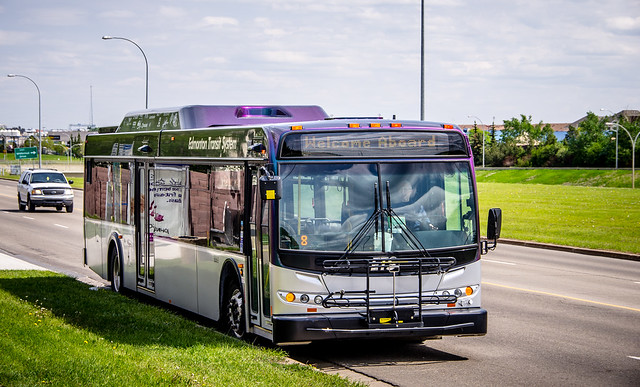
ETS Platinum (6002), photo by Kurt Bauschardt

I don’t think this is worth pursuing, given that we have an average of just 42 days per year with temperatures of 24 degrees Celsius or above, but the report does provide pricing information. The cost to add air conditioning to new buses is $22,500 per bus, and the cost to retrofit is $43,000 per bus. On top of that, if the entire ETS fleet were to be outfitted with air conditioning, it would cost an additional $457,000 per year to operate.

2016-2018 Waste Management & Drainage Services Utility Operating Budgets

The 2016-2018 Waste Management Utility Operating Budget is now ready for Council review:

  • 2016: Revenues of $187,952,000 and Expenditures of $189,998,000.
  • 2017: Revenues of $199,290,000 and Expenditures of $197,327,000.
  • 2018: Revenues of $207,332,000 and Expenditures of $206,461,000.

The 2016-2018 Drainage Services Utility Operating Budget is also ready for Council review:

  • 2016: Revenues of $172,890,000 and Expenditures of $133,896,000.
  • 2017: Revenues of $181,059,000 and Expenditures of $143,471,000.
  • 2018: Revenues of $187,142,000 and Expenditures of $149,920,000.

Council has until October 26 to submit written questions, which Administration will respond to by October 28. Budget deliberations will take place in late November.

Other interesting items

Wrap-up

You can keep track of City Council on Twitter using the #yegcc hashtag, and you can listen to or watch any Council meeting live online. You can read my previous coverage of the 2013-2017 City Council here.

Edmonton will be well-represented in our new federal government

Though most of Alberta voted blue in yesterday’s election, there were a few key races that went red, including two here in Edmonton. Current City Councillor Amarjeet Sohi narrowly won against incumbent Tim Uppal (Conservative) in Edmonton-Mill Woods, and Randy Boissonnault defeated James Cumming (Conservative) and Gil McGowan (NDP) in Edmonton-Centre.

trudeau & sohi
Justin Trudeau & Amarjeet Sohi, photo by Sukhpreet Benipal

Sohi’s victory (assuming it is confirmed) means that Council will see it’s first by-election in more than 20 years. As I wrote earlier this year, a by-election must take place within 90 days according to the MGA, but the City is planning to ask the Province for a 30 day extension so that the Christmas holidays can be avoided. That will likely mean a nomination day sometime in January with the by-election taking place in mid-February.

Throughout his time on Council, Sohi has proven himself as a strong, effective leader who understands the importance of cities. He could have run for mayor in 2013 if Iveson hadn’t. Sohi has been a consistent supporter of both expanding the LRT here in Edmonton and of our city’s efforts to eliminate poverty. I’m sad to see him go from Council, and although he leaves behind a very capable group of colleagues, I know they’ll miss his wisdom and dedication. At the same time I’m thrilled to have such a great Edmonton champion in our nation’s government.

Randy Boissonnault was the other successful local Liberal candidate. I’m sure he’s excited to get to work in Ottawa, but I bet he could also use a moment to catch his breath as it feels like he has been campaigning forever! Boissonnault has been a consistent supporter of many important initiatives in Edmonton, including TEDxEdmonton and Startup Edmonton. He’ll bring a great Edmonton perspective to the government, and seems to have a strong relationship with Justin Trudeau as well.

Randy Boissonnault
Randy Boissonnault, photo by Dave Cournoyer

Edmonton-Centre was previously held by Laurie Hawn (Conservative) who announced he would not seek re-election after serving since 2006. He defeated Anne McLellan (Liberal) to win the seat, who was at the time the Deputy Prime Minister (the last person to hold that position as the Harper government did not name anyone).

We won’t know until November 4 if either Sohi or Boissonnault are named to Trudeau’s cabinet, but it’s a positive sign that the Prime Minister-elect was in both Edmonton and Calgary on Sunday doing some last minute campaigning.

It’s also a good thing that Edmonton has strong representation from all three parties, because opposition MPs do important work as well. Linda Duncan (NDP) won re-election in Edmonton-Strathcona, and Mike Lake (Conservative) won re-election in Edmonton-Wetaskiwin. Both have represented our city well in Ottawa and will continue to do so, although in slightly different roles. Joining them are new MPs like former City Councillor Kerry Diotte (Conservative) who should also bring an interesting municipal perspective to his new role.

Although we now have fewer Edmonton representatives in the government than we did under the Conservatives, I don’t think that necessarily puts us at a disadvantage. Trudeau and the Liberals are arguably a better fit with progressives like Premier Notley and Mayor Iveson. And the Liberal promise to invest $20 billion over 10 years in transit aligns very well with Edmonton’s top infrastructure priority.

For now I’m cautiously optimistic about what the new Liberal government means for Edmonton, and I’m thrilled for both Sohi and Boissonnault!

Coming up at City Council: October 19-23, 2015

Monday is the federal election, so that will be the focus for most Edmontonians and I’m sure Council will be paying close attention also. Mayor Iveson joined other big city Canadian mayors in calling for cities to be a key factor in determining who to vote for. FCM has setup a website to provide information on all of the promises the parties have made related to cities.

Untitled

Here’s my look at what Council will be discussing in the week ahead.

Meetings this week

You can always see the latest City Council meetings on ShareEdmonton.

Zoning Bylaw Amendments on Urban Agriculture

Bylaw 17403 is a text amendment to the Zoning Bylaw 12800 that will add several urban agriculture uses and associated regulations. There are three new uses:

  • Urban Gardens “is for personal, community, or institutional food production and will be allowed in most zones.”
  • Urban Outdoor Farms “is for commercial food production on private property, primarily intended for vacant and underutilized lots in Edmonton.”
  • Urban Indoor Farms “is for commercial and industrial operations that take advantage of new technologies and processes to increase yield and operate year round.”

Additionally, “Farms” will be renamed to “Rural Farms” and “Greenhouses, Plant Nurseries and Market Gardens” is renamed to “Greenhouses, Plant Nurseries and Garden Centres” and will be updated to better align with the products those businesses sell.

The goal of these amendments is to more closely align the Zoning Bylaw with the policies identified in Fresh, Edmonton’s Food and Urban Agriculture Strategy. Importantly, the three new uses “are proposed to assert that primary food production is legal and encouraged in Edmonton.”

Anthony Henday Drive & 135 Street Interchange and Manning/Meridian Interchange

The City is recommending an interchange at Anthony Henday Drive and 135 Street, which could cost in the order of $125 million, “as one of the three top candidates for the Provincial-Territorial Infrastructure Component of the New Building Canada Fund.” They say the return of investment would come from further development of Heritage Valley.

Also up for Council’s consideration is a project bundle for the Edmonton Energy and Technology Park. The planned 4800 ha area envisioned as “a world-class eco-industrial park” is off to a slow start.

“Development in the Edmonton Energy and Technology Park to date has been limited. It is unlikely that development will occur as desired without infrastructure investment. A significant impediment to development taking place in the Edmonton Energy and Technology Park currently is the lack of existing infrastructure and its associated cost.”

The infrastructure investment in both transportation and stormwater drainage could cost in the order of $230 million. However, Administration advises that “it would be appropriate for Council to first provide direction with respect to the degree to which, and where, public funds should contribute to infrastructure servicing that is otherwise provided by developers.”

Meeting Schedule & Council Appointments

It’s that time of year again – Council needs to approve its meeting schedule for the year ahead. There’s nothing too surprising in the proposed schedule. Council would resume after the Christmas break on January 11 and would meet through March 24, right before the Easter break. The summer break would begin on July 15, with Council resuming on August 15.

“The draft January 1, 2016, to December 31, 2016, Council and Committee Meeting Schedule has 19 Council and Standing Committee meeting rotations, 19 Statutory Public Hearings, 18 Non-regular City Council meetings, along with three half-day Council meetings and eight Committee meetings for civic agency recruitment and selection matters.”

The report helpfully includes some statistics from 2013 – 2015 to compare the proposed schedule with previous years. Council must also set the Deputy Mayor and Acting Mayor schedules for the coming year. Each Councillor gets a turn.

As of December 31, a number of Council appointments to civic agencies will expire. The following appointments are being proposed:

  • Alberta Capital Region Wastewater Exchange Agreement Coordinating Committee – Councillor Anderson and Councillor Walters
  • Canadian Urban Transit Association Transit Board Members Committee – Councillor Sohi
  • Capital Region Board – Councillor Gibbons
  • Capital Region Waste Minimization Advisory Committee – Councillor Anderson
  • Edmonton Police Commission – Councillor McKeen
  • Edmonton Public Library Board – Councillor Henderson
  • Edmonton Salutes – Councillor Loken
  • Inter-City Forum on Social Policy – Councillor Esslinger
  • REACH Edmonton Council for Safe Communities – Councillor Loken (as advisor/liaison)

If Councillor Sohi is successful in Monday’s election, then a future report will be brought forward to replace his existing appointments. There is also a list of appointments not yet up for renewal if you’d like to see which Councillors are representing us where.

Northern Circumpolar Secretariat Memorandum of Understanding

The Northern Circumpolar Secretariat is a collaborative effort between the City, EEDC, Chamber of Commerce, U of A, and the Edmonton Regional Airports Authority. It was established earlier this year and the report on the table presents the Memorandum of Understanding for approval. It is “a policy tool to ensure the long-term stability of the Secretariat as it executes its mandate in support of the Northern Relations Council Initiative.” The MOU is 10 pages long and also attached is a 22-page business plan which outlines the budget, governance model, goals, vision, and timeline and deliverables for the Secretariat. The City is providing $90,000 this year, $35,750 in 2016, and $62,000 in 2017.

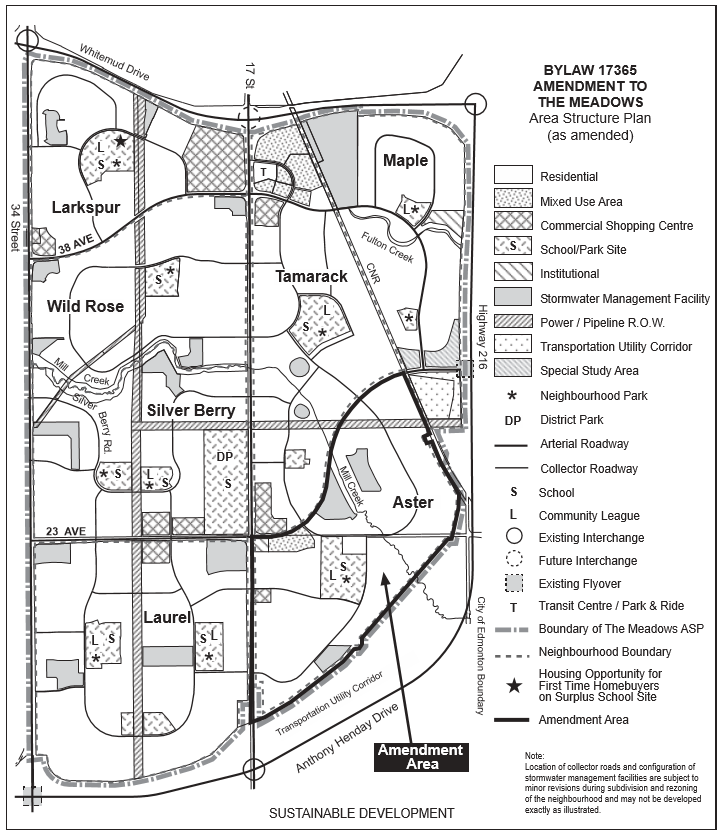
Adoption of the Aster NSP

Aster is the 7th and final neighbourhood in The Meadows ASP. Larkspur, Wild Rose, and Silverberry are considered 100& complete in terms of low density residential units while Laurel, Tamarack, and Maple are considered 45% complete.

meadows asp

Aster will accommodate approximately 3,499 dwelling units and 8,755 people, which is a density of 33.3 upnrha, barely meeting the CRB target for the region. It will account for approximately 15% of The Meadows ASP’s gross area and population.

The neighbourhood will include:

  • one school/park site, with two K-9 schools located in the centre of the area, and three pocket parks throughout the neighbourhood
  • approximately 22 hectares of preserved existing natural areas
  • approximately 13 hectares of stormwater management facilities
  • a system of shared use paths and a bicycle network

The initial neighbourhood infrastructure costs are being largely funded by developers – $104.7 million compared to the City’s $14.8 million – but as usual “there will also be associated operating and life cycle costs that would require City funding allocations in Operating, Utilities and Capital Budgets.” City funding could be required as early as 2017 if the planned construction begins in 2016.

Bylaw 17366 will be considered along with Bylaw 17365 to amend the Meadows ASP and Bylaw 17367 to amend the boundary of the North Saskatchewan River Valley ARP.

Committee Recommendations

Recommendations that have come forward from Committee include:

There are also two Executive Committee reports that have been referred without a recommendation:

Bylaws

There are a number of bylaws on the agenda. Here are a few highlights:

  • Bylaw 17352 will allow for digital signs to be erected in South Edmonton Common, between Gateway Boulevard and Parsons Road and 23 Avenue and Anthony Henday.
  • Bylaw 17373 and Bylaw 17374 together will “ensure the continued operation and preservation of the Oblats Maison Provinciale building, a Designated Municipal and Provincial Historic Resource.”
  • Bylaw 17297 would amend the Public Places Bylaw to include the prohibition of e-cigarettes in the same manner as tobacco products.
  • Bylaw 17432 authorizes borrowing of up to $250 million for the Valley Line LRT project.
  • Bylaw 17390 will increase the borrowing authority to finance construction costs for the Valley Line LRT from $152 million to $1.1 billion.

Other interesting items

  • Council will once again be discussing the Youth Council recommendation of vegetarian eating, in the name of sustainability.
  • There is a small change being proposed to the 2016-2018 Budget Process, to allow for an early release of the Utility Budget. Council must now submit written questions regarding the budget by October 28.
  • The City Manager Recruitment Committee, made up of Mayor Iveson and Councillors Esslinger, Loken, and Walters, met for the first time on September 30. Pretty much all of their activities will be carried out in private.
  • Tuesday’s agenda includes six private reports, including an update on the Valley Line LRT Funding Plan, an update on City Infrastructure Priorities for the Provincial Budget, and a status update from the Acting City Manager.
  • Wednesday’s agenda includes just two private reports: verbal shortlistings for both the Edmonton Regional Airports Authority and the Edmonton Police Commission.

Wrap-up

You can keep track of City Council on Twitter using the #yegcc hashtag, and you can listen to or watch any Council meeting live online. You can read my previous coverage of the 2013-2017 City Council here.