The City of Edmonton’s transformation continues with latest reorganization

The City of Edmonton’s internal transformation efforts continued this month with a reorganization taking effect on June 1. City administration has now realigned into six departments, plus the Office of the City Manager, in a bid to improve communications and to better align with strategic direction.

While I wouldn’t call the reorganization a “major” one – it’s certainly not like City ‘97 which streamlined 14 departments to just 8 and saved millions of dollars – it nevertheless is a significant step for the current City administration. Under the leadership of City Manager Simon Farbrother, the City of Edmonton has embarked on a major cultural shift known as Transforming Edmonton and Me.

Here are the details on the latest reorganization.

Old departments:

  • Asset Management & Public Words
  • Capital Construction
  • Community Services
  • Corporate Services
  • Finance & Treasury
  • Office of the City Manager
  • Planning & Development
  • Transportation

New departments:

Here’s the new organizational chart (PDF):

Community Services now includes the Parks and Community Standards branches in addition to Fire Rescue Services, Neighbourhood & Community Development, Community Facility Services, and Community Strategies.

Corporate Services remains largely unchanged, consisting of the Human Resources, Information Technology, Law, Materials Management, Fleet Services, and City Clerk branches. There’s also a new Customer Information Services branch, which is responsible for 311 and the website.

Finance & Treasury is now Financial Services, and consists of the Strategic Management, Client Financial Services, Corporate Accounting, and Assessment & Taxation branches. The former Transformation Management branch appears to no longer exist as a separate entity.

Asset Management & Public Works has become Infrastructure Services, and includes all above and below ground infrastructure. It now consists of three branches (Buildings & Landscape Services, Drainage Services, Waste Management Services) instead of four (Corporate Properties, Drainage Services, Parks, Waste Management). It will also contain the Project Management Office.

The Office of the City Manager has not changed since it adopted pieces of the old Deputy City Manager’s Office (DCMO) last year. Corporate Communications and Intergovernmental & External Affairs both report to the City Manager.

Planning & Development has become Sustainable Development, and now consists of four branches (Current Planning, Housing & Economic Sustainability, Urban Planning & Environment, Corporate Properties) instead of five (Assessment & Taxation, Community Standards, Current Planning, Housing, Planning & Policy). There’s also a new area called Transformational Projects, which will be responsible for projects like the proposed downtown arena and the City Centre Redevelopment. Urban Planning & Environment is now responsible for Parks Planning.

Transportation Services has gone from three branches (Transportation Planning, Transportation Operations, ETS) to at least five (Transportation Planning, Transportation Operations, ETS, LRT Design & Construction, Road Design & Construction). This is basically the adoption of the old Capital Construction department. The web page for the department also lists a new LRT Expansion branch, though it doesn’t appear on the org chart. The changes in this department are intended to put The Way We Move into a single area.

Final Thoughts

I think the changes, while mostly cosmetic, are important. Most of the departments now contain “services” right in the name, which better reflects their purpose and mission. The changes also reflect a desire by administration to better align with The Way Ahead, the strategic direction set by City Council. It’s not clear whether any jobs will be lost as a result of the reorganization, but I don’t think so. I also don’t believe it is in any way connected to the projected $31 million deficit the City is facing. The wheels were in motion for this reorganization some time ago.

City Centre Redevelopment ‘shorter-listing’ reveals problems that must be addressed

Last week City Council shorter-listed three of the five finalists in the City Centre Redevelopment Master Plan Design Competition, with the winner set to be named on June 22. The decision to narrow the field to three after a botched media conference was unexpected and was largely overshadowed by last week’s arena news.

The media conference was set to take place on Wednesday afternoon. The advisory had gone out less than 24 hours earlier:

Join City Manager Simon Farbrother for the announcement of City Council’s selected design team to transform the City Centre Redevelopment project into a world leading, environmentally sustainable community. The announcement completes a year-long international competition to select the best team to deliver a master plan to develop this centrally-located land which is approximately 266 CFL football fields in size. A representative from the winning team will be on hand for media interviews after the formal portion of the announcement.

Members of the local media filled the Councillor’s Boardroom at City Hall which had been setup with chairs and the competing teams’ display boards. Mayor Stephen Mandel, City Manager Simon Farbrother, City Centre Redevelopment Executive Director Phil Sande, Fairness Advisor James McKellar, and a representative from each of the five finalists were set to be in attendance. We chatted amongst ourselves as we waited for the proceedings to begin.

ECCA Announcement

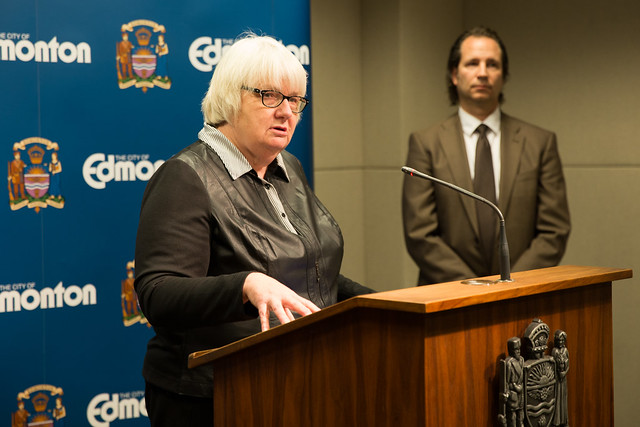
Just before four o’clock, Mayor Mandel and Simon Farbrother entered the room, nearly half an hour after the media conference was supposed to begin. The mayor took the podium and revealed that City Council had been discussing the proposals in camera (in private) and still had too many questions outstanding to make a decision. I tweeted the news at 3:57 PM, along with The Charrette and a few other people. Simon Farbrother also said a few words, and said the media would be given an update by the following morning. The whole thing lasted just five minutes.

I remember thinking as I left City Hall that someone must have screwed up. I mean, since when does Council discuss anything quickly? It’s their job to make an informed decision, and that usually takes time. I found out later that inconveniencing the media was just the tip of the iceberg.

Mayor Mandel ECCA Announcement

When Mayor Mandel had told the media that Council still had questions, I assumed they were questioning the finalists directly. Not so, Shafraaz Kaba of Manasc Isaac told me. While the media were sitting in the Councillor’s Boardroom waiting for the announcement, the five finalists were sitting in a windowless room in the City Clerk’s office. Shafraaz said they had been taken there while Council was discussing the selection committee’s recommendation. They were not told how long they’d be waiting. “They provided coffee and drinks, and some fruit and dessert that basically no one touched,” Shafraaz told me. He recalled that everyone was starting to get impatient as they watched the minutes slowly tick by. Finally after an hour and a half they sent someone to find out what was going on. Soon everyone had left the room and was waiting outside the clerk’s office for some kind of update. “That’s when I saw your tweets, about Council not being able to make a decision,” he told me. A few minutes later, Phil Sande arrived and told them that Council would not be making a decision after all. When Shafraaz told him that they already knew that, Phil seemed surprised and asked how they had found out. “It was like he didn’t seem to know that there was a press conference going on,” Shafraaz said.

The next morning, Phil called Shafraaz and told him that their team’s submission had not been chosen as one of the three to move ahead. It was clarified that the Mayor and City Council will make the final decision on the winning team. At the Downtown Business Association’s Spring Luncheon later that day, representatives from all five teams were introduced and then a short, pre-recorded video with Mayor Mandel was shown. In the video, Mandel made reference to “the decision” which brought chuckles to the packed room. Simon Farbrother then made the official announcement about the shortlisting of three teams.

City Centre Airport Design Competition Finalists

The way the finalists were treated last week is completely inexcusable. Five world-class teams are competing to help shape the future of Edmonton and we lock them in a room with no information about what’s going on? It’s completely unacceptable. What are the chances that they’re going to want to work with the City again after being treated like that?

The worst part is that Wednesday was just more of the same, according to Shafraaz. There has been confusion and some disappointing decisions made ever since the start of the competition. “We asked early on who had the final decision, the ‘jury of distinguished experts’ or City Council,” Shafraaz told me. The response from the City was that Council had the final decision but that hopefully they would respect the jury’s decision. The RFP stated that “the jury will ultimately recommend a winning Submission or combination of Submissions to City Council for adoption” and that “City Council reserves the right to accept or reject the recommendation of the jury.” It certainly seemed as though Council’s role was not to conduct its own analysis but was instead to ratify the recommendation of the jury. Why have an independent jury if that wasn’t the case?

There were other bumps along the road too. “It was unclear what the deliverables for a ‘master plan’ should be,” Shafraaz told me. With no guidance, each team likely interpreted the amount of work involved differently. That’s especially problematic given that 25% of the evaluation scoring was price (vision & team philosophy was 30%, primary requirements was 25%, and master plan principles was 20%). “Is it about design or is it about cost?” Shafraaz wondered. “If you want the best design, you pay for it; it should never have been about cost.”

Unsurprisingly, the finalists also had to dig for details on the public involvement aspect of the competition. “We had to ask how much information we could present, how many boards we could have, how long the videos could be,” Shafraaz said. The jury was supposed to consider how the public responded, but teams were given no information about how that would be done. I saw some great coverage at The Charrette, but what little buzz there was about the videos didn’t seem to be sustained or capitalized on by the City, let alone factored into any evaluation.

Shafraaz is obviously disappointed that his team wasn’t shorter-listed, but he doesn’t regret taking part in the competition. “What made losing worth it, in terms of time and energy and all of the hours put in, is the experience of working with amazing designers, engineers, and other consultants that have done this kind of work in other projects.” He hopes other local participants also learned from the experience.

Ultimately, the real work will begin after a winning team is finally selected next month. Shafraaz thinks the project can gain some momentum after that decision is made, “but they’re going to have to work at it.” I don’t think it’s enough to simply hope that the City does indeed work at it. There are clearly some issues that must be addressed. We need to hold the City accountable and we need to ensure the mistakes that have been made so far are not repeated. This project is too important.

Edmonton’s Downtown Arena moves ahead with agreement framework

The Katz Group scored a major victory tonight as City Council voted in private to approve an “agreement framework” for the proposed downtown arena. The framework is the basis for the two sides to negotiate a formal Master Agreement, which will require final approval by City Council. While not a final binding agreement, tonight’s deal nevertheless allows the project to move forward.

Here is the full motion and amendments as voted on back on April 6 (tonight’s was largely the same – see here):

Edmonton Downtown Arena Motion

The vote tonight succeeded 8-5. Who voted in favor of the framework? Who voted against?

For: Mandel, Krushell, Loken, Leibovici, Batty, Henderson, Anderson, Sohi
Against: Sloan, Gibbons, Caterina, Iveson, Diotte

The document outlines $350 million in funding for a $450 million arena. Where does the other $100 million come from?

Answering questions from the media tonight, Mayor Mandel would only say “other orders of government.” There is no confirmation on where the remaining amount will come from, but it is hoped that the Province will support the project.

How much of the total cost will be funded by a CRL?

The motion only states that $20 million be directed at the arena from a CRL. The remaining $105 million (the City’s maximum contribution will be $125 million) could come from direct tax revenues. However, the agreement framework page states that $45 million would come from a CRL. The final mix is likely to change.

What happens to Rexall Place and Northlands?

The motion specifies that City administration will continue “to work with Northlands to ensure the City understands their financial challenges and how these can be addressed.” Answering questions this evening, City Manager Simon Farbrother said that Edmonton cannot sustain two arenas. It would appear that Northlands has lost its seat at the table.

Will the City own the arena? Will it receive the revenue?

Under the agreement, the City would own the building and land. The Katz Group would be responsible for all maintenance, upgrades, operating and capital expense costs. The City also retains the right to access the facility four weeks a year. As for revenue, the motion only states that the City “negotiate options for potential revenue sharing.”

What will the arena look like?

The City stated tonight that the arena will contain 18,500 seats and 350 parking stalls. The design process will still need to happen once the project moves ahead.

What are the next steps?

The City and the Katz Group will now work to complete the Master Agreement. They’ll also be working to secure the remaining $100 million, likely from the Province.

Twitter was buzzing with the news tonight. Here are a few of the tweets that caught my eye:

#yegcc just came back in public – voted on a motion to approve a framework for #yegarena deal – details to be kept in private. Passes 8-5.

News conference upcoming at City Hall for major #yegarena announcement.

City announces framework to build arena!

City and Katz Group agree on agreement framework to build arena http://bit.ly/ipraRy #yegarena #yeg

The City of Edmonton and Katz Group agree to framework that “sustains NHL hockey in #yeg for 35 years.” #yegarena #Oilers

Mandel stresses optimism, forward momentum, believes holes in plan will come together now that framework of deal in place. #yegarena

This arena will built just when the construction labour and materials market explodes. I’m guessing it comes in at $700 million. #yegarena

This arena situation is just like the airport situation; everyone knew it was going to happen, it was just a matter of when. #yegarena #yeg

NOTE: #yegarena dissenters. A friendly reminder; you have until JULY 17th to file your plebiscite application. Just saying.

It’ll be interesting to see what happens next! Much more to come, stay tuned.

Photo Tour: Arctic Shores is coming to life at the Edmonton Valley Zoo

The Edmonton Valley Zoo is in the midst of a major transformation. One of the most talked about new features is known as Arctic Shores, set to open sometime in 2012. This week (before it snowed) I had the opportunity to tour the construction site, and was impressed by the progress!

Arctic Shores will improve the quality of life for the zoo’s seals and sea lion with a new indoor/outdoor pool. You really have to see the before and after to get a sense of how dramatic that change will be, however. Here’s what the facility currently looks like:

Valley Zoo
There are three sea lion/seal pools on the left.

Valley Zoo
The zoo’s South American Sea Lion.

Valley Zoo
The zoo’s two Harbour seals.

Valley Zoo
A new home is on the way!

The animals are well cared for, they just don’t have the most attractive or exciting space to live in. It looks and feels somewhat utilitarian, and doesn’t really allow visitors to get very close to the animals. But that’s all about to change!

Here’s a rendering that illustrates what the new facility will look like:

Polar Extremes Rendering

This is a model that was on display last May, courtesy of Sharon.

Seal habitat

And here’s another view, displayed on the fence around the construction area at the zoo.

Valley Zoo Arctic Shores Construction

And here’s what the construction status looked like as of this week. This is the road leading up to the Arctic Shores facility, inside the fenced off construction site. The zoo has around 75 acres of land, only 40% of which has been developed. The land that Arctic Shores is now on used to be home to camels and West Caucasian turs. They have been moved to a new home, which highlights one of the challenges of major construction at the zoo. It sounds like the construction team had some interesting encounters with the turs early on!

Valley Zoo Arctic Shores Construction 

The new facility is being built with sustainability in mind. It will have a green roof to minimize storm water runoff, and will also feature dark-sky-compliant exterior lighting.

Valley Zoo Arctic Shores Construction 

A big focus is water conservation. The building shown below is where filtration will happen, with the goal of achieving net zero water usage. There’s a mechanical filtration system that uses perlite (commonly seen in potting soil). That’s significant because it is safer for staff, and can simply be composted when it needs to be replaced. There’s also a biological filtration system, in the form of a saltwater marsh just behind the building.

Valley Zoo Arctic Shores Construction 

That filtration all happens via the 29 pipes buried underground. The pipes range in diameter from 4 inches to 16 inches, and altogether will ensure that all 870,000 litres of water goes through the cycle every 90 minutes. If all goes according to plan, the filtration system will mean that the pools are filled just once. In the current habitat, the water is refilled every week.

Valley Zoo Arctic Shores Construction 

This is the view from atop the back edge of the new outdoor pool. It’s pretty incredible to see the pathways and everything brought to life! The concrete you see here will be sealed and covered with a 2 inch layer of finishing concrete that looks like rock. Hopefully there are no leaks – the only way to tell is to fill it all up with water and then watch closely!

Valley Zoo Arctic Shores Construction 

The outdoor pool is connected to the indoor pool via the pathway you can see on the right below.

Valley Zoo Arctic Shores Construction 

Below you can see the viewing platform, where visitors will have a chance to get a closer look at the animals. There’s a big, curved piece of acrylic that will be added to the platform. And if you look closely, you’ll note the middle of the platform has a bunch of plywood on it. That will be turned into a viewing window as well!

Valley Zoo Arctic Shores Construction 

In the background here you can see one of the large piles of earth. In all, the construction team estimates they removed roughly 1900 end dumps (the large, 30-40 foot long dump truck trailers). The good news is that all of that earth stayed at the zoo, and will be used for refilling around the construction and other landscaping projects.

Valley Zoo Arctic Shores Construction 

In addition to the new sea lion/seal home, Arctic Shores will feature a pingo and a whale bone play structure. An arctic fox and ground squirrels will also call Arctic Shores home.

Valley Zoo Arctic Shores Construction 

The shot below is the space that will become the kitchen, where staff prepare food for the sea lion and seals. Everything will be stainless steel, with lots of work space and a viewing window into the indoor pool.

Valley Zoo Arctic Shores Construction 

In the background below, you can see the curved structure covered in black, green, and yellow tarps. That’s the acrylic piece that will encircle the viewing platform. It turns out that there are just two companies in the world that could make that component of the project, one in the United States and one in Japan. Due in part to scheduling requirements, the contract went to the company in Japan. The acrylic arrived in Edmonton late Monday night, lucky to have survived the earthquake and tsunami. You can read more about it here.

Valley Zoo Arctic Shores Construction

The final photo here is where the new zoo entrance will be. It will also serve as the entrance to The Wander, a new central trail system that will be built after Arctic Shores. Construction won’t begin on that for a while, but the zoo did get a head start this week. A total of 85 trees and shrubs will have been removed by today, in order to comply with the Migratory Birds Convention Act. All of them will be replaced.

Valley Zoo Arctic Shores Construction

As you can see, the construction of Arctic Shores has come a long way since last June. I’m really excited about the changes taking place the Valley Zoo, and will be writing more about the zoo’s ongoing transformation over the next few weeks. Thanks to Denise and Mary Lou for the tour!

You can see more photos here.

Recap: Mayor Mandel’s 2011 State of the City Address

Today I had the opportunity to attend the Edmonton Chamber of Commerce’s annual State of the City Luncheon at the Shaw Conference Centre. Hall D was absolutely packed with government, business, and community leaders – it was a really great turnout! The keynote speaker was of course Mayor Stephen Mandel, who delivered his latest State of the City Address, which you can read in PDF here (the archive of speeches is here).

2011 State of the City
Bella Rouge performed right before Mayor Mandel delivered his address.

Mayor Mandel started off talking about the “amazing arts community in Edmonton”. He talked about the importance of cultivating and investing in our arts industry, and made it clear: “Yes arts are an industry.” He talked about a new arts visioning committee that has been struck, co-chaired by Brian Webb and Diane Kipnes, to focus on raising the profile of arts in Edmonton.

He moved on to discuss working with citizens, something I have been thinking about a lot lately. He said:

And as much as I know we have more to learn in the area of citizen input, we have undertaken more citizen discussion in the last six years than at any other point in our city’s history.

I think Mayor Mandel understands that the way we’ve been doing things isn’t working. The expectations are greater, from both citizens and from the City of Edmonton employees that work so hard on their behalf. We can definitely improve when it comes to public involvement, and I think Mayor Mandel would absolutely be supportive of any such improvements.

2011 State of the City

The big news came about halfway through the address as Mayor Mandel was thanking Premier Stelmach for his support of the city. The Province has committed $497 million in new capital funding (through Green Trip) that will enable us to finish the LRT extension to NAIT.

And today, I am very privileged to say we have received assurances from the Province that money for our NAIT line – almost $500 million in new capital funding – has been secured through Green Trip. This new capital pay-on-progress money has already started to flow with $70 million advanced in 2010 through Green Trip. The balance of the province’s commitment is now confirmed which means LRT to NAIT is right on schedule.

The official Government of Alberta news release is here.

With the approval of the City’s submission for this LRT project, the province has provided $70 million from budget 2010-11 to the City of Edmonton to cover project costs already incurred. The remaining payments will be allocated to the City as progress on construction is made.

This is a big deal in my opinion, and while it did receive a pause and applause during the address, I wish a little more time had been spent on the issue. We cannot understate the impact transit will have on transforming Edmonton into the kind of city we want and need. Mayor Mandel did acknowledge the lack of support Edmonton has received from the federal government, saying that “what’s missing is full engagement of Ottawa on the big city file.” He called for citizens to speak out on the need for an urban agenda, something I can definitely get behind.

Mayor Mandel next spent a few minutes talking about the proposed downtown arena, expressing his “sincere hope that Council will take some constructive steps forward” when the issue is discussed at tomorrow’s Council meeting. “This is a project that has the potential to accelerate our efforts to bring more people, more energy and more activity to our core,” he said.

He lost me a little as he continued talking about the other opportunities we have in the downtown core, such as the Jasper Avenue revitalization and the Walterdale Bridge replacement, saying:

Within this context a broad-based CRL becomes a tool to support our efforts across our entire downtown plan – from Jasper Ave to the Quarters, to our warehouse district. So if we move forward tomorrow on the next steps towards a new arena and entertainment district we are moving forward with this entire vision.
 
I do want to frame what moving forward means. It means that we establish a baseline for a lead investment in a downtown arena project by the City of Edmonton, through a portion of any combination of CRL and a user-fee, both of which can be applied to building capital. 

Tying the future of downtown to the arena project’s CRL sounds risky to me. I’m not sure if that was the intent of his remarks, but that’s what it sounded like. It’ll be interesting to see what Council decides tomorrow (if anything).

2011 State of the City

Mayor Mandel next turned his attention to the economy, noting that efforts are underway to “reconsider the role of agrifood and urban agriculture in our region.” He also suggested that our local food economy may “become the seed of a broader economic effort.” He declared Edmonton’s economic future as “bright” but noted that we need to work hard to ensure we realize those opportunities.

He concluded by focusing on his key message, “that there is so much incredible opportunity here.” In particular, I really like his statement:

The best plans in the world, are really only this, until they are realized.

We actually have to do something about them (hence the second pillar of The Edmonton Champions Project: Connect, Do, Win). I think under Mayor Mandel’s leadership we have gotten better at this, but there’s still room for improvement.

2011 State of the City2011 State of the City

Throughout his speech, Mayor Mandel talked about the need for “a higher level of integration and collaboration.” He mentioned it a few times, almost more than “creativity” which seems to be his usual favorite word. I thought he did a good job of highlighting how working together can really make a difference, citing examples such as the Homeless Commission, REACH Edmonton, and the progress the Capital Region Board has made.

Given that there’s a federal election going on, I was particularly interested in Mayor Mandel’s comments on the relationship with the federal government, which we know has been strained at times. To start, he talked about the partnership with the Province and the success it has achieved:

It is based on understanding that municipal government, which is closest to the people is best to lead on key projects and that choosing an aligned path is better for our common citizen.

Then he made it clear – “it is also the message that our City must send to Ottawa through all parties and all MPs.”

All in all it was a great lunch and an uplifting address. My thanks to Robin Bobocel and the Edmonton Chamber for allowing me to join them for lunch today! You can see my photos from today here.

The City of Edmonton is failing at public involvement

In my opinion, the City of Edmonton needs to completely transform its public involvement practices. Over the last few years there has been the odd glimmer of hope that things are changing for the better, but I don’t think progress is actually being made. Sometimes it even feels like we’re moving backwards.

Here’s an excerpt from Mayor Mandel’s Swearing-In Address on October 26, 2010 (PDF):

Looking ahead to some of the major projects entering the consultation stage – the arena, LRT design and EXPO 2017 – it’s clear that we need to refine our consultation process and vastly improve how we communicate with our citizens.

Methods are changing, people contribute their opinions and receive information in different ways, and we are not keeping pace.

A City with a bold creative vision has to be able to communicate clearly with its citizens – we simply must do better here.

And from better process will come better solutions – ones where our citizens can witness their impacts and know that together we’ve all done the best for Edmonton.

Nothing has changed in the five months since he gave those remarks, and there’s no indication that anything is going to change.

The most recent example is the Walterdale Bridge project. There are so many issues I almost don’t even know where to begin. It’s a good illustration of some of the larger issues plaguing the public involvement process.

Oh look City of Edmonton, a dictionary!

The terminology used for public involvement is inconsistent and confusing. What’s the difference between an open house, an information session, and a community consultation? All three have been used on the Walterdale Bridge project, and I’m sure you have seen other terms used for other events. Can I always give feedback? Are some events more heavily geared toward sharing information than others? Does the name imply a certain stage of the process? There’s absolutely no way to tell based on the terminology used.

There are a bunch of other terms that are poorly defined as well. Who’s a stakeholder, for instance?

No consultation on the consultation itself?

Why doesn’t anyone ever ask how we’d like to be consulted on something? Is a bunch of private meetings with “important stakeholders” followed by an information sharing session open to the general public always the best approach? Why don’t more consultations make use of the vast array of effective technologies we have at our disposal? It wasn’t without fault, but at least the online questionnaire on the arena project was different. I think one of the simplest ways we could improve the public involvement process would be to gather feedback on how the process should work before starting it.

What’s happening?

Do you know when the public involvement process for the Walterdale Bridge started? Me neither. The first time the public became aware of the process was on November 15, three days before the first open house. Some “selected stakeholder groups” were interviewed prior to that event, but when? A couple of weeks before? Or years before as the issue popped up with each rehabilitation?

I went to the open house on November 18, and wrote about it here. At the bottom of that post, I captured the “next steps” as they were presented. There would be an interim plan in January, followed by a public information session (different from an open house apparently) in February or March, and then the final plan would go to Council in April. I added my email to the contact sheet at that event.

The update that was presented to TPW on January 25, 2011 came and went without any notice. No press release, no email. Unless you’re checking the agenda of each Council and committee meeting, there’s almost no way you’d have found out about that update. Part of the information shared at that meeting was an update on the public involvement process. The report mentioned the stakeholder interviews and the open house, then finished with this:

The balance of the Public Involvement Plan, to be undertaken in February and March, will be comprised of a series of meetings with key stakeholder groups to further discuss options and recommendations that will have been developed since the November Open House, in addition to another widely publicized public Information Session.  The purpose of this Information Session will be to communicate the content of the final report to City Council.  This Information Session will be held in late March.

So basically if you wanted to provide input but you didn’t attend the November open house, too bad. Unless of course you’re part of those secretive stakeholder groups that may or may not have taken place – no update on those was ever provided.

Finally we come to yesterday’s “widely publicized public information session”. The open house in November got a press release, this one didn’t. The only notice that went out about the event, in addition to a tweet the day of, was an email sent on March 14 to people who signed up at the November open house. That and the web page was updated, though unless you constantly check it, you’d never know that. Hardly a “widely publicized” event, if you ask me.

Actually there is one other way you could have found out about the event – at the City of Edmonton’s Public Involvement Calendar. That would be the calendar without email or text notifications, no RSS feeds, and no ability to search by keyword. None of those events show up in the much more functional Events Calendar, for some unacceptable reason.

You mean you didn’t see my tweet?

Sometimes there are comment forms, other times there are sticky notes, sometimes you participate in a group discussion with someone recording notes, and other times you fill out a survey. There are two problems. First, it’s not clear what I need to do to ensure my comments are going to be read and considered. Second, nearly all of those mechanisms for providing input require me to physically attend an event!

There are so many tools that we’re simply not making use of. It doesn’t even have to be Twitter or whatever the popular online service at the moment is. Why can’t I just send an email? Why can’t I fill out the survey online? Why can’t I just send a link to my blog post?

The very, very, very few speaking for many.

The January update boasted that the November open house was “heavily attended” at 225 participants. Just 80 comment forms were submitted, and there’s no word on how many sticky notes were written. Yesterday’s event apparently had around 150 attendees. Just 15 interviews of “stakeholder groups” were conducted.

We’re a city of nearly 800,000 people, and we’re basing the public involvement part of the decision on 80 comment forms and 15 interviews? I truly believe more people want to provide feedback, it’s just too difficult to do so at the moment.

At the November open house, the City shared a number of alignment and style options for a replacement bridge. Yesterday, they declared they had chosen the arch. There’s no opportunity to question this. It’ll go to Council without any additional public involvement.

Just going through the motions…

I want to be engaged. I want to contribute and help to make the outcome a better one for Edmonton. But all too often it feels like the City is simply going through the motions when it comes to the public involvement process. I can see why the vast majority of citizens find it hard to get engaged. Look at how much work it took to keep up-to-date on the Walterdale Bridge project!

The Walterdale Bridge Public Involvement Plan violated City policy.

Did you know the City of Edmonton actually has a policy on public involvement? Policy C513 (Word) outlines how administration should involve the public when making recommendations to Council. Let’s ignore for a minute that the policy itself absolutely needs to be improved (“…designed to involve the appropriate people at the appropriate time in the appropriate way…”). The trademarks of any City of Edmonton public involvement process are meant to be: clear purpose, consistent approach, and commitment to involve. The “commitment to involve” is pretty hard to get wrong as it is described in the policy, but the Walterdale Bridge public involvement process completely missed the boat on the first one, in my opinion, and we have to trust that the consistent approach was achieved.

Clear purpose is achieved by using the “Continuum of Public Involvement” which essentially states that you start by sharing information to raise awareness, then you consult people to test ideas and build commitment, then you share decision making with stakeholders.

  1. Sharing Information
  2. Consultation
  3. Active Participation

This was not followed with the Walterdale Bridge project. There was no information sharing or awareness building at the start, instead there were consultations with stakeholders. That’s supposed to be the third step of the continuum, not the first! Then we got the November open house, which combined steps one and two. It doesn’t seem like steps four or five, partnering with stakeholders to make a decision, ever took place.

Consistent approach is meant to be achieved using the City of Edmonton Public Involvement Roadmap:

  • Understanding the overall project
  • Defining the purpose and outcomes of public involvement
  • Clarifying the public involvement commitment
  • Public involvement process details
  • Developing the public involvement plan

Did this happen? Maybe, but it was never shared. The public doesn’t know the purpose or outcomes of the public involvement, nor did we know the process details. There was no plan available.

We simply must do better.

The Walterdale Bridge project is not unique. The same problems plague the vast majority of Edmonton’s public involvement efforts. I’ve been to so many open houses, or information sessions, or whatever you want to call them, where attendees have expressed their frustration at the lack of clarity about the process, or the fact that they feel the consultation is happening too late in the process.

In October 2009, I wrote about the proposed Centre for Public Involvement. I’m going to repeat the opening statement of the prospectus:

The timing is right for establishing the proposed Centre. In reality, the timing is probably late by ten years.

Toward the end of 2010, there was finally some movement and the Centre is now being organized. It took more than a year to get started, when we’re already so far behind.

Is this really the best we can do? I think we can do better. We simply must do better.

Taking the City of Edmonton to another level with City Manager Simon Farbrother

Last week, on the one year anniversary of his first official day as the City of Edmonton’s new City Manager, Simon Farbrother sat down with me to reflect on the past twelve months. In addition to settling into the role and continually learning about the organization, Simon is leading the City through a major cultural shift that is fundamentally changing the way it does business.

Simon Farbrother
Coffee with Simon

Simon came to the City of Edmonton from Waterloo, where he was that city’s Chief Administrative Officer. He’s not new to the capital region however, having worked at the City of Leduc from 1988 until 1997, and at the City of Spruce Grove from 1997 until 2005. I wondered if he had thought about working in “the big city” but he said that was never the game plan, though he did admit the thought crossed his mind once or twice. “I think it’s important to stretch yourself, “ Simon told me, “when opportunities come up you grab them and away you go.” That’s how he ended up in Waterloo, and in January 2010, how he found himself here in Edmonton taking over for retiring City Manager Al Maurer.

Simon said his first year has gone by really quickly, but described it as “challenging, fun, and stimulating.” Noting the number of projects the City has on the go, Simon said “Edmonton is at a very interesting point in time.” He lives in the southwest and uses the LRT quite a bit and depending on his schedule. “The south LRT has changed the way people think about transit in our city.” Though he felt Edmonton had matured politically while he was out east, Simon said that he has “always thought Edmonton’s strength was its people, and I still do.” He thinks it’s because we have a unique sense of connection here. “We’re the big city on the prairie, we’re multicultural; the people who choose to live here are really carving out their lives.”

For the first few weeks of last year, Simon spent his time getting to know people at the City while Al continued on as Manager (though Simon actually knew quite a few people already from his previous positions). On January 18th 2010, he took over and hit the ground running. “You have to get up-to-speed quickly and bring your skills to the table.” Simon told me the ladies in the Manager’s office were “tremendously helpful” and made the transition a smooth one. “When you join, naturally there’s a lot of questions about you,” he said, recalling that it wasn’t just him that had to adjust to the new role. “Fundamentally I am about building – I always have a strong belief in a person’s abilities and general willingness to do the right thing.”

Simon Farbrother
Conversation with Simon & Extended Leadership Team

One of the first things Simon did was have an open conversation with the general managers. “Leadership is about framing,” he said. Simon made it clear that the City would be moving in a new direction, and told them, “your primary role is to lead the City, not your department.” He called it a “fundamental shift” and said there has been a lot of positive engagement from the general managers on the new approach. Discussions since have focused on how the City leads, rather than on each individual project that comes up. “We also opened the door to branch managers and directors around leadership,” Simon confirmed. The City of Edmonton currently has 6 general managers and 35 branch managers, but the number is not important. “It’s about what makes sense at the time to lead.” To reinforce the shift, the Senior Management Team (SMT) was renamed to the Corporate Leadership Team (CLT). Demonstrating leadership is more important than having worked at the organization for most of your career. “We’re trying to engage people to be leaders, everyone can do that.”

Simon’s focus for 2011 is this internal cultural conversation. He shared that the City has formed a group called Transforming Edmonton and Me (TEAM) that has been challenged to explore the question, “what do we want our culture to be?” An early activity involved the creation of a word cloud, and ‘communication’ emerged as the biggest word. There’s a desire to be more transparent, and to have meaningful conversations (no more going to the meeting then having the real conversation in the hallway). “It’s about how we agree to work as an organization,” Simon said. “If you don’t see me acting in the way I say I am going to act, you have every right to tell me.”

Most of Simon’s communication has been focused internally so far (he’s going to look into updating his pagearchived here – on the public website). “Having various ways to communicate is really valuable.” To that end, Simon has published videos every few weeks for employees, focusing not on what the City got approved but on leadership within the organization. “For example, a video might talk about our approach to the budget, rather than giving details on what was approved.” The effort has given him the opportunity to meet people across the organization. “I’ve learned to cut trees, drive a bus, I’ve been in the sewers, it has been great.” He hopes the videos reinforce the notion that all employees at the City are important. He is thinking about an internal blog too, and said the intranet is a really important tool for giving context.

Simon Farbrother
Simon getting some hands-on experience felling trees in Delwood Park

Perhaps unsurprisingly, Simon was a BlackBerry user while in Waterloo. Now he’s got an iPhone and an iPad, but doesn’t consider himself to be an early adopter. “I really like the iPad in a meeting environment,” he said, because there’s less paper to carry and the device is great for graphics. “I do lots of email and text messaging,” he told me, and while he is familiar with Twitter, he has no plans to use the service. “A lot of my emails would look like tweets though!” Simon’s day consists largely of meetings, so it’s important to communicate efficiently. He uses text messaging to stay in touch with his family throughout the day.

Turning to external communication, Simon said the City “should talk about what we’re doing and what we’re trying to achieve.” It’s the philosophy that is important, not the list of projects. “We’re part of a bigger picture, we work for the full community.” Simon thinks it is important for employees to be mindful of that broader perspective too. “You can’t disconnect being a transit driver or an accountant or even a manager from being an ambassador and a representative of the City.” In other words, employees need to be accountable not just to their boss, but to all Edmontonians.

The word accountability was mentioned alongside transparency in his introductory letter last year. When I asked for his assessment of the City’s performance on those issues, Simon replied: “I think we’re getting better.” Being accountable and transparent to the public is a challenge given the size of the organization. “We’re in the A to Z business,” Simon remarked, “and we’re the only the organization that does all of our business in the public eye.” I suggested that the City could do more on the transparency side, especially as it relates to making information available and accessible. “I don’t think we consciously hoard,” he told me. “There are legitimate reasons for some information to be confidential.” He agreed that getting information into people’s hands is important though.

Simon Farbrother
Simon with Councillor Amarjeet Sohi

I asked Simon how he has found working with Mayor Mandel and the rest of City Council over the last year. Due to the nature of the position in large cities, Simon has worked more closely with Mayor Mandel, and described him as “very committed and very driven.” He said they get along well. Though he hasn’t had as many opportunities to work with the Councillors, he said “they’re all trying to build a better City, which is a positive environment to work in.”

Looking ahead to 2011, I asked if Simon had made any personal new years resolutions – he didn’t. “For me it’s about lifelong learning,” he said. “In whatever you do, you need to be relevant and adding value.” He’s excited for the year ahead, and talked about some of the big projects that have made headlines recently. “EXPO wasn’t just a three month event, it was positioning Edmonton as an important city in North America.” Similarly he thinks we need to look at the bigger picture when it comes to topics like the downtown arena or the city centre redevelopment. “We need to be strategic and aligned as a city.”

Simon said the City of Edmonton has always had aspirations, but has never embedded that into the culture. “Being aspirational has to be a fundamental part of what we do.” When it was discovered that some material was being created internally that talked about Edmonton being successful as a “tier 2 city”, Simon and his team put a stop to it. “What would a tier 1 city do? There’s nothing stopping us from being tier 1.” It’s about having vision and not being afraid to go after it. “We shouldn’t be shy about opportunities.” For Simon, it’s about taking Edmonton to another level. “We need to up our game and galvanize around being a city.”

“It’s going to be a good year.”

Chris Moore on 2010 and the year ahead for IT at the City of Edmonton

A couple of weeks ago I sat down with the City of Edmonton’s Chief Information Officer, Chris Moore, to chat about 2010 and to get his outlook on the year ahead. I first interviewed Chris back in July 2009, when we talked about the ongoing transformation of the City’s IT branch.

Open City Workshop

The IT transformation has progressed nicely, Chris told me. Recently his department ordered coffee mugs with the “ten ways of being” printed on them, something Chris resisted initially because he wanted the words to mean something. He gave a mug with the word “open” on it to City Manager Simon Farbrother as encouragement to continue the work he has been doing.

The IT transformation is ongoing, of course. The department has approval and funding to add 35 people this year, which can be an advantage because many firms are not hiring at the moment. “We want to create a place where employees want to be,” Chris said. “We need to use technology in a unique, dynamic, future way, so that they choose the City over other opportunities.” Chris is looking for the best tech people, but they also have to be a cultural fit, something that hasn’t always been a priority. The push to hire more employees should help the IT department reduce the number of contractors it has. That number currently stands at 64, but it has been as high as 99 and as low as 45, depending on the work required. “Contractors can create a knowledge void over time,” Chris told me, because they do the work but others have to support and maintain it. Furthermore, Chris wants to find a way to get employees closer to the business users. “The best place to be is embedded with the customer.”

It’s interesting that the IT department is growing given the question Chris posed near the beginning of our conversation: “Does IT, in any organization, have a future?” It’s something Chris has been thinking about both privately and out in the open on his blog. “There are a lot of folks blind to the fact that consumerization is impacting their systems.” Users are increasingly demanding more, and the technologies they use and learn about at home are making their way into the workplace as well. “Today’s consumer electronics are tomorrow’s corporate electronics,” he said. “The future of organized IT in enterprise is going to change dramatically, and I’m intrigued by that.” As a result, he is also thinking about his own position. “The role of the CIO has to change in government,” Chris told me. He said it needs to be much more strategic, but that it’s up to the people currently in the role to make that happen through their actions.

Looking back at 2010, I asked Chris about the City’s work on open data, something I’m particularly passionate about. Chris said that he was “pleased with the fact that we listened to the community” and noted that the open data initiative has benefited from three key elements: political sponsorship, administrative leadership, and community engagement. He agreed there is more work to be done, but said that “we showed up on the map in Canada” and definitely sees momentum building. Chris told me there has been “serious interest” from planning, transportation, and traffic safety, but that all the businesses at the City have questions about how to make it sustainable. “You need leadership and resources from IT to drive it forward, but you also need businesses with the data to want to play ball.” I’m hopeful that much more progress can be made in 2011 on the open data initiative.

Chris was also busy showcasing Edmonton on the world stage last year. In fact, he travelled more than any other City employee in 2010, visiting a variety of different places (PDF, page 11). He was able to speak at conferences about the work Edmonton is doing related to open government and social media (here’s a presentation he gave in Manila at FutureGov Asia), and also had the opportunity to learn from others around the world. Edmonton is now a part of the new World e-Governments Organization of Cities (WeGO) for instance. Chris was also instrumental in bringing the world to Edmonton, with events like Beyond 2010. “Lots of people asked why we were involved in that,” he recalled. “Because we can, because it is possible.” The event was another opportunity to showcase the work that IT has been doing. “A year ago we didn’t have a goal for it, but we did know we could be leading.”

I think Chris has definitely approached his role as CIO in that way as well. He has been really active on Twitter, something he is quite proud of. “I set an example for others, and articulated that you can use Twitter safely!” Recently Chris has started using Tumblr as well, and told me he’d like to spend more time blogging in 2011. “It’s a combination of what I have encountered with my work, telling the stories of what we’re doing, but also being disruptive and challenging people.” He likes the term “government futurist” as a way to describe the position he writes from.

open city workshop planning session
Chris Moore, Edmonton’s CIO, at the planning session for the upcoming Open City Workshop (March 6th, 2010) to discuss the City’s initiatives in open data and open government.

Though IT accomplished a lot in 2010, there is always more to do. In 2009 the corporate IT audit determined that governance needed to change. “I would have liked to have had more traction in 2010 with governance, but I am not disappointed.” Chris and his team had identified culture as a risk, and they have made progress on aligning IT governance with the shifting culture of the corporation as a whole. “We will absolutely crack the nut on it in 2011.” It’s one of many projects the department is working on, and Chris said to stay tuned for some exiting announcements.

This year is the 60th year of IT at the City of Edmonton (the first project was a payroll system for Edmonton Light & Power). While they didn’t celebrate ten years ago for the big five-oh, Chris assured me they are going to do something this year. With a new vision to be western Canada’s municipal IT leader and some exciting projects on the go, 2011 looks like it’ll be a great year for the City’s IT department. “Let’s return to world class,” Chris said. It won’t be easy, but Chris is looking forward to the challenge. “If you want to lead, you need continuous outcomes.”

Be sure to check out Chris’ post for additional thoughts: Technology in Government in 2011 and Beyond.

Edmontonians rank public transportation as the City’s top priority

If it were up to me, that would be the headline on the front of every newspaper and at the top of every news broadcast in Edmonton today. The result was buried in the middle of a report that goes to Council on Monday on the proposed downtown arena, but that makes it no less significant in my mind.

Edmontonians who participated in a statistically valid phone survey from December 20 to December 23 were asked what the key issues are that the City of Edmonton should address. Public transportation, and specifically LRT, came out on top.

The City is addressing this, of course, with an expansive plan to extend the LRT to all corners of the City. Shifting Edmonton’s Transportation Modes is also one of the goals in the City’s 10-year strategic plan, and public transportation is the key to achieving that. But we have to keep pushing. As the City’s Chief Economist John Rose said:

“[LRT is] the urban equivalent of an enabling technology – if you have it, you can do a lot of great things.”

Public transportation is costly – both to build and to operate. No question about that. But it’s worth it, and more importantly, Edmonton’s future success depends on it.

It’s important to remind ourselves, not to mention City Council, that improved public transportation is what Edmonton needs above all else.