Coming up at City Council: February 15-19, 2016

It has been a couple of months since my last “Coming up at City Council” update – time to get back into the routine. Thanks to everyone who has provided positive feedback on this series!

Untitled
Photo by City of Edmonton

Here’s my look at what Council will be discussing in the week ahead.

Meetings this week

You can always see the latest City Council meetings on ShareEdmonton.

Infrastructure Report Card

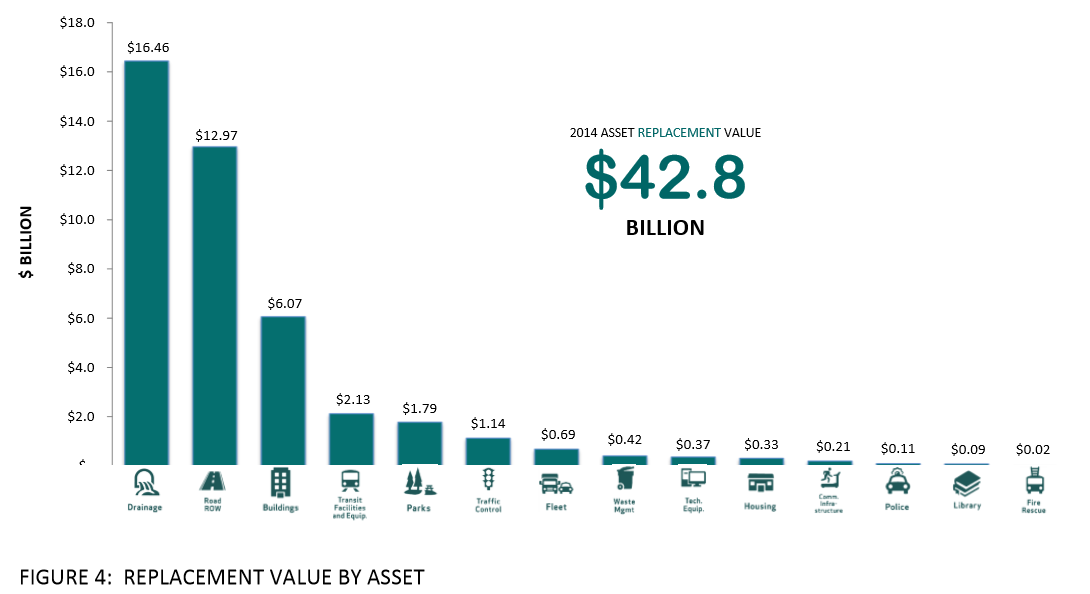
Every year the City compiles an annual inventory of its infrastructure. The report for 2014 is now available while the 2015 inventory is still under development. The 2014 Report indicates that the City’s replacement value for all of its infrastructure assets is $42.8 billion. Of that, $29.4 billion is drainage and road right-of-way, hence the phrase “roads and pipes”.

infrastructure value by asset 2014

The average state and condition of the City’s assets are as follows:

  • 57% of the City’s assets are in good or very good physical condition, 30% in fair condition and 13% in poor or very poor condition
  • 65% of the City’s assets have very good demand/capacity, 19% have fair demand/capacity and 16% have poor or very poor demand/capacity
  • 79% of the City’s assets have good functionality, 9% have fair functionality and 12% have poor or very poor functionality

How does that compare to other municipalities? “In comparison to national averages in the 2016 Canadian Infrastructure Report Card, the City of Edmonton generally has fewer assets in good and very good physical condition and more assets in fair condition.”

There are lots of charts and other information in the report, which you can read here (PDF).

ETS Bus & LRT Review

Well this report from the City Auditor is just depressing. I use transit and want to support ETS, but this just makes it extremely difficult to do so. The auditor found that “the reliability of service has been declining” and worse that “actions being taken to address reliability issues (i.e., on-time performance and overcrowding) are not improving the overall system performance.” Combine that unreliability with the cost of transit (which just went up yet again) and the value proposition isn’t very appealing. The single cash fare in 2011 was $2.85 and today it’s $3.25.

ets reliability

This chart shows that:

  • “Adherence to service schedules has declined from 2012 to 2015.”
  • “The best overall performance period was in the June to August period. In 2012, 74% of service was on-time. In 2014, performance declined to 69%.”
  • “The worst performance was experienced in the December to January period. In 2012, 60% of service was on-time. In 2014, performance declined to 58%.”
  • “The 90% performance target for arrival was not achieved in any time period measured.”

Why is the performance so bad? ETS says it is “a reflection of an increase in the number of persons with mobility devices and strollers, construction activity, and increased traffic congestion on city streets.” Sounds like a lot of excuses to me. On top of that, they suggest that operating budgets did not include funding to address these issues.

Capacity issues are also a problem. “In total there were 1,328 pass-by incidents reported in 2014,” the report notes. “Bus Operators estimated that more than 21,700 customers were affected.” While the current ETS fleet meets “the majority of ridership capacity needs” the report notes that “35% of customers rated overcrowding as unsatisfactory.”

Here are the auditor’s three conclusions:

  • ETS services are generally delivered in an efficient and economical manner when compared to other public transit organizations.
  • Service reliability expressed in terms of on-time performance was lower in 2014 than in prior years.
  • A lower percentage of ETS operating expenditures are funded by revenues than for comparable public transit organizations, single ride cash fares are comparable to that of other public transit organizations, and monthly pass prices are below average for comparable organizations.

You can find the auditor’s report here and Administration’s response here.

Designating the Molson Brewery as a Municipal Historic Resource

Bylaw 17507 “is to designate the Edmonton Brewing and Malting Company Ltd. Building as a Municipal Historic Resource and to allocate financial incentives for its restoration.” This bylaw is ready for three readings.

Molson Brewery Building, Edmonton
Photo by Connor Mah

Here are the details:

  • “The heritage value of the Edmonton Brewing and Malting Company Ltd. Building, built in 1913, consists in its association with the formation of the brewing industry in Edmonton and Alberta, its functional, yet artistic design, and its association with Chicago architect Bernard Barthel.”
  • “The Province has initiated the process to designate the building as a Provincial Historic Resource.”
  • “A payment of $417,550 annually over a ten-year period will be made to the owner to encourage the designation of the Edmonton Brewing and Malting Company Ltd. Building as a Municipal Historic Resource in accordance with City Policy C450B.”
  • “Annual rehabilitation grant payments of $417,550 will be made from the Heritage Reserve Fund to the owner starting in 2016, and will extend to 2025. However, the owner will be required to complete the identified rehabilitation work to the building by December 31, 2021.”
  • “The total estimated cost of the restoration portion of the project for the Edmonton Brewing and Malting Company Ltd. Building is over $8,350,999. Other non-heritage work is estimated at another $3,590,462.”

Great to see this moving forward!

Other interesting items

  • A review of the City’s Debt Management Policy finds that it “is consistent with debt management practices in other Canadian cities.” I wrote about Edmonton’s debt back in 2013 during the municipal election.
  • Executive Committee has recommended that the funding agreement between the City and EEDC for the Edmonton Film Fund be approved. They also voted on February 2 to have Administration, the Edmonton Arts Council, EEDC, and industry work together to develop “a preferred model to replace the Film Commission.”
  • Bylaw 17527 is an amendment to the Zoning Bylaw to “add Urban Gardens, Urban Outdoor Farms and Urban Indoor Farms to additional zones.” Council approved the three new classes back on October 19, 2015 as well as the zones they apply to. Additionally, they asked for special area residential zones like Terwillegar to allow Urban Gardens and for Commercial Shopping Centre zones to allow Urban Farms, which is what this bylaw will allow, among other minor changes.
  • As of February 4, there are 34 recommendations from the City Auditor outstanding, 10 of which are overdue. Administration has completed 13 recommendations since November 2015 and has provided an update on recommendations that are more than 6 months overdue.
  • The Coin Processing Audit report suggests that “the City’s coin processing operations are effective in mitigating the risk of mismanagement of City cash” and that “the services Coin Processing Operations provides are economical compared to other municipalities.”
  • Council’s furniture budget remains unchanged for 2016 at $11,278. Only $3,073 of last year’s budget was spent.

Wrap-up

You can keep track of City Council on Twitter using the #yegcc hashtag, and you can listen to or watch any Council meeting live online. You can read my previous coverage of the 2013-2017 City Council here.

Update on the race to join Edmonton City Council in Ward 12

With just 11 days to go until Election Day in the Ward 12 By-Election, let’s take a look at what has happened so far in the race to replace Amarjeet Sohi.

More than 3000 advance votes cast

The City of Edmonton held advance voting this week from Monday through Thursday at the Meadows Community Recreation Centre. Election officials told me today that more than 3,000 voters have cast a ballot. That’s a little less than anticipated, but is nevertheless a good start considering a total of 17,815 votes were counted in the ward in the 2013 Municipal Election.

The weather today didn’t help with advance turnout, and neither did the “overwhelming number of campaign supporters” present at the Rec Centre that may have intimidated voters earlier in the week. Election officials took action and setup a barrier to help deal with the situation.

Signs, signs, and more signs

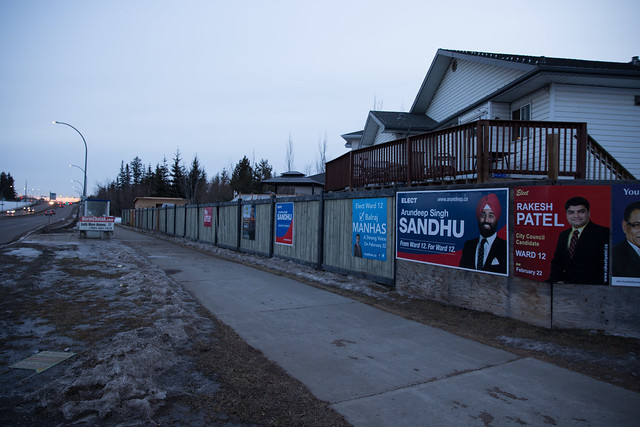
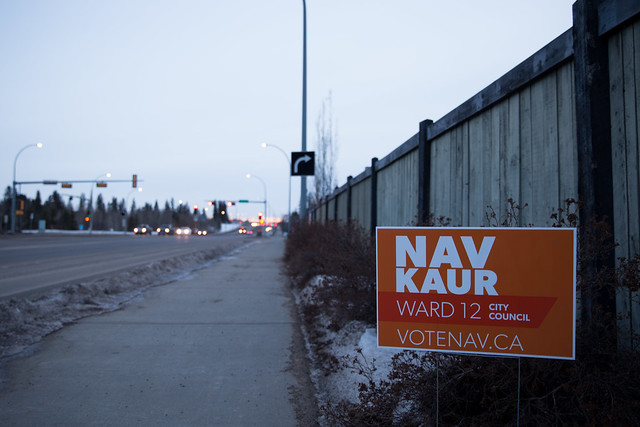
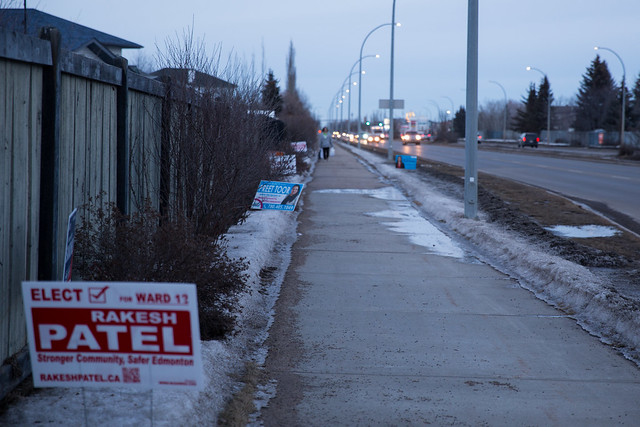
Much has been made in this by-election about the number of signs that are appearing around the ward. Signs are not supposed to be placed close to intersections, bus stops, schools, or polling stations, but they have been. Election officials had to take action because so many signs had been setup close to the advance voting location, and drivers and others have complained the large number of signs are distracting. Campaigns can face a $250 fine for poorly placed signs.

Ward 12 By-Election Signs

I was in the ward on Sunday, and observed dozens and dozens of signs that had fallen down or otherwise been damaged. The intersection at 34 Street and 35A Avenue did feature quite a lot of signs along the fences. But overall I saw fewer signs than I expected, based on the online chatter I was seeing about them. Campaigns have 72 hours after the election to remove all of their signs and other ads.

Lots of candidates

Most of the discussion about the by-election thus far has centered on the large number of candidates running. A total of 32 will be listed on the ballot, and that makes it difficult for a candidate to “break from the pack and distinguish themselves” let alone for voters to get to know all of the candidates in order to make an informed decision. The Journal has a pretty good introduction to each candidate, and while that may help to narrow down the field, it’s not enough.

So far, just one candidate has dropped out of the race. Shani Ahmad announced he is supporting Irfan Chaudhry instead, but because he dropped out after the nomination grace period ended, Ahmad will still appear on the official ballot.

I did not attend the forum last week at the Mill Woods Seniors Activity Centre, but it must have been quite the sight to behold. “The ratio of observers to candidates at Tuesday night’s Ward 12 Forum…was around five to one, and that’s with only 21 of the 32 candidates in attendance,” wrote Claire Theobald. Understandably, many people left early or otherwise complained about the unmanageable number of candidates.

Vote for a woman

One way that voters may reduce the number of choices is by focusing only on female candidates. There are six running, a ratio that isn’t too dissimilar to what we see on Council currently where Bev Esslinger is the only woman. Danisha Bhaloo, Nav Kaur, Nicole Szymanowka, Laura Thibert, Preet Toor, and Jeri Stevens are your female candidates.

Getting more women elected has been the focus of Equal Voice as well. Their goal is to have “half of Edmonton City Council and School Board candidates to be women” in the 2017 election and they have launched yegparity.ca in support of that effort. They recognize that if the by-election is any indication, things are not off to a great start. “Out of the current 31 candidates, only six are women…meaning only five percent of candidates,” they wrote (as a commenter points out below, that’s actually 19% of candidates). “That’s nowhere near close enough to meet our goal of 50 percent gender parity in 2017.”

Woman’s Initiative Edmonton also highlighted this issue with a feature on Nisha Patel, a young woman who lives in Ward 12. “The fact that there’s only a handful of women running amongst all these people who put their foot forward means that I want to support a progressive woman, because I think it’s about time,” she said.

Partisan-free civic politics

Do you think partisan politics should be kept out of the civic realm? That’s the issue everyone was talking about last week as Environment Minister Shannon Phillips took part in a fundraiser for candidate Nav Kaur. “This seems to be quite over the top,” is what Councillor Oshry told CBC Edmonton. Most of the comments I saw about the issue were overwhelmingly against the event and the NDP’s involvement.

Ward 12 By-Election Signs

On the other hand, Dave persuasively argues that it’s a “popular and misinformed myth that ‘there is no partisan politics in municipal elections.'” He notes that it “is natural for politically engaged people to be involved in elections for different levels of government” and that many current and past Councillors have had affiliations in provincial and federal elections, or endorsements from provincial or federal politicians.

Still, it’s hard to look at Nav Kaur’s incredibly orange website and list of key supporters and not immediately think the NDP is running for Council.

Where do they live?

For some voters, candidates simply must live in the ward to be considered. I generally feel that way too, but for me it’s a preference, not a hard and fast rule. And clearly it hasn’t hurt campaigns in the past, as both Councillor Nickel and Councillor Anderson do not live in the wards they represent, for example.

It turns out that about a third of the candidates running in this by-election do not live within the ward boundaries, according to an informal poll conducted by the Journal. With such a large number of candidates running, I don’t think this is that surprising. I also don’t think it’s such a problem. What’s more important than where a candidate lives is whether or not they can do the work necessary to represent their constituents.

There’s an awful lot of variation within Ward 12 as it includes new neighbourhoods like Summerside where median household income is $110,374 (average is $127,128) and also older ones like Minchau where the median household income is $81,139 (average is $89,686). Living in one part of the ward doesn’t mean that candidate will understand all of the challenges facing other parts of the ward any better than an outsider might.

Run-ins with the law

According to CBC Edmonton, six of the candidates running have had issues with the law. “While many of the incidents were minor, one candidate was convicted of assault, another was the subject of two court-ordered peace bonds and a third pleaded guilty to more than a dozen public health charges,” wrote Janice Johnston.

A second article by CBC Edmonton says that candidate Yash Pal Sharma is being sued “over his involvement in an alleged scheme to smear the reputation of a local Punjabi-language journalist.” He denied any involvement.

What do they stand for?

Considering we’re less than two weeks from Election Day, there hasn’t been much discussion about ideas or platforms. Candidate Nav Kaur did not like the fact that Council moved forward on the Uber decision without a Ward 12 Councillor, but clearly she’s not just running on the Uber issue. It’s probably a safer bet to suggest that’s why Balraj Manhas is running, but his website doesn’t include any platform information.

The other item I’ve heard/seen many candidates talk about is the Valley Line LRT and ensuring we get good value for money on that project. The Valley Line isn’t going to enter Ward 12 as it terminates at Mill Woods Town Centre in Ward 11, but it will have a big impact on transportation to and from the ward, of course. Still, it’s pretty easy for a candidate to say “we need to do better than the Metro Line” and just leave it at that.

Ward 12 By-Election Signs

But maybe there’s still time for more substantial discussions with candidates to take place. Edmonton’s NextGen has a set of questions they are asking candidates this week, I’ve sent a survey to candidates that I will share the results of next week, and I’m sure others are gathering input as well.

If you’re a voter in Ward 12, there’s not much time to get to know the candidates hoping to earn your vote. If you’re a first time voter, Edmonton’s NextGen has a good roundup of important things to know. Good luck to all!

The City of Edmonton is reorganizing in support of functional integration

The City of Edmonton is being reorganized effective March 1, 2016 around a new mandate of integration based on function. Acting City Manager Linda Cochrane announced the changes yesterday in an email sent to all City of Edmonton staff. She wrote:

“This new structure bundles work in departments based on function: all operations work, all infrastructure work, all planning work, all financial and corporate services work, all citizen services and all communications/public engagement work will each be grouped in the same department.”

The City’s last reorganization took place back in 2011, roughly a year and a half after Simon Farbrother was hired as City Manager. That restructuring was largely cosmetic though in that it didn’t dramatically alter the silos that had existed since the late 1990s (though the Financial Services and Infrastructure Services departments were later merged). This reorganization is all about getting rid of silos and breaking down barriers to more integrated service delivery. And the most notorious silo of all, Transportation, is now gone. More dominoes are indeed falling.

Here is the new organizational structure:

New Org Structure
Click for a larger version with the branches & managers

So previously there were five departments, plus the Office of the City Manager (you can see the old org chart here):

  • Community Services
  • Corporate Services
  • Financial Services & Utilities
  • Sustainable Development
  • Transportation Services

And now we have six, plus the Office of the City Manager:

  • Citizen Services
  • City Operations
  • Communications & Public Engagement
  • Financial & Corporate Services
  • Integrated Infrastructure Services
  • Sustainable Development

The new structure “bundles work in departments based on function.” This is perhaps most evident in the dissolution of Transportation Services. Here’s what happened to each of that department’s branches:

  • Edmonton Transit is now in the City Operations department
  • LRT Design & Construction is now LRT Projects in the Integrated Infrastructure Services department
  • Roads Design & Construction is now Transportation Infrastructure in the Integrated Infrastructure Services department
  • Transportation Operations is now in the City Operations department
  • Transportation Planning is now in the Sustainable Development department

Mayor Iveson spoke to the Journal about the changes yesterday, saying: “we’ve been talking about this for years; the transportation department, quite frankly, was very siloed and off on its own.” Well, no more.

Why now?

I had the opportunity to speak with Acting City Manager Linda Cochrane about the changes today. I wondered about the timing, given that a new City Manager could be coming on board in a few months and may want to make his or her own changes. “That’s true, some things could change with a new City Manager,” she acknowledged, but said that “Council endorses the bundling of services in a functional way.” She feels there is “strong support” for the new structure. On top of that, Linda is very interested in the role herself and will be applying to become the new City Manager.

During last year’s budget deliberations, Council asked for a full service review of everything the City is doing. Couldn’t that have an impact on the structure, I wondered? “A structure based on function will facilitate the service review,” Linda said. “It will let staff and stakeholders speak in functional ways and that will further the 2% initiative too.” She noted that this structure provides a different lens through which Administration can work to find efficiencies.

A number of City staff I spoke with about the change referenced the importance that Linda places on servant leadership. That’s reflected in her message to staff as well, where she wrote: “as always, service to citizens is our priority.” I asked if she had any other key messages for City employees. “Keep doing the good work you’re doing,” she replied. “That work is important on its own, but it’s also part of the context of service delivery.”

And that speaks to what I think is the big factor driving this restructuring: integration. “There is some phenomenal work taking place in the organization,” Linda said. “But we need to get better at integrating the good work that is happening.”

It’s about integration

There are four principles that “underpin the development and implementation of The Way Ahead,” which is the City’s strategic plan.

  • Innovation: A planning approach and operational culture within a municipality that encourages and enables continuous improvement and the exploration and adoption of new techniques, technologies, products and ways of operating in order to improve results and lead progressive change.
  • Integration: A holistic view of strategic planning that acknowledges the interrelated and interdependent reality of complex urban environments.
  • Livability: A set of interrelated factors that influence people in choosing where they live and reinforce their sense of well-being.
  • Sustainability: A way of living that meets the needs of the present and does not compromise the ability of future generations to meet their own needs.

The reality of the last eight years or so is that the City has been tackling these things relatively independently from one another. On some, there has been good progress. Livability is central to the City’s existence and much of the work of “The Ways” has addressed this. Council’s 2% and the changes in culture really address innovation. And with The Way We Finance, there’s been a good start on addressing the City’s sustainability. That leaves integration.

I think the one tangible attempt at addressing the integration principle was the creation of the Great Neighbourhoods Initiative. It falls under the Neighbourhoods branch of Citizen Services, but it is really a cross-department effort to more efficiently deliver services of all kinds, to conduct comprehensive neighbourhood planning, and to improve communication with residents. And it has worked well as a way to revitalize our mature and high-needs neighbourhoods. In fact, one City report said it exemplified a “One City-One Voice” approach to “leading City efforts to deliver services in a coordinated, effective and efficient manner.”

This reorganization builds on that success and is all about addressing integration. Here’s another excerpt from Linda Cochrane’s email to employees:

“The goal is to help open doors for work groups to integrate their work and share expertise. It is based on the One City principle and we believe it will further stimulate our cultural effort.”

Most citizens don’t think about the City in terms of the silos that have long-existed. But thinking about planning things vs. operating them is a pretty easy distinction to make. By bringing that citizen-oriented perspective to the City’s internal structure, there’s a good opportunity to integrate the work of the City to really have a positive impact.

This won’t be easy. Just because a bunch of branches have moved into a new department that has the word “integrated” in its title doesn’t mean that magically everyone is going to start working together effectively. The leadership there has a difficult task ahead to break down barriers and really encourage that integration to happen.

A cultural fit

The City has been undergoing a cultural transformation since at least 2007. Over the years this effort has taken on different names, including “Transforming Edmonton Through Organizational Excellence”, and “Transforming Edmonton and Me” (TEAM). Currently known as “Building a Great City”, the City’s internal cultural strategy focuses on five outcomes:

  • Our Employees are Engaged
  • We Have Effective Leadership
  • We are a High Performance Organization
  • Our Workplaces are Collaborative
  • Our Work Focuses on Citizens

It’s the last two that this reorganization seems most aligned with. The strategy notes that “there are many excellent examples of collaborative success in our organization” and that building upon those will be critical for achieving business objectives “in a rapidly changing and increasingly complex world.” It also highlights the public sector trend toward “citizen-centered services redesigned around the needs of the end user.”

Communications & Public Engagement

I think the other big takeaway is that Communications & Public Engagement has been elevated to its own department. It’s a major change for the organization. I think it makes a lot of sense for Customer Information Services (which contains 311) to be part of the same department as Communications and the Office of Public Engagement (formerly part of the Office of the City Manager). It’s about listening to citizens and talking with them just as much as it is about telling them what the City is up to.

Some of CLT
Gary Klassen, Adam Laughlin, Rob Smyth, Linda Cochrane, Dorian Wandzura (some of the members of CLT)

The Office of Public Engagement is quite small at the moment, with only a handful of staff, so resourcing it effectively will be a challenge. The good news is that improving public engagement has the full support of both City Council and Administration. The Council Initiative on Public Engagement has been underway since 2014 and just began Phase 2 a few months ago. Over the next year and a half, citizens will come together with Council, Administration, and other partners to improve public engagement in Edmonton.

And the timing for this could not be better, with the full service review later this year, a municipal election coming in 2017, and a more complete review of the City’s vision and strategic plan commencing in the next couple of years as well. Effectively engaging the public will be important for all of these initiatives and more.

Why City Council’s approval of ridesharing in Edmonton matters

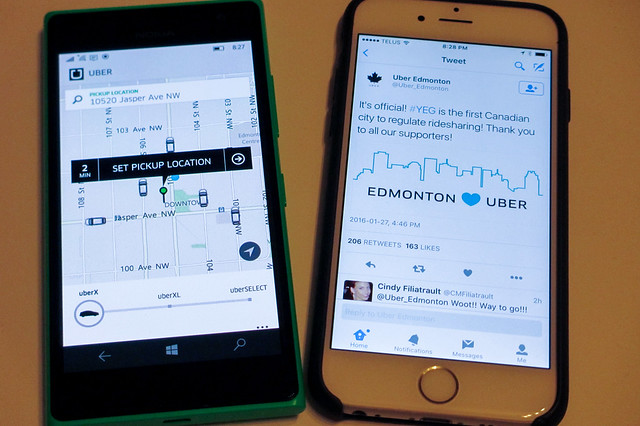
Edmonton became the first Canadian city to legalize ridesharing services like Uber with Council’s approval today of a new vehicle for hire bylaw.

“The regulatory framework in the new bylaw helps to answer citizen and business demand for more choice in the vehicle for hire industry,” says Mayor Don Iveson. “It represents a significant evolution of the industry and creates a model that will enable the taxi business and private transportation providers to co-exist.”

You can read more about today’s news in Elise Stolte’s story here. As she noted (and tweeted), “the bylaw passed 8-4 with councillors Dave Loken, Bryan Anderson, Mike Nickel and Tony Caterina against.”

Uber in Edmonton

Here is Uber’s statement on the new bylaw:

“Uber applauds the City of Edmonton for its leadership in being the first Canadian jurisdiction to adopt progressive regulations that embrace ridesharing. We thank Mayor Iveson, Councillors and City staff for supporting Edmontonian riders and drivers who want more affordable and reliable transportation options.

While these newly adopted regulations contain concessions for ridesharing service providers, the rules put in place a workable regulatory approach.

The spirit of collaboration and willpower demonstrated by the City of Edmonton to modernize its transportation laws can serve as a model for all Canadian regulators and elected officials.”

They were pretty happy on Twitter too:

//platform.twitter.com/widgets.js

The new bylaw will come into effect on March 1, 2016. Uber will be able to operate under a new class called Private Transportation Providers (PTPs). As they operate more than 200 vehicles, Uber will pay a license fee of $50,000/year plus $0.06/trip, with a $20,000/year accessibility surcharge on top of that. Only taxis will be able to pick up street hails or use taxi stands, but both taxis and PTPs will be required to charge a minimum of $3.25 for any trip. Drivers will be required to carry the appropriate insurance as outlined under provincial law, something Uber is working to acquire.

The new bylaw supports The Way We Move

I think the new bylaw supports Council’s transportation goals as outlined in The Way We Move, Edmonton’s transportation master plan. Here’s what I wrote back in September:

“The discussion about Uber in Edmonton lately has focused primarily on the fight between taxis and Uber, understandably. Lots of Edmontonians have horror stories to share about taxis, and there’s no question that competition from Uber will have a positive impact on the industry. But let’s not lose sight of the bigger picture. Uber and other transportation network companies can positively contribute to Edmonton’s transportation mix. We should do what we can to allow them to operate here legally.”

Councillor Knack spoke about this today, highlighting that ridesharing is an important way to help shift away from private vehicles to more sustainable options. “The status quo can no longer exist and change has to happen,” he said.

Council did what it was supposed to

Back in the summer of 2011, Council was already investigating ways to “provide increased capacity in the City of Edmonton taxi market.” The reality was already that Edmonton’s population had grown faster than its supply of taxis, and quality of service was suffering as a result. In 2012 Council wanted to issue 100 new licenses, but the Vehicle for Hire Commission refused to go along with the plan. So Council amended the bylaw to allow Administration to issue the licenses.

Something had to change, so it’s no surprise that when Uber showed up back in December 2014 Edmontonians embraced the service. All of a sudden at the touch of a button a ride could quickly and reliably be found. Ultimately Council’s role in this debate had very little to do with supporting taxis or welcoming Uber. Instead, it was about ensuring Edmontonians could move around the city efficiently.

I think Councillor Walters said this well in his post today:

“So equality is not the goal here, but rather equity – fairness – for our public. This is not about a big, bad, sophisticated multinational giving away free cupcakes, or the local taxi companies who come in to Council and scream and shout and take their shirts off. This about the kind of vehicle for hire service we want to facilitate with our bylaw. It is about Council’s role as a maker of public policy, not as a referee in an on-going battle between two different companies.”

Perhaps City Council’s most important job is to ensure that all taxpayer dollars spent result in the best possible value for citizens. They are charged with defining a vision for Edmonton and for making sure the City is operating effectively and efficiently toward it. I think their decision today is a reflection of that commitment.

The new bylaw supports innovation & choice

Nearly every Councillor spoke today about the importance of offering choice to Edmontonians by passing the bylaw. “We have to recognize there’s a huge part of our citizenry that want something different than we’re offering them,” said Councillor Henderson. Even Councillor Oshry, who had reservations about the bylaw despite voting in favor of it, said the taxi industry had become complacent. “They have to provide a better service than in the past,” he said.

Although a few Councillors tried to include more restrictions in the bylaw, I think an appropriate balance was ultimately struck. “This bylaw enables innovation and competition, rather than constraining them,” Mayor Iveson said. Too much regulation could have hampered the rapid innovation that is taking place in the industry. Making the Uber of today legal is a great outcome, but the bylaw also opens the door to additional services in the future. For instance, UberPool is a great twist on the Uber service that could have been restricted by overly aggressive minimum fare regulations.

The new bylaw actually specifies two levels of PTPs – commercial for providers with more than 200 vehicles, and regional for those with fewer than 200 vehicles. The license fees for regional PTPs are the same as taxis at $1000/year for dispatch plus $400/year per vehicle and $60/year for drivers. That’s much lower than the $50,000/year for commercial PTPs and means we may even see a homegrown alternative to Uber.

I’m hopeful that making ridesharing legal in Edmonton will entice competitors to Uber such as Lyft to enter the market also. It would be great to have some competition and choice in the ridesharing market.

Edmonton leads the way on ridesharing in Canada

It may have been painful to get there, but Edmonton has provided a way forward for other municipalities in Canada to adopt regulations that enable ridesharing for their citizens as well. I think it’s great that Council (most of them anyway) did not shy away from this challenge and instead chose to provide leadership on the issue. And as Mayor Iveson said today, there’s an opportunity for the City to work with other municipalities in Canada as well as the Competition Bureau to ensure that citizens are getting the best possible value from big organizations like Uber.

Recap: Edmonton’s Economic Impact Luncheon 2016

EEDC hosted its annual Impact Luncheon at the Shaw Conference Centre on Tuesday. Last year’s event featured Premier Jim Prentice and took place during a more positive time for Alberta’s economy – looking back now it seems like so long ago. A lot has happened over the last year, and to say the landscape in Alberta today is different would be a major understatement.

I think EEDC CEO Brad Ferguson showed great leadership during Council’s budget deliberations a couple months ago, requesting a 2% cut to EEDC’s budget. “Going into 2016, it could be one of the hardest years in Edmonton’s history,” he said at the time. No City-owned organization or branch had ever requested a decrease.


Photo by Brad Ferguson

Board Chair Barry Travers welcomed everyone to the event, and said that EEDC is “committed to doing more with less.” He reiterated that EEDC is focused on achieving $175 million in economic impact. After lunch, emcee Carrie Doll read a story about Edmonton. “Amidst a year of economic headwinds, this resilient city pushed forward once again,” she read. The story was full of feel-good statements like “this is a city of beauty, a city that’s engaged, a city that is alive 52 weeks a year.” I think many in the room felt it was inspirational, but it was perplexing to me. “It’s time to say goodbye to the Edmonton that once was, and hello to the Edmonton that now is.” What does that even mean?

In delivering his keynote address, I thought Brad did a great job of balancing the necessary realism of the current economic situation with the upbeat cheerleading that goes along with being CEO of the City’s economic development organization. He acknowledged that the next 2-3 years are going to be difficult for everyone, then continued:

“But in three years, if we are united and do this properly, this city and province will emerge even stronger than it’s been in the past, an economic powerhouse for our country, an incredible place for the next generation of Albertans to be born into, and a place where everyone will again want to come in search of an abundance of opportunity.”

Brad started globally and worked his way to the local context. “The world around us has lost its compass,” Brad said, explaining that the current period of time is unique because of high debt levels, the fast pace of technological change, and geopolitical tensions. He noted that “using debt to stimulate growth is incredibly addictive for politicians” but that it is citizens who end up paying the price. Global growth has stalled, he said, and that means “demand for commodities grinds to a halt.” He touched on oil, saying that the supply at the moment seems endless. And he talked about “an incredible time of volatility and anxiety, all around the world.”

Next Brad turned his attention to Canada. Though he again scolded politicians for being addicted to debt, he talked about how personal debt has escalated in recent years, despite the fact that middle income wages “have been relatively stagnant since 1995.” This has led to the “Age of Anxiety” as Brad called it, in which “people and families are doing everything possible and are still unable to make ends meet.”

Although he criticized some of the Province’s recent decisions, including “a delayed royalty review and a substantial amount of new provincial debt and new interest payments”, Brad said he wasn’t blaming Rachel Notley or her government. “They inherited 10 years of drunken-sailor euphoria that came after the Klein years,” he said, “which was the last time we made hard decisions about size of government, debt repayment and government program spending.”

More importantly, Brad placed blame on himself and everyone in the room, “We…didn’t do our job over the past 10 years of euphoria and we didn’t hold our government to account.” Regardless of who’s in power, Albertans need to question their political leaders and get more involved. But he didn’t let the current government completely off the hook. “It doesn’t matter what political ideology was campaigned on, our government has a responsibility to steward this province forward for the best interest of Albertans and future Albertans.”


Photo by Carrie Doll

Last year, Brad highlighted ten themes “that would strengthen our economy over the long term.” This year, he highlighted five calls to action:

  1. Entrepreneurship
  2. Export & Trade
  3. Energy Innovation
  4. Tourism, Conferences, and Major Events
  5. Leadership in Public Service

On entrepreneurship, Brad said “the most important thing we can do is continue to invest in talent.” He said the entrepreneurial ecosystem in Edmonton is “working exceptionally well” but noted that health innovation, agrifood, and a shared maker space are all areas that we could improve upon.

“Export & Trade are essential parts of the wealth creation formula,” Brad said. He encouraged local business leaders to speak up about the TPP, saying “we generate about $50 billion per year from TPP countries.” He also talked about pipelines and logistics and said “everyone has a role in making these opportunities come to life.”

“Our energy future is all about innovation,” Brad said, highlighting five challenges that we should be focusing on: CO2-Free Emissions, Enhanced Oil Recovery, Carbon Capture & Storage, Clean Coal, Safest Pipelines in the World. He said it doesn’t make sense to shut down or phase out one of our competitive strengths in exchange for “making green infrastructure investments in which we have no competitive advantage.”

Though he noted that EEDC has been working with Northlands to “end the 30-year old discussion of how we can best market the city under one banner,” most of what Brad said about major events and tourism was a repeat of last year. “Major events create an energy, rhythm and pulse in a city” he said, repeating last year’s message nearly word-for-word. It seems to be that civic leaders love to talk about Edmonton’s major events strategy, yet I have never seen one articulated.

“In this country we have three levels of government with the risk of introducing a fourth at the regional level,” he said. I assume he’s talking about regional government, and he argued effectively against it. “We can barely afford the multi-tiered system that we have, and we certainly cannot afford it becoming more engorged.” He talked about government becoming more efficient and less bureaucratic.

My favorite part of his remarks came when Brad talked about the complicated system of economic development and innovation organizations, saying “the level of duplication and inefficiencies is astonishing, with no overall leadership, coordination in planning or true accountability for results.” He called for an overhaul of the system, and extended an invitation to work with the other organizations to “reshape the economic development and innovation system to what is needed for our future, and leave behind the ineffective systems and structures of our past.” I hope Brad’s colleagues take him up on the offer.

Brad finished with this: “I believe this province will regain its potential, and out of this extended period of darkness, better days will come.”

Overall I think he delivered a thoughtful speech. With clear calls to action, some thought-provoking statements, and a personal touch, I think Brad had a big impact on everyone who listened. Let’s hope that other civic leaders follow his lead and do their part to help Edmonton emerge stronger from the downturn that is ahead.

A look ahead at 2016 for City Council and the City of Edmonton

This year is going to be a difficult one. “While technically it won’t be a recession, for many people it’s going to feel like one,” said City of Edmonton chief economist John Rose. Our economy is expected to grow by just 1% with unemployment rising, perhaps as high as 7%. We’re less energy-dependent than the rest of the Province, but low oil prices are still going to hurt many.

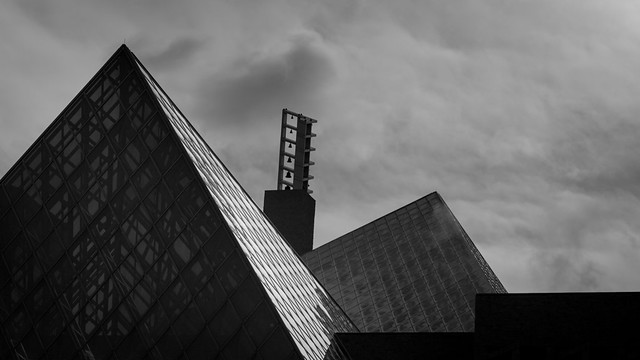
Angles on Clouds
Angles on Clouds, photo by Dave Sutherland

While the economy seems certain to dominate the headlines this year, there are plenty of other topics that will come up throughout the year. Here are some key things that City Council and the City of Edmonton are going to have to deal with in 2016 that we should keep an eye on:

New City Manager

With the firing of City Manager Simon Farbrother back in September, City Council will need to select a replacement this year.

I think this will be the single most impactful decision that Council will make in 2016 – who is the right person to lead the City in the years ahead? Council has already indicated they are looking for someone who is more involved in the day-to-day, “someone who can meet the aspirations of this city head-on.” The job posting further specifies that the successful candidate will be “a community-minded relationship builder and a consummate communicator who can advance an effective culture through accountability and ingenuity.” I think interim City Manager Linda Cochrane is doing a fine job, and she certainly has the knowledge, experience, abilities, and relationships that are critical to succeed in the role. But I don’t think Council will go with an insider. I think they’re looking for a fresh perspective.

A new City Manager will no doubt want to make changes to the organization, so expect more dominoes to fall this year.

Ward 12 By-Election

With Amarjeet Sohi being elected as MP for Edmonton-Mill Woods in October’s federal election, residents in Ward 12 are currently without a representative on Council. The by-election to fill his seat will take place on Monday, February 22 and there are already 29 declared candidates. That’s an incredible number of candidates, and it means voters in Ward 12 are going to have quite a difficult job deciding who should succeed Sohi. During the 2013 municipal election, Amarjeet Sohi raised more than $130,000 and spent more than $85,000 to win his seat. On average, the winning councillors spent $73,000. I don’t think we’ll see sums that large this time, however.

This is City Council’s first by-election in more than two decades. The new Councillor will need to get up-to-speed quickly, and won’t have much time to have an impact before we find ourselves in another municipal election.

With Amarjeet Sohi being named Minister of Infrastructure and Communities, I think Edmonton is very well-represented in the current federal government. Furthermore, we have a minister responsible for infrastructure in this country who knows first-hand the challenges faced by big cities like Edmonton. That bodes well for our city’s relationship with the federal government and for our interests.

LRT (Metro Line, Valley Line, Future Expansion) & Transit Strategy

Last year was not a great year for LRT in Edmonton, so I’m sure the City and Council will be hoping for a much-more train-friendly 2016.

The Metro Line LRT still has issues, of course. The City still hasn’t accepted the safety certification of Thales, and the line continues to run more slowly than planned (and seems to break down awfully frequently). The City says it wants to reach “Plan A”, which would be full operation using the computer-based train control system, but is currently at “Plan B-” (seriously? this is Plan C guys), which is reduced speeds and “line of sight” operations. The middle step, “Plan B”, is full speeds but using the new system only between Churchill and NAIT. It seems there’s still a long way to go.

Brad Smid, who “managed the planning, design and construction of the $700 Million Metro Line Stage 1 (North LRT Extension) from Downtown to NAIT” was just this month named Director of the Valley Line LRT Design & Construction. That could be good or bad, depending on your point-of-view. Some argue that Smid is a very capable manager who spotted issues with the Metro Line LRT early on and was instrumental in getting the project constructed under budget. But he didn’t do himself any favors this summer when he downplayed the issues with the Metro Line LRT. Saying that the project was completed “on time and on budget” from a design & construction point-of-view doesn’t mean much to taxpayers who ultimately ended up with less than they were promised. Maybe Smid is the right guy to lead the Valley Line LRT project, but he’ll have to earn the trust of Council and the public.

On the Valley Line LRT, things are looking better though. The City selected TransEd Partners late last year to design, build, operate, maintain, and finance the first stage of the project. The first task in 2016 will be to finalize the contract, which is expected to be complete in February. Construction will begin shortly thereafter (preparations have already been underway, of course). We’re promised that this line will be different, because it’s a P3. We’ll see about that.

A couple of reports on future LRT expansion were postponed from 2015 to this year, so we should see Council consider a long term funding plan for the LRT, a communications plan on LRT funding, and an “interdepartmental approach” for investing in transit and LRT, among other things. There’s also the ongoing work to create a new Transit Strategy that kicked off over the summer. The strategy won’t be complete until early 2017, but the bulk of the work will take place this year, and is an opportunity for Edmontonians to provide input on “how transit can best support the city we want to live in ten years from now.”

City Charter, MGA Review, Edmonton Region

Discussions about the City Charter will continue this year. Mayor Iveson was careful to set expectations last month that he doesn’t anticipate a charter being in place until the end of the current Council term, but we may see elements of it move forward in the year ahead. Both Mayor Iveson and Calgary Mayor Naheed Nenshi see the charter as a critical step forward for Alberta’s big cities, bringing fewer restrictions, a new relationship with the Province, and long-term sustainable funding.

Also ongoing this year is the effort to modernize the Municipal Government Act (MGA), the legislation that guides how municipalities in Alberta operate. The MGA review began in 2014 and made progress last year with Bill 20 being approved by the Legislature. Additional changes will now be considered, with a goal of competing everything in time for the next municipal election in 2017. The City of Edmonton has put forward some key principles and considerations that it would like to see reflected in the new MGA. I expect a new set of recommendations will come to Council for approval this year.

Council will also need to continue pushing ahead with its regional partners. The focus for the Capital Region Board this year is to finalize its Growth Plan 2.0. It is a 30-year strategy for managing growth in the region that was originally developed in 2010 and is now getting its first major update. The current plan is for the CRB to approve the final plan in September so that it can be submitted to the Province in October (roughly a year behind schedule). Also, while a decision likely won’t be made this year, the City’s annexation plans will continue to be a focal point for regional discussion.

Last year saw the launch of the Metro Mayors Alliance and “a blue ribbon panel on improving the competitiveness of the Edmonton Metro region.” I expect we’ll hear much more from that group in 2016.

Northlands & Rexall Place

Back in April, the Northlands Arena Strategy Committee (which I was a member of) released its final report and recommendations, which were accepted by the Northlands Board in May. Since then, Northlands has been hard at work on completing its Strategic Plan. That work is now complete, and it will be presented to Council in the next month or two. A report on enhancing the Coliseum LRT Station and perhaps building a pedway to the Edmonton Expo Centre was put on hold in 2015 while Northlands worked to sort out its strategy, so that could all come up this year too.

Some aspects of the plan have already begun to leak out, including repurposing the entire 160 acres of land, the oft-discussed possibility of joining Northlands and EEDC, and perhaps even the end of horse racing at Northlands Park. I understand we’ll also learn more about a potential agreement between Northlands and the Oilers Entertainment Group (outright competition would be detrimental to both).

This could prove to be one of the most difficult issues for Council in 2016. The fallout of previous decisions – to build Rogers Place, to keep Northlands out of the discussion about the new arena, to build the expensive Edmonton Expo Centre – all of that will need to be dealt with this year. In a worst case scenario, Northlands goes away and the City is left with debt and expensive, problematic assets on its hands. In a best case scenario, a new vision for that area of the city is agreed upon and led by Northlands. Either way, the City is going to have to contibute taxpayer dollars, so Council will need to determine how it wants to spend its limited money.

Blatchford

Blatchford is a long-term project, but this will be a critical year for the development of the future community. Late last year Council decided to cut the large lake from the vision, the latest in a number of features that have been cancelled. On the plus side for Blatchford, the cost of environmental remediation has been far lower than anticipated.

A report is expected in the first quarter addressing the District Energy Sharing System that has been proposed for Blatchford. Administration will be preparing “a comprehensive business case” for the implementation of such a system, plus a “detailed rate setting analysis”. Council will need to determine if the district energy system is critical or if it too will be cut. There are some other big decisions coming up as well, so it should be an interesting year.

The City is still planning to sell fully serviced lots at Blatchford to builders this year, if all goes well.

Walterdale Bridge, 102 Avenue Bridge over Groat Road

Both the Walterdale Bridge and the 102 Avenue Bridge experienced major setbacks in 2015.

The $155 million Walterdale Bridge remains on budget according to the City, even with the year-long delay. The completed bridge will span 206 metres and will be 54 metres tall. All of the arch steel is now on site, the heaviest piece of which weighs 125 tonnes. The current plan is for the new bridge to open by the end of the year, with the old bridge slated to be removed in 2017.

The best date we have for the completion of the new 102 Avenue Bridge over Groat Road is “fall 2016” but for a project that has already faced a number of delays, that’s not very reassuring. The installation of steel girders in March was a disaster, with three of them buckling (#girdergate). It was determined that “the spacing braces failed upon crane release of the second last girder, resulting in the buckling of three girders.” They were repaired off-site and have since been reinstalled.

The City can’t afford anymore delays with these two important projects. Apparently a new integrated infrastructure services department has been created to try to avoid issues like the ones faced by the bridge projects. Let’s hope it helps and that they’re completed successfully this year.

Affordable Housing

This is an issue that Mayor Iveson has made clear on numerous occasions he’d like to make progress on. But as he wrote back in December, while “City Council remains strongly committed to supporting affordable housing projects in Edmonton” they believe funding needs to come from other orders of government. “There has to be a better way, one that is fairer to city taxpayers,” the mayor said.

Affordable housing was most recently discussed by Council at the October 27 Executive Committee Meeting. In addition to having Mayor Iveson approach the other orders of government to help advance the Londonderry Regeneration Project, Council asked for a report to come back in April outlining “how a Community Development Corporation could be established” and to address “the role of current housing provides in the Edmonton Metro and the possibility for better integrating and coordinating their work.” Council is also expecting a report to come back in March addressing affordable housing at Blatchford.

Municipal Development Corporation

Over the last year or so Council has been investigating the creation of an arms-length development company. The idea is that a Municipal Development Corporation (MDC) could be used for city building and could even pay a dividend to the City. UDI Edmonton sent a letter to Council back in June offering support for Council’s desire to develop City-owned land assets more efficiently, but expressing “serious concerns” with doing so through an MDC. They don’t want to compete against the City, understandably.

Despite that opposition, Council seems keen to move forward. They approved a motion at the November 26 Executive Committee meeting to have Administration return with a report on April 12 that outlines how to get a Municipal Development Corporation up and running with the preferred “super light” model, and that includes identifying which lands “would be more suitable for primarily profit-motivated development” that the MDC could activate.

An alternative to creating an MDC could be to establish an advisory board made up of existing developers, but I think they’re likely going to go ahead with the corporation this year.

Infill

Last year wasn’t a great year for infill. We’re nowhere close to meeting the 25% target for infill development, and there was a lot of frustration shared by communities as some projects started to move ahead. Still, Council and the City have committed to infill as a critical component of building a sustainable city, so they need to find a way to keep it moving forward.

Infill was most recently discussed at the October 5/6/7 Executive Committee meeting. Council is expecting a report by March that addresses how to deal with infill sites in mature neighbourhoods. Among other things, Council is looking for “options to create an integrated inspection and enforcement team” and “options to implement a performance bond/letter of credit and/or liability insurance, and/or warranty programs to provide security for the adjacent City and private property.” Hopefully some of those options will provide a way past the negative headlines that seemed to dominate the last year.

Following that meeting, Mayor Iveson wrote that infill “is about creating more housing options for Edmontonians and their families, which is important for the social sustainability of our community over the short and long term.” He promised to “assist the communities where this important development will occur.”

Edmonton’s Infill Roadmap identified 23 actions, and roughly half of those have been completed so far. The remaining actions will be completed this year, but it’s not quite clear what will come next. The Mature Neighbourhood Reinvestment Report is to be released in the spring with numbers on the infill taking place around the city.

The Quarters, Rossdale

The Quarters project suffered a setback in 2015 when the deal between the City and BCM Homes to develop a 28-storey residential tower at Five Corners fell through. I went by the giant hole in the ground the other day and discovered it has become home to dozens of pigeons. Apparently just one interested party came forward to look at taking over the site, but no announcements have been made yet. With $56 million in infrastructure upgrades and new construction going into The Quarters, the City desperately needs private partners to come on board to help build out the area. Not to mention the City’s first CRL project at Fort Road has not been very successful, and it would be a shame to see The Quarters follow in its footsteps.

In December, Council voted to sell some land in West Rossdale to the Province for $13 million. Mayor Iveson said there will be plenty of discussion about the impact of this decision on the West Rossdale project in the year ahead. “I think we have signalled an intent we want to work with them and just want to work out some of the details,” he said. The West Rossdale Urban Design Plan was first approved in 2011, so it would be great to see some progress in the year head.

Uber, Taxis, Bike Lanes

After a year of illegal operation and some very heated debates, we should finally get a resolution on the Uber issue in 2016. Proposed changes to the Vehicle for Hire Bylaw were discussed by Council in November, but they deferred a decision until later this month. I remain a fan and happy Uber customer, and I have no doubt that Council will provide a way for Uber to operate legally in Edmonton and I’m confident they will remain here.

The other aspect of the Uber debate is what to do with taxis, if anything. Back in March Council asked for an independent study on Edmonton’s taxi service levels, and that is expected to be delivered in the first quarter of 2016. The taxi companies won’t be happy about Uber, but additional changes could be on the way for their operations too.

The other contentious transportation issue that Council will need to deal with this year is bike lanes. They voted over the summer to remove bike lanes on both 95 Avenue and 40 Avenue, with an argument that doing so would pave the way for better bike infrastructure going forward. Well, now they need to prove that. As Mayor Iveson wrote in July, “Council’s statements about implementing the next generation of spaces must be quickly followed with action.”

New Civic Tower

Rogers Place isn’t the only major downtown project expected to open this year. The City of Edmonton’s new office tower is also slated wrap up construction later this year. Featuring 29 storeys the tower will stand 129.8 m tall, putting it in the top five (until the other towers in the arena district are built). The City has signed a 20 year lease for roughly 60% of the tower and has an option on naming rights too. The currently approved name is simply “Edmonton Tower”.

Council will remain at City Hall of course, but the new tower will no doubt have a large positive impact on the culture of the City, putting thousands of colleagues under one roof for the first time. With two-thirds of the City’s downtown employees moving to the tower, it will also have a potentially negative impact on other downtown buildings, creating a lot of vacant space very quickly. The City of Edmonton’s leases at the CN Tower, HSBC Building, and Scotia Place all expire in March.

And that’s just scratching the surface

There’s no shortage of issues for Council to consider throughout the year, as the list above demonstrates. But those are just the big items. Some of the other issues that will come up this year include:

  • Proposed changes to the Public Hearing process
  • An update on efforts to protect & preserve the McDougall United Church
  • An update on the City’s Image, Brand and Reputation Strategy
  • Managing the availability of Park & Ride facilities and a Gorman Park & Ride Strategy
  • Options for Alley Rehabilitation and Renewal
  • An update on the Traffic Management Pilot in Prince Charles and Pleasantview
  • An Electrical Bus Pilot
  • EFCL’s 100th Anniversary Project
  • The proposed Lewis Farms Recreation Centre
  • Funding for the Milner Library Renewal & Upgrades
  • An update on the Urban Beekeeping Program
  • An update on the Urban Hens Pilot Project
  • Plenty of Zoning Bylaw Changes (including reduced parking requirements in three pilot areas and around eating & drinking establishments)
  • An update on the proposed Galleria project
  • The 2016 Municipal Census

This is going to be a busy, difficult year. Get ready!

LRT is about more than speed

If you’re angry about the Metro Line LRT, then you’ll love Tristin Hopper’s article in today’s National Post. He’s a self-described “fervent – almost fanatical – supporter of public transit” and he doesn’t hold back on eviscerating Edmonton’s latest addition to the LRT network:

“In short, it fails on every single possible justification for why cities should build light rail.”

It’s a colorful piece, complete with a comparison to “a candy company releasing a new chocolate bar called Herpes Al-Qaeda.” But while it’s clear the City of Edmonton made some mistakes and that it would indeed be bad to see them repeated elsewhere, Hopper’s arguments are clearly coming from a place of frustration rather than fact, and he comes off sounding more like a supporter of car culture than the transit booster he claims to be.

Before I get into that, let me say that I’m just as frustrated and disappointed as many of you are with how the Metro Line LRT was handled and how it is still not fully operational as promised. I’ve written a lot about it over the last year, and I’m sure there will be much more to come in the year ahead. There’s no question that the City of Edmonton screwed up on the Metro Line LRT, but Council didn’t do itself any favors by ignoring the project until it was too late either. People have been fired, lessons have been learned, and there’s undoubtedly more fallout to come.

But, let’s not make a mountain out of a molehill, mmkay?

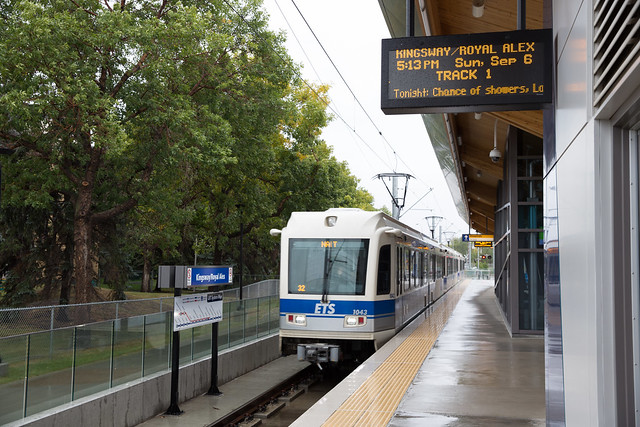
Kingsway/Royal Alex LRT Station

Hopper is right to point out how unacceptable it is that the line breaks down so regularly. And he’s right that due to the signalling system issues, the trains aren’t running as fast as planned. But his article also makes some pretty specious arguments about emissions1 and the impact on ambulances2. Hopper has some nerve adding up the amount of time wasted by drivers waiting for the Metro Line LRT trains to go by, as if those drivers had never before run into rush hour and gridlock. How much “human existence” has commuting by car, a much more dangerous, stressful, and expensive mode of transporation, extinguished? Easier to pick on LRT, I guess.

“The chief problem is that the train was built at grade and cleaves through several major intersections,” Hopper writes. This leads to delays for passengers and a “traffic apocalypse” for everyone else. “I’ve personally clocked a six-minute wait,” he complains. I get it, I hate being made to wait as much as anyone (thank goodness Sharon is a much more patient person than I am). But this is just as silly to highlight now as it was four months ago when the Metro Line LRT opened.

The only reason this extra-six-minutes argument has any appeal at all is that there’s something to blame. Probably every driver has spent far longer than six minutes stuck in traffic on many occasions, but without a train to complain about, those delays are just chalked up to the realities of driving. Over time drivers become oblivious to them. Sure people complain about traffic from time-to-time, but no one is crucifying the City over it like they are with the Metro Line LRT.

Also wrong is complaining about how slow the train ride itself is, especially given that the Metro Line LRT isn’t operating at full-speed yet. Even if it were, LRT isn’t supposed to be faster than other modes of transportation. It can be, in some cases, but it doesn’t have to be and that isn’t the reason to build it in the first place. LRT is primarily about capacity, not speed. And transit is about the network, not a single line.

It’s not the speed that matters

We need not look any further than the existing Capital Line LRT to see that speed isn’t why it has been successful. What if I wanted to get from my house on 104 Street downtown to Southgate Centre? Here’s a look at the trip by mode at three different times for today, according to the fastest option suggested by Google Maps:

7:00 AM 12:00 PM 5:00 PM
Cycling 30-34 minutes 30-34 minutes 30-34 minutes
Vehicle 16-20 minutes 16-22 minutes 16-40 minutes
Bus 38 minutes 38 minutes 41 minutes
LRT 24 minutes 24 minutes 24 minutes

And here’s the reverse trip, going back downtown from Southgate:

7:00 AM 12:00 PM 5:00 PM
Cycling 29-33 minutes 29-33 minutes 29-33 minutes
Vehicle 14-20 minutes 14-20 minutes 14-24 minutes
Bus 37 minutes 37 minutes 37 minutes
LRT 21 minutes 21 minutes 21 minutes

Depending on the time of day, direction of travel, your speed, and lots of other conditions that you have no control over (traffic, weather, etc.), driving is actually the fastest mode of transportation. LRT is pretty quick, but more importantly is consistent and predictable. My travel time in the real world is far more likely to match the prediction for LRT than it is for a vehicle. Not to mention taking the LRT means you can do something productive or enjoyable while you ride, and you don’t have to pay for parking.

That particular example, downtown to Southgate, makes the time to take the bus seem quite unappealing. Again, that’s to be expected given ETS’ approach of having buses feed into the LRT network, something that will also happen with the Metro Line LRT once it is fully operational. If we look instead at an example where there isn’t LRT, we see that the bus can actually be competitive and maybe even faster than travelling by vehicle. Here’s my place to West Edmonton Mall:

7:00 AM 12:00 PM 5:00 PM
Cycling 37 minutes 37 minutes 37 minutes
Vehicle 18-24 minutes 18-26 minutes 20-45 minutes
Bus 29 minutes 27 minutes 33 minutes

And here’s the reverse trip, going from WEM to downtown:

7:00 AM 12:00 PM 5:00 PM
Cycling 36 minutes 36 minutes 36 minutes
Vehicle 18-26 minutes 20-28 minutes 20-35 minutes
Bus 29 minutes 25 minutes 29 minutes

In this example there’s an express bus that travels between WEM and downtown. Again travelling by vehicle could be faster, but it depends greatly on time of day, direction, and unforeseen circumstances like accidents and weather conditions. The bus would also be subject to some of these considerations, so it’s not as reliable as LRT, but it is still a much more viable option in this example. And you can see how an express bus could potentially be a better way than LRT to achieve a fast trip, especially if it were afforded some of the right-of-way and separation advantages of the LRT (the express bus to WEM shares the road with vehicles and follows all existing signals).

This is all just to show that speed isn’t the driving factor behind LRT. If it were, we’d look at those times above and be complaining that it wasn’t always the fastest option. The negative impacts of LRT on traffic are easy to see, at some point vehicles have to wait for trains. But there are positive impacts of LRT on traffic too. More people riding the train means fewer people driving which means (in theory) less traffic than there would otherwise be. That speeds up commute times for everyone.

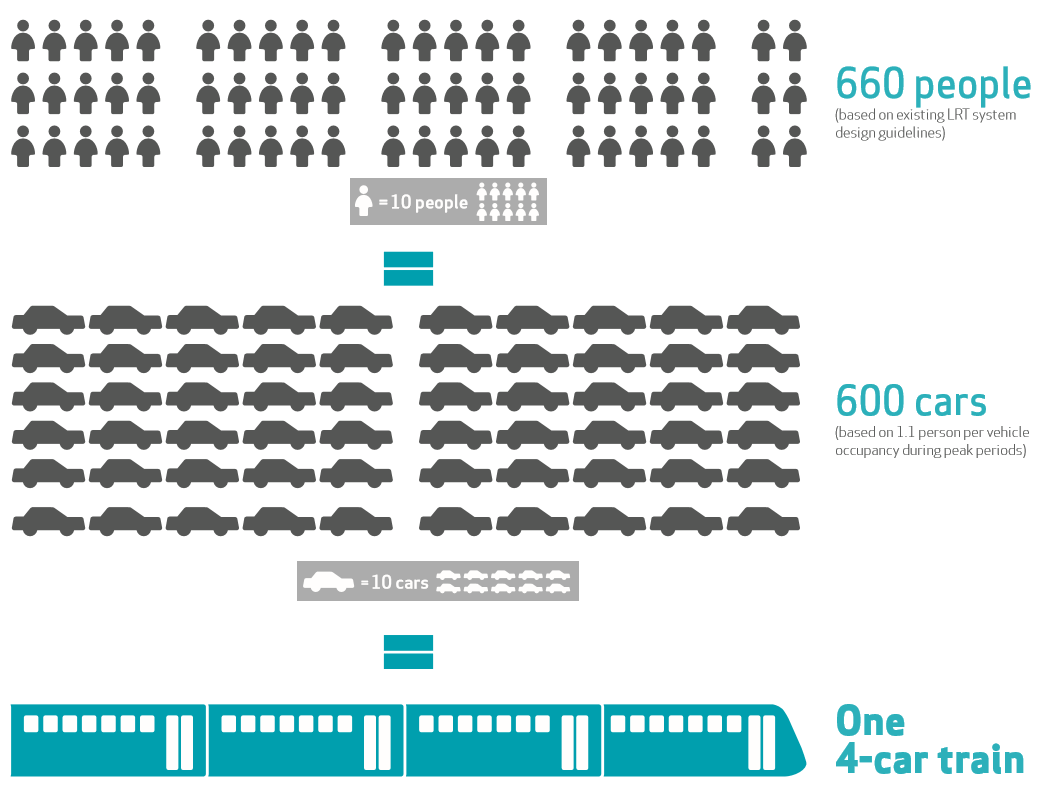
But the real reason you build LRT is for the capacity. Here’s what the City of Edmonton’s LRT for Everyone PDF highlights:

rails vs roads

One four-car train can move as many people as 600 typical cars. And let’s be honest, you could probably cram even more people onto those trains if you really wanted to. That potential capacity has a real, positive impact on the transportation network as a whole. It makes getting around the city better for everyone.

There are other reasons to build LRT of course. Accessibility, convenience, transit-oriented development, more efficient use of infrastructure, reduced energy use and environmental impact, and much more. But enabling more people to travel more efficiently throughout the city is the big benefit of LRT.

And when you consider it as part of the overall network, with a mix of bicycles, vehicles, buses, and trains, the capacity benefits of buses and trains make an even bigger difference. That’s why shifting Edmonton’s transportation mix to rely less on vehicles is such an important part of The Way We Move.

Set the right expectations

Hopper seems to suggest that fast LRT that doesn’t impact traffic is the only kind of LRT to pursue and that “don’t let idiots build your transit” is the only lesson to be learned from the Metro Line LRT project. But both of these things are off the mark. You don’t build LRT for speed and you can’t avoid idiots, they’re everywhere.

So yes policymakers of Canada, come to Edmonton and learn from the Metro Line LRT. There are clearly things you can do better and a real-world example to examine is better than a theoretical one. But don’t follow Hopper’s lead in setting the wrong expectations for the “decent, right-thinking people” in your cities. LRT is about much more than speed.


  1. For instance, he says the Metro Line LRT “is almost certainly increasing Edmonton’s net amount of carbon emissions.” I guess we’ll have to take his word for it, as he doesn’t provide any evidence to back the claim up. 

  2. Noting that the Metro Line is next to the Royal Alexandra Hospital, he suggests that “any Edmontonian unlucky enough to have a heart attack in one of the northwestern quadrants of the city must wait as paramedics wend a circuitous route through downtown.” This smacks of fearmongering to me, and we’ve already been-there-done-that-tyvm with medevac and the closing of the City Centre Airport. Although he expressed concern with the delays associated with the partial Metro Line operation, AHS’ chief paramedic said that dealing with traffic is not a new problem for paramedics. “We run into these situations all the time,” he told CBC. And as Transportation GM Dorian Wandzura noted in that same article, presumably AHS had already made some operational adjustments, given that the plan was approved and the route defined way back in 2008. 

Poor Jasper Avenue, Rossdale Land Sale, Star Wars in Edmonton

Here’s the latest entry in my Edmonton Etcetera series, in which I share some thoughts on a few topical items in one post. Less than I’d write in a full post on each, but more than I’d include in Edmonton Notes. Have feedback? Let me know!

A new vision for Jasper Avenue

Back in May 2009, I attended the first open house for the Jasper Avenue New Vision project. Then in November of that year, a more in-depth open house was held at Enterprise Square. Six years later, only a tiny portion of that vision has come to life between 100 Street and 102 Street. The original project was meant to cover Jasper Avenue between 97 Street and 111 Street. In theory that work will still get done, but don’t hold your breath! Already the City is conducting public engagement on the rest of Jasper Avenue, west of 109 Street. I guess that makes sense, given how long it has taken them to get to this point, but wouldn’t it be nice if we could finish the original project first?

Cyclist, Jasper Avenue, March 22. 2015
Cyclist, Jasper Avenue, March 22. 2015, photo by More Bike Lanes Please

Here’s what a recent Edmonton Journal editorial said about our city’s main street:

“Pity poor Jasper Avenue. It has always been the canary in the recessionary coal mine in our city — it can go downhill very quickly when the economy softens. The signs are there already, bringing back echoes of Edmonton’s bad old reputation as Deadmonton.”

In general I agree with Paul who wrote in response that “the sense of doom and gloom is overstated and unhelpful.” Yes there are empty spaces along Jasper Avenue that badly need to be filled, but there are plenty of examples of positive changes to the street too.

Filling those spaces is important but it’s not enough. What Jasper Avenue could really benefit from is a reduction in traffic lanes and wider sidewalks throughout, not just around 101 Street. Here’s what I wrote back in 2009:

“Almost every feature of Jasper Avenue is geared toward vehicle traffic. Any redevelopment needs to shift the focus to pedestrian traffic.”

Sadly, not much has changed.

Rossdale land sale to the Province

Council voted this week to move forward with negotiations to sell a block of land in Rossdale to the Province for about $13 million. The land, located southwest of 96 Avenue and 105 Street, is considered “surplus to municipal requirements” and is currently vacant park land with just four houses. The Province wants the land so that it can “restrict development on these lands to protect the view corridor to the legislature from the bridge crossing.”

The problem is that the City’s West Rossdale Urban Design Plan aims to “create a complete, mixed-use, highly liveable, walkable, and sustainable community” that could be home to 4,500 people. Council feels that the money isn’t the problem anymore (the $13 million is apparently market rate) but they are concerned about fit with the urban design plan. If the Province won’t allow any development on the land, that could be an issue.

The West Rossdale plan does include a recommendation to “reserve and enhance view corridors” so that part is aligned at least.

Star Wars in Edmonton

Forget Christmas, Star Wars is what everyone is talking about right now. And that means the media are looking for local angles to basically tell the same story as every other news organization in the world right now: people are excited for this movie! And why not, the reviews sound incredibly positive.

South Edmonton Common’s Cineplex theatre is one of six across Canada offering a Star Wars movie marathon where fans can watch the original six films before seeing the new one. Good luck getting tickets though, as well over 6000 tickets had already been sold at the southside theatre by Monday. Still, five of the theatre’s sixteen screens will be showing the new Star Wars movie. On Friday, The Force Awakens will play 103 times in Cineplex theatres throughout Edmonton.

So we know it’s going to be a big deal. If you’re going to wait a few days to watch it, then you can read about it in the meantime. Here is 5 ways to “find the Force” from an Edmonton Star Wars superfan, and of course there are interviews with lots of other Star Wars superfans. Here’s a sneak peek at the movie from an official Star Wars artist who lives right here in Edmonton. Even Paula decided to write about Star Wars this week! If you’re looking for a primer on what happened after Return of the Jedi, read this.

May the force be with you!

Budget 2016-2018 approved, Best Bar None 2015, Edmonton Journal Power 30 for 2015

I’m trying something new, where I share some thoughts on a few topical items in one post. Less than I’d write in a full post on each, but more than I’d include in Edmonton Notes. I’ll organize them here. Have feedback? Let me know!

Budget 2016 approved

City Council unanimously passed Edmonton’s first multi-year Operating Budget today, with a tax increase of 3.4% in each of 2016 and 2017, and 4.8% in 2018. For a “typical home valued at $401,000” that’ll work out to an extra $76 next year, according to the City.

“We made fiscally responsible decisions to control cost increases in certain areas, find reductions, and to reallocate existing funds to civic services that residents told us are their top priorities,” said Mayor Don Iveson. “Edmontonians expected us to show restraint. We delivered, while enhancing the services that are needed for our growing city, such as more police officers, firefighters and traffic safety measures.”

Roughly 2.6% of the increase is to cover population growth and inflation, and 0.8% is for the Valley Line LRT. The 0.1% decrease for 2018 comes from the $1.2 million that was leftover when all of the requests were decided upon. A small gesture, but still.

It’s probably not as much fiscal restraint as some would have liked, but Council did make some important decisions to reduce the increase down from the originally proposed 4.9%. First, they cut the 1.5% for neighbourhood renewal in 2016 and 2017, leaving the decision about 2018 to the next Council. Second, they finally did something about the ballooning police budget, capping increases to population growth and inflation. And third, they stood firm on affordable housing and the low-income transit pass, saying they are important initiatives but need funding from the other orders of government. Whether or not they get any additional funds remains to be seen.

One thing Council is planning to spend money on is the full service review, a process that could take three years and cost up to $3.75 million. They approved the preliminary terms of reference for the project today.

Props to Elise Stolte for all her live budget coverage on Twitter over the last week! Check out her list of budget winners and losers here.

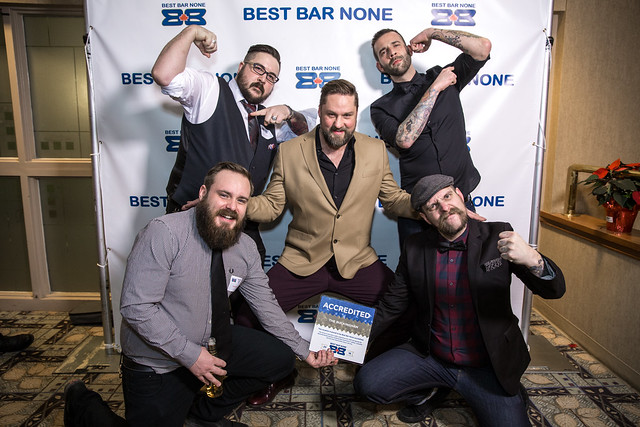
Best Bar None 2015

The 6th annual Best Bar None awards took place last week. The awards recognized 67 bars, clubs, pubs, and lounges “for their commitment to high service and safety standards.” This year’s winners included:

  • Bar/Lounge: OTR Kitchen + Bar
  • Hotel Bar: The Lion’s Head Pub – Radisson Edmonton South
  • Restaurant and Bar: Teddy’s Palace
  • Pub: Hudsons Canadian Tap House (Whyte Avenue)
  • Large Pub: O’Byrne’s Irish Pub
  • Club: The Ranch Roadhouse
  • Campus: The Nest Taphouse Grill
  • Casino: River Cree Resort and Casino

Best Bar None 2015
Photo by Sticks & Stones, courtesy of AGLC

A new category, Event Venue, was introduced this year too so next year there’ll be one more award. I wasn’t able to make it this year, but I did attend last year and enjoyed learning more about the program. In addition to competing for the awards, venues receive accreditation for meeting specific standards related to safe operation and responsible management.

“The value of Best Bar None lies in the fact that those bars that meet stringent standards have demonstrated that they are responsibly managed, and that they are committed to ensuring their patrons can socialize in a clean, safe, well-managed establishment,“ said Brian Simpson, Deputy Chief, Edmonton Police Service.

You can see the full list of accredited venues for Edmonton here. Congrats to all!

Edmonton Journal Power 30

The Edmonton Journal released its Power 30 list for 2015 on Saturday, and so begins the season of lists.

“Sometimes it feels like a game of rock-paper-scissors, playing who ‘tops’ whom. Sometimes it’s very much a reality check, tracking a lack of diversity or gender balance. But most of all, it’s a reflection of this community and a snapshot of the year that was.”

There’s nothing particular surprising about the list. Premier Rachel Notley at number 1 was easily predicted, and Amarjeet Sohi at number 2 is hard to argue with. I’d say my eyebrows went up seeing Daryl Katz at number 3, ahead of Mayor Don Iveson at number 4. I think Mike Nickel at number 8 (the only Councillor on the list) is a great choice – he’s been a pleasant surprise on Council this term. I would have expected to see Police Chief Rod Knecht higher than 25 and Bob Nicholson lower than 11. Great to see Andrew Leach on the list at 15.

Many were quick to criticize the lack of gender and racial diversity, but the list doesn’t show who should be considered powerful, but who actually is.

“We define “power” as this: well-connected, well-known individuals with the means, influence, vision and leadership skills to get things done. They have a little celebrity, certain skills and/or work ethic, and sometimes, just enough luck to land in the community’s spotlight.”

By that definition, it’s not surprising that many of the people on the list are there just because of the positions they hold. Like, um, Connor McDavid. He’s got celebrity and the spotlight, but really? And at number 10?!